|
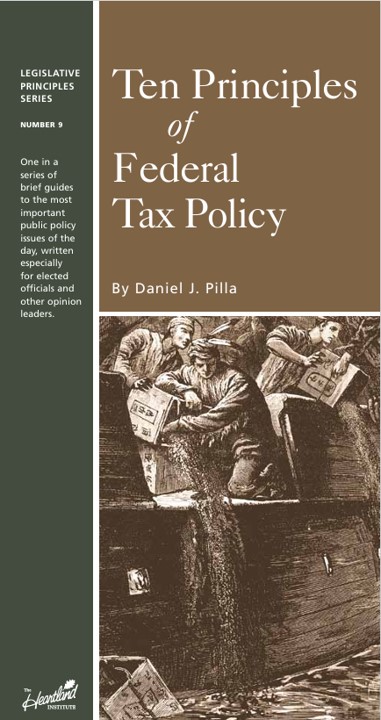
We will touch on each of the principles and provide the timestamp in the video when Dan discussed the principle.
Simplicity starting at 14:13. To quote Dan - "When two people of reasonable intelligence can read a particular provision of the tax code and come away with two completely different understandings of what it says" you don't have simplicity. If you listened to NFFV's first tax event, you saw and heard Senator Halloran's take on Nebraska's tax code. He brought all 1,275 pages and 14 lbs of the code to the event. Can 1,275 of code be described as "simplistic"?
Noninvasiveness starting at 21:22. Dan - "If we're going to have an income-based tax system, we have to have a government that knows everything about you - what you do, where you go, what you do, how you do it, who you do it with, the extent to which you gain from your activities with individuals". This is what is needed in order for the government to enforce an income tax. Does this sound noninvasive?
Efficiency starting at 26:12. Dan - "The compliance burden on the public is about 65%, which mean that for every dollar you pay in taxes, it costs you (the public) another $0.65 to get it there." This burden falls disproportionally on businesses. Individuals don't pay the full $0.65, however businesses pay more than the $0.65. Is this an example of an efficient system?
Stability starting at 35:53. Dan - "Think about something that can happen in the affairs of a person's life that doesn't have tax consequences. You get married or divorced - tax consequences, you buy a business or sell a business - tax consequences, you have a baby born into your family or a child leaves to go to school - tax consequences, you buy a house or sell a house - tax consequences, you start up a retirement fund or start drawing from a retirement fund - tax consequences". Almost every aspect of your private life has tax consequences and yet we can not know today what those consequences will be tomorrow. Want an example? How about property taxes? You buy a house planning to pay one amount and in a couple years you may be paying 1.5 times that amount. Sound stable?
Visibility starting at 41:40. Dan - "People have no idea what they're paying in taxes because they're not writing the checks". Why? The money is being sucked out of their paycheck. They are not writing the check: their employer is. Most people focus on net pay verses gross pay. Another point is hidden taxes are easy to raise. Do you have any idea how much you paid in taxes the last time you filled your car with gas? Do you know how the state is spending roughly $6.3B from the General Fund? One thing is for certain, State Auditor Mike Foley keeps finding questionable spending and waste.
Neutrality starting at 49:30. Dan - "Taxes can not fall more heavily on one group of individuals or one industry at the expense of another". Dan stated the tax code is complicated because "congress and the states use the tax code for something other than what it should be used for". The Constitution gives congress the power to tax for three things: debts of the nations, national defense, and to provide for general welfare. Dan explains how congress and the states use the tax law to "punish one segment of society to the benefit of another".
Economic Growth starting at 53:40. Dan - "What you tax you get less of, what us subsidized you get more of". If you tax savings and productivity, which our current system does, you get less savings and productivity. Our legislators know this. Why do you think some industries and businesses don't pay taxes while others do? Does this represent a neutral tax system?
Dan - "Corporations don't pay taxes - people pay taxes". The people fall into one of three categories; the owners, the employees, and the customers. They are the ones paying the taxes, not the corporation.
Broad-based starting at 1:03:40. Dan - "Another economic reality, you do not raise revenue by raising rates. You raise revenue by spreading the base". The problem we have is we have a shrinking base. In practically every legislative session, our tax code gets larger while our base gets smaller as more carveouts are created. Nebraska's 2022 Tax Expenditure Report offers some visibility to the exemptions in Nebraska's tax code.
Equality starting at 1:10:01. Dan - "People are treated differently under the income tax law specifically and only because of their economic status or social status". Dan - "There are seven different tax brackets in the code and they are all arbitrary and they were arbitrary from day one. What is the economic and what is the constitutional and what is the moral basis for the various brackets in the internal revenue code?" What more needs to be said?
Constitutionality starting at 1:16:20. Dan - "There was no authority in the constitution to use the taxing power for transfer payments for the physical support for a person or group of people". Dan - "In the supreme court case of Citizens Savings in Loans versus Topeka the court labeled this practice robbery".
|