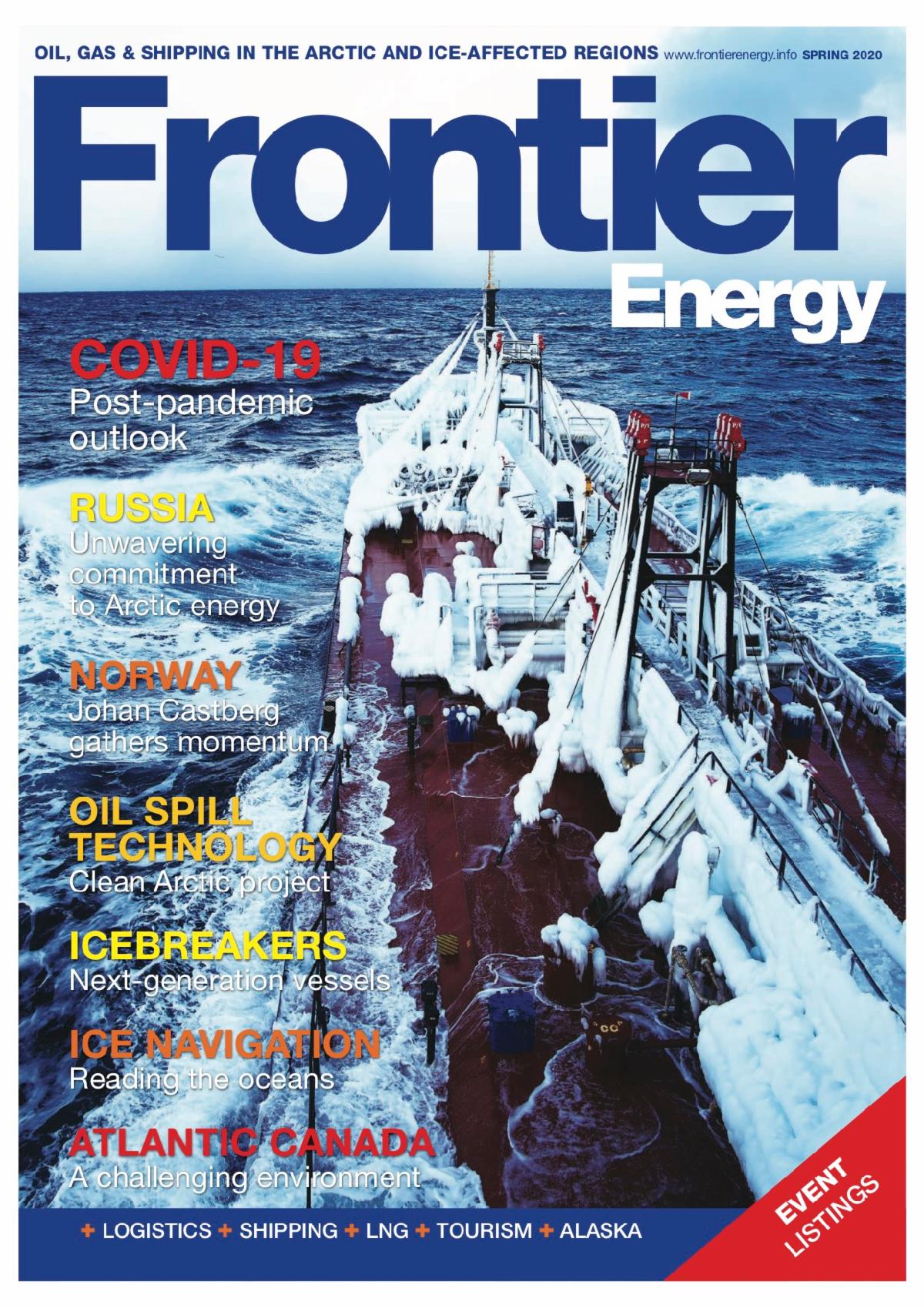
NEW ISSUE SPRING 2020
Unique news and features including
* COVID 19 - Post pandemic outlook
* RUSSIA - Commitment to the Arctic
* ICEBREAKERS - Next gen vessels
* NORWAY - Johan Castberg
* ICE NAVIGATION - Reading the oceans
* ATLANTIC CANADA - Challenging
Click HERE to read the latest issue
of Frontier Energy magazine!
In the light of the Covid-19 pandemic, our industry is facing unprecedented challenges. We will continue to report on events and wish that you, your families and work colleagues stay well and healthy.
|
|
OIL, GAS & SHIPPING IN ARCTIC & ICE-AFFECTED WATERS |
|
NEWS FROM ACROSS THE ARCTIC REGION |
|
 |
Arctic Council for May 19-20
The Arctic Council ministerial meeting is scheduled for May 19-20, said Nikolai Korchunov, the Russian Foreign Ministry’s Ambassador-at-Large for Arctic Cooperation.
“Over 200 people took part in the plenary session. The event focused on preparations for the Arctic Council ministerial meeting, which is scheduled for May 19–20,” Korchunov said during an online briefing at the Rossiya Segodnya Press Center following the Senior Arctic Officials’ plenary meeting, held online on March 16-18.
The diplomat also noted that the Foreign Minister typically represents Russia at the ministerial meeting.
“At the ministerial meeting, the Russian Federation is traditionally represented by the Foreign Minister, which is a common practice. There are sometimes exceptions and other ministers may also participate, but the Foreign Ministry is in charge of coordinating work within the Arctic Council as a foreign policy responsibility,” he added.
|
|
|
|
Container shipping giant MSC Mediterranean Shipping Company reaffirimed its position to avoid sending its vessels through the Northern Sea Route and urged others to follow suit, citing environmental concerns.
MSC CEO, Soren Toft said, “MSC will not seek to cut through the melting ice of the Arctic to find a new route for commercial shipping, and I consider this a position the whole shipping industry must adopt.”
Russian Arktika-M satellites will be used to monitor changing sea-ice formations and temperatures across the Northern Sea Route. Every 15, 20 or 30 minutes, an Arktika-M spacecraft can measure temperatures in each section of the Arctic zone.
This is made possible by the satellites highly elliptical orbit.
The satellites will therefore collect meteorological and hydrological data about the state of the northern latitudes, and their scanning equipment will take nonstop multi-scale images.
|
|
|
|
Equinor get green light from NPD for new well |
|
The Norwegian Petroleum Directorate (NPD) has granted Equinor Energy a drilling permit for well 7322/6-1 S.
The well will be drilled from the Deepsea Nordkapp drilling facility in position 73°34'39.68"N and 6°55'05.15"E after concluding the drilling of appraisal well 25/2-22 S for Aker BP ASA in production licence 442.
The upcoming drilling programme follows an appraisal well drilled in production licence 722. Equinor is named as the operator with an ownership interest of 45 per cent. The other licensees are AkerBP ASA (20%), Lundin Energy Norway AS (20%) and Sval Energi AS (15%).
The area in this licence consists of parts of block(s) 7322/6 and 7323/4. The well will be drilled about 350 kilometres north of Hammerfest and 50 kilometres west of the 7324/7-2 (Hansen) and 7324/8-1 (Wisting) discovery wells.
Production licence 722 was awarded on 21 June 2013 (22nd licensing round). This is the first exploration well to be drilled in the licence. (Image: Previous work in the Barents Sea being undertaken by Equinor © Ole Jørgen Bratland.)
|
|
Risks of vessels getting stuck in Arctic Sea Ice |
|
A new study is shedding light on some of the risks associated with Arctic shipping finding that vessels with lower ice-classes are up to 20 times more likely to become stuck in sea ice along Russia’s Northern Sea Route than vessels with higher levels of protection. The study’s authors hope that their work will improve safety of navigation in the Arctic, reports note. Over the past decade shipping traffic in the Arctic has expanded rapidly, especially along Russia’s Northern Sea Route (NSR), which has seen a ten-fold increase in cargo volume over the past decade. As Arctic sea ice recedes as a result of climate change, more and more vessels with low ice-class are venturing into the region. The study was reported by the High North News and originally published by the journal Cold Regions Science and Technology.
A new study aims to provide answers on how much riskier Arctic navigation is for ships with limited ice protection.
Ships traveling in the Arctic’s ice-infested waters face a host of hazards, including striking hardened multi year ice, ice buildup on the ship’s surface structures, remoteness, and difficult weather conditions, reports HNN.
|
|
New sponge technology for cold water oil recovery |
|
Researchers have developed a special coating for commercially available sponges which can recover oil droplets from water as cold as 5 degrees celsius. Scientists from Imperial College London and the University of Toronto have designed a sponge that can remove hard-to-recover oil from Arctic waters. Their research builds on previously developed sponge technology to target specific challenges with recovering oil from ultra-cold water.
Oil is more difficult to remove from ultra-cold water because it becomes viscous at low temperatures, reducing its flow and making it harder to collect.
Oil contamination in Arctic waters is a significant issue, with over one trillion litres of oil sands tailings, a waste by-product of oil extraction, marine and Arctic oil spills awaiting clean up.
Traditional technologies used to recover oil from such sites are either energy intensive, costly, or ineffective when faced with micrometre size oil droplets. Some can even risk causing further environmental damage, such as those that reheat the oil before collection, which can cause it to dissolve or evaporate.
The technology designed by Imperial and U of T addresses these challenges by harnessing the properties of cold-temperature oil to create a low-energy and cost-efficient solution. Not only will this benefit the environment and help to protect our natural resources, it offers an economically viable solution for industry which is vital to ensuring widespread uptake. For more information click here.
|
|
Russia to finance Arctic hydrographic vessel |
|
Russian prime minister Mikhail Mishustin has signed a resolution on allocating over seven billion rubles to build a hydrographic ship for Arctic operations which will enter into service in 2024.
“Over R7bn ($900m) will be invested in the construction of a lead hydrographic ship for the Northern Sea Route," said a govenemnt spokesman. .
The Arc-7 ice class ship can plow through 1.4-1.7-meter thick ice, depending on which season it is, or it can operate in more difficult environments, escorted by icebreakers.
The eight megawatt ship will feature modern navigational and hydrographic equipment. “This will allow the ship to accomplish various missions, to ensure safe navigation, to study water-surface specifics and seabed reliefs. The ship is to enter into service in 2024,” according to the press release.
The government says the decision will make it possible to partially meet the demand of raw materials companies and other Northern Sea Route users for hydrographic support.
|
|
Geopolitical impact of new Arctic shipping lanes |
The increasing accessibility of newly open Arctic shipping lanes and ports bring with them troubling geopolitical implications. Photo: NOAA
The advent of climate change has brought about a number of different changes in the Arctic, including increased accessibility to Arctic ports as well as the opening of new Arctic shipping lanes. With new trans-Arctic routes, including the Northern Sea Route (NSR) and the Northwest Passage (NWP), as well as newly built and refurbished ports from Russia, political and military interests are reevaluating the region as one of geopolitical competition.A report from the US Congressional Research Service (CRS) on the Arctic notes that although there is still important cooperation in the region, the Arctic is increasingly seen as an area for geopolitical competition amongst the US, China, and Russia.1) The article will discuss the geopolitical ramifications of the NSR and NWP as well as the building and refurbishing of ports in the Arctic. For the full Arctic Institute article, click here.
|
|
|
|
Novatek plans financing rise in Arctic LNG 2 |
|
Russia's major liquefied natural gas producer Novatek says it plans to put up its 60% stake in Arctic LNG 2 project as collateral for long-term financing of the project reports Reuters.
Novatek seeks to raise $11 billion in external financing and has said it planned to get the funds by the first half of this year.
The $21 billion project, which received final investment approval in 2019, is expected to be launched in 2023 and to reach its full capacity of almost 20 million tonnes per year in 2026.
The project’s equity partners include France’s Total, China National Petroleum Corp, China’s CNOOC and the Japan Arctic LNG consortium made up of Mitsui & Co and state-owned JOGMEC, formally known as Japan Oil, Gas and Metals National Corp.
Russia’s Sberbank said at the start of the year it had approved financing of up to E3 billion ($3.5 billion) for Arctic LNG 2.
|
|
Events Calendar : Conferences, Forums, Meetings |
|
EVENT: Arctic Development Expo
June 15 - 16
Inuvik, Northwest Canada (online)
The Arctic Development Expo typically takes place in Inuvik, Northwest Territories, Canada as we strive to make knowledgeable decisions to enhance circumpolar life and create innovative solutions for our northern realities. We look to develop the Arctic through sustainable means and will do so by concentrating on the following four themes: Natural & Renewable Resources, Climate and Energy Innovations, Indigenous Leadership and Circumpolar Governance and Knowledge Economy.
Click here for more information.
EVENT: International Conference on Polar Engineering and Infrastructure Development
July 18 - 19
Toronto, Canada (online)
This conference is a federated organisation dedicated to bringing together a significant number of diverse scholarly events for presentation within the conference program. Events will run over a span of time during the conference depending on the number and length of the presentations. With its high quality, it provides an exceptional value for students, academics and industry researchers.
Click here for more information.
|
|
|
|
|
|
|