Now Available:
Exosomes, PRP, and Stem Cells In Musculoskeletal Medicine: A Complete Guide To Regenerative Medicine
Exosomes, PRP, and Stem Cells in Musculoskeletal Medicine is a comprehensive and up-to-date guide to regenerative medicine. It covers essential topics related to regenerative medicine including basic science, needle technique, anatomy, and advanced applications of stem cells. The book is structured in a clear and concise manner, with each chapter building upon the previous one, offering a step-by-step practical manual for how to perform these procedures based on the latest regulatory changes through early 2023.
The book includes a comprehensive discussion of mesenchymal (or medicinal) stem cells and a history of stem cells, along with detailed chapters covering the shoulder, elbow, hand and wrist, hip, knee, and foot and ankle. Although this book is geared toward physicians and scientists, it also is an invaluable resource for students, patients, and all that are interested in regenerative medicine. This book is a departure from many medical textbooks as it is crafted with the reader in mind. It is written in a clear and easily comprehensible style that is both informative and engaging. With numerous helpful illustrations, it is a must-have for any medical library.
Overall, Exosomes, PRP, and Stem Cells in Musculoskeletal Medicine provides a complete guide to regenerative medicine, presenting the latest developments and practical guidelines in the field, and is an essential resource for anyone involved in the study or practice of regenerative medicine.
|
|
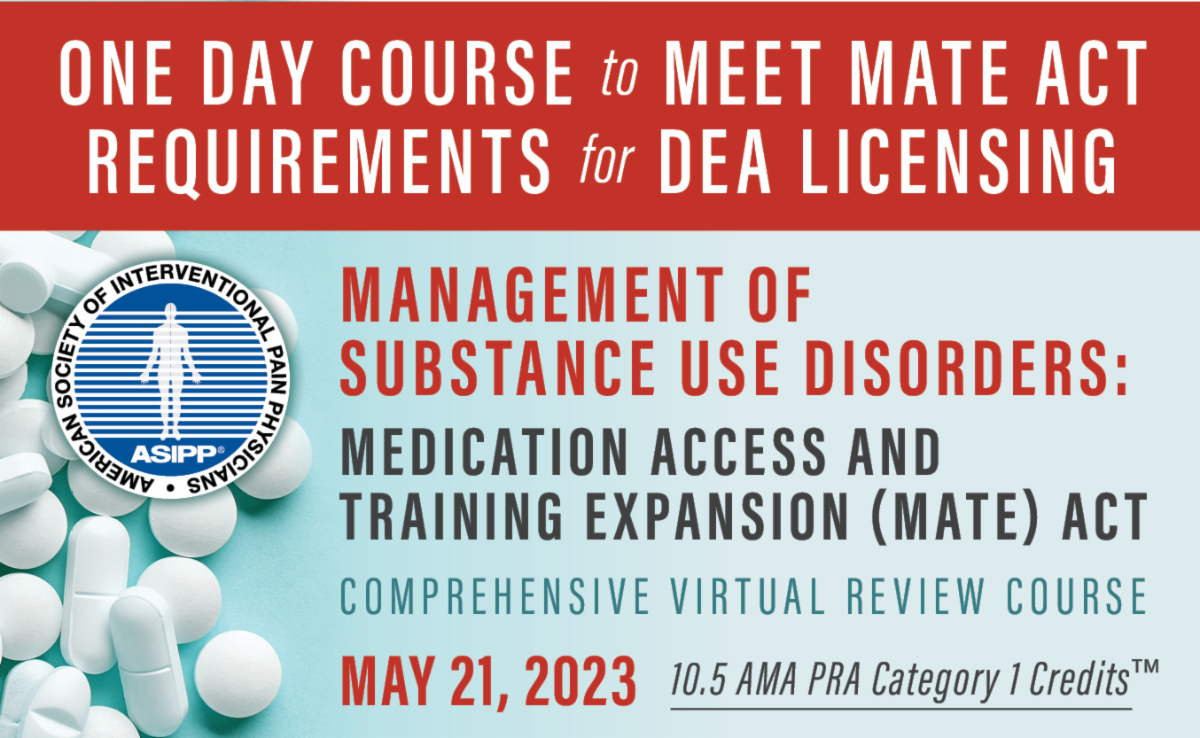
On December 29, 2022, the Consolidated Appropriations Act of 2023 enacted a new one-time, eight-hour training requirement for all Drug Enforcement Administration (DEA)-registered practitioners on the treatment and management of patients with opioid or other substance use disorders (Medication Access and Training Expansion (MATE) Act).
Beginning on June 27, 2023, practitioners will be required to check a box on their online DEA registration form—regardless of whether a registrant is completing their initial registration application or renewing their registration—affirming that they have completed the new training requirement.
The deadline for satisfying this new training requirement is the date of a practitioner’s next scheduled DEA registration submission—regardless of whether it is an initial registration or a renewal registration—on or after June 27, 2023.
This one-time training requirement affirmation will not be a part of future registration renewals.
In response to this need, ASIPP has developed the virtual review course Management of Substance Use Disorders: Medication Access and Training Expansion (MATE) Act. This virtual review course will be held on May 21, 2023.
In addition to covering the required Curriculum to Meet MATE Act Requirements for DEA Licensing, it will also provide 10.5 AMA PRA Category 1 Credits™.
|
|
After unrelenting pressure from the American Society of Interventional Pain Physicians (ASIPP), Florida Society of Interventional Pain Physicians, (FSIPP) (lead by Dr. Deborah Tracy), and other state societies, First Coast and Novitas have ruled to retire the proposed LCD, Nerve Stimulators for Chronic Intractable Pain (DL39406), related Local Coverage Article (LCA) (DA59190), Nerve Stimulators for Chronic Intractable Pain (DL39404), and Billing and Coding: Nerve Stimulators for Chronic Intractable Pain (DA59188)
In the correspondence from First Coast, the CMD responded, “all of the new information, along with any new evidence we reviewed specific to painful diabetic neuropathy, will be carefully considered if we decide to publish a revised proposed LCD. Any new proposed LCD will also be published for comment in accordance with CMS guidelines. If we decide to publish a new LCD on this topic, the earliest we anticipate publishing the revised LCD would be early in 2024.”
On March 23, 2023 ASIPP sent a letter of concern to Blue Cross Blue Shield of Tennessee in regards to a proposed policy which would consider implantable peripheral nerve stimulation devices for the treatment of acute and chronic pain to be considered investigational.
We will continue to lobby the remaining Medicare contractors and the national Medicare Director, Tamara Syrek Jensen on this matter as we did with First Coast.
ASIPP will keep our members updated as new information becomes available.
|
|
Room block reservation deadline is May 17.
|
|
Room block reservation deadline is May 17.
|
|
Recently, Dhruva, et al published an article on Long-Term Outcomes in Use of Opioids, Nonpharmacologic Pain Interventions, and Total Costs of Spinal Cord Stimulators Compared with Conventional Medical Therapy for Chronic Pain, showing no difference (click here to read the full article).
In response Drs. Manchikanti, Sanapati, and Hirsch sent a Letter to the Editor pointing out various issues related to this study and potential reasons (click here to read the letter).
|
|
The Office of Inspector General for the United States Department of Health and Human Services has conducted yet another audit on facet joint interventions, this is the third audit. There have been extensive audits from UPICs, SMRC, Nordian, and RAC, and MAC contractors.
In this study (click here to read), OIG looked at 120 sample sessions, with only 54 complying with Medicare requirements.
The overall estimated overpayments appear to be $29.6 million for facet joint interventions for an audit period of August 1 through October 31, 2021, with new LCDs in effect.
Obviously, there will be even more audits and there will be recoupment from multiple providers on these claims.
It is crucial that we follow appropriate algorithmic approach and utilize checklists to avoid such issues.
|
|
Doctors' groups are lining up to support new federal legislation to permanently tie Medicare physician payment updates to inflation.
Introduced by four physician US House representatives, HR 2474 would link Medicare fee schedule updates to the Medicare Economic Index, a measure of inflation related to physicians' practice costs and wages.
That's a long-sought goal of the American Medical Association, which is leading 120 state medical societies and medical specialty groups in championing the bill.
The legislation is essential to enabling physician practices to better absorb payment distributions triggered by budget neutrality rules, performance adjustments, and periods of high inflation, the groups wrote in a joint letter sent this week to the bill's sponsors. The sponsors say they hope the legislation will improve access to care, as low reimbursements cause some physicians to limit their number of Medicare patients.
|
|
A new federal rule seeks to reduce Medicare Advantage insurance plans' prior authorization burdens on physicians while also ensuring that enrollees have the same access to necessary care that they would receive under traditional fee-for-service Medicare.
The prior authorization changes, announced this week, are part of the Centers for Medicare & Medicaid Services' (CMS') 2024 update of policy changes for Medicare Advantage and Part D pharmacy plans.
Medicare Advantage plans' business practices have raised significant concerns in recent years. More than 28 million Americans were enrolled in a Medicare Advantage plan in 2022, which is nearly half of all Medicare enrollees, according to the Kaiser Family Foundation.
|
|
Virtual
ABIPP Part I; ABIPP Path - Combined DCCPM/CSM virtual exam; ABIPP Competency Exam in IPM; ABIPP Competency Exam in Regenerative Medicine
Memphis, TN
ABIPP Part II - Practical Portion; ABIPP Competency Exam - Practical Portion; ABIPP Regenerative Medicine Competency Exam - Practical Portion
|
|
Entire board resigns over actions of academic publisher whose profit margins outstrip even Google and Amazon
More than 40 leading scientists have resigned en masse from the editorial board of a top science journal in protest at what they describe as the “greed” of publishing giant Elsevier.
The entire academic board of the journal Neuroimage, including professors from Oxford University, King’s College London and Cardiff University resigned after Elsevier refused to reduce publication charges.
Academics around the world have applauded what many hope is the start of a rebellion against the huge profit margins in academic publishing, which outstrip those made by Apple, Google and Amazon.
Neuroimage, the leading publication globally for brain-imaging research, is one of many journals that are now “open access” rather than sitting behind a subscription paywall. But its charges to authors reflect its prestige, and academics now pay over £2,700 for a research paper to be published. The former editors say this is “unethical” and bears no relation to the costs involved.
|
|
The deadline for Abstract submission is June 2.
|
|
|
Dr. Rochelle Walensky, the head of the Centers for Disease Control and Prevention, submitted her resignation Friday, saying the waning of the COVID-19 pandemic was a good time to make a transition.
Walensky’s last day will be June 30, CDC officials said, and an interim director wasn’t immediately named. She sent a resignation letter to President Joe Biden and announced the decision at a CDC staff meeting.
Walensky, 54, has been the agency’s director for a little over two years, and the announcement took many health experts by surprise. In her letter to Biden, she expressed “mixed feelings” about the decision and didn’t explain exactly why she was stepping down, but said the nation is at a moment of transition as emergency declarations come to an end.
“I have never been prouder of anything I have done in my professional career,” she wrote.
|
|
Starting in early 2020, the emergency declaration, along with subsequent declarations, legislation and administrative actions, gave the federal government flexibility to waive or modify certain rules in the Medicare and Medicaid programs as well as in private health insurance. The goal has been to help the nation fight the worst public health crisis in a century and help some patients get care in a time of shutdowns.
As this long emergency period expires, experts say, the biggest impact for consumers will be the end of free coronavirus tests — both at-home tests and those performed by clinicians and analyzed by commercial labs — with broad implications for people’s ability to get timely covid diagnoses, prevent disease transmission and track the virus.
A recent study from the Centers for Disease Control and Prevention found that one-third of U.S. households used free at-home covid-19 diagnostic tests from a program the White House launched in January 2022 that allowed rapid antigen tests to be ordered at no cost to consumers through the U.S. Postal Service. The study suggested that, without the kits, 1 in 4 adults who used a test would likely to have gone untested.
|
|
ASIPP has been actively addressing recent coverage issues through letter correspondence to various agencies. The issues and letters include the following:
AIM published new guidelines effective 04/09/2023. Owned by Anthem, Inc (ANTM), the AIM guidelines are utilized by multiple insurers. ASIPP has addressed the guidelines with a comment letter on the guidelines for Appropriate Use Criteria: Interventional Pain Management. Our comments were related to paravertebral facet joint injection/medial branch nerve block/neurolysis/therapeutic facet joint interventions.
We are requesting LCD reconsideration requests to all of the Medicare Contractors for the LCD covering Facet Joint Interventions for Pain Management.
ASIPP immediate past president, Amol Soin, sent a letter to Cigna on February 7 addressing their Medical Policy Update on Peripheral Nerve Block Procedures (for trigeminal and occipital neuralgia) which considering them experimental, investigational, or unproven, with an efficacy date of April 18th, 2023. In the letter, we ask that the policy update restricting the use of peripheral nerve blocks be re-evaluated and modified. We recommended that these procedures continue to be covered and we find the characterization of these procedures to be experimental or investigational to be inaccurate.
|
|
- ASIPP Members Only Site Information - |
|
-
To log in for the first time you will need to click “forgot password” at the bottom of the login window.
- Check your email and then log in as directed.
-
If you have problems logging into your account, click here.
|
|
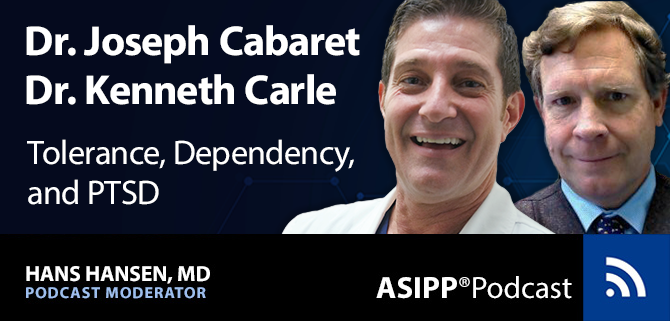
It is a pleasure to have Dr. Joe Cabaret return to the podcast because it’s not every day you get to hear from someone who is triple-boarded in anesthesia, pain, and addiction. The practice of pain medicine always has its difficulties—sometimes those difficulties involve simultaneously balancing pain, tolerance, and dependency. When you’re really trained and qualified to make the distinction between these three things, you’re better at balancing all of them. Dr. Cabaret not only understands pain, but he really understands addiction, so his approach to dealing with complex pain problems is especially effective. We also discuss central pain and its processing because, like it or not, most pain is processed through the central nervous system. That’s why we use so many different classes of medication—the Buprenorphines, Gabapentinoids, Pregabalins, and the like—we want to work in the central nervous system to help reduce the opioid load. Finally, we share some thoughts on the 2023 ASIPP (American Society of Interventional Pain Physicians) Annual Meeting.
We’re also welcoming a new guest to the podcast, Dr. Kenneth Carle, from Baltimore, Maryland. Dr. Carle is a practitioner of Interventional Pain Medicine who brings up several interesting talking points about the strategies we can use to help patients with PTSD.
|
|
As the Biden administration prepares for the federal COVID-19 public health emergency to end on May 11, the new normal is markedly better than the earlier phase of the pandemic in which we lost more than a million American lives. We’ve gone from the 2021 peak of an estimated 3,000 Americans dying daily from the infection to about 250 a day now. But this “normal” still includes more than 30,000 COVID-19 deaths since the beginning of 2023, and the virus remains a leading cause of fatality in the U.S. This is not acceptable.
We face confusing realities: The pandemic’s acute phase is over, but COVID remains a significant cause of death. New variants always loom, one of the latest being XBB.1.16 — nicknamed Arcturus by some on social media — which recently reached L.A. Any long-term approach to mitigate the impact of COVID-19 will require periodic boosters — yet as of March, fewer than 1 in 5 eligible Americans got the booster that was made available in September, suggesting that interest in the shots has dipped alongside the virus’ toll.
The Food and Drug Administration recently amended its authorizations for Pfizer and Moderna’s mRNA vaccines, prompting the Centers for Disease Control and Prevention to modify its COVID-19 vaccine recommendations. Wading through these changes offers a window into our next stage of confronting COVID: adapting as vaccine technology evolves, emphasizing protections for high-risk people and maintaining vaccination as a preventive measure.
|
|
Pain Medicine Case Reports (PMCR) and Editor-in-Chief Alaa Abd-Elsayed, MD, PhD would like to invite you to submit case reports and case series to the PMCR journal. Your article will be published free of charge.
Open access journals are freely available online for immediate worldwide open access to the full text of published articles. There is no subscription fee for open access journals. Open access journals are no different from traditional subscription-based journals: they undergo the same peer-review and quality control as any other scholarly journal.
Interested in becoming a member of the PMCR Editorial Board?
Editorial board members are asked to review 2-6 manuscripts per year. Please submit your most up-to-date CV to sgold@asipp.org for consideration.
For more information or to submit your articles, click here.
|
|
| CASE REPORT |
Marissa Catalanatto, MD, Christian Vangeison, DO, Joseph Roys, MD, Dominic Salvatore, III, OMS, Emanuel N. Husu, MD, and Donna Huang, MD
Abstract
BACKGROUND: Anterior spinal artery syndrome is a diagnosis associated with high morbidity, mortality, and long-term disability. It is a known complication following conventional celiac plexus and splanchnic nerve blocks. The popularity of minimally invasive pain procedures is growing, especially in the domain of oncology, and the interventions are being performed by specialists with varying backgrounds. Complications such as anterior spinal artery syndrome need to be at the forefront of specialists’ minds whenever there is manipulation of the celiac plexus or splanchnic nerves. These structures play an integral role in maintaining circulatory perfusion. The earlier hypoperfusion is suspected or confirmed, the better the prognosis, as steps can be taken to immediately correct this deficit.
CASE REPORT: We present a case of a 65-year-old man with a history of poorly differentiated metastatic pancreatic adenocarcinoma who suffered a thoracic anterior spinal artery infarction following a splanchnic nerve cryoablation. Noninvasive methods to control pain prior to the procedure were unsuccessful. Prior to becoming a paraplegic this patient was independent in all activities of daily living and ambulation.
CONCLUSIONS: This case report aims to prove the importance of being familiar with the early signs associated with spinal cord infarction and the importance of completing a thorough, transparent informed consent process when manipulating the celiac plexus or splanchnic nerves. Cryoablation procedures of such structures remain relatively novel compared to conventional blocks. Few case reports have documented anterior spinal artery syndrome following cryoablation. This unfortunate complication results in permanent, life-altering damage. We also propose steps that can be taken to minimize this risk.
KEY WORDS: Splanchnic nerve cryoablation, anterior spinal artery syndrome, pancreatic adenocarcinoma
|
|
| RETROSPECTIVE CASE SERIES |
Shen Ying, MD, Xiangjun Zhou, MD, Nan Ji, MD, and Fang Luo, MD
Abstract
BACKGROUND: Zoster-associated pain (ZAP) represents an important medical, social, and economic problem. The treatment approach for ZAP continues to be challenging. Tender point infiltration (TPI) with local anesthetic and steroids has been demonstrated to have potential in the treatment of severe pain, but there are rare reports of the efficacy and security of TPI for acute and subacute ZAP.
OBJECTIVES: The aim of this study was to retrospectively analyze the efficacy of TPI for pain control in acute and subacute ZAP.
STUDY DESIGN: Retrospective case series.
METHODS: Medical records of 152 patients who underwent TPI for acute and subacute herpes zoster pain were reviewed. The patients were divided into 2 groups: acute TPI group (TPI within 30 days after zoster onset) and subacute TPI group (TPI between 30 and 90 days after zoster onset). The numeric rating scale (NRS), effective rate, frequency of TPI and rate of medication discontinuation during the follow-up period of 3 months were retrospectively analyzed.
RESULTS: The NRS score significantly decreased from 7.80 ± 1.05 before TPIs to 0.97 ± 0.68 in the acute TPI group (P < 0.001) and was decreased from 5.76 ± 1.07 to 1.12 ± 0.70 in subacute TPI group (P < 0.001). The effective rate was 92.2% in acute TPI group and was 90.7% in subacute TPI group (P = 0.734). The rate of medication discontinuation at month 1 and month 3 was higher in the acute TPI group than in the subacute TPI group (P < 0.05). The frequency of TPI in acute TPI group (1.49 ± 0.79) was less than subacute TPI group (3.09 ± 1.02) (P < 0.001). A small proportion of the patients had mild complications, and all resolved over time after TPIs. No severe adverse events occurred during or after TPI procedures.
LIMITATIONS: Retrospective design without a control group, short period of follow-up, and the small number of patients.
CONCLUSIONS: TPI can be a useful and safe option for the control of acute and subacute ZAP with high feasibility. Early application of TPI in the acute phase of herpes zoster pain may show better clinical outcomes.
KEY WORDS: Tender point infiltration, herpes zoster, zoster-associated pain, acute pain, Diprospan
|
|
| OBSERVATIONAL STUDY |
Kevin R. Riggs, MD, Andrea L. Cherrington, MD, Stefan G. Kertesz, MD, Joshua S. Richman, MD, PhD, Aerin J. DeRussy, MPH, Allyson L. Varley, PhD, William C. Becker, MD, Melanie S. Morris, MD, Jasvinder A. Singh, MD, Alayne D. Markland, DO, and Burel R. Goodin, PhD
Abstract
BACKGROUND: Prolonged postoperative opioid use (PPOU) is considered an unfavorable post-surgical outcome. Demographic, clinical, and psychosocial factors have been associated with PPOU, but methods to prospectively identify patients at increased risk are lacking.
OBJECTIVES: Our objective was to determine whether an individual or a combination of several psychological factors could identify a subset of patients at increased risk for PPOU.
STUDY DESIGN: Observational cohort study with prospective baseline data collection and passive outcomes data collection.
SETTING: A single VA medical center in the United States.
METHODS: Patients were recruited from a preoperative anesthesia clinic where they were undergoing evaluation prior to elective surgery, and they completed a survey before surgery. The primary outcome was PPOU, defined as outpatient receipt of a prescribed opioid 31 to 90 days after surgery as determined from pharmacy records. Primary covariates of interest were pain catastrophizing, self-efficacy, and optimism. Additional covariates included social and demographic factors, pain severity, medication use, depression, anxiety, and surgical fear.
RESULTS: Of 123 patients included in the final analyses, 30 (24.4%) had PPOU. In bivariate analyses, preoperative opioid use and preoperative nonsteroidal anti-inflammatory drug use were significantly associated with PPOU. The combination of high pain catastrophizing and high preoperative pain (OR 3.32, 95% CI 1.41 - 7.79) was associated with higher odds of PPOU than either alone, and the association remained significant after adjusting for preoperative opioid use (OR 2.56, 95% CI 1.04 - 6.29).
LIMITATIONS: Patients were recruited from a single site, and the sample was not large enough to include potentially important variables such as procedure type.
CONCLUSIONS: A combination of high pain catastrophizing and high preoperative pain has the potential to be a clinically useful means of identifying patients at elevated risk of PPOU.
KEY WORDS: Postoperative pain, postoperative opioids, opioid prescribing, preoperative evaluation, pain catastrophizing
|
|
ASIPP is now in collaboration with Curi Medical Liability Program
Since this malpractice insurance program officially launched in November 2018, ASIPP has signed up hundreds of providers with an average savings of 30%. This is professional liability insurance tailored to our specialty and will stand up for us and defend our practices.
Curi is a full-service advisory firm that serves physicians and their practices. Their valued advice is grounded in your priorities and elevated in your outcomes. They are driven by a deep understanding of your specific circumstances in medicine, business, and life. To read a few important points to keep in mind about the program, including discounts, administrative defense, cyber coverage, aggressive claims handling, and complimentary risk management CME activities, visit our website.
|
|
ASIPP® has formed a partnership with Henry Schein and PedsPal, a national GPO that has a successful history of negotiating better prices on medical supplies and creating value-added services for independent physicians. Working with MedAssets, PedsPal provides excellent pricing on products like contrast media that alleviate some of the financial pressures you experience today.
|
|
ASIPP® is now offering our members the benefit of a unique revenue cycle management/ billing service.
We have received a tremendous amount of interest in the ASIPP® billing and coding program.
Click here to learn more about the negotiated rate for practices and more!
|
|
|
up-to-date news related to you, your practice, and your patients!
|
|
|
|
|
|
|