The Kenyon Review at AWP in Los Angeles
The Association of Writers & Writing Programs' Conference & Bookfair (AWP) is in full swing! This conference is an annual celebration of literature attended by writers, editors, publishers, and literary organizations. Please visit us booth #339 and learn about our submission opportunities, our workshops, fellowships, and more!
Friday, March 28
11:00 am–1:00 pm: Meet the Editor
Stop by and chat with our Editor, Nicole Terez Dutton
1:00–3:00 pm: Meet the Managing Editor.
Our new Managing Editor, Nayt Rundquist, will at the booth. Pop by and chat with them. They’ll be happy to meet you.
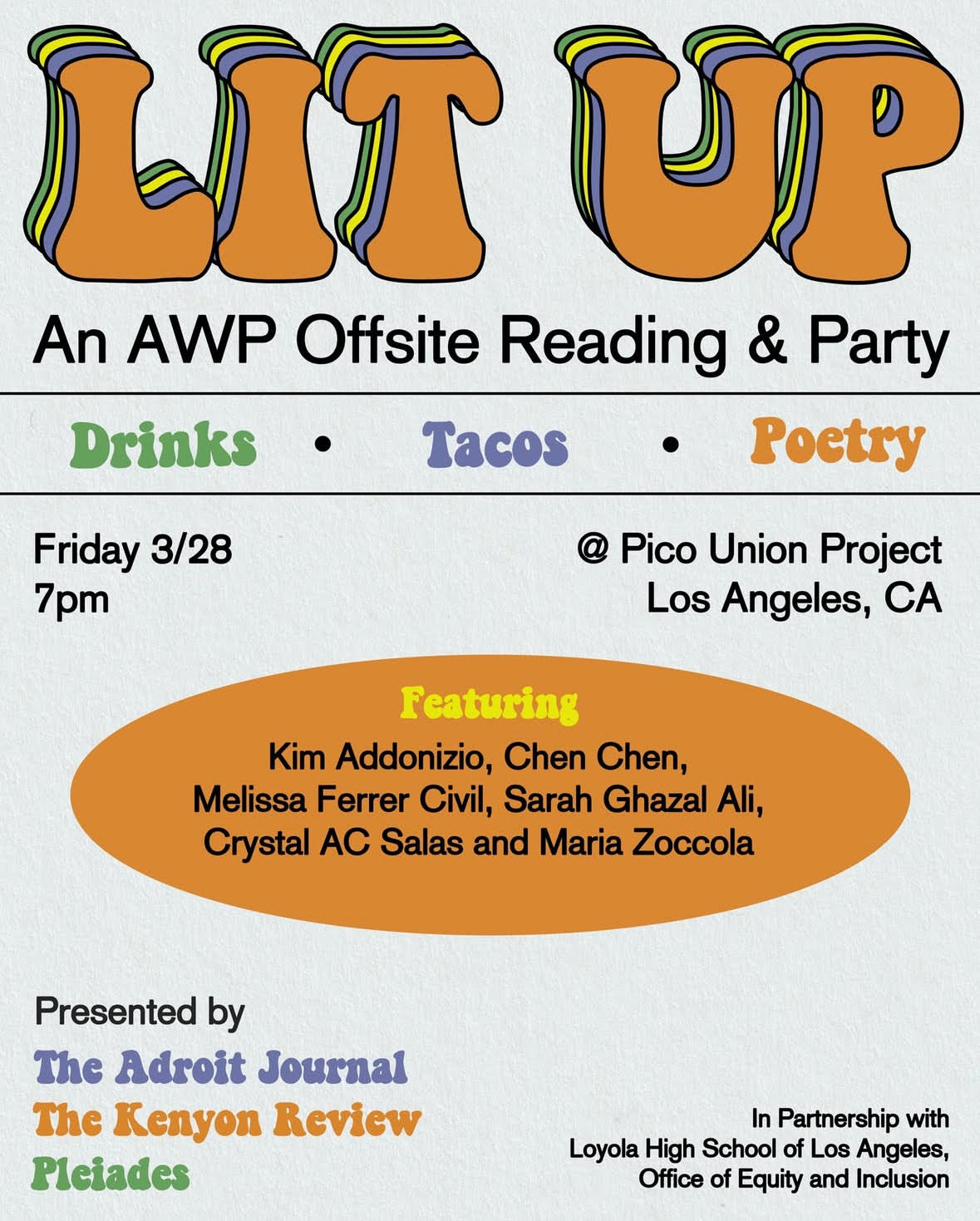
7:00 pm: Lit Up!
The KR will host a reading party alongside our friends, The Adroit Journal, and Pleiades. KR poet Maria Zoccola and KR Young Writers faculty member Crystal AC Salas will share their work alongside other writers. Come prepared–there will be drinks, tacos & a DJ. The Pico Union Project (1153 Valencia St, Los Angeles, CA 90015). Hope to see you there!
Saturday, March 29
12:45–3:00 pm: Book Signing
Senior Editor Orchid Tierney will be signing copies of her newest book, this abattoir is a college.
| |
Apply for KR's Young Writers Summer Online Workshops
These weeklong workshops for high school–age writers include daily synchronous Zoom workshops interspersed with solo writing time and one-on-one instructor conferences. Additional events include readings by visiting writers, craft talks, participant readings, and informal social gatherings. Workshops run June 15–20, with afternoon sessions 12:30–4:00 pm ET and evening sessions 7:30–11:00 pm ET.
Deadline for applications is April 14, 2025.
| | |
Learn more here about the program and how to apply.
| |
Apply for Summer Online Writing Workshops!
Deadline for applications is April 13, 2025.
The Kenyon Review is accepting applications for the Summer Online Writers Workshops through April 13, 2025. Join us for a single intensive week of generative writing workshops from June 23–28, 2025.
This year's faculty includes Melissa Faliveno and Lars Horn in creative nonfiction, E.J. Levy, Hanna Pylväinen, Jiaming Tang, Bryan Washington, Nick White, and Jenny Xie in fiction, and Gabrielle Calvocoressi, Yalie Saweda Kamara, Marlin M. Jenkins, Airea D. Matthews, Philip Metres, and Brad Richard in poetry.
Learn more on our site and apply here.
| |
Writers Reading Writers: A Look at The Kenyon Review Archive
Last year the KR completed the digitization of our entire archive of work published since 1939. Now we're delighted to present contemporary writers responding to pieces that resonate with and inspire them. This month, we’re highlighting Grace Talusan’s response to “A Small Party in a Garden” by Lynda Ty-Casper, originally published in Summer 1992.
| | |
Linda Ty-Casper’s short fiction “A Small Party in a Garden” transports the reader, no matter where or when they’re reading the story, to a day decades ago in the Philippines. The story follows an unmarried working woman on a day trip to the province outside of Manila with her father, who turns to her in the car and asks, “Why don’t you get married, hija?” His daughter wonders if “[p]erhaps he threw the question at me to keep me at a distance.”
I recognize the awkwardness of this moment from the many years that I was an unmarried working Filipina and would occasionally, when visiting the Philippines, find myself in a small space with a relative or even a stranger who asked me this same question. Did I understand that every year I delayed marriage, I was increasing my risk of not having a baby? (They were right: I delayed marriage and, indeed, did not have a baby.)
Read the entire essay online here.
| |
Why We Chose It: “I Do Not Know Lucy Ives” by Claire Oleson
Sam Bodrojan’s review of Lucy Ives’s essay collection An Image of My Name Enters America is a loving text. It doesn’t so much seek camaraderie as trip across it, making the acts of reviewing Ives’s book and interviewing her after feel like natural, gravitational results of each other. Bodrojan first offers from herself before she asks Ives anything: telling us where she and Ives had already been together before they met (albeit, that Ives was a text and that Bodrojan was younger, often with people, and depicted in moments around reading, but not inside it). This refreshes. We are reminded that the book being discussed here is also an object, a physical thing that Bodrojan has borne through relationships and misunderstandings and petting zoos. The book is equipment as much as it is intimacy, and Bodrojan’s meringue-folding of the critical and the personal light each other up; they matter together.
Read the full Why We Chose It here!
|
“I Do Not Know Lucy Ives” by Sam Bodrojan
The latest from Lucy Ives, An Image of My Name Enters America: Essays, published by Graywolf Press, is composed of five slyly connected essays, all orbiting an obsessive attempt to externalize self-knowledge through history, memory, speculation, and critical theory. The collection moves in a circle, beginning and ending with the birth of Ives’s son, touching on everything from The Unicorn Tapestries to Technicolor battle-of-the-sexes musicals. As with all of Ives’s work, the reader is made to reconstruct An Image nonlinearly in their own memory. The book exists in complete synchronicity with a world of oversaturation; Ives presents us with a compendium of erratic observations that absorb every experience, every trauma, every listicle. Ives’s most personal thoughts are reflected in the lowest cultural ephemera, the broadest existential syllogisms being found in a string of professional emails. Ives asks a reader to compose, rather than simply digest, the connective tissue between her bursts, asides, examples, and bits of world. Each reader’s own associative life is asked to enter the fray.
Read the complete piece, including an interview with Lucy Ives, here and in print in the Winter 2025 issue, due out soon!
| | | | |