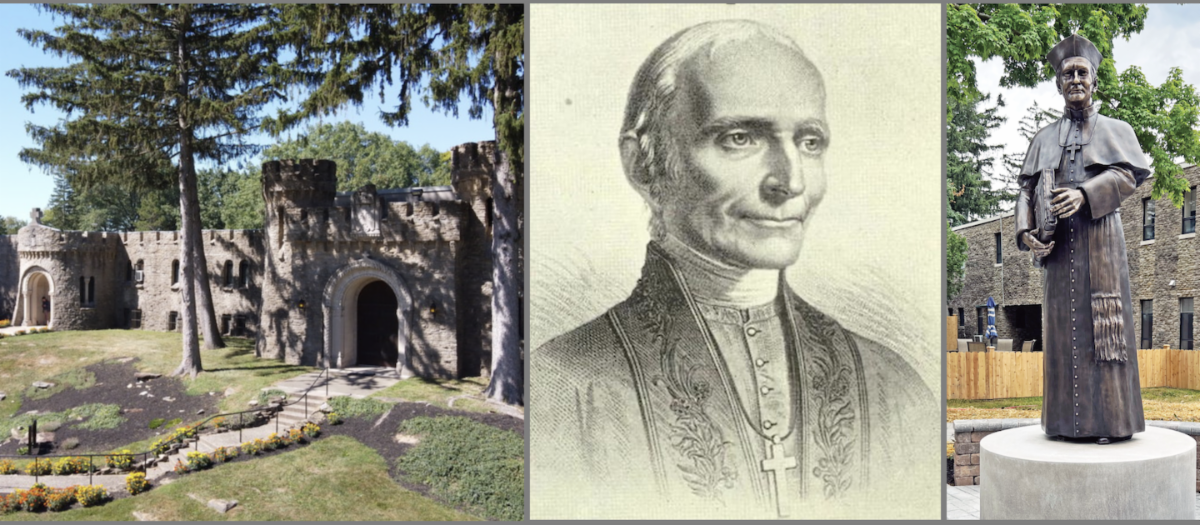
|
The American Society of Le Souvenir Français Inc.
Monthly Bulletin - Vol. IV. No 11 - November 2024
| |
|
French Missionaries in America
1800 - 1900 (Part 3 of a series)
| |
|
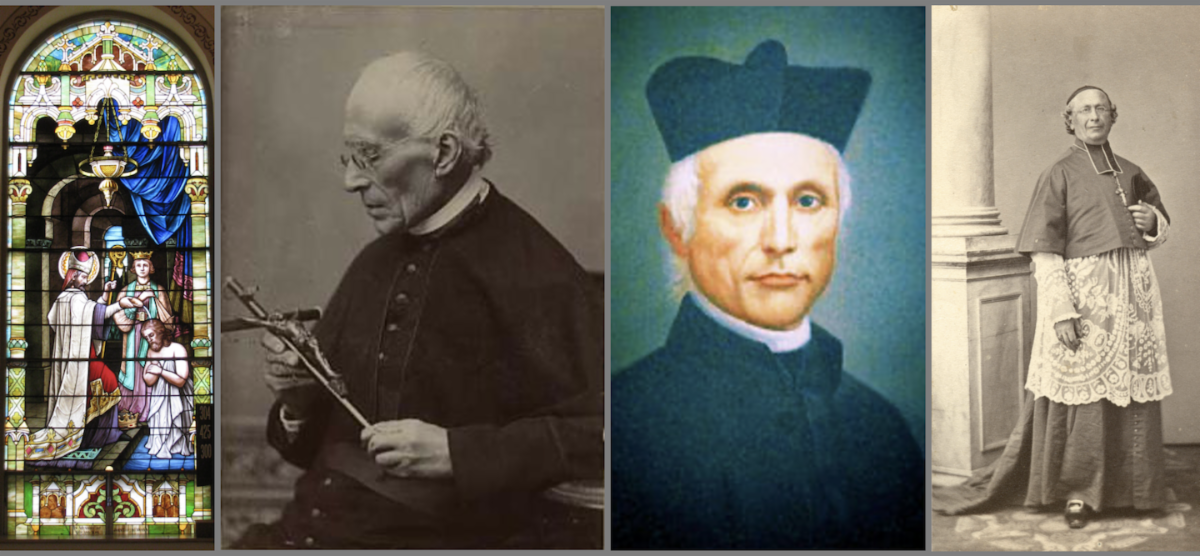
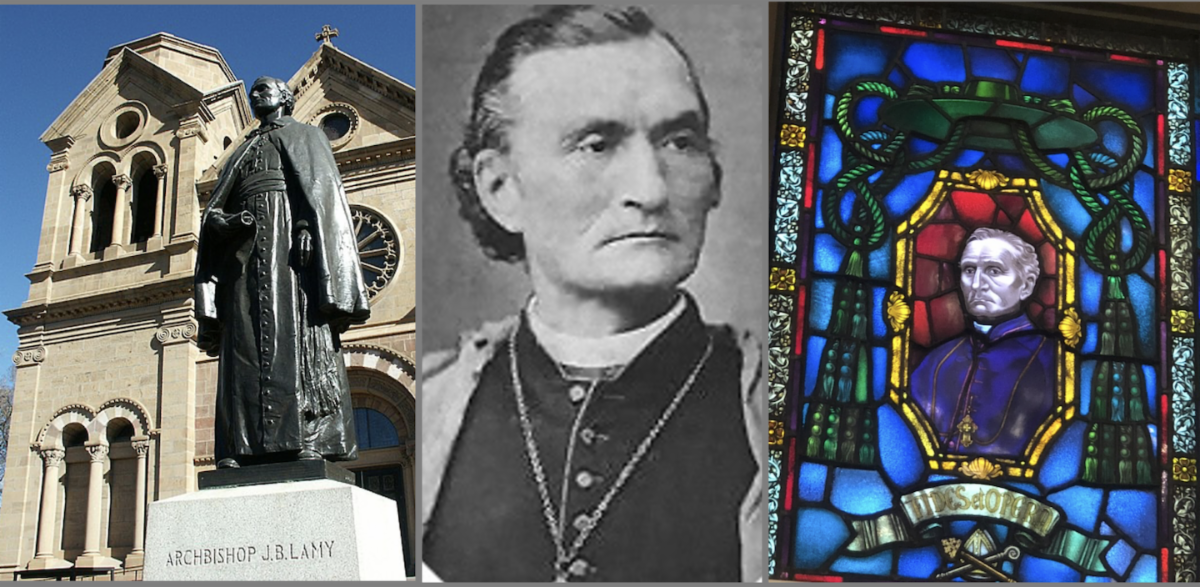
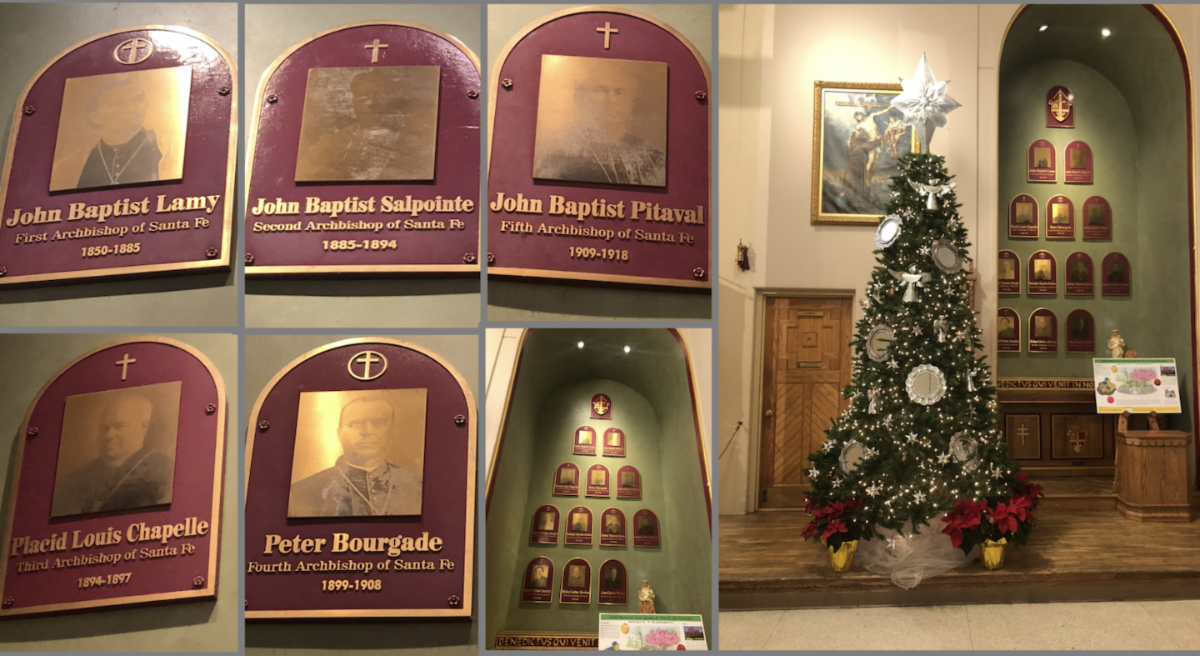
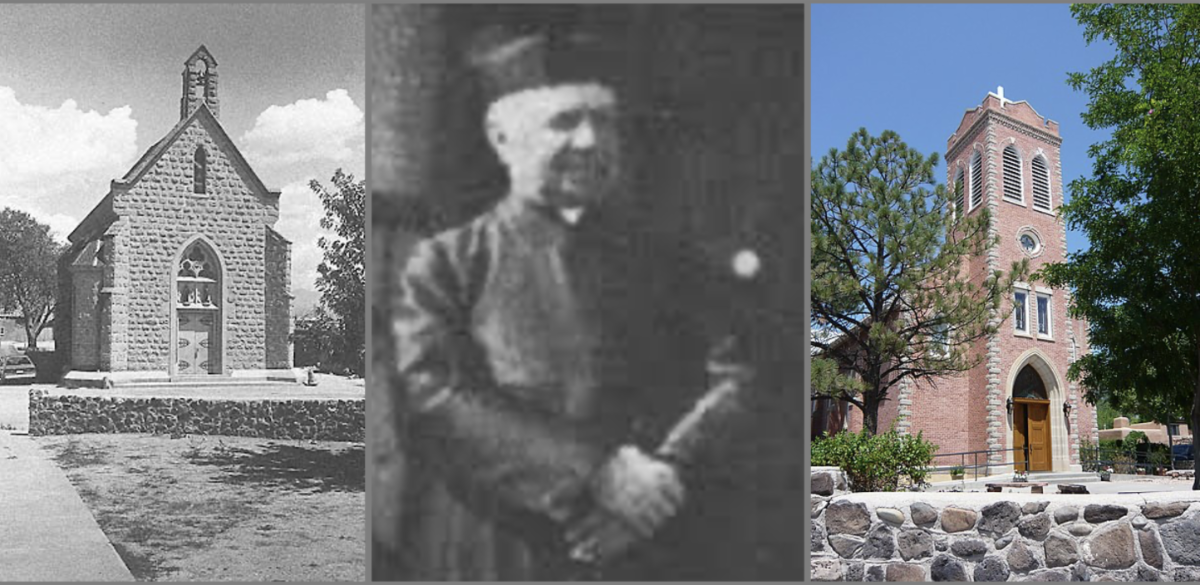
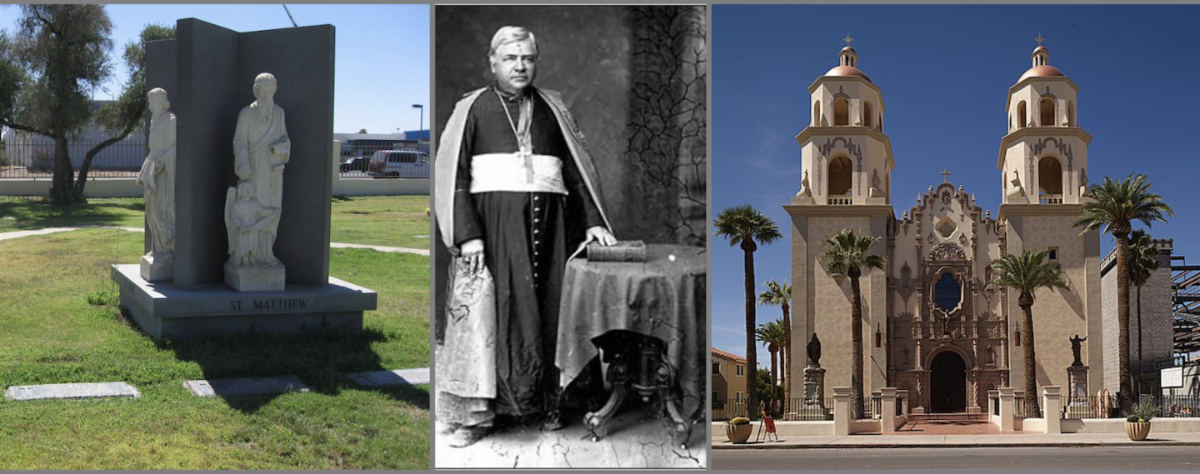
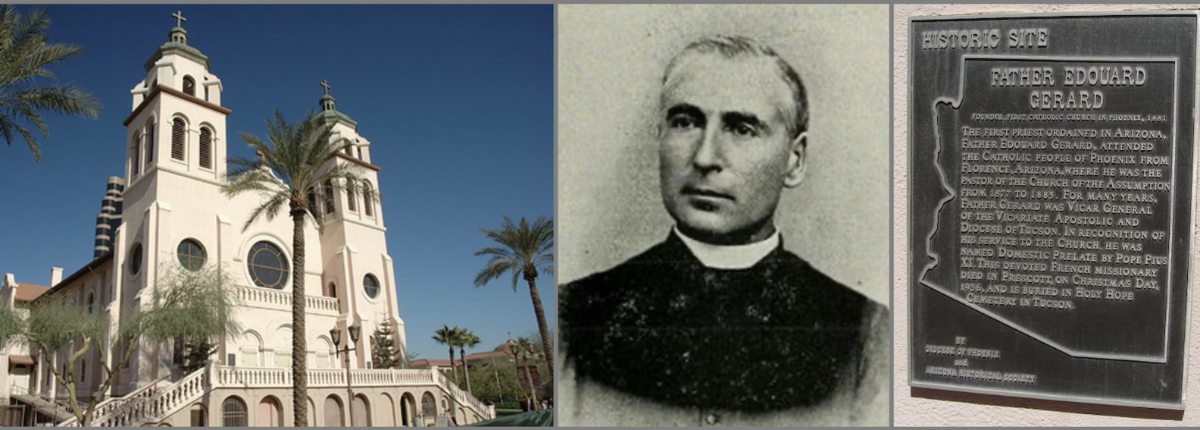
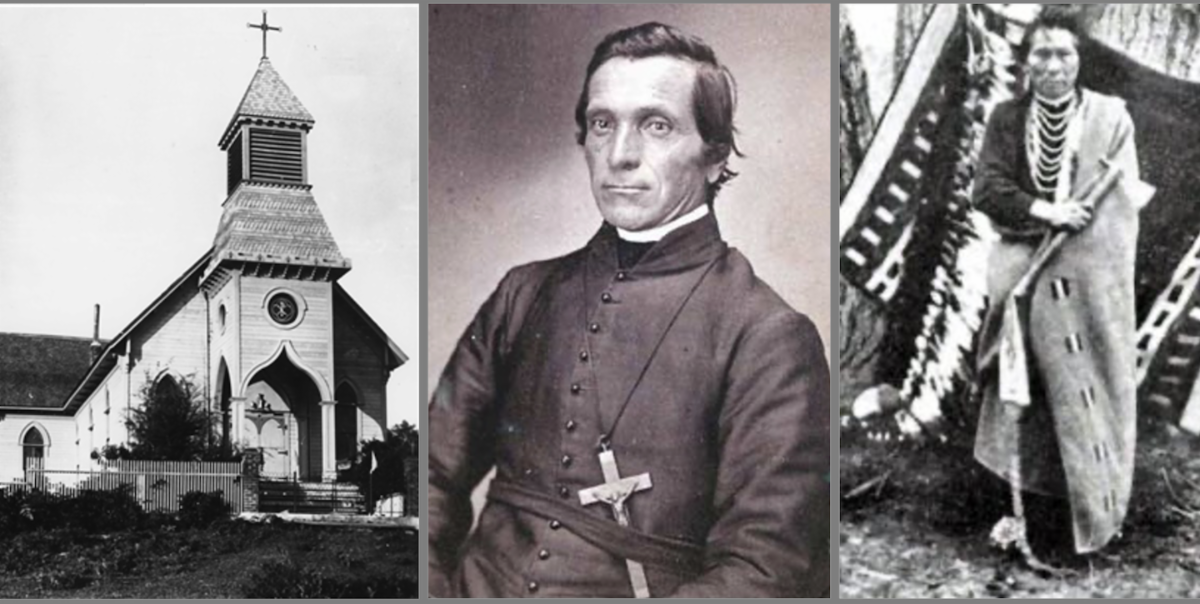
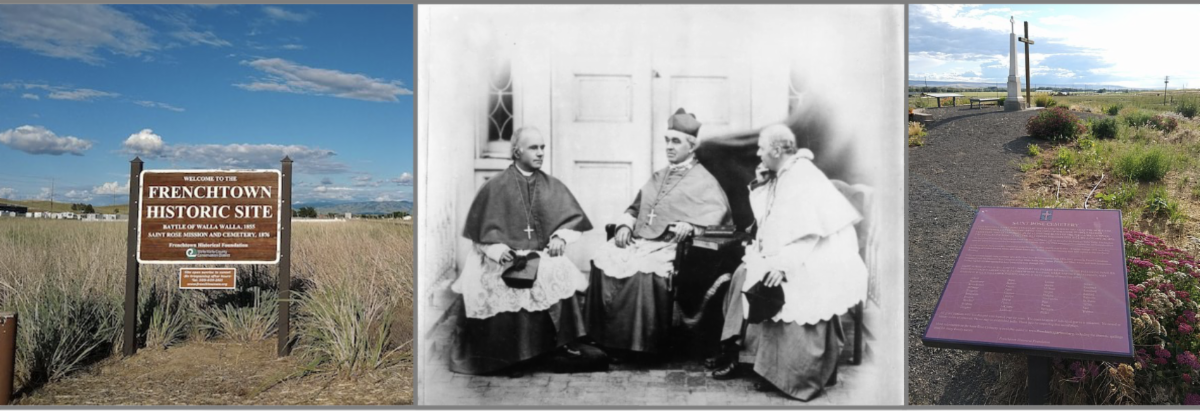
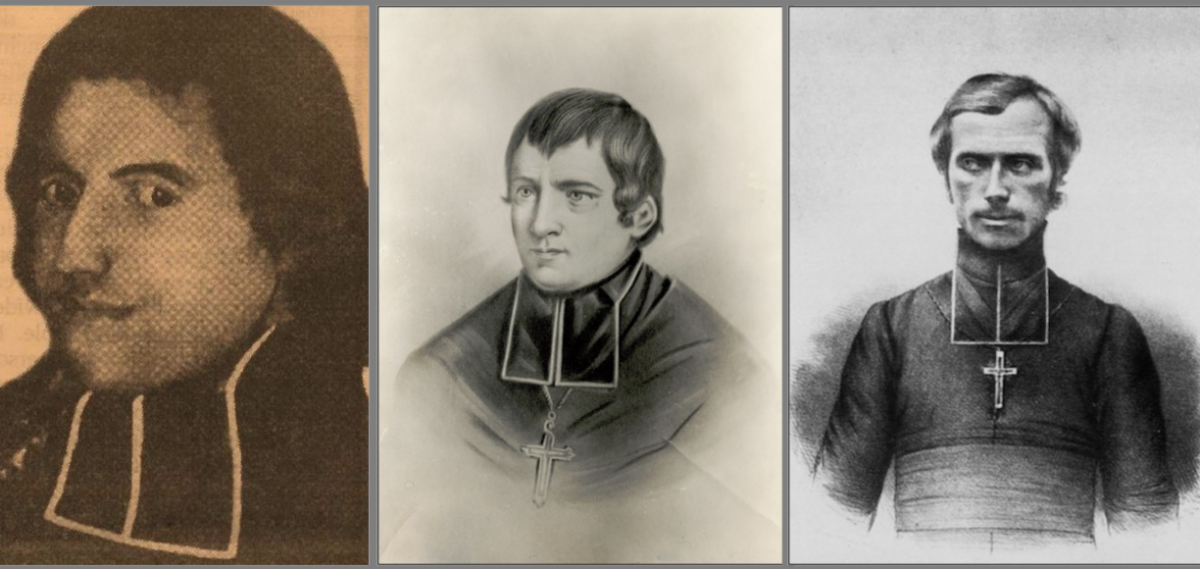
Cover illustration:
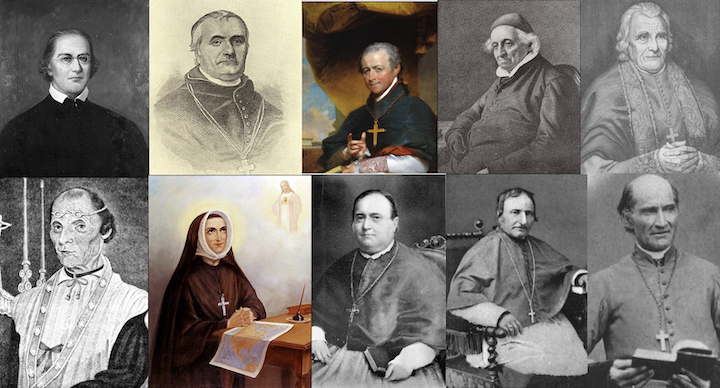
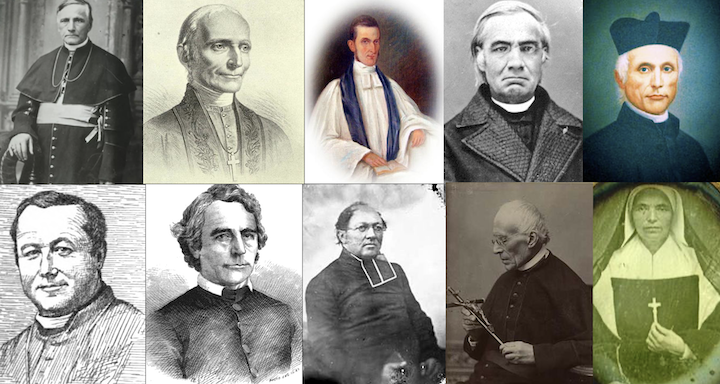
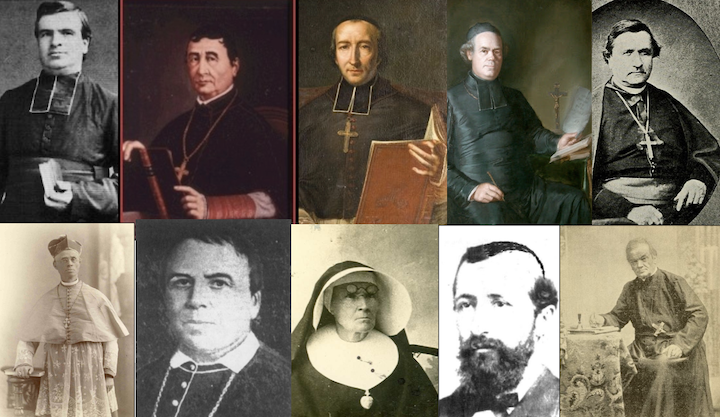
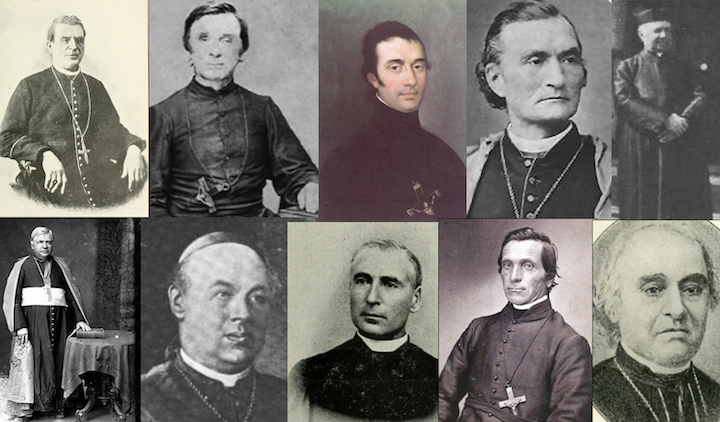
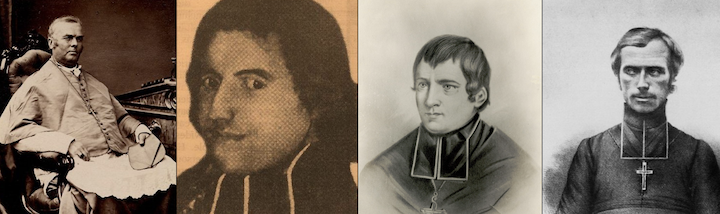
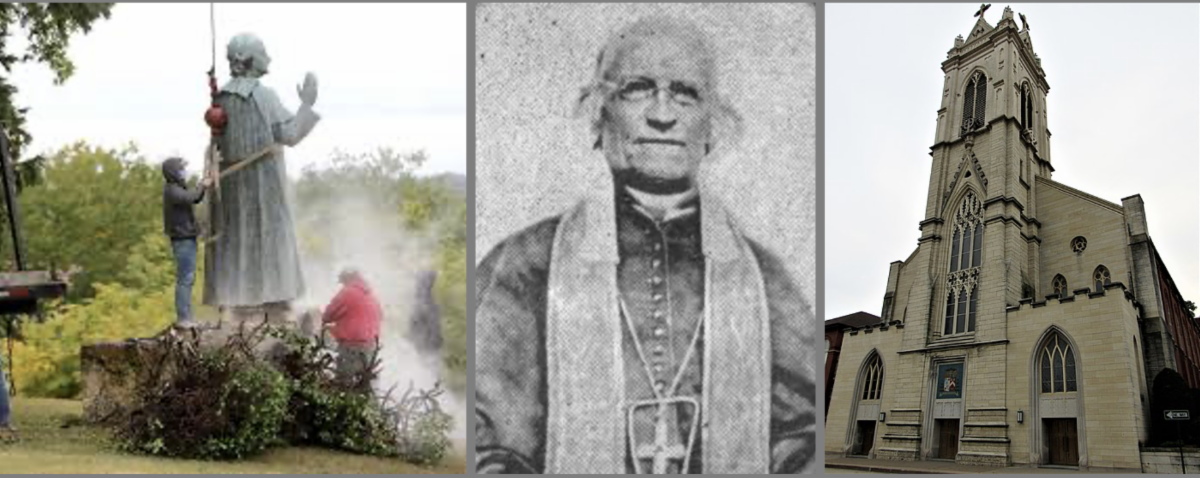
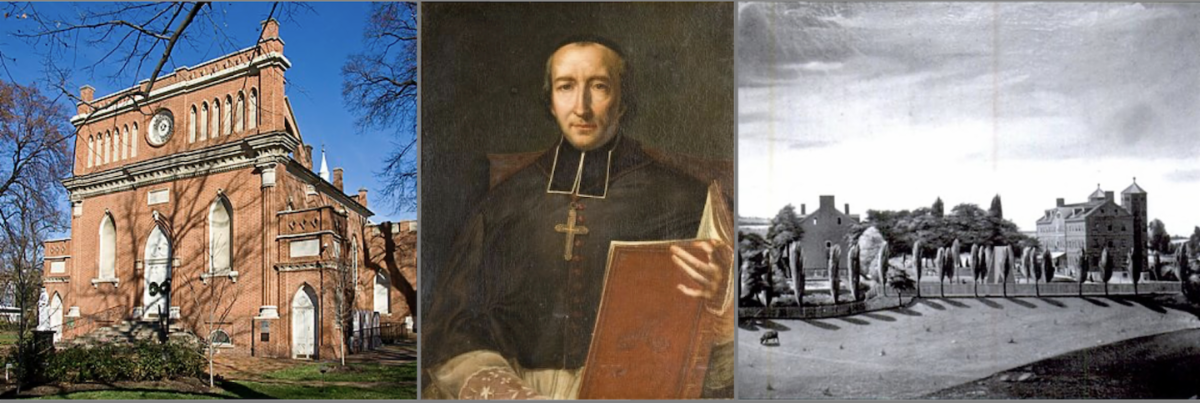
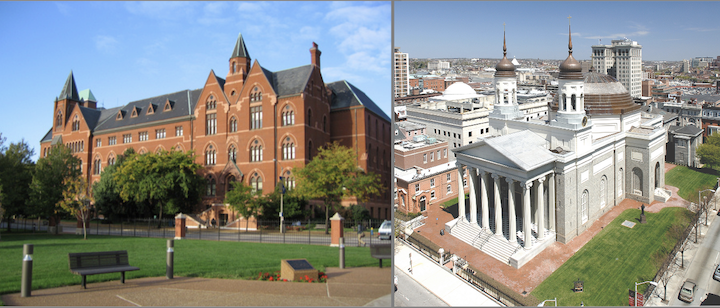
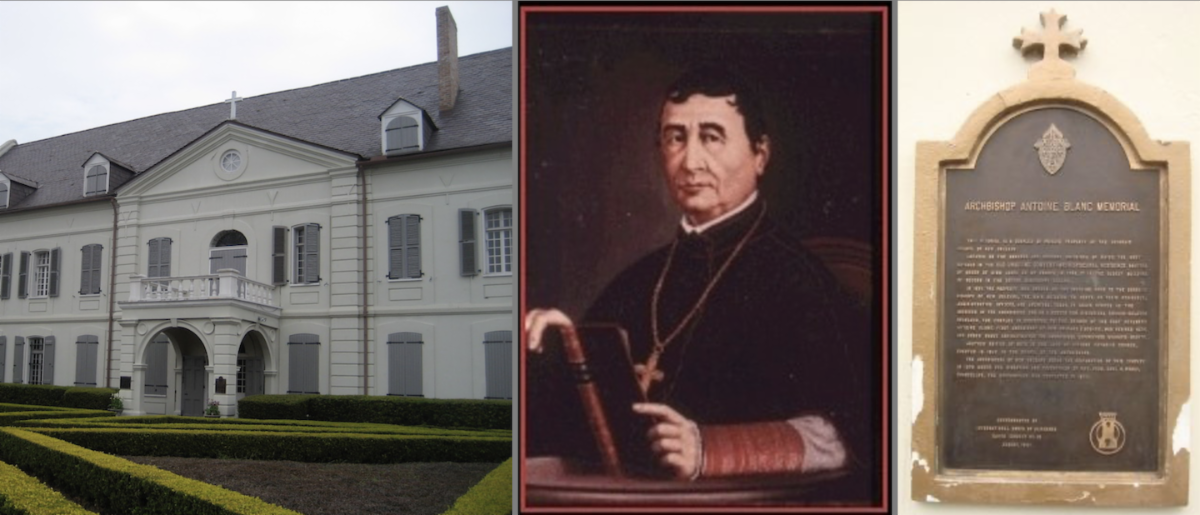
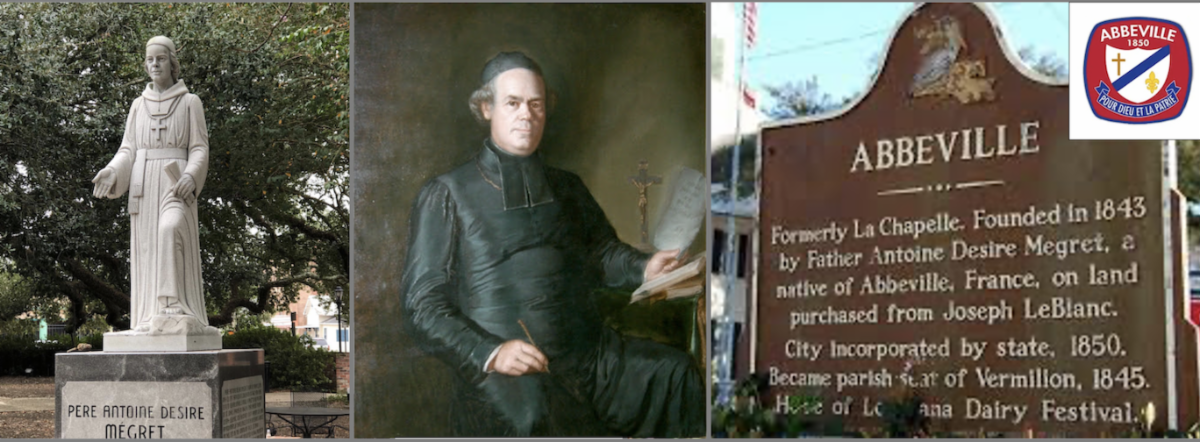
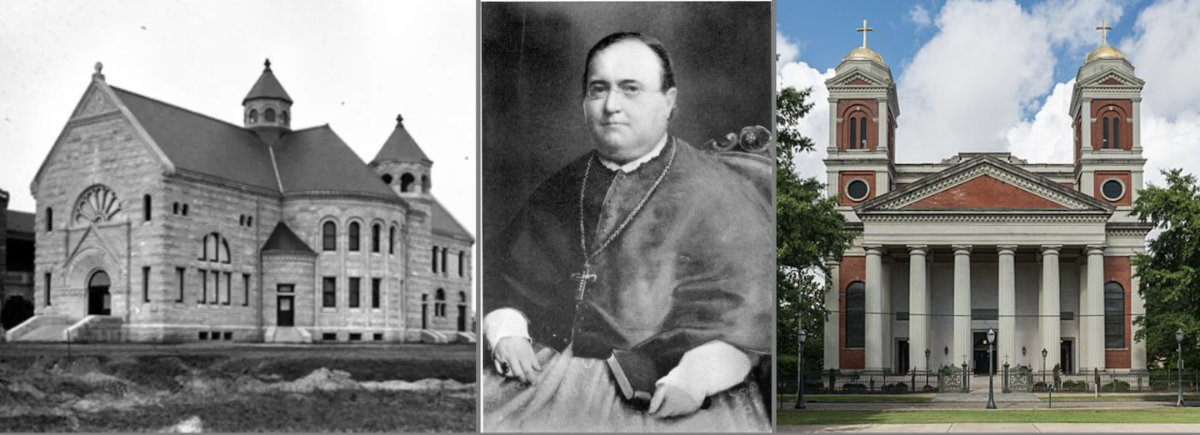
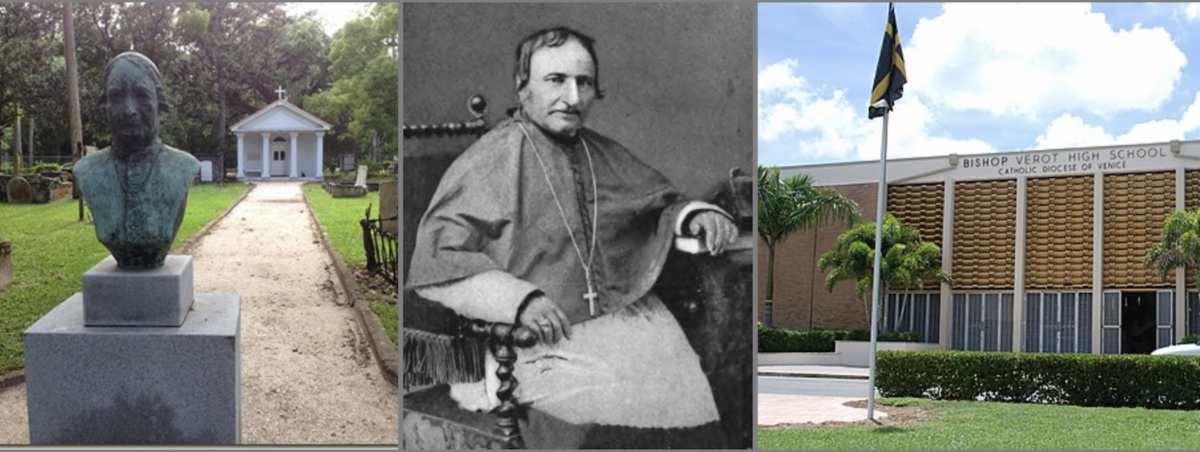
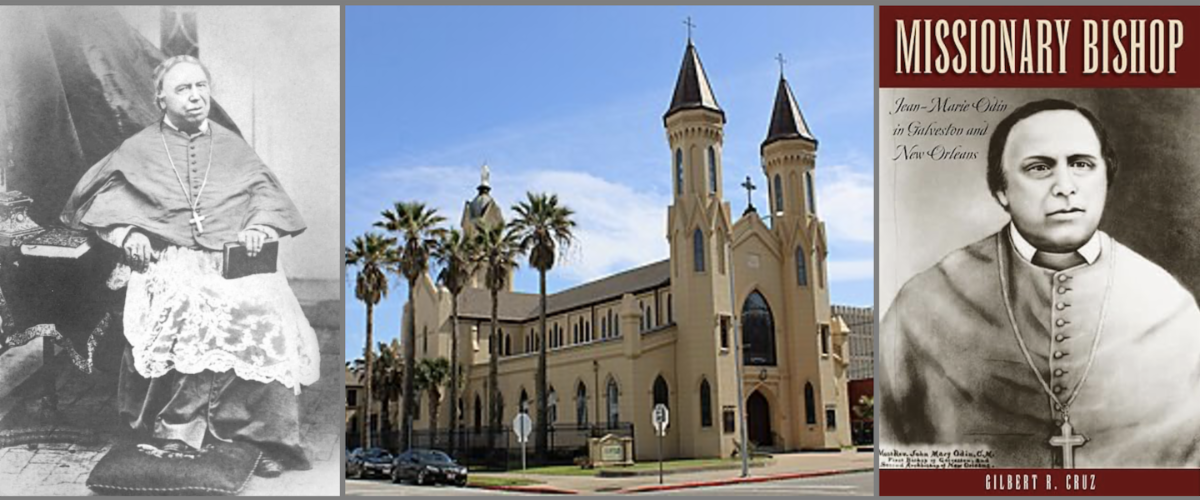
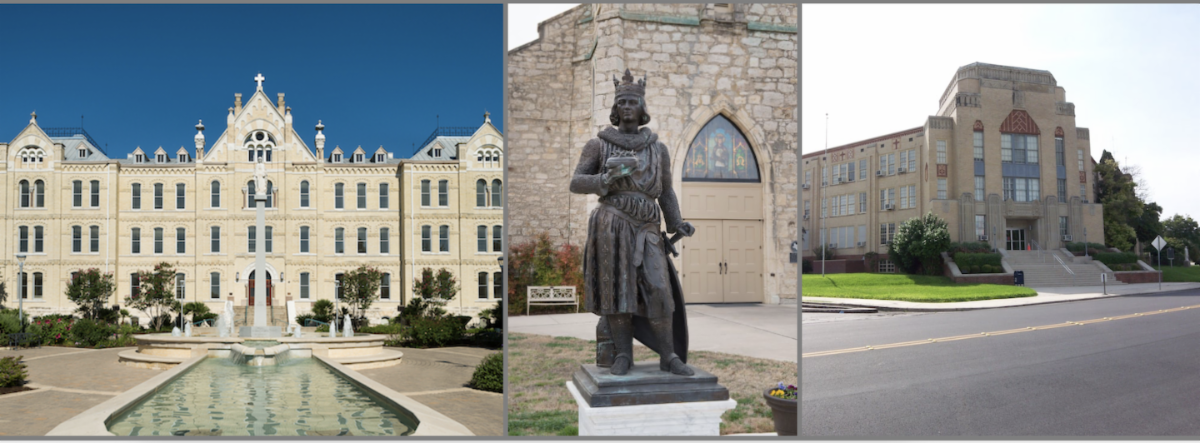
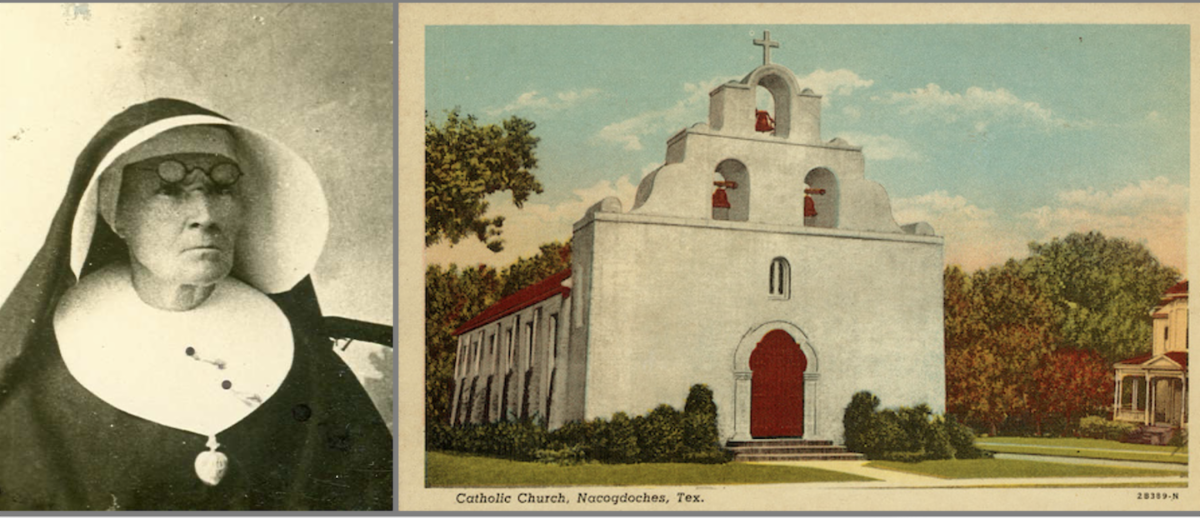
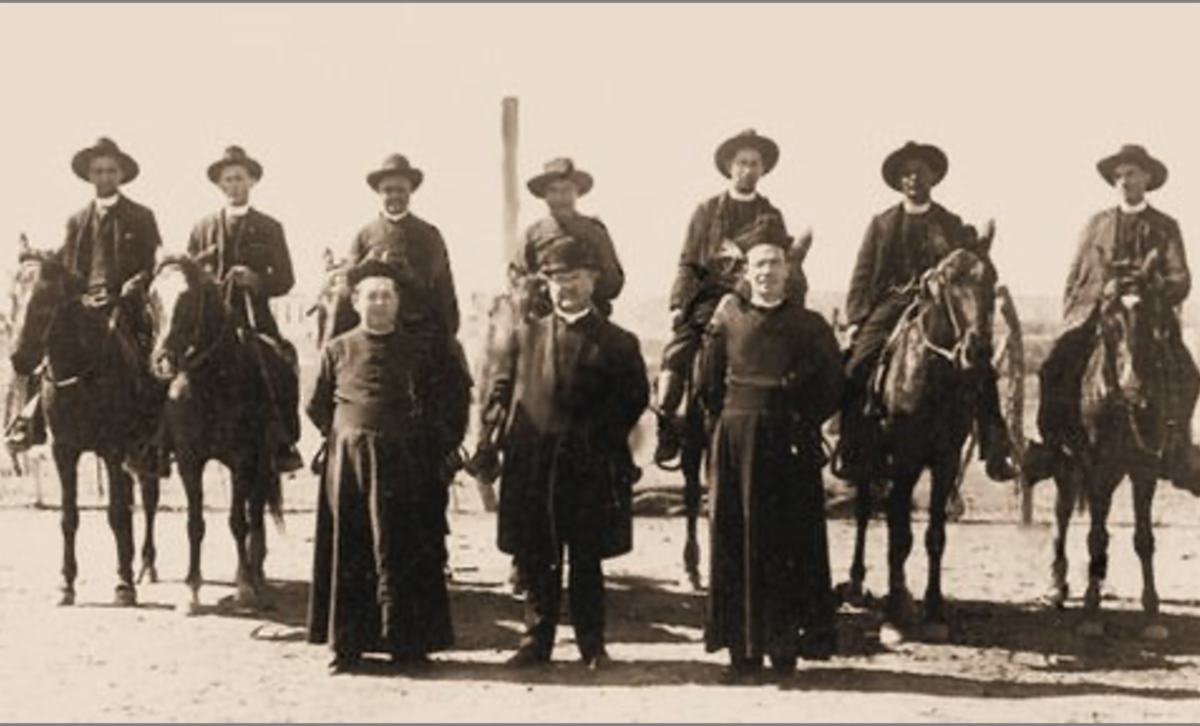
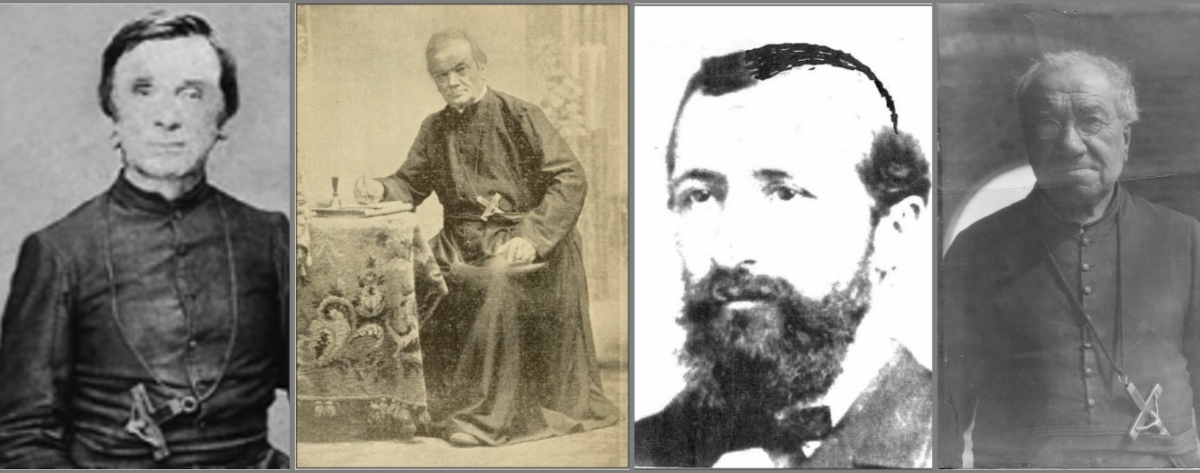
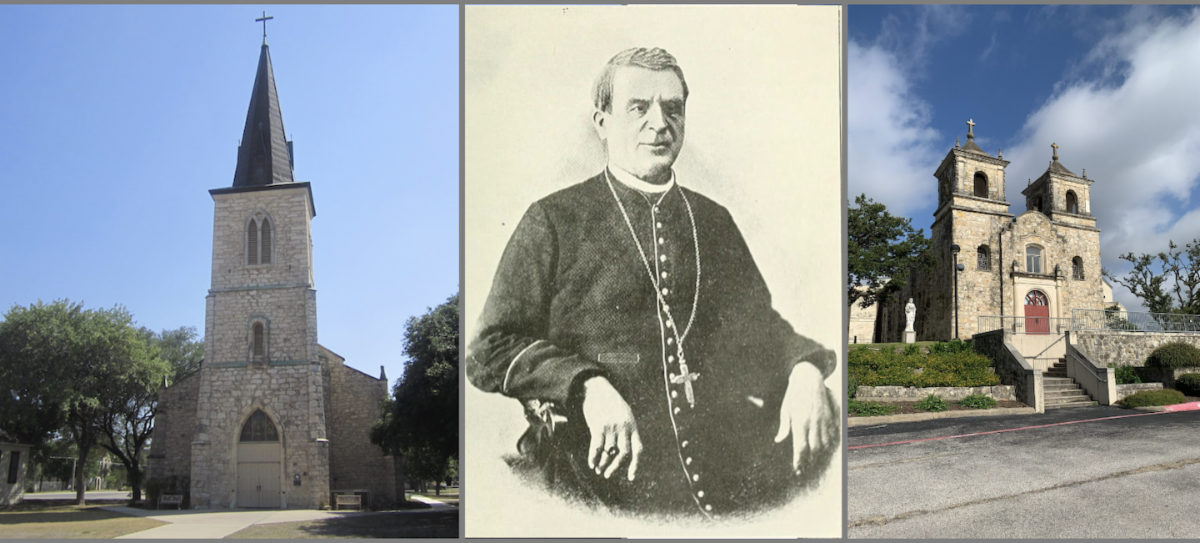
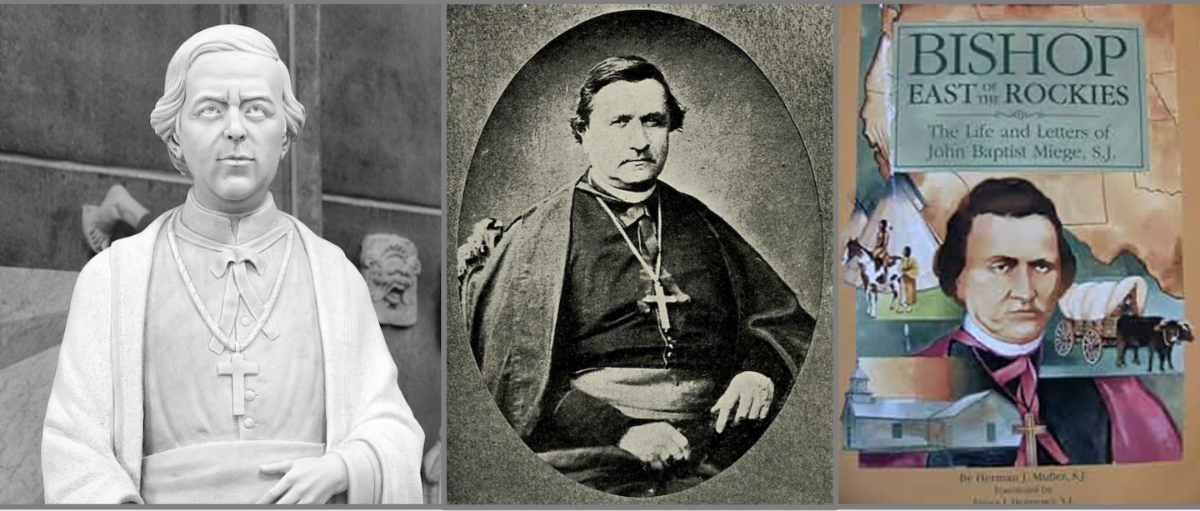
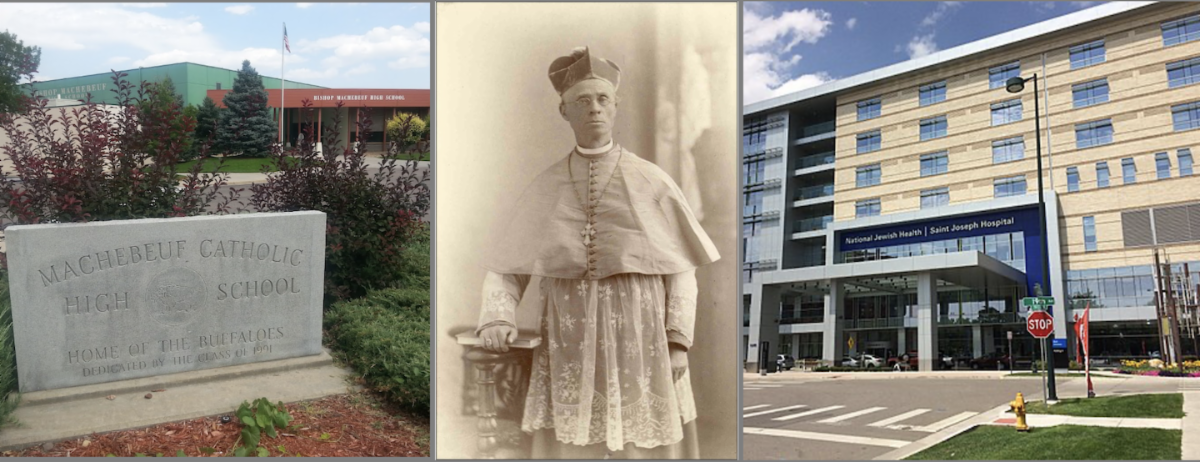
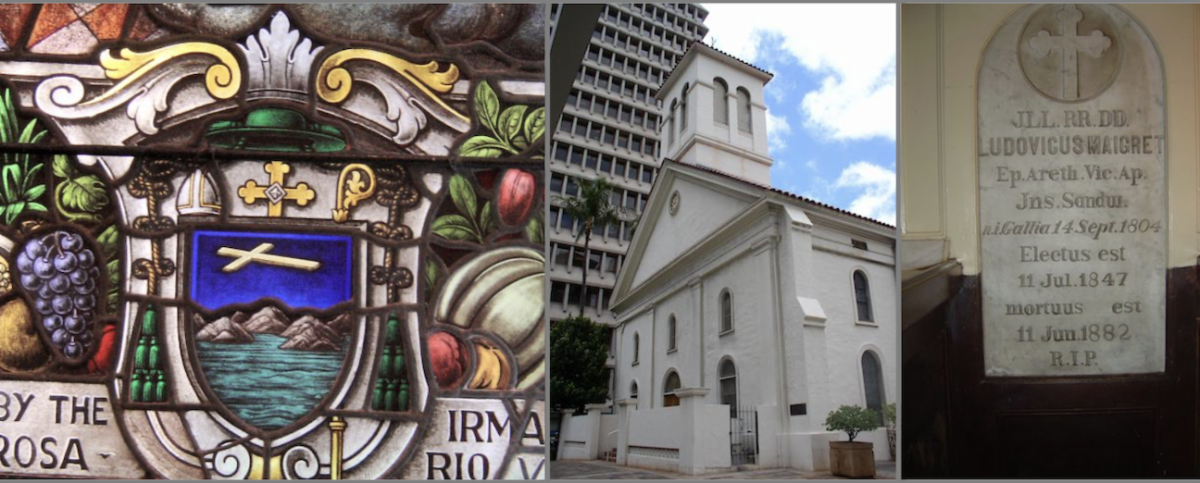
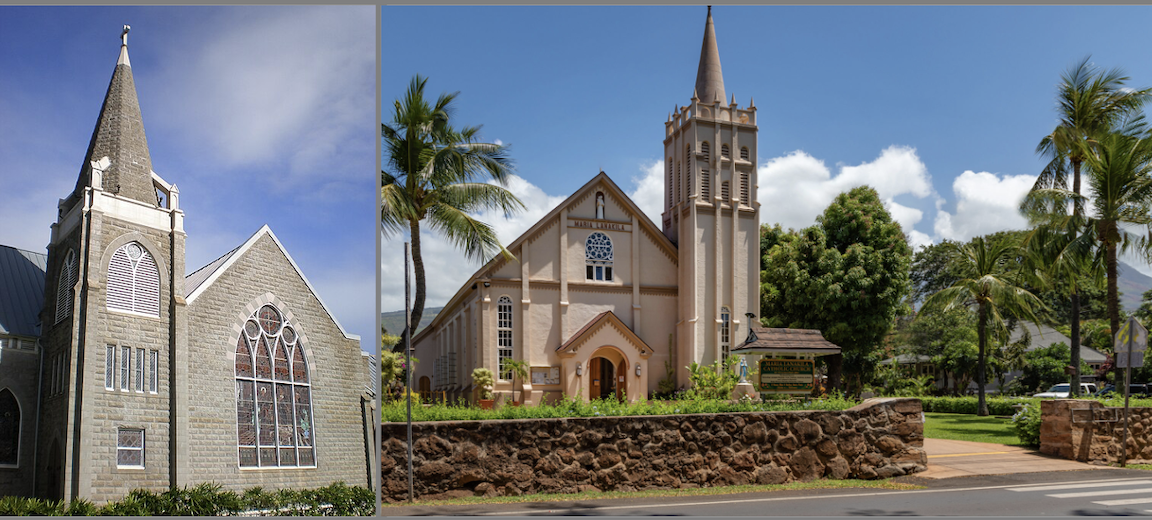
A few priests, prelates and nuns who left their mark in America throughout the 19th Century.
Scroll down in this Bulletin for proper photo credits and interpretive links.
| |
|
Editorial
We are concluding our series “French Missionnaries in the United States” with this monthly Bulletin dedicated to priests and prelates who came to build the foundation of the catholic church in the 19th Century.
Did you know that the first catholic bishops of Boston, Cleveland, Denver, Burlington, Vincennes, Minneapolis-St Paul, Mobile, St Augustine, Galveston, Santa Fe, Arizona, Oregon, even Honolulu were all born in France, often from the same seminaries?
Our goal is not to “brag” on their behalf by claiming to be the “first”.
Our Society simply aims to highlight and appreciate the good work and dedication of French immigrants to their new country and community.
Indeed, they are still fondly remembered… and some were called “Bishop of the West” , “Bishop of the Indians”.
Not content with building churches and cathedrals, they also started universities and schools - - think Notre Dame University - - even the “first free school West of the Mississippi”.
Statues, plaques and stained glass windows attest to the crucial role they played, paving the (spiritual) way for waves of Europeans catholic immigrants notably from Ireland, Germany, Italy, Poland. In fact, many of these priests accompanied the pioneers, as well as the Native Indians during some of their most tragic moments, and are still revered today for their compassion. Women as well, who created schools, orphanages, hospitals, when not caring for the most indigents. Two of these French nuns were canonized in the 20th Century.
Through them, we pay tribute to hundreds of forgotten priests and nuns who came from France to accompany the Western expansion of the United States, and continued the work started by the first Jesuit Missionaries of the 1600’s.
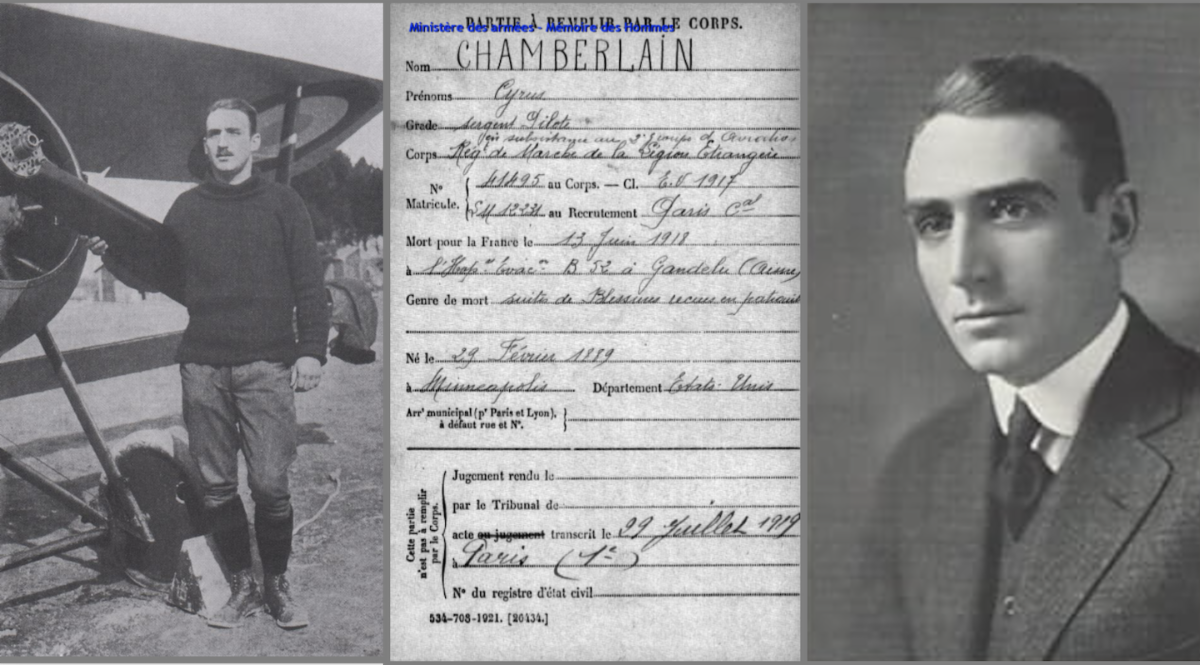
Our second part of our monthly Bulletin, as is now the tradition, will pay homage to another volunteer of the Lafayette Air Corps, Sgt. Cyrus Foss Chamberlain, who “Died for France" in aerial combat on June 13, 1918 over the town of Angelu in the Aisne department. Next time you fly to Minneapolis St Paul, his hometown, please have a thought for him. The international airport was named in his honor in 1923.
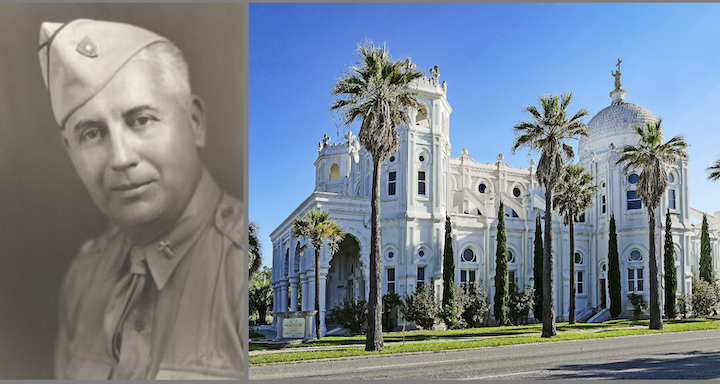
In keeping with the theme of this month Bulletin, we will also pay tribute to a French-born WWII US Army Chaplain, Marius Etienne Chatignon (1886 - 1957). Francis Cardinal Spellman of New York wrote of him in 1945, "I regard him as perhaps the best Chaplain in the whole Army."
Finally, our third part “News and Save the Dates” will report on events since our last Bulletin, including several commemorations of the Bicentennial of Lafayette’s Farewell Tour organized by the American Friends of Lafayette, the Yorktown victory celebrations and Veterans Day.
Next month will be our annual “The Year in Pictures” album, where you will reminisce with us all the activities of your Society.
Your continued support is key. Our 2025 membership dues and donations drive is about to start. Any dues received in the last quarter of the year automatically extends to the entire next calendar year. We thank you in advance for your support, and remind you that we are a non-profit 501 (c) 3 American corporation. Please donate generously, so that we can implement the installation of new memorials, markers and plaques!
We hope that, after reading this Bulletin, and as you carve the turkey, you will have a thought for all these missionaries who gave so much to America.
We wish you and your Family and friends a Happy Thanksgiving!
On behalf of the Board of Directors,
Thierry Chaunu
President, American Society of Le Souvenir Français, Inc.
| |
|
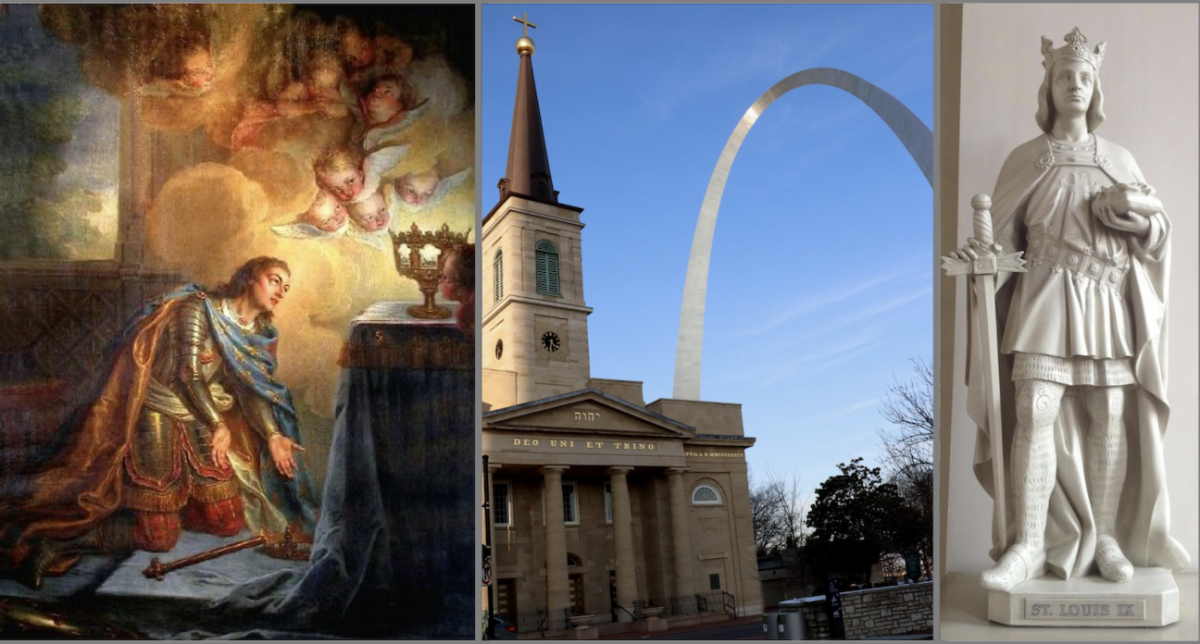
Above:
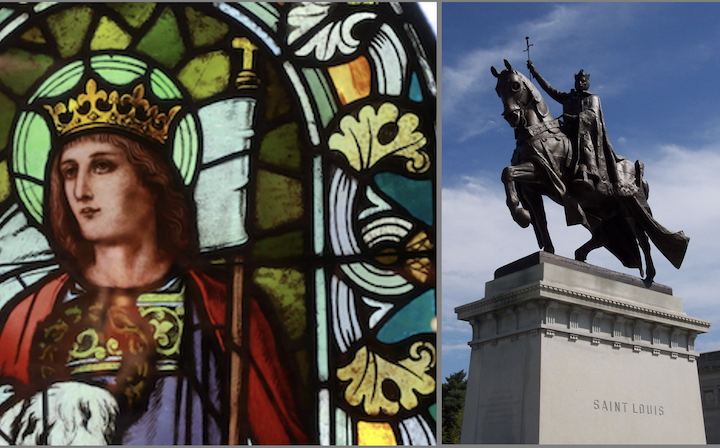
Left: Detail of stainglass window, Church of Saint Louis, King of France, Minneapolis, Minnesota
506 Cedar Street, Saint Paul MN 55101
GPS: 44.950124, -93.096860
https://www.stlouiskingoffrance.org/
Right: : Statue of Saint Louis, St Louis, Missouri
Forest Park, Fine Arts Dr, St. Louis, MO 63110
GPS: 38.6353025,-90.3150808
Photo: By Colin Faulkingham - Self-photographed, Public Domain, https://commons.wikimedia.org/w/index.php?curid=5338700
| |
|
A long tradition of French Missionaries:
French missionaries were dispatched to the most remote regions of the known world to spread Christianity among Indigenous populations, extending their efforts even into the uncharted territories of North America, referred to as "Terra Incognita."
In two earlier Bulletins this year, we detailed the remarkable lives and contributions of several courageous missionary-explorers from the 17th and 18th centuries, who are commemorated through statues, markers, and plaques across numerous States:
January 2024: Early French Missionaries in the United States (Part 1 - New York, Maine, Vermont)
https://conta.cc/41VLaPE (version in English)
https://conta.cc/3NWK407 (version in French)
September 2024: French Missionaries in America - 1600-1800 (Part 2 of a series)
https://conta.cc/3XCvfnP (version in English)
https://conta.cc/4ebwtxj (version en français)
After the end of New France in 1763, the independence of the United States in 1783 and the Louisiana Purchase in 1803, this French missionary presence changed in nature, and took different forms depending on the regional context.
In the 1800's, the Holy See in Rome was now creating dioceses and appointing prelates.
In the former 13 Colonies, and notably New England, the historic cultural distrust, if not outright animosity, towards the "Papists" was such that it would take several decades before the Holy See would be able to organize its dioceses. Catholics faced hostility and were often excluded, as Congregational or Episcopal churches received legal support. While many of the original catholic clergy in these parts of the country were Irish, some of the early catholic vicars or bishops were French.
In what was formerly New France, the entire Midwest from the Great Lakes to the Gulf of Mexico and the Rockies, corresponding to the Louisiana Purchase, it was natural to appoint French clergy as a continuation of 200 years of French presence.
Of course, the anti-catholic persecutions and the upheavals of the French Revolution led many seminarians and priests to seek refuge in America.
And when the United States expanded westward to reach the Pacific ocean, it was also not surprising that many of the missionaries and catholic clergy would come from France: the long tradition of proximity with the Natives, the interaction with predominantly French-speaking fur traders and settlers played a role.
What is interesting, as we will see, is that a given immigrant priest would often recruit aides and other priests from their former seminary in France. Equally noteworthy is the fact that several of the churches they built in America have the same roman architecture found in central France.
The pages below will introduce some of these "French Founding Fathers" of the Catholic church in America.
| |
|
A catholic diocese in New York City
Three key French figures
| |
|
Towards the Archdiocese of New York
1783-1850
New York currently serves as the headquarters of an archdiocese, which was referred to by John Paul II as the "archbishop of the capital of the world," reflecting the city's significant role in the global arena. Before attaining this archdiocesan status in 1850, largely due to the substantial arrival of Irish and German Catholic immigrants, New York City was designated as a diocese, established in 1808.
Among the first 3 bishops, the first two were Irish (but the first couldn't cross the Atlantic due to the Napoleonic Wars), and the third one was French: Jean (John) Dubois.
But before we present him, the origin of the first catholic church in New York owes much to the French General Consul at the time of American Independence, Michel Guillaume Jean de Crèvecœur, and Rev. Anthony Kohlmann SJ , the first French Vicar general who laid much of the groundwork of the newly created diocese. In truth, we must also mention the work behind the scenes of the Spanish and Portuguese Consuls who actively promoted the establishment of the first catholic church in New York City, St Peter's church.
| |
|
Michel Guillaume Jean de Crèvecoeur
Consul General of France in New York
naturalized as Hector Saint John
| |
|
Above:
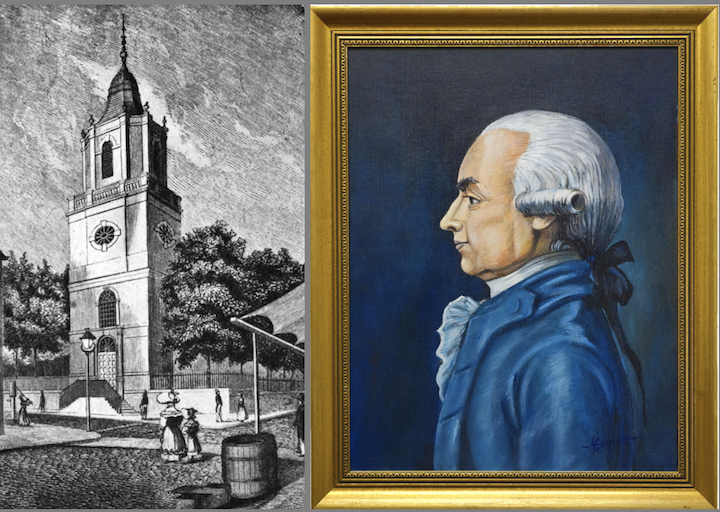
Left: the original 1785 St. Peter's Roman Catholic Church. Drawing by Regimus LaFort, Public Domain, https://commons.wikimedia.org/w/index.php?curid=59941744. Location: 22 Barclay Street at the corner of Church Street in the Financial District of Manhattan, New York City. A new church (see below) has been built to replace it. It is the oldest Roman Catholic parish in the city, It was designated a NYC landmark in 1965.
Right: Michel Guillaume Jean de Crèvecœur, by Cuchet, Paris, 1784, Public Domain, https://commons.wikimedia.org/w/index.php?curid=1530123
| |
|
Michel Guillaume Jean de Crèvecœur (born in Caen, Normandy, on December 31, 1735 – died in Sarcelles, France, on November 12, 1813), was a Consul of France in New York, covering New Jersey and Connecticut, as well as a famous author and farmer.
• We will devote a future Bulletin on his remarkable life. For now, we will just mention that in 1782, he released a collection of essays called Letters from an American Farmer. The book became a big hit in Europe and made Crèvecœur famous. He was the first to tell Europeans about life on the American frontier and to discuss the idea of the American Dream. A staunch abolitionist, he became a member of the Société des Amis des Noirs (Society of the Friends of the Blacks), which was established in Paris and was elected to the American Philosophical Society in 1789.
• Of direct relevance to the theme of this Bulletin, he played an important role in establishing the first Catholic church in New York City, St. Peters on Barclay Street.
• At the time of his appointment as Consul General of France in 1783, New York City was the national capital, and many Catholics were part of the diplomatic community. At first, they gathered for church services at the Spanish consul's home. Their group expanded as sailors, traders, immigrants from the Spanish West Indies, and a few Acadians joined in. In 1785, the Portuguese and Spanish Consuls, believing he was best person to do so, asked Crèvecœur to approach city officials with a request to build a catholic church.
• This was no easy feat, even though Crèvecœur's prestige was very high, being the representative of France, who had just helped the 13 Colonies to win their independence. Local prejudice against the "Papists" was still prevalent. After several rebuffs Crèvecœur finally succeeded probably (due to his longtime friendship with Lafayette) in obtaining permission to establish the first Catholic church in the city, and took on the role of president of the inaugural Board of Trustees for St. Peter's Church, located on Barclay Street. The cornerstone of the original church was laid in 1785 and the first Mass celebrated in 1786.
• The town of St. Johnsbury in Vermont is named after him, as proposed by Vermont founder Ethan Allen.
| |
|
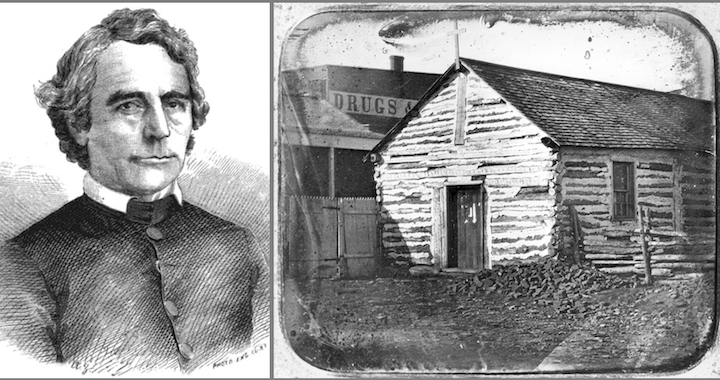
Anthony Kohlmann SJ
First Vicar general, Diocese of New York
| |
|
• Anton Kohlmann (born July 13, 1771, in Kaysersberg in Alsace - died in Rome April 11, 1836) studied in Colmar, Alsace, where he first joined the Capuchin order. He escaped persecution during the French Revolution by fleeing to Switzerland, Austria, Italy and Russia, where he became a Jesuit, and finally went to America in 1806 where he changed his name to Anthony.
• In 1808, he assumed the role of pastor at St Peters Church, the sole Catholic church in New York City, where he would deliver sermons in French, German and English. Back then New York counted 14,000 Catholics, mostly of German and French origin.
• Rev. Kohlmann subsequently became the apostolic administrator and inaugural vicar general of the newly established Diocese of New York. In 1809, he was instrumental in the construction of the diocese's first cathedral, which he named St Patrick.
• The architect chosen was French born Joseph-Francois Mangin, who had co-designed New York's City Hall with John McComb Jr., whose construction took place at the same time. Joseph-Francois Mangin also is credited with inventing the grid design of New York's streets.
• St Patrick became known later as Old St Patrick when the current St Patrick cathedral's construction started in 1858 in Midtown Manhattan.
• Rev. Kohlmann founded the New York Literary Institution, established an orphanage, and played a pivotal role in bringing the first Ursuline nuns to the United States.
• Kohlmann Hall at Fordham University is named in his honor.
| |
|
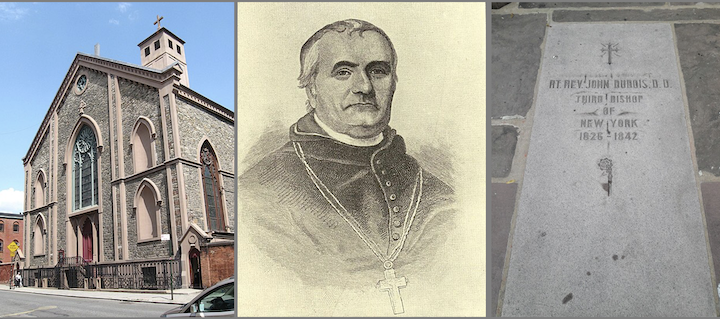
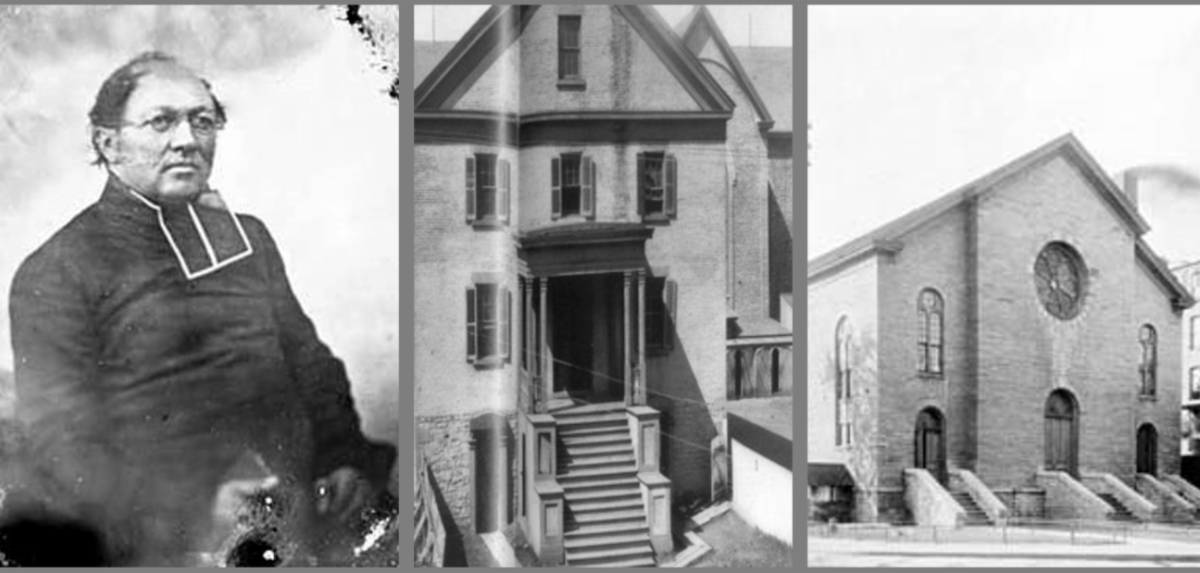
Jean (John) Dubois
Third Bishop of New York
| |
|
Above:
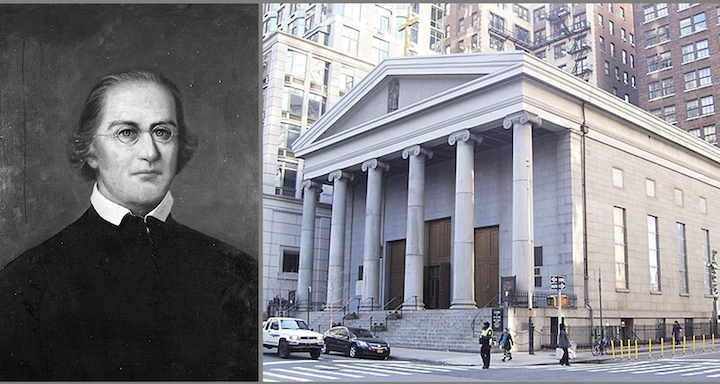
Left: St. Patrick's Old Cathedral, 263 Mulberry St, New York, NY 10012
By Jim Henderson - Own work, Public Domain,
https://commons.wikimedia.org/w/index.php?curid=4585865
Middle: John Dubois (French: Jean Dubois) served as the third bishop of the Roman Catholic Diocese of New York from 1826 until his death in 1842, By John Murphy - Public Domain
https://commons.wikimedia.org/w/index.php?curid=125100470
Right: Bishop Dubois' grave, Old St. Patrick's Cathedral, New York City, By Farragutful - Own work, CC BY-SA 4.0, https://commons.wikimedia.org/w/index.php?curid=82921780
| |
|
• Jean Dubois was born in Paris, France, on August 24, 1764. He went to Lycée Louis-le-Grand in Paris. Wanting to be a priest, he studied theology at the Oratorian Seminary of Saint-Magloire in Paris. After being ordained in 1787, Dubois worked as an assistant to the curé at the Church of Saint Sulpice in Paris.
• Amazingly, he escaped the persecution of priests during the French Revolution with help from none other than his classmate, Maximilien Robespierre, later leader of France during the dreadful time known as The Terror. In 1791, he arrived in Norfolk and was warmly welcomed in Richmond by influential families, thanks to a letter of introduction from... Lafayette!
• Virginia had only recently lifted civil restrictions on its small Catholic population in 1786. Dubois soon made friends with two Episcopalian ministers, which led to an invitation from the Virginia General Assembly for him to hold mass in the Capitol courtroom. While in Richmond, Dubois conducted masses at the homes of the few Catholic families in the city.
• In 1794, Dubois was assigned to Frederick, Maryland, to tend to the growing Catholic community there, remaining until 1811. In 1808, he established Mount St. Mary's College in Emmitsburg, Maryland, and became its first president.
• In 1826, Pope Leo XII named Dubois as the bishop of New York, following a recommendation from Reverend Anthony Kohlmann. He was consecrated in 1826 by French-born Ambrose Maréchal, Archbishop of Baltimore. To highlight the intricate connections within the Catholic clergy in America at that time, it's worth noting that Ambrose Maréchal, born in Ingré, in the Loiret, near Orléans, France, who studied to become a Sulpician priest at Issy-les-Moulineaux near Paris, had been himself consecrated by Mgr. Jean-Louis Cheverus, first bishop of Boston, who hailed from Mayenne, in the French historical province of Maine.
• The Irish clergy in the Diocese of New York were unhappy about the choice of a French bishop. Even though Dubois spoke English well enough, his accent made them see him as a "foreigner". At one point, the trustees of St. Patrick's Old Cathedral in Manhattan, who were in a conflict with Dubois over church property, stopped providing him with food and shelter.
• During his tenure as bishop, Dubois erected six new parishes in New York City. Dubois passed away on December 20, 1842. He is laid to rest beneath the sidewalk at the entrance of Old St. Patrick's Cathedral. He chose this location so that people could "walk on me in death, as they wished to in life".
A plaque at the church's entrance honors Dubois.
• Dubois was the first Bishop of New York not born in Ireland and, as of 2024, is still the only bishop or archbishop of New York with non-Irish roots.
| |
|
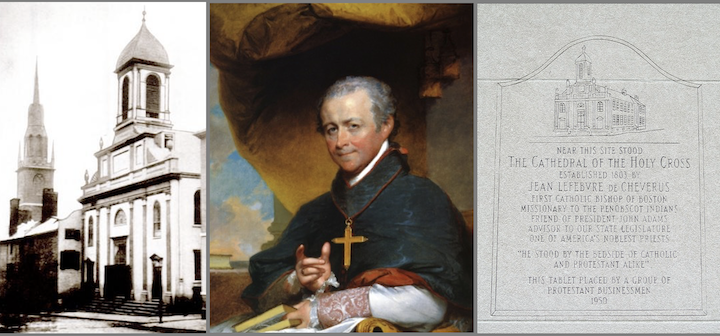
Bishop Jean-Louis Cheverus
First Bishop of Boston
| |
|
Above:
Left: Boston (1850s photo), By Author unknown - Sammarco, Downtown Boston. Arcadia Publishing, 2002., Public Domain, https://commons.wikimedia.org/w/index.php?curid=8988192
Middle: Jean-Louis Anne Magdelaine Lefebvre de Cheverus" By Gilbert Stuart - The Athenaeum, Public Domain, https://commons.wikimedia.org/w/index.php?curid=10670902
Right: Plaque at site of Cathedral of the Holy Cross, Boston, By Daderot - Own work, CC0, https://commons.wikimedia.org/w/index.php?curid=19338494
| |
|
• Jean-Louis Anne Madelain Lefebvre de Cheverus (also known as John Cheverus) (b. in Mayenne, 28 January 1768 – died in Bordeaux, 19 July 1836) was a French Roman Catholic bishop and later cardinal. He was the first Bishop of the Roman Catholic Diocese of Boston, Massachusetts, and later became a bishop and then archbishop in France.
• He studied at Collège Louis le Grand in Paris in 1781, ordained a priest at Le Mans in 1790, fled the French Revolution and reached Boston in 1796, where he faced significant anti-Catholic feelings throughout various parts of society. However, soon his preaching was listened to by many Protestants; indeed, the subscriptions for the Church of the Holy Cross which he founded in 1803 were largely from non-Catholics.
• Cheverus' work in New England, covering twenty-seven years, included every form of missionary activity. He lived among the Indians, mastering their dialect; traveled long distances on foot, attending scattered Catholics; nursed the sick and buried the dead during two yellow fever epidemics; collected funds and built a church in Boston; and served as businessman, adviser, peacemaker, servant, and pastor for his flock. His devotion to duty and extraordinary tact gradually won the respect of many Puritans. Ministers invited him to their pulpits. The legislature sought and acted on his counsel. At a state banquet to President John Adams (whose name had headed a list of Protestant contributors to the Catholic Church building fund), he was placed next to the President.
• The site of the old cathedral was sold by the diocese in the 1860’s and a new cathedral built on a new site.
Plaque, “Cathedral of the Holy Cross Site”
63 Franklin St, Boston, MA 02110
GPS: 42.355517, -71.058633
• Inscription:
“Near this site stood
The Cathedral of the Holy Cross
established 1803 by
Jean Lefebvre de Cheverus
First Catholic Bishop of Boston.
Missionary to the Penobscot Indians,
Friend of President John Adams,
Advisor to our State legislature,
One of America's noblest priests.
"'He stood by the bedside of Catholic and Protestant alike.”
"This tablet placed by a group of Protestant businessmen, 1950.”
Plaque, “Jean Lefebvre Decheverus”
220 Devonshire St, Boston, MA 02110
GPS: 42.3557167,-71.0628667
• Inscription:
“On this site stood the residence of
Jean Lefebvre Decheverus
First Roman Catholic Bishop of Boston
Beloved by Protestant and Catholic alike
Born in France 1768
Made bishop 1808
Recalled to France in 1823
Later made Cardinal Archbishop of Bordeaux where he died in 1836
"His thoughts were as a pyramid upheld on whose far top an angel stood
and smiled yet in his heart he was a child"
This tablet placed by the City of Boston 1925
This tablet restored by the George B. Henderson Foundation
Erected 1925 by City of Boston.”
• Cheverus helped create the Provident Institution for Savings in Boston in 1816, which was the first chartered savings bank in the United States. He thought this bank would assist his parishioners in developing sound financial habits.
• In 1823 Pope Leo XII named Cheverus as the bishop of Montauban in France. The people of Boston sent a request to the pope to cancel this decision, but it was unsuccessful. Before departing from Boston, Cheverus gave away all his belongings. He left for New York City in September 1823, with over 300 carriages accompanying him to bid him farewell.
• In 1826 Leo XII appointed Cheverus as the archbishop of Bordeaux. Pope Gregory XVI made him a cardinal in 1836, following the wishes of King Louis Philippe I of France. Cheverus died in Bordeaux
The following places were named after Cheverus:
• Cheverus Centennial School, an elementary school in Malden, MA.
• Cheverus Hall, a student residence at Boston College in Boston
• Cheverus High School, a Jesuit college preparatory school in Portland, ME
• Collège Cheverus, a secondary international school in Bordeaux, France
| |
|
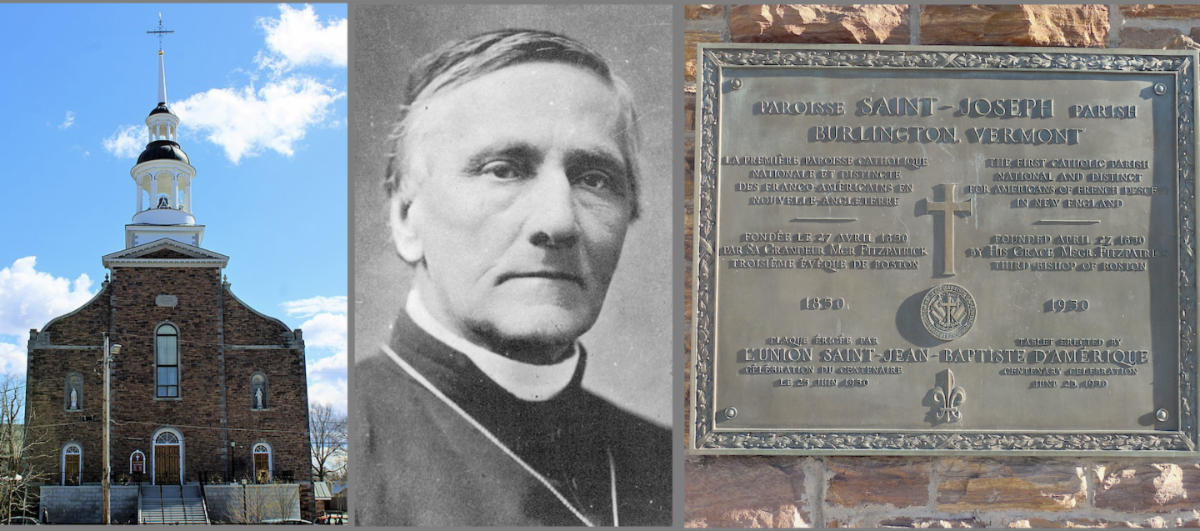
Louis Joseph Marie Théodore de Goesbriand
First Bishop of the Diocese of Burlington, Vermont
| |
|
• Louis Joseph Marie Théodore de Goesbriand (born in St Urbain, Finistère, Brittany on August 4, 1816 – November 3, 1899) served as the first bishop of the Diocese of Burlington in Vermont from 1853 until his death in 1899.
• He studied for priesthood at Saint Sulpice in Paris and accepted an invitation to become a missionary in Ohio where he befriended his compatriot Rev. Joseph Machebeuf (who later became the first bishop of Denver, as we will see further below), and eventually was sent to Vermont by Pope Pius IX.
• In 1855, de Goesbriand went to Europe to find priests from Ireland and France to work in Vermont.
• In 1894, he went to Rome and convinced Pope Leo XIII to part with one of the seven links of the chain said to have tied St Peter for nine months at the Memertime prison. The Pope accepted, when Goesbriand told him that " the link would allow the American people to grow in a greater love of St. Peter and his successors, including Leo XIII." The 2,000-year-old chain of St. Peter is one of the most valuable treasures in the Diocese of Burlington and across the United States.
• In 2019, Bishop Christopher Coyne, the 10th bishop of Burlington opened a cause for canonization. "He was known to be a holy and simple man," he said of Bishop Louis de Goesbriand. "He died well loved by many.”
• Though he had inherited from his parents about a quarter of a million dollars, by the time he died in 1899, he had only $2.12 to his name and a few old suits. He spent his wealth on purchasing church property, building churches, establishing and supporting an orphanage and helping the poor.
• He is the author of several books, such as Jesus the Good Shepherd or Meditations for the use of the Secular Clergy
Centennial Plaque, Cathedral of Saint Joseph
29 Allen St, Burlington, VT 05401
• Inscription:
"The first Catholic Church National and Distinct
for Americans of French descent in New England
Tablet erected by L'Union Saint-Jean-Baptiste d'Amérique
Centenary Celebration, June 23, 1950"
• The Cathedral of St. Joseph in Burlington was the first National French parish in New England (1850). Once a month at the 10:001m Sunday Mass, the First Scripture Reading is still proclaimed in French.
| |
The Midwest and the Frontier | |
|
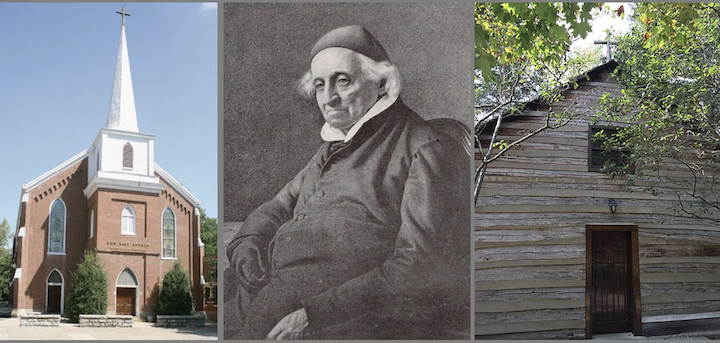
Étienne Théodore Badin
First Catholic priest ordained in today’s United States
| |
|
• Étienne Théodore Badin (born in Orléans, France on July 17, 1768 – died in Cincinnati, OH, April 21, 1853) was the first Catholic priest ordained in the United States. He spent most of his long career ministering to widely dispersed Catholics in Canada and in what became the states of Kentucky, Ohio, Indiana, Michigan, and Illinois. He also donated the land on which French priest Edouard Sorin founded the University of Notre-Dame in Indiana.
• Father Badin studied in Paris at the Collège de Montaigu but when his seminary was closed during the upheaval of the French Revolution, immigrated to the United States in 1791.
He finished his theology studies with the Sulpicians in Baltimore and was made a priest by Bishop John Carroll on May 25, 1793. After that, he learned English with the Jesuits at Georgetown College in Maryland and was sent to the Frontier in the newly created State of Kentucky.
• For the next 14 years, Badin journeyed on foot, horseback, and by boat to various Catholic communities in Kentucky and the Northwest Territory. It is estimated that he traveled over 100,000 miles.
• After a short trip back to France in 1819, Badin returned to the U.S. by 1825, where he documented his baptisms, marriages, and burials on Drummond Island, Michilimackinac, and Sault Ste Marie, continuing his missionary efforts in the Michigan Territory until 1828.
• In 1830, he worked as a missionary with the Potawatomi Indians in the western Great Lakes region.
• In 1832, Badin bought 524 acres (2.12km2)of land near South Bend, acquiring half from the government and half from two private owners. He built a log chapel that served as both a church and his home. In 1834, he donated the land to the new Diocese of Vincennes with the stipulation that it be used for a school and orphanage. This land later became the site of the University of Notre Dame. Additionally, Badin established the first orphanage in Indiana in 1834.
• After serving two more years as pastor in Bourbonnais, Illinois, he retired to Cincinnati where he died in 1853. He is buried in the Log Chapel that he built.
• The Log Chapel (photo above) was constructed in 1831 by Rev. Fr. Stephen Badin to serve the Potawatomi Indians in what is now northern Indiana. It was among the first Catholic churches in that region. In 1842, it was handed over to Fr. Edward Sorin, becoming the foundation of the University of Notre Dame. The original chapel was lost to a fire in 1856, but a matching replica was built on the same site in 1906.
Marker, “Calmoutier - Étienne Théodore Badin, First Catholic Priest ordained in the United States”
4527 Co Hwy 229, Fredericksburg, OH 44627
GPS: 40.665967, -81.778817
• Inscription (excerpts):
“Fr. Stephen Badin, the first Catholic priest ordained in America (by Bishop John Carroll in 1793), frequented St. Genevieve's from 1835-1837. He was Missionary Apostolic and Pastor of the Potawatomi Indians, Vicar-General of Bardstown and Apostle of Kentucky, and Vicar-General of Cincinnati. In 1841 he deeded the site of Notre Dame University, where he is buried, to its founder Fr. Edward Sorin, C.S.C. But the most celebrated missionary, Fr. Jean Baptiste Lamy, came from Danville in nearby Knox County between 1839-1841. In 1853 he was made the first Bishop of Santa Fe, New Mexico. Portrayed as Bishop Latour in Willa Cather's fictionalized novel, Death Comes for the Archbishop, he is also the hero in Paul Horgan's historical work, Lamy of Santa Fe. The famous Kit Carson, a convert, esteemed him highly and scouted for him.” [...] ”Calmoutier, was an early French Catholic farming community founded in 1832 by Claude Druhot, who came from Calmoutier, Haute-Saône, France...”
Erected 2003 by Calmoutier Memorial Association and The Ohio Historical Society”
Marker, « Portland / Our Lady Church”
802 Cedar Grove Terrace, Louisville, KY 40212
GPS: 38.276283, -85.804933
• Inscription:
“French immigrants established a community here in 1806. In 1814 it was surveyed and platted. By 1837 it was incorporated as a suburb of Louisville. It was an early port and boatbuilding center - 41 steamers had been built by 1855. Portland was site of first tramway in US, connecting it with Louisville, and once famous hostelry of South, St. Charles Hotel.
Our Lady Church
Congregation organized in 1837 - 38 by Father Stephen Badin, the first priest ordained in U.S. He saw to Portland's spiritual welfare when it was first a community of French immigrants. Also helpful in forming church were Bishop Flaget, first bishop west of Alleghenies, and Bishop Chabrat, first to be ordained in Ky. Bricks in original church, 1841, used for this building. “
Erected 1970 by The Kentucky Historical Society & The Kentucky Department of Highways. (Marker Number 1312.)”
| |
|
Bénédict Joseph Flaget
known as "the First Bishop of the West”
First Bishop of Bardstown and Louisville (1808-1850)
| |
|
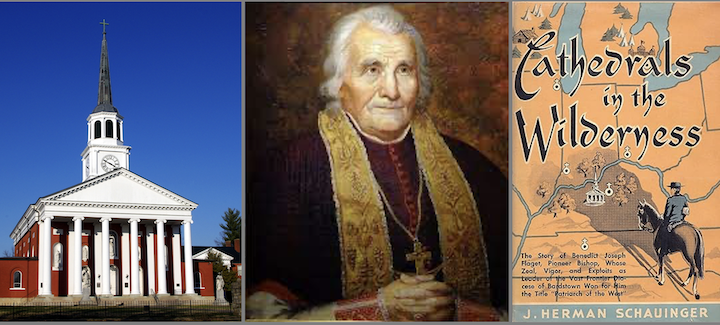
Above:
Left: Basilica of Saint Joseph Proto-Cathedral, By Nheyob - https://commons.wikimedia.org/w/index.php?curid=22953390
Middle: The Most Reverend Benedict Joseph Flaget, S.S., By Unknown author - Assumption College: Gallery Direct, Public Domain, https://commons.wikimedia.org/w/index.php?curid=26063728
Right: Hardbook cover, "Cathedrals in the Wilderness: The Story of Benedict Joseph Flaget, Pioneer Bishop, Whose Zeal & Vigor as Leader of the Vast Frontier Diocese of Bardstown Won for Him the Title Patriarch of the West " January 1, 1952, by J. Herman Schauinger (Author)
https://www.amazon.com/Cathedrals-Wilderness-Benedict-Bardstown-Patriarch/dp/B000SI9FA0
| |
|
• Bénédict Joseph Flaget (born in Contournat in Auvergne, France November 7, 1763 – died February 11, 1850 in Louisville, KY) was ordained in Clermont-Ferrand, Auvergne, in 1788 and was a priest in Angers (Maine & Loire). He fled the French Revolution in 1792.
• He preached in Vincennes, IN, where he founded a school and a library in the church (now the Old Cathedral and Library), the oldest educational institutions in Indiana. Then he preached and taught in Kaskaskia, IL., New Orleans, LA, Baltimore, MD., in Nashville, TN, where he conducted the first catholic mass at the home of Jacques-Timothée Boucher, Sieur de Montbrun (known as the "first citizen" of Nashville, Tennessee, see our May 2024 Bulletin)
• Flaget was appointed by the Holy See as the first Bishop of the newly established Diocese of Bardstown on April 8, 1808 (later transferred to Louisville, KY). This was the largest diocese ever formed in the United States and comprised an area now covering 10 modern states, including Kentucky, Ohio, Tennessee, Michigan, Indiana and others. Today this area includes 35 dioceses.
• He is buried in the undercroft of the Cathedral of the Assumption in Louisville, Kentucky. Several institutions have been named for Benedict Joseph Flaget in several States.
Marker, « Benedict Joseph Flaget (1763-1850”
"First Bishop of the West"
106 N 3rd St, Bardstown, KY 40004
GPS: 37.809500, -85.466983
• Inscription:
“A priest for 62 years, the "First Bishop of the West" became Bishop of Bardstown, 1810; of Louisville, 1841. Jurisdiction embraced area of Ky., Tenn., and old Northwest Territory. Flaget directed founding of colleges, congregations, and St. Joseph's Cathedral; witnessed ten dioceses formed from region. Bishop buried in Louisville.”
Erected 1988 by The Kentucky Historical Society & The Kentucky Department of Highways. (Marker Number 1827.)”
• Bénédict Joseph Flaget’s birthplace in Contournat in Auvergne, France is part of the town of Billom, which is sister city with Bardstown, KY., aka "the Bourbon Capital of the world".
• The Basilica of Saint Joseph Proto-Cathedral, (proto-cathedral means it is a former cathedral of a see that has transferred or moved) was consecrated by Bishop Flaget.
• King Louis-Philippe had befriended Flaget when he met him during his years of exile in the United States and visit to Cuba.
• Many of the paintings and interior decorations were donated by Pope Leo XII, King Louis-Philippe of France and others. The gift from the King of France included paintings by Murillo, Van Dyke and others. Gifts of royal embroidered vestments—the handwork of the queen and her court—and sacramental vessels were also made.
Marker, «Parc Billom”
1 Court Square, Bardstown KY 40004
Paintings and gifts from King Louis-Philippe,
Basilica of Saint Joseph Proto-Cathedral
310 W Stephen Foster Ave, Bardstown, KY 40004
GPS: 37.809517, -85.467083
• Inscription:
“ In honor of Bardstown’s
sister city in France
Birthplace of
Benedict Joseph Flaget ”
• Several institutions have been named for Benedict Joseph Flaget:
· Bishop Flaget School – Chillicothe, Ohio
· Flaget Memorial Hospital – Bardstown, Kentucky
· Flaget Elementary School – Vincennes, Indiana
· Flaget Center (Senior Center) – Louisville, Kentucky
· Flaget Community Center – Louisville, Kentucky
· Knights of Columbus, Flaget Council – Chillicothe, Ohio
· Bishop Flaget High School – Louisville, Kentucky (closed in 1974)
| |
|
Gabriel Richard
First Catholic priest ever to be elected to Congress
| |
|
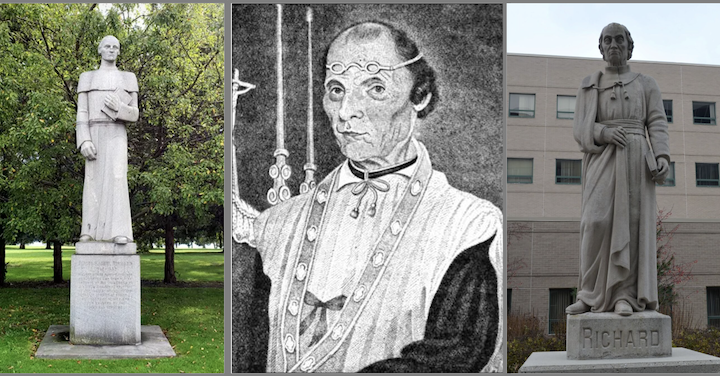
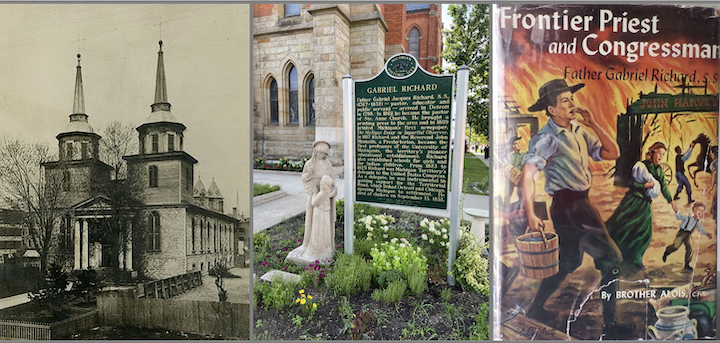
Above:
Top Left: Statue of Gabriel Richard, Gabriel Richard Park, Detroit, MI., Photo: https://buymichigannow.com/blog/meet-detroits-second-founder-gabriel-richard/
Top Middle: Photograph of portrait of Father Gabriel Richard, painted by James Ott. Lewis, 1799-1858 - Public Domain, https://commons.wikimedia.org/w/index.php?curid=152623515
Top Right: Statue of Gabriel Richard, part of the "Fabulous Four" (the other 3 are Antoine de la Mothe Cadillac, Father Jacques Marquette, Robert Cavalier Sieur de La Salle), Wayne University, Detroit, MI.
Photo: Ken Coleman https://michiganadvance.com/briefs/on-this-day-in-1823-gabriel-richard-becomes-first-roman-catholic-priest-to-serve-in-congress/
Lower Left: Ste. Anne's original "stone church" in 1840. Photo by Archdiocese of Detroit - Public Domain, https://commons.wikimedia.org/w/index.php?curid=117981386
Lower Middle: State of Michigan Historical Marker outside Basilica of Sainte Anne de Détroit, Photo Jac Getzinger, https://www.hmdb.org/m.asp?m=14879
Lower Right: Hardcover, "Frontier Priest and Congressman: Father Gabriel Richard, S.S."- 1958 By C. F. X. Brother Alois (Author) – Amazon.com
| |
|
• Gabriel Richard (October 15, 1767 – September 13, 1832) was a French Roman Catholic priest. He was born in Saintes (Vendée), entered the seminary in Angers in 1784 and was ordained priest on October 15, 1790.
• He refused to swear an oath to the French Republic and escaped the massacres of the French Revolution by emigrating to Baltimore where he taught mathematics, before being assigned to missionary work to the Indians in the Northwest Territory, first in Kaskaskia in Illinois and then in Detroit.
• The majority of people in Detroit, including both Catholics and Protestants, had French ancestry. He was known as Le Bon Père (the good father), no matter their faith. He trained teachers, provided education and delivered sermons to local Native Americans.
• The rest of his life is described in the marker below. It is noteworthy to add that he was the first Catholic priest ever to be elected to Congress.
• After a fire nearly wiped out the Town of Detroit in 1805, he and others designed a new plan for the town.His motto following the Detroit fire, Speramus meliora; resurget cineribus ("We hope for better things; it will arise from the ashes") is inscribed on the Seal of the City of Detroit.
• In 1808, Richard started a school for both Native American and white children. He owned the first printing press in Detroit and published a French-language magazine called Essais du Michigan, along with The Michigan Essay, or Impartial Observer, in 1809. Richard worked closely with the local Indian tribes and was well-respected by them. During the War of 1812, he was jailed by the British for not pledging loyalty after they took Detroit. He stated, "I have taken an oath to support the Constitution of the United States and I cannot take another. Do with me as you please." He was freed when Shawnee chief Tecumseh, who disliked Americans, chose not to fight for the British while Richard was in prison.
• Richard played a key role in negotiating the Treaty of Fort Meigs (the largest wholesale purchase of Indian land in the history of Ohio). He co-founded the Catholepistemiad of Michigania, which later became the University of Michigan. He was the first Catholic priest to be elected as a delegate from the Michigan Territory to the U.S. House of Representatives during the 18th Congress.
• On September 13, 1832, Gabriel Richard passed away in Detroit after helping those affected by a cholera outbreak. He was in itially laid to rest in a crypt at Sainte Anne's chapel, but later his remains were transferred to the Fr. Gabriel Richard Chapel, where they can be seen today.In 2020, the Fr. Gabriel Richard Guild was created as an early step in the process of canonizing Richard.
Marker, Ste. Anne Church – Father Gabriel Richard
2654-2698 Howard St, Detroit, MI 48216
GPS: 42.320983, -83.076817
• Inscription:
“Gabriel Richard”
“Father Gabriel Jacques Richard, S.S. (1767-1832)—pastor, educator and public servant—arrived in Detroit in 1798. In 1802 he became the pastor of Ste. Anne Church. He brought a printing press to the area and in 1809, printed Michigan’s first newspaper, the Michigan Essay or Impartial Observer. In 1817 Richard and the Reverend John Monteith, a Presbyterian, became the first professors of the University of Michigania, the territory’s pioneer educational establishment. Richard also established schools for girls and for Indian children. From 1823 to 1825 Richard was Michigan Territory’s delegate to the United States Congress. As a delegate, he was instrumental in gaining support for the Territorial Road, which linked Detroit and Chicago, opening Michigan to settlement. He died of cholera on September 13, 1832.”
Statue, Father Richard Park
7130 E Jefferson Ave, Detroit, MI 48207
GPS: 42.34830, -82.999355
• Inscription on pedestal:
"Father Gabriel Richard
1767-1832
Pioneer Priest Patriot Founder
Of Churches and School Co- Founder of
The University of Michigan
Member of Congress
Printer Martyr of Charity Pro-
Phet and Apostle of Christian
Civilization he served God
And country on the
Michigan Frontier"
• The Basilica of Ste. Anne de Detroit and the Fr. Gabriel Richard Guild host an exhibit each September and October detailing the legacy of Father Richard.
Legacy:
There are at least four schools near Detroit named after Richard:
* Gabriel Richard Catholic High School in Riverview, Michigan
* Father Gabriel Richard High School in Ann Arbor, Michigan
* Gabriel Richard Elementary School in Detroit
* Père Gabriel Richard Elementary School in Grosse Pointe Farms, Michigan.
| |
|
St Rose Philippine Duchesne
Founder of the first free school west of the Mississippi
Canonized on July 3, 1988, by Pope John Paul II
| |
|
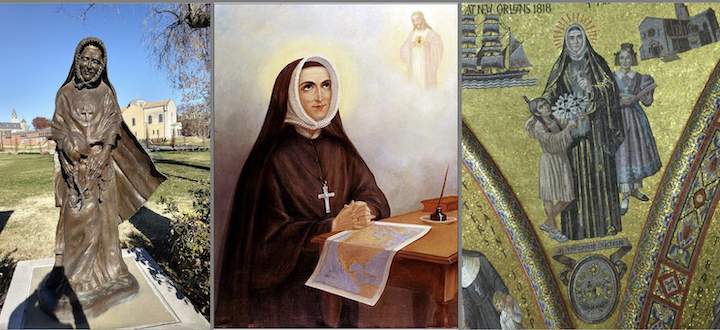
Above:
Left: Statue of St. Rose Philippine Duchesne, 619 North 2nd Street, Saint Charles, MO 63301
https://www.archcityreligion.org/st-rose-philippine-duschene
Middle: Portrait, (anonymous) of Saint Rose-Philippine Duchesne, sister of the Society of the Sacred Heart of Jesus, founderess of the congregation first house in America (1818) Public Domain, https://commons.wikimedia.org/w/index.php?curid=6831232
Right: Mosaic of Saint Rose Philippine Duchesne in the Cathedral Basilica in St. Louis, Missouri
Photo By Andrew Balet - self-made, attribution required, CC BY 2.5, https://commons.wikimedia.org/w/index.php?curid=2062448
| |
|
• Rose Philippine Duchesne (August 29, 1769 – November 18, 1852), was a French religious sister and educator who was beatified on May 12, 1940 by Pope Pius XII, and canonized on July 3, 1988, by Pope John Paul II.
• She was born in Grenoble and became a nun in 1788, surviving the Terror years of the French Revolution.
• In 1818, with the encouragement of her lifelong friend Sophie Barat, foundress of the Sacred Heart School, she became a missionary to the United States to evangelize the Indians and established a convent in Saint Charles, Missouri, “the remotest village in the U.S”.
• Her new Sacred Heart convent in a log cabin became the first free school west of the Mississippi.
• In 1842 she went for a year in a new mission with the Potawatomi tribe in eastern Kansas. Indian children named her Quahkahkanumad, which translates as ”Woman Who Prays Always”.
• She is recognized for her care and education of Indigenous American survivors of the United States Indian removal programs.
• Her cousin was Casimir-Pierre Perier, a prime minister of France (1831-32) under King Louis-Philippe, and her grand-nephew was Jean Casimir-Perier, president of the French Republic (1894-97).
Marker «St Rose Philippine Duchesne - First School - 1818”
1547-1553 River View Dr, Portage Des Sioux, MO 63373
GPS: 38.930700, -90.338800
• Inscription
“Arrived from France on mission
to convert the Indians and
established first school
west of the Mississippi in
St. Charles County”
Statue and markers «Sainte Rose Philippine Duchesne “
619 North 2nd Street, Saint Charles MO 63301
GPS: 38.785350, -90.480717
• Inscription of two bronze plaques:
(left plaque:)
"Saint Rose Philippine Duchesne, Pioneer Missionary of the Society of the Sacred Heart, came to St. Charles from France and founded the first free school west of the Mississippi on this site in 1818."
(right plaque:)
"Mother Duchesne established other schools in Missouri and Louisiana. She died here in 1852 and was canonized in 1988. This statue was commissioned by the City of St. Charles and created by sculptor Harry Weber in 2007."
• There is a statue of St. Rose Philippine Duchesne in the Hall of American Saints, Basilica of the National Shrine of the Immaculate Conception, 400 Michigan Avenue, Northeast, Washington, DC 20017. https://www.nationalshrine.org/blog/st-rose-philippine-duchesne-a-life-of-prayer-and-perseverance/
| |
|
Simon William Gabriel Bruté de Rémur
First Bishop of Vincennes, Indiana
| |
|
Above:
Left: Simon Bruté College Seminary, 2500 Cold Spring Rd, Indianapolis, IN 46222
https://www.archindy.org/Criterion/local/2022/07-15/brute-sidebar.html
Middle: Mgr. Simon Bruté By John Murphy - Public Domain, https://commons.wikimedia.org/w/index.php?curid=125100469
Right: A newly created bronze statue of the Servant of God Bishop Simon Bruté is featured at the recently renovated back entrance of Bishop Simon Bruté College Seminary in Indianapolis.
| |
|
• Simon William Gabriel Bruté de Rémur (born in Rennes, Brittany, March 20, 1779 – died din Vincennes, Indiana, June 26, 1839) was a French missionary in the United States and the first bishop of the Diocese of Vincennes, Indiana. President John Quincy Adams called Bruté "the most learned man of his day in America."
• Bruté started his medical studies in 1796 and finished in 1803, but he never worked as a doctor. After graduating, he joined the reopened seminary of Saint Sulpice in Paris in November 1803. He became a priest in 1808 but turned down the position of assistant chaplain to Napoleon I.
• Bruté, who had a strong interest in missions, met Benedict Joseph Flaget. Flaget had left Saint Sulpice when it closed during the French Revolution and later became a missionary in the United States, arriving in America in 1810.
• His great impact on the church, his achievements in organizing, funding, and implementing important reforms, and his strong leadership in his diocese made him a leading Catholic immigrant to the United States.
• A cause for his canonization was officially started on September 12, 2005.
Marker, “Inscription on the Big Bell 'Mary Anne' of the Old Cathedral”
205 Church Street, Vincennes IN 47591
GPS: 38.678400, -87.534567
• Inscription:
“ D.O.M. Ad Laud et Glor Domini Nostri et Redemptoris Jesu Christi Hanc Mariam Annam R.R. D.D. et in Chr Pater Simon G. Brute Qui Primus Vincennopolitanan Sedem Episcopus Tenuis Vovebat Dabat et Consecrabat An Rep Sal MDCCCXXXIX
Translation:
D.O.M. abbreviation for "Deo Optimo Maximo"..."To God the Greatest and the Best" To the Praise and Glory of our Lord and Redeemer Jesus Christ The Most Reverend Lord and Father in Christ, Simon G. Brute, who was the first Bishop held the See of Vincennes, vowed, gave and consecrated the Mary Anne in the year of Salvation 1839.
(In French): "Les Frères Grente de Hambye Deptnt de la Manche m’ont fait"
Translation: The Grente Brothers of Hambye Department of La Manche made me.
Erected by The Old Cathedral, Basilica of St. Francis Xavier.)”
| |
|
Father Benjamin Petit
Missionary to the Potawatomi in Indiana
| |
|
Above:
Top Left: Father Benjamin Marie Petit, from an oil portrait by George Winter, frontier artist, in 1838
http://www.wiskigeamatyuk.com/Benjamin%20Petit.htm
Top Right: Memorial Marker and plaques honoring Father Petit at Philippine Duchesne Memorial Park, Centerville KS 66014. Photo: By Chris Light at English Wikipedia, CC BY-SA 3.0, https://commons.wikimedia.org/w/index.php?curid=16995517
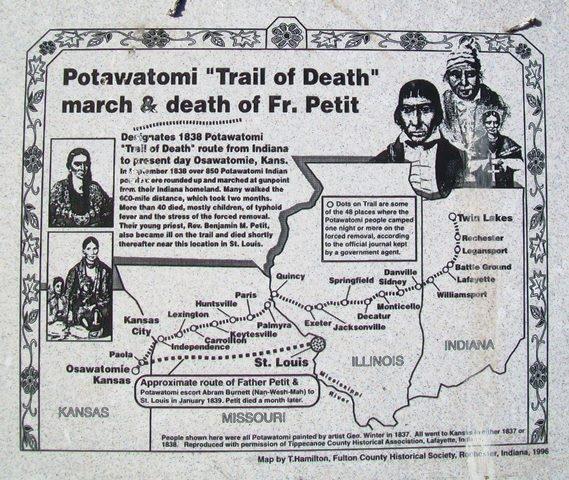
Bottom: Detail of plaque with map of the "Trail of tears": By Chris Light at English Wikipedia, CC BY-SA 3.0, https://commons.wikimedia.org/w/index.php?curid=73113450
| |
|
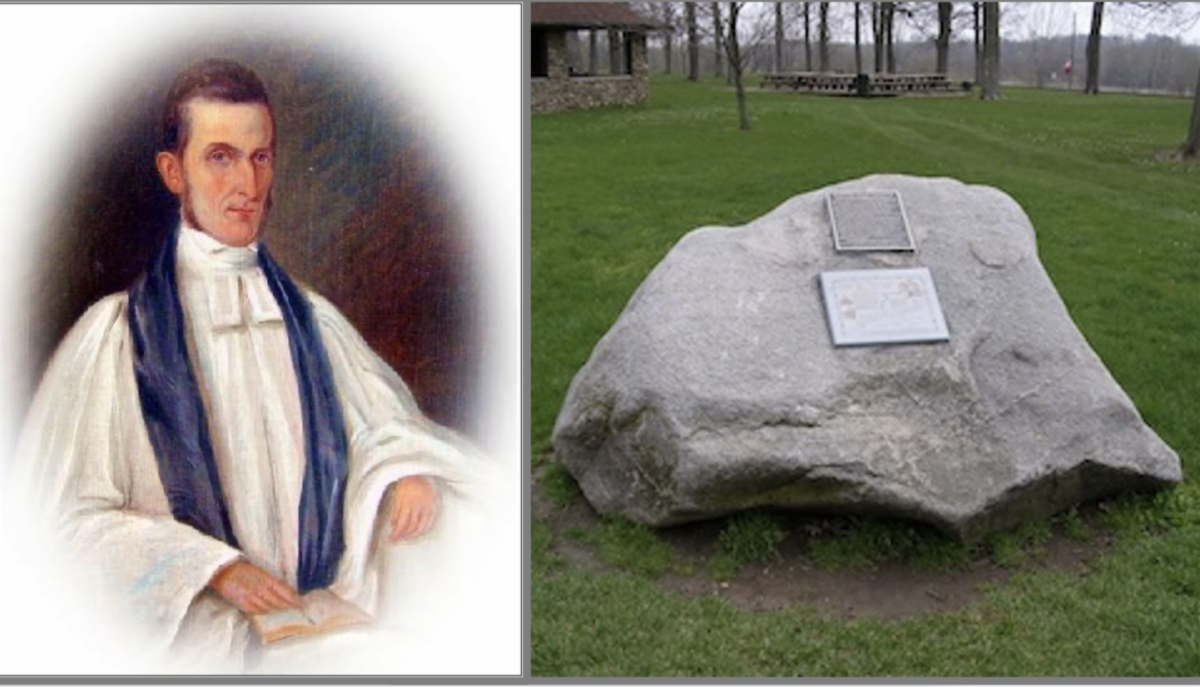
• Benjamin Marie Petit (born in Rennes, Brittany on April 8, 1811 – died in St. Louis, MO, February 10, 1839) istudied at the Seminary of St Sulpice in Paris and was recruited in 1835 by Bishop Bruté of Vincennes, Indiana to come to America. In 1837, he ordained him a priest in Vincennes and sent him to Twin Lakes, Indiana as a Catholic missionary to the Potawatomi.
• Father Petit quickly mastered the English and Potawatomi languages. In one letter, he showcases his skill in the Potawatomi language by ending with a phrase in Potawatomi and its translation: “Nin Mackahtaokônia Chichipé Outipé angenickaso gatamikoa tchaiai Muckatahokônia Autchakpock Kick. I, the Black Robe, known as the ‘duck's head,’ greet all the Black Robes from the mouth to the source (Vincennes).”
• Having trained and practiced as a lawyer in France, Petit attempted to assist the Potawatomi in creating a legal appeal against their removal, but it was unsuccessful.
• Father Petit was known for his compassion toward his Potawatomi parishioners. He deeply mourned their removal from Indiana and the closing of the Catholic mission at Twin Lakes. In a letter to his family dated September 14, 1838, he expressed, "It is sad, I assure you, for a missionary to see a young and vigorous work expire in his arms." He also shared his sorrow during the mission's last moments: "As I prepared to leave, I gathered all my children to speak to them one last time. I cried, and my listeners wept loudly; it was truly a heartbreaking scene, and over our dying mission, we prayed for the success of those they would establish in their new hunting grounds."He also joined them on their forced march to new reservation lands along the Osage River, at the present-day site of Osawatomie, Kansas, in 1838.
• Father Petit's remains are honored beneath the Log Chapel at the University of Notre Dame. He is remembered as a martyr of charity for his dedicated service to the Potawatomi people.
• A memorial marker for Father Petit was installed at St. Philippine Duchesne Park, which was once the location of the Potawatomi's Sugar Creek Mission in Linn County, Kansas. This marker features boulders from Kansas and Missouri, along with a map of the Trail of Death route. The dedication took place on Sunday, September 28, 2003.
Marker #1, “Father Petit and the Potawatomi 'Trail of Death'”
Philippine Duchesne Memorial Park, Centerville KS 66014
GPS: 38.235067, -94.944250
• Inscription
“Rev. Benjamin Marie Petit, of the City of Rennes, France, arrived as the Catholic missionary to the Potawatomi Indians in northern Indiana in November 1837. By June 1838, he had learned much of their difficult language and their culture, and had instructed and baptized many. “‘We were orphans,’ they said to me, ‘and as if in darkness, but you appeared among us like a great light, and we live’,” Father Petit wrote to his mother in France. The Indians begged their “Father Black Robe” to accompany them on their forced removal from Indiana in September 1838, His superior, Bishop Simon Brute of Vincennes, Indiana, finally consented, in time for him to join them enroute at Danville, Ill., ministering to their needs, both spiritual and material on their march to Kansas territory.
The Potawatomi “Trail of Death” had started at Menominee’s village south of Plymouth, down the Michigan Road (Old Hwy. 31), through Rochester on Main Street, through Logansport, and along the north side of the Wabash River to cross into Illinois at Danville. He baptized the dying children, among them newly born “who with their first step passed from earthly exile to the heavenly sojourn,” according to one of his letters, which were published by the Indiana Historical Society in 1941.
In them he vividly describes the hardships and the anguish of “my poor Christians, under a burning noonday sun, amidst clouds of dust, marching in line, surrounded by soldiers who were hurrying their steps” and the heartbreak of the Indians as they buried their loved ones and marched on. Across the great prairies of Illinois they marched, crossed the Mississippi River at Quincy, and then made their way through Missouri to enter Kansas territory south of Independence, Missouri. About 40 Indians died on the march, mostly children. Father Petit blessed each grave. He was himself at times sick with fever. [...] Father Petit’s remains rest under the Log Chapel at the University of Notre Dame.”
Erected 1997 by Fulton County Historical Society Indian Awareness Center
Marker #2, “Father Petit and the Potawatomi 'Trail of Death'”
Philippine Duchesne Memorial Park, Centerville KS 66014
GPS: 38.234500, -94.943333
• Inscription:
“Father Benjamin Marie Petit, a missionary to the Potawatomi in northern Indiana, accompanied them on the forced removal in 1838. He ministered to their needs, both spiritual and physical. He baptized the dying children, "whose first step was from the land of exile to the bliss of heaven."
Petit's letters to Bishop Bruté of Vincennes were published by the Indiana Historical Society in 1941. His letters vividly describe the hardships of the trek as they "marched in line and surrounded by soldiers, who hurried them along under a burning midday sun and amid clouds of dust" and the heartbreak of the Indians as they buried their loved ones and marched on. Across the great prairies of Illinois they marched, crossed the Mississippi River at Quincy, and then crossed Missouri to enter Kansas south of Independence, Mo. About 40 Indians died, and Father Petit blessed each grave, at times himself sick with fever. After turning the Potawatomi over to Father Christian Hoecken at the Sugar Creek Mission in Kansas on Nov. 4, Father Petit again fell sick with fever.
On Jan. 2 he started for Vincennes, accompanied by Abram Burnett, a full-blooded Potawatomi friend, but again was taken ill on the way. With three open sores draining his strength, he rode in an open wagon, the roads rough and rain frequent, from Jefferson City. He reached the Jesuit Seminary, St. Louis University, Jan. 15. The Fathers gave him all the medical attention and care they could, but he grew weaker and died Feb. 10, 1839, a martyr to duty... “ ...“Father Elet, president of St. Louis University, wrote that he placed the crucifix to Father Petit's lips and twice he kissed it tenderly. He suffered in agony and then expired 20 minutes before midnight, having lived 27 years and 10 months. Father Petit died in the Jesuit Seminary building at 9th and Washington Streets. His grave was in the old cemetery which was located at 7th Street and St. Charles Ave. and was moved in 1856 to make way for downtown St. Louis. In 1856 Father Edward Sorin, founder of Notre Dame University, came and took Father Petit's body back to Indiana.
Today Father Petit's remains lie under the log chapel at the University of Notre Dame."
Erected by Indian Awareness Center of the Fulton County Historical Society and St. Philippine Duchesne Memorial Park Committee.”
| |
|
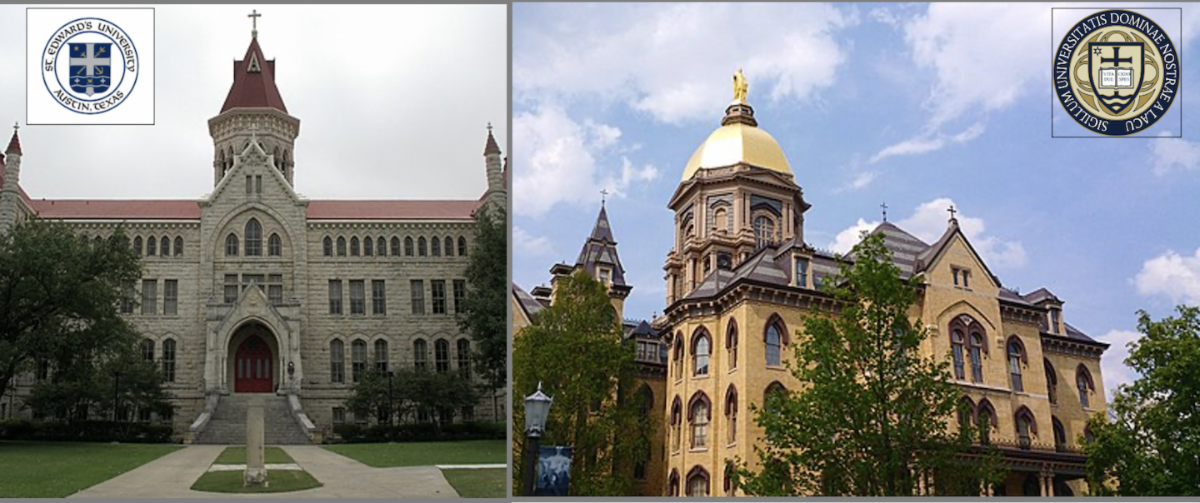
Rev. Édouard Sorin, C.S.C
Founder of University of Notre-Dame, Indiana
Founder of St. Edwards University, Austin, Texas
| |
|
Above:
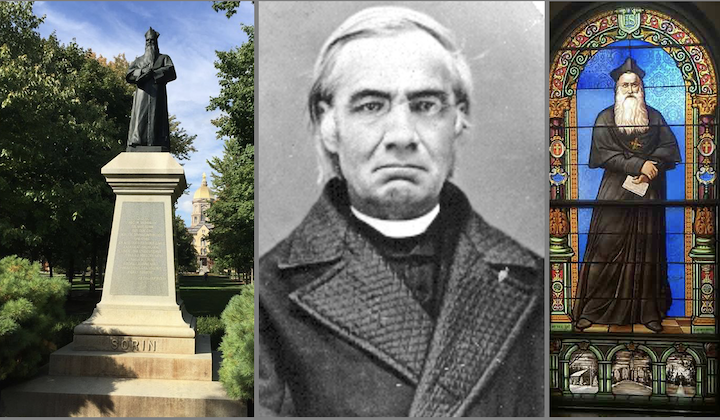
Top Left: : Statue of Edouard Sorin on the Campus of the University of Notre Dame, By Eccekevin - Own work, CC BY-SA 4.0, https://commons.wikimedia.org/w/index.php?curid=44762511
Top Middle: Portrait of Edouard Sorin By Unknown author - Public Domain, https://commons.wikimedia.org/w/index.php?curid=36907250
Top Right: Stained-glass window of Fr. Sorin in Saint Edward’s Hall, University of Notre Dame, Indiana, https://www.sanctuairebasilemoreau.org/en/edward-frederick-sorin/
Bottom Left: St. Edward's University, Austin, TX, By Mulder416 at English Wikipedia - Public Domain, https://commons.wikimedia.org/w/index.php?curid=30910961
Bottom Right: University of Notre Dame du Lac, Main Hall, built after the Great Fire of 1879, By Matthew Rice - Own work, CC BY-SA 4.0, https://commons.wikimedia.org/w/index.php?curid=41085468
| |
|
• Rev. Édouard Sorin, C.S.C. (born in Ahuillé, near Laval, France February 6, 1814 – died in South Bend, IN., October 31, 1893) was the founder of the University of Notre Dame in Indiana (then a very remote place) and of St. Edward's University in Austin, Texas.
• He studied theology in Le Mans and became interested in missionary work after hearing Simon Bruté, the bishop of Vicennes in Indiana, who returned to France to recruit missionaries. In 1841, he joined a mission to America. Upon arriving, Sorin knelt and kissed the ground to show his acceptance of his new country.
• In Indiana, Sorin and his fellow missionaries settled in a small log chapel built years earlier by Father Theodore Badin. There, at Notre Dame du Lac, as Father Sorin named it, they quickly worked to establish a collège, which later became Notre Dame University.
• The first end-of-year celebration at Notre Dame in 1845 began with a reading of the Declaration of Independence. Sorin became an American citizen in 1850 and was soon appointed as the local postmaster and superintendent of roads. One of the first buildings on the Notre Dame campus, Washington Hall, was named after the first U.S. president instead of a Catholic saint. During the Civil War, he allowed several priests and eighty sisters to serve as chaplains and nurses, even though their absence impacted the university. His strong "Americanism" and "patriotism" were praised by John Ireland.
• In July 1868, Father Sorin was elected Superior General of the Congregation of Holy Cross. In this role, he helped expand Holy Cross in America, including starting a successful Catholic college in Austin, Texas (St. Edward’s).
• Until his death in 1893, Sorin crossed the Atlantic no less than 50 times to bring recruits to America.
• In recognition of his contributions to education, the French Government awarded him the insignia of Officer of Public Instruction in 1888.
Statue, Edouard Sorin, Founder of University of Notre Dame
Marker “Old College”
Old College, Notre Dame, IN 46556
GPS: 41.701783, -86.242250
• Inscription:
Pedestal:
“D.O.M. / Hoc in memoriam / Eduardi Sorin / Sup. Gen. C.S.C. / Nostrae Dominae Universitatis / Fundatoris / Qui apostolicis Virtutibus Clarus / Catholicae Americanae / Educationis Studiosissimus / VIII ID. Feb. A.D. MDCCCXIV Natus / A.LXXVIII.M.X.VIXIT. / Discipuli, Alumni, Amici, Venerationis, Gratitudinis / Pignus Posuere / AN.SAL.REP. MCMV.” In Latin, it translates to “To God, Greatest and Best. In Memory of Edward Sorin, Superior General of the Congregation of the Holy Cross, Founder of the University of Notre Dame, who, renowned for apostolic virtues, most zealous for American Catholic Education, born February 6, 1814, lived for 78 years and ten months, students, alumni, and friends have erected this pledge of their respect and gratitude in the year of salvation regained 1905.”
Marker:
“This Building” - “The cradle of the University of Notre Dame was built by Father Sorin in 1843. Originally intended for a community house it served for two years as a temporary college. From 1845-1854 it was the residence of Sisters of the Holy Cross. Subsequently used as a college bakery. It became in 1880 the home of the lay Brothers in charge of the university farm. Finally, after a thorough renovation, it was formally opened, March 19, 1906, as a house of studies for the Teaching Brothers of the Holy Cross. And in 1912 it became the headquarters of the Holy Cross Mission Band”.
| |
|
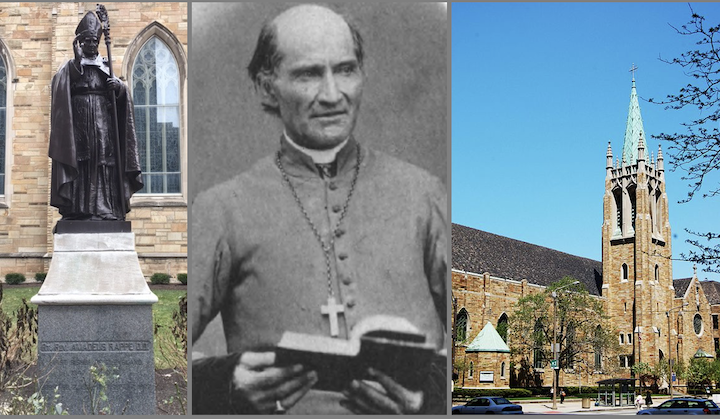
Louis Amadeus Rappe
First bishop of the new Diocese of Cleveland
| |
|
Above:
Left: Statue of Bishop Rappe outside of St. John's Cathedral, Cleveland, By Hamaxides - Own work, CC BY-SA 4.0, https://commons.wikimedia.org/w/index.php?curid=64711614
Middle: Louis Amadeus Rappe First Bishop of the Roman Catholic Diocese of Cleveland, By Michael W. Carr - University of California California Digital Library: A history of Catholicity in northern Ohio and the diocese of Cleveland from 1749 to December 31, 1900, Public Domain, https://commons.wikimedia.org/w/index.php?curid=28007062
Right: St. John's Cathedral, Cleveland, By OCLS Central Michigan University - Flickr: Cleveland, CC BY 2.0, https://commons.wikimedia.org/w/index.php?curid=12430661
| |
|
• Louis Amadeus Rappe (February 2, 1801 – September 8, 1877) was a French-born prelate of the Roman Catholic Church. He served as the first bishop of the new Diocese of Cleveland in Ohio from 1847 to 1870.
• He was born in Audrehem, Pas-de-Calais, and attended the Seminary in Arras. After being a priest for a few years, he received an invitation to emigrate to Cincinnati to serve as a priest there. Having no knowledge of English, he was sent to a special school in Chillicothe, OH. for 6 months.
• On April 23, 1847, Rappe was appointed the first bishop of the newly created Diocese of Cleveland by Pope Pius IX. He laid the cornerstone of St. John's Cathedral on October 22, 1848.
• In 1865, Rappe established St. Vincent Charity Hospital, the first public hospital in Cleveland. He brought in the Good Shepherd Sisters (1869), the Little Sisters of the Poor (1870), the Friars Minor (1867) and the Jesuits (1869), and organized the Sisters of Charity of St. Augustine as a new congregation
• Upon retirement, Bishop Rappe left the diocese with more than 100,000 Catholics, 107 priests, 160 churches, and 90 schools.
• He died at St. Albans, Vermont on September 8, 1877, at the age of 76 and was buried in St. John's Cathedral in Cleveland
• The statue honoring Rt. Rev. Amadeus Rappe, has been relocated in 2012to a new position in front of St. John Cathedral The life-size statue was created by Luella Varney Serrao. Originally unveiled in November 1902 to celebrate the 50th anniversary of the Cathedral, which Bishop Rappe dedicated in 1852, the bronze statue had remained in storage for several years after the demolition of the Catholic Center and its courtyard, where it was previously displayed. In 1902, a dedication ceremony took place with 10,000 people honoring the missionary leader from Northeast Ohio.
Statue, Louis Amadeus Rappe, First bishop of Cleveland
Outside of St. John's Cathedral, Cleveland, 943 Superior Ave, Cleveland, OH 44114
GPS: 41.502730, -81.688166
• Inscription at the base:
"Rt. Rev. Amadeus Rappe D.D.,
First Bishop of Cleveland, 1847 - 1870,
Born Feb 2, 1801 - Died Sept 7, 1877"
| |
|
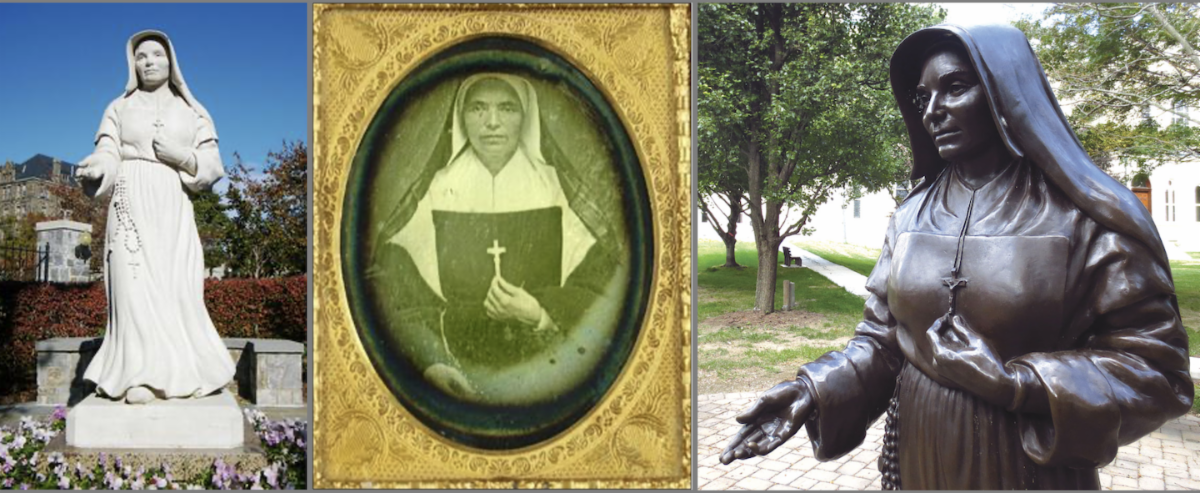
Anne-Thérèse Guérin
(Saint Theodora)
Founder of Sisters of Providence of Saint Mary-of-the-Woods
| |
|
Above:
Left: Sculpture of Saint Mother Théodore Guérin, Basilica of National Shrine, Washington DC.
Sculptor Theresa Clark was asked to make the statue of Guérin. Although she was not religious, the story of Guérin touched her deeply, and in 2006, at the age of 50, Clark became a Catholic.
Fair use, https://en.wikipedia.org/w/index.php?curid=30201548
Middle: The only known image of Saint Mother Théodore Guerin, this daguerreotype image was taken in 1853 when she was 54 years old. By Archives of the Sisters of Providence of Saint Mary-of-the-Woods, Indiana. Fair use, https://en.wikipedia.org/w/index.php?curid=27499722
Right: The Shrine Of Saint Mother Theodore Guerin, Sisters of Providence, 1 Sisters of Providence Road, St Mary-Of-The-Woods, IN 47876
https://fromthedeaconsdesk.wordpress.com/2022/10/03/memorial-of-st-theodore-guerin/
| |
|
• Anne-Thérèse Guérin, born in Étables-sur-Mer in Brittany, France on 2 October 1798 – 14 May 1856), a daughter of a French Navy officer, was canonized by Pope Benedict XVI in 2006 as Saint Theodora. She was the founder of Sisters of Providence of Saint Mary-of-the-Woods, a Catholic sisters congregation.
Marker, “Saint Theodora Guerin - Saint Mary-of-the-Woods College”
College Rd 10, West Terre Haute, Saint Mary of the Woods, IN 47876
GPS: 39.508767, -87.460833
• Inscription:
Side one:
"Born Anne-Thérèse Guérin in 1798 in France. In 1823, she entered the Catholic congregation Sisters of Providence of Ruillé; received the name Sister St. Theodore. Noted for her teaching, she led a mission from France to establish schools and orphanages in the Indiana wilderness; arrived here fall 1840 and established the Sisters of Providence in U.S."
Side two:
"Guérin opened a female academy in July 1841, the predecessor of Saint Mary-of-the-Woods College. Initially, she and the sisters endured anti-Catholic sentiments and harsh frontier conditions. At her death in 1856, she had directed the opening of 11 schools in 9 Indiana towns. Pope Benedict XVI canonized her in 2006, naming her Saint Theodora Guérin.”
“Erected 2009 by Indiana Historical Bureau and Sisters of Providence of Saint Mary-of-the-Woods.”
Legacy:
• Guérin is the patron saint of the Archdiocese of Indianapolis.
• A statue of Guérin, created by artist Teresa Clark, was installed in Mary's Garden at the Basilica of the National Shrine of the Immaculate Conception in Washington, D.C., and dedicated on 10 May 2008.
| |
|
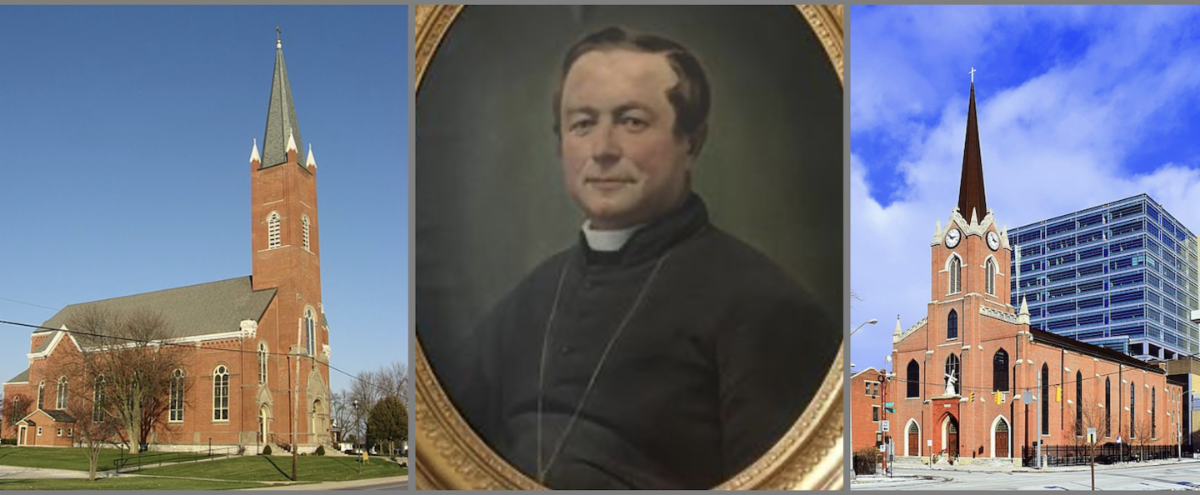
Henry Damian Juncker
First bishop of the Diocese of Alton in Illinois
| |
|
Above:
Left: Saint John Catholic Church, Maria Stein OH, site of first mass in 1836 By Nyttend - Own work, Public Domain, https://commons.wikimedia.org/w/index.php?curid=8380652
Middle: Bishop Henry Damian Juncker, Photo added by Br. Mark Kopejtka OSBCn on 01 Nov 2019, https://www.findagrave.com/memorial/154372989/henry-damian-juncker#view-photo=194958130
Right: Holy Cross Church, Columbus, OH, By Nheyob - Own work, CC BY-SA 4.0, https://commons.wikimedia.org/w/index.php?curid=95089703
| |
|
• Henry Damian Juncker (August 22, 1809 – October 2, 1868) was born in Fénétrange, Moselle, France, and studied at the nearby Seminary of Pont-à-Mousson. He was the first bishop of the Diocese of Alton in Illinois, serving from 1857 until his death in 1868.
He quickly understood that the new diocese required more priests, so in 1857, he went to Europe to find priests from France, Germany, Ireland, and Italy for his diocese.
• While in Red Bud, Juncker listened to confessions from 1,000 Catholics and got a land donation from a Protestant businessman for a new church.He was indefatigable. During a visit in Red Bud in Illinois, Juncker listened to confessions from 1,000 Catholics and even got a land donation from a Protestant businessman for a new church.
• When the American Civil War began in 1861, Juncker urged his church members to pray for peace. When the Union Army set up a medical camp for injured soldiers in Cairo, Illinois, he sent priests and nuns to help out.
• Juncker completed the first cathedral in the diocese in 1859, and founded two men's colleges, six girls' academies, a seminary, two hospitals, and one orphanage during his 11-year tenure!
Marker, Saint John Catholic Church,
8523 Route 119, Maria Stein OH 45860
GPS: 40.407817, -84.473400
• Inscription:
"In commemoration of its 150 years of existence. First Catholic Parish in present day Mercer County. First mass celebrated June 24, 1836 by Father Henry Damian Juncker.
Erected 1986 by Fr. John Behen."
• Immaculate Conception Church is located in Monroe County, approximately 15 highway miles south of downtown Saint Louis, Missouri, which was called "The Rome of the West".
This church is named after the Blessed Virgin Mary, specifically as the Immaculate Conception. In the 17th century, Father Jacques Marquette, S.J., explored this region with Louis Joliet and dedicated his missionary efforts to the Virgin under this title. He also named the nearby river, now known as the Mississippi, the Immaculate Conception River.
Marker, «Immaculate Conception Church”
340 S Main St, Columbia, IL 62236
GPS: 38.441467, -90.195883
• Inscription:
“Immaculate Conception Church was built in 1866 on land purchased for $600 from Henry Schumacher in 1863. The church was dedicated December 12, 1867 by Bishop Juncker. "
• Several other historical markers in Ohio and Illinois mention the role of Henry Damian Juncker in the construction of churches or formation of congregations. They can be found in the work "Memories of France" published by our Society. One particular site, however, doesn't mention his name, it is the Holy Cross Church in Columbus, OH (pictured above), listed on. tehNational Register of Historic Places. It was over twenty years after Columbus became the state capital in 1816 before the people had their own Catholic church. Once the church was established on South Fifth Street, it remained there.After he was ordained, Juncker went to Columbus, Ohio to manage the construction of St. Remigius Church which was dedicated on April 29, 1838. Father Juncker asked to change the parish's name to “Holy Cross.” The current building was named Holy Cross Church and was finished in 1848 right when Irish immigrants started coming to Columbus to flee the Great Famine.
| |
|
Lucien Galtier
First Roman Catholic priest who served in Minnesota
"Father of St Paul, MN"
| |
|
• Lucien Galtier (c. 1812 – February 21, 1866) was the first Roman Catholic priest who served in Minnesota. He was born in Saint-Affrique in the Southeast department of Aveyron. He built the church of St Peter, the oldest catholic church in Minnesota. Galtier discovered that many of the Indians in the area were good singers, so he taught them to sing several songs that had been translated into the Sioux language. Galtier also conducted many missionary trips in Wisconsin.
Marker, “The Reverend Lucien Galtier”, Father of Saint Paul”
62 W Kellogg Blvd, St Paul, MN 55101
GPS: 44.945183, -93.089300
• Inscription:
"In the year 1841
The Reverend Lucien Galtier
erected near this site
the Chapel of Saint Paul
from which this city
derived its name"
• “In 1841 and in the month of October I caused some logs to be cut, prepared
and put up and soon after a poor church of logs and fitted so as to remind one
of the Stable of Bethlehem was built. Now the nucleus of Saint Paul was formed. This church thus remained dedicated to Saint Paul and I expressed the wish to call the place by no other name.”
Extract from a letter written by Father Lucien Galtier in 1864"
| |
|
Joseph Crétin
First Bishop of St Paul, Minnesota
| |
|
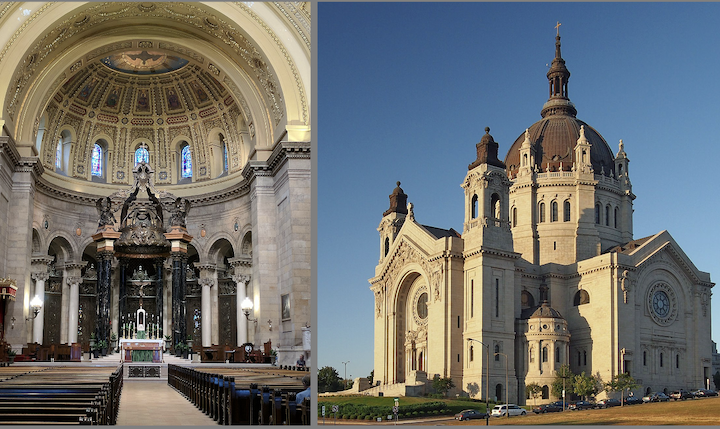
Above:
Top Left: : Bishop Joseph Crétin circa 1850, By unattributed - Minnesota Historical Society; Public Domain, https://commons.wikimedia.org/w/index.php?curid=11475724
Top Middle : The second cathedral, By Unknown author - Public Domain, https://commons.wikimedia.org/w/index.php?curid=155048909
Top Right: The third cathedral (1858-1914), By Unknown author - https://cathedralsaintpaul.org/history, Public Domain, https://commons.wikimedia.org/w/index.php?curid=155048908
Bottom Left: Baldachin and altar of the cathedral, By CMitch - Own work, CC BY-SA 4.0, https://commons.wikimedia.org/w/index.php?curid=62337211
Bottom Right: Saint Paul Cathedral, St Paul, Minnesota, National Shrine, By McGhiever - Own work, CC BY-SA 3.0, https://commons.wikimedia.org/w/index.php?curid=21499788
| |
|
• Joseph Crétin (December 19, 1799 – February 22, 1857) was the first Roman Catholic Bishop of Saint Paul, Minnesota. Several places, including Cretin Avenue in St. Paul, Cretin-Derham Hall High School, and Cretin Hall at the University of St. Thomas, are named after him.
• He was born in Montluel, Ain, France, on December 19, 1799, and studied at the seminary of Saint-Sulpice in Paris. His friend, Bishop Mathias Loras, the first bishop of Dubuque, Iowa, came to France in 1838 to find priests for his large diocese. He convinced Crétin to move to America instead of going to China, which Crétin had considered.
• Upon arriving in Dubuque on April 18, 1839, he was quickly made vicar-general of the new diocese. For over eleven years, he served as a priest in this area, spending time in Dubuque, Prairie du Chien, Wisconsin, and with the Winnebago Indians near Fort Atkinson in Winneshiek County, Iowa. In 1850, when St. Paul, Minnesota, became the center of a new diocese, Crétin was appointed its first bishop.
• He first appeared in the log chapel of St. Paul, which was his initial cathedral, and he gave his first episcopal blessing to his congregation. Within five months, a large brick building was built to function as a school, a residence, and a second cathedral. Another building started in 1855 was completed after his passing and served as the cathedral of St. Paul until the current Cathedral was finished in 1915.
• He looked ahead and worked to grow his diocese by bringing Catholic immigrants from Europe to the rich lands of Minnesota. At the same time, he continued to focus on his ministerial and pastoral duties. Crétin passed away in St. Paul, Minnesota, on February 22, 1857. Bishop Crétin is still remembered and veneered to this day.
Marker, “St Joseph’s Academy”
355 Marshall Avenue, Saint Paul MN 55102
GPS: 44.948317, -93.115433
• Inscription:
"St. Joseph's Academy, the oldest Catholic educational institution in Minnesota, was founded in 1851 by four Sisters of St. Joseph of Carondelet, two hundred years after the order's founding in Le Puy, France. Leaving the mother house in St. Louis at the invitation of Bishop Joseph Cretin, the nuns believed they were to start an Indian mission; instead; they established a school dedicated to their patron saint. The first classes were held in the vestry of Father Lucien Galtier's log chapel of St. Paul from which the city took its name. A year later the school was moved into a two-story brick building; in 1859, requiring larger quarters, it was relocated on the present site of St. Joseph's Hospital.
By 1863 the academy was moved to this location. The original structure (the southwest section of this complex) is thought to be the oldest remaining Catholic schoolhouse in the state. Built of yellow limestone from local quarries, its style may be classified as "Italianate." There have been four additions to the original academy which was chiefly a boarding school until about 1870 when the growth of the city improved transportation facilities.
Today the institution is a day high school for girls.
Erected 1966 by the City Planning Board of St. Paul."
| |
|
Other French Priests in the Frontier
Father Louis Navarron
Mgr Augustin Ravoux
Father François Joseph Rudolf
Bishop Célestin Guynemer de la Hailandière
| |
|
Above:
Left: Stain glass window, St Rémy Catholic Church, The Village of Russia, OH.(no photo of Father Navarron could be found) https://www.stremychurch.com/History
Middle Left: Augustin Ravoux, a French Jesuit Missionary to the Eastern Dakota in the years of the Minnesota Territory. By Charles Alfred Zimmerman (1844-1909) - Minnesota Historical Society: Visual Resources Database, Public Domain, https://commons.wikimedia.org/w/index.php?curid=11240056
Middle Right: Father Rudolph, founder of the "Village of Spires."
By Artist Johann Schmitt (1825-1898), located at the Convent of the Sisters of Saint Francis, Oldenburg, Indiana, Photo added by Patrizia, 24 Feb 2014, https://www.findagrave.com/memorial/120399785/francis-joseph-rudolf#view-photo=96966450
Right: Bishop De La Hailandière. Photo by Unknown author - Public Domain, https://commons.wikimedia.org/w/index.php?curid=30624018
| |
|
In 1833, the Diocese of Cincinnati covered all of Ohio. Bishop Fenwick tried to serve the French and Native American Catholics who lived 500 miles north of Cincinnati. However, Catholics were spread out across the state and rarely saw a priest. During the 19th Century, missionary work meant that priests had to travel a lot from one town to another.
• Father Navarron was born in France in 1807. He was recruited – along with seven other priests – by Bishop John Purcell to serve the Diocese of Cincinnati in 1831.
• Father Navarron went to Mercer and Auglaize counties where Germans and French immigrants settled. He ministered at St. Albert, St. Remy and Holy Family. He traveled in every direction to bring the sacraments to Catholics.
• When the Congregation of the Precious Blood arrived in these northern counties in 1844, Father Navarron moved to Clermont County, serving as pastor of St. Philomena, Stonelick, from 1851-1880.
Marker, "St. Denis Parish - St. Valbert Cemetery
Old St. Valbert Parish"
9265 Long Road, Versailles OH 45380
GPS: 40.234083, -84.407867
• Inscription:
"On this site in 1839, on 1 ½ aces, kindly donated by Nickolas Marchal, a log church 32 ft. x 40 ft. x 18 ft. high was built by he and his sons. It was to be called St. Valbert Parish.
It was the first Catholic Church in this area and directly served an area 8 miles by 10 miles.
For St. Valbert, Rev. Louis Navarron was recruited in Clermont France by Archbishop John Purcell of Cincinnati. He was to be the bishop’s delegate from 1838 to 1848. A zealous missionary, both fearless and eager, he served a territory from Greenville to Lima, Ohio.
In 1864, to be more centrally located, the parish ourchased the Baptist Church in Jacksonville - later to be named Versailles as the predominant nationality of the area was French. At that time also, the parish was re-named St. Denis in honor of the patron saint of all of France.
The site was retained as it was already a Catholic Cemetery, for St. Denis and the name unchanged for posterity reasons. This was given by a giving parishioner to preserve the heritage of the general area in 2012.
Erected 2012."
Marker, St Rémy Catholic Church
109 East Main Street, Russia OH 45363
GPS: 40.234083, -84.407867
• Inscription:
"Saint Remy Catholic Church. In 1839, Bishop John Baptist Purcell recruited European priests to minister to his Ohio flock. Father Louis Navarron, a young French missionary, was appointed to the French Catholic population of Darke and Shelby Counties in the area now marked by the villages of Russia, Versailles, and Frenchtown. St. Valbert, a centrally-located log church, was dedicated in December 1840 by Bishop Purcell to serve the region. In Russia, a log chapel was dedicated on Jean Jacques DeBrosse’s farm in 1846. Parish boundary lines were established in 1850, Precious Blood priests arrived, and a new church was dedicated to Saint Remigius in August 1852. As the congregation grew, so did the church buildings. The current Saint Remy Catholic Church, built between 1891-1892, was listed on the National Register of Historic Places in 1979.
The Village of Russia. The Village of Russia (pronounced ROO-she) began with the arrival of French Catholic immigrants from the region of France previously known as Alsace-Lorraine. Local lore attributes the name to early residents noting similarities in the area’s winter landscape to that of European Russia. Lewis Phillip purchased the land and sold plots where the village was later platted. In 1853, he built a house and established a store. Other businesses followed, including dry goods stores, a blacksmith shop, a sawmill, and grain elevators. A post office was established in September 1860 and Arsaine Pigney served as the first postmaster. The 1870 Federal Census was the first to officially reference “Russia.” Incorporated with the State of Ohio in 1967, the Village of Russia’s first mayor, Leo Herman Francis, was sworn in on June 12, 1968.
Erected 2023 by Village of Russia; Ohio History Connection. (Marker Number 7-75.)"
• Augustin Ravoux (January 11, 1815 – January 17, 1906) was a French Jesuit priest born in Langeac, Auvergne, who served in the area preceding Roman Catholic Archdiocese of Saint Paul and Minneapolis, in Minnesota.
• He left to America at 22 in 1837 after being ordained in Puy-en-Velay. He was sent as a missionary in Minnesota. He studied the Dakota language with Louis Provencal, a Frenchman who had been trading in the area for forty-five years.
• He authored Wakantanka ti ki Chanku (“The Path to the House of God”), a prayer book intended to explore the beautiful vocal abilities of the Dakota.
Marker, “History of Saint Paul”, Minneapolis, MN
Mgr Augustin Ravoux
62 W Kellogg Blvd, St Paul, MN 55101
GPS: 44.944867, -93.090133
• Inscription (excerpts):
“In 1841, Father Lucien Galtier traveled to our city, which was little more than a landing called Pig’s Eye. He built a chapel here and called it Saint Paul. Thus our city was formed and named.
[…] In October, 1841, eight men gathered here with their axes to build our city’s first chapel: Pierre & Charles Bottineau, two men named Pierre Gervais, Vital Guerin, Isaac & Joseph Labissonniere and Francois Morin.
[…] After the bell from the sunken steamboat Argo was salvaged in 1847, the Honorable Henry M. Rice presented it to Father Augustine Ravoux, who had it placed here in a belfry beside the chapel.”
• François Joseph Rudolf was born on 23rd April 1813 in Battenheim, Dept du Haut-Rhin, Alsace. At the age of 18, he left to study theology at the Grand Séminaire in Strasbourg during six years, and was ordained in 1839. In 1841, Reverend Father Julian Benoit, the second pastor of St. Augustine's Church in Fort Wayne, Indiana, went to Europe to seek donations and brought back with him Fr. Rudolf to serve as an assistant. In 1844 he was sent to Oldenburg, a village also known as the "Village of the Spires" due to the church he constructed. He also served as the spiritual leader for the surrounding communities.
Marker, “Father Franz Joseph Rudolf” (sic)
3027 Pearl St, Oldenburg, IN 47036
GPS: 39.340383, -85.203817
• Inscription:
“Born in Battenheim, Alsace,
April 23, 1813
"Founder of Village of Spires"
Appointed Pastor 1844
Built Stone Church 1845 – Present Church 1862
Founded Convent of Sisters of St. Francis 1851
Served as Civic Leader and
Missionary in Area
Buried June 1, 1866 Below
Church Sanctuary
Erected 1968 by Holy Family Parish.”
• Célestin René Laurent Guynemer de la Hailandière (May 3, 1798 in Combourg – May 1, 1882) was a French prelate of the Roman Catholic Church. He served as Bishop of Vincennes (now the Archdiocese of Indianapolis) from 1839 to 1847. He is best known for donating the land for the establishment of the University of Notre Dame.
• He died at the family estate at Triandin, near Combourg on May 1, 1882, 35 years after his return to France. At his request, his remains were returned to the United States in November 1882 and were transferred to and buried in the Old Cathedral of Vincennes.
Marker, “St. Rose Chapel Built in 1847”
205 Church Street, Vincennes IN 47591
GPS: 38.678683, -87.534683
• Inscription:
“By Bishop De La Hailandiere, second Bishop of Vincennes, to serve seminary students, and later, orphans and school students of the Catholic Institutions of Vincennes. The chapel was part of the original St. Rose Academy operated by the sisters of providence 1848 - 1876.
Erected 1983 by Cathedral Mens Club, through the generosity of parishioners of the Old Cathedral.“
| |
|
Pierre-Jean Mathias Loras
First Bishop of Dubuque, Iowa
| |
|
• Pierre-Jean-Mathias Loras (August 30, 1792 – February 19, 1858) was born into a very religious family in Lyon, France, on August 30, 1792. During the Reign of Terror, his father and 16 other relatives were executed by guillotine. He studied at the Seminary in Lyon and was ordained priest in 1815.
• When Bishop-elect Michael Portier from the Diocese of Mobile (see below) traveled to France to find priests for his diocese, he enrolled Loras who left for Alabama on November 1, 1829, and arrived in New Orleans on Christmas Eve. Loras became the vicar general for the Diocese of Mobile and was responsible for training the seminarians who came with Portier to America. He was also appointed rector of the Cathedral of the Immaculate Conception in Mobile, serving in these roles for seven years while assisting Portier in recruiting priests for the diocese. Loras was also the first president of Spring Hill College in Mobile, Alabama, serving from 1830 to 1832.
• In 1839 he became the first Bishop of Dubuque, in what is now Iowa. In just 21 years of service, he transformed the initial three chapels and one priest into around 60 churches, 47 chapels, and 9 religious communities that established schools, largely thanks to the Sisters of Charity and the Brothers of Christian Doctrine. He also set up 7 boarding schools and oversaw 48 ordinations for a community of about 54,000 people. After significant effort, the first girls' school was opened in 1843. He founded what is now called Loras College in Dubuque.
Removal of his statue at Loras College:
• A student study revealed that he had bought a slave named Marie-Louise in Alabama for $800. Since Iowa was an abolitionist state, he didn't bring her there, but he also didn't set her free; instead, he chose to rent her out. When Marie-Louise proved difficult to manage, Loras decided to sell her for $500...
• After learning this, Loras College officials decided in March 2020 to take down the statue, put it in storage, and establish two scholarships: one in Marie-Louise's name and another for Norman Dukette, the first black graduate of the university.
• Rev. Loras C. Otting, who used to work as an archivist for the Archdiocese of Dubuque and edited a book of letters to Bishop Loras, expressed surprise at some of the details shared by college officials.
Otting's own research revealed that Loras bought a married couple as slaves while living in Alabama but left them with a friend when he moved to the Midwest. He requested that the friend look after the couple well.
• "We know that people will disagree with the decision, and lots of people will have different opinions about what should or shouldn't be done, but over some period of time, we will review and receive all of that information and have another conversation," ... "There is no plan to change the college’s name because “the educational experience beloved by our alumni, students and faculty is not defined by the man,”Loras College President Collins.
• According to local lore, the statue of the bishop was keeping Dubuque safe from tornadoes. Time will tell... Maybe someday the statue will be back.
| |
Louisiana, Alabama, Florida | |
|
Louis Guillaume Valentin DuBourg
"Bishop of Louisiana and the Two Floridas"
Builder of the Basilica of St Louis, Missouri
| |
|
Above:
Top Left: "Mr. DuBourg's chapel" at St. Mary's College, By Acroterion - Own work, CC BY-SA 4.0, https://commons.wikimedia.org/w/index.php?curid=17556821
Top Middle: Monseigneur DuBourg, By Unknown; John Gilmary Shea is the author of the book the image appears in - From the 1890 book History of the Catholic church in the United States by John Gilmary Shea. Public Domain, https://commons.wikimedia.org/w/index.php?curid=24433698
Top Right: Early depiction of the Georgetown College campus, By James Alexander Simpson, Public Domain, https://commons.wikimedia.org/w/index.php?curid=88702353
Middle Left: DuBourg Hall at Saint Louis University, By en:User:Wilson Delgado - Own work, Public Domain, https://commons.wikimedia.org/w/index.php?curid=939752
Middle Right: Baltimore Cathedral, Photo by Basilica1, Public Domain, https://commons.wikimedia.org/w/index.php?curid=3878518
Bottom Left: Saint Louis kneeling at the altar of the Crown of Thorns, a gift from King Louis XVIII to Bishop Louis DuBourg, Old Cathedral of Saint Louis, Missouri, https://www.pinterest.com/pin/258253359872512261/
Bottom Middle: Basilica of Saint Louis, King of France, the first cathedral west of the Mississippi, with Gateway Arch. By Baylor98 - Own work, CC BY-SA 4.0, https://commons.wikimedia.org/w/index.php?curid=38285844
Bottom Right: To the right of the main altar is a statue of Saint Louis IX, King of France (1215-1270), patron of the Archdiocese, the City, and the Basilica. Old Cathedral of Saint Louis, Missouri, https://oldcathedralstl.org/history
| |
|
• Louis-Guillaume-Valentin Du Bourg, PSS (anglicized as Louis William Valentine DuBourg) born in the French colony of Saint Domingue, 10 January 1766 – 12 December 1833). He built up the church in the vast new Louisiana Territory as the Bishop of Louisiana and the Two Floridas
Bishop DuBourg's arrival with French clerical and religious recruits in 1817 further solidified the French presence, along with the establishment of the first diocesan newspaper, "Le Propagateur Catholique."
• He was sent to study at the Seminary of Saint Sulpice, Paris, and was ordained a priest in 1790, however the French Revolution soon took a radical turn. On 15 August 1792, a Jacobin mob massacred four neighboring priests , and he fled to Spain, where he learned Spanish. He soon emigrated and he landed in Baltimore in 1794.
• Remarkably, he learned English within a few months and was appointed president of Georgetown University in Washington in 1795! An historian, Curran, credited him as “transforming Georgetown from an "academy" into a "college." He increased the number of professors, students, so much so that George Washington visited Georgetown's campus in 1797.He greatly enhanced the institution's quality but incurred a large debt, leading to his removal by the Jesuit owners in 1798. DuBourg then established a lay college similar to St. Mary's Seminary in Baltimore. St. Mary's College quickly expanded, surpassing Georgetown's enrollment.
• He also selected the site and played an important role in the construction of Baltimore's first cathedral. He also established a congregation for the many poor Black Baltimoreans
• With the Louisiana Purchase of 1803, a vast new territory became part of the United States and new dioceses were created. In 1812, DuBourg became the apostolic administrator of the Diocese of Louisiana and the Two Floridas. Three years later, he was appointed bishop. In St. Louis, Missouri, he constructed the first cathedral west of the Mississippi River and set up missions for American Indians. He also established many churches and schools, including St. Mary's of the Barrens Seminary and Saint Louis University. Additionally, he brought in the Sisters of Loretto and the Sisters of the Sacred Heart, led by Rose Philippine Duchesne, to create several academies.
• In 1815, during the Battle of New Orleans, DuBourg urged Catholics to back the Americans instead of the British. After the American win, on January 23, 1815, Major General Andrew Jackson came into the city and was led by DuBourg to the St. Louis Cathedral, where a Te Deum hymn welcomed him.
• In 1826, he was appointed Bishop of Montauban in SW France. Just a few months before he passed away in 1833, he took on the role of Archbishop of Besançon near the Swiss border.
Legacy:
Many places are named after DuBourg. DuBourg Hall at Saint Louis University was opened on January 10, 1898. Bishop DuBourg High School in St. Louis, Missouri, started in 1950. https://www.bishopdubourg.org/about/db-history
| |
|
Antoine Blanc
First Archbishop of New Orleans
| |
|
• Antoine Blanc was born on October 11, 1792, in Sury, near Sury-le-Comtal, in the Rhône-et-Loire region. He passed away on June 20, 1860. He served as the fifth Bishop and the first Archbishop of the Roman Catholic Archdiocese of New Orleans.
• Blanc studied at a local seminary and was ordained in 1816. On July 1, 1817, he left Bordeaux with Louis William Valentine Dubourg, the Bishop of the Diocese of Louisiana and the Two Floridas, who was in Europe to recruit priests. They traveled on foot from Baltimore to Pittsburgh due to safety concerns. From Pittsburgh, they took a flatboat to Louisville, Kentucky.
• Dubourg assigned Blanc to assist Benedict Joseph Flaget, the Bishop of the Diocese of Bardstown, which covered much of Kentucky, Tennessee, Missouri, Illinois, Indiana, Ohio, and Michigan.
• By 1832, New Orleans had become the fourth-largest city in the United States, following New York, Philadelphia, and Boston. In 1850, the Diocese of New Orleans was elevated to an archdiocese, and Blanc became its first archbishop.
• During his time as bishop, more new parishes were created in New Orleans than at any other period.
Memorial, “Archbishop Antoine Blanc”
1100 Chartres St, New Orleans, LA 70116
GPS: 29.960850, -90.060550
• Inscription (excerpts):
“This memorial is a complex of private property of the Catholic Church of New Orleans.
Located on the grounds are several buildings of which the most notable is the Old Ursuline Convent – Archiepiscopal Residence erected by order of King Louis XV of France in 1745. It is the oldest building of record in the entire Mississippi Valley. In 1824 the property was deeded by the Ursuline nuns to the Catholic bishops of New Orleans, the main building to serve as their residence, administrative offices, and archives. Today, it again serves as the archives of the archdiocese and as a center for historical church-related research. The complex is dedicated to the memory of the most reverend Antoine Blanc, first archbishop of New Orleans (1835-80), who resided here and under whose administration the archdiocese experienced dramatic growth. Another edifice of note is our Lady of Victory Catholic Church, erected in 1845 as the chapel of the archbishops. [...]”
Erected 1981 by International Order of Alhambra Darro Caravan No. 29.”
Legacy and Achievements
Blanc played a key role in building institutions during the rapid expansion of New Orleans and the surrounding states. This led to an increase in the number of churches from 26 to 73 and the number of priests from 27 to 92. Under his guidance, many schools, academies, colleges, convents, and asylums were founded.
* The Archbishop Antoine Blanc Memorial at 1100 Chartres Street is named after him and contains the archdiocese's archives.
* The Archbishop Antoine Blanc Assembly #2047 of the Knights of Columbus, located in New Roads, LA, is also named in his honor.
| |
|
Père Antoine Désiré Mégret
Founder of Abbeville, Louisiana
| |
|
• Père Antoine Désiré Mégret (born in Abbeville, France, 23 May 1797 – died 1853) was the founder of Abbeville, Vermilion Parish, Louisiana. He was a Capuchin missionary.
• Formerly called La Chapelle, the land that became Abbeville was purchased for $900 by founding father Père Antoine Désiré Mégret. There are two theories how the town was named. The theory that is generally accepted is Mégret named the town after his hometown in France. The second theory states that it is a combination of "Abbe" for Abbé Mégret and "ville" the French word for town – thus Abbé's town.
• Father Mégret based his first plan for the village on a French Provincial village. In a map he created in 1846, the town covered 38 to 40 acres (160,000 m2). The people who settled there were descendants of Acadians from Nova Scotia who relocated to the area between 1766 and 1775. The village was officially incorporated in 1850.
Marker, “Abbeville”
145 N State Street, Abbeville LA 70510
On the Parking Lot next to the “Hôtel de Ville” (French for City Hall)
GPS: 29.974450, -92.135617
• Inscription:
English side:
“Formerly La Chapelle. Founded in 1843 by Father Antoine Desire Megret, a native of Abbeville, France, on land purchased from Joseph LeBlanc. City incorporated by state, 1850. Became parish seat of Vermillion, 1845. Home of Louisiana Dairy Festival.”
French side:
“D’abord appelée La Chapelle, la ville fut fondée en 1843 par le père Antoine Désiré Megret, originaire d’Abbeville, France, sur des terres achetées à Joseph LeBlanc, incorporée par l´Etat en 1850, Abbeville était devenue chef-lieu de la paroisse de Vermilion en 1845. Célèbre pour son Festival des Produits Laitiers de la Louisiane.”
Erected 1963 by Louisiana Board of Commerce and Industry.
Statue, Père Antoine Desiré Mégret (1797 – 1853)
In the Magdalen Square Abbeville LA 70510
GPS: 29.974336, -92.136989
• Inscription:
“Père Antoine Desiré Mégret born in France on May 23, 1797 arrived in Louisiana in 1842 and was sent to Vermilionville (now Lafayette) as pastor of St. John's Parish. In 1843 he purchased from Joseph LeBlanc one hundred sixty arpents of land approximately three miles north of Perry's Bridge, on this site by the Vermilion River. St. Mary Magdalen Church was dedicated in 1844. Property not reserved for the rectory, cemetery and town squares was sold in lots, and the community heretofore La Chapelle, became Abbeville in 1844.Père Mégret, having designed and developed his city around two central squares, offered property and a building for the courthouse and was influential in the ultimate establishment of Abbeville as the Parish seat in 1845.
In 1853 the community suffered from a yellow fever epidemic, which claimed seventy-three lives, the last of these was Père Mégret, who had been ministering to the victims of the disease. He is entombed under St. John's Cathedral in Lafayette, Louisiana.”
| |
|
Michel Portier
First bishop of Mobile, Alabama
| |
|
• Michel Portier was born on September 7, 1795, in Montbrison, France, and passed away on May 14, 1859, in Mobile, Alabama. He studied at the Seminary in Lyon and was invited by Bishop Louis William Valentine Dubourg to join the American mission. At 22, he moved to the United States in 1817, arriving in Annapolis with the aim of becoming a priest.
• He learned English, was ordained in 1818, and then went to New Orleans, where he served as Vicar-general. Like many bishops of his time, Portier owned slaves. In 1825, he became the first Vicar Apostolic of the newly established Vicariate of Alabama and the Floridas, which included Arkansas.
• In 1829, Pope Pius VIII elevated the vicariate to the Diocese of Mobile, appointing Portier as its first bishop. His cathedral was a small church measuring twenty feet wide and fifty feet deep, and his home was an even smaller two-room building. A new cathedral construction began in 1837, and on December 8, 1850, Portier consecrated the Cathedral Basilica of the Immaculate Conception.
• Around 1847, he brought the Brothers of the Sacred Heart from France and the Daughters of Charity from Emmitsburg, Maryland, to run orphanages for boys and girls. One of his final contributions was establishing a hospital in Mobile, now known as Providence Hospital, which is managed by the Daughters of Charity.
Marker, “Cathedral-Basilica of the Immaculate Conception / Archdiocese of Mobile”
2 S Claiborne St, Mobile, AL 36602
GPS: 30.690300, -88.045517
• Inscription:
“Cathedral-Basilica of the Immaculate Conception
Parish established in 1703 by John-Baptiste del la Croix, Bishop of Québec, while Mobile served as capital of Louisiana. Oldest religious congregation of any denomination in Alabama and the Mississippi River Valley. Rev. Henry Rolleaux, first pastor. Present church, constructed 1835-1850, is third parish church, built by Michael Portier, first Bishop of Mobile (1826-1859). Portico added 1870. Bell Towers 1890. Stained glass windows 1910. Cathedral designated a Minor Basilica by Pope John XXIII in 1962. Crypt Chapel for deceased bishops 1964.”
Archdiocese of Mobile
At various times part of the Dioceses of Québec, Santiago (Cuba), and Louisiana and the Floridas. Michael Portier, born in France, first Bishop (1826-1859). Original diocesan territory included all of present day Alabama and Florida. From 1858-1968 included all of Alabama and Florida Panhandle. Diocese established first schools and orphanage in Mobile, and first institution of higher learning in Alabama (Spring Hill College). Named an archdiocese in 1980. Today includes all Catholic parishes in southern 28 counties of Alabama.”
| |
|
Jean Marcel Pierre Auguste Vérot
First bishop of the Diocese of St. Augustine in Florida
| |
|
• Augustin Vérot was born on May 23, 1805, in Le Puy-en-Velay, France, and passed away on June 10, 1876. He studied at the St-Sulpice seminary in Paris and was ordained in 1828. Afterward, he joined the Society of Saint-Sulpice and moved to the United States. Vérot spent 23 years teaching science, philosophy, and theology at St. Mary's College. Later, he was assigned to Ellicott's Mills, Maryland, where he served for five years from 1853 to 1858.
• In 1857, the Pope appointed Vérot as vicar apostolic of Florida. He established new churches along the Gulf of Mexico in places like Tampa, Fernandina Beach, Palatka, Mandarin, and Tallahassee. He also set up Catholic schools in the area and brought in religious communities to run them. Sisters of the Order of Mercy came from New England to start a girls' academy, while Christian Brothers from Quebec opened a boys' school in St. Augustine.
• In 1861, he became the bishop of the Diocese of Savannah but continued to serve as vicar apostolic of Florida. During the American Civil War, Vérot helped evacuate several Sisters of Mercy from Jacksonville to Savannah. After the war, he wrote a pastoral letter encouraging Catholics in the diocese to overcome their prejudices against former servants. He also called for a national coordinator for evangelization efforts among African-Americans and invited French sisters from LePuy to assist in this work.
• In 1870, Pius IX upgraded the Florida vicarate to the Diocese of St. Augustine and appointed Vérot as its first bishop.
• Vérot was one of the early advocates for promoting St. Augustine, Florida, as a health and cultural destination. He made yearly visits across the diocese, setting up churches and schools. He also worked to honor the memory of Florida's early martyrs from both Spanish and French backgrounds.
• His most notable writings include his Pastoral on Slavery and his Catechism. Vérot played an important role in the Plenary Council of Baltimore and the First Vatican Council in Rome from 1869 to 1870. At the Council, he argued against the belief that African-Americans lacked souls and were not human.
• He is buried at Tolomato Cemetery where a marble bust i next to his tomb.
Marker, Phelan-Verot House Built Prior to 1866
124 N 4th St, Fernandina Beach, FL 32034
GPS: 30.672933, -81.461750
• Inscription:
"On February 5, 1875, Jean-Pierre Augustin Verot, Bishop of Saint Augustine, purchased this cottage from Sarah Phelan. The Sisters of Saint Joseph lived here in the year 1877, when a devastating epidemic of yellow fever swept over the Amelia Island community. From this place, for three weeks as the epidemic raged, the small coterie of sisters risked their lives, night and day, as they nursed the stricken of every race, Catholic, non-Catholic, rich and poor. They offered comfort and prayers for the sick and dying, and even helped bury the dead. Grateful citizens thereafter called them "Angels of Mercy." Mother Celenie and Sister de Sales, young French nuns far from their motherhouse in LePuy, France, died of the fever. They rest in Bosque Bello Cemetery, their graves marked with simple stone crosses bearing the date 1877.
Florida Heritage Site
Erected 1999 by Amelia Island Fernandina Restoration Foundation and the Florida Department of State. (Marker Number F-419.)"
Marker, St. Benedict the Moor School
2602 N. 20th Street, Tampa, FL33605
GPS: 27.966450, -82.436817
• Inscription (excerpts):
“ Located on this site was the former St. Benedict the Moor School, a Catholic school for black children that was one of the most important buildings associated with black history in Tampa. The property was purchased for $600 on March 15, 1900. The school, a two-story brick building, was completed several years after the acquisition of the property. It housed four classrooms and an auditorium that also served as a chapel. St. Benedict was built under the vision of Bishop Augustin Verot, who in 1858 was given jurisdiction of Catholic parishes in Georgia and Florida. In 1866, Bishop Verot used his authority to bring the Sisters of St. Joseph from Le Puy-en Valey, France to St. Augustine to establish schools dedicated to the spiritual enrichment and education of ex-slaves. Over the next several decades, they established schools throughout Florida. By 1903, they opened the St. Benedict School in Tampa. The School matriculated 30 children during the 1904-1905 school year. St. Benedict’s students were mostly Afro-Cuban children of workers in Ybor City and West Tampa cigar factories. In an era governed by racial segregation, the noble goal of educating black children was hindered by a 1913 law passed by the Florida legislature entitled “An Act Prohibiting White Persons from Teaching Negroes in Negro Schools.” Defiantly, the Sisters of St. Joseph throughout the state challenged this law and continued to teach black students. In April of 1916, three sisters were arrested in St. Augustine for teaching African-American children. Following the arrest, St. Benedict’s in Tampa temporarily closed. On May 20, 1916, a judge ruled that the 1913 law only applied to public schools, and the sisters had not violated the law by educating black students in a private school. Although understaffed, under equipped, and crowded, the Sisters of St. Joseph met their calling in the face of adversity and continued teaching until 1944...[...] The plaque stands in recognition of the vital role St. Benedict the Moor School and the Sisters of St. Joseph played in the education and enhancement of Tampa’s black community for almost 50 years."
Views on slavery & Legacy:
In January 1861, just before the Civil War began, Vérot gave a sermon supporting the rights of slave states and the legality of slavery in the U.S.
In the same sermon, Vérot denounced the international slave trade, aligning with Pope Gregory XVI's 1839 decree. He also advocated for legal protections for free African-Americans. Vérot believed enslaved individuals should be allowed to choose their marriage partners, treated with justice and fairness, provided with sufficient food, clothing, and shelter, and given the opportunity to practice their religion and receive education in it. Because of this sermon, Vérot earned the nickname "Rebel Bishop."
Bishop Verot High School is a private Catholic school located in Fort Myers, Florida. It was named after Vérot in 1964.
| |
|
Father Jean-Marie Odin, C.M.
Fist bishop of Galveston, TX
Founding figure of the Catholic Church in Texas
| |
|
Above:
Top Left: Jean-Marie Odin, https://txcatholic.org/from-the-archives-first-bishop-of-galveston-born-in-france/
Top Middle: St. Mary's Cathedral Basilica in Galveston, TX, by Farragutful - Own work, CC BY-SA 4.0, https://commons.wikimedia.org/w/index.php?curid=128902638
Top Right: Missionary Bishop: Jean-Marie Odin in Galveston and New Orleans by Patrick Foley and Gilbert R. Cruz, Amazon.com
Bottom Left: Saint Louis Hall, St Mary’s University, San Antonio, TX. by Ngood CC BY 3.0, https://commons.wikimedia.org/w/index.php?curid=33557661
Bottom Middle: Statue of Saint Louis outside the St. Louis Catholic Church in Castroville, Texas
1306 Angelo St, Castroville, TX 78009. Jean-Marie Odin, first bishop of Texas, who visited just nine days after the first colonists arrived at the site to establish the town of Castroville, celebrated Mass and placed the community under the patronage of St. Louis of France. Library of Congress, Public Domain https://lccn.loc.gov/2014631312
Bottom Right: Central Catholic Marianist High School in San Antonio, Texas.
Photo: By The original uploader https://commons.wikimedia.org/w/index.php?curid=57837452
| |
|
• Jean-Marie Odin, C.M., (b. Hauteville, Loire, February 25, 1800 – died Ambierle, Loire, May 25, 1870) held the position of the second archbishop of the Archdiocese of New Orleans from 1861 to 1870. Before his appointment in New Orleans, Odin served as the first vicar apostolic of Texas from 1841 to 1847 and later as the first bishop of the Diocese of Galveston in Texas from 1847 to 1861. He is widely recognized as the founding figure of the Catholic Church in Texas.
• He attended the Sulpician seminary in Lyon. In 1822, while still studying there, Odin was approached by a representative of Bishop Louis Dubourg to become a missionary in America. After reaching New Orleans, the archbishop directed him to Perryville, Missouri, to finish his training as a priest at St. Mary's of the Barrens Seminary. Odin took his vows for the Congregation of the Mission (the Vincentians) in November of that year.
• Odin was named the second archbishop of New Orleans by Pope Pius IX on February 15, 1861. When he got to New Orleans, Louisiana had already seceded from the United States, and the American Civil War had begun. Like many Catholic leaders in the South, Odin supported the Confederacy. He was one of Pope Pius IX's contacts in his efforts to negotiate peace to stop the war. Odin permitted priests from his diocese to act as chaplains in the Confederate Army, and nuns from the diocese worked in field hospitals throughout the southern states.
• After he was ordained, Dubourg did missionary work in New Madrid, Missouri, and with Native American tribes near the Arkansas River.
• In 1841, Pope Gregory XVI appointed Odin as the first vicar apostolic of Texas. He started several schools and brought in the Ursuline nuns, marking the first religious community in Texas to run them. In December 1845, Texas joined the United States as a state.
• In 1847, Odin became the first bishop of the newly formed Diocese of Galveston, which covered all of Texas. He invited the Brothers of Mary and Oblates of Mary to help run St. Mary's University in Galveston, which he founded in 1854. He also made challenging visits to the remote areas of Texas and traveled to Europe twice to find priests and resources for the diocese. By the end of his time, he had raised the number of priests to 84 and churches to 50, earning him the title of the father of the modern Catholic Church in Texas.
• Odin became the second archbishop of New Orleans when Pope Pius IX appointed him on February 15, 1861. When he got to New Orleans, Louisiana had already left the United States, and the American Civil War had begun. Like many Catholic leaders in the South, Odin supported the Confederacy. He was one of Pope Pius IX's contacts in his efforts to negotiate peace to stop the war. Odin permitted priests from his diocese to act as chaplains in the Confederate Army, and nuns from the diocese worked in field hospitals throughout the southern states.
• Odin traveled to Rome for the First Vatican Council in 1869 but had to leave early due to health issues. He never went back to the United States. Jean-Marie Odie passed away in Ambierle, Loire, on May 25, 1870, at the age of 70.
Marker, “The French Legation to the Republic of Texas”
French Legation, 802 San Marcos Street, Austin, TX 78702
(There are two identical markers, one inside the garden and one along the sidewalk by the gate)
GPS: 30.267044, -97.732124
• Inscription (excerpts):
“Father Odin: Father Jean-Marie Odin came to Austin at the request of the Pope in 1839. He petitioned the Republic of Texas for the return of church property. The properties included the missions in San Antonio such as the Alamo. Alphonse Dubois [French Legate to the Republic of Texas] invited Father Odin and Father Timon to stay at his rented house on Pecan St. while the French Legation was being constructed. Father Odin purchased the unfinished French Legation and property from Dubois in December of 1840 with the intention of opening a parochial school. Dubois’ relationship with Father Odin helped secure the Vatican’s recognition of the Republic of Texas. “
Erected by Texas Historical Commission”
Sign inside the French Legation to the Republic of Texas:
• Inscription (excerpts):
“Home for Faith”
“Known as the Father of the Modern Catholic Church in Texas, Bishop Jean-Marie Odin owned the French Legation from 1840 to 1847. Bishop Odin arrived in Texas in 1839 with Catholic mandate to secure title to all church property built under the Spanish government and to revive the prominence of the church in Texas. Dubois met Odin in New Orleans initially, and offered him the use of his home in the Republic of Texas' capital to further his work.
In Mexican Texas, immigrants from the United States and beyond were obligated to convert to Catholicism. But the turbulence of the Mexican war for independence from Spain closed seminaries and disrupted the appointment of priests. The Texas Revolution severed ties with the diocese-in Monterrey responsible for Texas.
President Sam Houston desired to establish Texas as a separate diocese for political reasons. The Church's recognition of the Republic of Texas as independent from
When he arrived in Austin, Dubois hosted lavish dinner parties where he lobbied Texas politicians to support the Church. Bishop Odin's petition to secure title to 25 missions in Texas was approved by Congress in January 1841. He is responsible for increasing the number of Catholic Churches and schools in Texas, initiating the building of more than 80 churches. He recruited priests from European nations who could speak the languages and serve those ethnic communities in Texas. In 1847, he was named the first Bishop of Galveston of the newly created diocese that encompassed all of Texas.
Father Odin established the first Catholic church in Austin with a mass on December 23, 1840. This lead to the creation of the congregation that would become St. Patrick Church, the predecessor of the present-day St. Mary Cathedral on
East 10th Street (left).
Marker, ” Site of Liberty's Ursuline Convent”
399-335 Austin St, Liberty, TX 77575
GPS: 30.058633, -94.799583
• Inscription:
“In 1859 Bishop John Mary Odin sent a group of Ursulines from Galveston to Liberty to establish a convent and girls' school. Under the leadership of an energetic French nun, Mother Ambroise, the Sisters bought land at this site and erected two frame buildings. Many prominent Liberty families enrolled their daughters in the convent school, as boarders or day students. The turmoil of the Civil War (1861-1865) caused attendance to decline, and the institution closed in 1866. Occupied by two other academies in the late 1860s, the Ursuline buildings were dismantled in the 1880s.”
Erected 1978 by Texas Historical Commission. (Marker Number 9691.)
Marker, ”Central Catholic High School”
1403 N St Mary's St, San Antonio, TX 78215
GPS: 29.436683, -98.484833
• Inscription:
“This school originated at a time when San Antonio lacked a boys' school of any kind. Bishop Jean-Marie Odin obtained teachers in France from the Society of Mary: Nicholas Koenig, Jean-Baptiste Laignaux, and Xavier Mauclerc. Andrew Edel, another Marianist from Ohio, was principal; San Antonio layman Timothy O'Neil also joined the staff. The school opened Aug. 26, 1852, in two rooms over a livery stable near San Fernando Cathedral. During the winter the brothers erected a building near the San Antonio River. "St. Mary's Institute” occupied that campus on March 1, 1853, and finished the school year with 100 pupils of various creeds. Enrolled as day students were Anglo-,French-, German-, and Mexican-Americans. South Texas ranch boys attended as boarders. After expanding that building the brothers erected others, including a four-story "Skyscraper" unique for the 1870s.
St. Mary's University of San Antonio was one outgrowth of the 1852 "Brothers' School. After several changes of names and facilities, Central Catholic High School in 1932 became the successor of the pioneer effort and is now revered as the oldest and the largest private boys’ school in Texas.”
Erected 1978 by Texas Historical Commission. (Marker Number 788.)”
Marker, “St Mary’s Institute”
River Walk, (east of the North St. Mary's Street access point) , San Antonio, TX 78205
29.425067, -98.490600
• The Marianists who established St. Mary’s were members of the Society of Mary, founded in 1817 by Blessed Guillaume Joseph Chaminade, a French priest who formed lay and religious societies that would reenergize the Christian faith in the post-French Revolution era. Four French Marianist missionaries traveled to Texas to open a school at the behest of Bishop Jean-Marie Odin. In May 1852, these brothers stepped off the Indianola stagecoach to get a glimpse of downtown San Antonio where they would establish their school.
• Inscription:
“Many immigrants from both the United States and Europe were attracted to the Republic of Texas after it became independent from Mexico in 1836. Among the new Texans were missionaries of various faiths, including the French Catholic priest Jean Marie Odin. Odin's immediate work was spiritual ministry and renovating crumbling churches that the Spanish had built years before, but his long-term vision was education. He raised money to construct schools and recruited teachers from Catholic religious orders in Europe, including the Brothers of the Society of Mary who came to San Antonio in 1852 to teach boys. St. Mary's Institute was completed here on the San Antonio River in 1853. Known later as St. Mary's College, it outgrew this site, and in 1894 a new campus was completed in the northwest suburbs. Elementary and high school students continued to study in the riverside buildings for many years, and after 1934 St. Mary's School of Law occupied the site. The historic buildings were sold in 1967 and converted into a hotel.”
| |
|
Sister Joséphine
Nacogdoches, TX
"Serving the poor and the neglected"
| |
|
• “...Sister Josephine, Renee Ernestine Francoise Potard, is still talked about by the old timers. She came to minister to the people of Moral in the late 1800s. She was born in France and first came to Notre Dame. In 1870, she volunteered for missionary work in Texas to teach in the Nacogdoches University. In 1874, when the others moved to Clarksville to begin a university, she chose to remain in East Texas. She spent the last days of her life in a cabin by the Catholic Church in Moral. Stories passed down tell of her wonderful energy and determination to help those in need.” - - The Daily Sentinel, “Serving the Oldest Town in Texas since 1899, Feb 8, 2013”
Marker, ” Sister Joséphine”
1422 County Rd 724, Nacogdoches, TX 75964
GPS: 31.552550, -94.743583
• Inscription:
“Renée Ernestine Françoise Potard was born on February 25, 1822, in Barthelemy, France. She entered the convent of the Sisters of the Holy Cross in Le Mans, France in 1846. After making her vows, she volunteered to come to America to pursue her desire to serve the poor and neglected. She made her perpetual vows in 1857 at Notre Dame, Indiana and took the name Sister Mary Saint Joseph. In 1871, during Reconstruction, she volunteered for missionary work in Texas and was sent with three other nuns to reopen the Nacogdoches University. Two years later, they were transferred to Clarksville. However, Sister Josephine chose to remain among the abandoned Spanish Catholics of Nacogdoches and teach in one room of the university. During this time, she took the name Sister Josephine. In 1880, she moved southwest along the Mansola road where a small Catholic church had been dedicated in 1877. There she taught the children, comforted the ill and dying, and attended to the many spiritual needs of the people. Her billowing habit became a familiar sight as she traveled on her mustang pony from house to house along the dirt roads. In 1885, five acres along the Moral Creek was purchased and a new church was built. From a small room at the rear of the church, she often wrote her superiors at Notre Dame telling them of her activities with her "abandoned Mexicans". One such letter ask for monetary assistance to purchase a statue of the Blessed Mary. When the statue arrived in Palestine, Texas, she traveled the 75 miles on her pony and brought it back alone. In 1893 after 20 years of service to the community, she developed pneumonia. The devoted men of the parish led by A.L. Cordova took her by wagon to the train station in Nacogdoches. She was taken to St Joseph's Infirmary in Houston where she died on April 27, 1893. Her remains were transported to Saint Edward's University in Austin and buried in the nearby Assumption Cemetery. Today, a simple granite cross marks the last resting place of this truly remarkable woman of God.”
| |
|
The Oblates: "The Cavalry of Christ"
Father Pierre-Yves Kéralum
Rev. Vital Quinon, "The Fighting Priest"
Rev. Pierre Fourier Parisot
Father Jean-Baptiste Brétault
Early builders of the Catholic Church in Texas
| |
|
Above:
Top: The Cavalry of Christ. Oblate missionaries who traveled on horseback 19th century to minister to Catholics living on isolated ranches in Texas and northern Mexico. The photo was published in newspapers in 1912. According to the Oblates' website, the Cavalry of Christ was active from 1849 to 1904. Presumably their activities tapered off gradually. Public Domain, https://commons.wikimedia.org/w/index.php?curid=76273045
Bottom Left: Pierre Yves Kéralum OMI (1817–1872) was a French-born Catholic missionary and member of the Missionary Oblates of Mary Immaculate. Fair use, https://en.wikipedia.org/w/index.php?curid=59849443
Bottom Middle Left: Texas missionary Pierre F. Parisot, circa 1899. This photograph appeared in his 1899 memoir, The Reminiscences of a Texas Missionary (San Antonio : Johnson Bros).
By Unknown, Public Domain https://commons.wikimedia.org/w/index.php?curid=76323533
Bottom Middle Right: Rev. Father Vitalus Quinon, Beaumont, TX ca. 1881 http://www.wtblock.com/wtblockjr/rev.htm
Bottom Right: Father Jean-Baptiste Brétault, aka Padre Juanito De La Costa, https://ost.edu/fr-jean-baptiste-bretault-omi-juan-de-la-costa/
| |
|
The "Cavalry of Christ" were Oblate fathers, who were Catholic priests from the Missionary Oblates of Mary Immaculate, originally founded in Aix-en-Provence in 1816, to evangelize the "abandoned poor" and natives in far-flung missions.
From 1849 to 1904, they traveled long distances on horseback to help Catholics living on remote ranches in the Rio Grande area.
After Texas became part of the United States, Bishop Jean-Marie Odin invited the Oblates to Texas. A small group of young French priests arrived in 1849, assigned to serve the eight southernmost counties of Texas. At that time, the Rio Grande region was like the Wild West, and the Oblates faced many risks, including violent crime and yellow fever. The Catholics they served were mostly poor and spread out over a large area that dealt with extreme heat and flooding. As they made their six-week journeys through the tough landscape, the Oblates were easily recognized by their long black robes "soutanes" and the Oblate cross around their necks. Besides providing sacraments, they also established and managed schools in Brownsville and Galveston.
• Father Pierre Yves Kéralum, (born in Quimper, Brittany, on March 2, 1817 and died around November 12, 1872 in the desert) a revered figure among local Catholics, continues to be honored in the Brownsville, TX, area.
• He studied at the Seminary in Quimper, He became a priest on February 15, 1852, when the Bishop of Marseille, Eugène de Mazenod, ordained him. After that, he was assigned to Galveston, Texas.
• Kéralum was talented in both masonry and carpentry, constructing brickwork, church pews, and coffins. He was recognized for his humility and kindness, earning the nickname "el Santo Padre Pedrito" from the local people.
• Even in his 50s, despite his poor health and worsening eyesight, he kept visiting over 70 ranches along his route. Almost blind, he often got lost. In 1872, he departed from a ranch northwest of Mercedes, Texas, and was never seen again. His remains were discovered in the underbrush a decade later.In 1920, a life-size depiction of the crucifixion was erected at the site in Mercedes where his remains were initially laid to rest before being moved to San Antonio, Texas. His legacy is further recognized through the naming of a Knights of Columbus chapter, as well as several streets and buildings in the region. Notably, in 1995, the cathedral square in Brownsville was dedicated to Kéralum. During a visit by Vatican officials in 2003, they were deeply impressed by the enduring reverence for Kéralum that had been preserved by the original ranching families. Local Catholics continued to advocate for his canonization in 2005, although no miracles had been attributed to him.
Marker, “Immaculate Conception Cathedral - 1854 -”
1218 E Jefferson St, Brownsville, TX 78520
GPS: 25.902600, -97.496133
• Inscription:
“Built in 1854-1859, the cathedral was designed by French architect Father Pierre Keralum of the Missionary Oblates of Mary Immaculate. The cathedral is Gothic Revival in the ecclesiastical form with a Latin cross plan. During the Mexican Revolution, priests and bishops fleeing Mexico were hidden in the rectory. The cathedral exterior was restored in 1963 and in 1970.”
Erected by Brownsville Historical Association.
• Rev. Vital Quinon (born Thizy, Rhône, July 1845 – died July 30, 1894 in Marseilles) was sent in this difficult frontier area of Texas to bring some peace. He was a priest “whose veins were as full of red blood as his heart was of charity”.
• Southeast Texas in 1850 was mainly Protestant, with no Catholic church present. It could take a year or more for a traveling priest to come and hold Mass or hear Confessions. Father Quinon played a key role in introducing the Catholic faith to this region. Although he only stayed in Orange, Beaumont, and Liberty for three years from 1879 to 1882, his impact laid the groundwork for future growth.
• During the Reconstruction period after the Civil War, there was a lot of lawlessness. The church became an important force in bringing order to the frontier. In 1870, Bishop Dubuis sent Quinon to serve in Texas, and he was ordained at Galveston Cathedral on October 27, 1871.
• Rev. Fr. Quinon built St. Patrick's Church, the first Catholic sanctuary, in 1874. In 1877, he celebrated the first Mass in the Chickasaw nation, now part of Oklahoma, where he baptized a 99-year-old woman, the oldest Catholic in the area. After swimming his horse across the Red River, he developed a serious chest illness that required him to recuperate in Europe for four years.
• Father Quinon worked diligently to bring order to the rough frontier. There’s a story about how he was forced at gunpoint to dance on a billiard table in Denison. Later, when he saw the man who instigated it enter a saloon, he confronted him in front of everyone, asking if he preferred to pray or take a beating. The man chose to pray.
Marker, Saint Anthony's Cathedral
700 Jefferson Street, Beaumont TX 77701
GPS: 30.078100, -94.100750
• Inscription:
"Traveling priests visited this area as early as the 1850s, conducting Catholic services outdoors, in homes, and later in the town Temperance Hall. The first church building was constructed in 1881 under the leadership of the Rev. V. Quinon. Located on the corner of Bowie and Orleans streets, the small wooden structure was dedicated as St. Louis Church.
The building was moved to this location in 1894. One year later a school was started here by Mother Pauline and Sister Augustine of the Dominican Order. Classes were held in the church rectory until 1896, when a separate schoolhouse was constructed nearby.
As the population increased during the Beaumont oil boom of the early 1900s, parishioners began planning for construction of a new church building. Started in 1903, this Italian Renaissance revival structure was completed four years later and named in honor of Saint Anthony of Padua. It features a copper dome and an ornate marble altar.
Additional buildings, including the convent and rectory, were constructed during the 35-year pastorate of Monsignor E. A. Kelly, 1919-54. Pope Paul VI created the Beaumont Diocese in 1966, and Saint Anthony's was designated a cathedral.
ecorded Texas Historic Landmark - 1980
Erected 1980 by Texas Historical Commission. (Marker Number 10560.)"
• Rev. Pierre Fourier Parisot, (born in May 20, 1827, in Ambacourt near Saint Dié in the Vosges département– died July 12,1903 in San Antonio, TX.) founded Saint Joseph's College in Brownsville (now Saint Joseph Academy) and served as pastor there. His 1899 memoir, Reminiscences of a Texas Missionary, describes what life was like for the Oblates at the time.
Marker, St. Mary's Catholic Church
912 West Cherry Street, Orange TX 77630
GPS: 30.097933, -93.738100
• Inscription:
The earliest recorded Catholic Mass in the area was conducted by the Rev. P. F. Parisot in 1853, five years before the city of Orange was incorporated. In 1879 the Rev. Vital Quinon (d.1894), a native of France, came to Orange at the request of the local railroad superintendent Charles A. Barton, who was concerned about the city's reputation as a rowdy and lawless industrial town. Known as the "Fighting Priest," Father Quinon provided the leadership necessary for the formation of this church. Established as St. Vital's it originally served a parish comprised primarily of German, Austrian, Irish, and Polish immigrants.
Significant growth began in 1896 when the Rev. J. M. Moran (1859-1922) of Ireland was assigned as the first resident priest of the parish. The congregational name was changed to St. Mary's in 1912 and a school and cemetery were established in the 1920s.
Prominent church leaders have included the Rev. George Berberich (d.1947) of Germany, who came here in 1929, and his brother the Rev. Msgr. Joseph Berberich (d.1980), who joined him in 1937. Through their guidance, St. Mary's Catholic Church developed as a leader in community involvement, in quality education, and in the establishment of area missions.
Erected 1981 by Texas Historical Commission. (Marker Number 11511.)
• Father Jean Baptiste Brétault (1843–1934) is known for his 39 years of dedicated service. He traveled around 70,000 miles while serving the regions that now include Hidalgo, Willacy, Kenedy, and Kleberg counties.
• Father Bretault, known as “Padre Juanito de la Costa,” was born in La Tournerie du Fief-Sauvin, France. He completed his early education in his village and at the college in Beaupréau before attending the major seminary in Angers. In 1870, he made his oblation at the novitiate in Nancy, France, and also studied at Notre-Dame-de-l’Osier and Autun.
• After being ordained in 1872, he moved to Texas, where he took over the coastal mission of the well-known “Lost Missionary,” Father Keralum, serving until 1896 and again from 1904 to 1909. This mission stretched 100 miles along the South Texas coast.
• Initially, there were concerns about Father’s health and whether he could handle the demanding life of a missionary in Texas. However, he rode horseback for many years, working in some of the toughest missions in South Texas, and lived to be nearly 90 years old.
• For many years, he managed the large Oblate ranch at La Lomita, which was later sold, and part of it became the town of Mission, Texas.
• In his later years, he resided at St. Peter’s Novitiate in Mission, Texas, where he was beloved by many novices who learned from his wisdom and example. He passed away from burns sustained on the novitiate grounds on May 31, 1934.
| |
|
Claude Marie Dubuis
Second bishop of Galveston
Founder of the Sisters of Charity of the Incarnate World
| |
|
Above:
Left: St. Louis Catholic Church in Castroville, TX
By Billy Hathorn - Own work, CC BY 3.0, https://commons.wikimedia.org/w/index.php?curid=15580071
Middle: Claude Marie Dubuis, second bishop of Galveston, TX, Photo: By James Martin Kirwin
Public Domain, https://commons.wikimedia.org/w/index.php?curid=123461025
Right: St. Peter’s Catholic Church, Boerne,TX https://travelandtell.com/boerne-a-texas-hill-country-jewel/
| |
|
• Claude Dubuis was born on March 10, 1817, in Coutouvre, Loire. In 1840, he began his studies at the major seminary of St. Irenaeus in Lyon. Four years later, in 1844, he became a priest for the Archdiocese of Lyon. In 1846, he met Bishop Jean Marie Odin, who was recruiting priests for Texas. Dubuis then moved to the United States and learned English after arriving.
• He became the pastor of a parish in Castroville, where most of the members were German or Alsatian immigrants. Dubuis started learning Alsatian and opened a new school, teaching 80 students in his first year. He traveled around his parish on foot or horseback. Once, he even spent a night in a tree to avoid rising floodwaters. He often rode through Comanche territory and was stopped by Native Americans four times. Some Native Americans would visit the Castroville church to enjoy the music. By 1850, he had built a second, larger church. In 1851, he was appointed pastor of San Fernando Parish in San Antonio, Texas, and became the vicar general of the diocese. At San Fernando, he made announcements from the pulpit in English, French, German, and Spanish.
• In 1862, Pope Pius IX named Dubuis as the second bishop of the Diocese of Galveston. While he was bishop, he brought nearly seventy religious groups to Texas. On one of his trips to Europe, he arranged for the Congregation of the Resurrection to serve the Polish community in Texas. Dubuis also established the Sisters of Charity of the Incarnate Word, which became important in providing healthcare in Texas. He returned to Castroville as bishop to lay the foundation stone for the third Church of St. Louis.
• Due to health issues, Dubuis left Galveston in 1881 and moved back to France, where he settled in Vernaison and passed away on May 22, 1895.
Marker, “St. Peter’s Catholic Church”
716 S Main St, Boerne, TX 78006
GPS: 29.786300, -98.729600
• Inscription:
“In 1866 Bishop Claude M. Dubuis of Galveston sent a young French immigrant, Emil L. J. R. Fleury, to organize a congregation and build a church to serve Boerne and the outlying towns and army posts. This stone structure was completed in 1867. Features include an entry portico with shingled gable end, a small belfry, and segmental-arch windows. Fleury, who left Boerne in 1869, returned in 1923 to help lay the cornerstone for a new sanctuary.
Recorded Texas Historic Landmark - 1987
Erected 1987 by Texas Historical Commission. (Marker Number 4484.)”
Marker, “St. Louis catholic Church”
1847 Angelo St, Castroville, TX 78009
GPS: 29.355317, -98.878583
• Inscription:
“Planned, according to tradition, by the Rev. Peter Richard, pastor who came from Loire, France, 1868. First (1847-51) resident pastor, the Most Rev. Claude Dubuis, returned as Bishop of Texas to lay cornerstone on July 2, 1868.
Locally quarried limestone and labor of men of parish went into the construction.
First Mass was celebrated in this church by Father Richard on Aug. 25, 1870, feast day of St. Louis, patron of the parish.
Recorded Texas Historic Landmark - 1970
Erected 1970 by State Historical Survey Committee. (Marker Number 5051)
• Following the conclusion of the Civil War, a trio of French nuns established the Sisters of Charity of the Incarnate Word, a religious group committed to providing care for the ill and vulnerable. In response to Bishop Claude Marie Dubuis' plea, Sister Blandine, Sister Ange, and Sister Joseph journeyed from Lyons, France to start a hospital in Galveston, Texas. Bishop Dubuis had already acquired a plot of land at the intersection of Market and 8th Street, where the construction of a two-story wooden structure to accommodate Charity Hospital commenced.
Marker, “St. Mary’s hospital”
404 8th St, Galveston, TX 77550
GPS: 29.309267, -94.776233
• Inscription (excerpts):
“Organized in 1866, this institution was the first private hospital established in the state. Originally known as Charity Hospital, it was founded by three French Catholic Sisters, members in the Order of Sisters of Charity of the Incarnate Word. Constructed on this site, which had been part of Fort Scurry during the Civil War, the hospital opened for patients on April 1, 1867.
The new hospital proved to be a vital addition to the health care facilities of the area. Three months after it was opened, a yellow fever epidemic struck the city. One victim of the disease was the hospital Superior, Mother M. Blandine. Following the epidemic an orphanage and school were established here by the Sisters for children whose parents died of the sickness. The school was closed and the orphanage was later moved to another site in Galveston.” [...]
Erected 1980 by Texas Historical Commission. (Marker Number 7173.)”
| |
|
Jean-Baptiste Miège, S.J.
“The Bishop of the Indians”
| |
|
Above:
Left: A life-size Carrara marble statue of Bishop John Baptist Miège made by Pedrini in Italy will be placed on a pedestal on the Immaculata’s facade above the entrance. 701 N 2nd St, St Marys, KS 66536
https://www.anewimmaculata.org/sponsorship-items/marble-statue-of-bishop-miege
Middle: John Baptist Miège, S.J., By Thomas Kinsella - Public Domain, https://commons.wikimedia.org/w/index.php?curid=124869203
Right: Bishop East of the Rockies: The Life and Letters of John Baptist Miege, S.J. (Campion Book) Paperback – 1994 by Herman J. Muller (Author) on Amazon.com
| |
|
• Jean-Baptiste Miège, S.J. (September 18, 1815 – July 21, 1884), was born in La Forêt, near the village of Mercury in Savoy, and was a Jesuit prelate and missionary. In addition to a career in education, he served as Vicar Apostolic of Kansas from 1851 to 1874 and was called “the Bishop of the Indians”.
• Miège was born in a house named La Forêt, located in the village of Mercury in Savoie. In 1836, he joined the novitiate of the Society of Jesus in Milan. He became a priest in Rome in 1847. In 1849, he requested to be sent to the Indian missions in the United States, where he began as the pastor of St. Charles's Church in Saint Charles, Missouri.
• On July 23, 1850, Miège was appointed the first Vicar Apostolic for the Indian Territory east of the Rocky Mountains. He left St. Louis in May 1851 and arrived among the Potawatomi along the Kansas River. Later that year, he moved to the Jesuit mission at St. Marys, Kansas. In 1855, he founded his cathedral parish, Immaculate Conception, in Leavenworth, Kansas.
• Miège traveled extensively to visit his scattered congregation in remote areas, going to Indian villages, forts, trading posts, and developing towns, where he celebrated Mass from the back of his wagon. He also established a girls' school for the Osage Indians.
• In 1863, he built an episcopal residence and laid the cornerstone for Immaculate Conception Cathedral in September 1864, dedicating it in December 1868. In 1877, he moved to Detroit, Michigan, where he founded Detroit College and became its first president.
Marker, «St Marys»
203 East Bertrand Street, Saint Marys KS 66536
GPS: 39.190200, -96.060450
• Inscription:
“This city and college take their name from St. Mary's Catholic Mission founded here by the Jesuits in 1848 for the Pottawatomie Indians. These missionaries, who had lived with the tribe in eastern Kansas from 1838, accompanied the removal to this area. A manual labor school was operated at the mission until 1871. From it developed St. Mary's College, chartered in 1869. In 1931 the college became a Jesuit seminary. A boulder on the campus marks the site of the first cathedral between the Missouri river and the Rocky Mountains. Built of logs in 1849, it became the See of Bishop Miege "Bishop of the Indians." Vice President Charles Curtis, part Kaw Indian, was baptized in this parish on April 15, 1860. The mission was an important stopping point on the Oregon trail. Here also was the U.S. Pottawatomie agency. This building still stands 600 feet northwest of this marker.
Erected by Kansas Historical Society and State Highway Commission”
| |
|
Rev. Joseph Projectus Machebeuf
First bishop of Denver, Colorado
| |
|
Above:
Top Left: Machebeuf High School, Denver, Colorado Photo: https://machebeuf.org/a-closer-look-at-bishop-machebeuf-high-school/
Top Middle: Joseph Projectus Machebeuf, By Charles Bohm - Public Domain, https://commons.wikimedia.org/w/index.php?curid=60817941
Top Right: St Joseph Hospital in Denver, Colorado By Tshonsey - Own work, CC BY-SA 4.0, https://commons.wikimedia.org/w/index.php?curid=61581755
Below: Cozen’s ranch, 77849 U.S. Hwy 40, Granby, CO 80446. Photos: two on the left:
https://sideofculture.com/2024/11/discover-the-hidden-gems-of-grand-county-a-cultural-journey-beyond-rocky-mountain-national-park/
Two frames on the right: TC ©ASSFI 2020
| |
|
• Joseph Projectus Machebeuf was born in Riom, located in the Puy-de-Dôme Department of Auvergne on August 11, 1812. He began his education with the Brothers of the Christian Schools and studied classical subjects at his local college. In 1831, he entered the seminary in Montferrand, run by the Sulpicians, and was ordained as a priest in 1836.
• In 1841, he became part of the Diocese of Cincinnati, Ohio. He established Holy Angels Catholic Church in Sandusky, St. Ann's Catholic Church in Fremont, and St. Philomena's Catholic Church in La Prairie before moving to New Mexico in 1851 to join his friend, Jean-Baptiste Lamy.
• When Lamy was appointed Vicar Apostolic of New Mexico in 1850, Machebeuf became his vicar-general. He served as pastor in Albuquerque from 1853 to 1858 and in Santa Fe from 1858 to 1860. Later, he moved to Colorado, where he was injured in a carriage accident in the Rocky Mountains, leaving him with a limp. In Colorado, he helped organize parishes, brought in priests, and by 1868, he had built eighteen churches, including the first one in Denver.
• On March 3, 1868, Machebeuf was named Vicar Apostolic of Colorado and Utah.
• He founded an academy and a boys' school in Denver, a convent for the Sisters of Loretto, St. Joseph's Hospital, the House of the Good Shepherd, and the College of the Sacred Heart, which is now part of Regis University. During his leadership, the Catholic population in Colorado grew from a few thousand to over 50,000.
• In 1887, the vicariate became a diocese, and Machebeuf was appointed its first bishop. He passed away two years later on July 10, 1889.
• Bishop Machebeuf High School, located in Denver, Colorado, founded in 1958, is named in his honor.
Marker, “Holy Angels Catholic Church” – Rev. Joseph Machebeuf
428 Tiffin Ave, Sandusky, OH 44870
GPS: 41.449467, -82.723267
• Inscription:
“Holy Angels Catholic Church is the mother church of Sandusky. Reverend Joseph P. Machebeuf, a French Missionary, began ministering to Catholics in the Sandusky area in late 1839. Soon after William H. Mills offered five lots, $530, and the materials needed to build a church. Father Machebeuf laid the cornerstone on October 13, 1841, and services were held in 1842. By Christmas of 1845, the building was complete, the steeple added, and the bell installed. The congregation was mostly Irish emigrants. In 1855 as more Germans settled nearby, they built St. Mary’s Mother of Sorrows Church. The city’s expansion prompted the building of Saints Peter and Paul Church, in 1871, Holy Angels became a mission church of Saints Peter and Paul until 1875, when Holy Angels was assigned its own pastor and reopened.
Erected 2016 by William G. Pomeroy Foundation, Holy Angels Catholic Church and The Ohio History Connection. (Marker Number 30-22.)”
• Machebeuf left some very concrete signs of his ministry. In a small pioneer museum in Colorado, I was touched to read a sign next to a display:
Cozens Ranch House museum
77849 U.S. Hwy 40, Granby, CO 80446
GPS: 39.932587, -105.790816
"Cozens Master Bedroom"
"Billy and Mary York Cozens married in 1860, both at age 30. They met in the nearby mining town of Central City, where Bily was long-time sheriff and Mary, a devout Irish Catholic girl, worked in a boarding house. Their marriage certificate shows that Father Joseph Machebeuf married them on December 30, 1860 in Central City, The Territory of Colorado, even though Billy was not Catholic but rather a staunch Mason. It was the first marriage ceremony in Northern Colorado at which the future Bishop of Denver officiated. Colorado did not become a State until 1876.”
Indeed, as pictured above, the owners' bedroom is adorned with the framed marriage certificate on the wall, signed by Msgr. Machebeuf, and a document (in French) addressed to the "Très Saint Père" (the Holy Pope)...
| |
|
Rev. Père Nicolas Point
Missionary to Indian tribes and artist
One of the first missionaries to the Rocky Mountains
| |
|
Above:
Top Left: Southwestern view of St. Mary's Roman Catholic Mission, located along North Avenue in Stevensville, Ravalli County, Montana, is listed on the National Register of Historic Places as St. Mary's Church. By Al Huntsman - Library of Congress, Public Domain, https://commons.wikimedia.org/w/index.php?curid=6425863
Top Right: Watercolor by Father Nicolas Point, SJ, depicting a buffalo hunt,
http://www.stmarysmission.com/BitterrootSalish-and-the-Buffalo.html.
The Nicolas Point Gallery introduces the missionary activities of the Jesuits among Native American in the Northwestern and Midwestern United States. Pencil sketches and watercolor drawings by Jesuit Nicolas Point (1799-1868) depict the encounter between the various groups. https://jesuitarchives.omeka.net/collections/show/4
Bottom Left: Portrait of No Horns on his Head, Nez Percé Chief, by George Catlin - Smithonian Institution, Public Domain, https://commons.wikimedia.org/w/index.php?curid=6033361
Bottom Right: Mission of the Sacred Heart (or Cataldo Mission), Coeur d’Alene, Idaho by Geoff Cole Images - CC BY-SA 4.0, https://commons.wikimedia.org/w/index.php?curid=128421097
| |
|
• Révérend Père Nicolas Point (Rocroi, France, 10 April 1799 – Québec, 4 July 1868), was a French Catholic Jesuit priest who was sent as a missionary to America in 1835. he helped establish the Mission of the Sacred Heart along the Saint Joe River in present-day Idaho for the Nez Perce and Coeur d'Alene people. His paintings may be seen as primitive, but he created fascinating journals and detailed artwork. Still, he is not well-known in Western art history because he was not a professional artist.
• Nicolas Point was born on April 10, 1799, in Rocroi, France. Inspired by a biography of Francis Xavier, he joined the Society of Jesus in 1819 and became a priest in 1831.
• In 1835, he traveled to America, reaching St. Mary's College in Kentucky by June 1836. The following year, he established St. Charles College in Grand Coteau, Louisiana, serving as its first rector until 1840. His superiors selected him for a mission to the Bitterroot Salish people in what is now Montana.
• Point created a settlement called St. Mary's Mission, modeled after Jesuit missions in Paraguay. The layout featured houses spaced fifty feet apart and lawns measuring sixty feet square, but it overlooked the Salish's need for defense. Initially, St. Mary's Mission thrived, but tensions grew between the priests and the Salish. While many Salish were baptized and embraced some Catholic practices, they resisted the priests' push for agriculture. The situation worsened when the priests proposed a mission for the Blackfeet, traditional foes of the Salish, leading to a breakdown in trust.
• Point traveled widely among the Plateau tribes in the Pacific Northwest. In 1842, he helped set up the Mission of the Sacred Heart along the Saint Joe River in present-day Idaho for the Nez Perce and Coeur d'Alene tribes. In 1846, he visited the Blackfeet but did not establish a mission there. Throughout his missionary work, Point kept a sketchbook, creating hundreds of drawings of the missions and the communities they served. Despite hs limited art training, his sketches are valued by historians and anthropologists as some of the earliest visual documentation of Pacific Northwest tribes.
"The buffalo is for the Indian…something more than manna in the desert. For there is no fatigue he will not endure, no enemy he will not defy, no form of death he will not face, to get the great beasts." ~Father Nicolas Point, S.J.
Crossing Lewis and Clark Pass
Priests and Roadbuilders, Homesteaders and Firefighters
Alice Creek Road (gravel/dirt), 10 miles from Montana State Hwy 200, Lincoln MT 59639
GPS: 47.139000, -112.456400
• Inscription (excerpts):
“Early Missionaries and Routefinders
Father Nicholas Point:
In the 1840s, the Jesuit missionary Father Nicholas Point became the first EuroAmerican to pass this way since Meriwether Lewis and his men crossed Lewis and Clark Pass in 1806.
Father Point journeyed with Salish hunting parties along the Road to the Buffalo. On one bison-hunting venture, Point wrote that they reached "the summit of mountain from which one could see a horizon more that a hundred leagues in circumference." Point was almost certainly referring to Lewis and Clark Pass and the awe-inspiring view from the top.
Erected by Lewis & Clark National Historic Trail.”
| |
|
Father Valentin Sommereisen
Pioneer Missionary Priest,
General George Custer’s 7th Calvary Chaplain
| |
|
• Father Valentin Sommereisen was born on May 28, 1829, in Rufach, Southern Alsace. While studying in Paris, he was recruited for the Diocese of St. Paul. He finished his studies in Minnesota and was ordained on March 8, 1851. He became the first resident pastor at St. Philip’s in Mankato, Minnesota. He worked as a missionary among the Indians and French Canadians in Manitoba, Canada, and in North Dakota and Montana. (Hays City Republican, Jan. 30, 1897)
• After spending 20 years in Mankato, he moved to Yankton, South Dakota. During this time, Father Sommereisen, who spoke Sioux, joined the Yellowstone Expedition in 1873. General George Custer’s 7th Cavalry was responsible for ensuring the safety of the Northern Pacific Railroad survey team during the three-month expedition.
• In the fall of 1876, Father Sommereisen left Yankton for Ellis County, Kansas. He settled in Hays and served a congregation spread over 170 miles along the Union Pacific Railroad. He established parishes in Hays, Victoria, Munjor, Catharine, Pfeifer, Schoenchen, Liebenthal, and Rush Center, and began building churches. When the Capuchins arrived in 1878, he was assigned to St. Francis Borgia in Cottonwood Falls.
• Father Sommereisen retired to a farm northwest of Hays in 1879. The priest-farmer became a popular figure among settlers, attracting many visitors to his vineyards, orchards, and gardens, where he sold his produce directly. He passed away on January 25, 1897, at the age of 67.
• Marker, “Father Valentine Sommereisen, Pioneer Missionary Priest“
St Josephs Cemetery, New Ulm, MN 56073
GPS: 44.268883, -94.452800
• Inscription (excerpts):
“Valentine Sommereisen was the first resident Catholic priest in three large areas of the American West: southwestern Minnesota, the Dakota Territory, and western Kansas. Born 28 May 1829 in Rouffach, Alsace, a German–speaking part of eastern France, he was one of seven theology students who followed the great missionary, Fr. Augustin Ravoux, to Minnesota in 1854. Sommereisen was ordained by Bishop Joseph Cretin 8 March 1856 in the second Cathedral of St. Paul. [...] From there he ministered to 36 communities in 14 counties in southwest Minnesota. Many area families can trace ancestors’ baptisms, marriages, and funerals to his signature on parish records.
This is the site of St. Joseph Church, the first Catholic church in Brown County, completed in 1861. Fr. Sommereisen celebrated the first Mass. [...]. Fr. Sommereisen accompanied fr. Ravoux, baptizing and consoling 33 of the 38 Dakota Sioux who were hanged in Mankato on 26 December 1862. Fr. Sommereisen moved west in 1871 to Yankton, then the capital of Dakota Territory. From there he visited various forts and stations along the Missouri River.[...] In 1876 Father Sommereisen was appointed pastor at Hays, Kansas, with the care of six nearby Volga-German settlements and various railroad towns along the Kansas Pacific. [...] He died 25 January 1897 at age 67 and is buried in St. Joseph's Cemetery in Hays.”
Erected 2011 by the Fourth Degree Knights of Columbus Bishop Cretin Assembly, with research done by Fr. Eugene Hackert and George L. Glotzbach."
• "Sommereisen was credited with the idea of creating what looked like a cannon by putting together two sections of stovepipe on a wagon and making a small fire, during the Dakota attacks on New Ulm in August 1862....it was convincing enough to prevent the Dakota from attacking New Ulm a third time." - Historian chronicles pioneer priest, The Journal, June 6, 2014.
| |
|
Jean-Baptiste Lamy
First Archbishop of Santa Fe, New Mexico
| |
|
Above:
Top Left: Statue of Lamy in front of St. Francis Cathedral, Santa Fe, NM. Photo by camerafiend. - Own work, CC BY-SA 3.0, https://commons.wikimedia.org/w/index.php?curid=891
Top Middle: Jean-Baptiste Lamy, By W. Henry Brown - New Mexico Palace of the Governors Photo Archives Negative no. 9970, Public Domain, https://commons.wikimedia.org/w/index.php?curid=8919458
Top Right: stained glass window of Archbishop Lamy, St. Francis cathedral, Photo TC © ASSFI 2022
Bottom: Five French-born archbishops, St. Francis cathedral, 1850-1908, Photos TC © ASSFI 2022
| |
|
• Jean-Baptiste Lamy (October 11, 1814 – February 13, 1888), served as the first Archbishop of Santa Fe, New Mexico.Lamy was born in Lempdes, Puy-de-Dôme, in Auvergne.
• As a missionary in North America, Lamy served at several missions in Ohio and Kentucky when, to his surprise, he was notified that Pope Pius IX was appointing him as bishop of the recently created Apostolic Vicariate of New Mexico on July 23, 1850.
• Lamy was responsible for the construction of the Cathedral Basilica of Saint Francis of Assisi (commonly known as St. Francis Cathedral) inspired by the cathedral of Clermont-Ferrand, and the Loretto Chapel inspired by the Sainte Chapelle in Paris. On February 12, 1875, the Diocese of Santa Fe was elevated to an archdiocese with Lamy as its first archbishop. He appointed several priests coming from France as well, and as his successors.
• The village of Lamy, New Mexico, was named after him.
| |
|
Father Camille Seux
Builder of Our Lady of Lourdes Shrine, New Mexico
| |
|
Above:
Both renovated church and Lourdes chapel across the street were built by French priests with French architecture in a middle of a pueblo, a radical statement back in the 1880’s.
Left: Shrine of Our Lady of Lourdes, Owingeh, New Mexico, Photo: University of California Press
Middle; Father Camille Seux, aka Camilo Seux, photo: https://npshistory.com/publications/kessell/nm-missions/san_juan.htm
Right: San Juan Bautista Church, Owingeh, New Mexico, By Davidhc9 - Own work, CC BY-SA 3.0, https://commons.wikimedia.org/w/index.php?curid=28066925
| |
|
Marker, “Shrine of Our Lady of Lourdes – Constructed 1889-1890”
198 Po'Pay Ave, Ohkay Owingeh, NM 87566
GPS: 36.053983, -106.071100
• Inscription (excerpts):
“San Juan Parish's Shrine of Our Lady of Lourdes was conceived as place of pilgrimage for those faithful wishing to honor Our Lady and to be given a glimpse of her place of apparition to St. Bernadette Soubirou in the Pyrenées Mountains of southern France beginning February 11, 1838.
In 1888, 15 years after Lourdes was declared an official Marian apparition by the Church, Fr. Camillo Seux (born in Lyon, France), our pastor from 1868-1922, erected the statue of Our Lady of Lourdes that is on the pedestal in front of the church across the street. Large numbers of pilgrims came to pray on their knees on the pavement beneath the statue. Moved by this sight, Fr. Seux decided to use his family's inheritance to build the Shrine.
The Shrine was consecrated and blessed on April 19, 1890 by Archbishop Jean Baptiste Salpointe. We believe that the architect for the construction of the Shrine was Martin Mouley, the same architect who built the Basilica of St. Francis and the Loretto Chapel in Santa Fe. The Shrine is built one-fifth scale to Sainte Chapelle in Paris which was built in 1248 and is the quintessential model of French Gothic church architecture.
The Shrine is one of only 19 buildings in the United States built entirely out of lava rock. It contains the original stained-glass windows imported from Claremont, France.
Fr. Seux, in the tradition of French burials of its famous priests, is buried under the floor boards of the main aisle, along with his assistant priest for many years, Fr. Alverline who also died in 1922.”
| |
|
Jean-Baptiste Salpointe
First Bishop of Arizona
Second Archbishop of Santa Fe
| |
|
Above:
Right: The Cathedral of Saint Augustine, the mother church of the Roman Catholic Diocese of Tucson, Arizona. Initial work on the structure was completed in 1897; the original plans called for a Gothic structure, but the spires were never completed. It was not until 1928 that the brick structure was transformed into its present Mexican baroque form, including the cast stone facade, which was inspired by the Cathedral of Queretaro, Mexico. Photo by Carol M. Highsmith - United States Library of Congress's Prints and Photographs division Public Domain, https://commons.wikimedia.org/w/index.php?curid=76027252
Middle: Photograph of bishop Salpointe, by Unidentified photographer - Arizona Historical Society, Public Domain, https://commons.wikimedia.org/w/index.php?curid=33886970
Left: Mausoleum to Bishop Salpointe and other clerics buried at Holy Hope Cemetery, Tucson, Arizona. https://www.findagrave.com/memorial/90875959/jean_baptiste-salpointe/photo#view-photo=62075908
| |
|
• Jean-Baptiste Salpointe (February 22, 1825 – July 15, 1898) was the first Bishop of Arizona and the second Archbishop of Santa Fe.
• Salpointe was born in Saint-Maurice-près-Pionsat, Puy-de-Dôme. He received his preparatory education in a school in Agen and studied the classics at the College of Clermont (now Clermont-Ferrand).
• Salpointe was ordained a priest on December 20, 1851, and in 1859 he volunteered to come to the New Mexico Territory as a missionary.
• In 1860, Salpointe was assigned to the parish in Mora, New Mexico, where he served for six years. The expanse of that parish extended for over 200 miles from north to south.
• On February 7, 1866 Salpointe arrived in Tucson, Arizona, along with two priests from Santa Fe. At the time Arizona consisted of approximately 6,000 settlers in some half a dozen settlements and several mining camps, as well as the Native Americans that inhabited the territory. Salpointe set about building churches, organizing new congregations, and founding schools and hospitals in the territory. According to historian David Leighton, of the Arizona Daily Star newspaper, Salpointe helped complete the San Agustin Church in Tucson. This was the first cathedral church built in what was then called the Arizona Territory, now the State of Arizona. In 1868 Arizona was given the status of a Vicariate Apostolic by the Church and Salpointe was appointed its first bishop.
• Archbishop Salpointe retired on January 7, 1894, and moved to Tucson, where he wrote a History of the Catholic Church in the Southwestern United States.
• Salpointe died on July 15, 1898, and is buried under the altar of St. Augustine Cathedral in Tucson. Salpointe Catholic High School in that city is named in his honor.
Marker, “His Excellency, The Most Reverend Jean-Baptiste Salpointe”
First Bishop of Arizona, La Catedral de San Augustin
Veinte de Agosto Park, Tucson, AZ 85701
GPS: 32.221467, -110.972650
• Inscription:
“On this site stood the Catedral de San Agustin, the first church near the Tucson Presidio, Arizona Territory. The adobe and stone structure was built under the direction of Bishop Salpointe in 1883.”
| |
|
Father Edouard Gérard
Founder first Catholic church in Phoenix, Arizona
| |
|
• From his obituary in the Salt Lake City Tribune, Dec. 26, 1936:
"Death Claims Pioneer Priest: Prescott, Ariz., Dec. 25 - Monsignor Edward Gerard, for 30 years vicar general of the Arizona diocese of the Catholic Church, and builder of the faith's first church in Phoenix (St. Mary's Basilica in 1881), died peacefully at Mercy Hospital here Friday. Father Edward was one of the foremost of the pioneer priests in Arizona, coming to this place in 1876. He traveled between Tombstone, Florence and Phoenix by horseback to say Masses. He resigned as vicar general to become chaplain for the Sisters of Mercy at Silver City, N.M., remaining there until 1914, when he was transferred here. Funeral rites will be held in Prescott, Phoenix and Tucson Monday. Burial will be in Tucson."Construction of a church on the present site of Third and Monroe Streets began in 1880 under the supervision of, who was the first priest ordained (February 2, 1877) in Arizona. The church was built of adobe, 60’ x 40’, with a steeple pitched, shingled roof. With its completion, the church was dedicated by Bishop Salpointe on June 24, 1881. Rev. Joseph Bloise, the first resident priest, came in 1825. His successor, Rev. François X. Jouvenceau, came in 1887."
Marker, “Father Edouard Gérard, Founder First Catholic Church in Phoenix, 1881”
St. Mary's Basilica, 231 North 3rd Street, Phoenix AZ 85004
GPS: 33.450500, -112.069250
• Inscription:
“The first priest ordained in Arizona, Father Edouard Gerard, attended the Catholic people of Phoenix from Florence, Arizona, where he was the pastor of the Church of the Assumption from 1877 to 1885. For many years, Father Gerard was Vicar General of the Vicariate Apostolic and Diocese of Tucson. In recognition of his service to the Church, he was named Domestic Prelate by Pope Pius XI. This devoted French missionary died in Prescott, on Christmas Day, 1936, and is buried in Holy Hope Cemetery in Tucson.”
Erected by Diocese of Phoenix and Arizona Historical Society.”
| |
|
Father Eugène Chirouse
First priest ordained in Oregon
"Apostle to the Indians"
| |
|
• Father Eugene Chirouse was born in France in Bourg-de-Péage on May 8, 1821 and was a missionary who traveled with the Oblates in the Far West. He was the first priest ordained in Oregon.
• He lived and worked among the Yakamas from 1848-1856 and for a short time was missionary to the Cayuse tribe.
• He was a master of Salish dialects, translating the scriptures, authoring a grammar and a catechism, and creating an English-Salish/Salish-English dictionary.
• He wrote a short method to learn the Snohomish Indian language in 14 lessons “Prepared for the use of missionaries to the Indians. Includes grammar rules, some vocabulary, and prayers.”
• He was well loved in the region and is still remembered. He died in British Columbia in 1892.
Marker, « Saint Rose Mission” & Father Eugène Chirouse
“Apostle to the Indians of Puget Sound”
8174 Old Highway 12, Walla Walla, WA 99362
GPS: 46.050817, -118.508550
• Inscription (excerpts):
“The first of three Saint Rose missions in the area was established in 1847 at the confluence of the Yakama and Columbia rivers by Father Eugene Chirouse and was vacated the same year during the Cayuse War. In 1853, Saint Rose of the Cayouse Mission and Cemetery were established several miles southeast of here along Yellowhawk Creek, and that mission was burned in 1855 during the Yakama War. A log chapel was moved to the vicinity of the Frenchtown site in 1863 and a cemetery was established there along the Walla Walla River [...] the Saint Rose of Lima Mission Church [..] served the French-Canadian community in the area until about 1900.” [...] In 1838, Catholic fathers Modeste Demers and François Norbert Blanchet were the first Catholic missionaries to pass through this area. They baptised willing local tribal people and employees at Fort Nez Perces. Erected by Tamastslikt Cultural Institute”.
• On August 8, 1855, Father Chirouse wrote to Bishop J.B.A. Brouillet:
“For four months I have been with the dear Cayouses. By working I have been able to build a house of two rooms, 12′ by 15′, and have cultivated enough land to provide food for myself and to sell some of the vegetables. Young Chief, in accordance with the other great chiefs, has given me, written with his sign and the sign of others, some land (here), about 4 miles above the Whitman Mission…It would tempt no one, but its richness and beauty are hidden. For I believe I have found the most fertile place….It might be, dear sir, that I misjudge, but I do not believe that this mission will flourish for a long time, neither with the whites nor with the Indians..."
| |
|
Rev. Francis Norbert Blanchet
Archbishop of Oregon City, Oregon
Rev. Augustin-Magloire Blanchet
Bishop of Nesqually (Walla-Walla, Seattle)
&
Modeste Detmers
First priest in Oregon City, Bishop of Vancouver Island
Founders of the Catholic Church in Washington & Oregon
| |
|
• François Norbert Blanchet was born near Saint-Pierre-de-la-Rivière-du-Sud in Québec. He and his younger brother, Augustin-Magloire Blanchet, attended the Seminary of Quebec and became priests in 1819. Blanchet was assigned to work with the Micmac and Acadian communities in what is now New Brunswick. To communicate with the local Irish population, he learned English.
• In 1838, Blanchet was named Vicar General of the Oregon Country, working alongside fellow priest Modeste Demers to support missionary activities. Archbishop Joseph Signay of Quebec instructed them to study local Indian languages to better serve the native people: "In order to make yourselves sooner useful to the natives... you will apply yourselves... to the study of the Indian languages... so as to be able to publish a grammar after some of your residence there."
• In 1843, Pope Gregory XVI established the Vicariate Apostolic of the Oregon Territory and appointed Blanchet as its vicar apostolic.
• An amazing journey to be consecrated...:
Since there were no bishops in the west to consecrate him, he traveled back to Quebec for this ceremony. His journey began in December 1844, taking him through various locations including Honolulu, Cape Horn, and England, and then to Montréal, covering a distance of 22,000 miles (35,000 km)!
• Blanchet became the Bishop of Oregon City, while Demers was appointed Bishop of Vancouver Island and Augustin Blanchet became Bishop of Walla Walla. The Diocese of Oregon City was elevated to an archdiocese on July 29, 1850, and François Blanchet was made archbishop.
• He retired in 1880 but kept the title of archbishop and was assigned to a titular see, as was customary at the time. He passed away in 1883 and was buried at St. Paul Cemetery in St. Paul, Oregon.
• François’s youngest brother, Augustin-Magloire Blanchet, served as Bishop of Walla Walla until 1850 and then became the Bishop of the Diocese of Nesqually, which later evolved into the Diocese of Seattle.
• Modeste Demers was born on October 11, 1809, in Saint-Nicolas, Quebec, He studied at the seminary in Quebec, and was ordained in 1836. In 1838, he traveled to the Willamette Valley in what would later become Oregon, alongside Blanchet. Demers quickly engaged with the local trading post and the Chinookan people. He learned their language and worked on creating a dictionary, catechism, prayer book, and hymns in Chinook.
• In 1844, he became the first priest in Oregon City. His skills in French and English, along with his interest in native languages, helped him in his mission. In 1847, he was made Bishop of Vancouver Island by Bishop François Norbert Blanchet and was also appointed as the apostolic administrator for the Queen Charlotte Islands and New Caledonia in Canada. He passed away on July 28, 1871.
Marker, « Sainte Rose Mission”
8174 Old Highway 12, Walla Walla WA 99362
GPS: 46.050817, -118.508550
• Inscription (excerpts):
“The first of three Saint Rose missions in the area was established in 1847 at the confluence of the Yakama and Columbia rivers by Father Eugene Chirouse and was vacated the same year during the Cayuse War. In 1853, Saint Rose of the Cayouse Mission and Cemetery were established several miles southeast of here along Yellowhawk Creek, and that mission was burned in 1855 during the Yakama War. A log chapel was moved to the vicinity of the Frenchtown site in 1863 and a cemetery was established there along the Walla Walla River. In 1876 the river burials were moved to a hill at the Frenchtown site and the Saint Rose of Lima Mission Church was erected on the lower portion of the site, which served the French-Canadian community in the area until about 1900.
[...] At the time, missionaries and governments believed that the formal education of and adoption of Christianity by Indian peoples would result in the assimilation of Indians. [...] In 1838, Catholic fathers Modeste Demers and Francois Norbert Blanchet were the first Catholic missionaries to pass through this area. They baptised willing local tribal people and employees at Fort Nez Perces.
For his Saint Rose of the Cayouse Mission, Father Eugene Chirouse applied for a donation claim on 160 acres near the confluence of Yellowhawk Creek and the Walla Walla River adjoining the claim of William McBean.[...]. In 1876, the St. Rose of Lima Mission Church was established by Fr. Charles Augustin Richard and a framed church building was erected on the lower portion of the site on land donated by Marcel Gagnon. The church building was removed in 1911, and the wood was used to build a grocery at Ninth & Chestnut in Walla Walla.
Erected by Tamastslikt Cultural Institute.”
Marker, « Sainte Rose Mission”
8100 Old Hwy 12, Walla Walla, WA 99362
GPS: 46.048067, -118.510683
• Inscription :
“Here stood
St. Rose Mission
also known as Frenchtown
1850 - 1900
Land Donation Claim of Narcisse Reymond
Cemetery on hill north
Oregon Volunteers fought Indians Dec. 7, 8, 9, 1855
Chief Peu-Peu-Mox-Mox of Walla Walla's slain.
Erected by Home economic clubs of Walla Walla County.”
Marker, « St. James Mission — Officers Row —”
Fort Vancouver Way, Vancouver WA 98661
GPS: 45.625650, -122.665550
• Inscription :
“Many employees of Fort Vancouver were of French-Canadian descent, and had been raised as Roman Catholics. Separated by thousands of miles from their home parishe, these men pleaded with the Bishop of Quebec to send them priests.
The Reverend Francis Norbert Blanchet and the Reverend Modeste Demers arrived at Fort Vancouver in 1838 at the official request of Dr. John McLoughlin, and established the first Catholic mission in the Oregon Country. In 1844, the Hudson’s Bay company donated a tracte of land northwest of the fort for the construction of a proper mission. By 1872, the St. James Mission was recorded as containing 28 separate structures, including a church, orphanage, laundry, bake house, hospital, and college for boys.
The U.S. Army established Vancouver Barracks around the Mission claim, and legal wranglings on the ownership of the property were not resolved by the U.S. Supreme Court until 1895. The Mission was closed by the Army in 1887, when they forced the inhabitants to abandon the grounds. The church and most of the other buildings were destroyed by arson in 1888.”
Erected by Vancouver National Historic Reserve."
| |
Alexis Bachelot
Inaugural Prefect Apostolic of the Sandwich Islands
Étienne Rouchouze
First Catholic church in the Kingdom
&
Msgr. Louis-Désiré Maigret
Our Lady of Peace or Malia O Ka Malu cathedral basilica
| |
|
Above:
Left: Alexis Bachelot, SS.CC., inaugural Prefect Apostolic of the Sandwich Islands
By Unknown author - Sacred Hearts Archives, Public Domain, https://commons.wikimedia.org/w/index.php?curid=34219523
Middle: Etienne Jérôme Rouchouze SS.CC. (1798–1842) Vicar Apolstolic of Eastern Oceania, Public Domain, https://commons.wikimedia.org/w/index.php?curid=34511094
Right: Louis Désiré Maigret, SS.CC., (September 14, 1804—June 11, 1882), served as the first vicar apostolic of the Vicariate Apostolic of the Sandwich Islands; now the Roman Catholic Diocese of Honolulu. By Unknown author - Hawaii State Archives, Public Domain, https://commons.wikimedia.org/w/index.php?curid=15800415
Bottom Left: Episocopal arms of Msgr. Rouchouze, Vicar Apostolic of Oriental Oceania, in the Cathedral of our Lady of Peace, Honolulu. By Aloysius Patacsil https://commons.wikimedia.org/w/index.php?curid=34783810
Bottom Middle: Eastern face of Cathedral of Our Lady of Peace in en:Honolulu, Hawaii, By blahedo - https://commons.wikimedia.org/w/index.php?curid=1103222
Bottom Right: Memorial stone at Maigret's burial crypt in the Cathedral of Our Lady of Peace, Honolulu. By User:Aloysius Patacsil - https://commons.wikimedia.org/w/index.php?curid=34783670
| |
|
• Alexis Bachelot, SS.CC., was a prominent Catholic priest who served as the inaugural Prefect Apostolic of the Sandwich Islands, leading the first permanent Catholic mission to the Kingdom of Hawaii.
• Born as Jean-Augustin Bachelot on February 22, 1796, in Saint-Cyr-la-Rosière, Orne, France, he pursued his priesthood education at the Preparatory Seminary of Picpus in Paris after leaving home in 1806.
• In the early 1820s, Jean Baptiste Rives, a French adviser to the Hawaiian king Kamehameha II, traveled to Europe to seek support from European Catholics for a mission to Hawaii. The Congregation of the Sacred Hearts of Jesus and Mary responded positively to his proposal, and in 1825, Pope Leo XII assigned them the task of evangelizing Hawaii. Bachelot was appointed as the Prefect Apostolic of the Sandwich Islands and led the first permanent mission to Hawaii.
• However, Kamehameha II passed away in 1824 and his younger brother Kamehameha III ascended to the throne, with Queen Kaʻahumanu serving as Kuhina Nui. On the advice of Hiram Bingham I, a Protestant missionary who had converted the Hawaiian royalty four years earlier, Queen Kaʻahumanu adopted a hostile stance towards Catholicism and refused to allow the missionaries to stay upon their arrival.
• Suspecting them to be covert agents of the French government, she persecuted Catholics from 1829 until her death in 1832, forbidding Hawaiians from attending masses and instructing Bachelot not to proselytize.
• Bachelot and his fellow missionaries lived in three small rented structures for several months, conducting their first mass on the island in a grass hut. They later purchased a small plot of land and built a chapel, which was dedicated as the Cathedral of Our Lady of Peace in 1843.
• After being deported to North America, Bachelot taught and evangelized in Los Angeles until King Kamehameha III allowed his return. However, the King changed his mind 13 days after Bachelot's return, prompting the French government to send the frigate L'Artémise to Hawaii in 1839 to force the government to stop persecuting Catholics. In response to this show of force, King Kamehameha III granted Catholics freedom of religion.
• Bachelot translated a prayer book into Hawaiian (O Ke A'o Ana Kristiano, "Christian Doctrine", c. 1831), authored a catechism in Hawaiian (He Ōlelo Ho'ona'auao, "A Word of Instruction", 1831), and wrote an introduction to Hawaiian grammar in French (Notes Grammaticales, "Grammatical Notes", 1834).
• There is a Bachelot Street honoring Jean-Augustin Bachelot in Honolulu, HI 96817, GPS: 21.324450, -157.854017
• Étienne Jérôme Rouchouze was born on February 28, 1798, in Saint-Sauveur-en-Rue, Auvergne, France. He joined the Picpus Fathers in 1817 and became the first vicar apostolic of Eastern Oceania in 1833, which included Tahiti, the Marquesas, and Hawaii.
• In 1840, he participated in the French naval expedition that restored Catholic rights in Hawaii, installing Louis Désiré Maigret as Apostolic Vicar in Honolulu.
• After returning to France, he recruited 24 missionaries and nuns to travel to the Marquesas Islands. Their ship, the Marie-Joseph, was initially thought to have sunk in the Pacific after crossing the Cape Horn. However, recent research suggests they were captured, killed and eaten by the natives on Easter Island. (https://www.tahiti-infos.com/Carnet-de-voyage-Mgr-Rouchouze-devore-a-l-ile-de-Paques_a157226.html)
• A plaque and a bust mark his birthplace, and a stained glass window featuring his episcopal coat-of-arms can be seen at the Cathedral of Our Lady of Peace in Honolulu: Cathedral Lady of Peace, 1184 Bishop St, Honolulu, HI 96813, GPS: 21.310925, -157.859555
• Louis Désiré Maigret, SS.CC., (September 14, 1804—June 11, 1882), served as the first vicar apostolic of the Vicariate Apostolic of the Sandwich Islands; now the Roman Catholic Diocese of Honolulu.
• Louis Désiré Maigret was born in Saint-Pierre-de-Maillé, Dept of Vienne in Western France, and was ordained to the priesthood as a member of the Congregation of the Sacred Hearts of Jesus and Mary at the age of 24. As part of his missionary work, Father Maigret embarked on a voyage to the Kingdom of Hawaiʻi to assist in the establishment of its Catholic community of native Hawaiians.
• Following the unfortunate loss of the Vicar Apostolic of Oriental Oceania, Msgr. Étienne Rouchouze, SS.CC., at sea aboard the ill-fated Marie Joseph in early 1843, the Holy See appointed Father Maigret as the first vicar apostolic of the Sandwich Islands on September 11, 1846, at the age of 42. He was officially ordained as a bishop of the titular see of Arathia (Arad) on November 28, 1847, at the age of 43.
• Bishop Maigret was responsible for overseeing the construction of what would become his most enduring legacy, the Cathedral Basilica of Our Lady of Peace. Upon his passing, Maigret was interred in the crypt beneath the sanctuary.
• On August 15, 1843, Msgr. Louis-Désiré Maigret dedicated the cathedral basilica under the title of Our Lady of Peace or Malia O Ka Malu. It is reputed to be the oldest cathedral in continuous use as a cathedral in the United States. As a gesture of reconciliation, Kamehameha III granted a portion of the royal estate to the first Roman Catholic missionaries led by Apostolic Vicar Étienne Rouchouze to construct the first Roman Catholic church in the kingdom. Etienne Rouchouze was lost at sea in 1843 on board the Marie Joseph.
• A Memorial Stone honors Mgr Louis-Désiré Maigret at:
Cathedral Lady of Peace, Crypt, 1184 Bishop St, Honolulu, HI 96813
GPS: 21.310925,157.859555
"JLL RR.DD.
Ludovicus Maigret
Ep. Arth. Vic. Ap.
Jns. Sanduj.
n.i. Gallia 14 Sept. 1804
Electus Est
11 Jul. 1847
Mortuus Est
11 Jun. 1882
R.I.P."
| |
|
Additional notes:
Other French-built churches and institutions
in Honolulu and Maui
| |
|
• The Catholic Church has been in Hawaii since 1827, when the first missionaries from France arrived from the Congregation of the Sacred Hearts of Jesus and Mary. The first Roman Catholic Mass on Maui occurred in 1846.
• In Maui, the first Mass was celebrated in a grass hut on Front Street, Lahaina, on January 25, 1841. However, it was not until April 21, 1846, when Frs. Modest Favens, Barnabe Castan, and Brother John-Marie Gabriac came, that the Catholic Church was formally established on the island. Although there was some pushback from the Protestant community, the missionaries concentrated on serving the growing Catholic population and planning a new church.
• In 1850, Father Albert Bouillon became the leader, and work began on Maria Lanakila Church. After eight years, it was finished and dedicated to Our Lady of Victory (Maria Lanakila) on September 8, 1858. The church, reflecting the missionaries' love for Mary and built in a Romanesque style, had high narrow windows, a vaulted ceiling, and intricately carved altars. For many years, Hawaiians preferred using lauhala mats instead of pews, honoring their traditional worship practices.
• Father Albert Bouillon also established a parish school called Sacred Hearts School in 1862, which has been educating Maui's children for over 150 years. It began with just two classrooms next to the church, and in 1870, two more classrooms were added, doubling the school's capacity.
Other noteworthy legacies of the French presence in Honolulu:
• Sacred Heart Church-Punahou is situated at 1701 Wilder Avenue in Honolulu, Hawaii. French priest Father Clement Evrard founded the church in 1864. It was dedicated in 1914, and Bachelot Hall was added in 1923. The rectory was built in 1927, and the church was listed on the National Register of Historic Places on February 6, 2001.
• Saint Louis School:
Known as the College of ʻĀhuimanu when it was founded in 1846 by the Congregation of the Sacred Hearts of Jesus and Mary, a French religious Order formed during the French Revolution. After relocating to downtown Honolulu in 1881, the school was renamed the College of Saint Louis, in honor of Louis Maigret, the Bishop of Honolulu's patron saint. Étienne Jérôme Rouchouze, Louis Désiré Maigret, and Alexis Bachelot were all part of the Congregation of the Sacred Hearts of Jesus and Mary.
This narrative comes to an end. The efforts of these missionaries did not cease on January 1st, 1900. Many others continued their important work in America throughout the 20th Century, and still contiinue to do so up until today, despite the decreasing number of priests in France and Western Europe overall.
We entrust future members of our Society in the 22nd Century with the responsibility to honor and remember them...
| |
|
Tribute to the American Volunteers
who joined the Lafayette Flying Corps:
We continue our series started in October 2023 with tributes to members of the Escadrille Lafayette, later part of the Lafayette Flying Corps. For access to our Bulletin dedicated to the Escadrille Lafayette, please click on:
https://conta.cc/3Qz0Xjl (original version in English)
https://conta.cc/3QCRqYM (version en français)
This month we are paying tribute to:
Sgt Cyrus Foss Chamberlain
"Mort Pour la France"
at Gandelu (Aisne) June 13, 1918
Note*: "Mort pour la France" meaning "Died for France," is a legal term in France. It is an honor given to those who lost their lives in conflicts while serving the country. This phrase appears on their death certificates. Both French citizens and foreign volunteers can receive this recognition.
| |
|
• Cyrus Foss Chamberlain was born in February 1889 to a wealthy banker in Minneapolis, Francis A. Chamberlain, who was Chairman of the First and Security National Bank
• He graduated from Princeton University in 1910 and returned to Minneapolis to work as a partner at the Marsh and McLennan insurance firm until the spring of 1917.
• In June 1917 he traveled to France in June 1917 to train and joined the Lafayette Flying Corps. He started his training at Avord, opting for the Bleriot school because he believed it would prepare him for action more quickly, despite being tougher. He graduated in October and moved to Pau for advanced training on Nieuport planes.
• On May 19, 1917, Cyrus traveled to France on the S.S. Chicago, arriving in Bordeaux on May 29. He joined the French Service Aeronautique on June 3, 1917, and from June 6 to December 8, he trained in aviation and gunnery. He started his training at Avord, opting for the Bleriot school because he believed it would prepare him for action more quickly, despite being tougher. He excelled in his training and received praise from his instructors.He graduated in October and moved to Pau for advanced training on Nieuport planes. He earned his brevet on the Caudron on October 15, 1917.
• Cyrus was assigned to Escadrille SPAD 85 at the Front on December 12, 1917, and moved to SPAD 98 on January 9, 1918. During the German offensive in spring 1918, his squadron conducted missions over enemy lines.
• On June 13, Chamberlain was killed during a patrol. His unit of three was attacked by 13 German planes. His two fellow pilots reported that he tried to distract the Germans to help them escape. He was likely shot down, as his plane was seen diving to the ground at full speed.
• Cyrus Chamberlain received the Croix de Guerre with Palm posthumously.
• Initially buried in a military cemetery in Coulommiers, his remains were later moved to the Lafayette Flying Corps memorial near Paris in 1928. He also has a cenotaph located in Victory Memorial Drive, Minneapolis, Hennepin County, Minnesota.
• In 1989, he was inducted into the Minnesota Aviation Hall of Fame.
• In 1923, Speedway Field in Minneapolis was renamed "Wold–Chamberlain Field" to honor World War I pilots Ernest Groves Wold and Cyrus Foss Chamberlain. In 1944, it was changed to "Minneapolis–St. Paul Metropolitan Airport/Wold-Chamberlain Field," and four years later, "International" took the place of "Metropolitan". The airport IATA code is: MSP.
Thus the official name of the airport is:
"Minneapolis–St. Paul International Airport/Wold-Chamberlain Field"
However, the Wold–Chamberlain part of the name is seldom seen, regrettably.
After his death, his parents published a compilation of his letters into a book, originally for private distribution, now available on Amazon:
"Letters of Cyrus Foss Chamberlain. a Member of the Lafayette Flying Corps. Hardcover – January 1, 1918"
In keeping with the theme of this Bulletin, we thought it appropriate to also pay tribute to a French-born, US Army Chaplain from WWII:
Marius Etienne Chatignon
| |
|
• Marius Etienne Chatignon was born September 17, 1886 at Cellieu, Loire - died Nov 18, 1957 in Galveston, TX. Joseph Cardinal Spellman of New York wrote of him in 1945, "I regard him as perhaps the best Chaplain in the whole Army."
• He was in the French Army before moving to the U.S. in 1907. He studied at seminaries in Baltimore, Maryland (St. Joseph’s) and La Porte, Texas (St. Mary’s), and was ordained in 1911 at St. Mary’s Cathedral in Galveston, where he became an assistant pastor. Known as “Father Chat,” he served as a U.S. Army chaplain and first lieutenant during World War I, using his knowledge of the French countryside as a liaison officer. He participated in the Champagne and Meuse-Argonne Offensives with the 36th Infantry Division.
• Father Chataignon served again in the Army during World War II as the Chief Chaplain of the II Corps of the Fifth Army in North Africa and Italy. In Sicily, he got the nickname “Chaplain York” after 55 Italian soldiers surrendered to him. His Legion of Merit citation highlights that he understood the importance of morale and worked hard to make religious services available to as many people as possible, even in tough battle conditions. He also took on the role of Grave Registration Officer, often leading teams into dangerous, mine-filled areas to recover the bodies of soldiers who had died in battle. He did everything he could to ensure proper burials for both our troops and the enemy.
• Father Chataignon received the Legion of Merit from General Dwight D. Eisenhower for his work as a corps chaplain in North Africa and Sicily. He also earned the Cross of Merit from Italy, the Distinguished Service Cross, and the Bronze Star. People fondly referred to him as "Father Chat."
• After the war, he went back to Sacred Heart parish in Galveston, where he worked until he passed away in November 1957. The Rosenberg Library in Galveston holds some of Colonel Chataignon’s military items, such as his bed roll, medals, and dog tags. In 1991, an Official Texas Historical Marker for Chataignon was installed at the historic Sacred Heart Cathedral.
Marker, “The Rt. Rev. Monsignor Marius Etienne Chataignon”
San Agustín Plaza, Grant St, Laredo, TX 78040
GPS: 27.502583, -99.505950
• Inscription
“A native of France, Marius Etienne Chataignon served in the French army before coming to the United States in 1907. He came to Texas in 1910 to attend St. Mary's Seminary in La Porte. After his ordination, he was appointed assistant pastor at St. Mary's Cathedral in Galveston in 1911. Chataignon served as a chaplain in the U.S. Army in France during World War I. Appointed chaplain in the U.S. Army Officers Reserve Corps in 1923, he also served with the Texas National Guard, 36th Division. In 1924 he became pastor of Galveston's Sacred Heart Church. In 1942 "Father Chat, Galveston's soldier priest," as he was fondly known, was promoted to the rank of colonel and served as chief chaplain of the II Corps, 5th Army, in North Africa and Italy during World War II. Pope Pius XII appointed Father Chataignon to the rank of domestic Prelate in 1943. Monsignor Chataignon returned to Sacred Heart Church in 1945 a highly decorated veteran and retired from the army in 1953. During his years as pastor at Sacred Heart, "Father Chat" was instrumental in the establishment of the Odin High School for Boys which became Kirwin High School, and he organized Boy Scout troops. He is buried in Mt. Olivet Cemetery in Dickinson.”
Erected 1991 by Texas Historical Commission, Msgr. Chataignon Knights of Columbus #9978. (Marker Number 268.)”
| |
|
NEWS, ANNOUNCEMENTS & SAVE THE DATES
243rd Celebration of French-American Victory,
October 19, 1781
Yorktown battlefield, Virginia
| |
|
Commemoration of the 243rd anniversary of the victory at Yorktown:
Saturday October 19, 2024
• On October 19, 2024, we celebrated the 243rd anniversary of the British surrender at Yorktown, and commemorated the French soldiers and sailors who died for the cause of American Independence in the presence. of H.E. Mr. Laurent Bili, Ambassador of France to the United States, and Mme Caroline Monvoisin, Consul Général of France.
Ceremonies were held in the presence of Major General Bertrand Jardin, French Air Force, Defense Attaché at the French Embassy in the United States, Brigadier General Vincent de Kytspotter, Ph.D., Head of Military and Defense Mission, French Permanent Mission to the United Nations, Rear Admiral de Rupilly, Deputy Chief of Staff, Plans, Joint Force Command, NATO.
8:30AM – Commemorative Ceremony at the French Cemetery:
This is where 50 French soldiers and sailors are buried in a mass grave, in a clearing along the Battlefield Road. The American Society of Le Souvenir Français, Inc. honored them with a wreath, which was laid by its president Thierry Chaunu and Rear Admiral Frédéric de Rupilly, French Navy.
Mr. Chuck Schwam, Executive Director of the American Friends of Lafayette, was the Master of Ceremony. Mr. Richard Azzaro, co-Founder and past president of the Society of Honor Guard/Tomb of Unknown Soldier, laid a "Never Forget" bouquet of white roses.
9:15AM – Commemorative Ceremony at the French Memorial:
This ceremony was organized by the French military at NATO Headquarters in Norfolk under the command of COL Nicolas Durand, National Liaison Representative. Thierry Chaunu, president of the American Society of Le Souvenir Français, Inc. and Rear Admiral Frédéric de Rupilly laid a wreath to honor the French Soldiers and Sailors who gave their lives for the Independence of the United States. Several school children from the French Community gathered to lay a wreath and pay their respects to their elders.
10:30AM – Yorktown Day Parade and 11:15AM – Patriotic Exercises at the Monument to Alliance and Victory, Yorktown: A French Rafale fighter jet from the Escadron Lafayette and a US Air Force F-22 flew over the parade. The French Ambassador reminded the audience of the crucial role of France in helping the United States win its independance, thanks to the intervention of its army under Rochambeau and its Navy under de Grasse, delivery of arms and equipment since 1777, and considerable funding, as well as the fact that France was the very first nation to officially recognize the United States by a formal Treaty of Alliance, Friendship and Commerce signed in Paris on February 6, 1778. The French-American victory at Yorktown, which led to the Independence of the United States, involved 10,800 French troops commanded by General Rochambeau and 36 French warships under Admiral de Grasse (as inscribed on the Monument), and 5,900 American troops and 3,100 militia, under the overall command of General George Washington. No other nation fought the British on these sacred grounds. It is the perfect example of a modern operational collaboration between two countries' armed forces.
Click to view the flyover: https://www.facebook.com/franceintheus/videos/1216599036263873
Photos: Courtesy of French Military, NATO Norfolk Headquarters
| |
|
Annual Tribute to the Unknown Soldier
On board the USS Olympia
The Independence Seaport Museum, Philadelphia
Saturday, October 26, 2024
| |
|
Above: all photos copyright Patrick J. Hughes U.S.M.C. ChuLai 67/68, Rolling Thunder® Inc. National Photographer, YouTube: mag12chulai, Twitter: @Patrickmag12chu, with special permission.
• On October 26, 2024, our Society was honored to participate in the annual tribute to the Unknown Soldier on board the USS Olympia, at the invitation of The Society of the Honor Guard, Tomb of the Unknown Soldier, Tomb of the Unknown Soldier Foundation & The Independence Seaport Museum.
This tribute commemorates the transfer of the Unknown Soldier from Le Havre, France, on October 25, 1921 to Arlington National Cemetery on board this historic cruiser, now berthed at the Independence Seaport Museum, Philadelphia, PA.
Several civic and patriotic associations were invited, such as the The Association of the United States Army, Greater Philadelphia, Penn & Franklin Chapter, Daughters of the American Revolution, American Gold Stars Mothers, Philadelphia Flag Day Association, Joe Griffith’s Welcome Home Veterans on WIBG 1020AM and 101.3FM. The Federation of French War Veterans and the Association of French Reserve Officers in the United were also invited.
Brigadier General Vincent de Kytspotter, PHead of Military and Defense, French Permanent Mission to the United Nations was the keynote speaker and gave a stirring account of the longstanding alliance between France and the United States since 1778. Ms. Marine Havel, Honorary Consul of France in Philadelphia, was among the many dignitaries present.
After the ceremony we gathered at the Chapel of the Four Chaplains at the nearby Navy yard for refreshments and a detailed account of the extraordinary story of the return home of this American Soldier who died far away from home to defend our freedom and our democracies. “With the Hand of God, He will be delivered Home"
| |
|
Annual Tributes to French Soldiers, Sailors, Veterans
November 2, 2024
French War Veterans Lot, Flushing Cemetery
25 French Sailors WW1, Cypress Hills National Cemetery
November 10, 2024
25 French Soldiers from the Revolutionary War
Providence, R.I. Old Burying ground
| |
|
Above: Photos two first rows, by Daniel Falgerho, Federation of French War Veterans. Third row: courtesy of Raymond Patnaude, via Prof. Norman Desmarais.
• On Saturday, November 2, 2024, Mme Myriam Gil, Deputy Consul General of France in New York , honored the memory of French soldiers buried in the Flushing Cemetery, Queens, in the French War Veterans Section. They served in the two World Wars, in Indochina or in North Africa campaigns. The oldest was born in 1865 and died in 1948. Among them is the American Eugène Bullard, officially recognized by teh US AIr Force as the first African-American fighter pilot in history, who volunteered during WWI and fought in Verdun, and in Orleans during WWII after joining the Légion étrangère. (see our Bulletin in his honor:
February 2021: honoring Eugene Bullard, America's First-ever Black Fighter Pilot
https://conta.cc/3scOXoB (original version in English)
https://conta.cc/2NIjFHJ (version en français)
The ceremony was organized by the Federation of French War Veterans, with the American Society of Le Souvenir Français Inc. and the Association of French Reserve Officers in the United States. We were honored by the presence of colonel Terrance Holliday, former commissionner of NYC Mayor's Office for Veterans' affairs and The American Legion National Headquarters member. We also payed tribute to the 24 soldiers who passed away in 1918 and are buried at the Cypress Hills National Cemetery in Brooklyn. They had been engaged in anti-submarine warfare and convoy escort in the Atlantic when they succumbed to the so-called “Spanish Flu” pandemic in the last months of the First World War while on active duty.
Thierry Chaunu evoked the memory of these sailors who had served in extremely difficult conditions and died far from home, all but two were from Brittany, one from Martinique and one from Picardy.
Deputy Consul General Marianne Gilles and LT Xavier Million reminded us of the importance of fidelity to the memory of those who served in the service of France and the United States.
The Federation was represented by President Alain Dupuis, Paul Garabedian, Secretary, Henri Dubarry, Treasurer, Jean Legall, Color Guard and Daniel Falgerho. Vice President.
• On Sunday, November 10, Le Régiment Bourbonnais, the Second Rhode Island Regiment and a group of about 15 Sons of the American Revolution, Rhode Island chapter met at the North Burial Ground in Providence, RI for a joint ceremony, on Saturday morning November 5. A small group of public attended.
The ceremony began with a historical introduction followed by the laying of a wreath at the monument for the French soldiers.
Norman Desmarais, member of le Régiment Bourbonnais, and Regional delegate, New England, of the American Society of Le Souvenir Français, read the names of the 25 soldiers commemorated by the monument. Because everything was so dry, they didn't fire the muskets to avoid the risk of a spark starting a fire. The photos were taken by Raymond Patnaude.
https://souvenirfrancaisusa.org/honor-roll/#providence
| |
News from the "Merci Train" 75th Anniversary Celebrations | |
|
• Our November 2022 Bulletin narrated the incredible story and ongoing legacy of the "Train de la Reconnaissance Française", affectionately called "The Merci Train" (November 2022: "The Merci Train, 49 boxcars of French gifts"
https://conta.cc/3OLtgJ3 (original version in English)
https://conta.cc/3VpKzRP (version en français)
• 2024 is the 75th anniversary of the "Merci Train", a gesture of friendship and gratitude from the French people to Americans who gave 49 boxcars full of gifts for each State in 1949.
• The Merci Train, the 40&8 National Box Car Association and many other local organizations, custodians of the various "Merci train" boxcars in several States are planning celebrations throughout the year. We express our admiration for the fantastic work they are doing and we are honored to help get the word out.
• David Knutson, of the 40&8 National Box Car Association shared this short video: made in 2011, this is an excellent short video on the Forty and Eight story. Created for an interactive media unit for the Southern Museum of Civil War & Locomotive History (In Association with the Smithsonian) for their new education wing centered on the "Merci Train". Credited to Ava Wilkey of the Southern Museum of Civil War and Locomotive History. https://vimeo.com/18495973
There is a link on the homepage of their website: https://texasboxcar.org/
| |
|
Monday, November 11, 2024
Commemoration ceremony, Florida boxcar
City of Holly Hill (Daytona Beach)
| |
|
Above: Photos courtesy of David Knutson, Brigitte van den Hove-Smith
• On Monday November 11, 2024, a very special ceremony took place in front of the Florda boxcar of the Merci Train.
Many Thanks to the City of Holly Hill and the Holly Hill Historic Society & Museum, as well as the Sons of the American Revolution Color Guard. The involvement of the different groups coming together to make this a special event.
Steve Dircks, Directeur, National Box Car Association, travelled from Minnesota for the event. Grand Directeur Boxcar Keith Varney and Grand Correspondant Debra Reynolds of the Grande Voiture du Florida also attended.
A wreath from the General Consulate of France was laid by Mme Brigitte Jensen Honorary Consul of France in Orlando, who was accompanied by François Kloc, Honorary Consul of France in Jacksonville, Claude Berthoin ("Chef d’Ilots" Speed Coast), Brigitte van den Hove-Smith (Déléguée Générale Adjointe American Society of Le Souvenir Français USA and Co-Chef d’Ilots South West Florida), Sheila Kloc (Vice President - Nantes Committee for the Jacksonville Sister Cities Association), Honorable Chris Via - Mayor of Holly, Isabelle Tran, President - French American Business Chamber of Orlando, Polly Cappuccio - President, Holly Hill Historic Society & Museum, Steve Breckenridge - Florida State Secretary, Sons of the American Revolution, Mr. Jim Bowers - Northern Area Commander & Chef de Gare 40 & 8 Voiture 294.
A photo shows a section of the exhibit at the Holly Hill Historic Museum, showcasing drawings gifted from the Florida Merci Boxcar. These pieces belong to June Cutchins, who has a private collection in Alabama. When June was just 4 years old, she witnessed the arrival of the boxcar in Sarasota, Florida, in 1949. Her mother, a long-time school teacher in the area, received the drawings from the boxcar. It was a meaningful way to honor these items during the 75th Anniversary celebration.
| |
|
Save the Date!
Sunday, February 2, 2025
Dedication of the restored Hawai'i boxcar
Ewa Beach (Honolulu)
| |
|
Above:
Photos courtesy of Mr. Jeff Livingston, Historia, 40 & 8 Project Manager
Hawaiian Railway Society, 91-1001 Renton Rd. Ewa Beach, Hawaii 96706
GPS: 21.331976, -158.046023
"Troop benches have been added in one end of the car to illustrate how 40 men were carried in these cars, 20 per end...The mannequin in the car represents Pvt. John R. Rowe. Rowe is the only known ethnic Hawaiian killed on the battlefield in France, 31 July 1918. The uniform is original to the era and the insignia similar if not identical to that Rowe would have worn. A horse mannequin is planned for the other end of the car. As none of the original gifts contained in the boxcar have been located we've started a collection of period and reproduction pieces that will represent the type of items donated by the people of France. Since the boxcar and displays will remain outside for the foreseeable future we plan to build a weather tight enclosure for the "gifts". While the restoration/reconstruction can be considered complete there is still much work to be done before the 2 February 2025 rededication to complete the story. "
Do not miss this article in the Honolulu Civil Beat:
Denby Fawcett: Restoring A Giant Symbol Of Postwar Generosity And Friendship
| |
|
Veterans Day commemorations
in New York and Houston
November 10 & 11, 2024
| |
|
Above: Photos New York: Daniel Falgerho, FFWV
• On Sunday November 10, the traditional mass took place at Notre-Dame Church, 405 West 114th Street, at 11:00AM, and was followed by a wreath-laying ceremony at the church's Honor Wall honoring the 463 "Morts Pour la France" who left New York to fight for freedom and democracy in two world wars. This ceremony is organized by the French War Veterans and their president Alain Dupuis. This year we paid a special tribute to the 28 from the American Field Service, who "Died for France". We were honored to have with us Mr. Daniel Obst, CEO of American Field Service Intercultural Programs, as well as Mme. Evelyne Renaud-Garabedian, Senator of the French Living Abroad, Gérard Epelbaum, Conseiller Consulaire, Brigadier General Vincent de Kytspotter, Ph.D., Head of Military and Defense, French Permanent Mission to the United Nations, COL(H) Patrick du Tertre, president of the French Reserve Officers in the United States, Lt. Col. Dionysios & Susan Dionou-Weiss, US Army, Prof. Clément Mbom, to name a few.
A luncheon at the nearby restaurant Le Monde concluded this Day of Remembrance.
• On Monday, November 11, took place the traditional Veterans Day parade on Fifth Avenue with H.E. Mr. Laurent Bili, Ambassador of France to the United States accompanied by Mr. Cédrik Fouriscot, Consul Général of France in New York who laid a wreath, as well as Gérard Epelbaum, Conseiller Consulaire, COL(H) Patrick du Tertre, president of the French Reserve Officers in the United States, and French War Veterans led by their president Alain Dupuis, Lt.(R) Pierre Gervois, to name a few, who marched in the parade..
Veterans Day Parade in Houston, Texas
| |
|
Above: Photos courtesy Lex Parker - Bruno Cateni, French Veterans of Texas
In Houston, Veterans Day weekend was very busy with the French Veterans of Texas:
• On Saturday November 9th: Laying of the Wreath at the Buffalo Soldier Museum with our Vice Consul - François Chassaigne-Audouin and Conseiller Consulaire Pierre Grosdidier,
• On Monday November 11th: Houston Parade 2024 featuring the FVOT, The Forty and Eight - La Societe des Quarante Hommes et Huit Chevaux - and Le Souvenir Français, followed by the Luncheon hosted at the Residence of France General Consul Valérie Baraban. The Legion of Honor was awarded posthumously to the family of Mr. Carl Rush who fought in France D-Day+30.
• On Tuesday, November 12th: D-Day discussion with Q&A at the Dawson High School with Bruno Cateni, Délégué Général Adjoint, Le Souvenir Français, (here shown in front of the students) and the French Consul Anne-Laure Pol.
| |
|
PHOTO ALBUM LAFAYETTE
Bicentennial of Lafayette's Farewell Tour
Recent selected events in Virginia
| |
|
Photos above and below courtesy American Friends of Lafayette
"Our estimate is 6 million people saw Lafayette. He was a bigger rock star than even the Beatles. He was the original rock star” - - Chuck Schwam, executive director of The American Friends of Lafayette.
Below is a small selection of the dozens of events that have already taken place since August 16 when we welcomed general Lafayette in lower Manhattan.
From the beaches of Yorktown to William & Mary and the Executive Mansion, Major General Lafayette has certainly made his rounds in Virginia for his farewell tour's 200th anniversary with plenty more stops to come. Click here for a recap and look ahead at what's next for the Lafayette Bicentennial
For more complete coverage we invite you to visit The American Friends of Lafayette's Facebook page at: https://www.facebook.com/AmericanFriendsofLafayette
Every day, almost every hour, you can find the latest updates on upcoming events, and discover everything that you missed! But you can catch up there are still 12 months to go.
Lafayette in Portsmouth, VA:
| |
|
Above: For all photos: https://lookportraits.shootproof.com/gal.../Lafayette24/home
The Marquis de Lafayette is welcomed by James Armistead Lafayette and a crowd of happy citizens. Lafayette took a horsedrawn carriage to the historic Hill House and the Marquis de Lafayette park.
Fort Nelson Daughters of the American Revolution rededicated the pyramid centennial monument they erected 100 years ago to the date.
The monument commemorates the Oct. 25, 1824 visit of Revolutionary Major General Lafayette to Portsmouth!
The rededication included patriotic and Lafayette-inspired music, as well as a proclamation by Mayor Shannon Glover declaring it Lafayette Day in Portsmouth!
The rededication took place against the backdrop of Youth Virginia Regiment's Revolutionary War Encampment, and through the magic of living history, YVR reenacted the Battle of Scotts Creek.
Watch the video at: https://www.youtube.com/watch?v=MOgz2x-cXXI
Renovation of a memorial stone
| |
|
Above: To view all the photos: https://lookportraits.shootproof.com/gal.../Lafayette24/home
On June 9, 1890, a memorial stone was placed in the sidewalk to mark the site of Portsmouth's 1824 Civic Arch, Badly worn by foot traffic, the original stone was replaced in 1974. In 2024, that stone was refurbished and new signage added to commemorate General Lafayette's visit. Funded by Towne Bank, the Portsmouth Historical Association, and Fort Nelson Chapter NSDAR, the stone and sign were dedicated during the City's Bicentennial Celebration of the General's 1824 Return on October 25, 2024.
Hill House Volunteers also spent countless hours completely overhauling the signage, and landscaping at Marquis de Lafayette Park where Crawford Street meets Glasgow. Huzzah!
Lafayette at Monticello
| |
|
Above:
Lafayette visits his Francophile friend Thomas Jefferson at his home in @tjmonticello!
“Mr. Jefferson received me with a strong emotion. I found him much aged, without doubt, after a separation of thirty-five years, but bearing marvelously well under his eighty one years of age, in full possession of all the vigor of his mind and heart which he has consecrated to the building of a good and fine university..” - Lafayette
Video by @a_lafayettebicentennialartblog Lafayette is @charles_wissinger_actor
https://www.facebook.com/AmericanFriendsofLafayette/videos/554738017273572
"The meeting between Jefferson and Lafayette was most affectionate. They fell into each other's arms with these words: 'My dear Lafayette,' 'My dear Jefferson,' and wept."
As part of his Farewell Tour of the United States, the Marquis de Lafayette visited Thomas Jefferson at Monticello from November 4-15, 1824. After their time together, the two kept up their correspondence, during which Lafayette encouraged Jefferson, "to facilitate the Emigration of Coloured people."
Discover firsthand accounts of the Marquis's visit to Monticello: https://swll.to/yiRPlvr
Lafayette at the Montpelier Hunt Race:
| |
|
Above: Lafayette at Montpelier Hunt Races! A grand day celebrating Lafayette and a little horsing around . Mark Schneider is an avid equestrian and made us proud!
Thank you to all the 15,000 estimated folks who attended today’s event. It was a perfect fall day!
Watch the video at: Lafayette taking the horse by the reins in orange, Virginia
“From Monticello we went to Montpelier, the charming residence of the ex-president Madison; there we found with some slight shades of difference the same habits and virtues as at Monticello. The career of Mr. Madison has a surprising conformity with that of Mr. Jefferson, with whom he was always connected by the warmest friendship…
Mr. Madison at the time of our visit was 74 years of age, but his well preserved frame contained a youthful soul full of sensibility, which he did not hesitate to show...
The four days passed with Mr. Madison were agreeably employed in promenades over his beautiful estate, and still more agreeably by our evening conversations, particularly concerning all the great American interests, which are so dear to general Lafayette. The society which at this time habitually assembled at Montpelier, was almost entirely composed of the neighbouring planters, who for the most part appeared as well versed in all great political questions as in agriculture. Lafayette, who though perfectly understanding the disagreeable situation of American slaveholders, and respecting generally the motives which prevent them from more rapidly advancing in the definitive emancipation of the blacks, never missed an opportunity to defend the right which all men without exception have to liberty, broached among the friends of Mr. Madison the question of slavery.
It was approached and discussed by them frankly, and in a manner to confirm me in the opinion I had previously formed concerning the noble sentiments of the majority of Virginians upon this deplorable circumstance. It appears to me, that slavery cannot exist a long time in Virginia, because all enlightened men condemn the principle of it, and when public opinion condemns a principle, its consequences cannot long continue to subsist.
After the question of personal slavery in the United States, the equally important question of the spiritual slavery, to which some of the people of Europe are condemned by the dominant or state religions, was discussed.”
https://tinyurl.com/mw6ezdah
Lafayette at University of Virginia
| |
|
Above: In November 1824, shortly after arriving to Monticello, Thomas Jefferson and “committee” escorted Lafayette to visit Jefferson’s new Academical Village, the University of Virginia. After a tour of the grounds, Lafayette was welcomed to a grand dinner in the not yet completed Rotunda Dome. It was attended by 400 men and over 32 toasts were offered and was quite a grand affair.
The program started with a flirtatious greeting by the Ladies in the Balcony as Lafayette entered the hall with Presidents Thomas Jefferson and James Madison. Then just as 200 years ago, Wm Gordon welcomed Lafayette and the evening of history began!
Raise your glass to Lafayette!
To the Constitution!
To Madison! To Jefferson’s new university!
To George Washington!
To our Republic!
To France!
Listen to Jefferson’s heartfelt speech to Lafayette and the tears that are to follow!
Lafayette with the Governor of Virginia & Mrs. Youngkin
| |
|
Above: On October 27, 1824, the Marquis de Lafayette dined at the Executive Mansion with Governor James Pleasants as part of his celebrated return to the United States as “Guest of the Nation,” 50 years after the end of the Revolutionary War.
To mark that occasion, Governor of Virginia Glenn Youngkin and First Lady Suzanne S. Youngkin hosted an event at the mansion, together with the #VA250 Commission and The American Friends of Lafayette, to highlight the power of place and the importance of key anniversary moments during Virginia’s 250th commemoration of the nation’s founding.
Lafayette's legacy of unity and hope remains a beacon for our journey toward a more perfect union today.
Discover the power of anniversary moments with VA250.
View the video of this memorable visit at:
https://www.facebook.com/VARevolution250/videos/549076304379812
| |
|
UPCOMING EVENTS
Lafayette Farewell Tour Bicentennial
For a complete list, visit: Lafayette200.org
| |
|
Our Hermione Fund raising appeal continues!
• This past November, our Society helped launch the US Fund raising campaign to help Save the Hermione and have it sail back in time for the United States Semiquicentennial. This is an ongoing campaign and all donations are tax-deductible.
| |
|
OUR PAST MONTHLY BULLETINS
OUR AIM: To turn the spotlight on a famous, or less famous, episode or historical figure during the long shared history between France and the United States, with illustrations and anecdotes.
You can have access to our past monthly Bulletins
(in English and French) at: www.SouvenirFrancaisUSA.org
Click on each photo for further access to sources and references
| |
OUR MISSIONS:
• To preserve the memory of the French soldiers, sailors and airmen who gave their lives for freedom, and who are buried in the United States.
• To honor French Citizens who did great deeds in the United States, or with a strong connection with the United States,
• To promote the appreciation for French culture and heritage in the United States, and the ideals that unite our two nations, in order to pass the torch of memory to younger generations.
• To strengthen the long-standing traditional bonds of friendship between the American and French peoples, and to this end: erect or maintain memorials and monuments and encourage historical research, public presentations and publications in the media.
The American Society of Le Souvenir Français, Inc. is an independent American corporation, apolitical, established in 1993 in NY, with 501 (c) 3 non-profit status.
| |
Board of Directors
American Society of Le Souvenir Français, Inc.
Members (2024):
Françoise Cestac, Honorary President • Thierry Chaunu, President, and General Delegate, Le Souvenir Français in the United States • Yves de Ternay, Treasurer • Patrick du Tertre, 1st Vice President • Henri Dubarry • Francis Dubois • Alain Dupuis, 2nd Vice President & Deputy General Delegate, Le Souvenir Français in the United States • Daniel Falgerho, General Secretary • Clément Mbom, Education Advisor • Jean-Hugues Monier, Auditor • Harriet Saxon • Nicole Yancey
Regional Delegates:
Jacques Besnainou, Great Lakes and Midwest • Bruno Cateni, South
Prof. Norman Desmarais, New England • Alain Leca, Washington D.C. •
Marc Onetto, West Coast • Brigitte Van den Hove – Smith, Southeast • Nicole Yancey, Yorktown & Virginia, former Honorary Consul of France in Virginia
| |
Help us implement several historic commemorative projects celebrating the 246-year-old Franco-American friendship and alliance such as our latest Memorial to French Soldiers in Gloucester, Virginia! | |
|
The American Society of Le Souvenir Français, Inc. is a registered NY State non-profit corporation and has full IRS tax exempt 501(c)3 status. All donations are tax deductible.
Copyright © 2024 The American Society of Le Souvenir Français, Inc.
All Rights Reserved
Merci de nous contacter si vous souhaitez recevoir ce bulletin dans sa version traduite en français.
Contact: Thierry Chaunu, President
Email: tchaunu@SouvenirFrancaisUSA.org
| | | | |