Weekly Digest Number 43 - October 26th, 2021 |
|
(Editor's Note: The working class fightback continues to spread across the land. All railroad workers are encouraged to get out on the picket lines and support the strike in your community! Wear your union and RWU colors. Don't have any shirts or hats? Get them HERE. Show your solidarity and concern for your fellow workers. We might just be the ones out on strike next! Solidarity is a two-way street.
|
|
#Striketober: 20 Strikes and Counting! |
|
Working people, rise up! Thousands of workers are going on strike, so October is now known as Striketober. We made a map of all the strikes happening across the country — support one near you ...
Working people keep our country running through this pandemic. Many corporations are even making record profits! (including the Class One railroads, see below). But as union members negotiate new contracts, we’re being told we have to give things up: lower wages, losing benefits and fewer days off (sound familiar Mr. Railroad Man?)
And working people are saying NO. As AFL-CIO President Liz Shuler said, “The strikes are sending a signal, no doubt about it, that employers ignore workers at their peril. I think this wave of strikes is actually going to inspire more workers to stand up and speak [out].”
In Solidarity, Team AFL-CIO
|
|
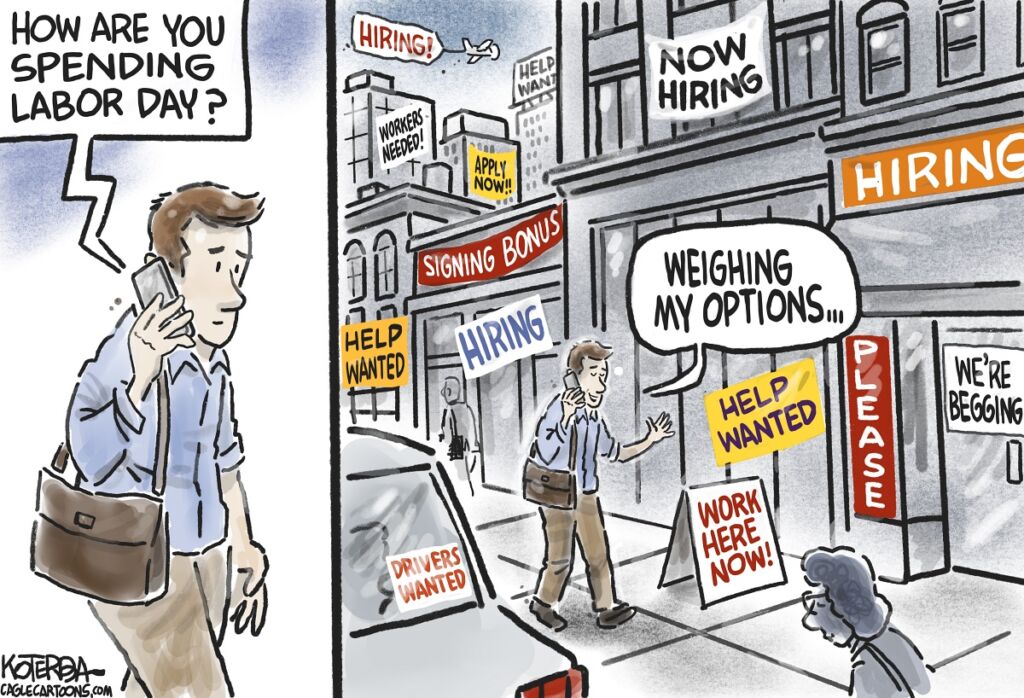
(Editor's Note: The number of workers quitting their jobs is unprecedented. And we have not seen this number of strikes for decades. On the railroad, freight workers have failed to return from furlough, others seek refuge in passenger service, while others jump ship from the industry altogether. Is the American working class awakening from it s deep slumber. We can only hope so!) |
|
Why Are Workers Quitting and Striking in Record Numbers? |
|
... So serious is the labor market upheaval that Jack Kelly, senior contributor to Forbes.com, a pro-corporate news outlet, has defined the trend as, “a sort of workers’ revolution and uprising against bad bosses and tone-deaf companies that refuse to pay well and take advantage of their staff.” In what might be a reference to viral videos like those of McGrath, Ragland, and the growing trend of #QuitMyJob posts, Kelly goes on to say, “The quitters are making a powerful, positive and self-affirming statement saying that they won’t take the abusive behavior any longer.”
The resignations ought to be viewed hand in hand with another powerful current that many economists are ignoring: a growing willingness by unionized workers to go on strike.
Film crews may soon halt work as 60,000 members of the International Alliance of Theatrical Stage Employees (IATSE) announced an upcoming national strike. About 10,000 employees of John Deere, who are represented by the United Auto Workers, are also preparing to strike after rejecting a new contract. Kaiser Permanente is facing a potential strike from 24,000 of its nurses and other health care workers in Western states over poor pay and labor conditions. And about 1,400 Kellogg workers in Nebraska, Michigan, Pennsylvania and Tennessee are already striking over poor pay and benefits.
The announced strikes are coming so thick and fast that former U.S. Labor Secretary Robert Reich has dubbed the situation “an unofficial general strike.”
Yet union representation remains extremely low across the United States—the result of decades of concerted corporate-led efforts to undermine the bargaining power of workers. Today only about 12 percent of workers are in a union.
The number of strikes and of striking workers might be far higher if more workers were unionized. Non-union workers like McGrath and Ragland hired by historically anti-union companies like Walmart might have been able to organize their fellow workers instead of resorting to individual resignations. While viral social media posts of quitting are impactful in driving the conversation around worker dissatisfaction, they have little direct bearing on the lives of the workers and the colleagues they leave behind.
One example of how union organizing made a concrete difference to working conditions is a new contract that 7,000 drug store workers at Rite Aid and CVS stores in Los Angeles just ratified. The United Food and Commercial Workers Local 770 negotiated a nearly 10 percent pay raise for workers as well as improved benefits and safety standards.
|
|
(Editor's Note: This is an update of our Report from last week on this exciting development. Citizens groups are joining with railroad workers in a chorus of discontent with the nation's Class One railroads.) |
|
Solutionary Rail: "We're picking a fight with Wall Street Railroads - Are You In?" |
|
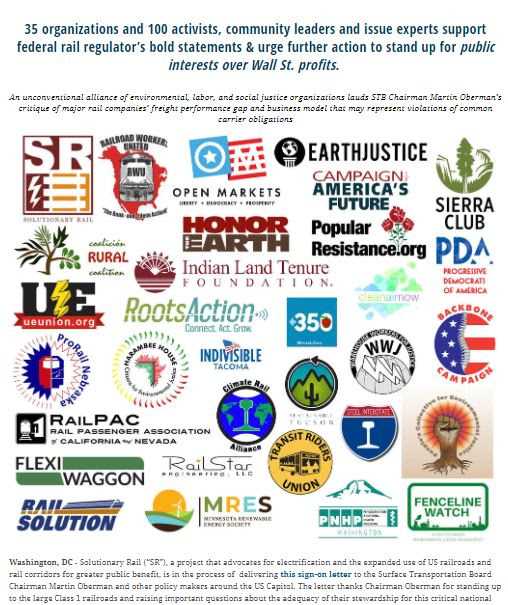
Over the last few days, Solutionary Rail delivered the sign on letter to Surface Transportation Board (STB) Chairman Martin Oberman, as well as over 100 copies to key members of Congress, Secretary Buttigieg, and other STB board members. Here's the press release about that letter and the 35 organizations, 100 activists, community leaders and issue experts who signed on in support of this federal rail regulator’s bold statements.
Our unconventional alliance of environmental, labor, and social justice organizations is letting STB Chairman Martin Oberman know that we have his back. We need you to have ours. We support Chairman Oberman's critique of the Class 1 railroads' misdirected loyalties to Wall Street rather than the public good. They have most certainly failed to live up to their common carrier obligations. Together, we are calling for coordinated action between the STB, Congress, and the Biden Administration.
Standing up to the Robber Barons of today and their Wall St. Railroad monopolies can and must be done. Our forebears did so, and now it's our turn. It won't be easy. So, we need you help. Please lock arms with us, lean in, and take action.
Here's What You Can Do to Assist
Contact members of the Senate Commerce Committee and House Transportation & Infrastructure Committee to confirm that they received a copy of the Solutionary Rail sign on letter (from committee staff). Then ask them to support Oberman and collaborate with him on both: Characterizing the External Costs of Freight Transport AND the updating of Common Carrier Obligations to serve 21st Century Public Interests.
-
Use our Social Media Toolkit to amplify this effort.
This is a critical moment in the Solutionary Rail campaign. We are deeply grateful and honored that so many excellent people and organizations signed onto the letter to STB Chairman Oberman.
Your follow through is critical for growing the momentum of this moment.
Forward Together!
Bill Moyer
|
|
(Editor's Note: RWU issued a Special Bulletin on this subject last week. If you missed it, click on the link below. The trial is currently in progress.) |
|
Landmark Railroad Worker Case Goes to Trial Again After a Decade of Fighting for Justice |
|
Curtis Rookaird - former BNSF Conductor - passed away on September 10, 2021, not living to see the end result of his wrongful termination whistleblower landmark case against BNSF Railroad, which originated back in February, 2010. It was revealed at his initial trial that the company had intended to "make an example out of Curtis Rookaird and his crew." Curtis lost his life to cancer caused by the stress. According to court records, Curtis' brother in-law recently has stepped in as the plaintiff for Curtis' grieving wife, Kelly and their two young boys. Kelly has been Curtis' main advocate for nearly 12 years.
Timeline of a Railroad Worker Whistleblower Case
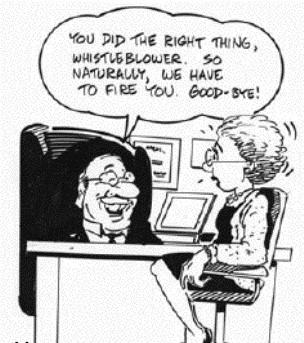
Former BNSF conductor Curtis Rookaird and his family have been battling BNSF since February, 2010 as a whistleblower for wrongful termination. He won his initial case before the Occupational Safety & Health Administration (OSHA) only to have it appealed by the rail carrier. Then in federal court, he won $1.66M in a jury trial, only to have the carrier appeal once again. The case goes to court again next week. For him and his family, this ordeal has been brutal. This is a classic case of a wealthy corporation with deep pockets using the courts, the legal system, and endless appeals in an attempt to destroy any opposition to their power and authority.
-- July 2010: Rookaird files a complaint with the federal government accusing BNSF of retaliation.
-- July 2011: Panel rules in favor of the carrier
-- September 18, 2013: OSHA issues a detailed report supporting Rookaird and ordering BNSF to pay him more than $110,000 in compensatory damages and $25,000 in punitive damages and back pay in addition to rehiring him. This never is implemented by BNSF. Instead, case is appealed to federal court.
in his local community.
-- November 2018: Ninth Circuit reverses the district court's grant of partial summary judgment, vacates the judgment against BNSF, and remands the case for further proceedings.
-- December 22, 2020: Oil train derails in Ferndale, WA, close to the same location where Rookaird insisted on performing an air test a decade earlier that resulted in his being fired. BNSF is accused of failing to properly inspect and test the train prior to movement!
-- September 10, 2021: Curtis Rookaird dies of cancer after a long battle.
-- October 25, 2021: The Curtis Rookaird case - now more than 10 years in the making - is set to go to trial once again.
|
|
(Editor's Note: As late and as limited as it is, this is a positive development to see the union be a little proactive on the question.)) |
|
SMART-TD Produces Advertisement in Support of the Two-Person Crew |
|
The SMART Transportation Division continues to fight for the safety of the public and rail employees by advocating the Rule of 2, a certified conductor and engineer aboard U.S. freight trains. |
|
(Editor's Note: A positive development for the potential of passenger rail coordination and expansion.) |
|
California Passenger-rail Agencies Form Advocacy Coalition |
|
The coalition will seek to educate federal policymakers on the nature of Amtrak state-supported services, raise awareness of California's growing passenger-rail system and proposed capital investments, and build stronger relationships with national intercity rail stakeholders.
"We look forward to working together with our sister agencies to raise awareness about our growing rail corridor services and the important role our state plays in maintaining Amtrak’s state-supported services," said Donna DeMartino, managing director of LOSSAN, in a news release.
Over the past four decades, California has invested more than $3.2 billion in improving its intercity passenger-rail network. Pre-pandemic, one out of every five Amtrak riders boarded a train in California.
|
|
Amtrak Again Asks STB to Order Passenger-rail Access to Gulf Coast Freight Tracks |
|
Amtrak wants access to the freight-rail lines so that it can relaunch passenger-rail service along the Gulf Coast. Amtrak trains haven’t traveled along the coast since Hurricane Katrina hit the area in 2005.
Initially, Amtrak sought an interim order in March, but the STB ruled in August that the request was moot because Amtrak received the access it sought and the parties were working to reach agreement on the matter.
"Unfortunately, in certain areas, Amtrak is no longer receiving the access to CSX's rail lines that Amtrak seeks and CSX is no longer working with Amtrak to reach a suitable accommodation," Amtrak states in an Oct. 20 filing with the STB.
At issue now is Amtrak's request for access to survey CSX's Choctaw Yard as a site for a temporary layover track for the Gulf Coast service. Amtrak previously used a track at the yard to store trains on Amtrak’s Gulf Coast Limited and Gulf Breeze services.
However, in 2019 CSX removed the track from the yard and Amtrak is now seeking the Class I’s cooperation on a survey of the site for potential restoration of the track or to determine the options for an interim layover of the track, according to Amtrak’s filing.
Amtrak, CSX and NS have been at odds over some issues involving the passenger railroad’s interest in reestablishing service along the coast. Amtrak announced earlier this year that it wants to start serving the region in early 2022.
|
|
(Editor's Note: Once again, no matter how bad it gets for us, somehow the railroads continue to lower the OR and rake in the dough...) |
|
CSX in Q3: Higher Net Earnings, Lower Operating Ratio |
|
CSX posted an operating ratio of 56.4% in Q3 2021 compared to 56.9% in the prior year period, CSX officials said in a press release.
Revenue for quarter climbed 24% from the prior year to $3.29 billion, driven by growth across all business lines, increases in other revenue and the inclusion of Quality Carriers’ results.
Operating income improved 26% to $1.44 billion for the quarter.
"I want to thank all of CSX’s railroaders for their continued dedication to our customers amidst the combination of ongoing supply chain disruptions and challenges presented by the COVID-19 Delta variant this quarter," said President and CEO James Foote. "We are committed to helping our customers overcome current supply chain constraints and will continue to take action in order to keep our network fluid and design new solutions that enable the delivery of critical goods to millions of Americans."
|
|
(Editor's Note: To see UP and NS posing as some sort of guardian of the health and safety of their employees is sickening. Throughout the pandemic they have done little to ensure the health and well being of their employees, made deep cuts to the payroll, then petitioned - and received - a waiver from then FRA Director Ron Batory to ignore numerous safety regulations due to "pandemic caused short staffing.") |
|
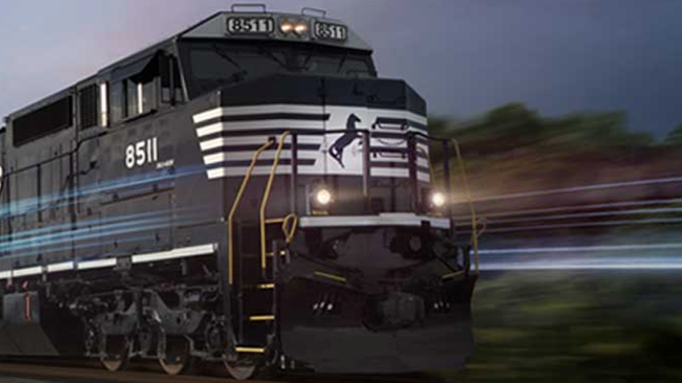
NS Requiring COVID-19 Vaccinations for All Employees |
|
The move stems from an Executive Order and associated guidance mandating that federal contractors require vaccinations for all employees. “We haul tanks, Humvees, and jet fuel for the U.S. Department of Defense and deliver coal to the federally run Tennessee Valley Authority,” NS wrote in an internal memo to employees, obtained by Railway Age. “After reviewing the order carefully to be certain, we determined that we are covered under the mandate.”
Railway Age reproduces the NS memo, in full, below:
“Federal Vaccine Mandate Will Require Change in NS Policy
“From the start of the pandemic, we’ve put a priority on maintaining safe and healthy workplaces as we pull together to keep our economy moving. We’ve encouraged employees to follow guidance from public health experts regarding vaccination, but we haven’t mandated vaccination as some companies have done. Our employees have diverse and often deeply held views on this topic, and we respect those differences.
|
|
Senate Transportation Appropriations Bill Includes Funds for Passenger-rail, Transit |
|
The U.S. Senate Committee on Appropriations has released the legislative text of the Transportation, Housing and Urban Development,and Related Agencies Appropriations Act (THUD) Appropriations bill, which would provide $13.5 billion for public transit and $3.4 billion for passenger-rail grants, according to the American Public Transportation Association (APTA).
The public transit amount represents a $503 million increase from the fiscal-year 2021 THUD Appropriations Act, and for the passenger-rail grants an increase of $863 million from the FY 2021 enacted level. In total, the bill provides $16.9 billion for public transit and passenger rail, an increase of $1.4 billion from the FY 2021 enacted level, according to the APTA's Legislative Update.
The legislation bases the public transit contract authority levels on the FAST Act extension and does not assume enactment of the bipartisan infrastructure bill, the Infrastructure Investment and Jobs Act (IIJA).
This approach results in a lower level of contract authority and obligation authority for public transit than if the IIJA is enacted. APTA is actively advocating for enactment of the IIJA and for THUD Appropriations legislation to reflect the higher IIJA funding levels.
|
|
‘Carloads Up, Intermodal Down’ Trend Persists in Week 41, AAR |
|
For the week ending Oct. 16, 2021, total U.S. rail traffic dropped 4.2% from same week last year, with intermodal losses dragging down carload gains for the 11th consecutive week, according the Association of American Railroads’ Oct. 20 report. Total carloads for the week ending Oct. 16, 2021, came in at 229,730, rising 1.2% vs. the prior-year period, and intermodal volume was 267,253 containers and trailers, falling 8.5%. Combined, carloads and intermodal units reached 496,983.
The intermodal fall-off spans 11 weeks now. For more on the trend, including rising carloads, see “AAR: No Single Solution to the Intermodal Problem” and “AAR: North American Rail Volume Up 7.6% Through 40 Weeks.” According to AAR, five of the 10 carload commodity groups posted an increase compared with the same week in 2020. They included metallic ores and metals, up 3,471 carloads, to 21,990; chemicals, up 3,000 carloads, to 32,721; and nonmetallic minerals, up 1,157 carloads, to 32,210. Commodity groups that posted declines compared with the same week in 2020 included coal, down 2,493 carloads, to 57,772; motor vehicles and parts, down 2,260 carloads, to 13,374; and miscellaneous carloads, down 798 carloads, to 9,601.
|
|
(Editor's Note: The RMT has engaged in a series of strikes over wages, benefits and working conditions in the last few years in the UK. Many in recent years were over train crew staffing and the demand to keep the "guard" and the two-person crew on the train. Thier startegy of striking appears to be working.) |
|
UK Rail Union RMT Moves Forward with Strike Action in Scotland |
|
National Union of Rail, Maritime and Transport Workers (RMT) - Strike action during COP26 goes ahead as RMT AGM rejects latest "pitiful" pay offer from Scotrail Delegates at RMT's AGM in Leeds have voted to reject a “revised pay offer" from Scotrail and to go ahead with strike action alongside Caledonian Sleeper members throughout COP26 in a fight for pay justice for Scotland's rail workers. Representatives from Scotrail slammed the proposed "new deal", which has been driven by Nicola Sturgeon, the SNP and Transport Scotland, as poor, loaded with productivity strings and wholly unacceptable to the members who voted overwhelmingly for strike action to secure a fair pay deal. General Secretary Mick Lynch said: "RMT is a democratic organisation and following a string of impassioned speeches by Scotrail delegates our AGM has voted to reject this offer, to support our Scottish members and to press ahead with the action throughout COP26. "We have been given a wholly arbitrary deadl
|
|
|
|
|
|
|