November 4, 2026 • כ״ד מרחשון תשפ״ז

Dear Chaverim,


The U.S. (and Israeli) polls have closed, and as I write (on Tuesday afternoon) we are still waiting to learn the results and what they mean. Whatever the outcome, I want to share something with you that is, by design, not always visible from the outside: the RCA is involved in the public square.


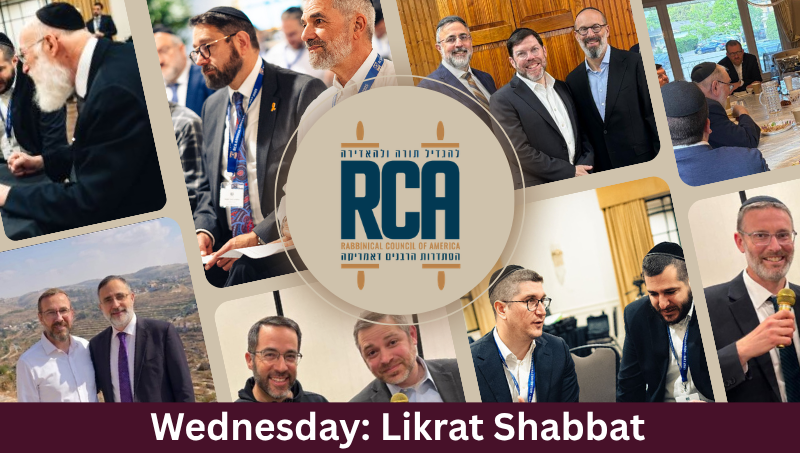
The calling of the shul rabbi is to keep the doors of our shuls open to every Jew who wants to walk through them, and our shuls are not, and must never become, partisan spaces. That is as true today as ever. At the same time, we are the voice of 1,000 rabbis, many of us concentrated in the New York metropolitan area, and that carries significant responsibility. When it comes to fighting antisemitism, we cannot afford to stand on the sidelines, and our strength lies in what we accomplish together. I serve, for example, on the JCRC New York Coalition, and just last week I spent a full day at a program where I represented the RCA and brought the Orthodox voice to the table. I am grateful for the chance to be in those rooms on your behalf, because that is where our presence matters.


I would like to hear from you, so if you have ideas, concerns, or something happening in your own community that we should know about, please reach out to me directly at any time.


May our shared efforts help bring about a time of שלום for our communities and for all of Klal Yisrael.

With warm regards and wishes for a good Shabbos,

R. Menachem Penner

Chomer Lidrush

A spark to start your drasha heading into Parshas Chayei Sarah

1) A Hundred, Twenty and Seven at Once


A guest contribution from our chaver R. Aaron Goldscheider


Why does the Torah count Sarah's life as "mei'ah shanah v'esrim shanah v'sheva shanim" (23:1) rather than simply 127 years? Rashi reads it as praise: at a hundred she was like twenty in sin, at twenty like seven in beauty, and all her years were equally good. Writing in a guest post for us, R. Aaron Goldscheider brings Rav Soloveitchik's reading that Sarah was all three ages at the same time, with the wisdom of an elder, the idealism of a young adult and the wonder of a child, together with the Netziv's comment that chaim can also mean joy. The Rav found thhttps://buzzy.blog/yoni-schwartz/did-you-make-it-or-did-the-robotat inner child indispensable in three places: in tefillah, which begins with a child's longing to be held by a parent; in emunah, since, as the Rav put it, only a child is capable of absolute, unconditional surrender; and in talmud Torah, which he saw reflected in the childlike faces of the keruvim. The Gemara (Bava Kamma 97b) describes a coin from the days of Avraham and Sarah with an old man and woman on one side and a young boy and girl on the other. A congregation that spends all week being responsible adults can hear that Sarah's greatness was that she never stopped being young.

2) Is There Room to Lodge?


Eliezer gives Rivka a gold ring weighing a beka and two bracelets weighing ten (24:22), and both Targum Yonasan and Rashi read them as hints: the beka to the half-shekel, the bracelets to the two luchos, the ten to the Aseres HaDibros. In "Ransom for the Soul," Rav Soloveitchik asks why, of all the mitzvos, the half-shekel should stand for Israel's future. Unlike a chatas or asham, which atone for particular sins, the half-shekel is a "kofer nafsho" (Shemos 30:12) given by everyone, "sinners as well as God-fearing, ordinary Jews and Talmidei Chachamim." No one is complete. Every Jew has something to teach and something to learn, and no one may rebuke others unless he is ready to be rebuked himself.


Click Here to Read More

3) Arriving With All His Days


"V'Avraham zakein ba bayamim" (24:1) is usually translated "advanced in years," but the Zohar (I:224a) reads it as "he came with all his days": every one of Avraham's days was full of mitzvos and ma'asim tovim, and when he left the world he came before Hashem together with all of them. Rav Moshe Wolfson zt"l, in Wellsprings of Faith, builds a Jewish concept of time around this. A day is not an empty stretch of hours but a creation of its own; the Zohar teaches that each day comes down to a person like a blank parchment, records whatever he does, and goes back up when it ends. That is why each unit of time has a window for teshuvah just before it leaves us: Krias Shema at the close of the day, erev Shabbos, erev Rosh Chodesh (Yom Kippur Katan) and erev Rosh Hashanah.


Click Here to Read More

4) Parperet: A Building That Outlasts Death


Rav Zvi Sobolofsky, in Kol Chosson, starts from the Rambam (Hilchos Ishus 1:1): before Matan Torah a couple married privately, "beino l'vein atzmo," with no one present, while after Matan Torah kiddushin requires eidim. What happens in private is casual and passing; witnesses make it permanent, which is why the sheva berachos (Kesubos 7b-8a) speak of a "binyan adei ad," since the eid is what makes it ad. That, he suggests, is why so many dinei kiddushin come from our parsha, and why the Gemara (Kiddushin 2a) learns kiddushei kesef from Avraham's purchase of the Me'aras HaMachpelah. Before Matan Torah a marriage ended with the death of a spouse, and a man who saw it that way would not have spent such time and money on a burial place for his wife.


Click Here to Read More

Manning the Media


"Did You Make It, Or Did the Robot?," Yoni Schwartz, Worth Asking (November 1, 2026)


On AI Creation and Authorship


RCA Nachas


Rabbi Mark Dratch, RCA Executive Vice President Emeritus and Chair of the International Jewish Committee for Interreligious Consultations (IJCIC), delivered a keynote address at the opening ceremony of the G20 Interfaith Forum's annual conference in Salt Lake City on October 15. Speaking alongside religious leaders from around the world, he offered a message of hope rooted in the prophet Zechariah's call to the asirei ha-tikvah, the "prisoners of hope" (Zechariah 9:12), urging people of faith to remain bound to hope even in difficult times. His participation reflects the RCA's ongoing commitment to representing Orthodox Jewish values with dignity and conviction on the international stage.


Do you have some nachas to share about yourself or another RCA member? Let us know!


Partnered Content


The Menorah of Hope is looking for its home this Hanukkah


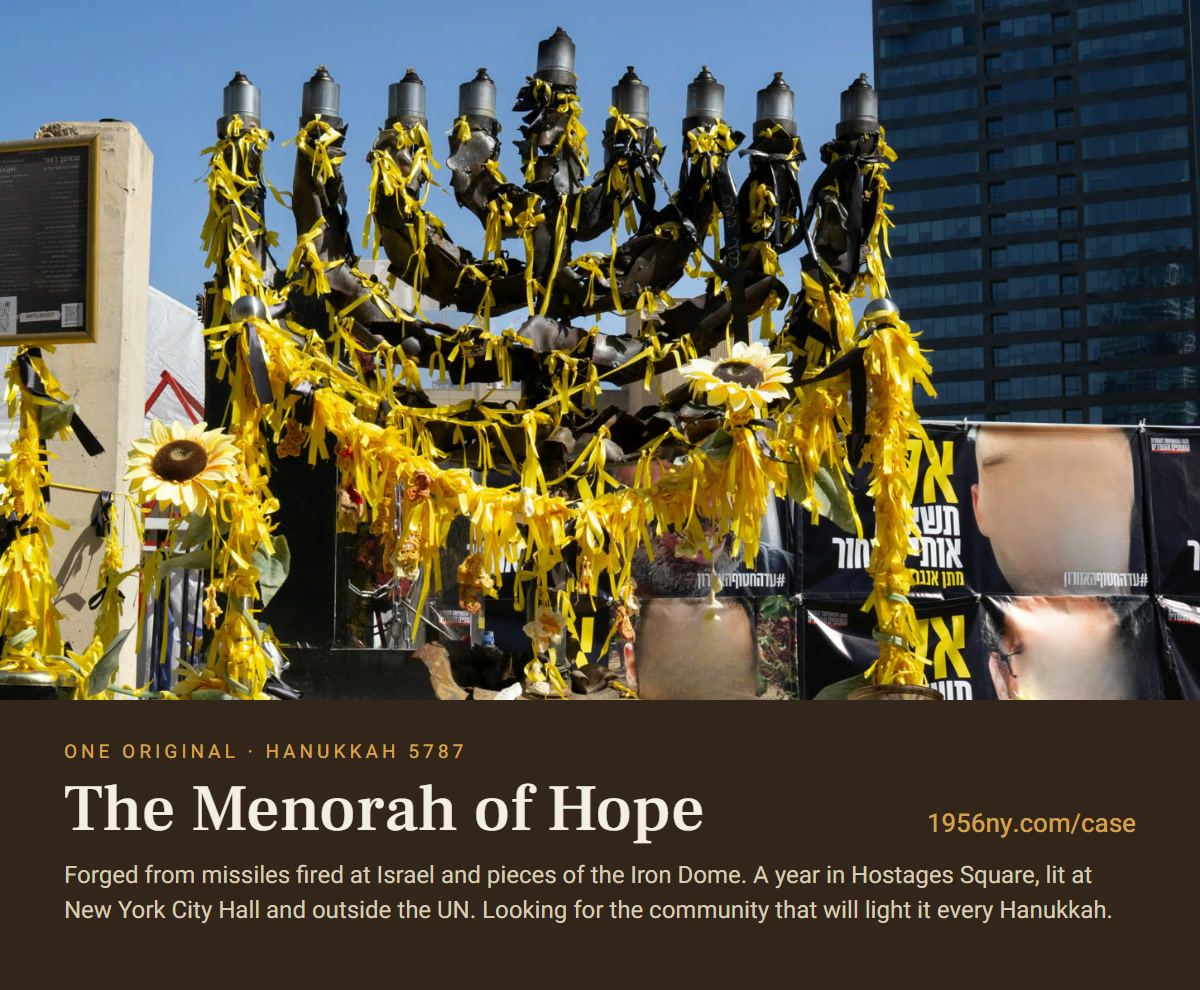
Israeli artist and Air Force reservist Eli Gross forged the Menorah of Hope from fragments of missiles fired at Israel from Iran, Gaza and Lebanon, and pieces of the Iron Dome that stopped them. None of those missiles took a life.


For a year it stood in Hostages Square in Tel Aviv, where thousands tied yellow ribbons to its branches. Last Hanukkah, it was lit at New York City Hall and outside the United Nations.


Now the single original is offered for acquisition to one community, to be lit every Hanukkah, for generations. It stays with that community permanently. A family can dedicate it, in their name or in memory of someone dear, or a circle of families can share it as a Minyan of Hope, with every name on the plaque.


To have it in place for the first night of Hanukkah, communities decide by mid-November.


Watch the 94-second film and see the full case: 1956ny.com/case


Eli Gross · grossjewishart@gmail.com


L'maan Tzion: Advocacy for Israel

Confessions of an Election Day addict by our chaver David Fine


Do I want another election? No. Neither do most of us. But I’d be lying if I said a little part of me didn’t wish Election Day came around more often.


Most of us don’t actually think another election is a good idea. But a little part of me secretly craves one.


I don’t know about you, but I love seeing the pictures people post of themselves voting. What I find most remarkable is that olim who have been here 30 or 40 years seem just as excited as they were the first time they voted. I made aliyah a little over 18 years ago and I’m just as excited as I was then. I keep going back to a video my son posted on our family WhatsApp group of my four-year-old grandson placing his father’s envelope in the ballot box. I’ve watched it more times than I would like to admit. I love election day and I’m sure most Israelis reading this will agree. It’s hard to convey to our friends and family back where we came from how we really feel on this day.


Click here to continue