December 2023

Wishing Each of You the Happiest of Holidays  

Industrial Wage Orders – Are Yours Posted?


Listed in this link are brief historical perspectives on each of the Industrial Welfare Commission's 17 individual industrial and/or occupational wage orders. Each effective date cell displays an individual wage order and its evolvement since 1980. The effective date usually represents the point in time when significant changes to a wage order were to be implemented. However, in some instances, minor revisions and amendments to the wage order not previously incorporated, may be included as of that particular effective date.


Also provided as another informational aid is a link that will allow you to review the summary for each individual wage order. This link can be used two different ways to access all wage order summaries: by clicking on the link here, or when you access a particular wage order there will be another link to that wage order's specific summary. 


Industrial Wage Order 16 is the one that covers construction. Pay particular attention to the section about Uniforms and Equipment (see below):


UNIFORMS AND EQUIPMENT

  • (A) When the employer requires uniforms to be worn by the employee as a condition of employment, such uniforms shall be provided and maintained by the employer. The term ”uniform” includes wearing apparel and accessories of distinctive design or color. (B) When the employer requires the use of tools or equipment or they are necessary for the performance of a job, such tools and equipment shall be provided and maintained by the employer, except that an employee whose wages are at least two (2) times the minimum wage may provide and maintain hand tools and equipment customarily required by the particular trade or craft in conformity with Labor Code Section 2802

Risks of Rounding: Court Requires Timekeeping to the Minute

Courtesy of Michelle Galbraith, J.D.; Employment Law Expert, CalChamber


California employers often round employee time punches to a portion of an hour — the practice can allow employees leeway when running a few minutes late, and it often simplifies payroll and invoicing. Federal law, California’s Division of Labor Standards Enforcement (DLSE) and California appellate court decisions had long approved of rounding, as long as it was neutral and didn’t work to systematically deny employees their full wages.


In the past few years, however, some California courts of appeal have issued opinions disapproving of rounding policies, and the California Supreme Court is currently hearing a case — Camp v. Home Depot U.S.A. — that will resolve the conflicts between the legal decisions.

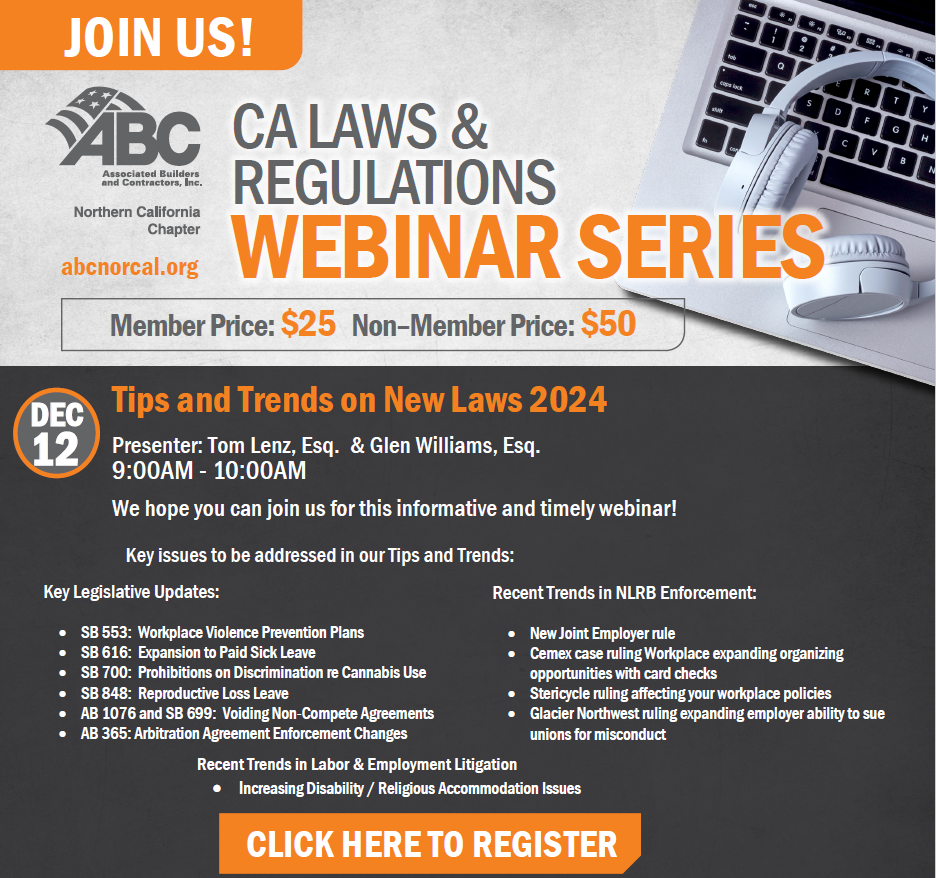
Ring in the New Year with Handbook Updates for 2024!

Courtesy of  DANIEL F. C. KOZIEJA / NOVEMBER 30, 2023


As we approach the end of the year, employers are busy putting plans in place for 2024. A key priority that should not be neglected as businesses prepare to commence the new year is updating their employee handbooks to ensure compliance with new laws as discussed below.


Reproductive Loss Leave

Beginning January 1, 2024, Senate Bill 848 requires employers with five or more employees to provide up to five days of protected leave for eligible employees experiencing a “reproductive loss event.” A “reproductive loss event” is defined to include a failed adoption, failed surrogacy, miscarriage, stillbirth, or unsuccessful assisted reproduction. Employees are eligible for this leave if they have been employed for at least 30 days before the need for leave arises. An employee’s right to reproductive loss leave shall be construed as a separate and distinct right from any other protected leaves the employee would be entitled to.


When requesting a reproductive loss leave, an employee does not need to take time off consecutively. However, the employee must complete the leave within three months of the reproductive loss event. If an employee experiences more than one reproductive loss event within 12 months, an employer is only required to provide up to a total of 20 days of leave.


Employees requesting leave are not obligated to furnish any documentation to support their request. Furthermore, employers must maintain the confidentiality of any employee requesting reproductive loss leave. Any information provided to the employer shall not be disclosed except to internal personnel or counsel, as necessary, or as required by law.


If an employer does not have an existing applicable paid leave policy, reproductive loss leave may be unpaid, except that an employee may use vacation, personal leave, accrued, and available sick leave or compensatory time off that is otherwise available to the employee.


Expanded Sick Leave Requirements

As discussed in greater detail here, as of January 1, 2024, Senate Bill 616 requires employers to increase the amount of paid sick leave provided to their employees from 3 days (24 hours) to 5 days (40 hours). Employers must also increase their annual sick leave usage cap from 3 days (24 hours) to 5 days (40 hours). Similarly, employers using the accrual basis to calculate paid sick leave must increase their overall annual accrual cap from 6 days (48 hours) to 10 days (80 hours).


Off Duty Cannabis Use and Drug Testing

Passed in 2022, but not effective until January 1, 2024, Assembly Bill 2188, discussed in further detail here, prohibits employers from discriminating against applicants and employees based on the use of cannabis off the job and away from the workplace or an employer required drug test, which reveals the presence of non-psychoactive cannabis metabolites. Key to the ban on this specific type of testing is the fact that it only shows whether an individual has used cannabis within the last few weeks and not whether an individual is currently impaired. While the law does contain exemptions for certain types of employers and employees, including those “in the building and construction trades,” most employers will need to revise their existing drug testing policies to delete reference to off duty cannabis usage and testing for marijuana if such testing reveals only the presence of non-psychoactive cannabis metabolites.


National Labor Relations Act Compliance

In 2023, the National Labor Relations Board took a stand against employer policies which potentially infringe upon employee rights to engage in concerted activity protected under Section 7 of the National Labor Relations Act (NLRA) (see detailed discussion here). As a result, employers should review their existing policies, particularly those addressing standards of conduct, confidentiality, and social media usage, to determine whether such policies have a reasonable tendency to chill employees from exercising their NLRA rights.


Next Steps for Employers

Employers should evaluate their current policies and procedures to ensure compliance with these new laws. Next steps include reviewing and updating employee handbooks or stand-alone policies and training management on the new laws. Please contact your Cook Brown attorney for assistance.

SB 553 Law Requires Implementation of Workplace Violence Prevention Measures

Courtesy of  DANIEL F. C. KOZIEJA / NOVEMBER 22, 2023


Effective July 1, 2024, Senate Bill 553 requires employers with at least one employee to take several steps to prevent workplace violence, including implementing a written workplace violence prevention plan, providing training on the plan, and maintaining a log of workplace violence incidents and investigations. Notably, although Cal OSHA is authorized to begin enforcing these requirements next summer, the agency is not required to adopt standards regarding the plan until December 31, 2026.


Plan Components

The bill requires employers to create a written workplace violence prevention plan, either as a separate document or as part of an existing injury and illness prevention program (IIPP), containing procedures for the following:

  • Identification of employees responsible for implementing the plan
  • Obtaining active involvement of employees / employee representatives in developing and implementing the plan
  • Coordinating implementation of the plan with other employers (such as staffing agencies)
  • Accepting and responding to reports of workplace violence
  • Prohibiting retaliation against reporting employees
  • Ensuring employees comply with the Plan
  • Communicating with employees regarding:
  1. How to report violent incidents, threats, and workplace violence concerns to the employer or law enforcement
  2. How concerns will be investigated and results communicated
  • Responding to actual and potential workplace violence emergencies, including:
  1. Means to alert employees of the presence, location, and nature of workplace violence emergencies
  2. Evacuation or sheltering plans
  3. Obtaining help from assigned staff, security personnel, and law enforcement
  • Identification, evaluation, and correction of workplace violence hazards
  • Post-incident response and investigation
  • Reviewing the plan annually when a deficiency becomes apparent or after a workplace violence incident


Training Requirements

Employers will be required to provide training on the plan when it is first established and annually thereafter and to retain training records for at least one year. The training must cover the following topics:

  • The plan and how employees can obtain a free copy of it
  • How to report workplace violence hazards and incidents
  • Corrective measures implemented by the employer
  • How to seek assistance to prevent or respond to violence
  • Strategies to avoid physical harm
  • Information about the employer’s violence incident log and how employees can obtain a copy


Incident Log

Employers also must record workplace violence incidents in a written incident log, which must be retained for five (5) years and made available to employees upon request for examination and copying within fifteen (15) days. Information recorded in the log must exclude personal identifying information and include the following details: 

  • Date, time, and location of the incident
  • Detailed description of the incident
  • Classification of who committed the violence
  • Type of violence involved, e.g. physical attack or threat, sexual assault, involvement of weapons
  • Incident consequences, including contact with security or law enforcement and actions taken, if any, to protect employees from continuing threats


Exemptions

The following employers, employees, and places of employment are exempt from SB 553’s requirements:

  • Employers already covered by Cal OSHA’s Violence Prevention in Health Care standards
  • Employees who telework from a location of their choosing that’s outside the employer’s control
  • Locations not open to the public where less than 10 employees work at a given time
  • Department of Corrections and law enforcement agencies.


Next Steps

Given the multiple requirements imposed by SB 553, employers should take steps to ensure compliance well in advance of the July 1, 2024 implementation date. Your Cook Brown attorneys are ready to assist with that process.

 
Check ABC NorCal website for ALL upcoming classes, events and webinars.

Upcoming Webinars/Events


Public Works Compliance 101 - December 14th - 10:00 a.m. - 11:00 a.m. - Webinar

Subscribe to the Newsletter
 
Facebook  Instagram  Twitter  Linkedin