Vol. 8, Issue No. 12
September 8, 2020
|
|
From the Hawk's Nest, New River CTC's employee newsletter, is distributed twice a month, and we need your input! Have story ideas or photos for From the Hawk's Nest? Send them to the Office of Communications for the next edition.
|
|
Navigating the New School Year: So Now What? |
|
Remake Learning's "So Now What?" virtual series brings the country’s leading experts in education and childhood development, including PBS Kids, Common Sense Media, Learning Heroes and UPMC Children’s Hospital, together with parents and caregivers to share and learn from one another. Speakers will cover a range of topics specific to this moment in time, including social and emotional wellness, mental health, learning resources, communication, tech safety and much more.
|
|
|
#RemakeTomorrow: How Learning Could Look in a Post-Pandemic Future |
|
The COVID-19 pandemic has elevated incredible examples of improvisation and emergency responses in and beyond education. Much work remains as this pandemic continues to change and deepen the needs of children, caregivers and educators, leaving those who were previously under served and harmed by inequitable systems most exposed to its impacts. In the wake of COVID-19, some innovations may gain long-term traction as we work towards an equitable education system that serves all students.
Read the full report here.
|
|
Fiscal year 2021 Perkins local application approved |
|
Each year, New River CTC is awarded funding through the Perkins Act. This money is to be used to strengthen career and technical education programs.This year, the college was allotted $211,548.00. However, in order to use this money, the college must submit an application for how it will spend that money. This works like other grants in that we must apply for the money, but it is different in that we have the opportunity to correct or amend our application if the Vice-Chancellor's office (who oversees Perkins spending for all of the community colleges) takes issue with any part of our application. Our original submission was accepted.
These funds must be used for the benefit of our students in career and technical programs and beyond that, there are many additional restrictions on how the funds can be used. This leads to a lot of mystery surrounding these funds and, consequently, can lead to frustration over how funds are used. This is a transition year for how both the state and the college manage these funds. Our application had to be project based and had to fit into "Local Uses". There are six Local Uses that we could chose from: (1) Career Exploration and Development; (2) Professional Development; (3) High-skill, High-wage, In-demand Careers; (4) Academic Integrity; (5) Initiate / Improve Programs; (6) Evaluation. Here's what we settled on.
Career Exploration: $7,500 to deliver the Tech and Healthcare Expos as we have in the past.
Professional Development: $25,000 for faculty, staff, or administrators who work directly with students in career and technical programs.
Initiate/Improve Programs: $179,048 for the purchase of qualifying classroom equipment and supplies for eligible programs.
Over the next few weeks, we will develop an application and scoring process for the Professional Development and Program Improvement funds. The details are still being finalized, but alignment with assessment results, the College's strategic plan, and local workforce needs will be part of the final product. This represents a drastic change in how we approach Perkins spending as an institution. It provides more flexibility and it will provide a documented tie between planning, budgeting, and assessment of student learning. Additionally, we will have the opportunity to request modifications to our spending plan.
|
|
|
|
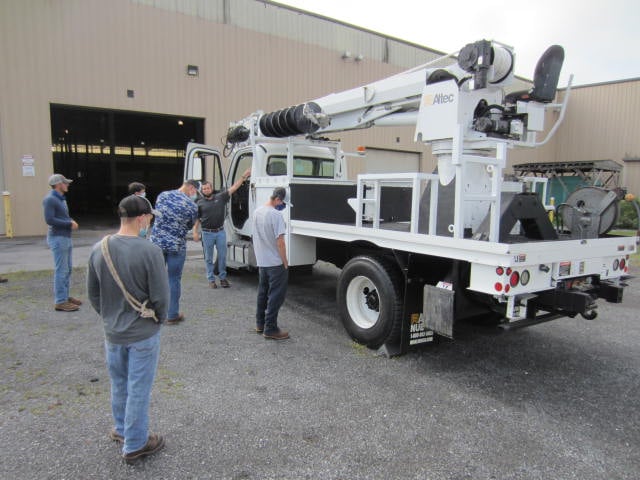
New River Community and Technical College added this ALTEC DC47-TR digger derrick line truck to our fleet of training equipment. Twana Jackson and David Shrader picked up the truck, and Austin and Gray from ALTEC provided training. |
|
With the start of the fall semester, Mike Williams is beginning his 51st year as assistant part-time librarian at the Greenbrier Valley Campus. Mike served in his role at the predecessors of New River CTC, the Greenbrier Community College Center of Bluefield State College and the Greenbrier Valley Extension Center of West Virginia University. Congratulations Mike! |
|
New River CTC Foundation awards 2020-2021 scholarships |
|
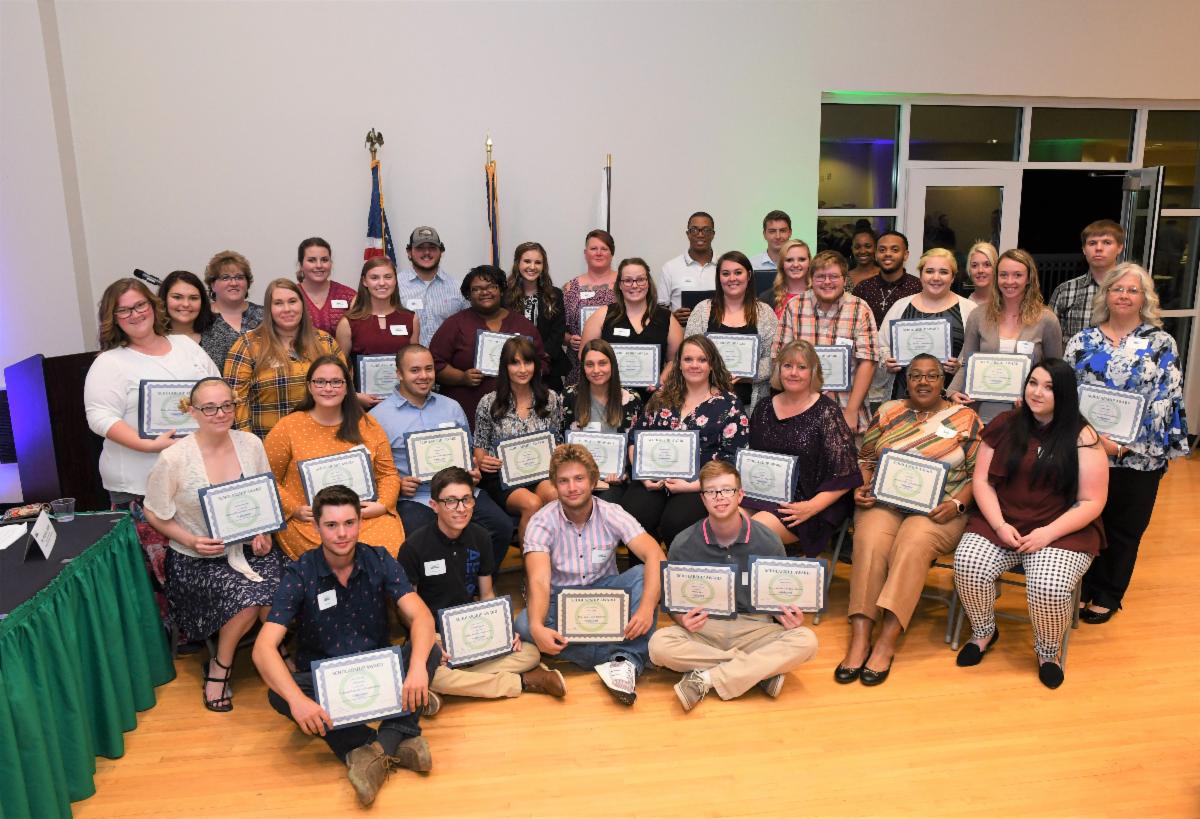
The Office of Institutional Advancement and Foundation will be recognizing this year’s scholarship recipients with an online social media promotion since the traditional banquet festivities have been canceled due to COVID-19.
Thank you to all of the faculty and staff who assisted with awarding this year’s scholarships, especially the financial aid department and faculty members who wrote letters of recommendation.
This year in addition to students receiving awards through the spring application process, the Foundation also worked with financial aid and an anonymous donor to provide one-time scholarships to students with full Pell awards who owed a balance to the College.
The mission of the Foundation is to secure financial resources to complement New River CTC’s efforts in providing higher education and enhanced workplace skills, to optimize student access to educational programs and services, and to provide a margin of excellence unavailable with state and federal funds.
To support a scholarship fund or establish a direct payroll contribution, please contact 304-929-6734, Foundation@newriver.edu, or donate via Paypal online. |
|
Active Southern
West Virginia
|
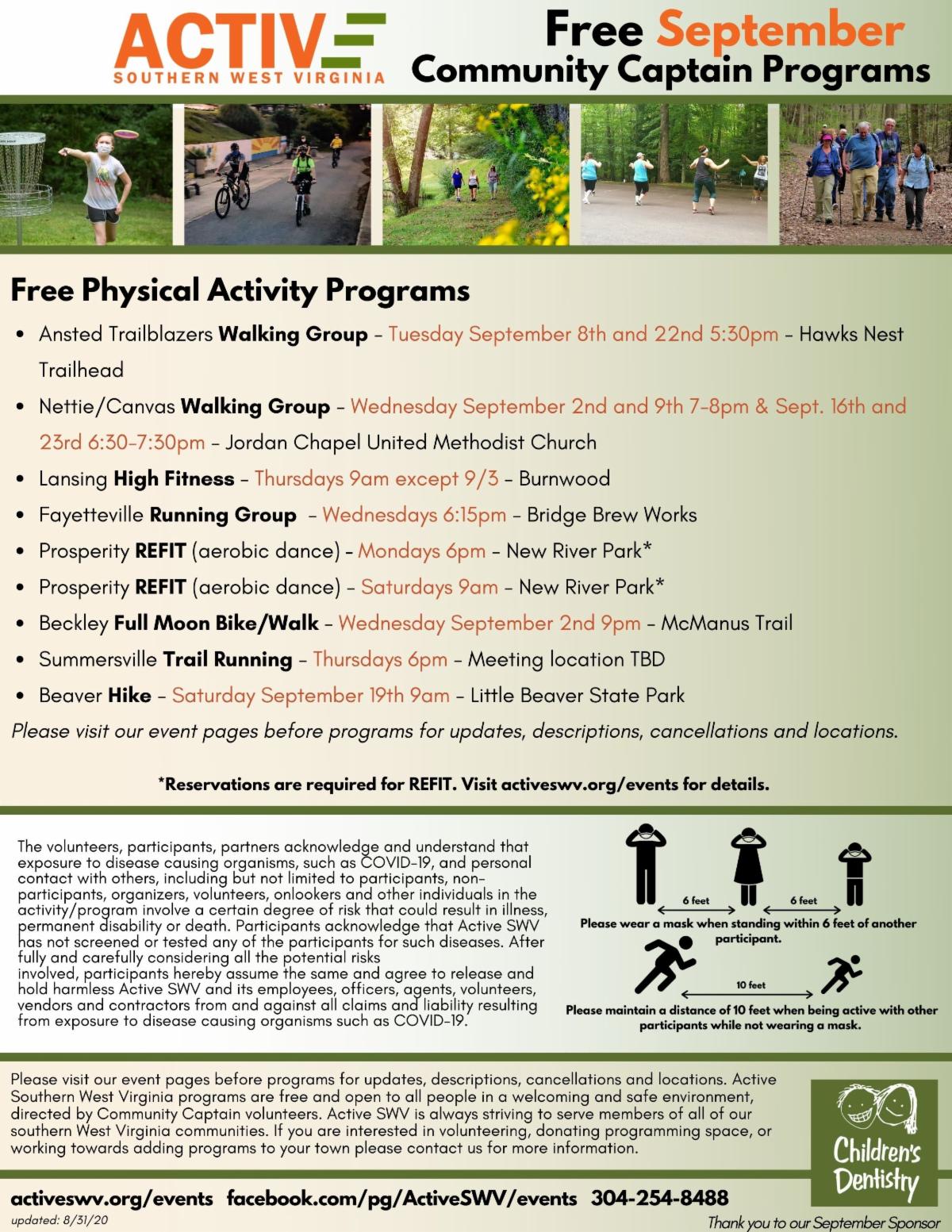
We are especially excited to recruit and train new Community Captains in Boone and Kanawha counties to lead hikes and any other activities in safe and responsible ways.
|
|
|
Currently, West Virginia is near the top in response rates for the census and is 10 percent ahead of where we were in 2010. However, there is still time for those who have not completed the census to do so. The last day for collection is September 30, 2020. A complete count helps ensure West Virginia gets all the federal funding it deserves, including Pell grants and, of course, it also affects our congressional seats. Following the 2010 census, West Virginia lost out on more than $1,000 each year for every person who was not counted.
West Virginia is responding. Don't stop. Spread the word.
|
|
 |
2020 CCA Fall Conference
The 2020 Fall Conference theme is “Pivot! Serving in a New Reality” and will be hosted by BridgeValley Community and Technical College November 4-5, 2020. This will be a virtual conference and registration is free.
|
|
|
|
Virtual experiences
Explore museums, zoos, aquariums and even amusement park rides through virtual experiences. Good House Keeping has put together a list of some of the best free virtual experiences available.
|
|
|
|
Defensive Driving September 2020 |
|
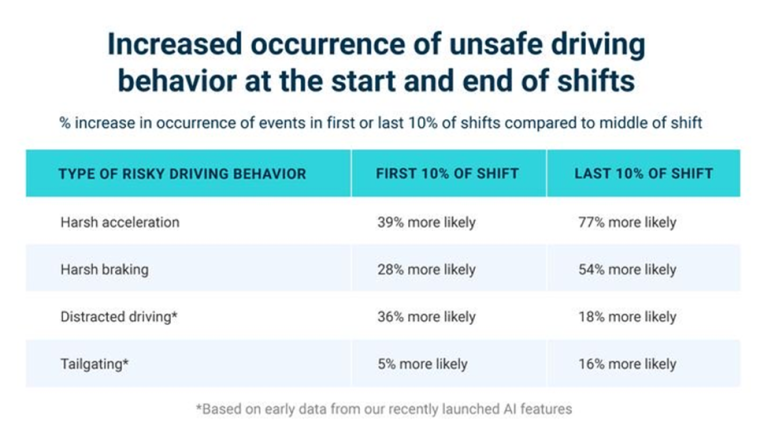
Risky driving behaviors occur more frequently at the beginning and end of drivers' shifts |
Fleet Management provides monthly driving tips to provide agencies with a way to promote good defensive driving techniques ensuring the safety of state vehicle operators. For September 2020, Fleet is providing information on risky driving behaviors.
|
Driver safety is more important than ever. Although the nation’s roadways may be emptier due to COVID-19, multiple reports have shown they are not necessarily safer—and may even be more dangerous. In fact, a recent Samsara analysis found less congested roads have resulted in a 20% increase in severe speeding among U.S. commercial drivers.
To help fleet managers better understand patterns in risky driving behavior, Samsara wanted to know: How does driver behavior change over the course of a shift? When are drivers most likely to exhibit risky behaviors?
Samsara took a sample of some of their most frequently observed unsafe driving behaviors—including two measured by g-force (harsh acceleration and harsh braking) and two detected using artificial intelligence (distracted driving and tailgating).
Here are their key findings:
-
Harsh acceleration, harsh braking, distracted driving, and tailgating occur more frequently at the beginning and end of drivers’ shifts.Samsara found these risky driving behaviors are 26% more likely to occur in the first tenth of a shift than the middle of the shift. In the last tenth of a shift, they are 41% more likely to occur.
- There is no one factor responsible for this trend. The data shows there could be multiple factors leading to these risky driving behaviors, including increased traffic and distractions in cities, last mile stops, and driver fatigue.
- It is possible to adjust this behavior. The data shows when drivers receive in-cab alerts for harsh braking and harsh acceleration, the frequency of those behaviors is reduced by up to 40%
|
|
Fleet Management Division has noticed a rise in fraudulent activity occurring at the Exxon Mobil Station located at: 1639 Washington Street East, Charleston, WV. As a precaution, we are requesting that you notify your driver’s NOT to use this vendor for State Fuel Card purchases.
Please do not hesitate to contact Fleet Management Division should you have any questions or concerns.
|
|
New River CTC does not discriminate in its educational programs or in admission to, access to, treatment in, or employment on the basis of race, color, religion, sex (including pregnancy), sexual orientation, gender identity, national origin, age, marital status, veteran or military status, disability, or genetic information or any other status or condition protected by applicable federal or state laws. The following office has been designated to handle inquiries regarding the College’s non-discrimination policies relating to disabilities, sex, Title IX or other forms of discrimination: Peter Hoeman, Interim Dean of Student Services and Title IX Coordinator, 304-929-5027, phoeman@newriver.edu, 280 University Drive, Beaver, WV 25801. Additional information can be found on the College’s website at www.newriver.edu/nondiscrimination.
|
|
|
|
|
|
|