Lawyers Committee on Nuclear Policy
February 2021 Newsletter
|
|
Happy New Year!
2021 is in full swing, and while the year has already seen its share of difficulty, this new chapter also holds an air of promise and hope. In the US, the Biden administration offers new opportunities to engage and educate on the existential risks of nuclear weapons and the body of law that establishes the weapons' illegality. The new administration has already taken steps away from the dangerous nuclear policies of the Trump administration by extending the New START agreement with Russia, calling for future negotiations with Moscow, and exploring rejoining the Iran Nuclear Deal. Biden's inauguration came just two days before the Treaty on the Prohibition of
President Biden has also appointed a variety of progressive arms control experts to carry out his agenda. These appointees represent a push towards reducing the US nuclear arsenal, a step toward the goal of eliminating nuclear weapons altogether. Regardless of national leadership, though (see the Bulletin of the Atomic Scientists on presidential sole authority, under "Recommended reading"), nuclear weapons unrelentingly threaten
humankind and our Earth so long as they exist.
Stakes remain high, and our work continues.
Take a look at some of LCNP's recent work below and
connect with us across social media.
|
|
Human Rights & Nuclear Weapons:
New Dimensions
|
|
 |
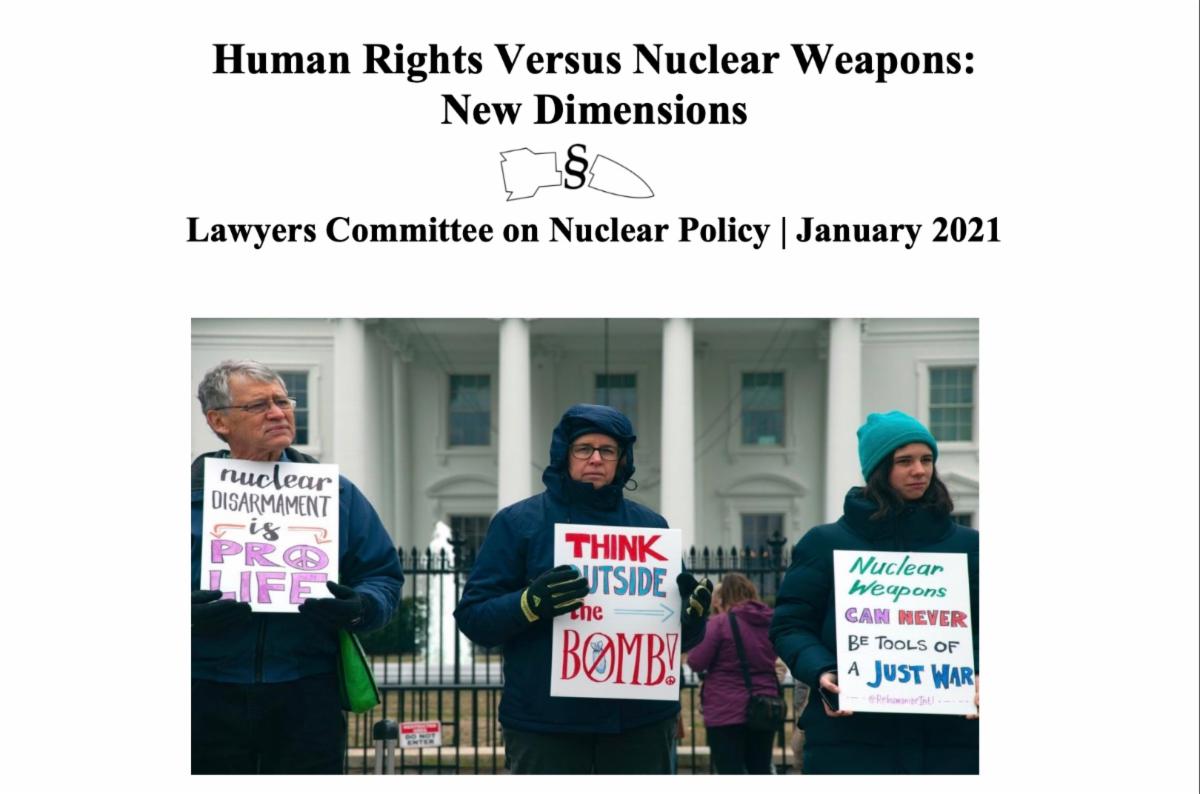
In January, LCNP published a report entitled "Human Rights and Nuclear Weapons: New Dimensions." This report includes analysis and commentary on UN Human Rights Committee General Comment No. 36; the Treaty on the Prohibition of Nuclear Weapons; and Human Rights, Democracy, and Nuclear Weapons.
Read more below, and find the full publication here.
We are witnessing a resurgence of interest in the application of international human rights law to one of the principal threats to the human future: nuclear weapons. A general comment issued by the UN Human Rights Committee in 2018 finds the threat or use of nuclear weapons to be incompatible with respect for the right to life. The Treaty on the Prohibition of Nuclear Weapons adopted a year earlier is suffused with a humanitarian perspective, protects the rights of victims of testing and use of nuclear arms, and cites human rights law and the principles of humanity in its preamble.
Lawyers Committee on Nuclear Policy twice brought together leading lawyers, law professors, and analysts to reflect on these developments, in December 2018 and in May 2019. This publication collects papers based on the speakers’ remarks.
-
Prof. Roger Clark of Rutgers Law, LCNP Executive Director Ariana Smith, LCNP President Emeritus Peter Weiss, and Dr. Daniel Rietiker of the University of Lausanne examine and reflect upon the significance and implications of the finding of the UN Human Rights Committee.
-
Bonnie Docherty of the Harvard Law International Human Rights Clinic addresses human rights aspects of the Treaty on the Prohibition of Nuclear Weapons.
-
Andrew Lichterman of Western States Legal Foundation explores how human rights discourse could be a terrain for making connections between disarmament movements and other movements for a more fair, democratic, and ecologically sustainable society.
This publication is highly recommended reading for anyone seeking to understand how a human rights approach can contribute to the abolition of nuclear weapons.
|
|
|
|
UN Human Rights Committee Reviews DPRK |
|
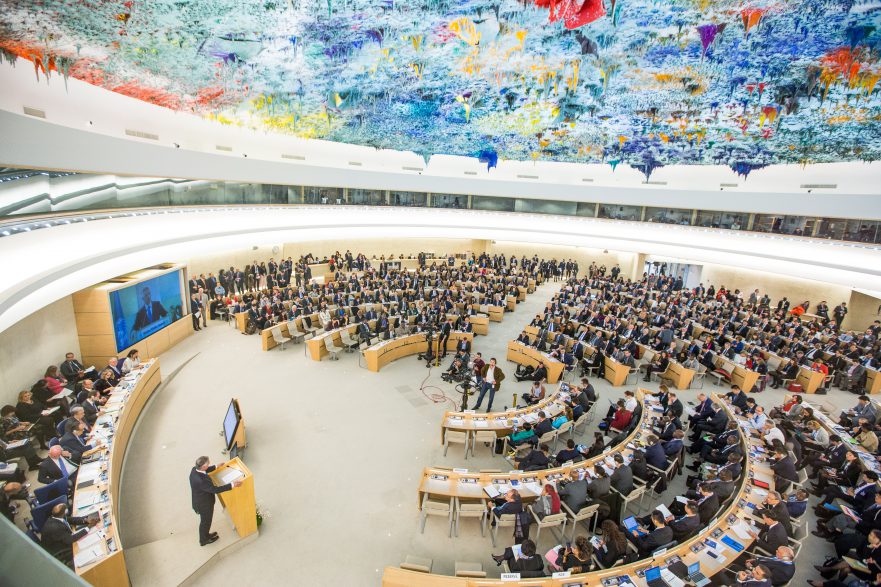
Lawyers Committee on Nuclear Policy and Western States Legal Foundation made a list of issues submission to the United Nations Human Rights Committee concerning the nuclear weapons program of the Democratic People’s Republic of Korea (DPRK). This submission argued that the use and threat of use of nuclear weapons is incompatible with multiple rights enshrined in the International Covenant on Civil and Political Rights (ICCPR), focusing primarily on the non-derogable right to life (Article 6)—the most fundamental human right. The committee’s periodic review of the DPRK is now underway.
The submission begins:
The use and threat of use of nuclear weapons is incompatible with multiple rights enshrined in the International Covenant on Civil and Political Rights (ICCPR). For practical reasons, however, this submission concentrates on the non-derogable right to life (Article 6)—the most fundamental human right.
Article 6 of the ICCPR defines the right to life in its paragraph 1 in the following terms: “Every human being has the inherent right to life. This right shall be protected by law. No one shall be arbitrarily deprived of his life.” In 2018, in a general comment discussed below, the United Nations Human Rights Committee addressed nuclear weapons, finding among other things that the use or threat of use of nuclear weapons "is incompatible with respect for the right to life." In this submission, Lawyers Committee on Nuclear Policy (LCNP) and Western States Legal Foundation (WSLF), drawing on the general comment, hold that the policy and practice of the Democratic People’s Republic of Korea (DPRK) in relation to nuclear weapons contravenes the right to life under the ICCPR in multiple ways. At the end, we suggest questions to be included in the list of issues.
LCNP and WSLF have previously submitted a comment to the Committee concerning the Russian Federation’s nuclear weapons policy and have also made a submission to the Human Rights Council concerning the nuclear weapons policy of the United States of America. We are fully aware that the geopolitical situation of the DPRK is far different than that of major powers whose projection of power worldwide relies in part on nuclear arms. In particular, the DPRK for decades, even before it acquired nuclear weapons, has faced possible US use of nuclear weapons in certain circumstances. In 2017, the United States and the DPRK each made unmistakable and belligerent threats of use of nuclear arms, with President Trump making reference to “fire and fury” and the DPRK referring to its “rockets’ visit to the entire U.S. mainland.” Nonetheless, international human rights law and other relevant international law apply universally, regardless of a country’s particular circumstances, and each country must comply with the law.
The submission goes on to address threat and use of nuclear weapons; the obligations to negotiate nuclear disarmament, to refrain from nuclear testing, and to dismantle the nuclear stockpile; the obligations to afford adequate reparation to victims of nuclear testing and use and to remediate the environment; and the need to end the expenditure of resources on nuclear arms. It closes with suggested questions for the review.
LCNP's submission in its entirety can be found here.
See also a submission made by colleague organizations Aotearoa Lawyers for Peace, Basel Peace Office, Schweizer Anwälte für Nukleare Abrüstung (Association of Swiss Lawyers for Nuclear Disarmament), World Future Council and Youth Fusion.
|
|
|
|
Launch of
"Reverse the Trend"
|
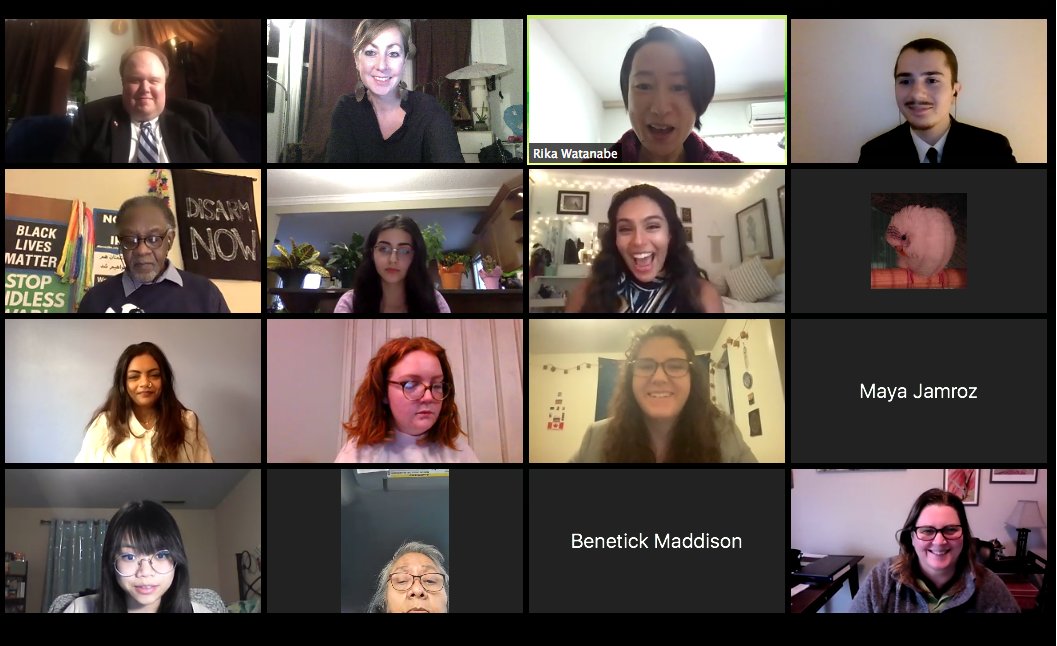
In celebration of the entry into force of the TPNW, LCNP participated in the launch of "Reverse the Trend," a global youth advocacy network that seeks to amplify the voices of youth from frontline communities who have experienced the legacy of the twin existential threats of nuclear weapons and climate change. LCNP fellow Danielle Samler is one of three project coordinators for this initiative.
Find more information on "Reverse the Trend" here.
|
|
|
|
-
On the episode "Racism and Nuclear Weapons" of the Press the Button podcast, Drs. Katlyn Turner, Denia Djokic, and Aditi Verma engage in an in-depth discussion on systemic racism in the nuclear field and how to begin addressing it.
-
This article in Consortium News argues that as Biden enters the White House, he has the opportunity to make good on his pledge to end the forever wars that are part of Biden's legacy.
-
The high-risk policy in the US of sole presidential authority to launch nuclear weapons is outlined in this article by Bulletin of the Atomic Scientists, along with suggested limitations to such authority.
-
Arms Control Association outlines five important nuclear weapons policy challenges that the Biden administration needs to address in its first 100 days. The organization notes that the previous administration made "nearly every nuclear policy challenge facing the United States worse."
-
Less reading, more viewing, this symposium by the United Nations Institute for Disarmament Research (UNIDIR) presents a series of panels on the implementation of the nuclear ban treaty. Watch the previously-live sessions as well as register for the final panel on Monday, February 8 here.
|
|
Lawyers Committee on Nuclear Policy |
|
|
|
|
|
|