|
Vintage Ventures - Spain 2017
December 2
Barcelona
| |
VINTAGE VENTURES: I write my travel journals to look back and remember our ventures. A secondary reason is to allow me to organize all my trip photos. I have thousands of photos. Organizing them into a cohesive story makes sense. | |
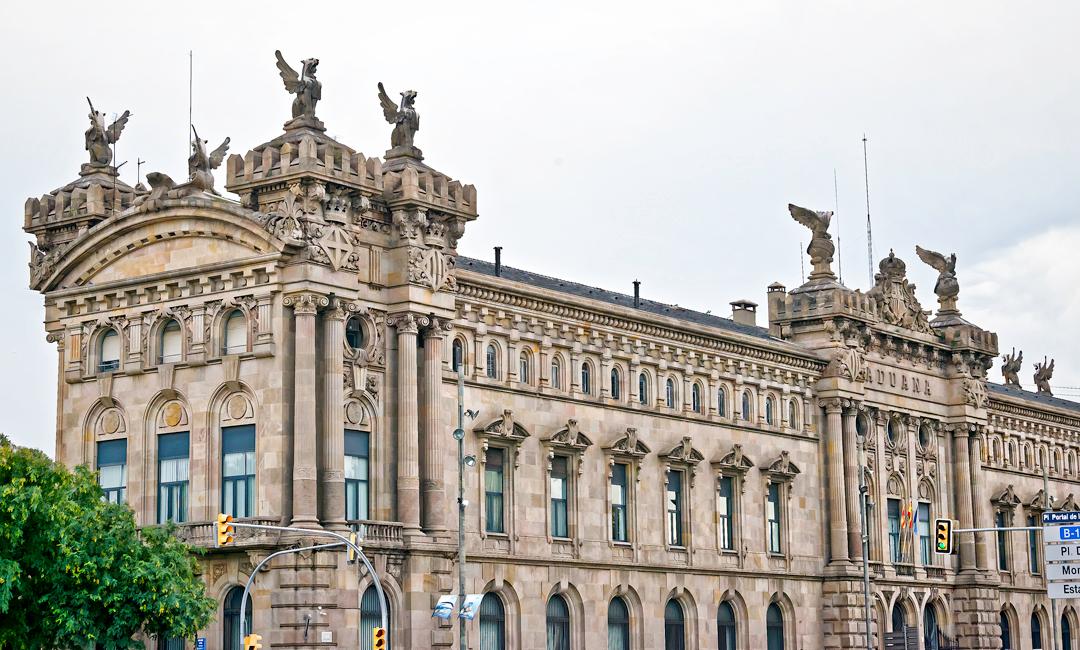
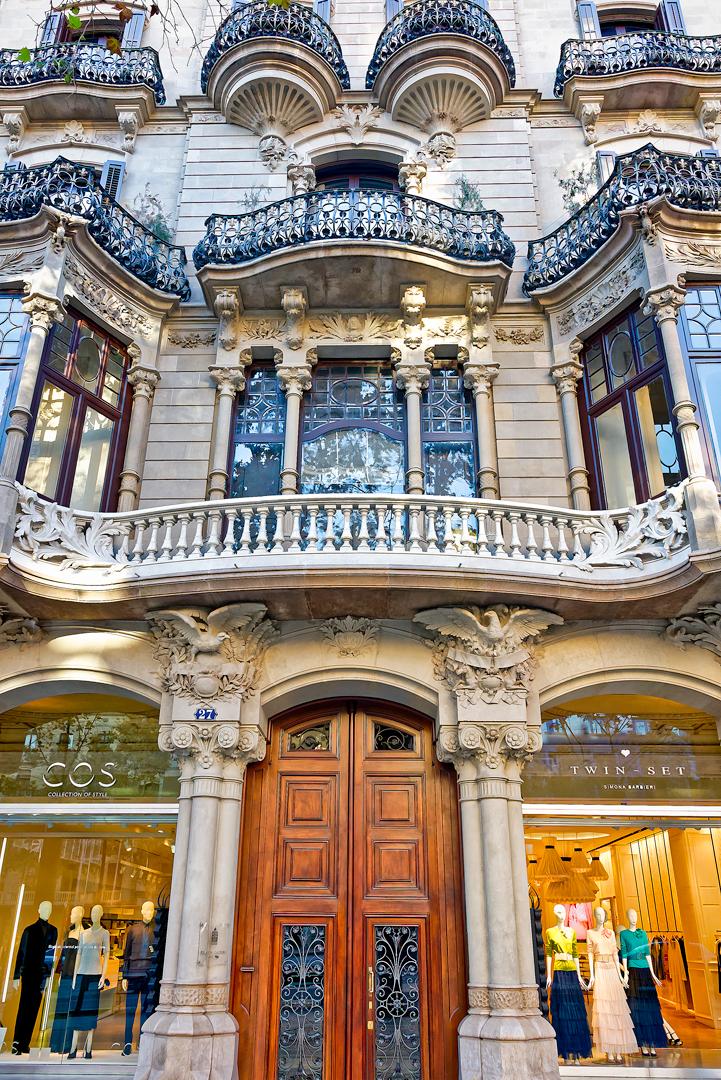
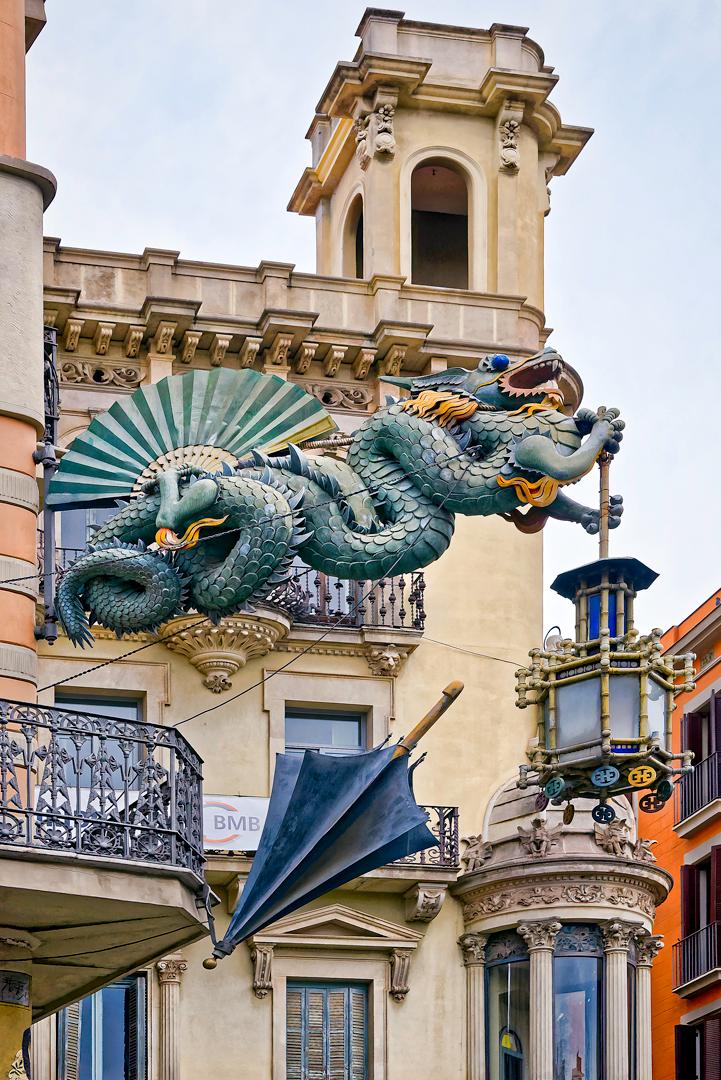
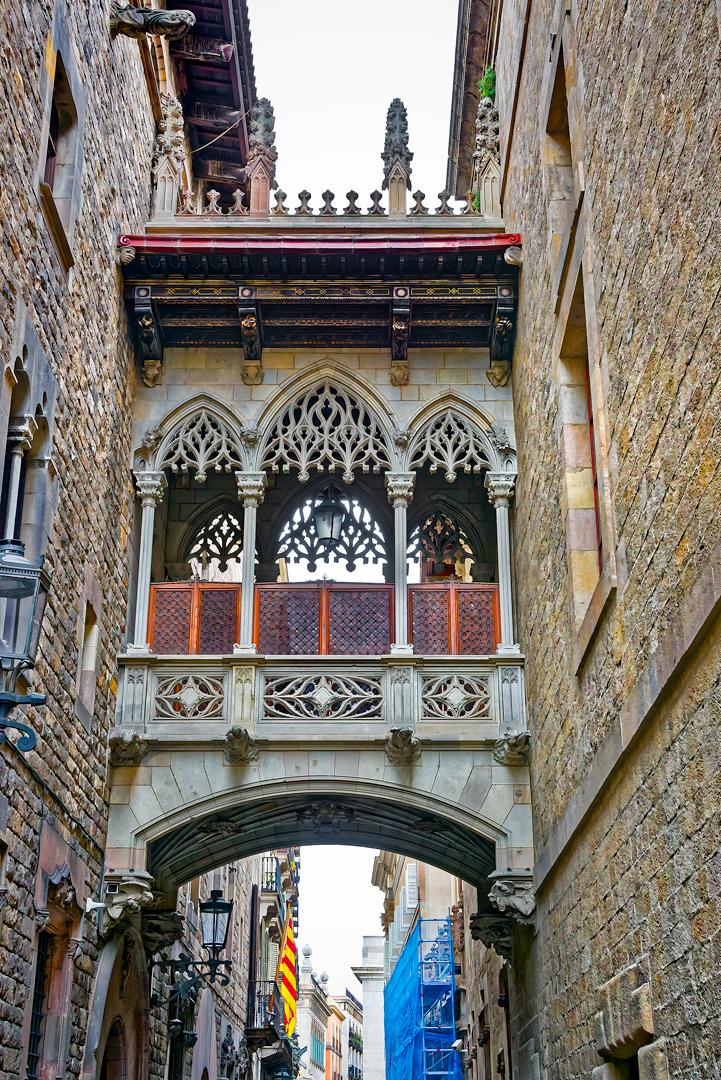
The buildings of Barcelona were spectacular. Check out those awesome gargoyes. | |
|
Day 23, Saturday, December 2
BARCELONA
The RV park, Estrelle Camping de la Castlelldefes, is a megalopolis in its own right. There are blocks and blocks of permanent 'camps' packed together. They are called bungalows, which implies something far more permanent than the tiny trailers with their add-on tent porches suggest. Diane says that these are mainly weekend and summer ‘cottages’ for Spanish families – we are near the beach and near Barcelona. However, it does seem like some are permanent housing. The more transient mobile RV part, for travelers like us, is also pretty big. There are three large toilet/shower houses, a laundry facility, a supermercat (Catalan for grocery store), a bar and restaurant, and a social room. The gate entrance is guarded like a military base. You need a pass just to walk in and out.
After boondocking for the past few days, we look forward to hot showers. Actually, showering in the RV is not bad, but we have to be a little careful about water usage. Not all of the free city RV parking places have water, nor do they all have grey water dumps. So, we have to take what we refer to as ‘submarine showers’ – a quick wetting, shut off the water, lather up, rinse, and done. However, with the weather turning unseasonably chilly and all the RV parks having unheated shower houses, showers take a bit of advanced planning.
We run the shower for a bit as it usually takes a while for the hot water to reach the showerhead, and once hot, the water warms the ice-cold floor tiles and steams up the little shower stall. We undress while this pre-heating takes place. You have to lay out your towel and clothes just right so that when your shower is completed, you can grab your towel and dry off your upper body and head quickly. You have to get your shirt on ASAP before the warm steam goes away. Then you dry your bottom half to get your pants on. The shoes are trickier. These showers spray water everywhere. You need to hide your shoes well around a couple of corners to stay dry, but that means walking on very cold tiles. Here you just have to run fast and get into your shoes quickly. Fortunately, Diane bought me a pair of fur-lined Crocs for lounging in the RV. They make great shower footwear. There’s no need to fuss with socks. You just slip on the fur-lined Crocs, and its instant warm feet.
After a lazy start, Wanda and I headed into Barcelona, mainly on a reconnaissance mission. We wanted to figure out the transportation system; find out how to get to Montserrat, a beautiful monastery an hour and a half train ride into the mountains; locate the ancient city center; locate the Gaudi-designed buildings for later exploration; and most importantly, find Calle de Blai, the street famous for its fancy tapas bars.
Again, the public transportation is incredible. The bus fare for an hour's ride into Barcelona is cheap, 2.15 Euros; however, if you purchase the 10-ride tickets, and we do, it is only 1 euro. The tickets are also accepted on the trams, subways, city buses, and regional buses. Why own a car? Traffic in Spain usually flows quite well, even in metro areas. I give much of the credit to the affordable public transportation, plus the liberal use of scooters and subcompact cars – there are no big SUVs and certainly no monster pickup trucks.
Barcelona hosted the Summer Olympics in 1992, and right next to the RV park is the Olympic Lake, about a kilometer long and about two football fields wide. Surrounding the lake is an elevated powered zip line with water ski ropes hanging down, eliminating the need for powerboats for water skiing. We watched two hardy souls in wet suits waterboarding around the lake, playing with a variety of jumps and slides. We were shivering just watching them. The sun is out and mildly warm, but the air is cool, and the wind is cold.
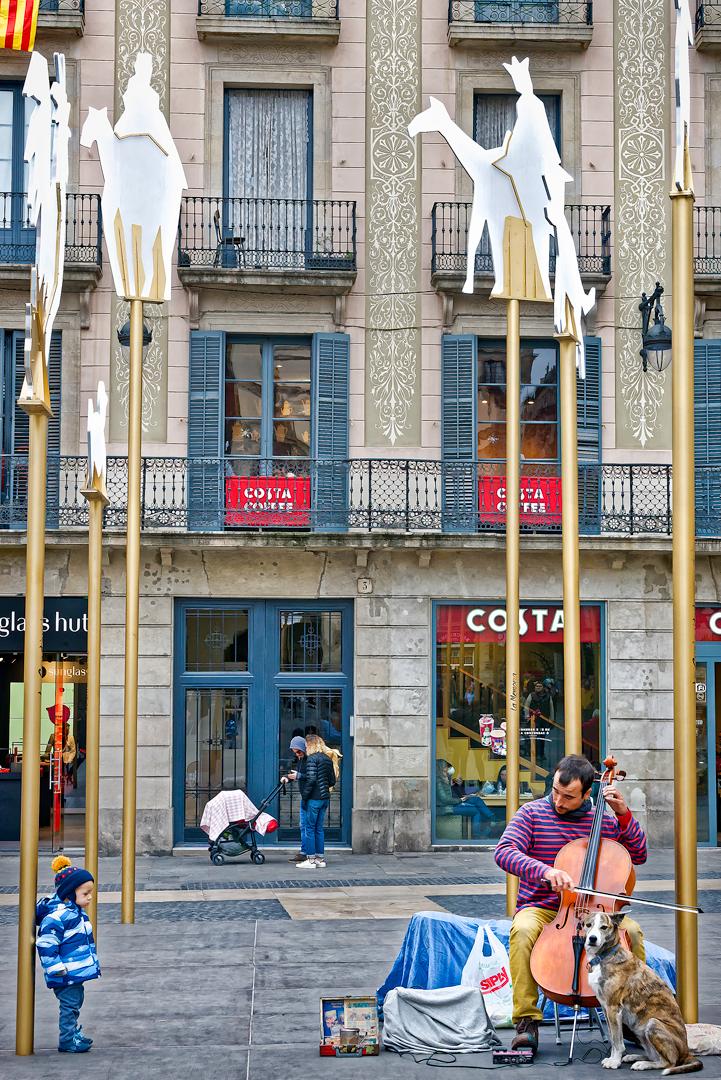
We arrived at Placa de Catalunya, the central hub of downtown Barcelona, around 2 pm, just as a big cloud overcast the sky. We immediately noticed that Barcelona doesn’t do ‘siesta’. The city’s hustle and bustle rivals Manhattan. After a session of collecting info and brochures at the info center, we headed down La Rambla, an amazingly wide boulevard for Spain with shops lining both sides of the street and tons of street vendors packed in the wide middle pedestrian ‘neutral-ground’ between the opposing one-way streets.
This vendor area is where an ISIS-inspired terrorist drove down last August, killing several people. In response to that attack, there is a military presence stationed along the middle part of the boulevard. These urban guards are outfitted in high-tech black gear with facemasks looking both menacing and autonomous.
| 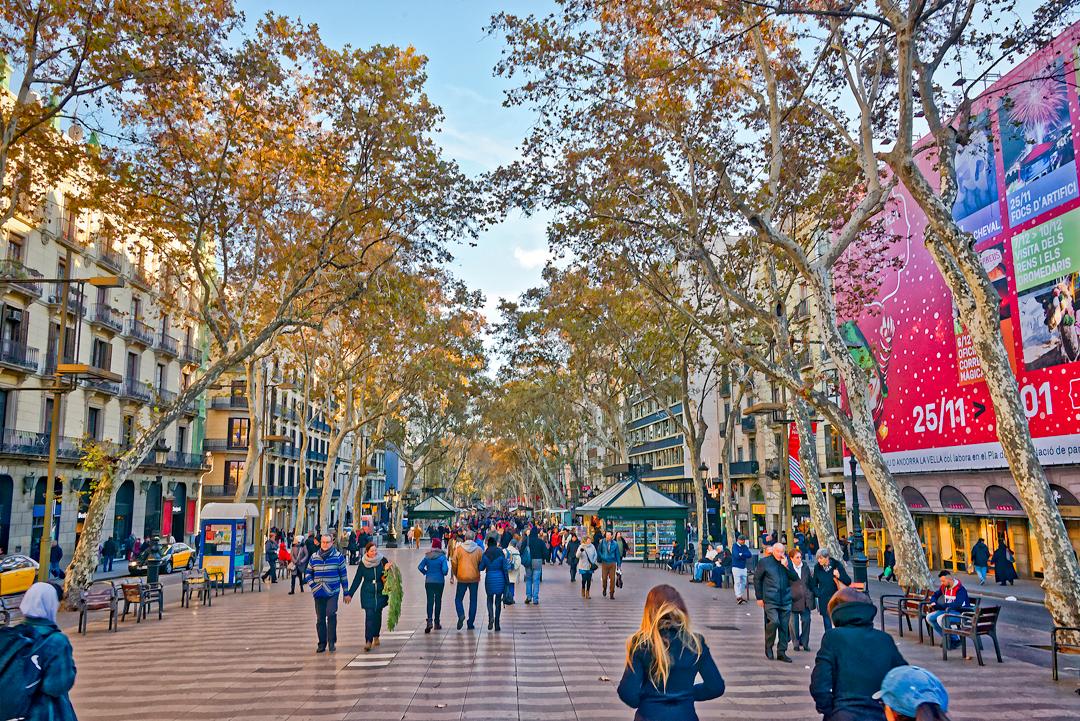 | |
Above: La Rambla, the main commercial street through downtown Barcelona with its extensive pedestrian neutral-ground area in the middle of the street.
Below: A small sidewalk section of La Rambla.
|  | |
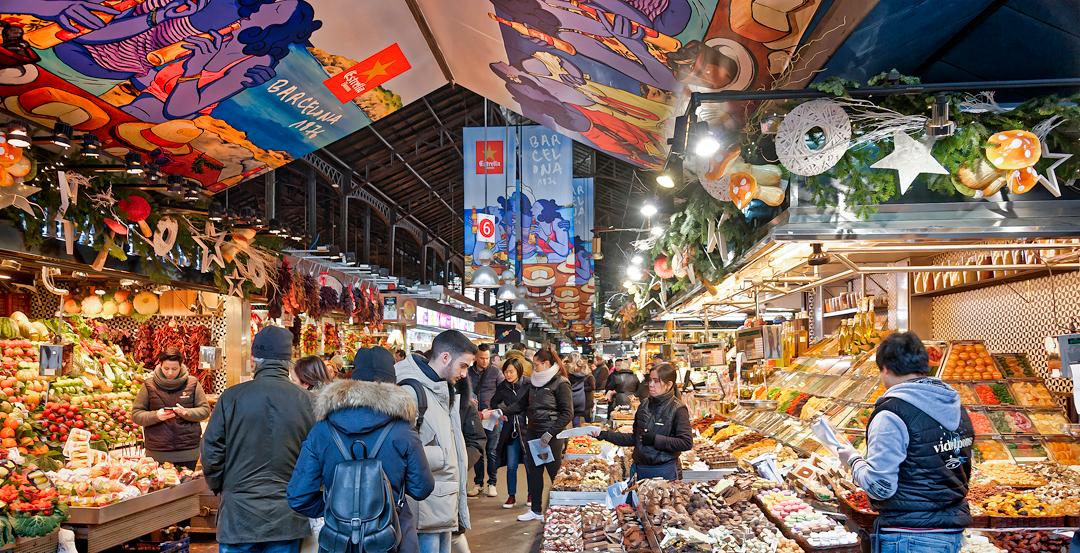
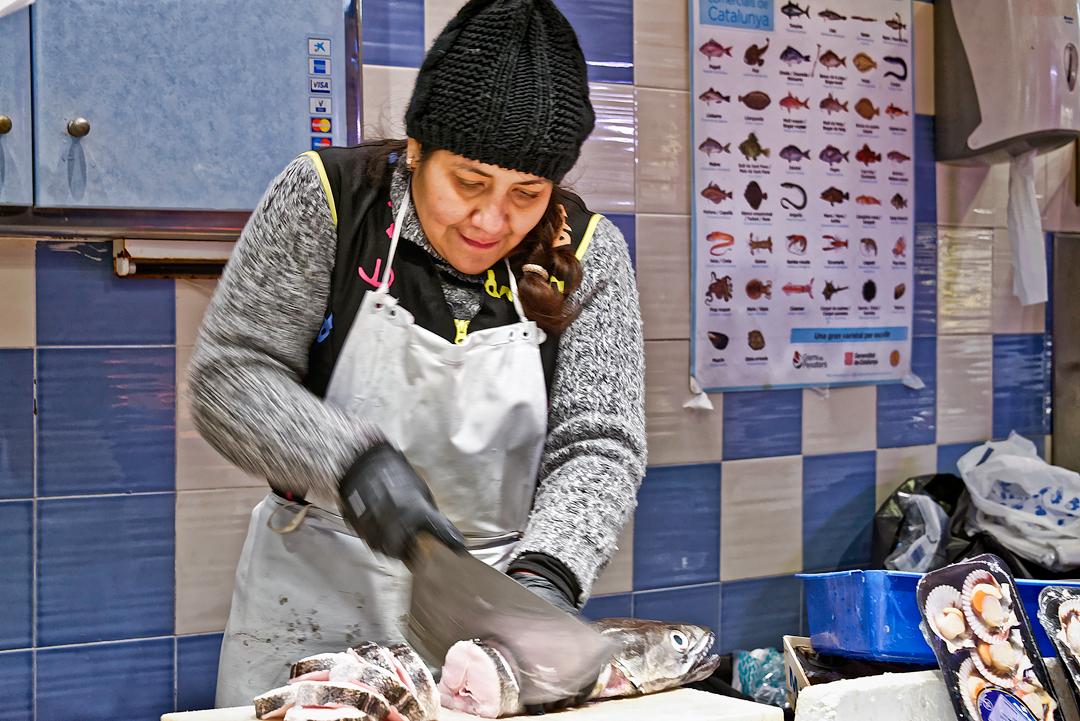
Along La Rambla is one of two giant city Markets, the Mercat Sant Josep Boqueria. Every bit as awesome as the Markets in Valencia and Alicante, the Mercat houses acres and acres of foodstuffs of all varieties beautifully and artistically laid out, begging to be taken home and made into delicious meals. And if you aren’t into cooking, there are many vendors selling their own wonderful ready-made cuisine.
However, the first thing we noticed was that Barcelona is expensive. Gone is the giddiness we got from cruising through markets. Along with authentic American commercialism were authentic American prices. After paying ridiculously low admissions to museums, monuments, and cathedrals, we were blown away by the ridiculously high admission prices in Barcelona.
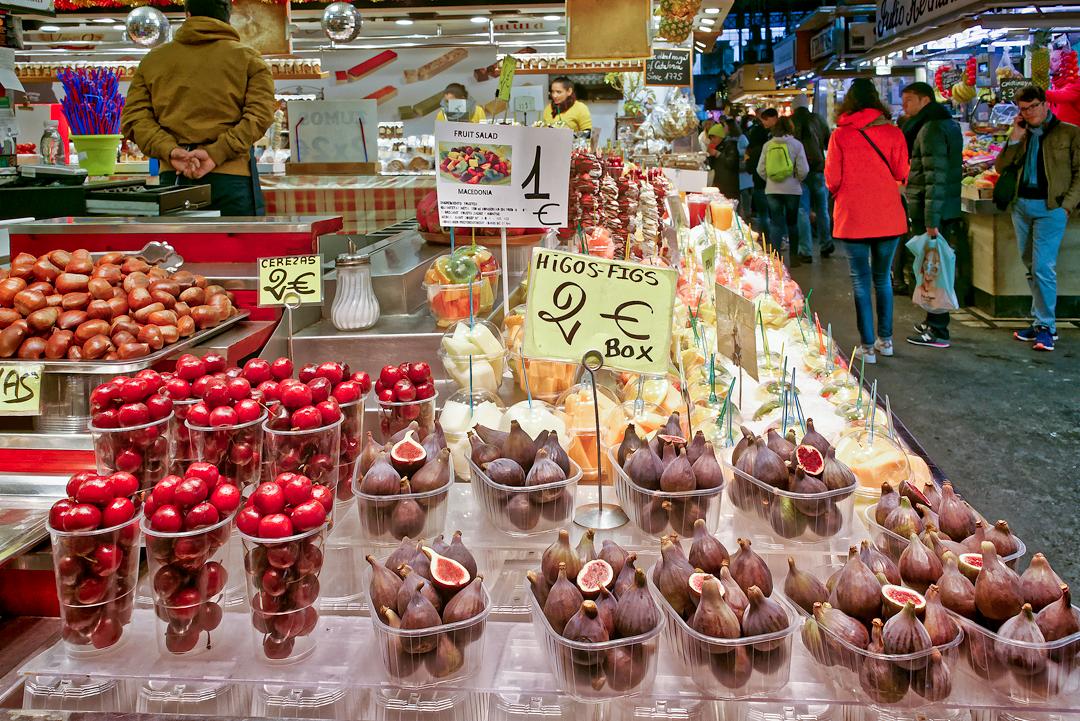
Still, there were some bargains to be found. I finally ran across the fresh Higo figs that we enjoyed in Cambrils. We only get shriveled-up dried figs in America – good, but not awesome. These Spanish fresh figs are large, moist – almost juicy, sweet, and absolutely delectable. We bought a box for 2 Euros, about the same price as in Cambrils. We wanted to bring some back to share, but somehow they all vanished in our mouths. The other bargain, as previously mentioned, is the public transportation system. It is dirt cheap.
| |
The giant city Market, Mercat Sant Josep Boqueria. The entire market, the size of a sports stadium, is housed under a colossal roof. | Our delicious juicy Higo figs, next to the cherries. | |
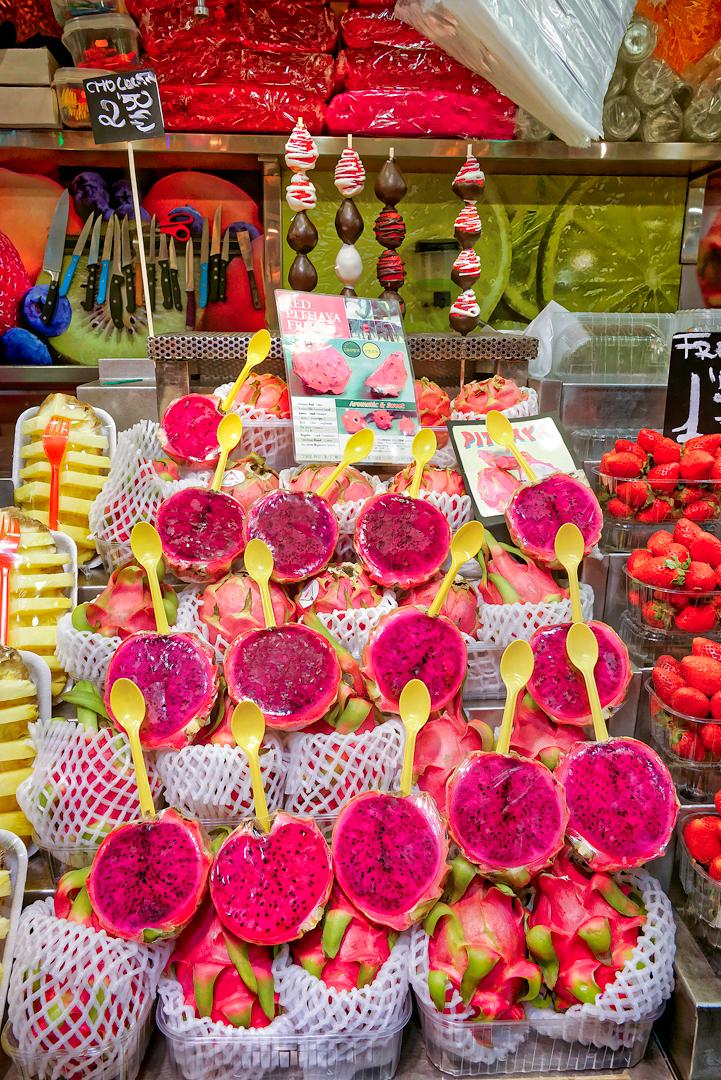
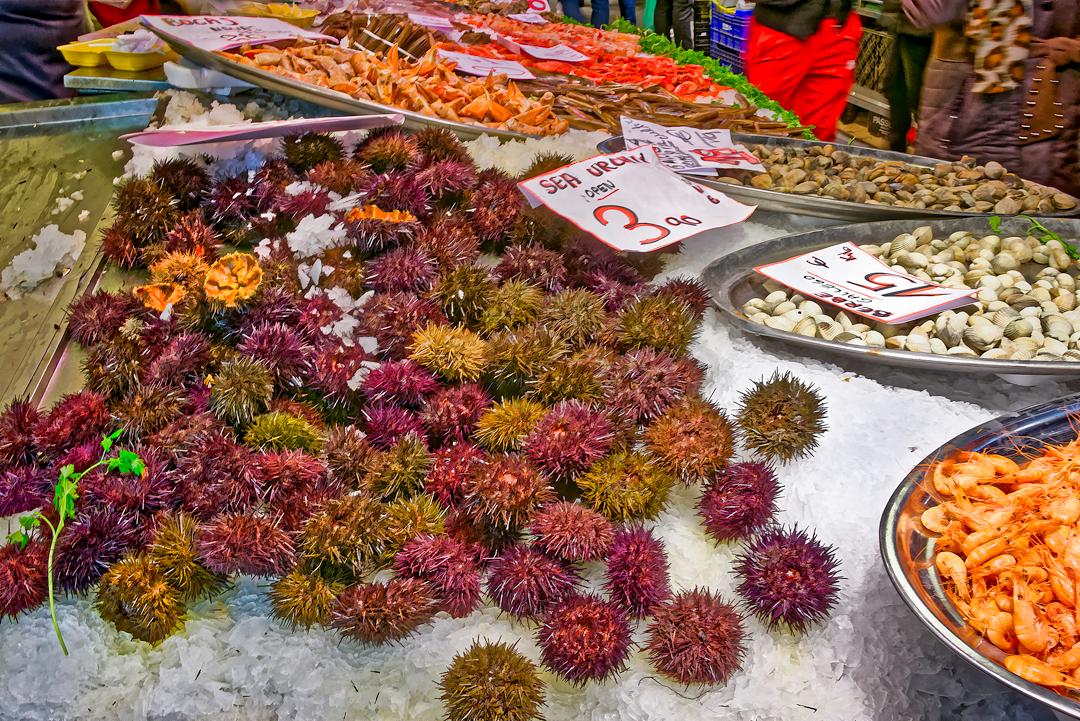
So, how do you eat these fuzzy sea urchins? | |
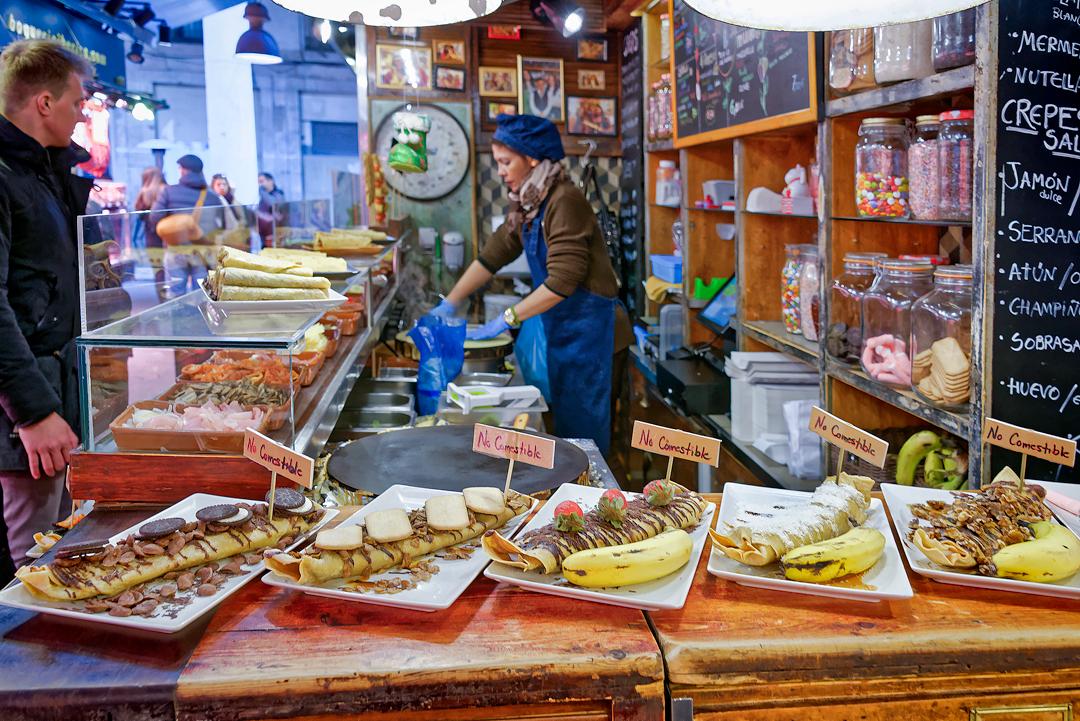
Premade wrapped-up crepe desserts. They are works of art. | |
|
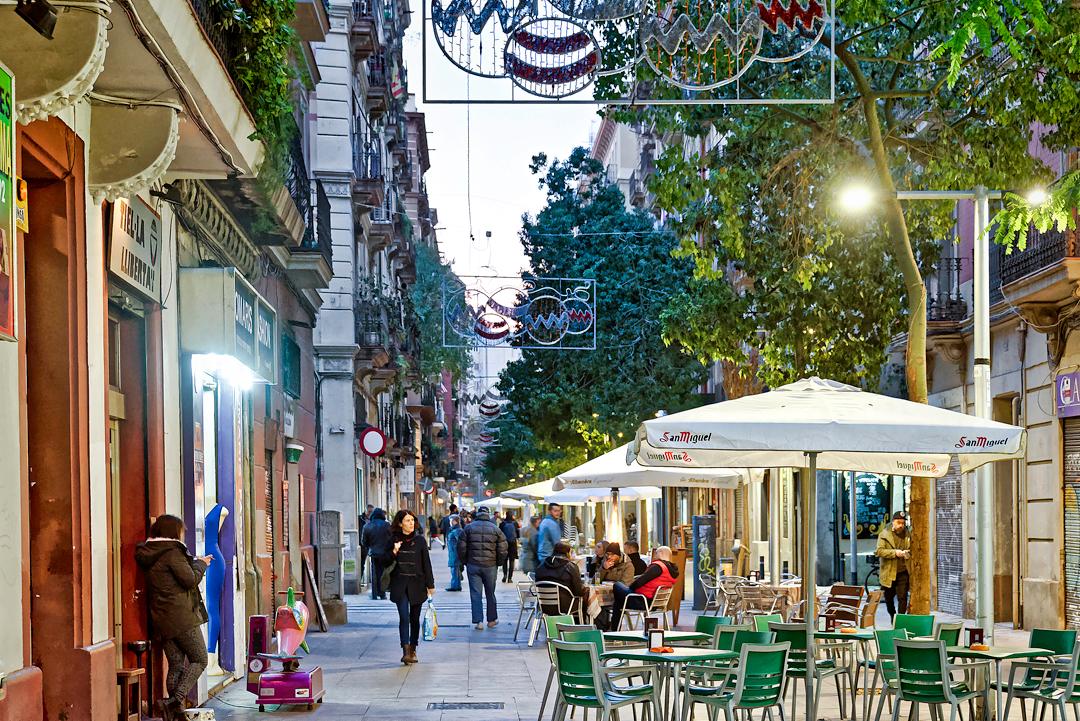
La Rambla is lined with outstanding buildings, with the usual tiny back streets radiating away from the expansive La Rambla. La Rambla ends at the Mediterranean Sea, so we turned left to do the ‘wandering-thing’ through the older city center. There are back alleys with shops that we wondered how they could survive so far off the beaten track and classy hotels that are absolutely hidden from any type of street exposure that defies any logic for success. We ran across the usual gigantic Cathedral – “ho-hum”; and the outdoor restaurant-laden plazas – “ho-hum”; and the monuments and museums, etc. (I am being facetious with the “ho-hum”, these were all incredible, but we were getting spoiled by all the impressive architecture.)
Barcelona is different. From the large cities of Valencia, Granada, and Cordoba to the villages of Beaza, Ubena, and Albarracin, the old city centers immerse you in a magical medieval time warp. Barcelona’s center city is way too vibrant, big, and cosmopolitan to be a medieval time warp. But that does not take anything away from Barcelona. It is a wonderful place to be in – it is just a little bit different.
| |
A Gaudi-inpired building in Barcelona. Gaudi is a famous architect from the late 1800s to the early 1900s. He loved curvy lines. | |
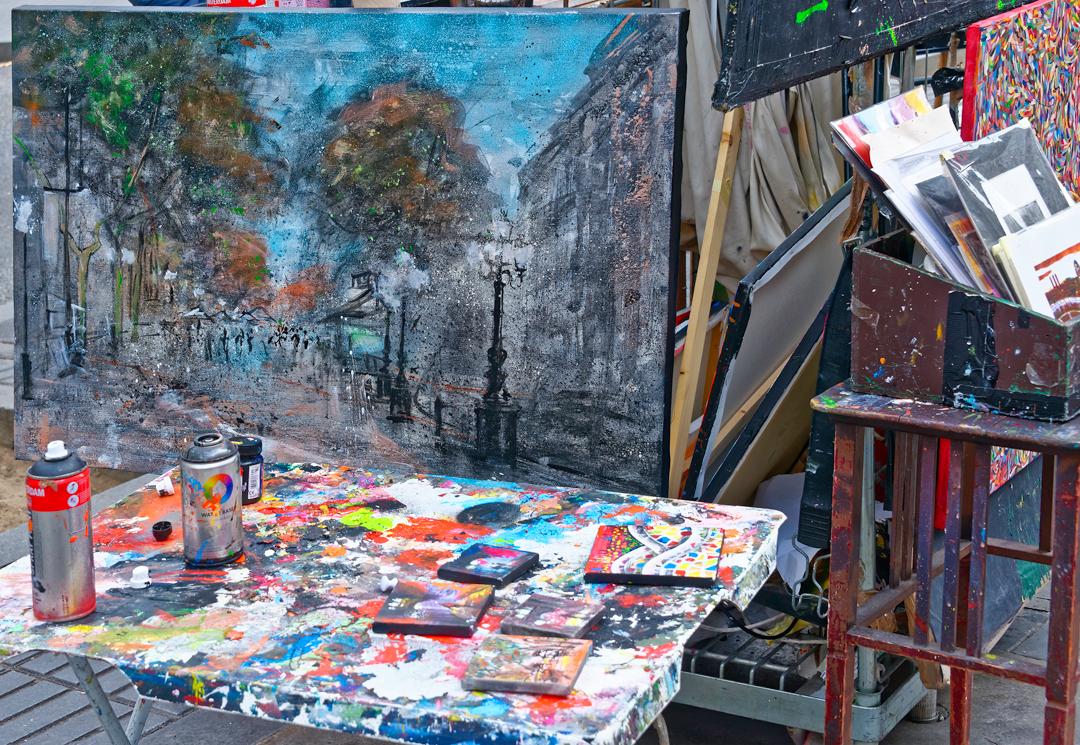
Above and below: Barcelona is home to many artists. | |
|
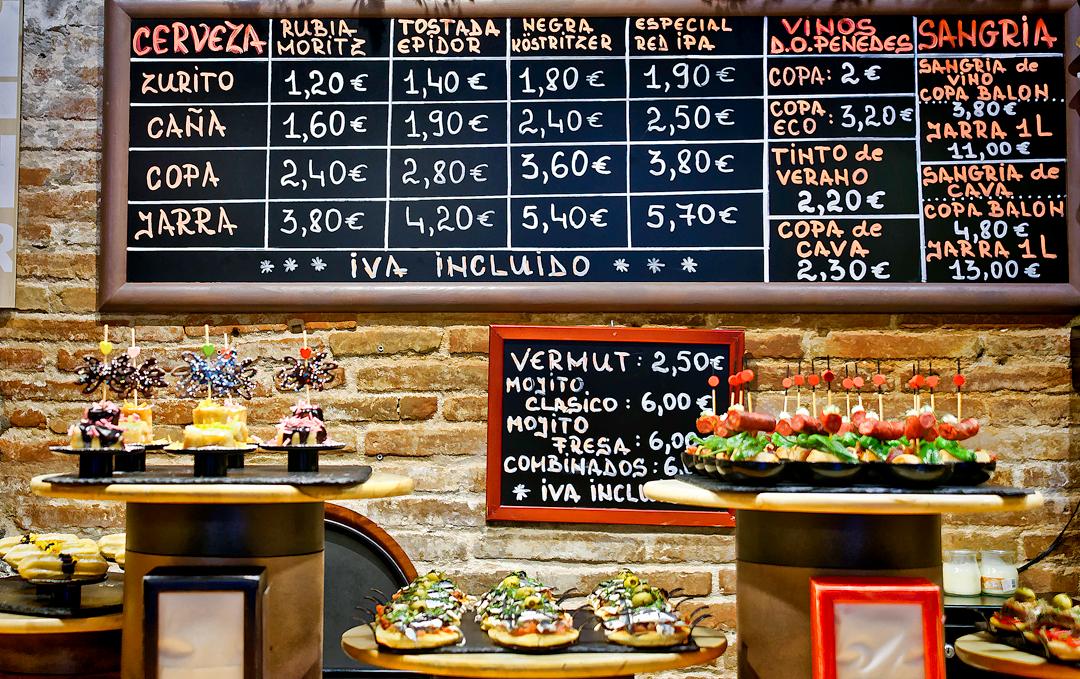
Another difference I noticed was the diversity of the people. Overall, Spain is pretty solidly Spanish, but Barcelona is much more of a melting pot. Then we noticed subtle language variations. We discovered that in the province of Catalonia, they speak a different language. It is similar to Spanish – it is Catalan. A plaza is a plaça. Aseos (toilets), a word I was very adept at sniffing out as public toilets are nearly non-existent, is now lavabos. Beer is caña, not cerveza. Tapas in Barcelona are actually two different things: 1) The word tapas, in Barcelona, is usually a more substantial appetizer served on a small plate, costing a few Euros. 2) A ‘pincho’ is a small kabob appetizer on a huge toothpick that costs anywhere from 1 to 2 Euros. Pincho bars display scores of colorful trays, each with a different set of beautifully crafted pinchos lined up and waiting for your selection.
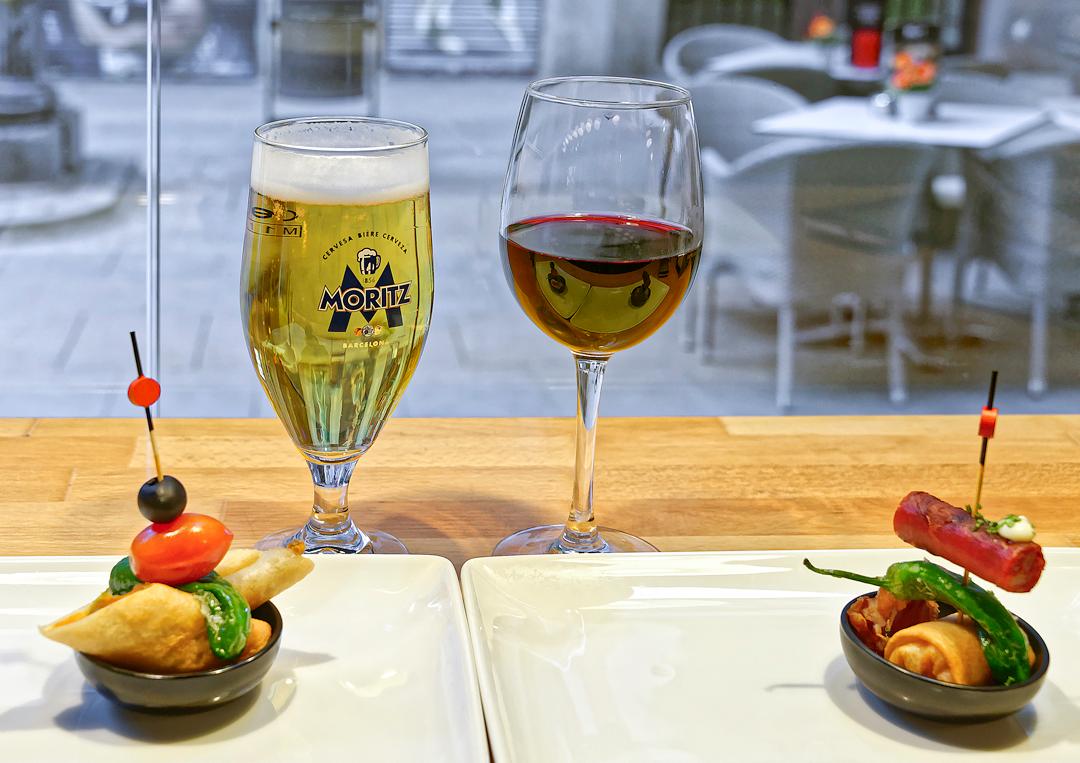
A few blocks away from the old city center, in an Arabic area, was Calle de Blai, a street concentrated with pincho bars. At the first bar we tried, Blai 9, we ordered a red wine and a draft beer. Pinchos are self-serve, so you just pick whatever pincho you fancy off a tray. The varieties seemed endless. There are seafood pinchos, meat pinchos, veggie pinchos, and dessert pinchos.
After our experience with the pig’s blood tapas sandwich, we didn’t want to know specifically what was in the pinchos – we just picked what looked good. In this case, one pincho had two small pastries filled with a pizza sauce, a lightly fried green pepper dusted with sea salt, a cherry tomato, and topped off with an olive. I’m not sure what the other pincho was, except it had a meat-filled pastry and a cute little sausage plus another sautéed and sea-salted pepper.
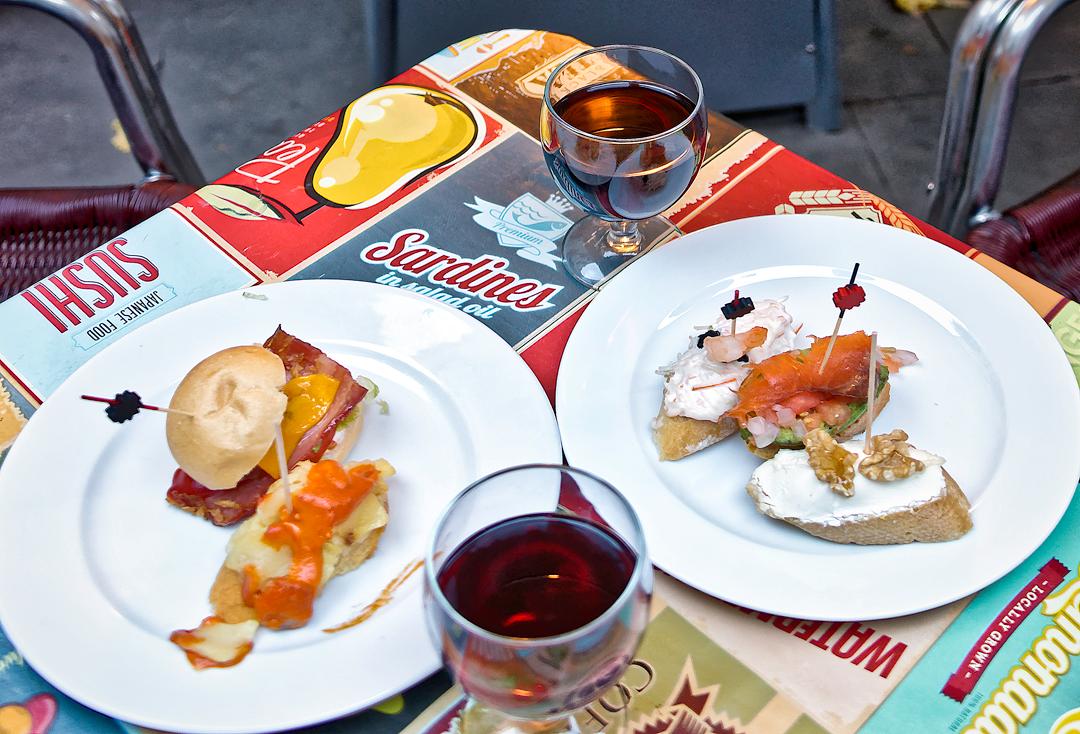
We went all out at the next bar picking out five pinchos. One pincho was a crisp bun filled with chorizo, tomato slice, cheese, and sauce. Another was a wad of sliced American fries, cheese, and a cooked red pepper. There was a croissant with a cream topping and walnuts. Then there was a creamy crab salad on a piece of baguette topped with a cherry tomato. I can’t recall the last one, but it entailed a large slice of avocado, cheese, some kind of meat, and a tomato slice on a small piece of bread. It was all incredibly yummy.
| |
Above and below: Artistically made pinchos. | |
Pincos are laid out on trays. The board shows the beer and wine prices. | |
Wanda read that Barcelona has pickpocket artists. Crime is extremely low in Spain and also in Barcelona, but picking the pockets of tourists is a fairly common petty crime. I always keep my wallet in my front pocket to make it more challenging for pickpocket artists so I felt pretty safe even though I was walking around with a map and an expensive Nikon camera, practically tattooing TOURISTA on my forehead. Sure enough, in a back alley photo-op spot, a middle-aged gypsy-looking woman with two stout older guys in tow came up behind me on a stairway right after I took a really cool photo. I felt a hand creeping into my front pocket from behind. With the reflexes of a cat, I grabbed the hand and told the gypsy, “You really DO NOT want to do that.” She quickly replied, “No, I don’t.”
After that, I put my wallet in a far more secure zippered fleece jacket inner pocket. Sure enough, on our way to Calle de Blai, I felt another hand enter my back pants pocket. Again I grabbed the hand; it was attached to a young dark-skinned Arab-looking guy. He looked sheepish but quickly turned to innocent looking when I shoved him away. I consider myself lucky to have returned to the RV with all my valuables intact. Wanda’s warning really paid off.
We polished off the leftover chili when we returned to the RV and hit the sack fairly early.
| | | | |