 |
|
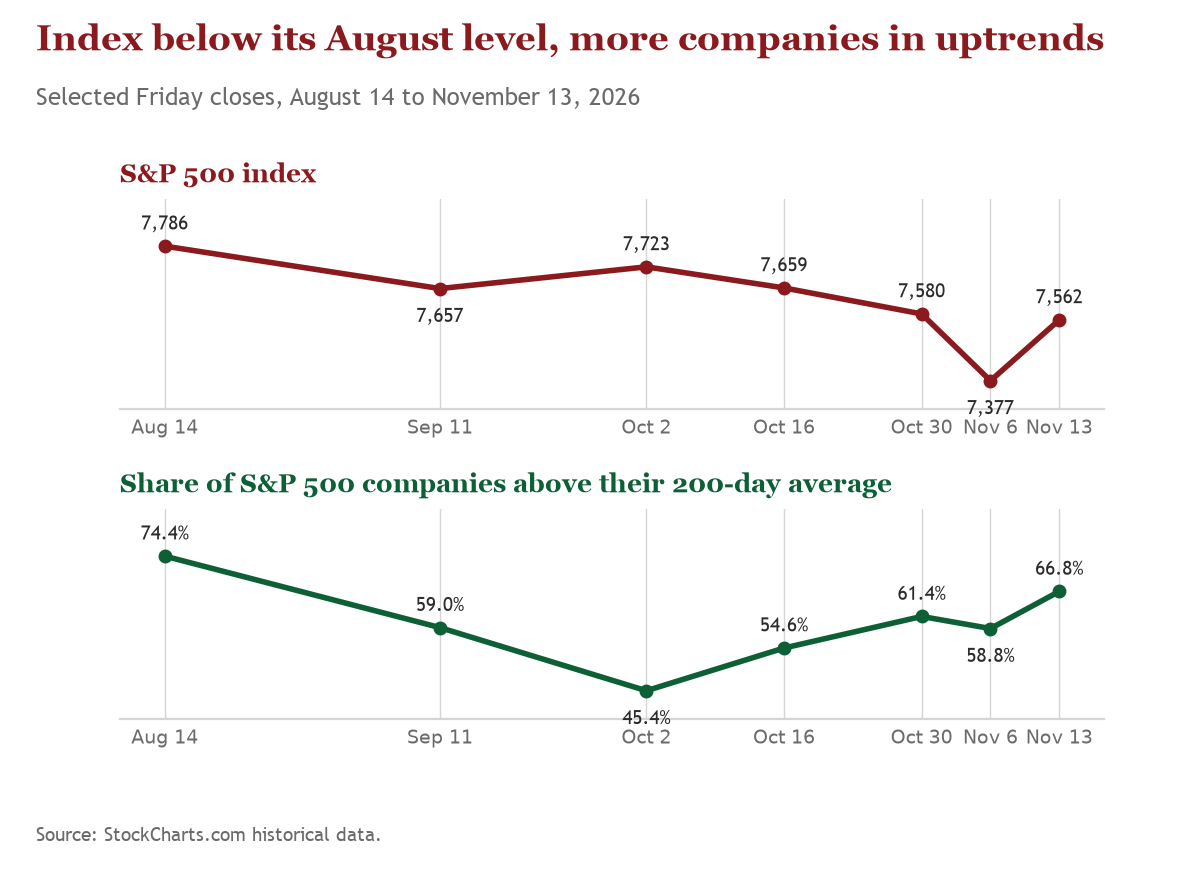
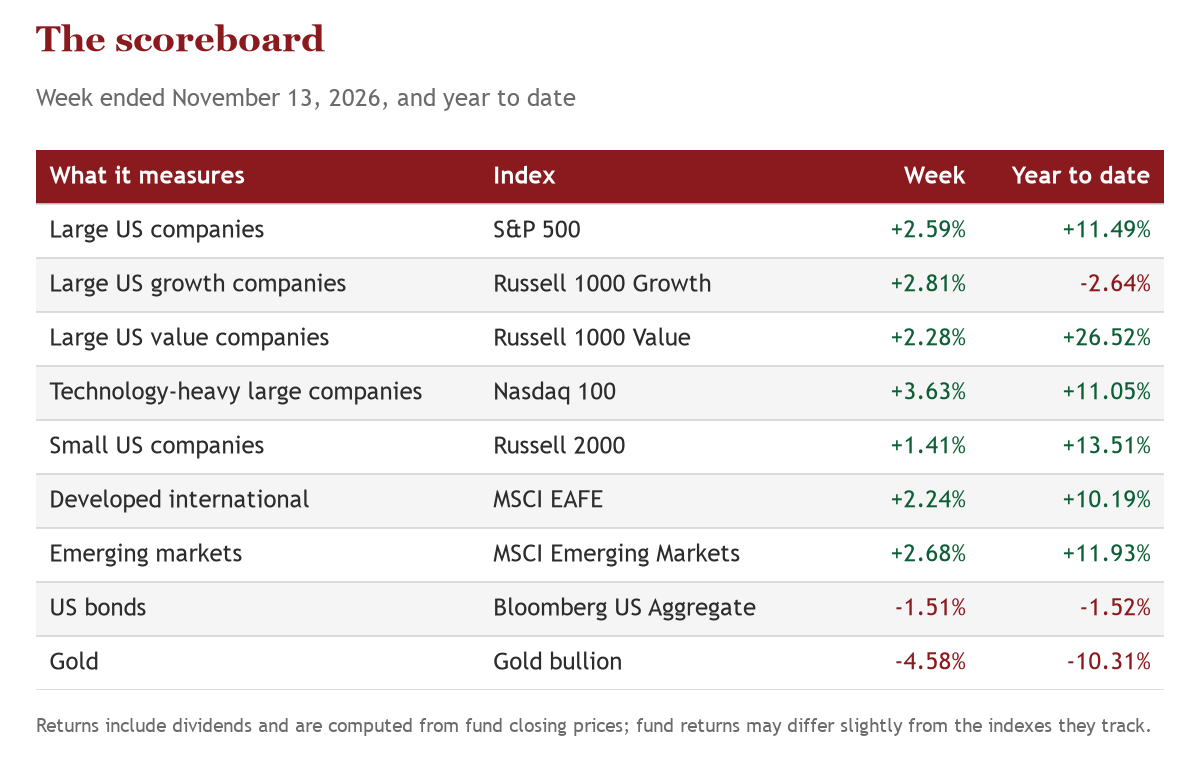
Saturday Morning Markets, week ended Friday, November 13, 2026 Stocks Rose, and So Did RatesThe S&P 500 had its first winning week since early October; more companies took part, and rates on government bonds climbed after a firm inflation report. S&P 500, week: +2.59% with dividends. Groups that went up: 11 of 11. 10-year Treasury rate: 5.15%, up from 4.86%. S&P 500, year to date: +11.49% with dividends. Sources listed at the end. Returns include dividends and are computed from fund closing prices unless noted. The S&P 500 rose 2.59% for the week ended Friday, November 13, including dividends. It was the index's first weekly gain in five weeks. Most of the gain came on Monday, and the index held most of it through small losses on Thursday and Friday. More companies took partOne useful test of the market's health is how many companies are in a long-term uptrend. A common way to count them is to check whether each stock trades above its own average price over the past 200 trading days. At the start of October, fewer than half of the companies in the S&P 500 passed that test, even though the index had barely moved. This week the share rose to about two in three.
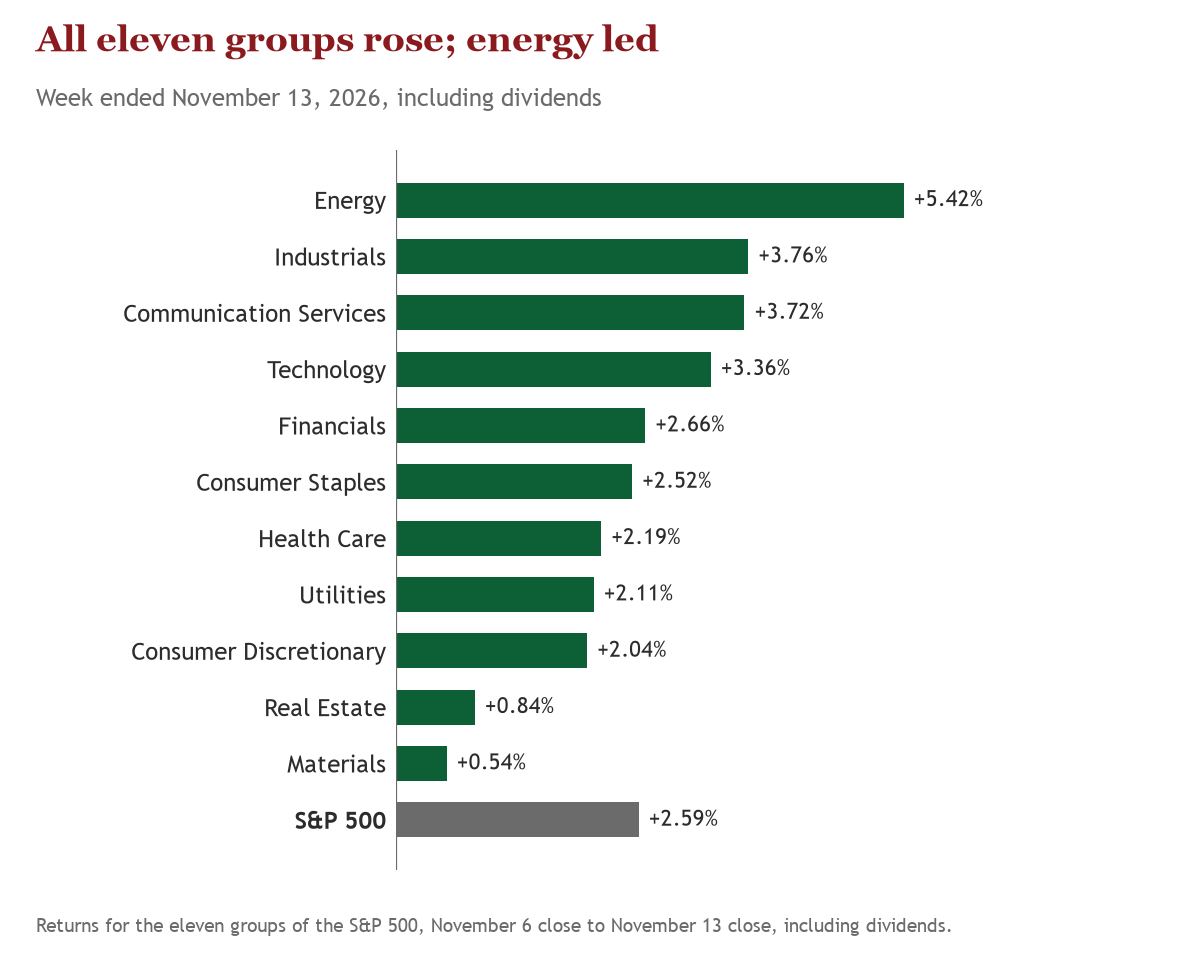
That matters because a market lifted by a handful of very large companies is more fragile than one where most companies are rising. The index is still a little below where it was in mid-August, but the footing underneath it is broader than it was a month ago. Not every measure agrees. More companies are still setting new lows than new highs, which tells me the improvement is real but not finished. Inflation and interest ratesConsumer prices rose 0.4% in October, after 0.6% in September, according to the Bureau of Labor Statistics. Prices excluding food and energy, which change less from month to month, rose 0.3% for the third month in a row. Housing costs made up more than 30% of the monthly increase. Because the government shutdown last year stopped data collection in October 2025, the bureau could not publish the usual year-over-year figure. The same day, Federal Reserve Governor Christopher Waller said in a speech that he believes further rate increases will be needed, sooner rather than later. Over the week, the 10-year Treasury rate rose from 4.86% to 5.15%, and the 2-year rate, which tends to follow expectations for the Fed, rose from 4.51% to 4.88%. Bond prices fall when rates rise, so the broad bond index slipped for the week. A government bond paying more than 5% sets a high bar for everything else that pays income. That is why, when we invest for income, we lean on companies and funds that can raise what they pay over time, rather than on payments fixed the day you buy them. Where the money wentStocks are often sorted into eleven groups, such as energy, health care and technology. All eleven rose this week. Energy companies did best, followed by industrial companies and communication businesses such as internet search and social media. Real estate and materials companies rose the least. Over the past month the bigger story is different: money has favored health care, consumer staples and financial companies, while technology has lagged.
The scoreboard
What I take from thisA week ago the selling was concentrated in the largest technology companies. This week the rebound was wide, and the count of companies in long-term uptrends is the highest it has been since late August. At the same time, the 10-year Treasury rate is back above 5%, and a Fed governor is talking openly about raising rates again. I do not know how the Fed will act at its next meeting. What I can say is that more of the market is now carrying the load, and that is a healthier place to start from than where we were a month ago. What this means for youThe S&P 500 is up a little more than 11% this year including dividends. Nothing in this week's numbers leads me to make serious changes to how our portfolios are invested from an equity perspective, and I would have said the same after last week. One week up 2.6%, after four weeks down, tells us very little about next week, but we are watching closely. If you draw regular income from your accounts, a single good or bad week does not change that amount. Dividends and fund distributions arrive on their usual monthly or quarterly schedule. Higher Treasury rates change what newly issued bonds pay; they do not change what the companies and funds you already own pay this month. Two reminders
If you are near retirement and want to talk through how any of this applies to you, I would be glad to. Jim Kilgore, CFP®, CEPA® |
Buckeye Wealth Partners, LLC | Fee-Only Fiduciary | 937-434-1790 | buckeyewealthpartners.com Buckeye Wealth Partners, LLC is a registered investment adviser with the Ohio Division of Securities. Registration does not imply a certain level of skill or training. This material is for informational purposes only and does not constitute legal, tax, or investment advice specific to your situation. Index and sector returns are shown for broad market context, do not reflect the performance of any Buckeye Wealth Partners account, composite, or strategy, and are not a projection of future results. Indexes are unmanaged and cannot be invested in directly. Past performance is not indicative of future results. Sources
|