The American Society of Le Souvenir Français Inc.
Monthly Bulletin - Vol. III. No 11 - November 2023
|
|
French Forts of Ohio & Pennsylvania
Territorial claims and a spark that started a global war
|
|
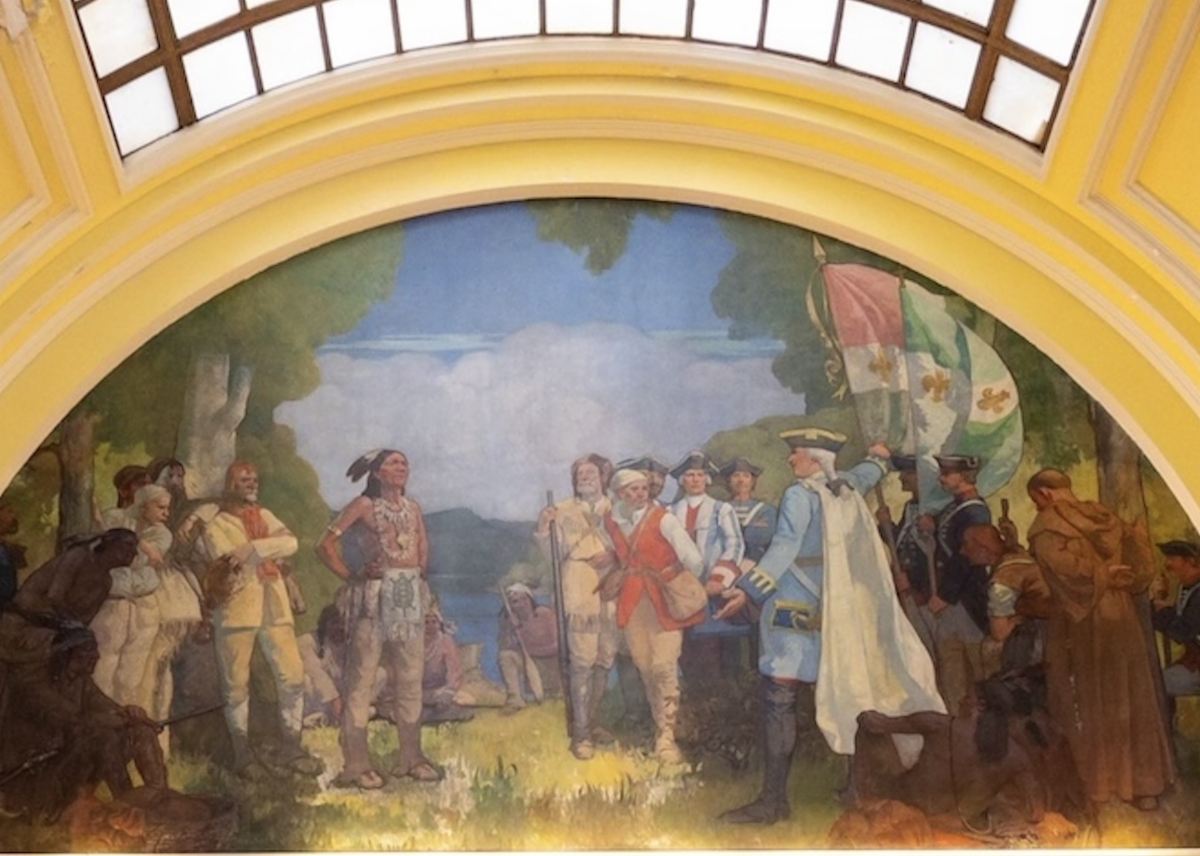
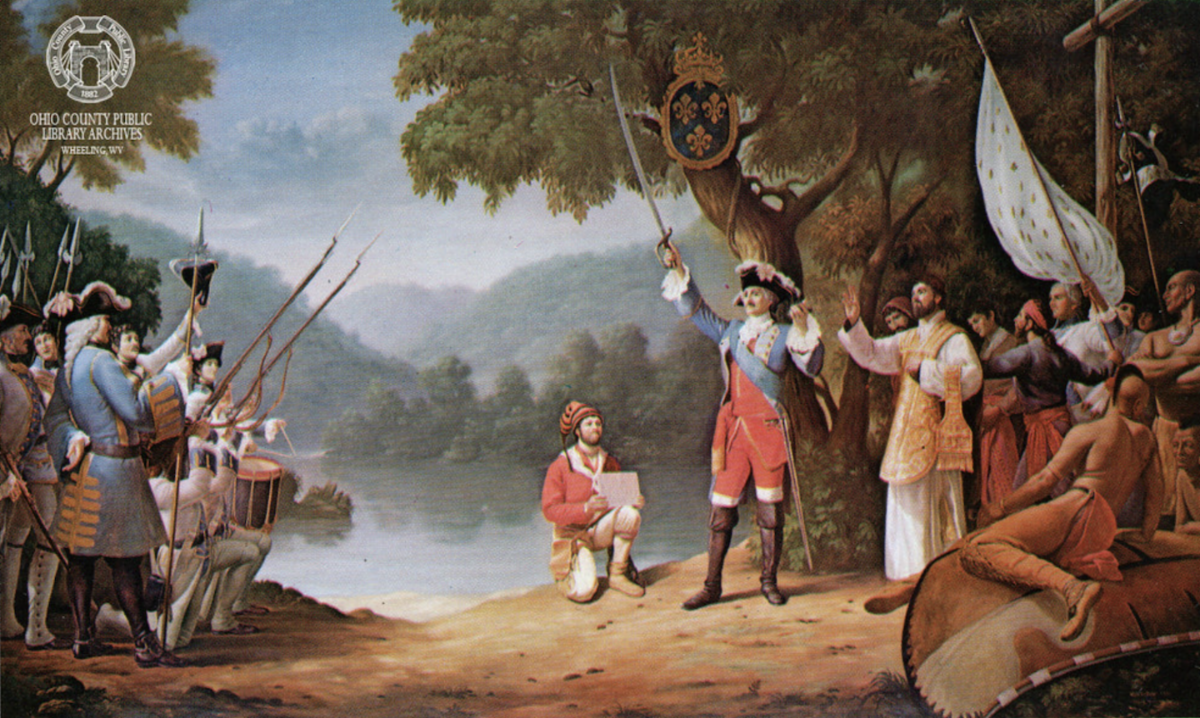
Cover Illustration: Herman H. Wessel’s mural, “Under the Banner of France” (1927)
The mural is located in the Law library of the Scioto County Courthouse
605 Front St, Portsmouth, OH 45662
The French officer of the "Troupes de la Marine" Celeron de Blainville, is shown meeting with Native Americans and a few British traders at the confluence of the Ohio and Scioto Rivers laying claim to the entire Ohio Valley and its tributaries. This was done by burying lead plates at certain locations along the course of the Ohio River.
|
|
EDITORIAL
In this Bulletin, we will visit the Forts of Ohio and Pennsylvania, and narrate the events that occurred over there which sparked what could be termed the first global war: the French & Indian War, or the "Guerre de Sept Ans" (Seven-Year war) as it is known in Europe. This war, as we all know, would put an end to two centuries of French imperial presence in North America, just a few years before the French would come back, this time to help the fledgling United States win its independence against the British empire.
Today, these French forts are mostly remembered with interpretative markers and bronze plaques. With the extraordinary expansion of the United States in less than 250 years, we are left with archeological or reconstructed sites. Still, the memory of what happened in Ohio and Pennsylvania teaches us several lessons. In the troubled times in which we live, it is not difficult to see the parallel with other current imperial tectonic plates moving against each other elsewhere in the world, replete with skirmishes, territorial confrontations, diverging demographics, rivalling economic spheres of influence, and the game of shifting alliances with proxies.
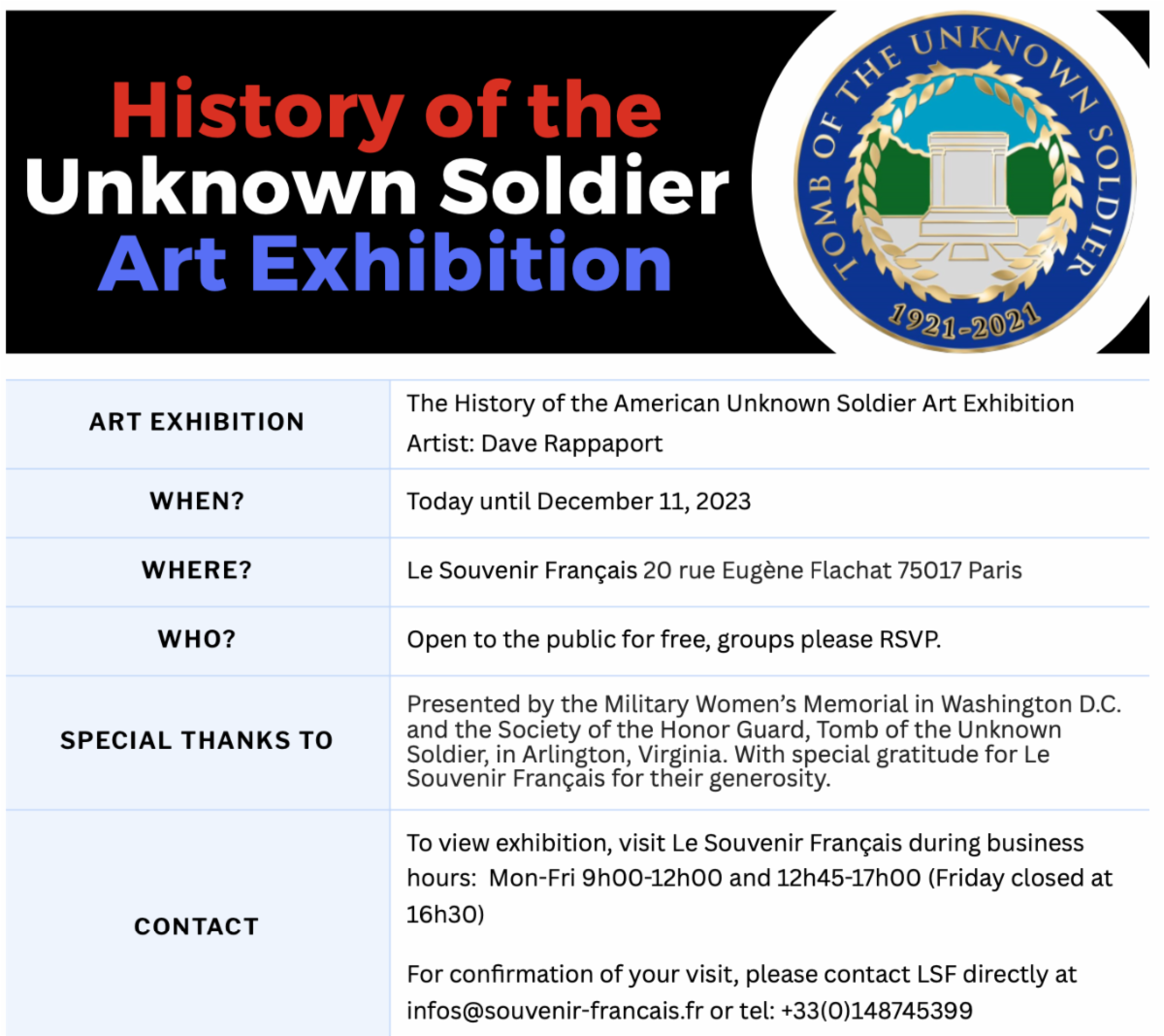
Further down in this bulletin we will continue our series started last month and we will pay tribute to Douglas Mac Monagle, an American volunteer pilot of the original Escadrille Lafayette of WWI who "Died for France" in combat. During your next visit to Paris, please include the Escadrille Lafayette Memorial at Marnes-la-Coquette in your itinerary, or, if you cannot go to the suburbs, visit the American Volunteers Monument inside the Thomas Jefferson square, located alongside the Place des Etats-Unis in the 16th arrondissement. And since no visit to Paris is complete without at least a couple of exhibitions, make sure you visit the Musée de la Marine at the Place du Trocadéro nearby, which just reopened its doors. Last but not least, by all means stop by the Headquarters of Le Souvenir Français, located at 20 Rue Eugène Flachat in the 17th arrondissement to view the exhibition on the History of the US Unknown Soldier. The exhibition is open until December 11th.
As always, this Bulletin will include reports on recent commemorations, among them the annual homage paid to the French soldiers buried in Providence, Rhode Island, and the celebration of Veterans Day and the armistice of November 11, 1918 in New York and Washington D.C.
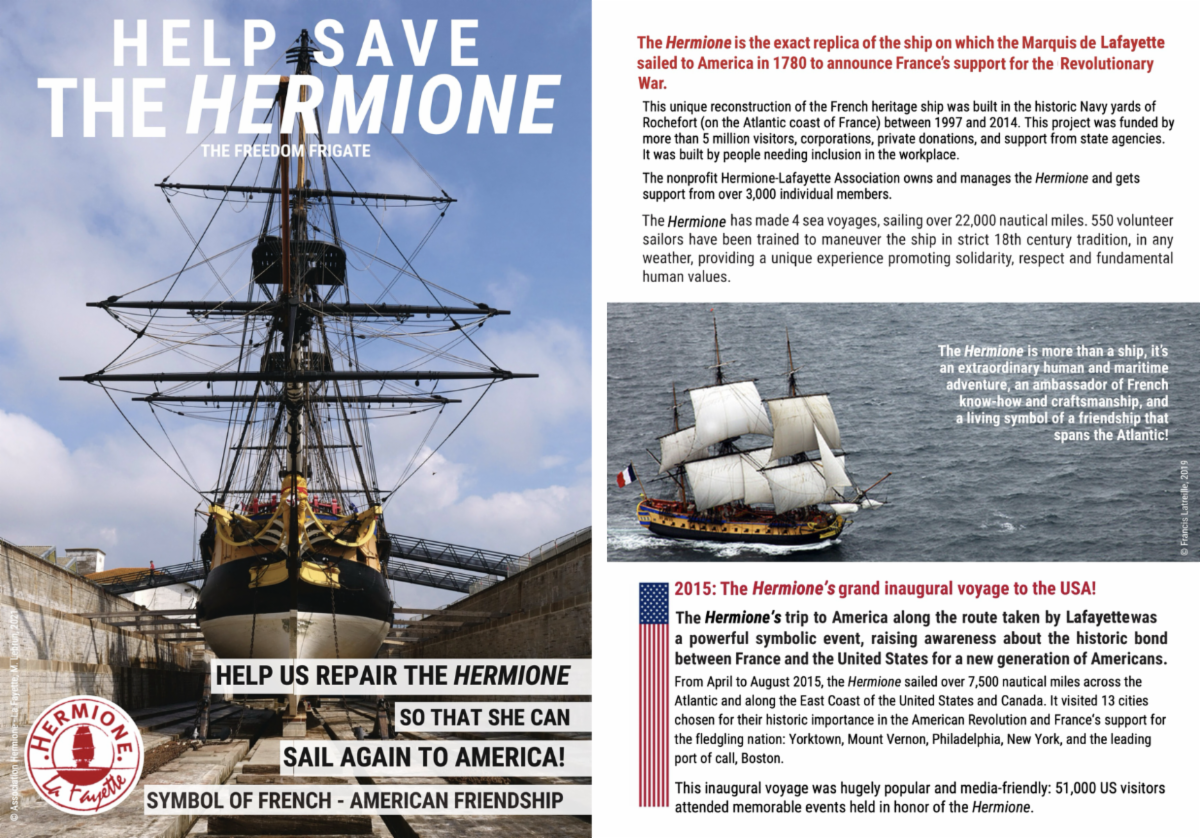
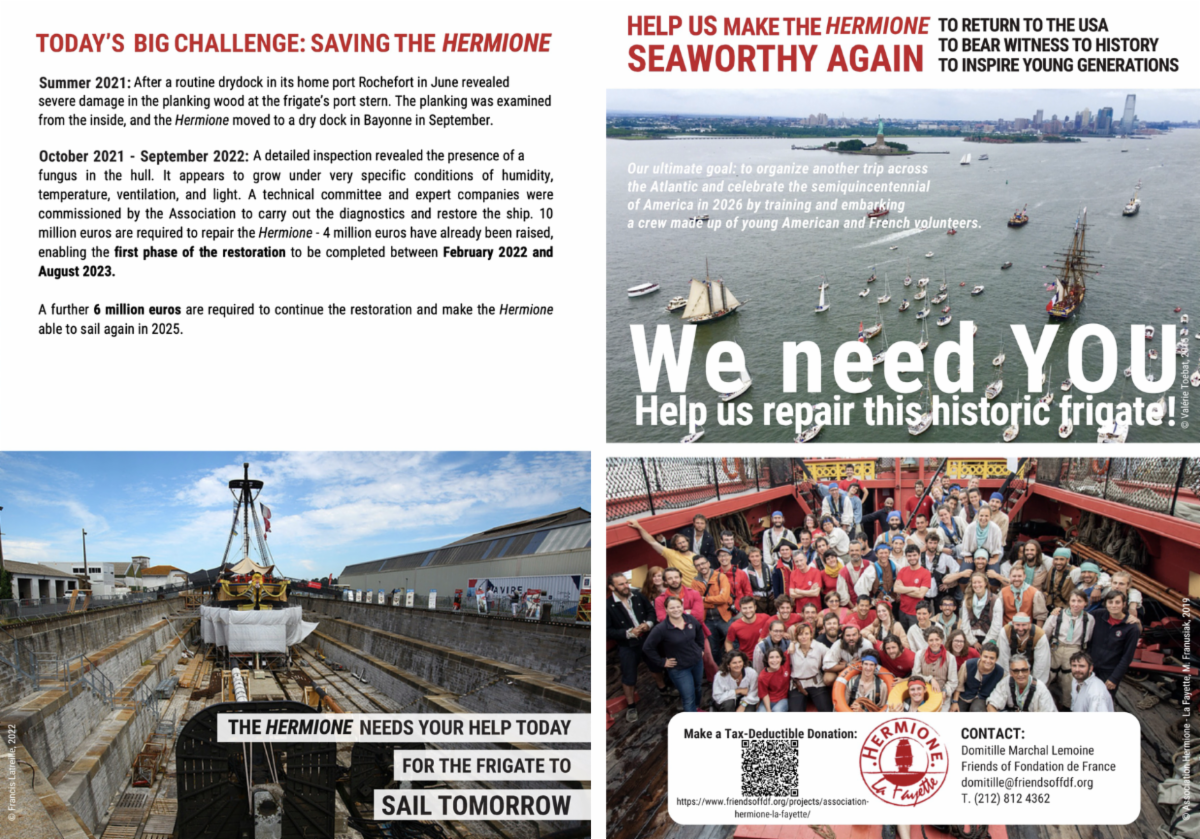
We are also excited to share details about upcoming events and important dates organized by our partners and friends. Among the many events and initiatives that are announced, please pay notice to the nationwide fund-raising campaign to help repair the frigate Hermione, of Revolutionary War fame, also known here as the "Freedom frigate". We are also sharing several exciting announcements regarding the upcoming Bicentennial of Lafayette's farewell in America!
Thank you for your ongoing support. We appreciate every donation, regardless of the amount. Each one greatly contributes to the realization of lasting concrete projects. This allows us to fulfill our mission of celebrating and preserving the historic, strong bonds of alliance and friendship between the United States and France.
We wish you and your family a very Happy Thanksgiving Holidays!
On behalf of the Board of Directors,
Thierry Chaunu, President,
American Society of Le Souvenir Français, Inc.
|
|
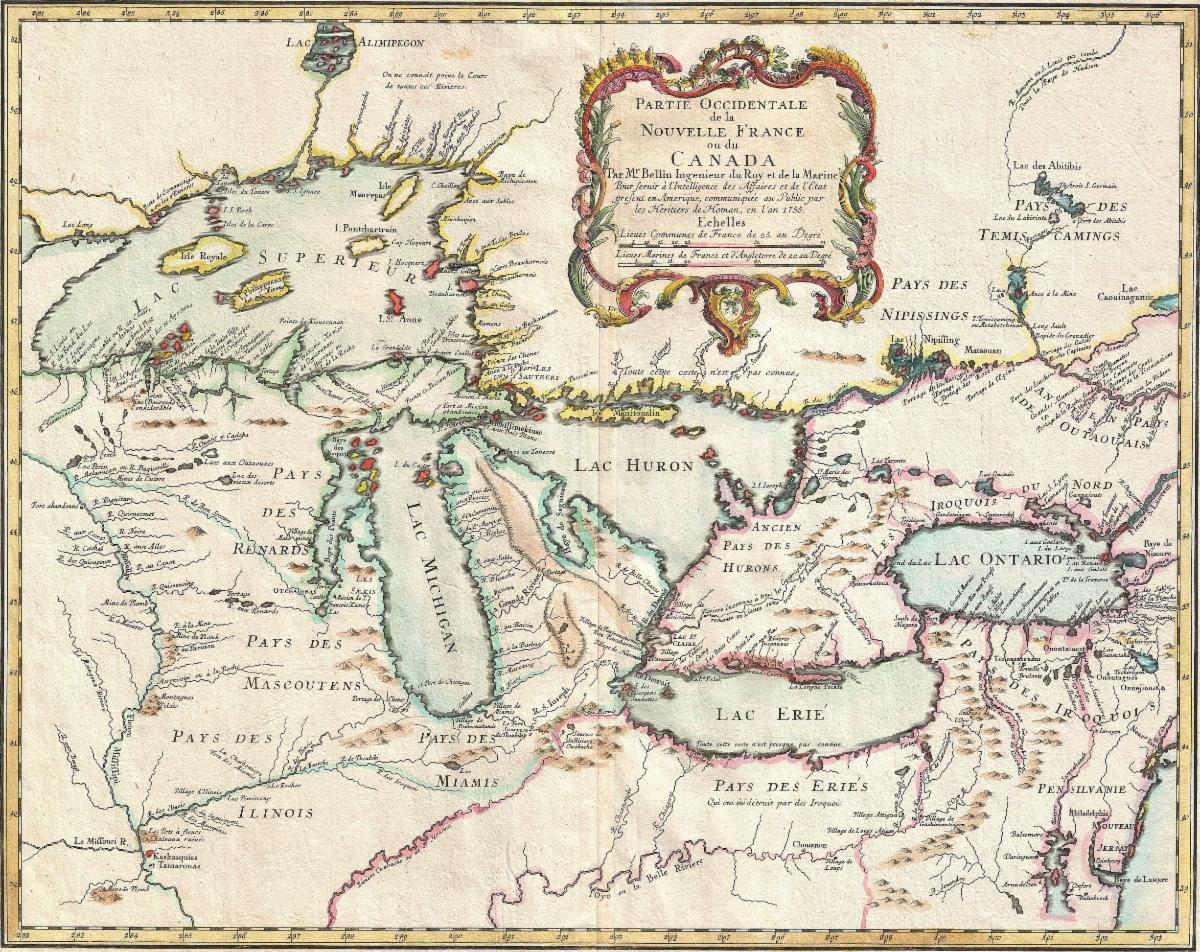
Above: a rare and extremely influential 1755 map of the Great Lakes drawn by Jacques Nicolas Bellin. This map, which appeared in the 1755 issue of the Homann Heirs Atlas Major, covers all five of the Great Lakes as well as the adjacent Indian lands and the English colonies of Pennsylvania, New Jersey and New York. Among the Forts indicated are Fort Frontenac, Fort Niagara, Mission Francois Xavier, and the fledgling “R. et Port de Checagou,” the future site of Chicago. The French, without the vast colonial resources of the English and Spanish, relied heavily on alliances with, rather than outright control of, indigenous populations.
|
|
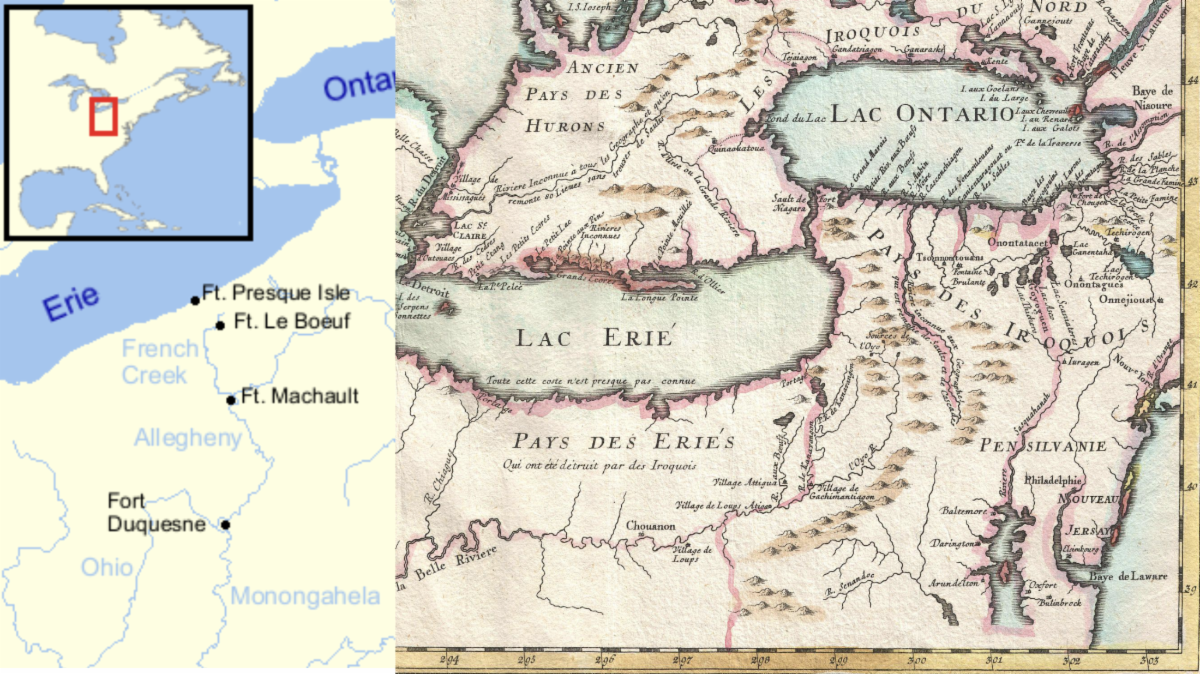
Above: The portion of Bellin's map of 1755 showing the Ohio Valley is blown up, with the sites of the four forts indicated on the left inset. One can see on the upper left inset the strategic importance of this large area, linking Canada, La Nouvelle France, with the Mississippi river, itself linking Upper and Lower Louisiana.
|
|
• During the mid-1700s, France and Great Britain found themselves on the verge of conflict as they vied for control over the Ohio Valley, which encompassed a significant portion of present-day Ohio, Pennsylvania, and West Virginia. The French asserted their rights to the region based on explorations conducted by the renowned explorer La Salle in 1669.
• In an effort to solidify France's position, the governor of Canada, Marquis de la Galissonnière, dispatched Pierre-Joseph Celoron de Blainville (1693–1759) on a mission down the Allegheny and Ohio rivers. Accompanied by 230 French troops and Indian guides, Celoron arrived at the mouth of Wheeling Creek in August. At this location, his party buried a leaden plate, symbolically claiming all the land drained by the surrounding streams in the name of Louis XV, the king of France. Continuing their journey, Celoron's party proceeded down the Ohio River until they reached the present-day site of Point Pleasant, where the Kanawha River meets the Ohio. On August 18, they buried another plate, further asserting French sovereignty. In total, six plates were buried along the course of the Ohio River.
• However, these efforts ultimately proved futile. The French and Indian War (1754–63) concluded with Great Britain emerging victorious. As part of the Treaty of Paris, France relinquished all claims to the Ohio Valley. The lead plate buried at Point Pleasant, which had become a historical curiosity by then, was discovered by a young boy playing along the riverbank in 1846.
The four forts that we will visit in this Bulletin tell the story of this territorial struggle which sparked a global war. The "French and Indian War", as it is called here in America, is only one front of a global war, called the "Seven Years War" in Europe, which saw the end of the French presence east of the Mississippi.
|
|
Celoron de Blainville & French claims to the Ohio Valley |
|
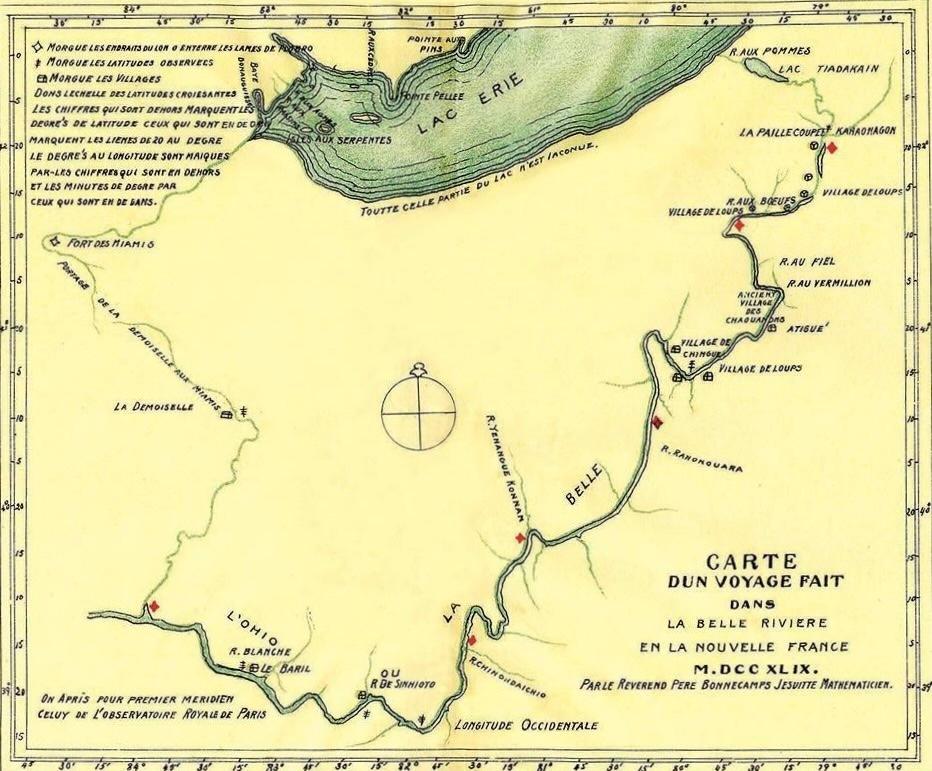
Above: "Carte d un voyage fait dans la Belle Riviere en la Nouvelle France M.DCC XLIX. Par le Révérend Père Bonnecamps, Jésuite Mathématicien". (Map of the route followed by Pierre Joseph Céloron de Blainville along the Ohio River in 1749), drawn by Joseph Pierre de Bonnecamps. Public Domain,
Father Bonnecamps was born in Vannes, France. He entered the Jesuit seminary at Paris in 1727 and was professor of hydrography at the Collège de Québec. From 1743 to 1757, during which time he was a member of the expedition of Pierre Joseph Céloron de Blainville to the Ohio Valley from June to November 1749, occupying the roles of chaplain, hydrographer and historian. He completed the first map of the Ohio Valley.
|
|
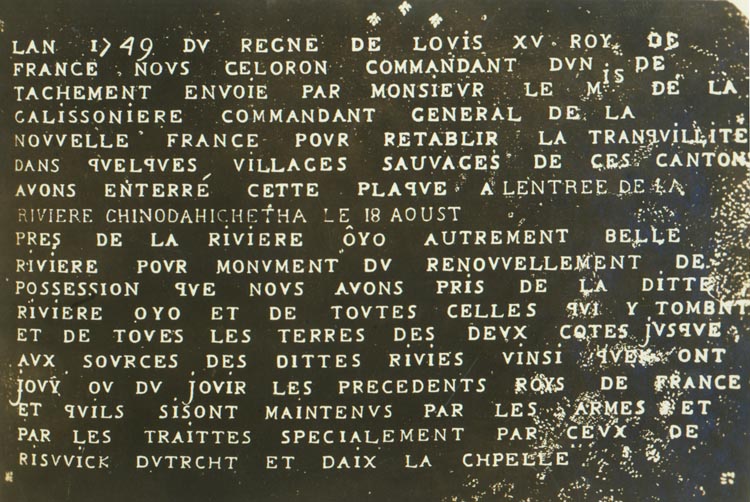
Lead Plate claiming territory for France. Virginia Museum of History & Culture
428 N Arthur Ashe Boulevard Richmond, Virginia 23220
Explorers used to claim the territories they discovered by installing lead plates, which over time would get buried. Of course, this practice would not by itself confirm actual possession. Only the presence of soldiers and colonists would give credence to territorial claims and enforce bordes. In such vast lands, these claims could be easily contested by rival nations...
|
|
• One of the most important artifacts to survive from Virginia’s colonial period, this lead plaque (pictured above) was placed at the junction of the Kanawha and Ohio Rivers in 1749 by Captain Pierre Joseph Céloron de Blainville. Five other plates were laid along other tributaries of the Ohio River to assert France's claims to all the lands watered by those rivers. This is the only plaque that survives intact. It reads:
" In 1749, in the reign of Louis XV, King of France, we, Celeron, Commander of the detachment sent by Monsieur the Marquis de la Galissoniere, Governor General of New France, to reestablish tranquility in some uncivilized districts, have buried this plate at the mouth of the Great Miami River, 31st of August, near the River Ohio, otherwise Beautiful River, as a monument to the renewal of possession we have taken of said River Ôyo and lands on both sides of its tributaries to their sources, as enjoyed or ought to have been enjoyed by the preceding Kings of France, as they have there maintained themselves by arms, and especially by the treaties of Ryswick, Utrecht, and Aix La Chapelle. "
|
|
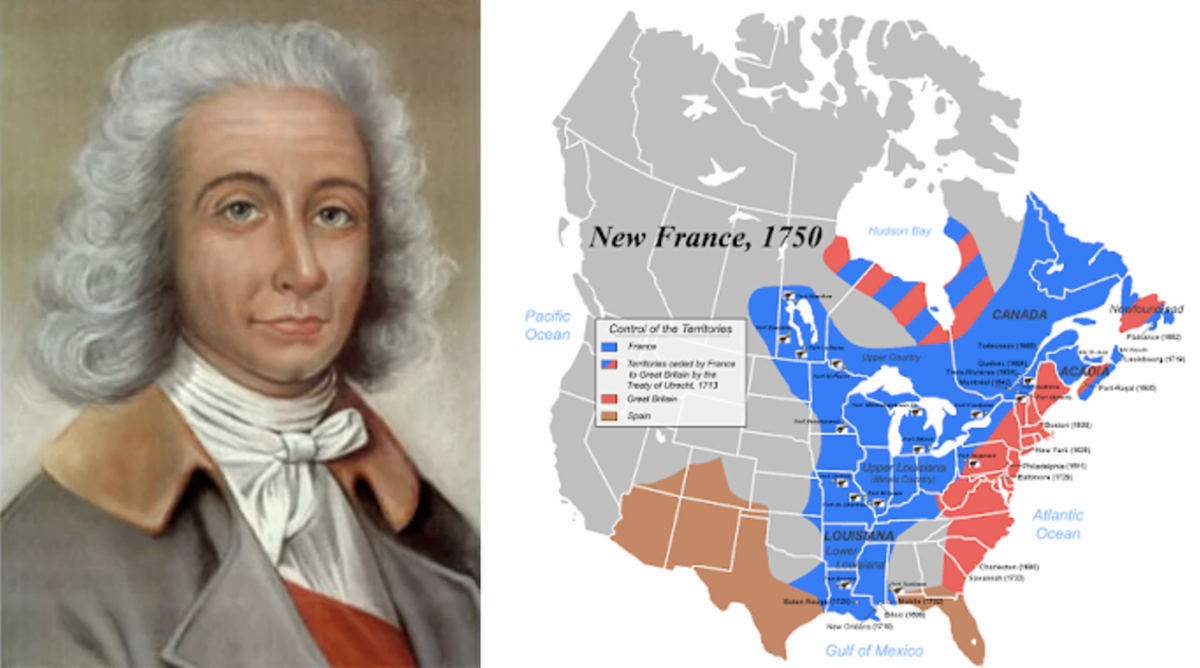
• Pierre-Joseph Céloron de Blainville (29 December 1693, Montreal—14 April 1759, Montreal) — also known as Celeron de Bienville (or Céleron, or Céloron, etc.) — was a French Officer of the Troupes coloniales de la Marine (troops of the French Navy). In 1739 and '40 he led a detachment to Louisiana to fight the Chickasaw in the abortive Chickasaw Campaign of 1739. In 1749 he led the 'Lead Plate Expedition' to advance France's territorial claim on the Ohio Valley.
• Pierre Joseph Céloron de Blainville joined the military in 1713 and was appointed as lieutenant commandant to the post at Michilimackinac in 1734. Céloron was called to Louisiana before the expiration of his second term in 1737 due to the British-allied Chickasaw nation blocking communication between Upper and Lower Louisiana. In response to a call for assistance, Céloron was dispatched to Fort de l'Assumption near present-day Memphis, Tennessee, with a 'considerable number of Northern Indians' and a company of cadets. After some skirmishing, the Chickasaw were willing to make peace.
• Céloron was appointed to command of Detroit after his return to Michilimackinac and was referred to as a Chevalier of the Military Order of Saint Louis and a Captain in the Department of Marine. He was appointed to command at Fort Niagara in 1744 and Fort St. Frédéric on Lake Champlain in 1746.
|
|
Murals, Steles and Markers |
|
Above: "Celoron claims the Ohio Valley for Louis XV", 12'x20' Foot Mural by Mark Missman, 2009. The mural was designed to commemorate the presence of the French explorers and their Jesuit companions in the Upper Ohio Valley.at the Wheeling Civic Center, (Wesbanco Arena)
2 14th Street, Wheeling, W. Va. 26003
|
|
There are several markers and plaques located in different States,
all memorializing the expedition of Celoron.
Marker, “1749 French Claims to Ohio River Valley”
801 East Pete Rose Way, Cincinnati OH 45202
• Inscription:
“In 1749, the French in North America perceived a threat by British expansion west of the Allegheny Mountains to the Ohio River Valley and beyond. The French commander, Pierre Joseph Celeron, sieur de Blainville, with 250 men, left Montreal, New France, to establish French claims. They buried inscribed lead plates at the mouths of six important tributaries to the Ohio River. Three lead plates have been recovered, one was sent to England, and two are in American historical societies. The final plate was buried just west of here at the mouth of the Great Miami River, before the detachment turned north. However, after the British captured Montreal in 1760, French claims east of the Mississippi River were ceded to Britain by the 1763 Treaty of Paris. British Parliament annexed to Quebec (now Canada) and controlled all lands north of the Ohio River until 1776.
Erected 1994 by The Society of Colonial Wars in the State of Ohio and The Ohio Historical Society. (Marker Number 12-31.)"
Stele & Plaque, “At this Point”
71 Chestnut St, Westfield, NY 14787
• Inscription :
“The French Portage built by
Celoron in 1749 and rebuilt in 1753
descended the bank and crossed
Chautauqua Creek
Erected 1924 by the Patterson Chapter D.A.R.”
Marker, “Celoron Expedition”
18 Jones and Gifford Avenue, Jamestown NY 14701
• Inscription :
“Celoron Expedition”
“Captain Pierre Joseph Celoron de Blainville in 1749 with a force of 213 soldiers and Indians traveled down Chautauqua Lake and the Chadakoin River to the Allegheny and Ohio Rivers renewing the French claim to the watershed.
Erected 1986 by Jamestown Historical Marker Committee.”
Marker and boulder, “Old Portage Road”
Intersection of South Portage Road & South Gale Street, Westfield NY 14787
• Inscription:
“Built by Celoron in 1749 when he
explored and claimed this region for
France, followed an Indian Trail and
crossed the highway at this point.
In 1753 it was rebuilt by the French
for military purposes.
Erected 1924 by the Patterson Chapter D.A.R.”
Marker, “Celoron’s expedition”
353 Pennsylvania Ave W, Warren, PA 16365
• Inscription:
“In 1749 a French force under Celoron de Blainville entered the Ohio valley by way of Chautauqua Lake and Conewango Creek. A lead plate was buried at the mouth of the Conewango claiming the area for France.”
Erected 1947 by Pennsylvania Historical and Museum Commission"
|
|
“French Monument, Celoron de Blainville" |
|
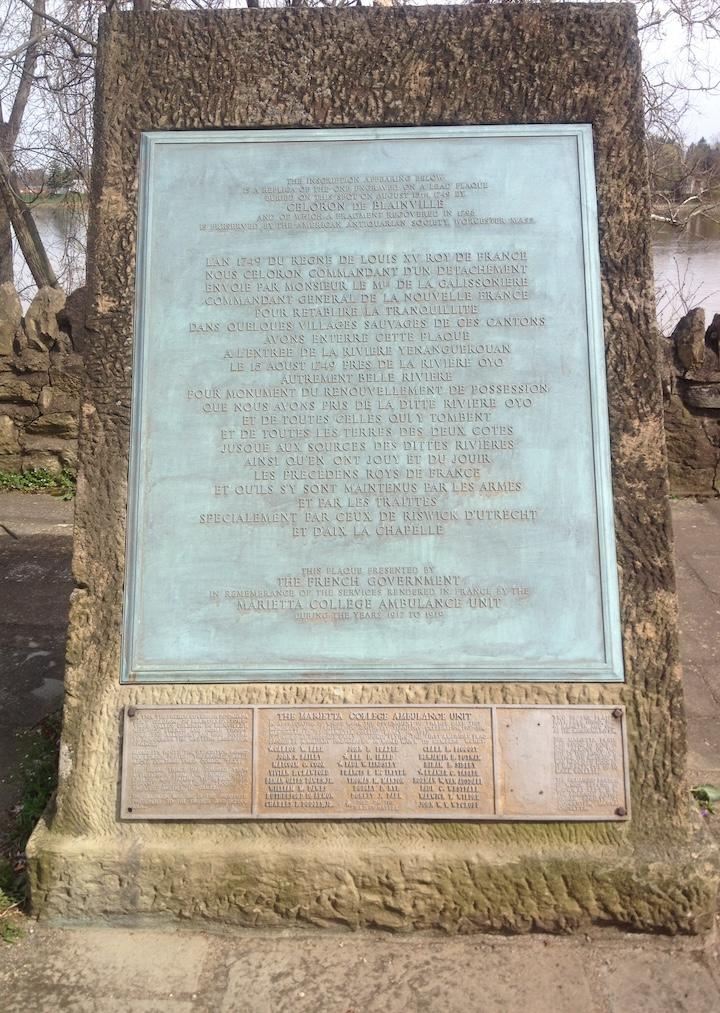
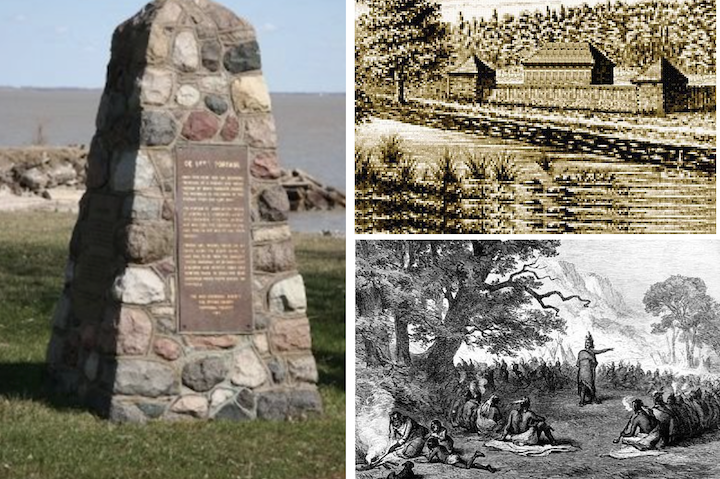
“French Monument, Celoron de Blainville”
100 Gilman Avenue, near the end of Virginia Street, Marietta, OH 45750
By Snoopywv - Own work, CC BY-SA 3.0,
|
|
The inscription appearing below is a replica of the one engraved on a lead plaque with the additional mentions:
"Buried on this spot on August 15th, 1749 by CELORON De BLAINVILLE
And of which a fragment recovered in 1798 Is preserved by the American Antiquarian Society, Worcester, Mass.”
[The Monument has the original text, please see the English translation above]
“This plaque presented by The French Government
In remembrance of the services rendered in France
by the Marietta College Ambulance Unit
During the years 1917 to 1919”
[Lower Plaque, Left Side]
"In 1749 the French Governor of Canada sent Celoron de Blainville (sometimes called Celeron de Bienville), with 235 French and Indian troops down the Allegheny and Ohio Rivers to re-possess the western lands for France. Along its route the expedition buried six leaden plates. The bronze tablet above contains their common text."
|
|
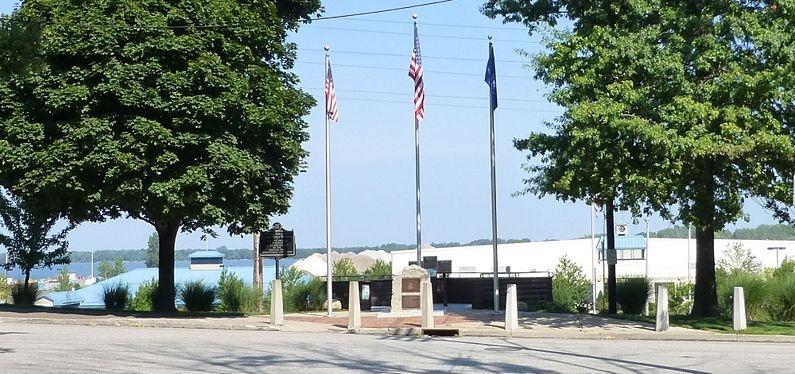
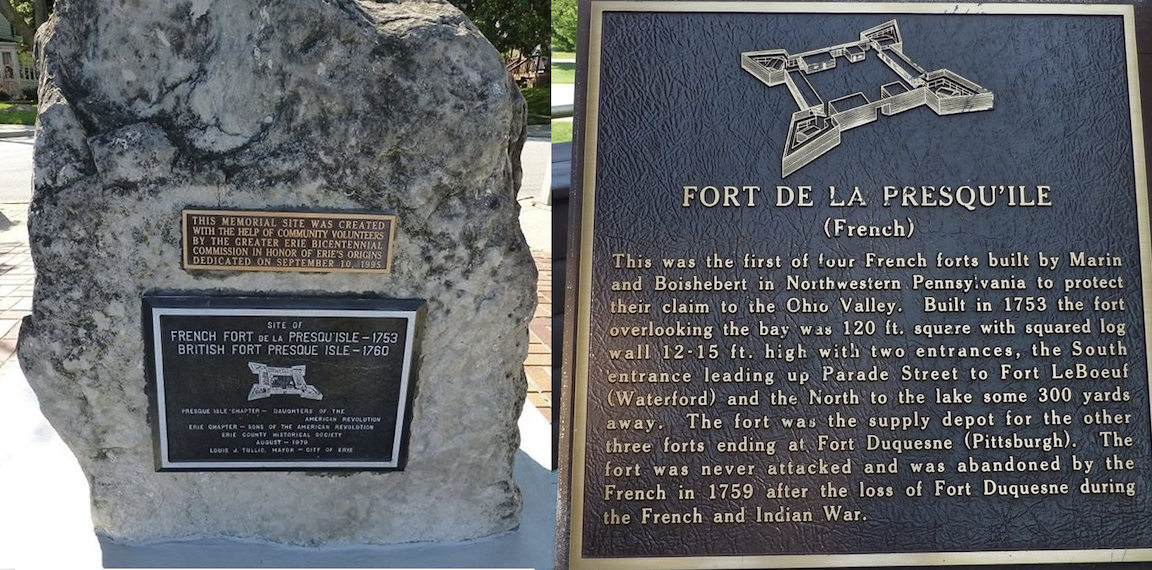
Historic site of Fort de la Presqu'île
1 State Street, Erie PA 16507
Photos top and middle: Fort Presque Isle French Fort Marker, photo by John Stanton 16 Aug 2012
|
|
• Fort Presque Isle, also known as Fort de la Presqu'île, was constructed by French soldiers during the summer of 1753 along Presque Isle Bay in present-day Erie, Pennsylvania. Its purpose was to safeguard the northern end of the Venango Path. This fort marked the first establishment of French posts in the Ohio Country and formed part of a defensive line that included Fort Le Boeuf, Fort Machault, and Fort Duquesne.
• The construction of Fort Presque Isle was a result of the French military occupation of the Ohio Country, which sparked rival claims by the British and ultimately led to the French and Indian War. Following the British victory at the Battle of Fort Niagara in 1759, the French burned the fort and withdrew from the area. Today, a marker at the intersection of E. Front St and Parade Street serves as a commemoration of the fort's location, situated among the houses in the southeast corner of E. Front and Parade Streets.
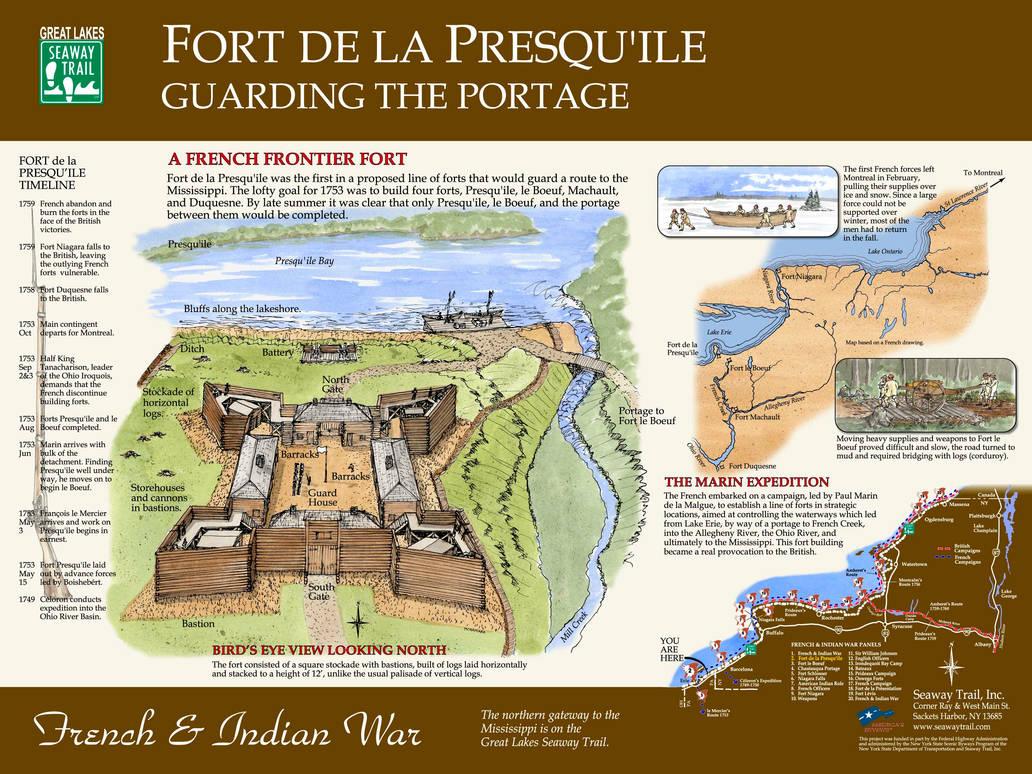
Stele & interpretative marker, “Fort de la Presqu’île, Guarding the Portage”
1 State Street, Erie PA 16507
• Inscription:
"A French Frontier Fort"
"Fort de la Presqu'ile was the first in a proposed line of forts that would guard a route to the Mississippi. The lofty goal for 1753 was to build four ports, Presqu'ile, le Boeuf, Machault, and Duquesne. By the late summer it was clear that only Presqu'ile, le Boeuf, and the portage between them would be completed. The first French forces left Montreal in February, pulling their supplies over ice and snow. Since a large force could not be supported over winter, most of the men had to return in the fall.
Moving heavy supplies and weapons to Fort le Boeuf proved difficult and slow, the road turned to mud and required bridging with logs (corduroy)."
"The Marin Expedition"
"The French embarked on a campaign, led by Paul Marin de la Malgue, to establish a line of forts in strategic locations, aimed at controlling the waterways which led from Lake Erie, by way of a portage to French Creek, into the Allegheny River, the Ohio River, and ultimately to the Mississippi. This fort building became a real provocation to the British.”
|
|
Stele, “Fort Sites / De Lery Portage / French Expedition 1754”
1985 Fulton St, Port Clinton OH 43452
Left: Image capture Nov 2007 (c) Google 2021
|
|
• Fort Sandoské was the name of the French fort. Fort Sandusky was the name given by the British when they originally built a fort in 1745, and again in 1761. The chronology shows the intense and prolonged tug of war between the French and the British in the region:
• In 1739, Orontony, a Huron chief, sought permission from Charles de Beauharnois, the governor of Canada, to settle in the heart of New France for better protection against his Iroquois enemies. However, due to the French colonial authorities' inaction, Orontony relocated his tribe to the south shore of Lake Erie, near Sandoské Bay, where he established a fortified encampment surrounded by a wooden palisade. Subsequently, Orontony engaged in commercial negotiations with English traders who were active in the area.
• A fresh dispute erupted in 1744 between the French and English military. The English provided assistance to Orontony and made him a powerful ally by building a fortified camp, which was later called Fort Sandusky. In 1747, Paul-Joseph Le Moyne de Longueuil, the governor of New France, dispatched substantial reinforcements to Fort Detroit. Consequently, Orontony opted to relocate from the Great Lakes area and set fire to his fortified village of Sandoské before migrating southward to the Ohio River valley.
• In 1747, the French military gained control over the Great Lakes and proceeded to construct a fresh stronghold known as Fort Sandoské on Sandoské Bay. Amidst the Seven Years' War, the Hurons, who were allies of the French, received a group of Amerindians from the Iroquois Nation at Fort Sandoské. These Amerindians cautioned the Hurons to remain cautious of the English, as they were solely interested in sowing division among them in order to more effectively annihilate them after expelling the French.
• In the year 1754, the French successfully founded Fort Junandat, a trading outpost situated on the southern shores of Sandusky Bay. In certain historical documents, the French referred to this location as Lac Sandoské. This fort was strategically positioned within the boundaries of what is now known as Erie County, Ohio.
• In 1761, the British successfully seized control of the fort, but the French, with the support of the Outaouais Amerindians, managed to recapture it. Following the signing of the Treaty of Paris in 1763, the French troops abandoned the Great Lakes region. Subsequently, the British arrived and constructed a new fort, which they named Fort Sandusky. Indian Chief Pontiac would then lead a rebellion against the British in 1763, killing the garrison, but it is another story...
• Excerpts of bronze plaque:
South face: Fort Sites. Here near the peninsula carrying place where earlier British traders may have had a post, French soldiers built in 1750 and 1751 a small palisaded fort later called "Sandoski." Lt. deLery reported that the fort was in ruins by 1754.
West face: De Lery Portage
Near this point was the southern terminus of a French and Indian portage by which travelers crossed the peninsula to the mouth of the Portage River and Lake Erie.
"The portage is named after French Lt. Joseph G. Chaussegros de Lery who described it in his journal and who used the crossing in 1754 and 1755 on his way to and from Detroit.
French and Indians traveling by canoe along the south shore of Lake Erie, to or from the Sandusky – Scioto Waterway, or between Fort Duquesne and Detroit, used this carrying place to avoid the more dangerous water route around the Peninsula."
French Expedition 1754
"Across the De Lery Portage: From Quebec to Detroit and Michilimaquinakas noted in the journal of the chevalier Shaussegros de Lery which on August 4 1754 landed near this spot "and discovered the ruins of the old fort."
Fort Sanduski 1745 - 1746, 1750-1751”
|
|
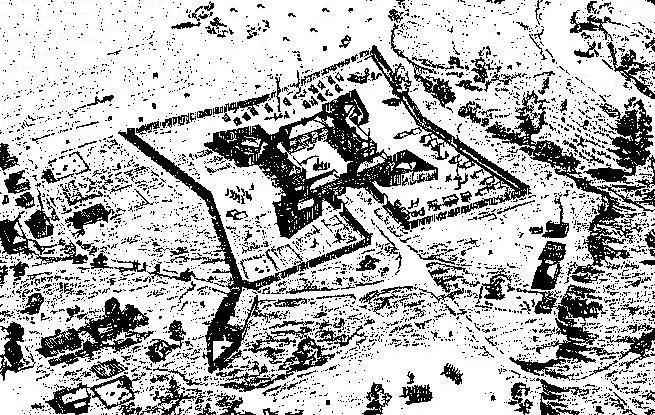
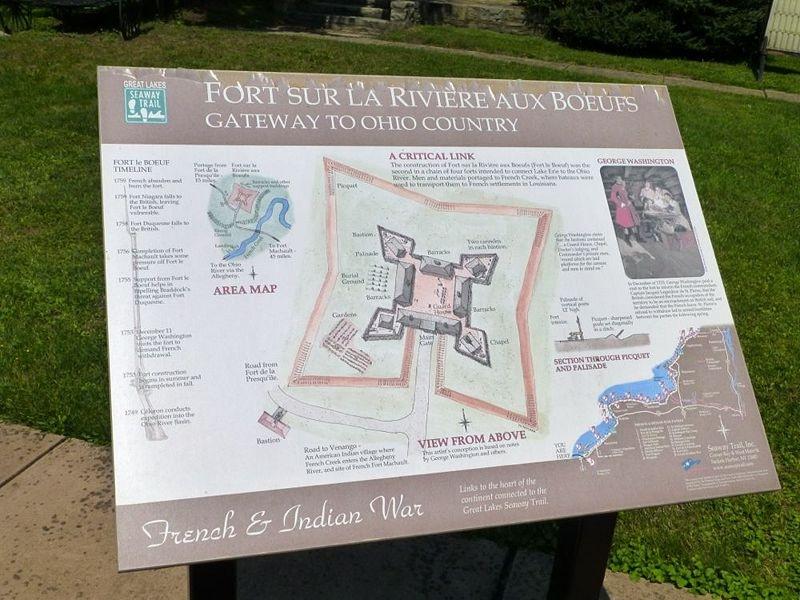
• During 1753, the French established Fort Le Bœuf, also known as Fort de la Rivière au Bœuf, on a fork of French Creek in the drainage area of the River Ohio, which is present-day Waterford in northwest Pennsylvania. The fort was part of a line that included Fort Presque Isle, Fort Machault, and Fort Duquesne. The fort was named after LeBoeuf Creek, on the banks of which it was located, about 15 miles (24 km) from the shores of Lake Erie. The French portaged supplies and trade goods from Lake Erie overland to Fort Le Bœuf and then traveled by raft and canoe down French Creek to the rivers Allegheny, Ohio, and Mississippi. Today, the Fort LeBoeuf Museum, operated by the Fort LeBoeuf Historical Society, occupies the site of the fort.
• On 11 July 1753, Captain Paul Marin de la Malgue initiated the construction of a fort that would later be known as Fort LeBoeuf. This fort was one of several posts built by the French between 1753 and 1754 to establish their control over the Ohio Country. Jacques Legardeur de Saint-Pierre assumed command of the fort on 3 December 1753. The French took over the British trading post of John Frazier at the Lenape village of Venango, located at the confluence of French Creek and the Allegheny River. This seizure allowed the French to assert their dominance over the region. The French left a garrison at the new posts and returned to Canada for the winter. Fort LeBoeuf, which was located in modern-day Waterford, Pennsylvania, was strategically positioned at the southern end of the Venango Path, a portage road connecting Lake Erie and French Creek. The fort served as a French trading post and garrison until 1759.
Marker, “Fort Le Boeuf”
55 High St, Waterford, PA 16441
• Inscription:
“Three forts have stood on this site. French fort, built 1753, to guard road into Ohio Valley, abandoned 1759. British fort built in 1760, burned by Indians in 1763. American fort to protect settlers, built 1794.
Erected by Pennsylvania Historical Museum Commission.”
|
|
The first encounter between George Washington and the French |
|
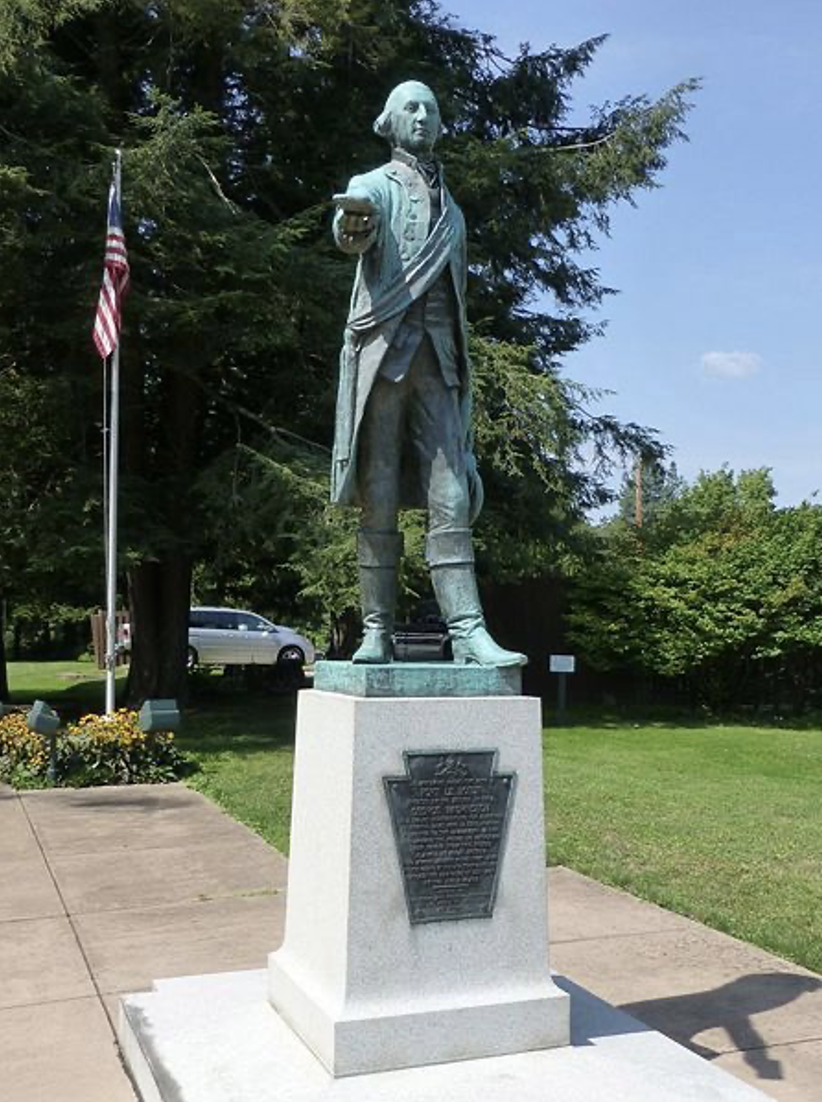
Plaque and statue of George Washington, “This Monument Marks the Site of Fort Le Boeuf”
George Washington Memorial Park, 32 High St, Waterford, PA 16441
Photo: by John Stanton 16 Aug 2012
http://www.fortwiki.com/File:Fort_Le_Boeuf_George_Washington.jpg
|
|
• In response to reports of French fortifications in the Ohio Country, Robert Dinwiddie, the governor of Virginia, dispatched George Washington, a 21-year-old major in the Virginia militia, along with seven escorts, to Fort Le Boeuf. The purpose of the mission was to deliver a message to the French, demanding that they vacate the area. On 11 December 1753, Washington arrived at Fort Le Boeuf, where he was received cordially by Jacques Legardeur de Saint-Pierre, the commandant at the fort and a veteran of the Western frontier, who invited him at dinner.
• This courteous gesture left an impression on George Washington. However, Saint-Pierre refused to comply with Washington's aggressive demands, citing various treaties signed in Europe.
• After granting Washington three days of rest and extending his hospitality at the fort, Jacques Legardeur de Saint-Pierre entrusted him with a letter to be delivered to Governor Dinwiddie. This letter contained a directive for the Governor of Virginia to convey his demand to the Major General of New France, who resided in the capital city of Quebec.
• Inscription:
“This monument marks the site of Fort Le Boeuf. Erected by the French in 1752. George Washington, as a major representing the governor of Virginia, came here in 1753, bearing a letter to the commander of the fort, warning the French to withdraw their forces from this region claimed by Great Britain. This mission was one of the first links in the chain of events that settled forever the dominance of our land by the Anglo Saxon.”
“Erected 1921 by The Pennsylvania Historical Commission and the People of Waterford and Friends.”
|
|
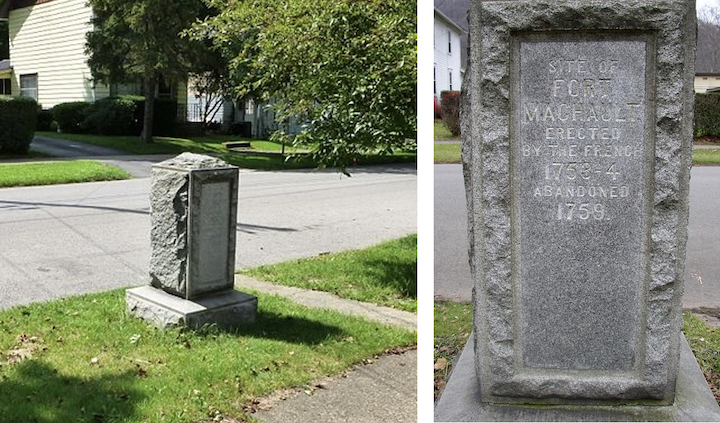
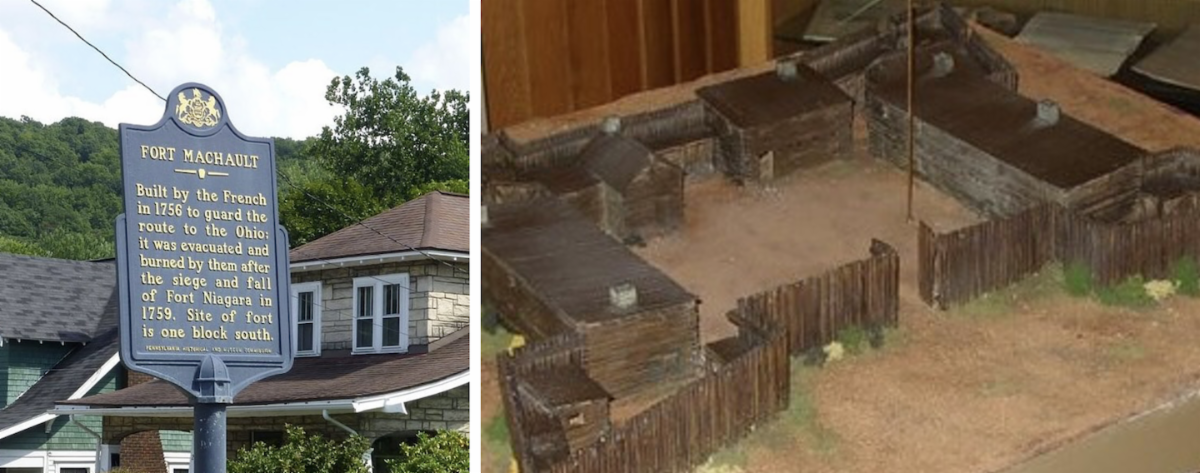
Marker, “Fort Machault”
800-804 Elk St, Franklin, PA 16323
|
|
• Governor Jean de Lauson endeavored to construct a fortified trading post at the junction of the Allegheny River and French Creek in Venango in 1753. During that year, the English traders were expelled from Venango, and Philippe-Thomas Chabert de Joncaire, captain of the Troupes de la Marine, was stationed. He was raised by the Iroquois at age 10 and served as an interpreter for Celoron. Joncaire established Fort d'Anjou with a permanent garrison at that very site. In 1754, Philippe-Thomas was succeeded by Michel Maray de La Chauvignerie as the officer responsible for the fort's construction, and eventually, the fort was renamed Fort Machault.
• It was named in honor of prominent financier, Jean-Baptiste Machault d'Arnouville, the French Minister of the Marine at the time of its construction.
• It is Philippe-Thomas Chabert de Joncaire who first greeted young George Washington and escorted him to Fort Le Boeuf for his meeting with the commander Jacques Legardeur de Saint-Pierre.
• In his report George Washington wrote:
“We found the French Colours hoisted at a House which they drove Mr. John Frailer, an English Subject, from; I immediately repaired to it, to know where the Commander re- sided: There were three Officers, one of whom, Capt. Joncaire, inform'd me, that he had the Command of the Ohio, But that there was a General Officer at the near Fort, which he advised me to for an Answer. He invited us to sup with them, and treated us with the greatest Complaisance”.
• Following the abandonment of Fort Duquesne in November 1758, the French retreated to Fort Machault, where they were expected to launch a counterattack in the next campaign season. In July 1759, the French began a campaign to retake Fort Duquesne (which had been renamed Fort Pitt by the British), but the British had already begun a siege of Fort Niagara in New York. The French were forced to abandon their assault and sent available forces to attempt to relieve the besieged Fort Niagara. When the French lost Fort Niagara on July 25, 1759, it made their presence in the Ohio Country untenable. In August 1759, the commander of Fort Presque Isle ordered Fort Le Boeuf and Fort Machault to be abandoned. The French burned Fort Machault to prevent its use by the British and retreated to Canada in anticipation of a British expedition there.
• This location eventually became the site of present-day Franklin. The fort played a crucial role in enabling the French to assert their dominance over these vital water routes, forming a significant segment of the Venango Path, which facilitated travel from Lake Erie to the Ohio River.
• Inscription:
“Built by the French in 1756 to guard the route to the Ohio; it was evacuated and burned by them after the siege and fall of Fort Niagara in 1759. Site of fort is one block south.”
Erected 1969 by Pennsylvania Historical and Museum Commission.”
|
|
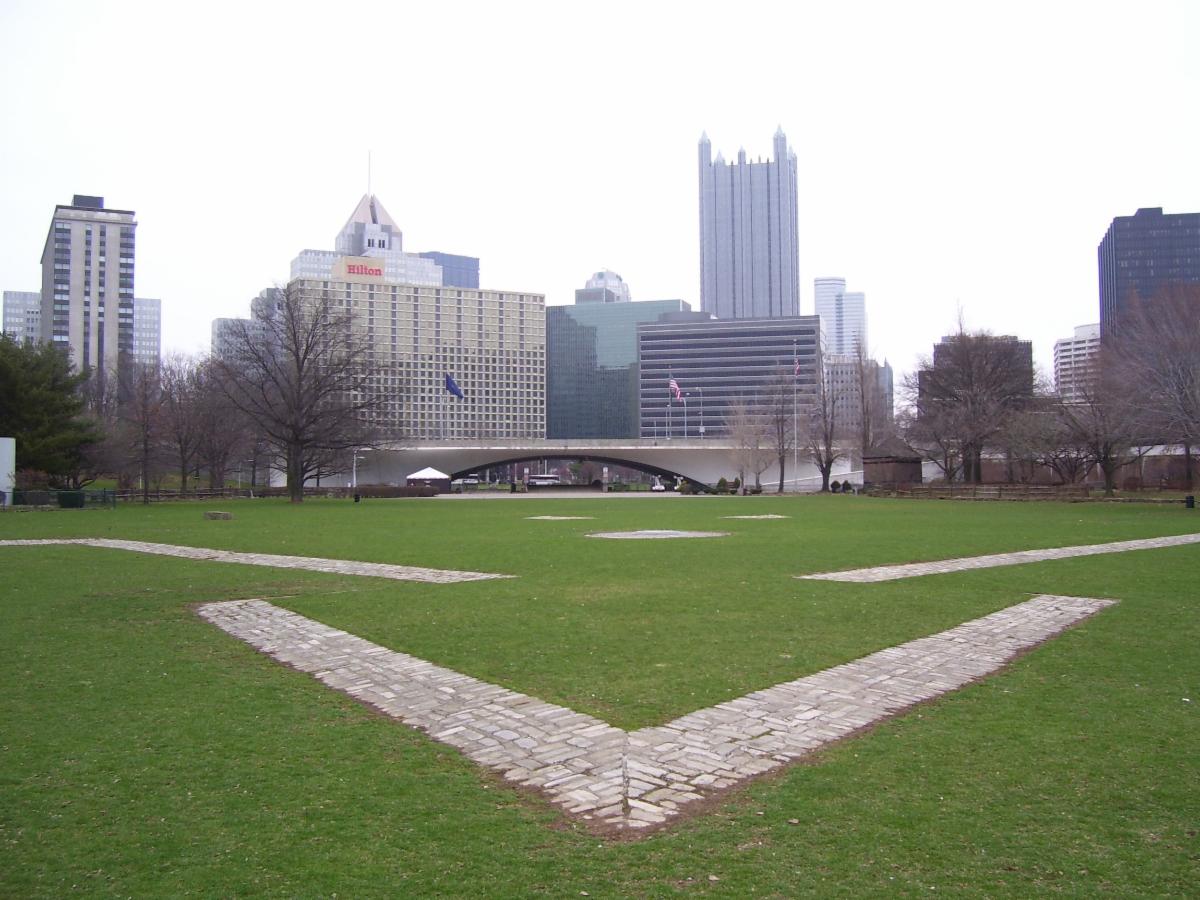
Fort Duquesne (present-day Pittsburgh, PA) |
|
Outline of Fort Duquesne, Point State Park
3 Rivers Heritage Trail System, Downtown, Pittsburgh, PA 15222
Photographed April 2006 by Kevin Myers CC BY-SA 3.0
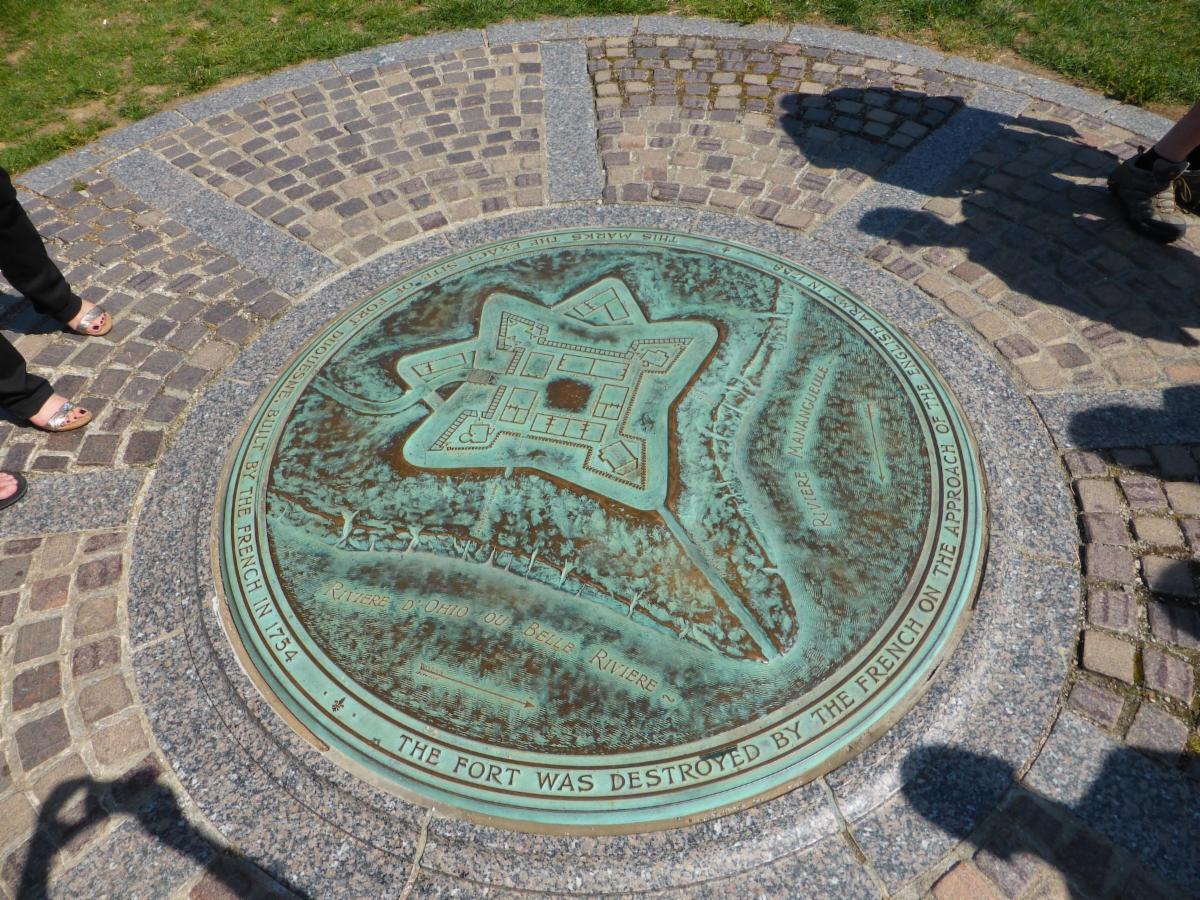
Close-up: Marker for Fort Duquesne.
|
|
• After George Washington's return to Virginia in January 1754, Governor Dinwiddie dispatched Virginians to construct Fort Prince George at the Forks of the Ohio. Construction of the fort commenced on February 17, and by April 18, a significantly larger French force of five hundred, led by Claude-Pierre Pécaudy de Contrecœur, arrived at the forks, compelling the small British garrison to surrender.
• The French dismantled the modest British fort and erected Fort Duquesne in its place, naming it in honor of Marquis Duquesne de Menneville, the governor-general of New France. The fort was constructed based on the design of the French Fort Frontenac, situated on Lake Ontario.
Marker, “Fort Duquesne“, in modern-day Pittsburgh, PA
Fort Duquesne, 3 Rivers Heritage Trail System, Pittsburgh, PA 15222
• Inscription of marker at "the Point":
“This marks the exact site of Fort Duquesne, built by the French in 1754. The Fort was destroyed by the French on the approach of the English Army in 1758”
• Since the late 20th century, this area of downtown Pittsburgh has been preserved as Point State Park, or simply, "the Point." The park includes a brick outline of the fort's walls, as well as outlines to mark the later Fort Pitt.
• On 14 September 1758, the British launched an attack on Fort Duquesne, as part of a larger expedition to drive the French out of the Ohio Country and pave the way for a Canadian invasion. General John Forbes led the 6,000-strong British force, which included Major James Grant and his 850 men, and a contingent of Virginians led by George Washington. Grant, without orders, attacked the French position using traditional European military tactics, but his force was outmaneuvered, surrounded, and largely destroyed by the French and their native allies under François-Marie Le Marchand de Lignery. The British survivors retreated to Fort Ligonier, and Major Grant was taken prisoner.
• Despite successfully repelling the initial British assault, Lignery realized that his contingent of approximately 600 soldiers would be unable to withstand the main British army, which outnumbered them by over tenfold, at Fort Duquesne. The French maintained control of the fort until November 24, when they deliberately set it ablaze and departed under the veil of night, and started their withdrawal from the Ohio Valley.
• Subsequently, the fort was taken over by the British who renamed it Fort Pitt, and later by the Americans, eventually developing into the city of Pittsburgh.
• The location of the battle is memorialized by a bronze plaque situated on the Allegheny County Courthouse, which was erected in 1901. Notably, the hill where the battle took place has been designated as Grant Street in present-day Pittsburgh.
Bronze Plaque, “Grant Hill“
On Grant Street, wall of the Allegheny County Courthouse
436 Grant Street, Pittsburgh PA 15219
• Inscription:
"On this hill the British under Major James Grant were defeated by the French and Indians from Fort Duquesne, September 14, 1758.
Erected 1901 by Daughters of the American Revolution-Pittsburgh Chapter."
|
|
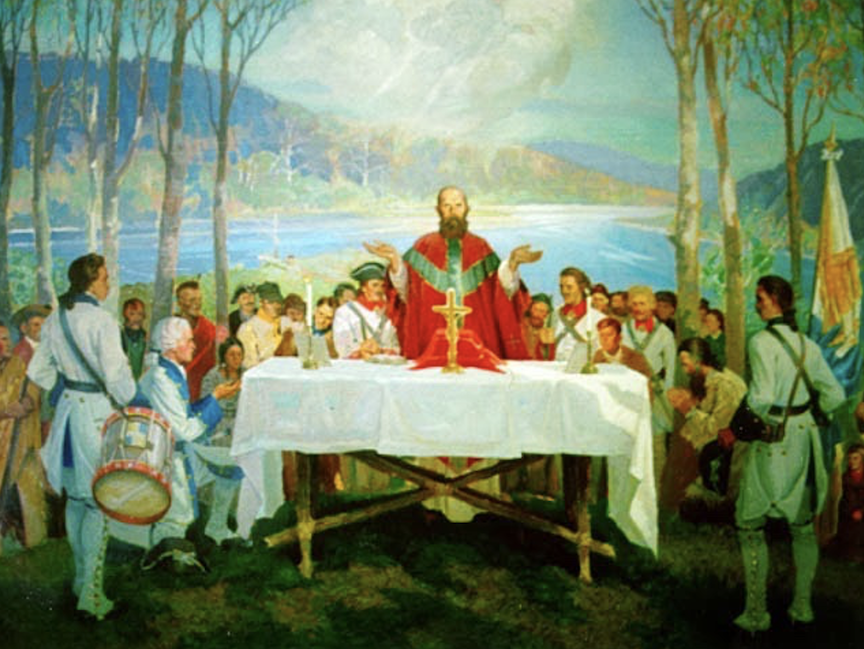
Painting & tablet, "the First Holy Mass at Fort Duquesne"
|
|
1957 painting by Charles Hargens portraying "The Reverend Denys Baron celebrating the first Mass at Fort Duquesne on 16 April 1754" (Catholic Diocese of Pittsburgh)
|
|
• On April 17, 1754, the day after their arrival, Rev. Denys Baron celebrated the first Mass at the chapel they called the Assumption of the Blessed Virgin Mary at the “Beautiful River”.
Bronze tablet at St Mary of Mercy Roman Catholic Church
202 Stanwix St, Pittsburgh, PA 15222
• Inscription:
“This tablet commemorates the First Holy Mass at Fort Duquesne, celebrated April 16th, 1754, by the Reverend Denys Baron, chaplain to the French forces in occupancy. The Church of St Mary derives from the chapel of that period called “La Chapelle de l’Assomption de la Ste Vierge à la Belle Rivière”
Erected 1929 by Fort Pitt General Assembly Fourth Degree Knights of Columbus.”
• A reprint and translation of the "Registres des baptesmes et sepultures qui se sont faits au Fort Duquesne pendant les années 1753, 1754, 1755 & 1756," published, New York, 1859, as no. 9 of J.G. Shea's Cramoisy press series is available from the Library of Congress and is in the Public Domain. “The Fort Dusquesne Register, published by the Diocese of Pittsburgh, is not only is a record of deaths, marriages and baptisms of the Catholic settlers, soldiers and Native Americans, it is also a testament to the pastoral concern of Father Baron for the spiritual welfare of his people”.
• "It was the custom in Catholic countries to select a patron saint for important sites, someone whose protection would be assured through public dedication and veneration. Accordingly this new fort and its associated chapel were dedicated to "L'Assomption de la Ste. Vierge a la Belle Rivière" (Assumption of the Blessed Virgin of the Beautiful River). A footpath used for funerals led from the chapel (original location unknown but somewhere near Fort Duquesne and what we know today as the Point) to a cemetery near the Native American burial ground in midtown. That path was called L'Allée de la Vierge Marie and the cemetery was also dedicated to la Ste Vierge à la Belle Rivière, the Blessed Virgin of the Beautiful River. When this area passed from French to British ownership, the established street names were altered accordingly.
L'Allée de la Vierge Marie thus became Virgin Alley, today known as Oliver Avenue. In the late 18th/early 19th century, the original Episcopal Trinity Church was built on lots bordering Virgin Alley, over the tumulus that had served as a Native American burial ground and cemetery for early French and English settlers and military personnel. That site is thought to have encompassed some 4000 graves."
Excerpts from:
|
|
The tragic Jumonville incident sparks a global war |
|
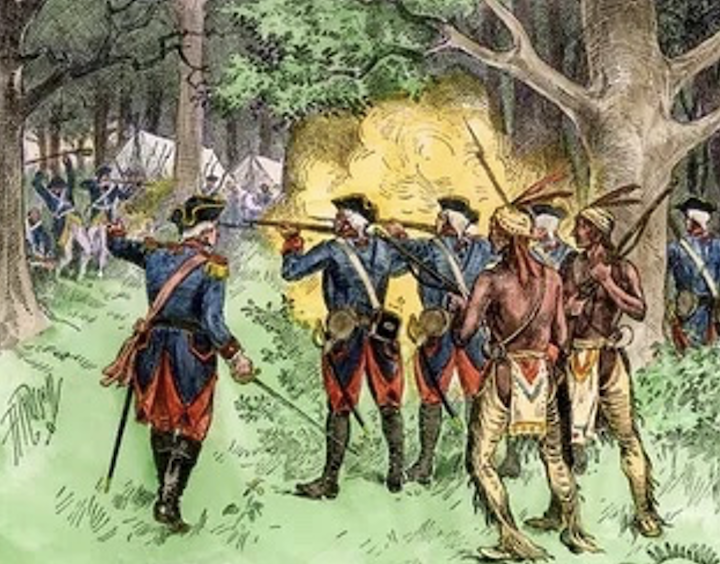
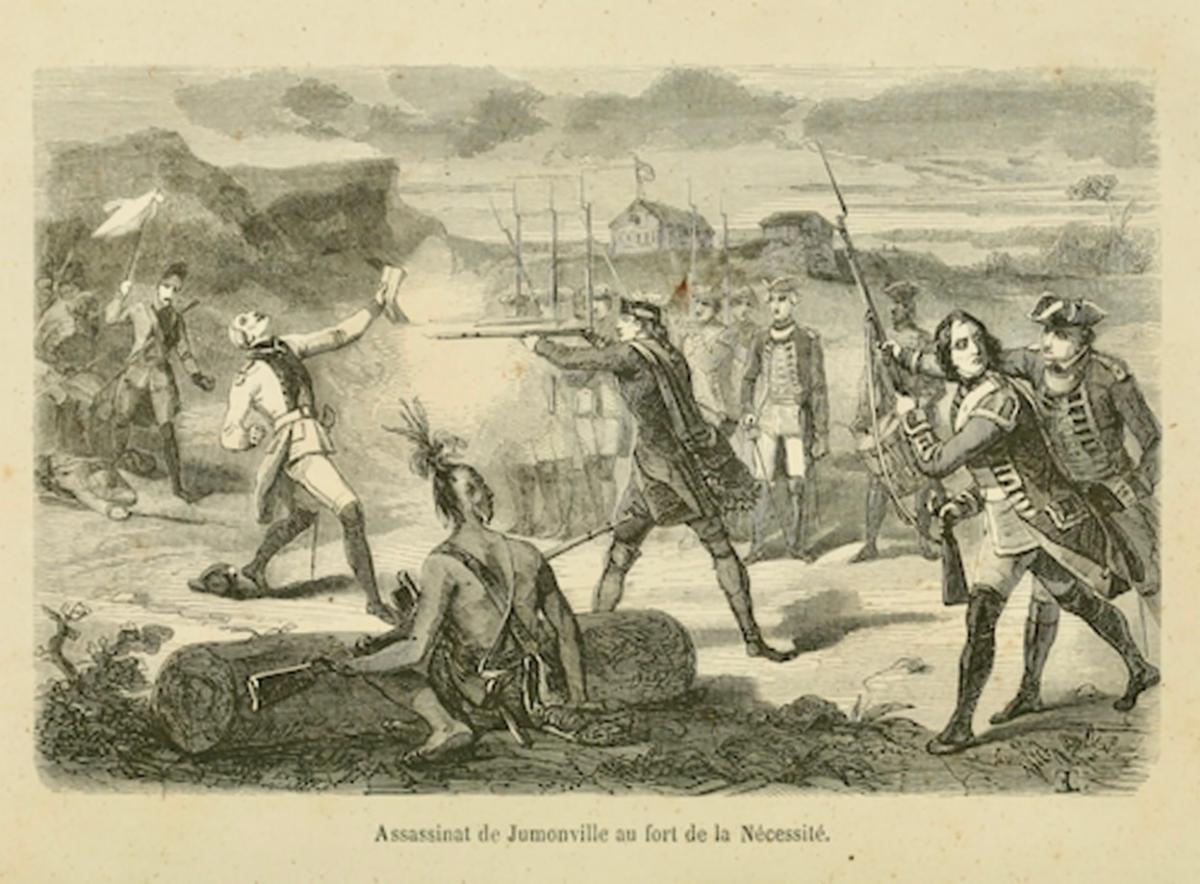
Illustrations:
In this artist's version of the incident at Jumonville Glen, the English under the command of George Washington are depicted as murdering the defenseless French commander Jumonville in cold blood. Contemporary accounts of the incident are contradictory; it is more likely that Jumonville was in fact tomahawked by the Indian leader Tanaghrisson while Washington watched without intervening.
|
|
• On April 2, 1754, Lieutenant Colonel Washington, while stationed at Wills Creek in Maryland, received news of the French expedition expelling the British and the construction of Fort Duquesne. On May 28, Washington encountered a French scouting party near Jumonville Glen, where he launched an attack and killed 10 French soldiers while capturing 21 others. Unfortunately, many of the prisoners were later killed by Washington's Native American allies.
• When news reached France, it sparked an outrage. This incident is widely regarded as the spark of the French and Indian War, which was the North American theater of the Seven Years' War.
Several markers recount the tragic incident:
Marker, “Jumonville - the "skirmish...that set the world on fire"
1000 Old Braddock Road, Hopwood PA 15445
• Inscription:
“At sunrise on May 28, 1754, young Colonel George Washington and Seneca Chief Tanacharison ("The Half King") led a combined force of 40 Virginia militia and Iroquois warriors in an attack against 33 French soldiers camped along the large ledge of rocks now known as "Jumonville Glen"-a few hundred yards from this spot. The French, taken by surprise, were defeated in fifteen minutes, with ten soldiers killed, 22 taken prisoner, and just one escaping.
Among the dead was the French commander, Joseph Coulon de Jumonville. His death had international repercussions, for France and England were not at war, but both claimed ownership of the "Ohio Country." According to the French, Jumonville was on a peaceful diplomatic mission, was ambushed, and tried desperately to summon Washington before he was killed. Washington denied these claims. Nevertheless, this undeclared war escalated when a French force defeated Washington at Fort Necessity on July 3rd. The French commander, Louis Coulon de Villiers (Jumonville's brother) witnessed Washington's signature on the surrender document that included a phrase admitting to the "assassination”. Despite debate over whether Washington really knew he had admitted to murder, the account of the Jumonville affair was widely publicized in Europe, leading England and France toward another "War for Empire" in North America. In the words of historian Francis Parkman, "this obscure skirmish began the war that set the world on fire."
Erected by National Park Service and the American Battlefield Protection Program.
Marker, “Washington's First Battlefield, Prelude to the French and Indian War“
Jumonville Road County Road 2021, Hopwood PA 15445
• Inscription:
“Lieutenant Colonel George Washington in command of a company of Virginia militia, forty in number assisted by the half king Tenacharisson and a company of Indians, surprised, killed, wounded or captured the entire engaged French force under command of Ensign Coulon de Jumonville hidden below this ledge of rocks since known as "Washington's Rocks." May 28, 1754.”
"This obscure skirmish began the war that set the world on fire." Francis Parkman
Erected by Westmoreland-Fayette Branch of the Historical Society of Western Pennsylvania.”
Marker, “Jumonville Defeat”
Route US40 near scenic outlook, Hopwood PA 15445
(This marker, like the event it describes, leaves much to be explained...)
• Inscription:
“Three miles to the north, the French & Indian War began on May 28, 1754, when a force of Virginians and Indians led by Col. George Washington defeated a French party under Jumonville, who was killed”
Marker, “Surprise attack“
Jumonville Road County Road 2021, Hopwood PA 15445
• Inscription:
“About 7:00 a.m., most of the 32 French troops camped here were preparing breakfast or just arising. Suddenly, the French saw enemy soldiers at the edge of their camp, called out an alarm, and ran for their muskets stacked nearby. Lt. Col. George Washington ordered his men to fire, and their volley was echoed by Captain Adam Stephen's men above the glen.
Confusion reigned. The French soldiers tried to escape down the glen. But when they encountered the Indians with tomahawks, they ran back toward the British with their hands in the air. As Washington accepted the French surrender, some Indians continued to scalp the dead and wounded. They wanted to take the prisoners, too, but Washington refused to release them.
When the attack ended, the British had suffered one dead soldier and two wounded. Ten French soldiers lay dead, including their leader Ensign Joseph Coulon de Jumonville. Although 21 were captured, one man escaped barefooted and walked 60 miles to Fort Duquesne (present-day Pittsburgh) to report this incident that became known worldwide as the "Jumonville Affair.”
Erected by National Park Service, U.S. Department of the Interior."
|
|
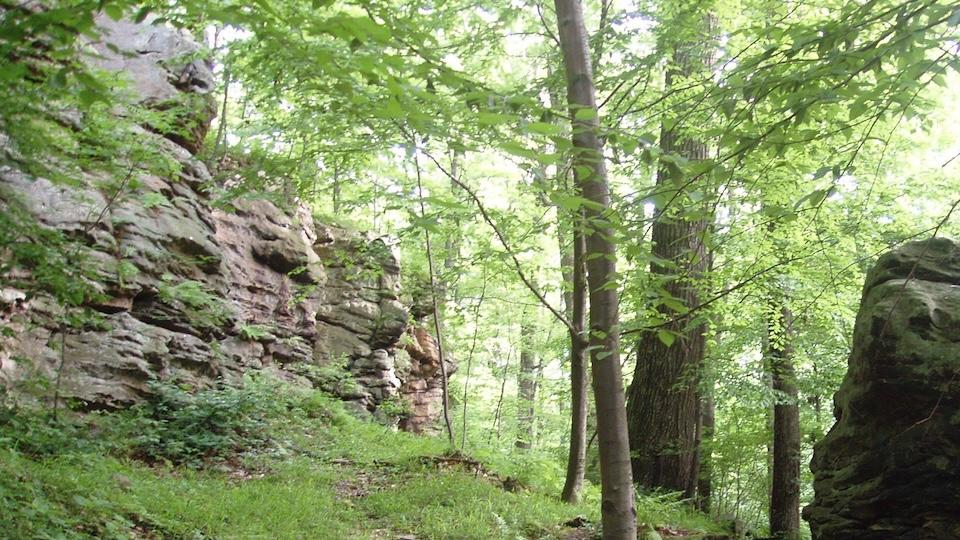
Photos:
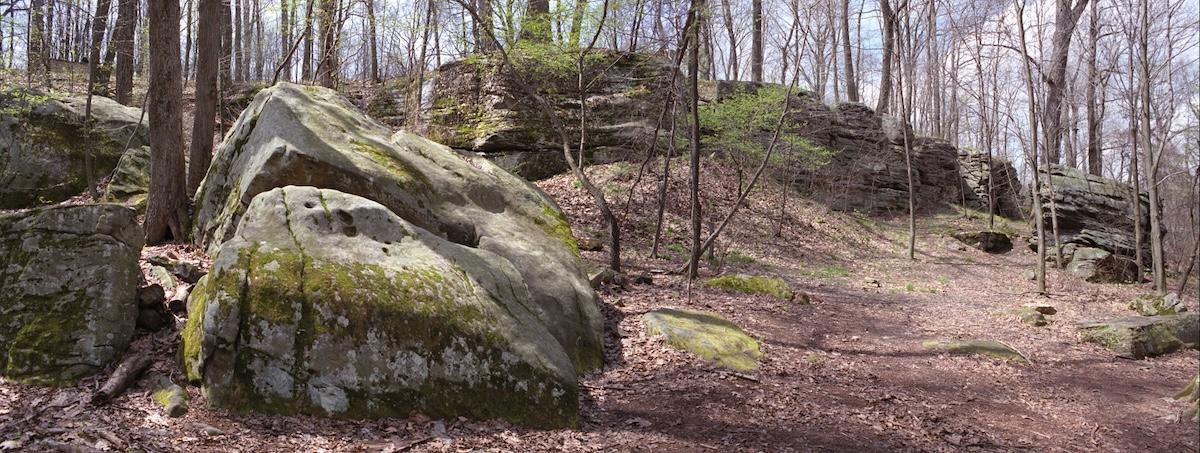
The 1/2-mile loop trail ahead leads to a secluded ravine, thick with trees and boulders. Considered serene today, this wilderness landscape covered most of North America in the mid-1700s.
|
|
Marker, “ From Jumonville to a world war“
On the loop trail of the Jumonville Glen unit of the Fort Necessity National Battlefield
Hopwood PA 15445
• Inscription:
“The 15-minute skirmish fought here on May 28, 1754, had long-term consequences. One month later, 600 French soldiers and 100 Indians under Captain Louis Coulon de Villiers - Jumonville's brother - left Fort Duquesne "to avenge ourselves..." On July 3, the French and Indian force surrounded almost 400 British troops at nearby Fort Necessity and forced a surrender.
In 1755, the French and Indians defeated Maj. Gen. Edward Braddock's larger British army at the Battle of Monongahela. Tensions between the two powers increased and, in 1756, they officially declared war on each other. The "French and Indian War," also called the "Seven Years War" in Europe, was fought on four continents and three oceans before it ended in 1763.
Erected by National Park Service, U.S. Department of the Interior.”
|
|
French revenge for Jumonville and battle at Fort Necessity |
|
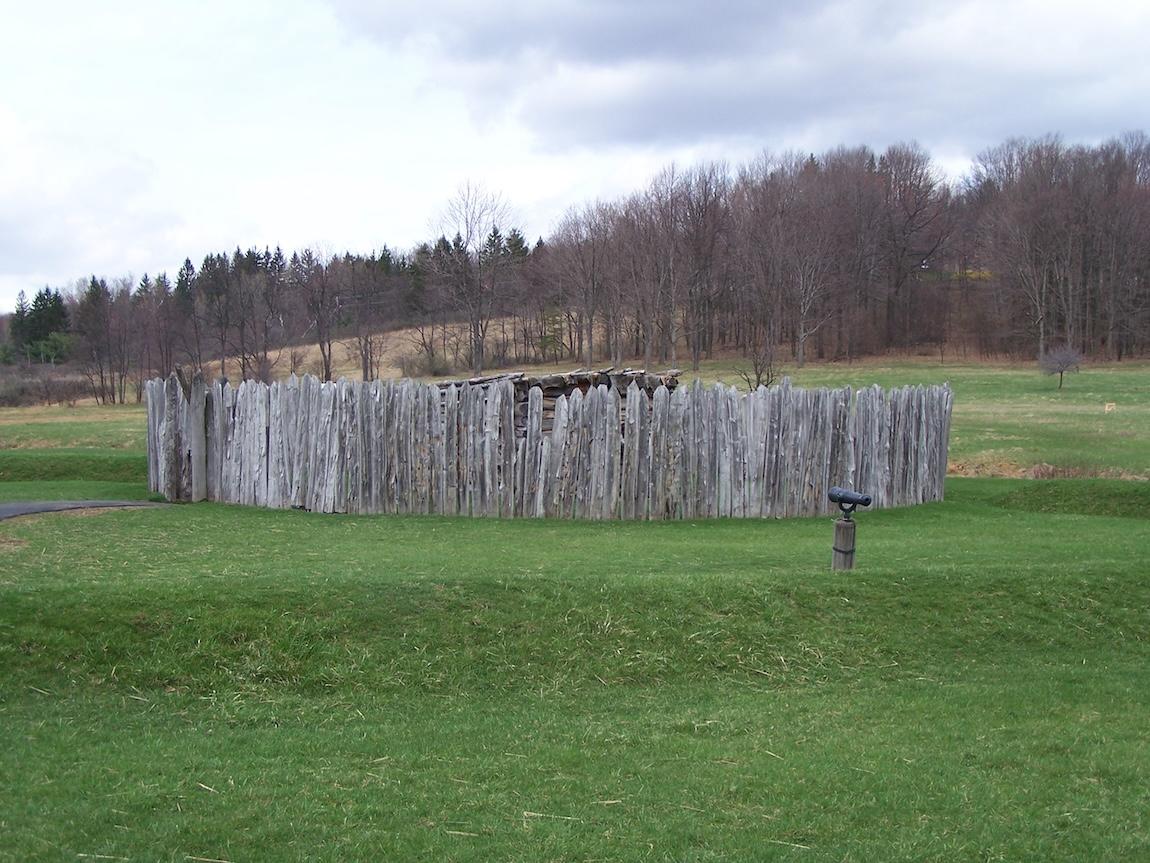
1 Washington Parkway, Farmington, PA 15437
Photos:
Top: Fort Necessity replice, photo by ScottyBoy900Q
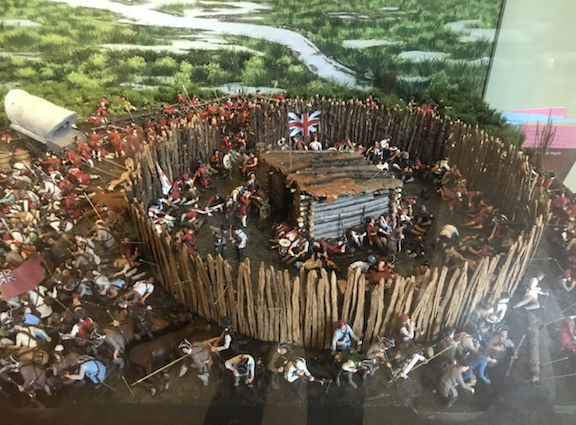
Middle: Diorama Visitor Center, Fort Necessity
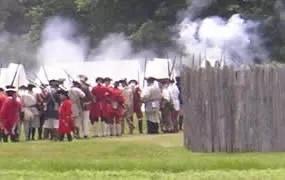
Bottom: Washington's men formed ranks outside Fort Necessity in anticipation of a pitched battle
Photo by Doug Fouser, National Park Service
|
|
• Louis Coulon, sieur de Villiers (17 August 1710 – 2 November 1757) was a French Canadian military officer during the French and Indian War (Seven Years' War).
• He is the only military opponent to force George Washington to surrender.
• Villiers was leading a French force to avenge the death of his half-brother, Ensign Joseph Coulon de Jumonville, who was killed by Indians at the Battle of Jumonville Glen after having surrendered to George Washington.
Marker, “Fort Necessity”
Fort Necessity National Battlefield, 3414 National Pike, Farmington, PA 15437
• Inscription:
• Fort Necessity was located about 400 yards to the south in the Great Meadows. Built and commanded, 1754 by Lieutenant Colonel George Washington, aged 22. Here, after 9 hours engagement with M. Coulon de Villiers in command of 900 French regulars and their Indian allies, Washington and his 400 raw Virginia and South Carolina troops capitulated and early next morning July 4, 1754 marched out with the honors of war.
Erected 1926 by The Pennsylvania Historical Commission and Citizens of Fayette County.
Marker, “The French Attack“
Jumonville Road County Road 2021, Hopwood PA 15445
• Inscription:
“July 3, 1754 dawned gray and drizzly. Mid-morning about 700 French and Indians approached from the far end of the meadow toward fewer than 400 British soldiers in and around Fort Necessity. French Captain Louis Coulon de Villiers saw the British standing before their trenches, in battle lines typical of European tactics.
With a cry the Indians and French advanced. Strategies quickly changed as the British withdrew into their fortifications while the French and Indians dispersed into the woods to surround the fort. Most of the French and Indians concentrated in the woods behind you where — protected by trees and within accurate firing range — they held the advantage. As rain fell throughout the day, the French exchanged musket fire with the British, most of whom were lying in water-filled trenches.
The French and Indian force approaching along Washington's unfinished military road until they reached the Great Meadows. They briefly appeared in this part of the Great Meadows, before following their scouts into the woods.
The French commander, de Villiers, positioned his troops "so as to continue the English in their fort and entirely prevent them from leaving."
The majority of the French troops and their Indian allies then fought from this position in the woods within musket range of Fort Necessity.
Erected by National Park Service, U.S. Department of the Interior.”
Marker, “Surrender Negotiations“
Jumonville Road County Road 2021, Hopwood PA 15445
• Inscription:
“Soon after 8:00 p.m. on July 3, 1754, the British crossed this meadow to discuss the surrender terms being offered by the French under Captain Louis Coulon de Villiers. The timing was fortunate for the British as about half of their 400 soldiers were sick, wounded, or dead. Surrounded by some 700 French and Indians, they had little chance of escape. Over the next four hours, French and British officers negotiated the surrender details.
At daybreak on July 4, the British marched from Fort Necessity between two facing ranks of French troops. The surrender terms allowed the British to carry out their arms, supplies, and wounded, and "return to their own country." Soon after it was vacated, the French burned Fort Necessity and left it in ruins.”
Erected by National Park Service, U.S. Department of the Interior.”
|
|
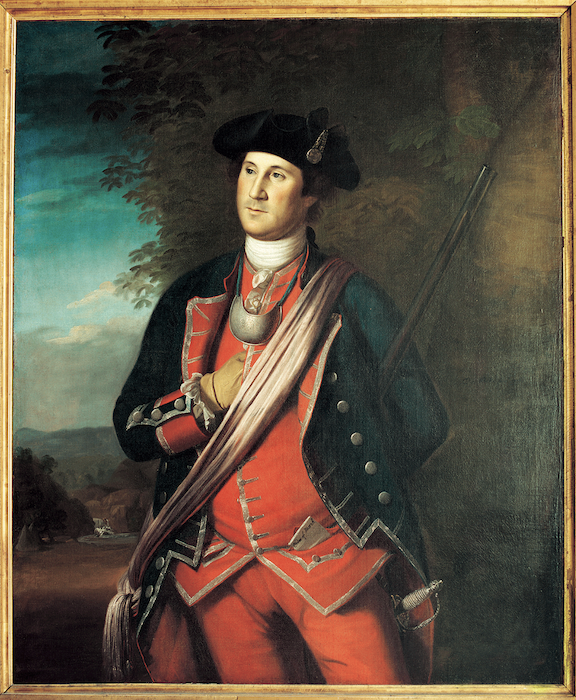
George Washington as Colonel in the Virginia Regiment, Charles Willson Peale, 1772. Washington-Custis-Lee Collection, Washington and Lee University, Lexington VA
Painted by Charles Willson Peale at Mount Vernon in 1772, this is the earliest known portrait of George Washington (commissioned by Martha Washington in 1757)
|
|
• It is interesting to see that propaganda back then was not unsimilar to what we witness today in these troubled times of ours.
• The impact of Jumonville's fate reverberated strongly throughout the French national consciousness during the Seven Years' War. Shortly after Jumonville's death, his younger brother, Captain Coulon de Villiers, led an attack on Fort Necessity on July 3rd, resulting in Washington's surrender. The negotiations between Washington and de Villiers were conducted in French, as the latter emerged victorious.
• The terms of Capitulation, translated from the French are:
"Capitulations granted by Mons. De Villier. Captain of infantry and commander of troops of his most Christian Majesty, to those English troops actually in the fort of Necessity, which was built on the King's lands of dominions on July 3rd, at 8 o'clock at night, 1754. As our intentions have never been to trouble the peace and good harmony which reigns between the two friendly princes, but only to revenge the assassination [emphasis added] which has been done on one of our officers, bearer of a summons, upon his party, as also to hinder any establishment on the lands of the dominions of the King, my master, upon these considerations, we are willing to grant protection or favour, to all the English that are in the said fort, upon the conditions hereafter mentioned..."
And so - - the British garrison, with George Washington at the head, was allowed the honors of war and to walk free back home.
• The utilization of the term "assassinated" gave rise to a political condemnation that positioned Washington and his comrades as the responsible individuals in the incident. George Washington managed to evade a political scandal associated with the Jumonville "assassination" affair by asserting that he had not fully understood the contents of the document presented to him by his translator Van Braam. Furthermore, he went as far as accusing Van Braam of either incompetence (rightly so, as his knowledge of French was limited) or deceit.
• In any case this caused a deep sense of indignation in France, and the French Court actively fostered this surge of nationalistic fervor. As an example, Bishop de Pontbriand in a pastoral letter (1756) declared:
"You will all remember that when we captured Fort Necessity so gloriously, hostages were given to us, as well as a promise to return the prisoners taken in the action when Monsieur de Jumonville was killed contrary to international law and by a kind of assassination."
• Jumonville was used by French propaganda to mobilize public opinion. Indeed, the war-martyr as an emblematic symbol of the nation to promote national sentiment was a growing trend across Europe.
• As for the Ohio Valley, all French efforts to secure the territory were abandoned when Fort Niagara in New York fell to the British, and the loss of all American possessions east of the Mississippi, including Canada, was formalized at the Treaty of Paris in 1763. It was the effective end of centuries of French presence in North America. The French were stretched much too thin over a territory half the size of the United States, with very few colonists compared to the English colonies, and the military was also engaged in numerous fronts elsewhere. It was only a matter of time until they were forced to abandon what Voltaire derisively and summarily called "a few acres of snow-covered land".
• As for George Washington, his appreciation for the French gradually changed from initial enmity, as a loyal officer serving the British Crown, to the most steadfast, and often effusively sincere friendship, towards his French allies during the War for Independence... and an alliance between France and the United States formalized a mere 15 years later in 1778, that has never stopped ever since.
|
|
Dauphin County in Pennsylvania |
|
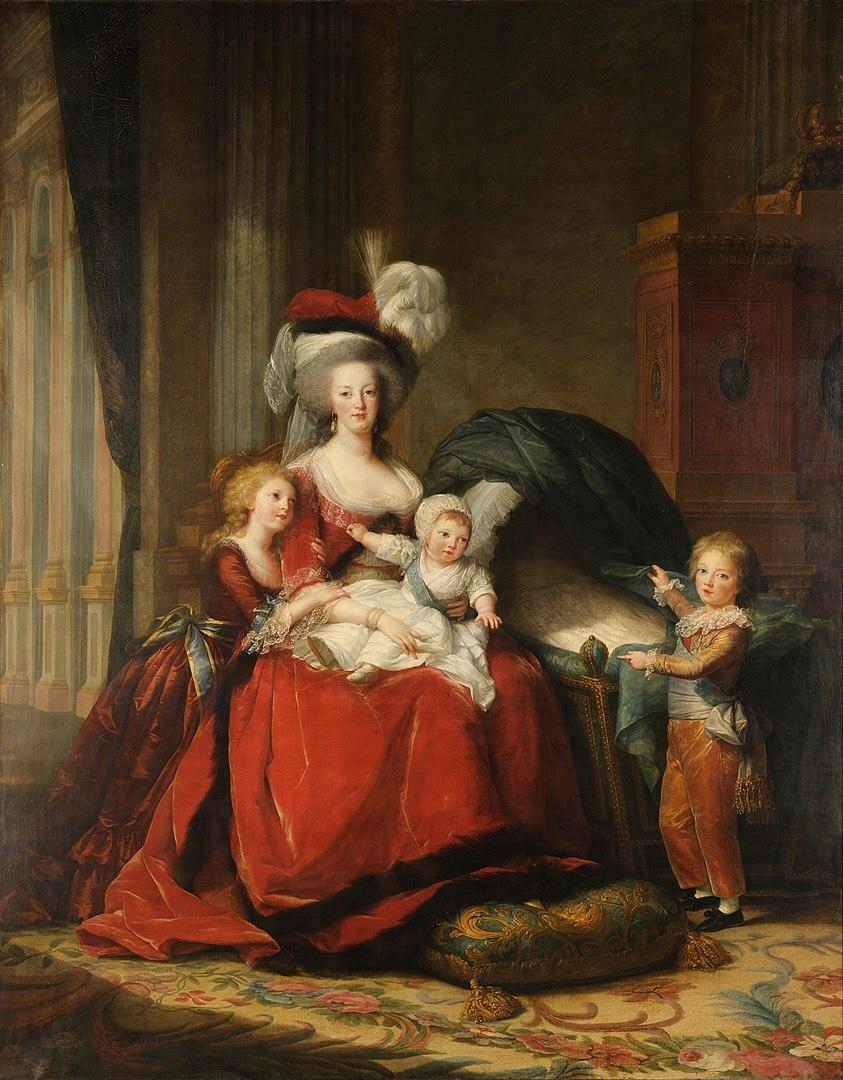
Portrait of Queen Marie Antoinette with her children, 1787 at Versailles; (L-R); Marie Thérèse Charlotte, known as Madame Royale at court; the Queen with the Duke of Normandy on her lap; the Dauphin is on the right pointing into an empty cradle;
By Élisabeth Louise Vigée Le Brun - Public Domain
|
|
The entire Ohio Valley was lost by the French. Yet, a nod to France is still evident in the naming of "Dauphin County" in Pennsylvania.
• Louis Joseph Xavier François, born on October 22, 1781, and passing away on June 4, 1789, held the title of Dauphin of France. He was the second child and first son of King Louis XVI and Marie Antoinette. In the hierarchy of the French royal family, Louis Joseph was known as a fils de France, which translates to "Child of France." Unfortunately, he died at the young age of seven due to tuberculosis. Following his death, his four-year-old brother, Louis Charles, succeeded him as the Dauphin and the next in line to the throne, Louis XVII, who never reigned.
Marker, “Dauphin County“
Across from Dauphin County Bldg & Grounds, 2 Market St, Harrisburg, PA 17101
• Inscription:
“Formed March 4, 1785 from part of Lancaster County. The name honors the eldest son of the French King Louis XVI. Harrisburg, the county seat, was laid out in 1785 and chartered a city in 1860. Since 1812 it has been the State capital of Pennsylvania.
Erected 1981 by Pennsylvania Historical and Museum Commission.”
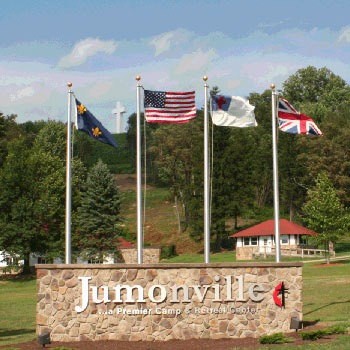
• As for Jumonville, a town in Fayette County, Pennsylvania, bears his name. A religious retreat center erected in 1950 a giant white cross on its grounds (visible in the photo below). And the flags of the three nations proudly fly side by side, at the center's entrance.
|
|
Continuation of our Series:
Paying homage to the original
Lafayette Escadrille American Pilots
who "Died For France"
|
|
Douglas MacMonagle
"Mort Pour la France", September 4, 1917, near Verdun
|
|
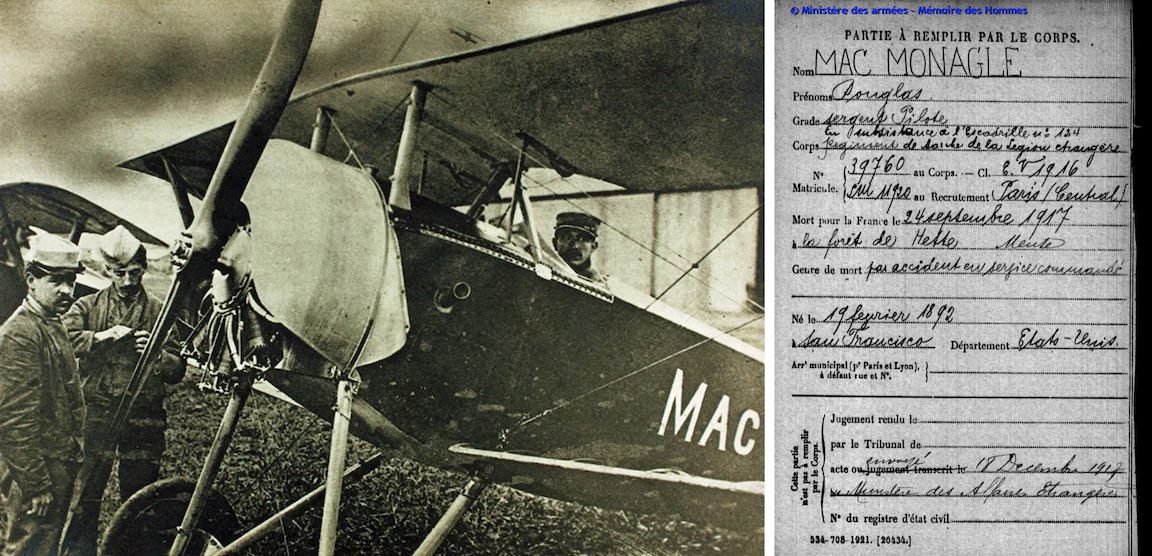
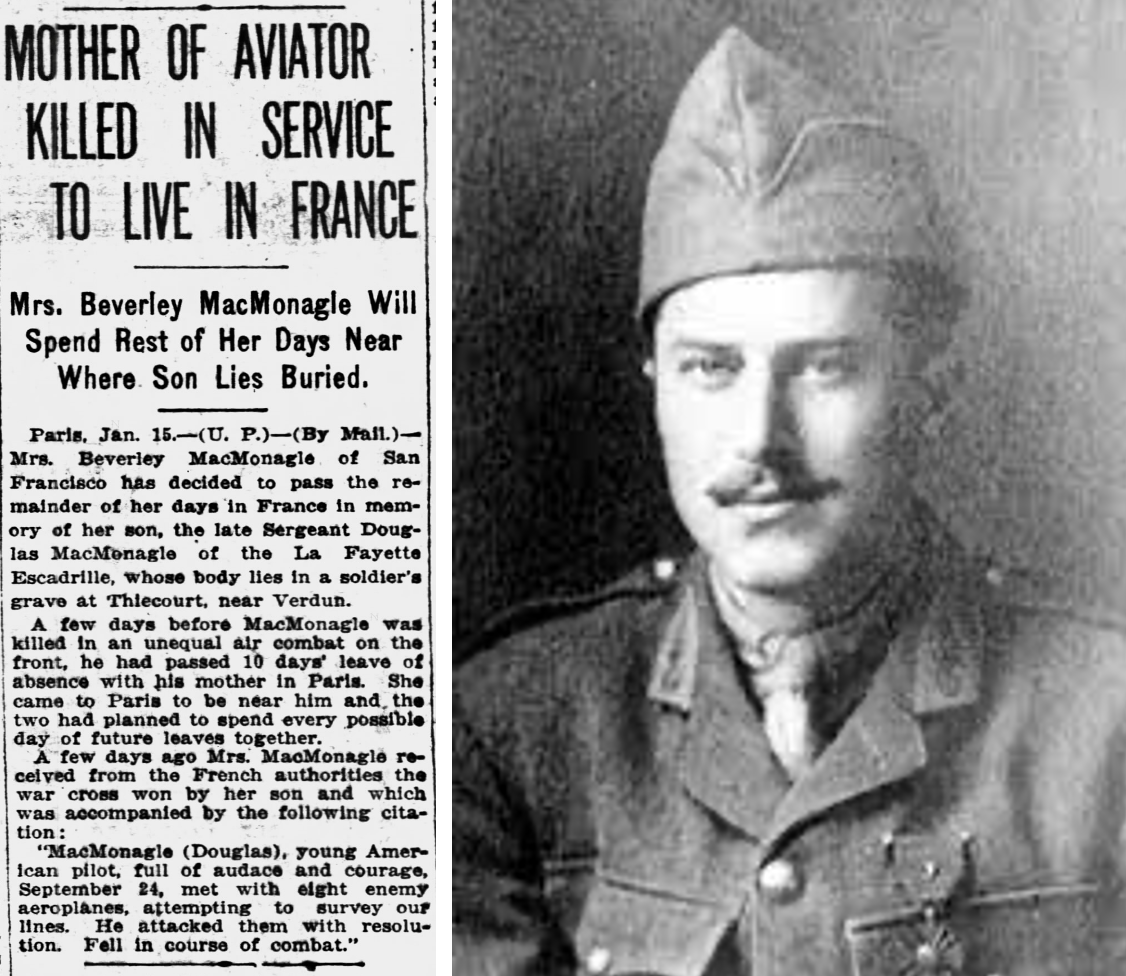
Left: Excerpt, The Oregon Daily Journal Portland, Oregon 10 February 1918, page 4
Right: Douglas Mac Monagle in French uniform & Croix de Guerre (War Cross)
|
|
• Douglas MacMonagle served heroically in the American Ambulance Service and was awarded the “Croix de Guerre” for his actions. He came to the Lafayette Escadrille from the Foreign Legion in June 1917 at Chaudun.
• He was born February 19, 1892, in San Francisco, California, the son of Beverly and Minnie C. MacMonagle. Educated Hackley School, Tarrytown, New York; Berkeley School, California, Switzerland and Germany; and University of California, Class of 1917. He joined the American Field Service, December 30, 19 1915 and enlisted in French Aviation, October 3, 1916. He was trained at Avord and Pau. He was killed in combat, September 24, 1917, near Verdun.
• A moving "footnote of history" can be read in this newspaper article below, from The Oregon Daily Journal Portland, Oregon 10 February 1918, page 4:
"Mother of Aviator Killed in Service to live in France"
Mrs. Beverley MacMonagle Will Spend Rest of Her Days Near Where. Son Lies Buried. Paris.
Jan.15 (U. P.) (By Mll.) Mrs. Beverley MacMonagle, of San Francisco has decided to pass the remainder of her days In France in memory of her son, the late Sergeant Douglas MacMonagle of the La Fayette Escadrllle, whose body lies in a soldier's grave at Thiecourt, near Verdun.
A few days before MacMonagle was killed in an unequal air combat on the front, he had passed 10 days leave of absence with his mother in Paris. She came to Paris to be near him and the two had planned to spend every possible day of future leaves together. A few days ago Mrs. MacMonagle received from the French authorities the War Cross won by her son and which was accompanied by the following citation "MacMonagle (Douglas), young American pilot, full of audace and courage. September 24, met with eight enemy aeroplanes, attempting ' to survey out lines. He attacked them with resolution. Fell in course of combat.".
|
|
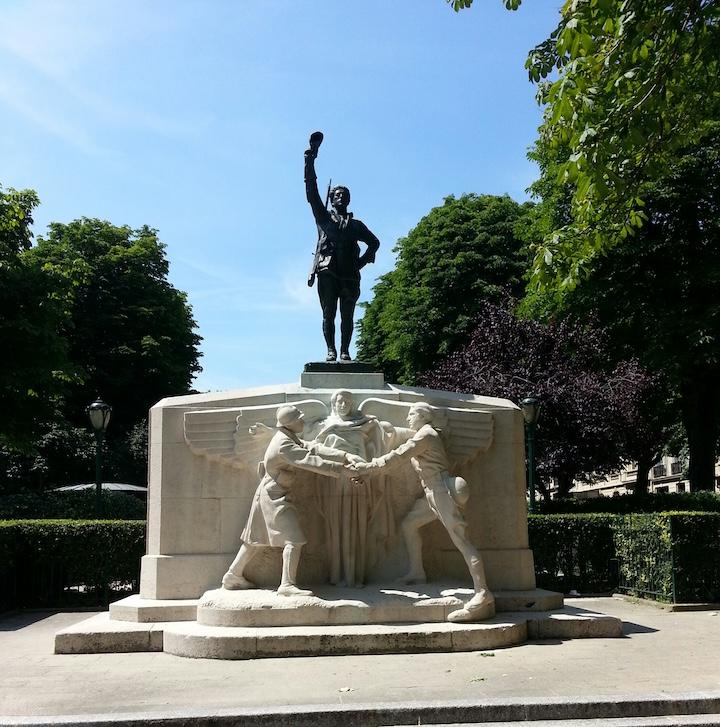
Memorial to American Volunteers, Place des États-Unis, Paris. |
|
Monument aux Volontaires Américains, Place des Etats-Unis, 75116 Paris
|
|
• The Monument aux Volontaires Américains is inside the Thomas Jefferson Square, about 150 yards south of the Monument à Washington et à Lafayette.
• It was dedicated by the French Prime Minister Raymond Poincaré (who prior to being President of the Council of ministers had been President of the French Republic from 1913-1920) on July 4 1923 to the Americans who had volunteered to fight in World War I.
• Jean Boucher (1870-1939) created a bronze statue on a plinth, which was funded by a public subscription. The statue was inspired by a photograph of Alan Seeger, a soldier and poet, and his name is one of twenty-three fallen members of the French Foreign Legion listed on the back of the plinth.
• We are citing below one of the two excerpts from Seeger's Ode to Memory of the American Volunteers Fallen For France are also found on both sides of the sculpture. To read the poem in its entirety, please click here.
"HAIL BROTHERS AND FAREWELL;
YOU ARE TWICE BLEST, BRAVE HEARTS.
DOUBLE YOUR GLORY IS WHO PERISHED THUS
FOR YOU HAVE DIED FOR FRANCE AND VINDICATED US"
ALAN SEEGER
|
|
PAST MONTHLY BULLETINS
OUR GOAL: turn the spotlight on a famous, or less famous, episode or historical figure during the long shared history between France and the United States, with illustrations and anecdotes.
You can have access to all our past Monthly Bulletin
since February 2021 by visiting our website:
You can click on the photos throughout our bulletins and also on the links indicated in blue for more information and direct access to sources.
|
|
Next month in December, our "Year in Pictures" Bulletin will recapitulate all the memorable events of 2023 in which your Society was represented. |
|
ANNOUNCEMENTS & SAVE THE DATES |
|
The Society of Honor Guard / Tomb of Unknown Soldier
Military Women’s Memorial, Arlington National Cemetery
present at
Le Souvenir Français Paris Headquarters
20 rue Eugène Flachat, 75017 Paris
November 14 - December 11, 2023
|
|
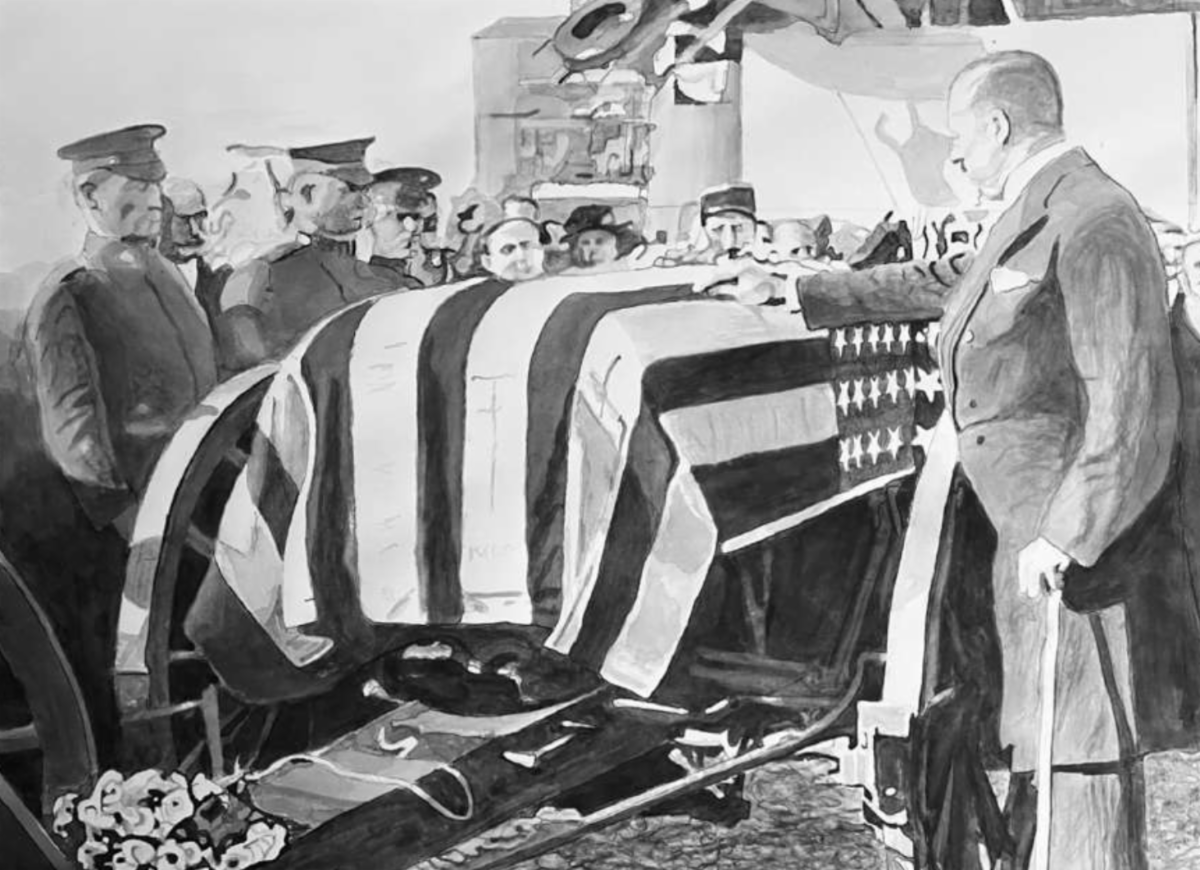
“The whole of France bows down with me before your coffin, brother from America, they can take you back to the great land from which you came, but your French family will always piously preserve your memory and the land of France will not forget that it was to it you entrusted your last dreams.”
- André Maginot, Minister of Pensions, Le Havre, Oct 25, 1921
Illustration above: One of 26 paintings by Dave Rappaport, artist
|
|
Above: click on the thumbnail to view a wonderful short movie has been created by Les Owen, using colorized archival clips from 1921, showing the journey of the Unknown Soldier from Châlons-en-Champagne to Le Havre, then on board the USS Olympia, to his final resting place at Arlington National Cemetery.
You can also access the version with French subtitles HERE
|
|
• On October 25, 1921, Minister André Maginot pinned the Legion of Honor on the coffin of the Unknown Soldier at the pier in Le Havre, moments before it was hoisted on board the USS Olympia for the voyage back home. This exhibit of 26 black & white paintings by artist Dave Rappaport retraces key moments of this poignant journey, from the battlefield of Eastern France and Châlons-sur-Marne, to Le Havre, with the people of France lining up to pay tribute to this American soldier who “Died for France” and for the cause of Freedom.
• Inspired by this exhibition that took place at the Military Women's Memorial at Arlington National Cemetery this past November, we worked hand-in-hand with Richard Azzaro, co-Founder and past President of the Society of Honor Guard, Tomb of the Unknown Soldier and Donna Houle, Senior Director of Memorial Engagement & Impact at the Military Women's Memorial to have this very moving and informative exhibition travel to France.
|
|
Please join
the Lower Manhattan Historical Association
|
|
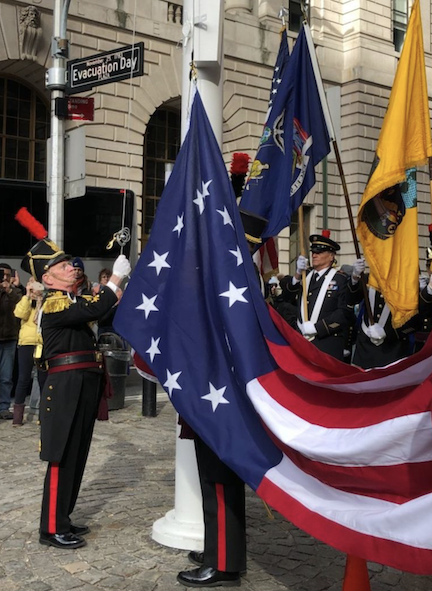
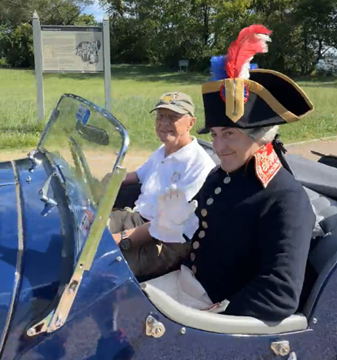
10тн ANNUAL COMMEMORATION OF
EVACUATION DAY
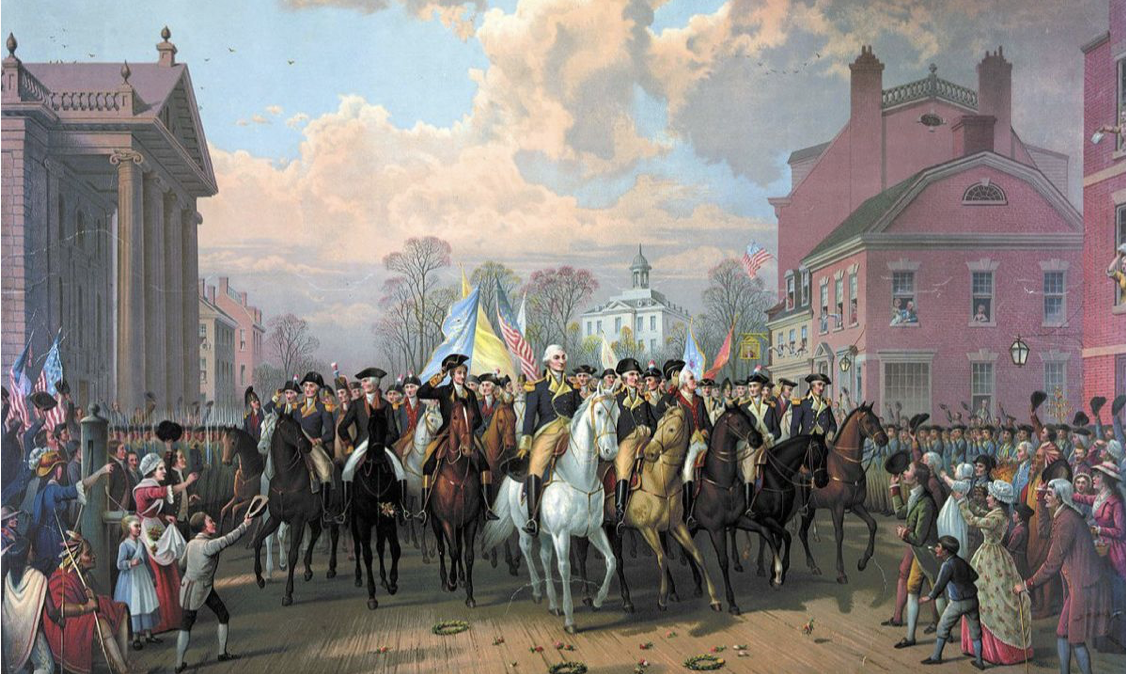
THE END OF 7 YEARS OF BRITISH OCCUPATION OF NEW YORK CITY
AND WHEN THE UNITED STATES BECAME TRULY INDEPENDENT IN 1783
Saturday, November 25, 2023
Assemble at 12:30 p.m. in front of Fraunces Tavern - 54 Pearl Street
Procession begins promptly at 12:40 p.m.
Flag Raising at 1:00 p.m. at Evacuation Day Plaza (Bowling Green)
|
|
The LOWER MANHATTAN HISTORICAL ASSOCIATION
and its Constituent Organizations
1ST NEW YORK CONTINENTAL & BATTLE OF BROOKLYN CHAPTERS OF THE SONS OF THE AMERICAN REVOLUTION • ALLIANCE FOR DOWNTOWN NEW YORK BOWLING GREEN ASSOCIATION • BROOKLYN CHAPTER, NATIONAL SOCIETY DAUGHTERS OF THE AMERICAN REVOLUTION • CHINATOWN BUSINESS IMPROVEMENT DISTRICT • CHINATOWN PARTNERSHIP • CULTURENOW • FINANCIAL DISTRICT NEIGHBORHOOD ASSOCIATION • GOLD's DRAGOONS • HERCULESMULLIGAN SOGIETY • INSTITUTE OF HISTORY, ARCHAEOLOGY, AND EDUCATION
MANHATTAN COMMUNITY BOARD 1 • MUSEUM OF AMERICAN FINANCE • SONS OF THE REVOLUTIONS™ IN THE STATE OF NEW YORK, INC. AND ITS FRAUNCES TAVERN® MUSEUM • VETERAN CORPS OF ARTILLERY OF THE STATE OF NEW YORK
|
|
An announcement from
The Lafayette Trail, Inc.
Saturday, December 9, 2023 in Troy, VA.
|
|
The Lafayette Trail, Inc. is pleased to announce the upcoming dedication of a new Lafayette Trail historic marker to be installed in the Commonwealth of Virginia.
The tavern was the first stop that Lafayette made in Albemarle County upon crossing the county line on November 4, 1824, on his way to Charlottesville and Thomas Jefferson's Monticello.
The event will include formal remarks from all the stakeholders involved in the preparation of the marker, the actual unveiling, as well as photo opportunities with the property owners and local officials. The ceremony is expected to last 45 minutes.
Following the unveiling, attendees will be welcomed inside the house where Lafayette artifacts will be on display for the occasion.
Plenty of parking will be available near the unveiling site.
|
|
From the American Friends of Lafayette:
Lafayette returns to America in 2024!
Kick-off fund raising evening at
Services Culturels - Villa Albertine, New York
March 7, 2024
Broadway Parade, New York
August 16, 2024
|
|
Almost 200 years ago, Lafayette's 13-month Farewell Tour of America officially started. Our goal is to celebrate Lafayette's legacy and to educate the American public about his contributions to the world.
We are working hand-in-hand with The American Friends of Lafayette, who are the stewards of his incredible legacy, to make this Bicentenial a resounding success.
On Thursday, March 7, 2024 a fund-raising event will be held at the French Cultural Services - Villa Albertine (Payne Whitney Mansion, 978 Fifth Avenue). More details will be forthcoming.
On Friday August 16, 2024, a parade will take place in Broadway, to commemorate the start of his triumphal tour.
Please mark your calendars, and contact us if you wish to participate. It will be well worth changing the dates of your summer vacation to France, just for this event!
In an effort to kick things off, the American Friends of Lafayette have produced a short, two-minute promotional video for you to see (and more importantly share). Our goal is to generate excitement, donations and momentum as we hurdle towards August 16th, 2024.
There is also a Boutique selling great merchandise to raise money for the Bicentenial. Please visit:
Last but not least,
The American Friends of Lafayette is sponsoring the
2024 Lafayette Essay Contest:
"Who is Lafayette, and What Does He Mean to America, Then and Now?"
where kids will have the opportunity to learn about General Lafayette, one of America's Revolutionary War heroes and all around fantastic human being.
Contest winners will receive cash prizes and be invited to present their essays in New York City as part of the launch of the 2024-25 Bicentennial of Lafayette's Farewell Tour.
-
Here is a link to our official Essay Contest Video with a special invitation from General Lafayette himself !!!: HERE
-
Details in English can be found: HERE
-
Details in French can be found: HERE
Learn full details about the contest with the registration form: HERE
Our Society is proud to be working hand in hand with the AFL and other patriotic associations to make this Bicentennial a memorable success.
|
|
PHOTO ALBUM
ANNUAL TRIBUTE TO FRENCH SOLDIERS
BURIED IN PROVIDENCE OLD BURYING GROUND, RHODE ISLAND
NOVEMBER 5, 2023
|
|
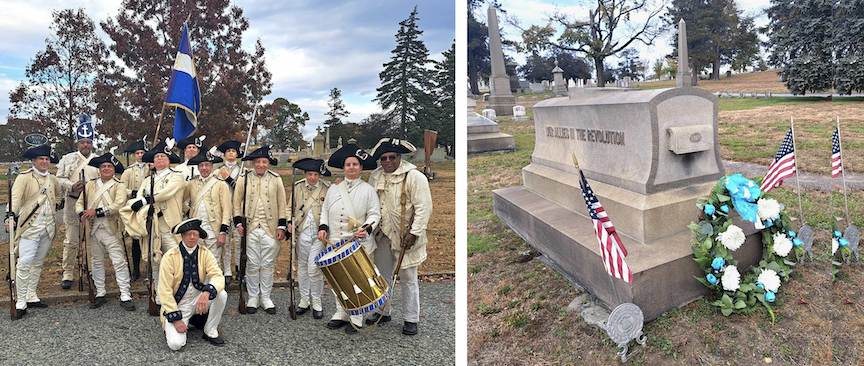
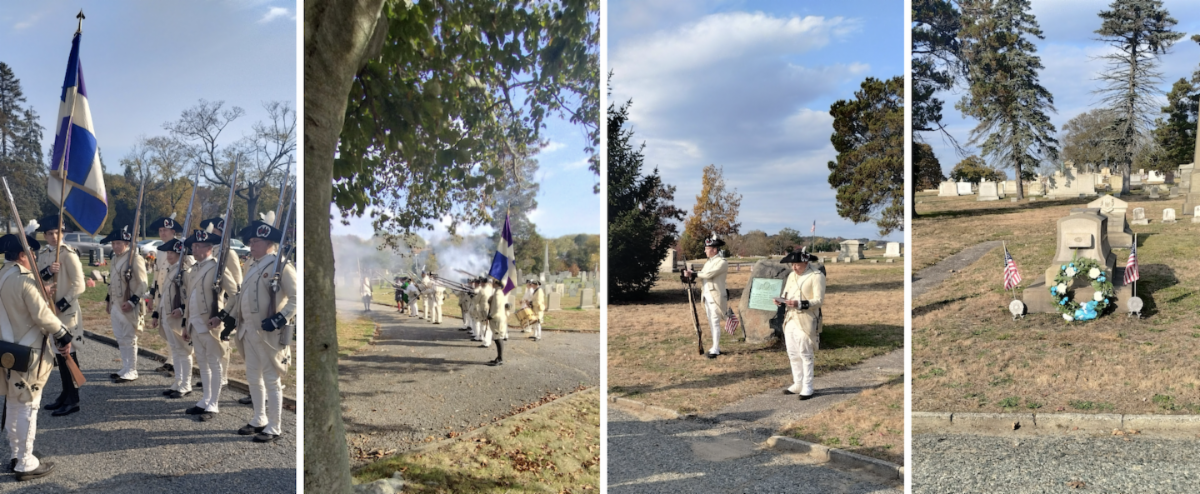
Le Régiment Bourbonnais, the Second Rhode Island Regiment and a group of about 15 Sons of the American Revolution, Rhode Island chapter met at the North Burial Ground in Providence, RI for a joint ceremony, on November 5th at 1:00PM.
The ceremony began with a historical introduction followed by the laying of a wreath at the monument for the French soldiers.
Norman Desmarais, member of le Régiment Bourbonnais, and Regional delegate, New England, of the American Society of Le Souvenir Français, read the names of the 25 soldiers commemorated by the monument. A salute of three musket volleys was followed by a moment of silence.
For a list of their names, please visit our Honor Roll in the Society's website:
Photos courtesy of A.J. Liuba, Raymond Patenaud, Roger Bonin
|
|
VETERANS DAY NOVEMBER 11, 2023
5TH AVENUE, NEW YORK, NY
|
|
VETERANS DAY NOVEMBER 11, 2023
FRENCH EMBASSY, WASHINGTON, D.C.
|
|
ANNUAL MASS & CEREMONY
SUNDAY, NOVEMBER 12, 2023
EGLISE NOTRE-DAME, NEW YORK, NY
PLAQUES TO THE 463 "MORTS POUR LA FRANCE" OF WWI & WII
|
|
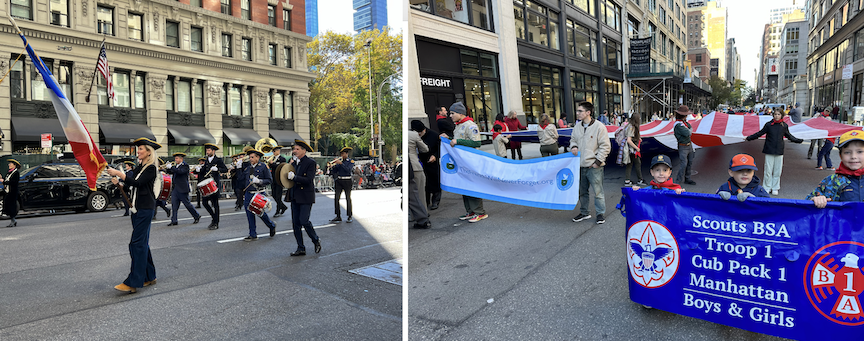
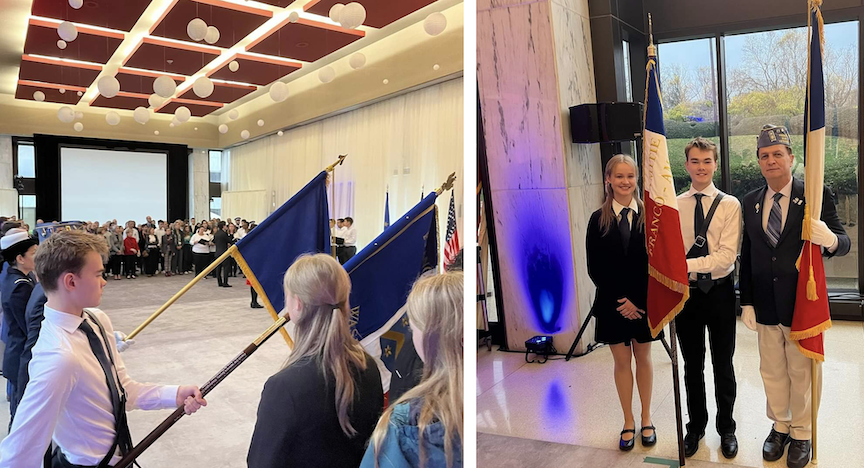
Like every year we celebrated "Armistice Day" and all the Veterans on Saturday, November 11 by joining the traditional parade on Fifth Avenue.
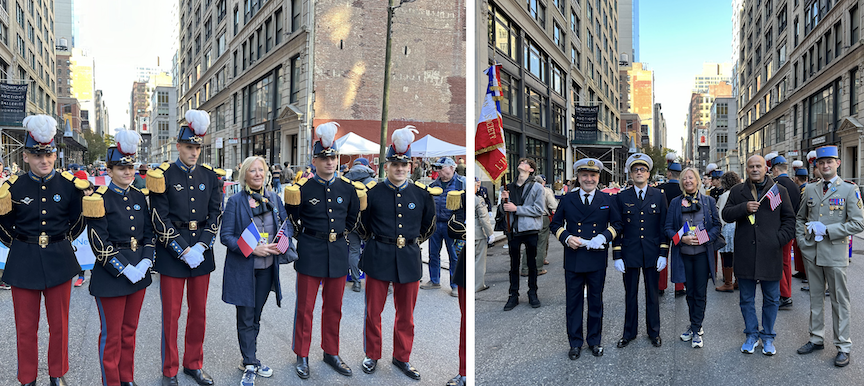
After the Cadets Lafayette Marching Band, we marched with Mr. Jérémie Robert, Consul General of France in New York, alongside the Federation of French Veterans, the Association of French Reserve Officers in the United States (ACREFEU), Scouts from Troop #1 deploying the two huge American and French flags of TheFrenchWillNeverForget. We were joined by 6 cadets from the Saint-Cyr Military Academy, currently on an exchange program with the American Military Academy at West Point.
In Washington DC, a commemoration was held at the French Embassy. Students of the "History and Memory Club" of the Rochambeau French International School in Washington displayed the French flag embroidered with the coat of arms of General de Rochambeau that was offered to them last year
Alain Leca, Regional Delegate of our Society, and president of the French War Veterans in Washington D.C. attended as well (photos courtesy of Alain Leca)
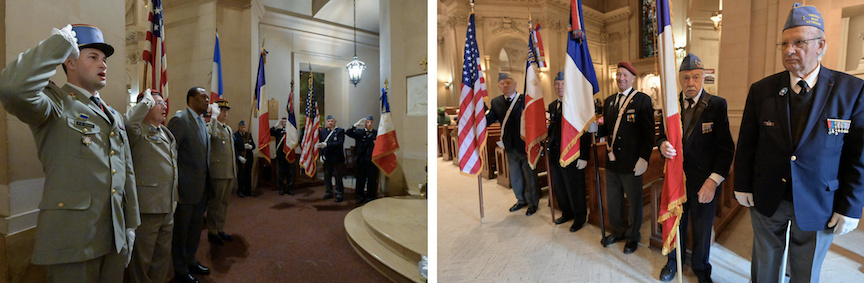
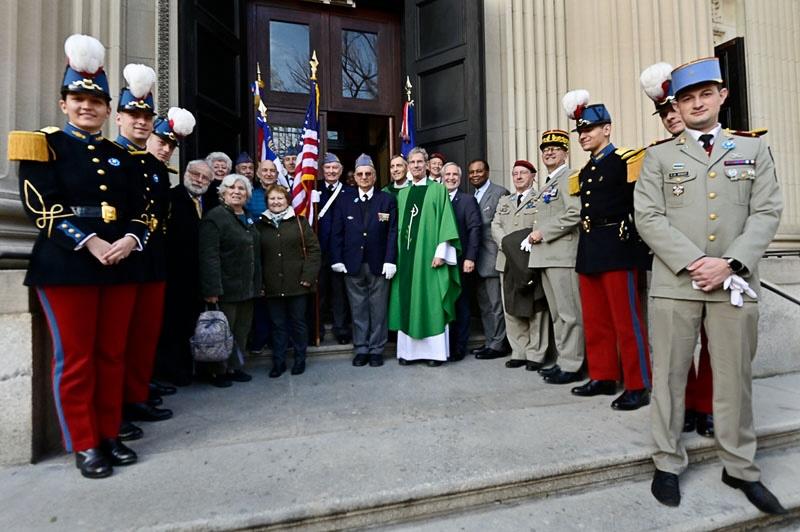
The next day, on Sunday November 12, the traditional mass took place at Notre-Dame Church, 405 West 114th Street, at 11:00AM, and was followed by a wreath-laying ceremony at the church's Honor Wall honoring the 463 "Morts Pour la France" who left New York to fight for freedom and democracy in two world wars. This year we paid a special tribute to the 38 from the original Lafayette Escadrille who later evolved into the Lafayette Flying Corps, and particularly the 9 who "Died for France".
A luncheon at the nearby restaurant Le Monde concluded this Day of Remembrance.
Photos: Daniel Falgerho
|
|
THE "FRIENDS OF THE CHÂTEAU DE LAUZUN"
MAKE AN APPEAL FOR DONATIONS
|
|
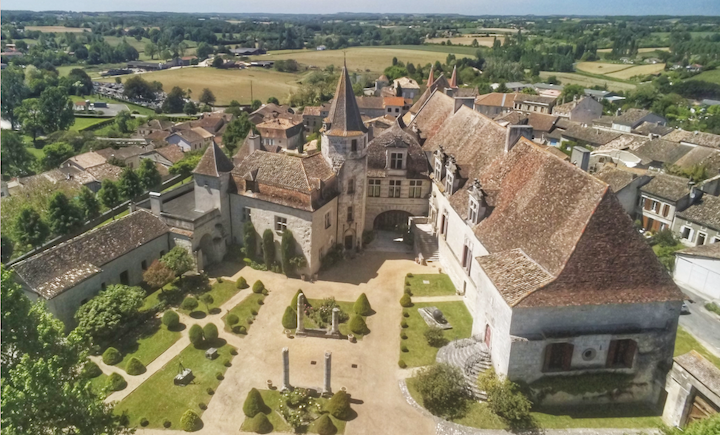
Château de Lauzun, Lot-et-Garonne, borders the Dordogne region.
23 Rue du Château, 47410 Lauzun, France (80 miles east of Bordeaux)
|
|
In order to support the municipality of Lauzun which just acquired the Castle (listed as a Historic Monument), its park and its outbuildings, the association aims to safeguard, encourage and integrate the castle in the regional cultural heritage. This monument, a rare example of the Renaissance with its monumental chimneys, its architecture and its park will be open to the public.
The Association Les Amis du Château de Lauzun will work alongside the village of Lauzun to develop cultural attractions and events linked to the rich history of the Dukes of Lauzun.
In addition, the installation of a Hussars museum is planned, in
link with the Association of Anciens Hussards de Lauzun, regiment
commanded by Armand Louis de Gontaud-Biron, second Duke of Lauzun, during the War of American Independence. A room in the Castle will be dedicated to the democratic ideals and the Enlightenment spirit of the 18th century and a celebration of the shared history between the United States of America and France.
The castle of Lauzun will eventually become an additional touristic site in this most magnificent region of France, which includes the castles of Duras, Bonaguil and Biron.
|
|
Announcing the kick-off of the US Fund Raising Campaign
to SAVE THE HERMIONE
|
|
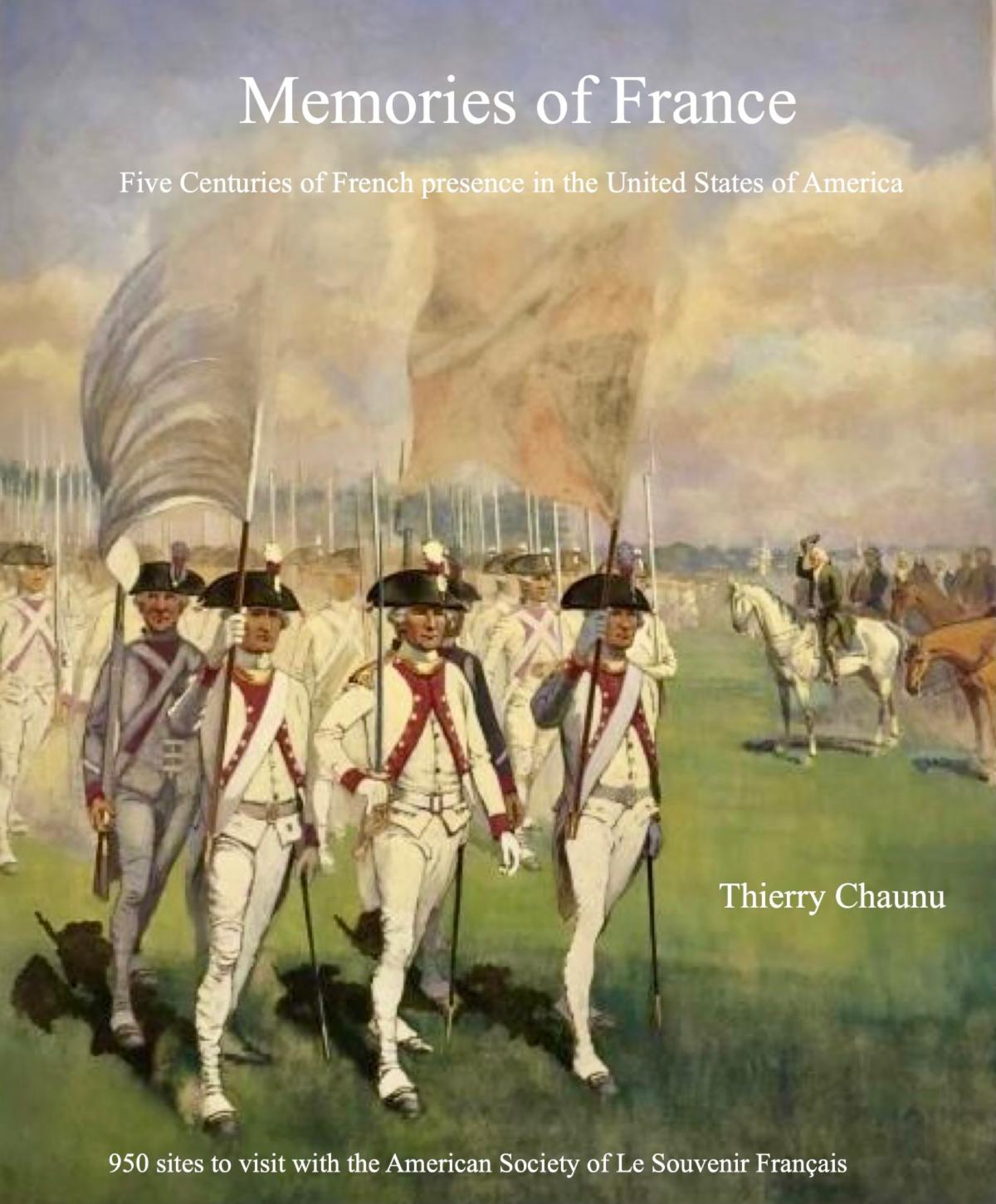
SUPPORT US AND BUY (OR OFFER) OUR E-BOOK ON AMAZON! |
|
Book Cover : "Scenes from the American Revolution: The French "Soissonnais" Regiment Being Reviewed at Philadelphia by President Washington and Congress, 1781". By Charles MacKubin Lefferts (American, 1873 – 1923). Reproduced with permission of the New York Historical Society Museum. |
|
Support our organization! Purchase or offer this e-book which makes great reading for all ages. All royalties go to the American Society of Le Souvenir Français, Inc. Simply click on this link: Amazon.com
We are pleased to have given to the Consulate General of France several dozens of sites for the application mapstr. The complete and extensive descriptions are only available in our book, copyrighted by our organization.
MEMORIES OF FRANCE
950 sites of French presence in the United States over the past 5 centuries
Everyone knows that Lafayette, the Statue of Liberty, or New Orleans, were all French imports…
But did you know what the first protestant prayer in America, the first recorded birth of a European in North America, the first commercial artist, the first free school west of the Mississippi, the first discovery of Niagara Falls, the first grapefruit planter in Florida, the first discoverer of oil in America, the first Pulitzer Prize in history, the first archbishop of New Mexico, to name just a few, have in common? (Hint: they were all French)
CONTENTS:
Guide - historical directory of more than 950 sites where a French footprint has been left across the 50 states of the present United States, from 1524 to the turn of the 20th century.
It is written in two versions: in English and in French.
It is a tribute to explorers, missionaries, soldiers, adventurers, French, illustrious or unknown, who left their mark in the United States and are recognized, whose memory is honored by a monument, a statue, a stele, a panel, a billboard, a plaque...
Each page corresponds to one site and includes:
• Photo (with url link)
• Address with postal code
• Exact GPS coordinates
• A brief historical explanation
• The exact transcription of the inscription appearing on the pedestal or plaque
• One or more internet links directing the reader to more detailed information
• Some divider pages are dedicated to a brief biography of a related historical figure
This Guide can thus be compared to:
• An “Enthusiast’s dictionary” compiling the traces left by Frenchmen in the United States
• A collection of French postcards from the 50 States
• A tourist guide for all lovers of US history
Available in e-book
• E-book price: $19.50
• The book is copyrighted © American Society of Le Souvenir Français, Inc.
|
|
OUR MISSIONS:
• To preserve the memory of the French soldiers, sailors and airmen who gave their lives for freedom, and who are buried in the United States.
• To honor French Citizens who did great deeds in the United States, or with a strong connection with the United States,
• To promote the appreciation for French culture and heritage in the United States, and the ideals that unite our two nations, in order to pass the torch of memory to younger generations.
• To strengthen the long-standing traditional bonds of friendship between the American and French peoples, and to this end: erect or maintain memorials and monuments and encourage historical research, public presentations and publications in the media.
We are looking to complete our geographic coverage with Regional Delegates for the SouthWest in cities such as Austin, or Houston, and Louisiana, in cities such as New Orleans or Baton Rouge.
The American Society of Le Souvenir Français, Inc. is an independent American corporation, apolitical, established in 1993 in NY, with 501 (c) 3 non-profit status.
|
|
Board of Directors
American Society of Le Souvenir Français, Inc.
Members (2023):
Françoise Cestac, Honorary President • Thierry Chaunu, President, and General Delegate, Le Souvenir Français in the United States • Yves de Ternay, Treasurer • Patrick du Tertre, 1st Vice President • Henri Dubarry • Francis Dubois • Alain Dupuis, 2nd Vice President & Deputy General Delegate, Le Souvenir Français in the United States • Daniel Falgerho, General Secretary • Pierre Gervois • Caroline Lareuse • Clément Mbom, Education Advisor • Jean-Hugues Monier, Auditor • Harriet Saxon • Nicole Yancey
Regional Delegates:
Jacques Besnainou, Great Lakes and Midwest • Bruno Cateni, South
Prof. Norman Desmarais, New England • Alain Leca, Washington D.C. •
Marc Onetto, West Coast • Brigitte Van den Hove – Smith, Southeast • Nicole Yancey, Yorktown & Virginia, former Honorary Consul of France in Virginia
|
|
Help us implement several historic commemorative projects celebrating the 245-year-old Franco-American friendship and alliance! |
|
The American Society of Le Souvenir Français, Inc. is a registered NY State non-profit corporation and has full IRS tax exempt 501(c)3 status. All donations are tax deductible.
Copyright © 2023 The American Society of Le Souvenir Français, Inc.
All Rights Reserved
Merci de nous contacter si vous souhaitez recevoir ce bulletin dans sa version traduite en français.
Contact: Thierry Chaunu, President
697 Third Avenue #341 New York, NY 10017
|
|
|
|
|
|
|