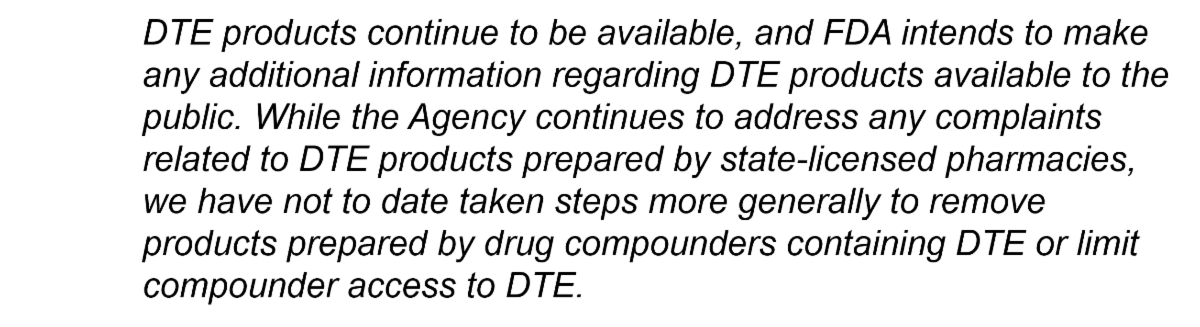
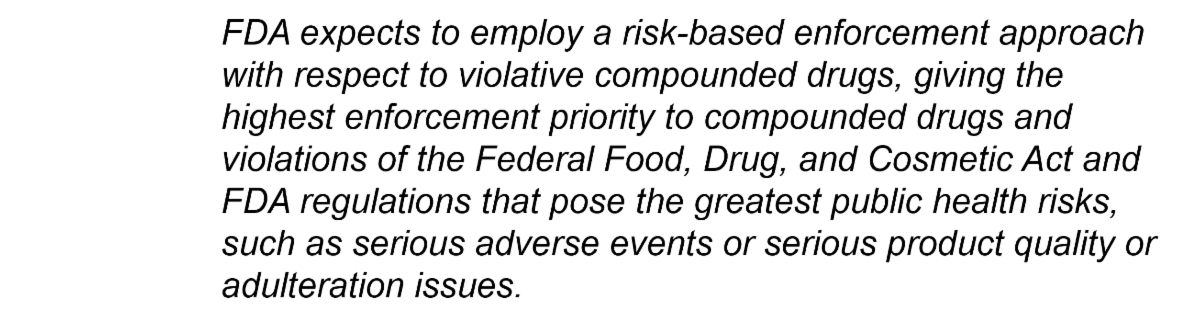
Though some reading between the lines is required, we interpret those statements to mean that FDA intends, at least for the foreseeable future, to take no action against compounders of DTE unless they receive a complaint about adverse events or product quality—in which case, the agency would commence an investigation of the pharmacy that prepared the DTE drug that is the source of the complaint. (That’s our interpretation; I urge you to seek legal counsel for advice on how FDA’s letters should guide your DTE compounding activities in your state.)
That’s all well and good, as far as it goes. The issue, of course, is how state boards respond to this second letter. Will they adopt the same position as FDA and take no action against compounders who prepare compounded DTE? Or will they take direction from the earlier letter that classifies DTE as a biologic and pursue enforcement action against compounders in the state who prepare it? I suspect the answer to that question could vary by state.
APC intends to provide some perspective and counsel to state boards on this matter, and we’ll need your help in reinforcing our message. Within the next week or so, we’ll sending state boards of pharmacy a memo outlining our concerns and suggesting a prudent path forward for enforcement on DTE, given FDA’s apparent decision not to enforce its earlier reclassification. We’ll provide our members a copy of that memo as well, and I urge you to share it with your state board of pharmacy members directly and provide them the benefit of your expertise in navigating this matter. Stay tuned for that.
It hasn’t escaped our notice that FDA’s second communication in two months on this issue fails to address the poor logic and process by which FDA has reclassified DTE/Thyroid USP as a biologic in the first place. You can read our
concerns about that here. In coming days, APC will be submitting formal comments to FDA outlining our concerns. We first raised those concerns with them verbally in a special meeting on November 9. We’ll restate them in another listening session with FDA on December 13. And we will, of course, share our comment letter with our members after it has been submitted to FDA.
Despite our ongoing concerns, we’re grateful for FDA’s willingness to respond to our request for more clarity on whether compounders may continue, at least for the time being, to prepare DTE for patients. We now know how FDA says it will approach that situation. What we don’t know is how state boards will respond. In coming days, we’ll be seeking your help in briefing your state board, so that compounded DTE patients can continue to be served in your state.
Best,