July 28, 2025

Top stories

■ Trump's lawyers argue that Rupert Murdoch should be deposed within 15 days because of his advanced age, in the $10B libel suit against Murdoch and WSJ (New York Times) / Trump-Epstein saga splinters the Murdoch empire (Axios) / Joe Rogan isn’t letting go of Epstein — that’s a problem for Trump (CNN) 


■ The FCC approves Paramount’s $8B deal with Skydance after months of chaos and political intrigue (Associated Press) / Paramount and Skydance expect deal to close Aug. 7 (Variety) / The fight for free speech goes corporate (Columbia Journalism Review) / Trump cowed Paramount. Now he’s targeting ABC and NBC. (Poynter)


■ CPB prepares for closeout while hoping Congress reverses course (Current) / Laura Ross departs CPB board amid legal fight over dismissal (Current) 


■ WBD reveals new names for cable networks business, film studio (The Desk) / Warner Bros. Discovery sets leadership for post-split companies (Wall Street Journal)


■ How Fox got ahead on the big media future (Semafor) 


■ Project Veritas withdraws lawsuit against The New York Times (New York Times) 


■ ‘Per a note from Washington Post top editor Matt Murray, The Post will focus its news video efforts on short- and medium-length work’ (Ben Mullin) / Washington Post fact-checker takes buyout (The Hill) / ‘Dave Jorgenson, The Post’s viral “TikTok guy,” explains why he left the paper to launch Local News International’ (Status)


■ DallasNews Corporation board formally rejects Alden affiliate offer as Hearst ups bid (DallasNews)


■ Northwest Arkansas outpaces US in local journalism (Axios)


■ Minnesota publication closings show stark reality for newspapers (Dakota News Now)


■ The Atlantic hires Jake Lundberg as first staff archivist and historian, and Drew Goins as senior editor (The Atlantic) / Dana Milbank joins the Futures Desk as a columnist (Washington Post) / Reporter Anna Werner joins Gray’s InvestigateTV (TV News Check)/ Hope Hicks, former Trump official and Fox PR chief, joins Megyn Kelly’s media company (Variety)


■ Generative AI models love to cite Reuters and Axios, study finds (Nieman Journalism Lab) / Read the Generative Pulse report (Muck Rack) / ‘We asked 2,000 Substack publishers how they’re using and thinking about AI. Here’s what we found.’ (Substack)


■ How the Kyiv Independent reached 20,000 paying members — with no paywall (Nieman Journalism Lab)

CRAFT

How 5 journalists tackled health inequities across the US


By Maggie Amacher


Covering public health isn’t just about reporting on the science. It’s about earning trust, navigating risks, and elevating voices that are too often ignored. 


Five journalists experienced this firsthand during the inaugural Public Health Reporting Fellowship from the Institute and the Common Health Coalition.


Over six months, the fellows explored urgent and underreported public health challenges from emerging infectious diseases to the isolation of older adults across rural areas, immigrant communities, and other underserved populations.


Fellows included: 


  • Ted Alcorn, an independent health and justice journalist
  • Jamal Jordan, a multimedia documentarian and audience editor at The Washington Post
  • Eleanor Klibanoff, women’s health reporter at The Texas Tribune
  • Lygia Navarro, an independent journalist focused on Latine and health stories
  • Amanda Seitz, a health policy reporter for The Associated Press


Here are some key themes from their reporting on connecting with sources, navigating challenges, and telling stories that matter.

Public Health Journalism: Lessons from our inaugural journalism fellowship cohort

Center the voices of those most affected. Ask yourself who is bearing the brunt of the issue and if their voices are being heard. In her story on avian flu outbreaks, Navarro focused not just on the science but on the farmworkers whose health and livelihoods were at risk. “I began to notice who wasn't being talked about and who was also most at risk of H5N1, which are farm workers, many of whom are Latine immigrants,” Navarro said.


Leverage trusted intermediaries to reach difficult sources. Partner with clinics or nonprofits that already have established relationships. These connections can build trust with wary sources. “We were really lucky that we built trust with the director at a clinic,” Seitz said. “We were able to really take free rein for a couple of days at their clinic and follow folks everywhere.”


Build transparency with your sources. Take time to explain journalistic terms like “on background” or “off the record.” Allow people to go back and forth between different levels of transparency throughout their interviews. Setting these clear expectations builds trust. “Everybody I was speaking to was vulnerable in some way, because everybody essentially, if they said the wrong thing, was at risk of losing their job,” Navarro said.


Be upfront about potential risks. Don’t downplay what it means to go on the record. Seitz stressed the importance of informed consent. Ensure sources fully understand the implications of being named or photographed, without promising what you can’t guarantee. “As a reporter, you don't want to lose that source, but you have to be honest with people about the risk they're taking,” Seitz said.


Remember why your reporting matters. Focus on the people affected. Keeping the human impact front and center makes your coverage more powerful. “These stories are really important, and because they're hard to tell right now is all the more reason to tell them,” Klibanoff said.


Trust your instincts and persist. Pursuing stories on health inequities takes time, persistence, and empathy. Follow your gut and stay committed to finding the truth. “Sometimes you get a good idea, and people say no to you. My point of view is always to take it to other people, and eventually you'll find someone that will let you write it,” Alcorn said.


Highlight stories of hope and resilience. Alongside the challenges, seek out examples of positive change. Jordan reminded journalists that readers crave inspiration and reminders of what’s possible, both individually and collectively. “We're really desperate to be reminded of the things that we should also aspire to, societally and personally, and I want to remind people to look for those stories as well,” Jordan said.


To learn more about the fellows' work, click here.

CAREER
 
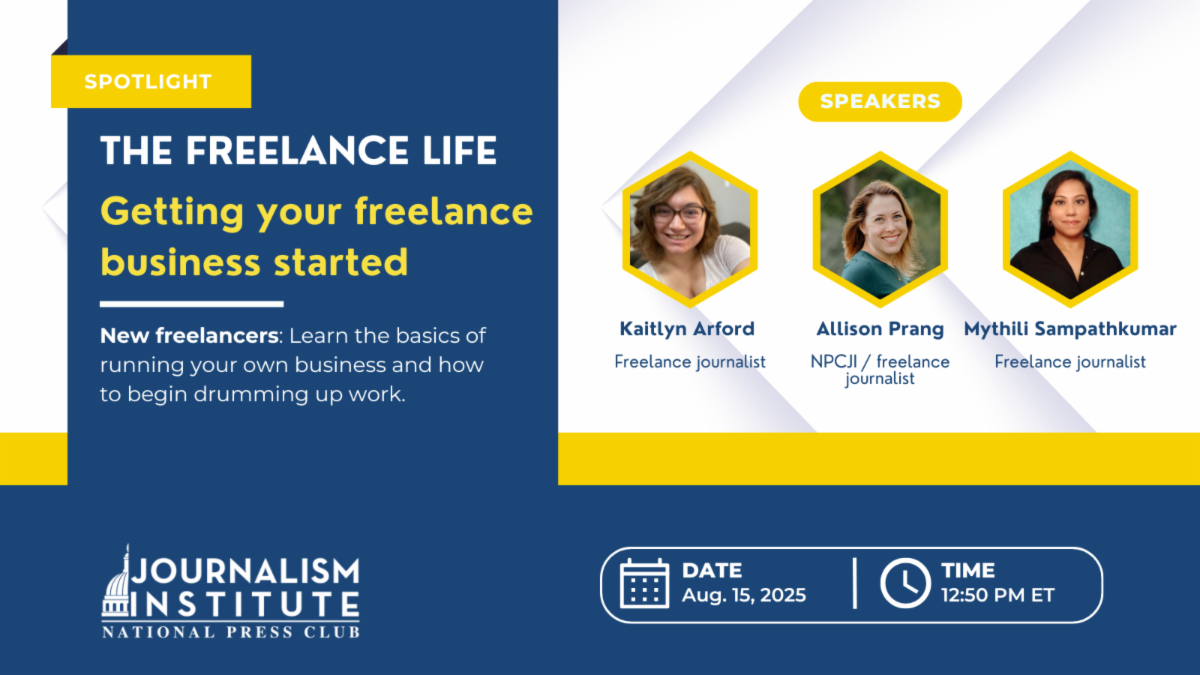
The Freelance Life session spotlight Getting your freelance business started For new freelancers Learn the basics of running your own business and how to begin drumming up work Speakers freelance journalists Kaitlyn Arford Allison Prang and Mythili Sampathkumar August 15 at 1250 pm ET

Session Spotlight: Getting your freelance business started


Whether you're just stepping into the freelance world or looking to grow your independent journalism business, join the Institute for a half-day virtual conference at noon ET on Aug. 15. With tailored tracks for both new and experienced freelancers, this conference will equip you with practical tools, insider knowledge, and expert guidance.


The track for new freelancers kicks off with a session on all the essentials for getting your business started.


Maybe you got laid off and are looking to make some money in the interim while you hunt for your next full-time job or you’re interested in trying freelancing as your main gig going forward. We’ll delve into how to get started, the basics of running your own business, and how to begin drumming up work.


Tickets for the conference are available now: $35/public, $25/National Press Club members and students.

Speakers:


To see the full conference agenda and speakers, click here.


COMMUNITY


Resources

This newsletter is written and edited by the National Press Club Journalism Institute staff: Beth Francesco, Holly Butcher Grant, Elliot C. Williams, Allison Prang, and Mitch Harle. Send us your questions and suggestions for topics to cover.


Get this from a friend? Subscribe, and view the archives.

Facebook  X  Linkedin  Youtube  

DONATE TO THE INSTITUTE


The National Press Club Journalism Institute promotes an engaged global citizenry through an independent and free press, and equips journalists with skills and standards to inform the public in ways that inspire a more representative democracy. As the non-profit affiliate of the National Press Club, the Institute powers journalism in the public interest. The Institute's tax ID number is 52-1750908.