RETIREMENT SECURITY MATTERS
A forum for retirement innovation information sharing focused on
states, supporters, and service providers.
December 17, 2020
|
|
Greetings! welcome to Retirement Security Matters – where we talk about retirement readiness innovation by states, supporters, and service providers.
|
We got you all set this week:
-
First of all, Happy 7th day of Hannukah, Happy Advent and Merry Christmas, ⛄ Happy Winter and, welcome a new holiday in 2021: Happy Vaccination Day.
-
Michael Davis Talks Truth! About Retirement Security and More
-
States stats and updates – New Mexico, Virginia, Colorado, California, North Carolina, Wisconsin, and Connecticut!
-
Grant’s Best Practices – Resources Galore for winter reading
-
Hot Sauce! Fresh new stuff, what we’re reading, and a TRUE STORY
-
And finally, some delightful and refreshing Pix.
Got some good pix this holiday season? Send them on, we like to share.
|
Retirement Micro and Macro: Thinking Big While Minding the Details
|
|
 |
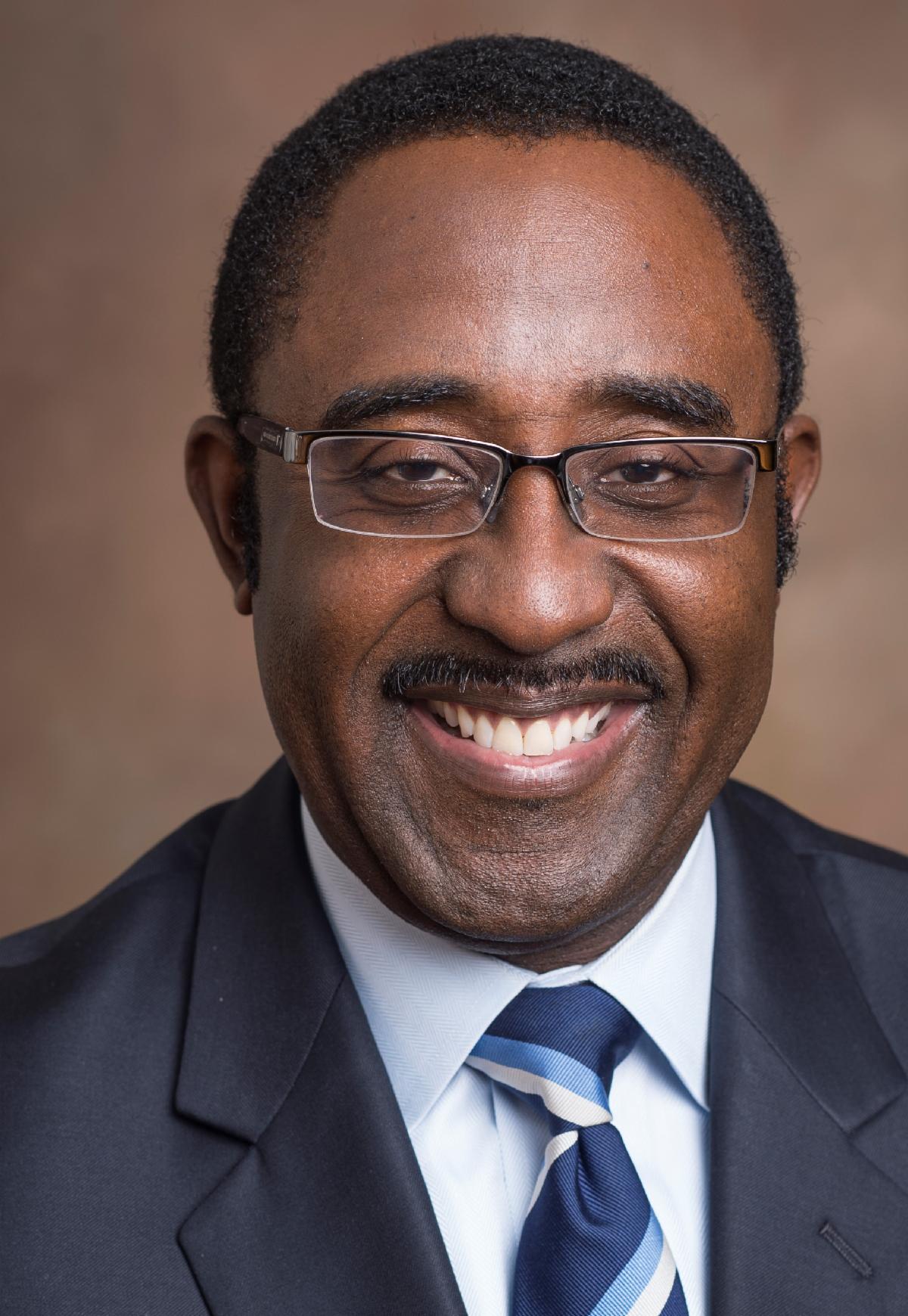
Michael Davis
Head of Defined Contribution Plan Specialists, T. Rowe Price
|
|
|
|
We talk with Michael Davis about - maybe - the most important issues on the planet: financial wellness and security, race and financial services, ESG, and family.
Michael's perspective comes from a career that encompasses roles in the private sector at JP Morgan, Prudential and Calvert before taking a public sector role with EBSA at the Department of Labor.
He brought that valuable experience to T. Rowe Price in 2016 where he heads the U.S. Institutional Defined Contribution Plan Specialists for the Americas. Read on!
|
|
|
|
Michael, folks may have heard of T. Rowe – tell us something about yourself and your team.
Thank you! I head the Defined Contribution specialist team here at T. Rowe Price. This team engages directly with Defined Contribution plan sponsors around the country on their investment-only needs. We are all about bringing the resources of the firm to bear against the challenges that plan sponsors have in trying to deliver strong and consistent retirement outcomes for their participants. 🍃 Earlier in my career I was a Deputy Assistant Secretary in the Department of Labor in the division that focuses on ERISA and retirement security: the Employee Benefits Security Administration, or EBSA for short.
We know you have a passion for retirement security. Tell us a little bit about some of the things you're focused on.
I have had the blessing to be able to see retirement security both from a provider and a government standpoint. That gives you a broad aperture to be able to think about the issues at the micro level and at the macro level.
We’re intrigued – tell us what you see.
I’ll start at the macro level. I think that some of the biggest challenges we have around retirement security are those of access, adequacy, and sufficiency. We also now have large numbers of people starting to decumulate assets.
Overlay that with the broad conversation the country is having around race and diversity, and it does take you down a path of making sure that most people have access to a retirement plan.
And that gets you focused on the need for more automatic enrollment, the need for automatic escalation, and giving people the wherewithal to be able to save enough. Of course, you can't save enough if you're not even in the system. So, what can we do at a … (You’ll want to hear the rest of this! … Click here to open, read and save).
Super awesome, Michael, thank you so much. In addition to his other roles, Michael is a member of T. Rowe's leadership team and plays a key role in guiding the group’s U.S. DCIO strategy. Follow Michael and his team on social media here. And you can reach Michael directly here.
|
|
State Facilitated Retirement Programs in Rollout and Study Mode |
|
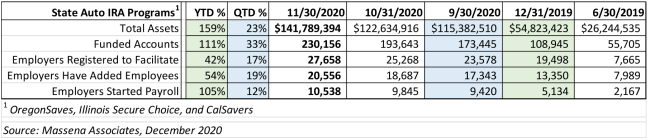
Funded accounts are up by more than 40,000 participants over the last 30 days, from 193,000 to over 230,000. Combined program assets are over $140 million, putting average account balances at about $616. Savers in the Oregon program have average account balances of about $925, reflecting a longer average saving period. More than 10,500 employers have now submitted payroll, with another 17,000 in the pipeline.
🍂🍁🍃
|
|
New Mexico (workforce 950,000) - The New Mexico Work and Save Board met on December 16. Executive Director Claudia Armijo led a program design discussion based on comparisons with other state-facilitated savings programs; Board Chair Lynn Hoffman led a discussion of a board resolution related to proposed legislative revisions to be introduced in the 2021 state legislative session (session schedule: January 19 to March 10). Key revisions under review include a) flexible timing for program introduction, and b) creation of a statutory fund not revertable to the state that would allow New Mexico Work and Save to seek funding from private contributors. The Board has preliminarily set its next full meeting for February 18. In the meantime it will work on formation of three committees, beginning in January: Rulemaking, Outreach and Education, and Finance.
|
|
Virginia (workforce 3.8 million) -- Virginia529 this week submitted their Report and Recommendations to the General Assembly on December 15, 2020. Providing a thorough review of considerations for the Commonwealth related to retirement security in the state, the report will be posted shortly. You can find more information on Virginia’s retirement study site, here.
|
|
Colorado (workforce 2.4 million) – the Colorado Secure Savings Program Board held its third meeting on December 10. The full Board was joined by legislative sponsors Senators Brittany Pettersen and Kerry Donovan who said of SB20-200, “this is one of those bills that I think is life changing”. The Board received a fiduciary update in closed session. Staff provided a summary of the relevant procurement and RFP processes in Colorado, and provided a preliminary work plan and timeline associated with program launch and operation. The Treasurer’s office is targeting filling the Executive Director role by year end. Next Board Meeting: January 4, 2021.
|
|
California (workforce 17.9 million). The CalSavers Board met December 7. Key actions included approval of amendments to update the investment policy statement including a) recognizing that going forward contributions will be invested in Capital Preservation for 30 days, rather than having the first $1,000 contributed invested in Capital Preservation; and b) inclusion of longer-dated target date funds for the program’s youngest savers. The Board also approved regulations amendments for the program to be adopted in January as part of a longer rulemaking process. Rules changes include the change in standard approach to Capital Preservation fund use noted earlier (beginning in April 2021), and the addition of the ability for participants to make recurring non-payroll contributions, Finally, the Board approved an interagency agreement with California Franchise Tax Board for enforcement services. The CalSavers program added 24,000 savers in the month of November.
|
|
North Carolina (workforce 4.9 million) – following work by its Joint Legislative Study Committee on Small Business Retirement Options published Retirement Security in North Carolina: Findings and Recommendations to the General Assembly on December 1. And here’s a quick fact sheet covering the report. North Carolina found that 53% of its workforce was not covered by a plan at work, that significant retirement savings gaps exist, and that those gaps will drive negative fiscal impact for the state and its taxpayers. The report recommends that the state adopt a state-facilitated Auto IRA program.
|
|
Wisconsin (workforce 2.6 million) – Wisconsin’s Retirement Security Task Force met on November 20 as part of its steady research, engagement and progression toward a report to the legislature. Three committees presented their recommendations. The Task Force is now working to complete its report and is scheduled to meet again for review and discussion on January 6, 2021.
|
|
Connecticut (workforce 1.6 million) – the Connecticut Retirement Security Authority is scheduled to meet December 18 to discuss 2021 legislative recommendations, contracting, and access to employer data for purposes of program operations.
|
|
Grant's Best Practices: Resources Galore! |
|
Keeping up with industry trends and new ideas is important, but often takes a back seat to urgent day-to-day concerns. If you’re like me, you probably find it difficult to carve sufficient time out your busy schedule to find and read articles and reports to help you keep current.
To make things easier for our readers, Massena Associates has pulled together a small collection of reports and articles from the past year that are particularly relevant to state-facilitated retirement savings programs and useful in terms of informing design decisions and advocacy efforts. This week's focus: the state of state retirement initiatives and programs in 2020.
|
|
In the coming weeks we’ll share research and reports on topics such as retirement (in)security in the U.S., gender and racial/ethnic disparity in retirement wealth, and defined contribution trends and innovations.
Stay tuned and Happy Holidays! / Grant
|
|
We are all about the Resources this week. Here’s some browsing for when you’re sitting by that crackling fire and the wind is blowing and the snow (or rain) is falling.
At the top of the list is one of the most important pieces to be produced this year, Universal Access to Retirement Savings: An Analysis of National Options to Expand Coverage. Developed by Angela Antonelli of Georgetown’s Center for Retirement Initiatives in conjunction with Ethan Conner-Ross and the team from Econsult Solutions, this piece explores current estimates of the uncovered (aging) population; US and international efforts to expand access, and the impact on individuals, spending and US GDP of an improvement to coverage and savings. Must read.
This month Boston College’s Center for Retirement Research publishes How Much Taxes Will Retirees Owe on Their Retirement Income? – courtesy of Anqi Chen and Dr. Alicia Munnell. Excerpt: “While the results show that taxes for most households are negligible, the burden rises to 11 percent for the top quintile, 16 percent for the top 5 percent, and 23 percent for the top 1 percent.” Impact to you and yours?
Retirement savings portability is a hot topic – especially for those with lower balances. The IRS has new guidance related to escheatment and tax withholding – worth a look. Especially for you folks working on auto-portability.
And finally, NEST Insight and Invesco teamed up to study the impact of language on participant engagement with retirement savings, to wit: there’s “a challenge at the heart of pensions auto-enrolment. The approach has been successful because it harnesses people’s inertia. Yet this same inertia is the thing that’s standing in the way of people engaging with their levels of saving.” Beyond the Defaults, authored by Jo Phillips and Matthew Blakstad finds that certain messages are particularly useful, including:
1 ‘You can contribute more to your pension’
2 ‘You can make a difference to your financial security in later life by
rethinking the amount you contribute to your pension’
3 ‘Contributions you make when you are younger work harder for you’
There’s more to this piece so dive in and spend a little time – this one is important for the long haul in the auto-enrollment space – which we think is going to apply to the majority of savers, soon.
A TRUE STORY. “OregonSaves – that’s my retirement account!” On a recent afternoon a friend queued up to take his driver’s test with field test agent Lauren (not her real name!). Lauren works for a third party driver education center that employs 12 field agents, among other staff. She’s in her mid-20’s. “I had an office job for about three years. The company gave me a retirement plan, but when I left, I lost access to that. This new company gives me OregonSaves – I’m so glad. It’s really important to me.”
WHAT WE ARE READING: Through Five Administrations, by William H. Crook. OK by reading, we mean “listening to on Audible at 1.2x”. This is a fantastic book. If you’re a bit of a presidential nerd or a Lincoln nerd and want to know what it was really like in the White House, this book’s for you. Go for the Audible version and crank it up – the voice actor is very laconic.
|
|
... We've been scrolling and scrolling, just give us some pix! |
|
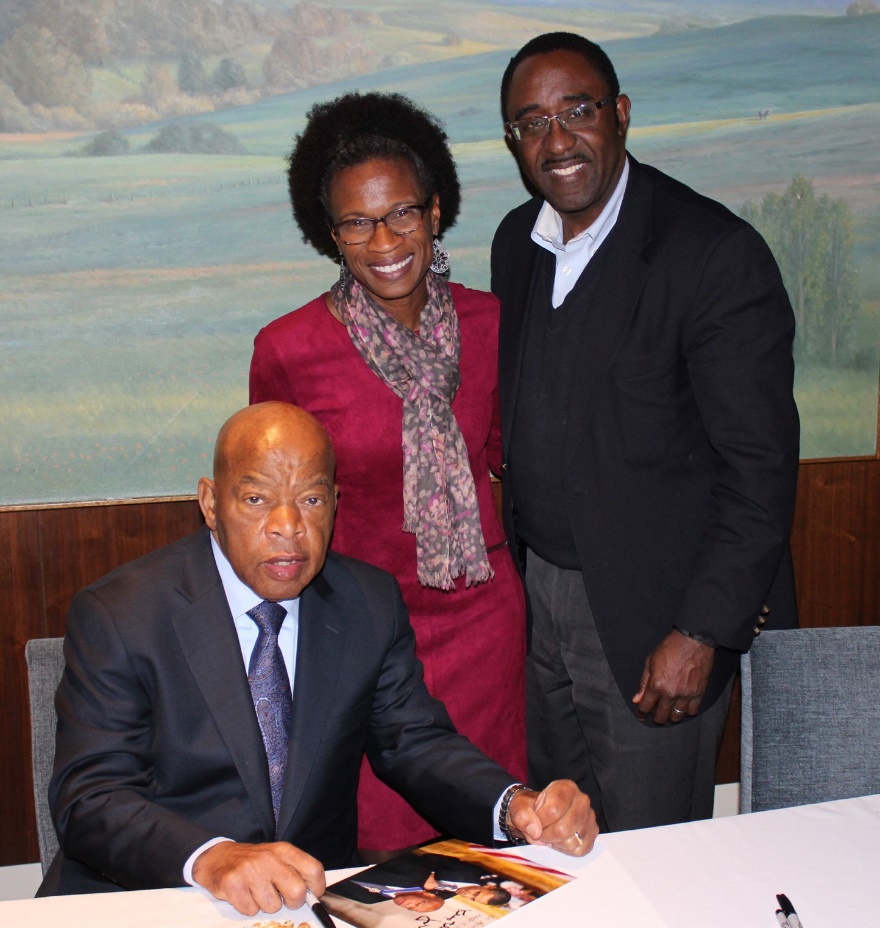
Before we flip to full holiday, let’s take a moment for the meaningful. Here’s our Michael Davis, his beautiful wife Dr. Carol Davis, and the late and respected Senator John Lewis together not long ago. Thank you so much for sharing this, Michael, and for being willing to give us your wisdom and experience. We want to meet Dr. Carol!
|
|
OK, now we are going holiday. We love this pic from John Wasilisin, Executive Director for MarylandSaves. While he is totally mum about the program and its current post-RFP negotiations, he did have a cool Christmastime story:
This tree is a long-standing tradition for my family. We live on the water in Maryland, and when my boys were very young, they asked me how Santa would find us in our new home. I told them that I would put a Christmas tree at the end of our pier so Santa would see it when he flew over our house on Christmas Eve.
But the biggest gift is for me...to see the joy a simple tree can bring to my family. Even COVID could not break this cherished family tradition!
Thank you John!
|
|
|
We know you have your own fabulous wintertime traditions and we hope you are enjoying them in an even more close-knit way this year. Read: unable to leave the house, still. Oh wait, we can still enjoy the outdoors! We’ll leave you with a shot of our favorite mountain, taken this past weekend as we strapped on our gear. #welovecorduroy
|
|
OK, that’s a wrap. Thank you for joining us. Stay safe! ❤
If you like this piece, please stick with us. We’ll be back in about two weeks. If you don’t like it, please unsubscribe. Comments for us? Please let us know. Want your own subscription? Request one here. All information shared is from public sources or used with express permission.
|
|
Massena Associates provides process, policy, and implementation consulting on retirement savings programs and products. Our clientele includes states, governments, policy organizations, and private sector providers. Our specialty – efficient, targeted results. We are an active speaker on retirement security topics, including state-facilitated programs, MEPs and more.
“We would not be where we are without Lisa’s great leadership and direction.”
If you’d like to explore working together, we welcome the conversation. Connect with us here, and at 339-236-0684. |
|
Looking for a great retirement savings innovation resource? Led by Dr. Alicia Munnell, the Center for Retirement Research at Boston College develops and hosts terrific content and proprietary research related to states, financial security, social security, and more.
Pew’s Retirement Savings Project studies the challenges and opportunities for increasing retirement savings and is another great resource - check out the work of John Scott and his terrific team.
|
|
|
|
|
|
|