|
RETIREMENT SECURITY MATTERS
A forum for retirement savings innovation, together.
Vol 107 | October 22, 2026
| | |
Greetings! Greetings! welcome to Retirement Security Matters—your forum for retirement readiness innovation by fresh thinkers, states and feds, service providers and policymakers. | |
With fall we look backward and forward. We’re calling this edition Tide Check. You’re going to get plenty of vampires & ghouls everywhere else. We’re bringing you crisp winds, stiff sails and beverages with tonic in them. Grab one. Take a moment for yourself. Exhale. Read on.
In this edition:
-
Peter Thompson of RetirePath Virginia—an important moment
- It’s sunny in State Auto IRA-land—fresh numbers for you
- Tide Check—what’s new, what matters
- Hot Sauce 🔥 Cool Stuff—we’re on a work break, and
- … The best Pix of the Week!
Here we go.
| | View as Webpage Comments or content suggestions? We welcome both. Have something about your program or work you’d like to share? We are all ears. | This Is a Moment: Peter Thompson on RetirePath Virginia, and More | | |
Virginia’s Auto IRA leader on a growing program, a big expansion, and a call to more states.
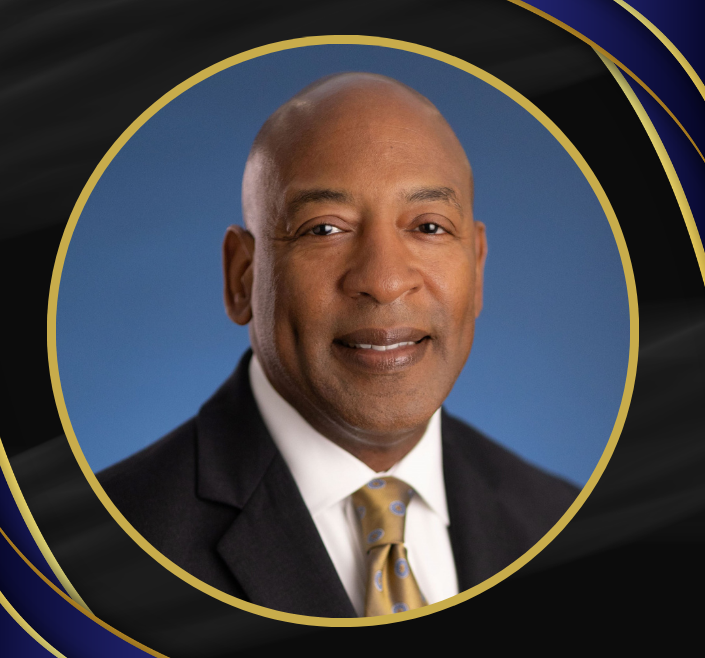
Peter Thompson has been with RetirePath Virginia since before it opened. As Program Director, he is helping the state’s Auto IRA program reach more Virginians who have no retirement plan at work. We caught up with him earlier this month. His big message? “I think this is a moment.” We do too.
Prove it, then grow it
RetirePath opened in 2023 for employers with 25 or more full-time employees. A high bar, and on purpose. Those first years gave the team “the data and the experience” to go back to the General Assembly and ask for more. Would some bigger employers pick a private plan instead? Maybe. Peter is fine with that, because “the overarching goal is really to close the access gap.”
Then came July 1. Now employers with five or more employees are in, and part-time workers count. “That opened the program up to more than 35,000 Virginia businesses.” The rollout is in phases. The September 30 deadline for employers with 10 to 24 employees just passed. For the smallest, with five to nine employees, the date is October 30.
The bill passed with “bipartisan unanimous support.” And the early response from small employers? It “reaffirms the fact that these programs really help the smallest of employers.” (Oh - want to see the numbers? They’re here.)
Three lessons for states that have not started
One: Show up early and keep it up. “Stakeholder engagement early and often is key.” Peter’s team built ties with lawmakers, trade groups, and business groups. Then they listened closely.
Two: Get the law right. Virginia kept its statute light, but enforcement considerations gave Peter pause: “there has to be that delegated authority in statute.” He has keen views on why enforcement matters. Employers with their own plans already face penalties. Hear him out in the full piece.
Three: Watch where the road is going. Emergency savings and financial education are hot topics. So, Virginia’s new law lets the board explore an emergency savings option, beefs up financial education, and makes room for the Saver’s Match.
The Saver’s Match: a reason to come back
The Saver’s Match starts with tax year 2027. The first matching dollars land in 2028. Treasury has already mailed awareness letters to just over 1 million Virginia taxpayers who claimed, or could have claimed, the Saver’s Credit in 2025. For Peter, that is a door opener.
And here’s an interesting tie-in other states might consider. Virginia’s law now allows re-enrollment. There is no plan yet for how it will work. But picture the workers who opted out, or changed jobs and stopped saving. The match gives RetirePath a fresh reason to engage. Peter also does some “back of the napkin” math on who will qualify, and he flags a Roth IRA wrinkle. Both are in our full conversation. In 2027, expect a big push on getting started and saving early.
“Now is the time to do something.”
— Peter Thompson
A moment for states and for our friends in Washington
Earlier this year came an executive order on TrumpIRA.gov. The marketplace is not live yet, but Peter sees a signal to the states. Only 17 states have programs that are active and open. He hopes the rest get moving.
A state Auto IRA does something a voluntary marketplace cannot. It enrolls people automatically, right from the paycheck. Then there is portability. People change jobs, and tiny accounts get left behind. Roth IRAs, where 99% of savers in these programs are, can’t roll into an employer plan today. Peter’s take? “I think this is the moment.” … to reconsider portability across the system.
Savers as partners
What else is on Peter’s mind? Affordability, emergency savings, and financial education tied to real money. Talking about saving is like talking about riding a bike: nothing sticks until you get on the thing. These savers are already on the bike. It’s a great time and place to surround them with relevant opportunities to learn more. He also wants to “debunk” the myth that engaged savers will yank their money out.
The big goal: savers who see RetirePath as important and trusted. “A state entity as a trusted partner.” Imagine that. Peter sees this as the moment for states, for portable accounts, and for savers. Is your state ready?
Read the full Q&A with Peter
Peter Thompson—Thank you! If you’d like to connect with Peter you can reach him on LinkedIn and by email here. You can follow Virginia RetirePath here.
See more: we talked with Peter in 2023, and with Commonwealth Savers CEO Mary Morrison in 2021.
| | By the Numbers: State Auto IRAs Today | | |
A special thank you to Angela Antonelli and the Georgetown Center for Retirement Initiatives for this data. You’ll find more detailed metrics and information on their site, here.
We read it so you don’t have to! Bottom line: 1.45 million Auto IRA savers have socked away $3.4 billion. Deets follow.
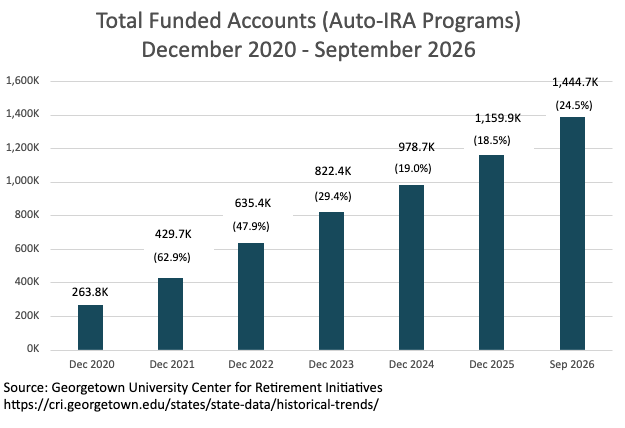
Total Funded Accounts
As of September 31, 2026, 1,444,700 workers have funded Auto IRA accounts—up over 25 percent from 1,159,900 at year-end 2025. That’s about 285,000 new funded accounts added in the first nine months of this year. 85,000 of these accounts come from New York alone, and just over the last few months—we told you they would be a powerhouse.
Since December 2020 when we were at about 263,800 funded accounts, the total has grown more than 5-1/2x.
| | |
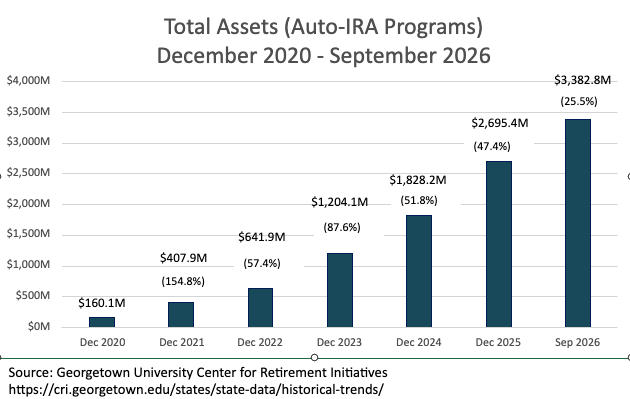
Total Assets
State Auto IRA programs now hold a combined $3.38 billion—in total assets as of September 30, 2026. That’s a 25.5 percent increase from $2.69 billion at year-end 2025. Crude division gives us an average account size of about $2,341. You’ll expect this to vary by program, and it does. Longer-lived programs have higher balances—see Oregon, California and Illinois at $3,263, $2,888 and $2,028 respectively. Colorado is up in the top five as well. Brand new programs like New York, Minnesota and Rhode Island have average balances ranging from $316 to $629. The balance of programs range from $882 to $1,802.
Since December 2020, when programs collectively held $160.1 million, total assets have grown more than 21x. You can see it in the charts: year-over-year growth has been consistent and strong.
| | Tide Check—Hi Lo Where We Go | | |
Here’s some High and Low, followed by a thought on Where We Go.
Where We’ve Been.
State Programs. We’ve given you the skinny on state Auto IRA assets and account growth, above. Here are a few more 2026 milestones. We should save this for year end, but we’re not going to. We’ve got something special planned for the December edition.
-
New programs launched and launching: Minnesota, in January. (Brrrr) New York’s deadlines began to take effect in March, May and July. Hawaii is targeting December.
-
State and City legislation: Mississippi enacted an opt-in program in April—stay tuned. And PhillySaves passed locally and looks like it will be the first city-based program to launch, in 2027. Philadelphia is as big as some of our smaller states, and we think they are well poised for success.
-
Auto IRA assets passed the $3 billion mark this spring. We think we’re saving the $4 billion milestone for next year but WHO KNOWS.
-
And, in a good-guys-also-win moment, it turns out that states with Auto IRA programs experience excellent growth in private sector new plan formation. We like new plans. Also, they use auto-enroll.
| | |
Refreshing! Made with the assistance of our friend, ChatGPT
Federal Action.
-
After some breath-held waiting, the federal Saver’s Match is squarely on plan for implementation in 2027 (the awareness, contribution, and construction year) and 2028 (the first match payout and fine-tuning year). It came with some important guidance—IRS Notice 2026-48—useful for industry and others working on this initiative. Stay tuned for regulations to follow the comment period, which closed October 5.
-
February’s State of the Union address brought the delightful surprise announcement of TrumpIRA.gov—coming soon to a location near you. We like the integrated Saver’s Match acceptance requirement, and the use of a lot of earned media to promote this marketplace into the corners of America where today’s DC and DB plans, auto IRA and other retirement arrangements are NOT YET REACHING.
-
Trump Accounts for kids, arguably, satisfy a range of policy goals. We hear all of you shouting at us right now. We’ll just say, we like the idea of getting way more American kids and families ‘on the bike’ of an early investment account. We like the idea of more kids achieving early adulthood with assets they wouldn’t otherwise have had. This is a great social experiment and we can’t wait to see how it evolves. We like the idea of the accidental/intentional, we don’t know which, Child IRA account. Cuz, #retirement.
-
And, we like that the conversation around a federal standard for workplace retirement savings access stays visible. Perhaps in back rooms we are refining our thoughts about what really works: one and two. This policy piece from our friends at BPC says more, and expresses their current view. BPC also talk about Auto IRAs and new plan formation, which we like.
Industry Innovation (and adoption).
It is hard to make new stuff in the private sector! Partly because adoption takes forever and product profitability timelines can run out before a good idea gets traction. We have some wins though.
-
Emergency savings – Workplace. Access. Is. Slowly. Growing. BlackRock’s ESI report for 2026 reflects that their initiatives have achieved $7.9 billion saved across a reach of 22 million workers. See page 5 for more detail. And yes, this was a higher set of figures than we were expecting to see.
-
Automatic enrollment – use, impact and analysis continues. This year, Vanguard reports a shift in the use of auto-enroll from 10% of their plans in 2006, to 61% of plans in 2025. The use of all three automatic levers has increased (enrollment, escalation, investment choice). And initial contribution rates are up—62% of plans studied now use a rate of 4% or more.
-
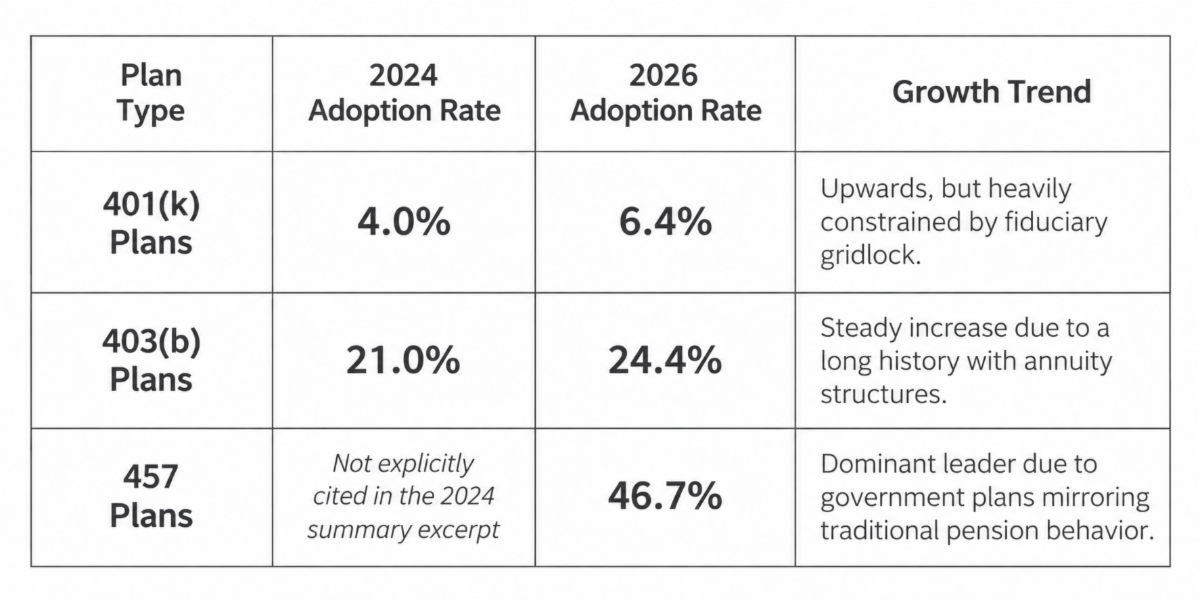
Lifetime income - these were forecasts: one and two. This is reality: 44% of recordkeepers said they do not support recordkeeping for available in-plan retirement income products. This will slow 401(k) plan adoption. Good news: PlanSponsor surveys—we find just two—show that adoption has risen over the last several years. Here’s a little chart for you:
Comparing the 2024 PLANSPONSOR Survey to the 2026 PLANSPONSOR Survey highlights how adoption rates have evolved -- see their chart here:
| | |
Where We’re Going.
OK, hear us out. Predictions for the 2027-2028 season. No particular order. Come back next year and see how we did.
1 – federal legislation passes establishing a workplace retirement savings access standard, and allowing current Auto IRA programs to serve employers across state lines. New plan formation leaps; the coverage tide (see what we did there) continues to come in.
2 – the Saver’s Match rolls out. LMI taxpayers, many many of whom have saved in matchable ways, have to use Form 8880-A to claim their refundable credits. It’s a pain in the neck but with a lot of environmental support, more than half of them are successful. Small balances leap upward. The program receives formal and information evaluation and analysis and everyone involved in the matching process tunes up their processes ahead of the 2028 tax season (in 2029).
3 – TrumpIRA.gov launches to some fanfare and with the challenges facing any new voluntary, marketplace solution. It achieves adoption in corners of the USA where the workplace retirement account has not reached. It too receives evaluation and continues to evolve and improve.
4 – adoption rates rise meaningfully for the slow-but-important retirement-supporting tools of workplace Emergency Savings and in-plan (plan-linked?) retirement income. “Meaningfully” means, a growth rate of at least 25%, year over year. We know the base is low, but that’s a good number, yes?
5 – and, while we are waiting for #1 to happen and in the interest of excellence for their populations, five more states and large cities adopt and launch Auto IRA programs.
THAT’S ALL WE ASK.
6 – ok, one more. AI becomes a useful tool for curated, personalized, point-in-time retirement security engagement and guidance.
| | |
Work break style!
1 – A book to read – not on anyone else’s current list because it is Vintage: from 2011, Ann Patchett’s State of Wonder. It’s a tale of scientists and the Amazon, love, loss, all the good things. Tightly written, dramatic. We’re reading it again asap.
2 – From the TikkyTokky – volume alert, we love this guy. Thank uu Mr Cutts for making our day. Over and over again.
OK this one actually is a back-to-worker.
3 – In September EIG analysis described over 76 million workers lacking access to an employer-provided plan. We’re going to have to follow up on this. When we started this work the number was lower! Mr. Glasner, we’re coming to talk with you. We mean that in a good way.
| AND ON THAT NOTE ... we bring you Pix of the Week! | | Peter’s been busy expanding RetirePath Virginia, but that hasn’t stopped him from finding time for a few adventures along the way! 🌎 With an eye for colorful murals, a curiosity for history, and an appreciation for beautiful scenery, Peter takes us from the meaningful memorials and vibrant street art of Oklahoma to the Arizona Biltmore in Phoenix and the breathtaking coastline of Torrey Pines in San Diego. A little history, a little art, and a little fresh air—Peter clearly knows how to make the most of his travels! ❤️ | | That’s it for this edition. ❤ Hug your people and change the world. | | |
Massena Associates provides process, policy, and implementation consulting on retirement savings programs and products.
Our clientele includes public entities, policy organizations, and private sector providers. Our specialty – efficient, targeted results. We are an active speaker on retirement security topics, including state-facilitated programs, MEPs and more.
If you’d like to explore working together, we welcome the conversation. Connect with us here, and at 339-236-0684.
| | |
Looking for a great retirement savings innovation resource? The Center for Retirement Research at Boston College develops and hosts terrific content and proprietary research related to states, financial security, social security, and more.
The Defined Contribution Institutional Investment Association (DCIIA) is dedicated to enhancing the retirement security of America’s workers. To do this, DCIIA fosters a dialogue among the leaders of the defined contribution community who are passionate about improving defined contribution outcomes. DCIIA's site provides a range of public and member-specific resources.
The Georgetown Center for Retirement Initiatives, Led by Angela Antonelli, GCRI provides excellent information on state-based and other retirement security innovation and policy.
Pew’s Retirement Savings Project studies the challenges and opportunities for increasing retirement savings and is another great resource - check out the work of John Scott and his terrific team.
If you want a great source of broad-based, consumer-focused retirement news, Jeffrey H. Snyder’s The Morning Pulse is your ticket. You can subscribe here.
| | | | |