|
Navigating Difficult Family Conversations
Around Care Planning
| | |
When a loved one receives a dementia diagnosis, there are many conversations for the family to have around navigating things like medical care, living situations, safety, and more. Navigating these conversations can be difficult, especially if the family members you’re talking with don’t see your loved one on a consistent basis. They may not understand the complexity of caring for a loved one with dementia, which can result in conversations that feel difficult to navigate.
As a primary caregiver, you are the most familiar with your loved one’s day to day; how far their dementia has progressed, what care they may need, how safe they are in their living situation, and when it might be time to consider additional care options. You are often the one attending doctor appointments, taking over tasks your loved one can no longer do, and feeling the weight of the caregiving experience. Explaining these things to your family may seem to be an impossible feat. If you start conversations around care planning, you may have family members push back saying additional care options are unnecessary, that “it’s not that bad” or “they seem fine”. In today’s article, I’ll discuss some tips for navigating these conversations that will hopefully lead to more productive, supportive conversations around care planning.
| |
Knowing when to have conversations with family members is difficult, and varies depending on your unique family structure and dynamic. Some people may be able to hold off on these conversations and others may need to have them early on. As the caregiver, you are responsible for doing what’s best for the loved one you are caring for. If family member input would seem unhelpful, you may wish to only provide necessary information to avoid conflict and stress that could negatively impact you and your care receiver. If it would be helpful to involve family, or it is necessary for any number of reasons, planning for these conversations before they occur can set you up for a more productive conversation.
- Write down the facts you wish to convey, without emotions behind them. Emotions will come up naturally, so stating the facts upfront can be helpful to clarify for everyone what is going on and what needs to be addressed. Instead of saying, “I can’t care for all of mom’s needs anymore, we might need to consider a facility”, say “mom’s dementia has progressed to where she would benefit from additional support options at a facility”. This changes the conversation from being about your capability to being about the loved one’s needs, minimizing possible comments or discussion around your capability and keeping the focus on supporting your loved one based on their symptom progression.
- Have relevant examples ready. If you are communicating that your loved one’s symptoms have worsened, have examples ready to give. These examples should show a difference between the past and the present. Focusing on examples that family members would understand the severity of is also helpful. If your loved one used to love going out and gardening every day and hasn’t been able or desired to due to symptoms, your family members may realize the severity of progression if their loved one is no longer doing something they were so used to seeing them do.
- If the conversation escalates, ask to regroup at a later time. Stepping away from an unproductive conversation can prevent escalation that could inhibit future conversations. If the conversation isn’t going well, you can say something along the lines of “it’s important to me we focus on dad’s needs and it seems this conversation has strayed from that, can we talk another time and try to come to an understanding then?”. In preparation for the regroup, try to reflect on where the conversation went poorly, and have examples, plans, and information ready for next time. For example, if the conversation escalated around the question of cost, gather some cost information for when that conversation comes up again. This ties back into the first tip, addressing facts so the conversation stays centered around your loved one’s needs.
| | Navigating difficult conversations with family members around care planning isn’t always going to be smooth sailing. Doing your best to have information ready and keep the focus on your loved one can go a long way in having these conversations be productive. | | |
— Jayde Hart, B.A.
Memory Care Cafe Program Coordinator at DayBreak
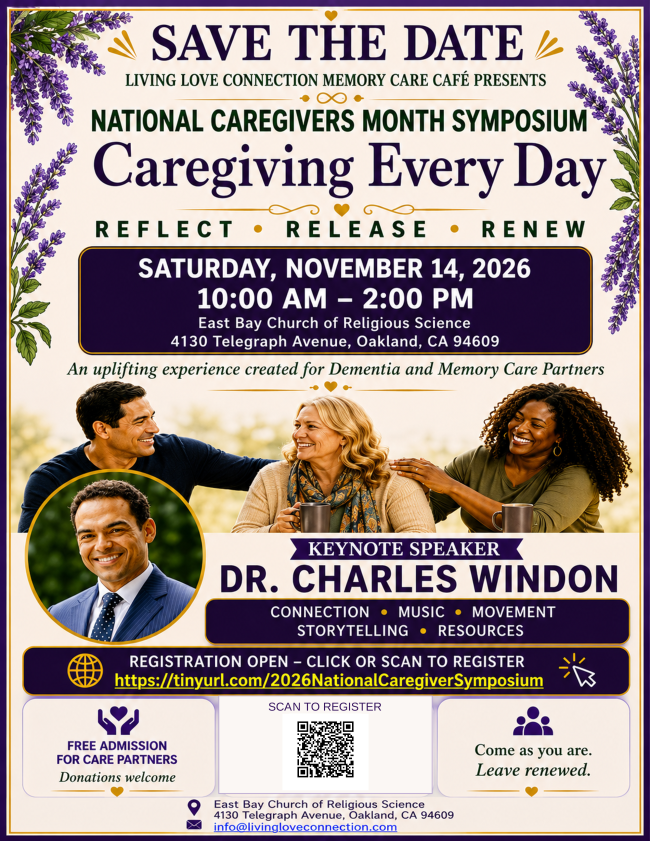
| | East Bay Church of Religious Science Memory Care Program Presenter: Dr. Charles Windon | | |
|
As part of DayBreak Adult Care’s development of a guidebook for organizations and individuals interested in establishing their own Memory Care Café (MCC), DayBreak collaborated with the East Bay Church of Religious Science (EBCRS) during the final phase of the pilot program. This phase provided an opportunity to test and refine the MCC logic model in preparation for development of the final guidebook, which is scheduled for publication later this year.
A key component of the pilot was connecting EBCRS with Dr. Charles Windon, an Assistant Professor of Clinical Neurology at the UCSF Edward and Pearl Fein Memory and Aging Center in San Francisco. DayBreak had collaborated with Dr. Windon on several occasions during Phase I of the pilot and invited him to participate in the EBCRS program as a guest speaker on topics related to memory loss and brain health.
This collaboration resulted in three educational videos featuring Dr. Windon. In the videos, he discusses strategies for navigating medical care related to memory loss, explores the connection between lifestyle and brain health, and explains warning signs that may indicate memory loss. Dr. Windon also responds to questions from the audience, providing practical information and guidance for individuals and families affected by memory concerns.
DayBreak will be sharing the links to the videos in our weekly newsletter as follows:
|
|
Upcoming Events & Workshops 📣 | |
Join Our Community of Care ❤️
| | Your gift helps keep older adults and individuals with disabilities safe and supported. Join us in spreading love, hope, and care throughout our community! | | |
If you know an elder in need of our care and coordination services, or a caregiver seeking support, please encourage them to reach out to us at:
510-834-8314
| | | | |