Rail Workers Weekly News Digest
Number 9 - March 3, 2020
|
|
Below is a series of articles compiled over the previous week.
They are of interest to railroad workers.
_____________________________________________
|
|
Article 1 -
PSR NEWS
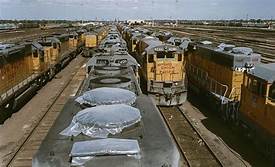
Union Pacific Cut 17% of its Workers, Will Cut 8% in 2020. Revenue Fell 9.5%, Income 10%.
Bought Back $5.8 Bn in Shares.
Stock Hits New High.
Its debt surged to fund the share buybacks. And truckers ate its lunch. But don’t tell any of this to the “market.”
|
|
The first thing to know about Union Pacific’s earnings, which it
released
this morning, is that despite cutting its workforce by 17%, promising more layoffs in 2020, experiencing a 9.5% drop in revenues and a 10% drop in net income in the fourth quarter, the company blew $600 million in Q4 and $5.8 billion in the year 2019 on buying back its own shares, which it funded with $3 billion in new debt.
This comes on top of the $8.3 billion in share buybacks in 2018. Since it started repurchasing its own shares in 2010, fired up by the Fed’s cheap-money policies, its cumulative share buybacks have reached $34.2 billion:
Freight recession & truckers sap revenues.
For Union Pacific, freight revenues in Q4 2019 dropped 10% year-over-year to $4.85 billion, and total revenues fell 9.5% to $5.2 billion. For the whole year, revenues fell 5% to $21.7 billion.
Expenses drop, due to layoffs and lower fuel costs
Operating expenses fell 12% in Q4 to $3.1 billion. Various expense items dropped, including fuel expenses, which plunged 20% on lower price-per-gallon of diesel fuel and less freight to haul. In terms of dollars, the drop in fuel expenses amounted to a savings of $128 million in Q4, bringing total fuel costs down to $512 million.
But the biggest line item was the 18% drop in compensation and benefits. In dollars, compensation and benefit expenses fell by $231 million in Q4 to $1.05 billion. How is this possible?
Slashing headcount by 25%
Over the 12 months between Q4 2018 and Q4 2019, Union Pacific axed 7,133 employees, or 17% of its workforce, bringing its headcount down to 34,563 employees in Q4.
In 2020, it plans to cut another 3,000 or so jobs. Which would mean that over the two-year period through Q4 2020, the company will have axed about 25% of its employees.
Throughout 2019, there has been a series of layoffs at rail yards across the country, a few hundred people here and a few hundred people there. When word would leak out that Union Pacific was laying off people at a local rail yard,
local news media
would reach out to the company and get the prepackaged statement that would always cite its “Unified Plan 2020” and would usually include something like this:
“Union Pacific continues streamlining operations as part of our Unified Plan 2020 operating plan.” Then it would address the specific locations of the layoffs that the media outlet had inquired about, how those operations were being transferred to somewhere else, or were being consolidated into something else.
And it would add something like this: “These changes will improve operating efficiencies, helping us provide customers with safe and reliable rail service.”...
And Union Pacific’s 14% decline in revenues in its “Premium” segment (intermodal containers and trailers) where it competes directly with truckers shows that some of its business has already been driven off the railroad and on to the highway.
|
|
Article 2 -
CRUDE BY RAIL NEWS
U.S. Rails Monitoring Canadian Crude
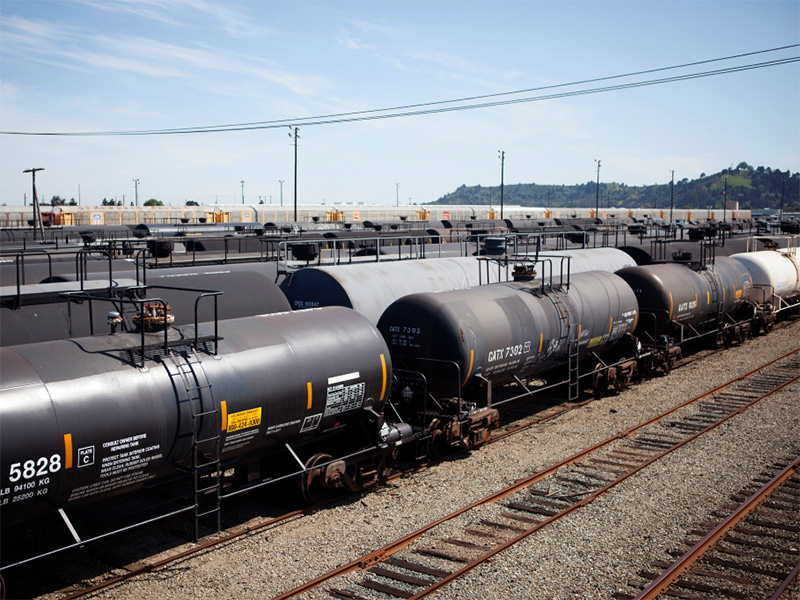
The derailment of two separate oil trains roughly two months apart near Guernsey, Sask., each spilling more than 300,000 gallons of crude onto the ground and one igniting into a smoldering inferno, plus the resulting 30-day mandatory speed limit on such trains imposed by Transport Canada (20 mph in urban areas, 25 mph elsewhere), have raised questions about not only the cause of those derailments, but also about the durability of the tank cars, and the volatility of the crude they were carrying. It should also raise questions, and awareness, about the transport of Canadian crude on the U.S. rail system.
Both Saskatchewan derailments took place on Canadian Pacific, which also owns and operates trackage in the U.S., as does CN. Additionally, CP and CN interchange some of their crude traffic to U.S. railways at or near the U.S./Canada border. In many cases, those unit trains of Canadian crude travel far greater distances in the U.S. than they do in Canada, heading to refineries or offloading terminals as far south as California, Texas and Louisiana. How are U.S. railroads reacting to the recent events up north?
Courtney Wallace, Director of Public Affairs at BNSF, declined to comment on the volume or volatility of Canadian crude that BNSF hauls south from its international connections near Vancouver, B.C., and in north-central Montana, but she did speak to the need for railcar safety. Wallace says, “BNSF continues to handle all car types allowed under federal regulation for crude, but we are working with our individual customers to facilitate getting the newest and safest tank cars, currently the DOT 117Js, in service sooner on our railroad. BNSF doesn’t own the tank cars used to ship crude oil on our network; however, it is incumbent on all parts of the supply chain to ensure we have the safest tank car in which to move this commodity.”
|
|
Article 3 -
REGULATION NEWS
NTSB Members Displeased That FRA Omitted Fatigue in Risk-Reduction Rule
Jennifer Homendy, a member of the National Transportation Safety Board (NTSB), said that the Federal Railroad Administration (FRA) final rule for Class I railroads and certain smaller railroads to establish risk-reduction safety plans issued Feb. 18 falls well short of the intent of the Rail Safety Improvement Act (RSIA) that was passed by Congress in 2008.
“As the lead @TransportDems staffer who drafted the Act, I’m glad the rule’s out but it doesn’t comply with the RSIA,” Homendy said on Twitter. “It leaves out commuter and passenger railroads (that rule has been stayed 9 or 10 times now) and it fails to require freight railroads to implement fatigue management plans as part of their risk reduction program (which was required in RSIA).”
Later in her Twitter thread, she cited five accidents investigated by NTSB involving both freight and passenger rail that were linked to fatigue and reminded her followers that fatigue management is on the NTSB’s most-wanted list in preventing railroad accidents. She also mentioned that FRA has seemed to reverse course over the years as in 2015, agency leadership had told NTSB that fatigue management would be addressed in a final rule.
The final rule as published requires Class I railroads to compose an FRA-approved RRP plan.
“These comprehensive, system-oriented safety plans are required to identify and analyze hazards and their associated risks, and develop and implement plans to eliminate or mitigate those risks,” FRA said in a release announcing the final rule. “An RRP is designed to improve operational safety, complementing a railroad’s adherence to all other applicable FRA regulations. Each railroad must tailor an RRP for its individual operations, and the RRP must reflect the substantive facts on any hazards associated with each railroads’ operations.”
|
|
Article 4 -
RAIL EMPLOYMENT NEWS
US Rail Employment Tumbles
Employment at the Class I railroads fell to its lowest in years, with January’s totals tumbling over 12% year-over-year. Headcount among the Class I railroads in January totaled 128,311 employees, a 12.4% decrease from January 2019’s total of 146,556, according to data from the
Surface Transportation Board
(STB).
That overall total is the lowest since January 2012, which is the earliest STB data that FreightWaves has available.
Meanwhile, the headcount within the train and engine category, which tends to be more sensitive to the rail market and rail demand, dropped 17.3% year-over-year in January, to 51,709 employees from 62,545 in January 2019. January’s total in the train and engine category is also the lowest total since January 2012.
The Class I railroads, with the exception of
BNSF
(NYSE:
BRK
), have also been deploying some form of
precision scheduled railroading
, an operational model that seeks to streamline rail operations.
Whether the railroads will cut headcount levels even further in 2020 remains to be seen. Executives at
CSX
(NASDAQ:
CSX
) said last month during the company’s fourth-quarter earnings call that the company would look at headcount levels in light of rail volume trends. CSX and other freight railroads have indicated that rail volumes could grow in the second half of 2020.
|
|
Article 5 -
WHISTLEBLOWER NEWS
Railway Ordered to Pay $1.74 Million for Whistleblower Retaliation
The U.S. District Court for the District of Colorado recently ordered a Railway to pay damages to a whistleblower who suffered retaliation. The whistleblower received over $1.74 million from Burlington Northern Santa Fe Railway Company (BNSF) to cover lost wages, emotional distress, and punitive damages after losing his job for reporting safety concerns.
According to
a statement
from the Occupational Safety and Health Administration (OSHA), the BNSF retaliated against the former employee after they reported track defects. “Railroad employers and owners must comply with the Federal Railway Safety Act, enacted to protect railroad workers who report hazardous safety or security conditions,” said OSHA Acting Regional Administrator Rita Lucero, in Denver, Colorado.
|
|
Artic
le 6 -
PASSENGER NEWS
TCU and Rail Passengers Association Hold Joint Rally to Oppose Job Cuts
(Editors Note: This is the kind of unity we need where workers and their unions come together with the community, passengers)
Reps. Brendan F. Boyle (D-Pa.) and Brian Fitzpatrick (R-Pa.) joined TCU-IAM members in front of Amtrak’s William H. Gray III 30th Street Station to protest the nation’s passenger rail corporation’s unjust removal of good, union-protected jobs, organizers said. The lawmakers will also be joined by Jim Mathews, President of the Rail Passengers Association (RPA).
The 3:30 p.m. rally marked the latest action against Amtrak, which has been steadily shifting services and displacing jobs under the leadership of Richard Anderson, the former chief executive of Delta Air Lines.
One of the common criticisms from the elected officials is Amtrak’s contracting with a third-party, non-union, low-wage outsourcers in Florida and Ohio.
"Amtrak is America's railroad, and that means being able to serve all Americans," said Mathews. "There are millions of Americans who rely on the help provided by the real human beings at Amtrak's call centers. They choose to call in because of religious observances; because of financial hardship or lack of access to broadband in their rural community; sometimes simply because they lived in an America before the age of smartphones. They deserve to receive quality service in return for their train fare—and their tax dollars. We stand ready to work with Congress and with Amtrak to ensure that America’s railroad is able to offer sustainable levels of service, from 30th Street Station to Main Street USA.”
|
|
Article 7 -
HEALTH CARE
Comedian John Oliver Takes on Medicare for All
(Editor's Note: In February, Comedian John Oliver lays out the case for Medicare for All amidst a hilarious discussion of its pros and cons, its detractors and supporters. RWU has supported Medicare for All for 12 years now).
As presidential candidates continue to discuss Medicare for All, John Oliver explores how much it might cost, what it will change, and who it will help.
|
|
Article 8 -
PASSENGER RAIL NEWS
High-Speed Rail Takes Center Stage in Presidential Campaigns and Debates
Rail got a prime-time plug in the Democratic presidential debate on Wednesday when Joe Biden responded to a question about his plans to combat climate change by saying he would “invest in rail, rail, rail” because it will “take hundreds of thousands, millions of cars off the road.”
Biden has called for construction of a national high-speed rail system that connects the coasts. It would boost train speeds in Amtrak’s Northeast Corridor, extend the line to the South, and fund other regional high-speed rail projects, notably in California and the Midwest.
High-speed rail has been in the spotlight frequently during the current election cycle. The “Green New Deal”—a climate solutions blueprint published last year by the progressive wing of the Democratic Party—called for the U.S. to “build out high-speed rail at a scale where air travel stops becoming necessary.” It also promoted heavy investments in “clean, affordable, and accessible transportation.”
Biden has described the Green New Deal “a crucial framework,” and all the major Democratic candidates express support for high-speed rail. Last summer, for example, Bernie Sanders tweeted that “trains from Boston to D.C. take 7-8 hours. Trains from Beijing to Shanghai go nearly twice as far in half the time. A Green New Deal means major public investments in American-made high-speed rail. We can lower emissions, create good union jobs, and improve our quality of life.”
Sustainable alternatives to car and air travel are critical to solving climate change because the transportation sector accounts for
30 percent
of greenhouse gas emissions—more than any other. And its share is rising, even as emissions from other sectors hold steady or decline.
|
|
|
|
|
|
|