|
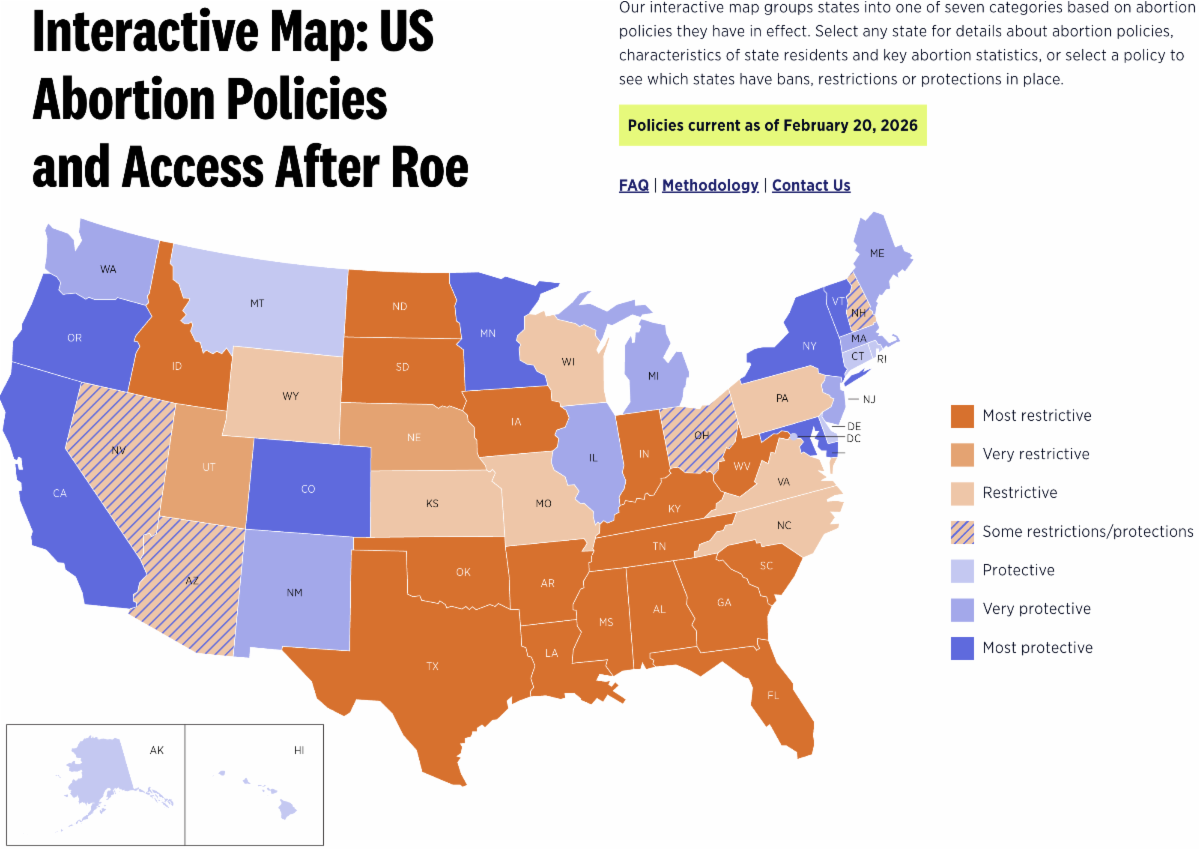
Let’s think about what this map shows. First, it changes color regularly, which feels disconcerting and unpredictable to me as a physician and is disruptive and dangerous for my patients. At the time of this writing, thirteen states are under total abortion bans. Six more restrict abortion before many people know they are pregnant. Eighteen states, with nearly one-third of the U.S. population, have implemented restrictive policies. Eight have no exception for rape or incest. Eleven have no exception for fatal fetal anomalies.
Notably, maternal mortality decreased twenty-one percent in states without bans after Dobbs but rose fifty-six percent in Texas during the first year of its ban.
I am thankful California is shaded as protective, due to our constitutional amendment and clarifying statements from Attorney General Bonta. But last month I had a patient drive eight hours across California to get care. She had always supported abortion rights, and her doctors did too—but they were not permitted by their health system to ensure hers. This is what the map cannot show. State policy is just one map. Other maps might show the location of religious or government health systems or per capita healthcare facilities.
For patients who can access care early, medication abortion offers another pathway—over sixty percent of abortions now occur this way. Mifepristone was approved by the FDA in 2000. In the twenty-five years since, hundreds of studies involving millions of patients have demonstrated its safety. Medication abortion has allowed patients to disregard the map more easily, accessing care via telehealth and mail even when the nearest clinic is hundreds of miles away. Yet the FDA is now conducting a safety review prompted not by science but by a politically motivated report that over 260 researchers publicly denounced as junk science. The review could restrict telehealth prescribing, reimpose in-person requirements, or remove the drug from the market. This is not about protecting public health. This is about redrawing the map.
States are also attempting to extend their borders. Louisiana has brought criminal charges against out-of-state physicians for prescribing abortion medication. Texas has filed civil suits resulting in six-figure fines. Governor Newsom recently rejected Louisiana's attempt to extradite a California physician and Governor Hochul has done the same in New York. Shield laws are maintaining the borders for now, but the chilling effect is real.
I am Jewish, and I try to live by a Jewish principle called Tikkun Olam—"repairing the world." It is a principle that is meant to transcend any single map, any border. Tikkun Olam is the idea that we are obligated to work toward healing what is broken. The people restricting abortion access work to dehumanize our patients and make them invisible. Our work as clinicians is the opposite: we see each person's struggles, witness their decisions made with love and grief, and offer compassion. Tikkun Olam means we tell their stories, humanize them, and hold policymakers accountable.
The Guttmacher map is very scary. Rights that I hoped would always exist have been stripped away. To maintain my hope, I try to see this as backlash—the reaction of a movement losing the long game. Average Americans as well as medical professionals understand that abortion access is a public health issue – that outlawing abortion does not eliminate it, just makes a safe process dangerous. Ballot measures protecting it have won even in the most restrictive states. I believe the map will change again. But at what cost? How many patients will have to cross hostile terrain that should never have been hostile to them? How many more families will face devastating grief and loss?
Tikkun Olam does not promise the work will be easy or quick. It promises the work is worth doing. Each of you holds influence in a map of your own making—the map of your institutions, your communities, your networks. I encourage you to use your influence, even if you don’t provide abortion care. Reproductive health is public health, and that landscape belongs to all of us.
|