RETIREMENT SECURITY MATTERS
A forum for retirement innovation information sharing focused on
states, supporters, and service providers.
|
|
Greetings! welcome! to Retirement Security Matters – where we talk about retirement readiness innovation by states, supporters, and service providers.
|
In this refreshing, thirst-quenching edition: |
-
Emergency Savings and more with Tim Flacke, Commonwealth
-
The latest Auto IRA figures and Board meeting updates from OregonSaves and Illinois Secure Choice, including new worker research from Pew Charitable Trusts
-
A new piece in the Benefits Law Journal by David Morse
-
And, Pix!
|
What the Retirement System Would Be, if it Could Be |
|
 |
Tim Flacke, Co-Founder and Executive Director, Commonwealth |
|
|
|
Imagine a world where, when you begin working you’re automatically enrolled in a retirement savings program. Regardless of the type of work you do, regardless of how young you are – assuming you’re at least 18. Imagine that your retirement account is set up with a sidecar savings account so that the first amounts you save get tucked away for an emergency – giving you peace of mind that you have a buffer against adversity. You’re now in a better position to commit to that |
|
|
|
longer term retirement savings. Of course you can always opt out of these easy pathways. But wow, what kind of world would that be?
Tim Flacke, Co-founder and CEO of Commonwealth, has been giving this a lot of thought alongside his incredible group of peers. Here’s a world he is watching begin to take shape. Quick insight below, and a deeper conversation here.
Tim, we started talking about retirement and you jumped into the deep end of the pool. Tell us more.
Well, I’ve just long felt that the retirement system can and should be playing more of a role in what is the pressing concern for most Americans in terms of their financial lives, which is much nearer term.
You mean, if we were better at emergency savings, we’d be in a better position to think about retirement savings.
Yes. We at Commonwealth think there's this enormous apparatus – the workplace retirement savings system - that has a strong policy foundation, wide recognition and acceptance by employers, a robust industry, really all the assets you want to have to come up with a systemic, comprehensive solution to a problem.
[continued below]
|
|
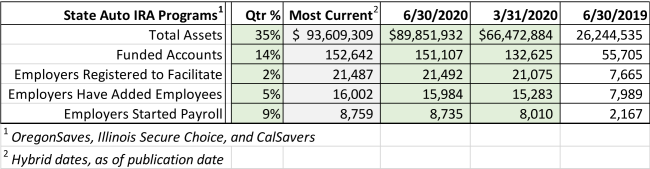
State Facilitated Retirement Programs in Rollout and Study Mode |
|
Employer facilitation continues to rise. The great shakeout of the pandemic has pulled down the absolute number of employers covered by state programs. At the same time, close attention to and work with employers is leading more of them to begin facilitating. You see those numbers increasing even since June 30. Assets and funded accounts are also up. Note that these are hybrid figures blending 6/30 data with some more recent data where it’s been reported.
And, what are your favorite states up to?
|
|
The Oregon Retirement Savings Board met on Tuesday August 4th and heard presentations on program implementation and administration as well as investment performance. As of June 30, the program had total assets of just over $58 million, more than 14,000 registered employers, and just over 70,000 funded accounts with an average funded account balance of $830. That average is up from $700 at the end of March – a nice bump for and by savers. The average monthly contribution has also risen (counterintuitively?), from $120 in March to $138 at the end of June.
On the other side of this, just over 10% of accounts that have ever had a contribution have also had a withdrawal. A bit more than half of those accounts now have zero balances. Note, some of these will be accounts where savers cleared out their balances within the first 90 days of establishment. Others are savers who stayed in the program longer but later stopped saving and took full distributions.
In his comments, Executive Director Michael Parker mentioned two areas of interest for the program including a closer look at usage by near-retirement savers, and at the idea of appending emergency savings accounts to the program.
As of June 30, 54% of program assets are invested in the OregonSaves Capital Preservation fund. This number is gradually declining as participant savings cross the $1,000 line and subsequent amounts are invested in target date funds.
|
|
The Illinois Secure Choice Board met on August 11. As with OregonSaves, the program is having success with its close employer engagement following a thoughtful pandemic-related pause. Program assets are up 76% since the period ended March 31. Funded accounts are up 13%, and facilitating employers are up by 6%. Average monthly contribution rates are also rising, up to $94 a month, from $85 in March and $70 at the program’s outset.
In a pattern similar to Oregon’s, the program experienced a two-day spike in withdrawals after 2nd quarter statements were released in early July. Withdrawals have been trending slightly upward since lows experienced in May, averaging 85% as full and 15% as partial withdrawals.
The Pew Charitable Trust’s John Scott reported on recent survey results, part of a longitudinal study of workers eligible for Illinois Secure Choice taking place at three points from Spring 2020 to Spring 2021. Results from the baseline study indicate that some workers in the state are unsure whether they're saving through the program - more noticeable among younger workers. When workers know they have opted out, they often cite that they can't afford to save. Roughly half the sample stated that they were experiencing financial insecurity. For clarity, this survey covers eligible workers who may or may not be participating in Illinois Secure Choice.
|
|
From the Benefits Law Journal, Summer Edition: Life happens. Not having enough money to cover a financial emergency impacts long term retirement savings. Washington should expand 401(k)s and other DC plans to facilitate emergency savings. It's time for a retirement & savings reboot! Check out this new piece from Editor-in-Chief David Morse of K&L Gates. |
|
... Flacke, Commonwealth, continued from above
|
|
This must seem especially timely right now.
It is. In fact, in 2019 we started some research on the state of financial insecurity in the country. Honestly, the genesis of this was the government shutdown, which seems like forever ago. In early 2019, suddenly we're reading in news stories that there are hundreds of thousands of pretty well-paid federal workers who are literally a paycheck or two away from real trouble.
In our research, Perceptions of Financial Security in America, we learned that 81% of people said - pre-COVID – that financial insecurity is a major problem. Even more interesting: the majority of folks pointed to factors beyond their individual control.
Let’s jump forward. You’re starting to see folks take action to create automated, streamlined workplace savings products.
We are. Just a few weeks ago my colleague Nick Maynard conducted a webinar with leaders from John Hancock, MassMutual, Prudential and Voya. As you’ll see, there are now at least three or four products in market from household name providers that focus on employer-based emergency savings. Here’s one. Here’s another. This is a really important shift that's happened fairly recently.
And it’s the result of concerted effort. As you know, Commonwealth is one of three organizations helping bring to life BlackRock’s Emergency Savings Initiative, an ambitious, multi-year effort to enable LMI (low and middle income) households to access and use proven emergency savings tools.
Integrating emergency savings into the workplace and into the retirement system has been a key focus of the Initiative – since some savings cushion is the foundation of financial security, with benefits for workers and their employer alike - and it’s starting to bear fruit. As one example, under the Initiative we’re working with UPS to bring emergency savings to tens of thousands of their associates, operating in tandem with their 401(k) plan.
-
Colleagues: Get some of the metrics on Black and Latinx experience, along with more details about how these accounts work, here.
Tim, thank you for such timely perspectives. Folks, connect with Tim on LinkedIn and by email. You can also follow the work of Commonwealth on social and engage with them on these channels: Twitter, LinkedIn, and Facebook.
|
|
Are people in the retirement space naturally outdoorsy? We’re starting to think so! Or perhaps we are all desperate to be somewhere other than our own back yards. |
|
|
And nothing beats a little time in the mountains, backpacking with your daughter. Here’s part of the Flacke family hiking Wilson Peak in southwestern Colorado. Tim says: It’s one of Colorado’s 58 peaks over 14,000 feet. First time for my 17-year-old climbing at this elevation -- turns out being young and in-shape is an advantage in strenuous activity!
Sometimes nature gets even closer than you want, like this guy, when we were reaching for our stapler this week:
|
|
|
|
|
He looks awfully comfortable. |
|
|
|
♥
OK, that's a wrap.
If you like this piece, please stick with us. We’ll be back in about two weeks. If you don’t like it, please unsubscribe. Comments for us? Please let us know. Want your own subscription? Request one here. All information shared is from public sources or used with express permission. |
|
Looking for another great retirement savings innovation resource? The Center for Retirement Research at Boston College develops and hosts terrific content and proprietary research related to states, financial security, social security, and more.
MEPS and PEPS: We’re speaking at an industry-focused conference alongside some experts you won’t want to miss on August 27. More info here. Hosted by Chris Carosa’s FiduciaryNews.The place to get fresh perspectives on this emerging space
|
|
|
|
|
|
|