April 1, 2026


About Us

Membership

Advocacy

Events

News


In This Issue:


  • Healthcare Hiring Under Pressure: New H-1B Costs, Delays, and Potential Relief
  • KFF Health Tracking Poll Reveals Prior Authorization a "Major Burden" Among Insured Adults
  • Reflections from the 2026 CMS Burden Reduction Conference
  • ICD-10: More Than the Basics Coding Webinar - April 8th

Healthcare Hiring Under Pressure: New H-1B Costs, Delays, and Potential Relief


By Samantha Wolfe, Partner, Holland & Hart


Healthcare employers continue to face increasing immigration-related uncertainty at a time of sustained workforce shortages. Recent legislative developments and agency actions may significantly impact your ability to recruit and retain foreign national healthcare professionals. This alert provides a targeted update on:


  1. Proposed legislation exempting certain healthcare workers from new H-1B restrictions
  2. The ongoing "benefits pause" affecting adjudictions
  3. Practical implications for healthcare workforce planning


Proposed Legislation: H-1Bs for Physicians and the Healthcare Workforce Act

A new bill introduced in Congress, titled the "H-1Bs for Physicians and the Healthcare Workforce Act," seeks to address the impact of the September 2025 Presidential Proclamation imposing additional restrictions and fees on H-1B workers.


The bill would exempt certain healthcare workers in H-1B status from the additional restrictions and fees imposed under the Presidential Proclamation, including relief from the $100,000 employer-paid fee currently required for certain H-1B workers residing abroad. Notably, the exemption is tied to the definition of "healthcare worker" under the Affordable Care Act (ACA), which covers a wide range of licensed and regulated healthcare professionals, such as:


  • Physicians
  • Registered nurses
  • Physical therapists
  • Occupational therapists
  • Other allied health professionals


This is significant because it expands relief beyond physicians to include a broad range of healthcare professionals, capturing a substantial portion of the workforce that hospitals and healthcare systems depend on to maintain operations and meet patient care demands.


If enacted, the bill would remove a significant financial barrier to hiring international healthcare workers, particularly by eliminating the substantial additional fee currently imposed on certain H-1B employees abroad. It would also help restore the viability of overseas recruitment pipelines for H-1B professionals, which many healthcare systems rely on to meet persistent staff shortages. The impact would be especially pronounced for rural and underserved healthcare systems, where access to foreign-trained providers is often critical to maintaining essential services. That said, the bill has not yet been enacted, and employers should continue to plan strategically under the current restrictions while closely monitoring development, as these constraints remain fully in effect. READ MORE

KFF Health Tracking Poll Reveals Prior Authorization a "Major Burden" Among Insured Adults


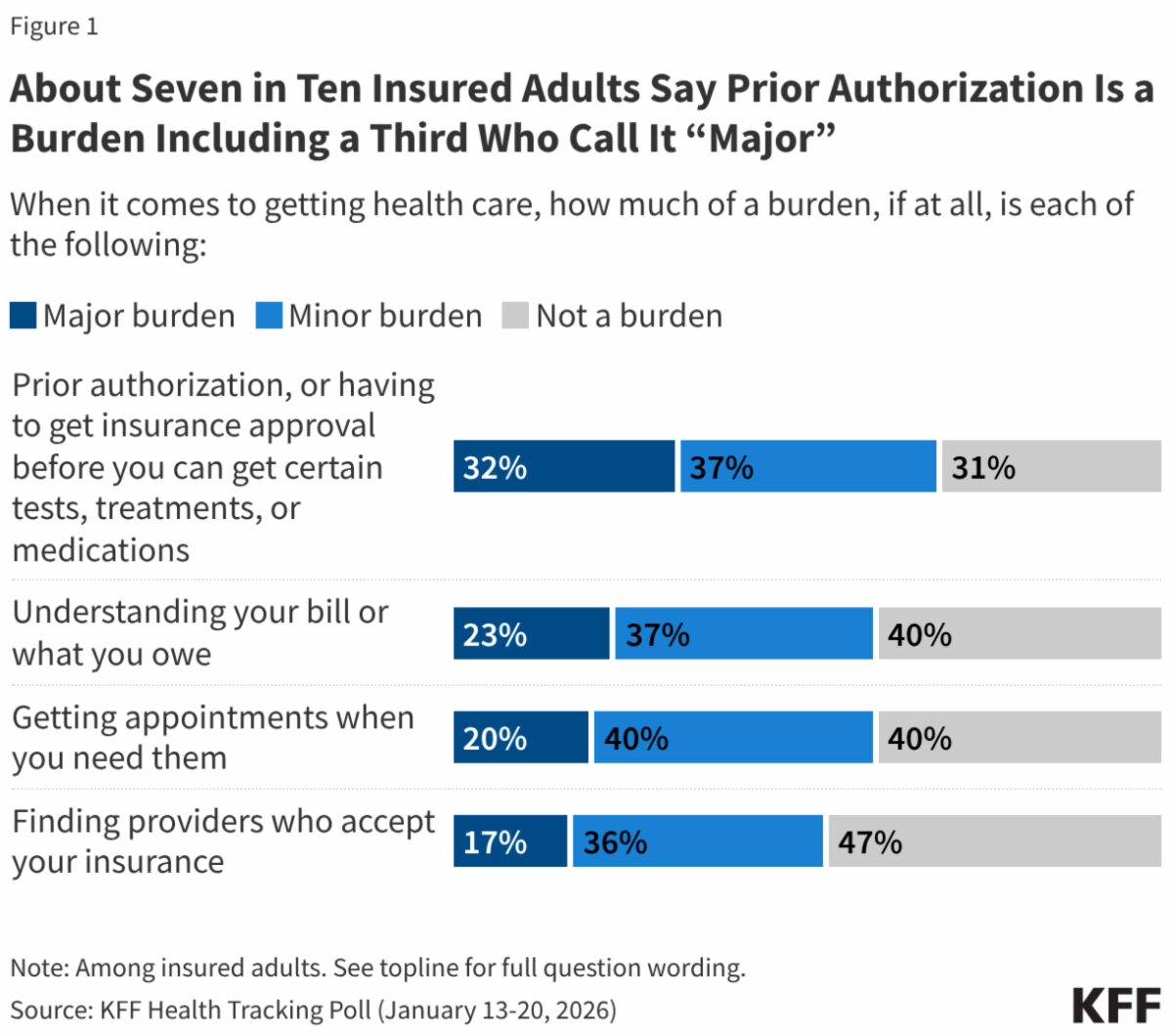
The latest KFF Health Tracking Poll shows that one in three insured people report prior authorizations as a "major burden" to receiving proper care. Additionally, nearly four in ten (37%) say the process is a "minor burden," bringing the total share of insured adults who find the process burdensome to about seven in ten (Fig. 1).


The choice of prior authorizations as the single biggest burden outside of cost is even more stark among adults with a chronic condition that requires ongoing medical treatment (about half of adults). Four in ten (39%) insured adults with a chronic condition say prior authorizations are the single biggest burden when it comes to accessing the care they need.


Overall, nearly half (47%) of insured adults say they have had a certain service, treatment, or medication either denied or delayed in the past two years, rising to nearly six in ten (57%) among those with a chronic condition. Perhaps most concerningly, one in three of those who experienced a denial or delay say the actions required by their health insurance company had a "major negative impact" on their mental health and emotional well-being as well as on their finances. One in four say the delays or denials has a "major negative impact" on their physical health.


The burden of prior authorization is no surprise to physicians, who have long contended with unilateral decisions with dubious clinical support, lack of uniformity in authorization processes, and lack of transparency. Some insurance companies even use technologies like AI and automated processing to deny patients' claims categorically.


Between 2022 and 2023, care denials increased an average of 20.2% and 55.7% for commercial and Medicare Advantage claims, respectively. Meanwhile, companies have made appealing denials so difficult that fewer than 1% of denials are disputed.


Mass denials hurt patients and the hospitals and health systems they rely on for care. A 2022 survey by the American Hospital Association found that 35% of hospitals reported losing more than half a million dollars every year to denied claims. The survey results echo findings from a U.S. Department of Health and Human Services Office of Inspector General report that raised serious concerns about beneficiary access to care and inappropriate coverage and payment denials in the Medicare Advantage program.


As previously reported, IMA supports efforts to reform prior authorization and will continue to work with legislators and regulatory agencies on this important issue.

Reflections from the 2026 CMS Burden Reduction Conference


By Jana Weis, Principal, Gill Compliance Solutions


I had the opportunity to attend the CMS Burden Reduction Conference late February bringing together clinicians, health care leaders and policymakers. This was not the usual acknowledgment that administrative burden is a problem, but more an urgency to find measurable solutions. The conversation leaned into what can actually be changed, how quickly, and how those changes could impact clinical settings.


Throughout the conference, there was broad agreement that administrative burden is no longer just a physician frustration; it is directly affecting patient access and the capacity of practices to deliver care. Delays tied to prior authorization, duplicative documentation, and inconsistent payer requirements are not abstract issues; they are showing up every day as postponed treatment, longer wait times, and increasing strain on clinicians and staff. No surprise that prior authorization dominated much of the discussion and the level of alignment around what needs to happen next. CMS is working toward modernizing its claims processing system by 2027, with the goal of enabling real-time prior authorization within the clinical workflow. The practical implication is significant as most prior authorizations could be completed while the patient is still in the office. If CMS can deliver on this, it would remove one of the most persistent sources of delay and frustration in care delivery.


Another consistent theme was variability across Medicare Advantage plans, which continues to drive unnecessary complexity. The issue is not just the volume of administrative work, but the lack of consistency in how requirements are applied. Greater standardization and clearer expectations could go a long way toward reducing redundant documentation and streamlining interactions with payers.


Technology and AI were discussed as part of the solution, but there was a clear and appropriate level of skepticism. The expectation is not for more tools, but for better ones and solutions that actually reduce manual work, integrate into existing workflows, and operate in the background. The goal throughout this and other conversations was to make the burden invisible for the patient and the clinician.


CMS has indicated that it wants continued input from the public and especially physicians, promising to consider each response. They specifically asked for feedback on two points: which administrative tasks are truly necessary to support patient care, and which policies, however well-intended, could be reduced without negatively affecting outcomes. Input can be sent to burdenreductionconference@cms.hhs.gov.


What I took away from the conference is that there is real momentum behind reducing administrative burden, but the success of these efforts will depend on how well they translate into practical changes at the point of care. If initiatives like real-time prior authorization and better payer alignment are implemented effectively, they have the potential to meaningfully improve both the physician experience and patient access. The opportunity now is to make sure those changes reflect what is actually happening in medical practices every day. I encourage IMA members to submit feedback to CMS and ensure that the real experience and needs of physicians are represented.

ICD-10: More Than the Basics


Join us on April 8th for this session from the 2026 IMA Education Series


Level up your coding skills as we delve into:


  • Causal relationship coding
  • Specifics in social determinants of health
  • Assigning the correct 7th digit alpha character and sequencing
  • Non-specific Z codes
  • And more!


Presented by: Nicole Benson, Audit Manager, BA, CPC CPMA, COSC

Date: April 8, 2026

Time: 12:15 - 1:15 (MST)


All registered attendees will earn 1 CEU credit for participation and completion of this education webinar

Facebook  LinkedIn