SESSION 2026

First Legislative

Committee Week

The Florida Legislature began its work this week leading into the 2026 Session. Below- quick highlights of health care issues discussed.

Senate Health Policy

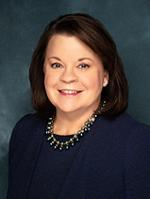
Chair: Senator Colleen Burton, R, Lakeland

Presentations on implementation of recently-enacted health care laws by AHCA & DOH.

UPDATES on the following:

  • Rural Emergency Hospitals
  • NCAP (Non-Emergency Care Access Plans)
  • TEACH Program (Training, Education & Clinicals in Health)
  • KIDCare Eligibility increase to 300% of FPL- delay
  • Frame (Medical Student Loans Repayment)
  • Cinotti Grant Program
  • Health Care innovation Loan Program
  • Telehealth Maternal Care Program
  • Infection Prevention Drug Program

House Insurance & Banking Committee

Chair: Rep Brad Yeager, R, New Port Richie

Panel Discussion on the Current and Future Use of Artificial Intelligence in the Insurance Industry.

Members of a House committee on Tuesday took an early look at what laws or regulations, if any, may need to be considered for the use of artificial intelligence by insurance companies. The House Insurance and Banking Subcommittee listened to a panel of experts on AI use by insurers, including a representative of a state consumer protection office, but mostly from trade groups for the insurance industry. The committee doesn't yet have legislation before it, but the panel discussion came as scrutiny around the country has increased over how insurers, particularly in the health insurance industry, are increasingly using AI and algorithms in decisions about claims and authorization of care. "We are aware of litigation across the country where, in the health care space, insurance companies are utilizing AI for denials and not having human review," said Rep. Hillary Cassel, R-Dania Beach, the panel's vice chair. "What law is on the books in Florida that's going to tell an insurance company that AI cannot be the sole basis for the denial of a claim whether it's health insurance, property etc.?" Insurance industry officials say generally that existing laws that cover how insurance companies must operate cover the actions of the insurer, regardless of the technology used. "If a practice is prohibited for a human to do on behalf of an insurance company, it is prohibited for AI to do," said Paul Martin, vice president of state affairs for the National Association of Mutual Insurance Companies. "We are of the mindset that any decision made or any action taken by an insurance company, be it by a person, a human, an AI platform, whatever, all of that is governed by Florida law." Cassel was among the legislators who filed legislation during the 2025 session seeking to prevent AI from being the sole element in claim denial decisions. Neither Cassel's bill (HB 1555), nor any of the others (SB 794, SB 1740, HB 1433), made it to a floor vote. None of the members on the panel committed to filing similar legislation for the coming year, though some made clear through their questioning that there remains interest in additional rules. Pluribus reported Tuesday that lawmakers in 46 states have introduced more than 250 bills dealing just with the role of AI in health care. According to the consulting firm Manatt, 27 measures have been enacted in 17 states and three more are awaiting the governor's approval in California. 

Florida Lawmakers Debate AI Regulations in Insurance Sector

Florida lawmakers discuss AI in insurance, focusing on claims, premiums, and new regulations. Learn how artificial intelligence affects policyholders.

House Health Professions & Programs Subcommittee

Chair: Rep Kaylee Ruck, R, Sebring

Implementation briefing by the Department of Health on legislation passed during the 2024 and 2025 sessions.

Updates include:

  • Stem Cell Therapy
  • Interstate Mobility
  • HIV Prevention Drugs
  • Screening & Treatment of Blood Clots

House Health Care Facilities & Systems Subcommittee

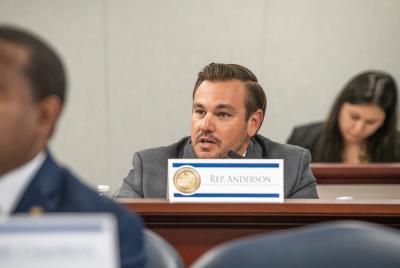
Chair: Rep Adam Anderson, R, Tarpon Springs

Implementation briefing by AHCA:

- HB 885 (2024) Coverage for Biomarker Testing (Gonzalez Pittman) and SB 2514 (2025) related to biomarker testing.

- HB 1043 (2023) Medicaid Coverage of Rapid Whole Genome Sequencing (Anderson).

Briefing on Medicaid related provisions of the federal One Big Beautiful Bill Act, Pub. L. No. 119-21, by the AHCA.

Senate Budget Committee

Chair: Senator Ed Hooper, R, Palm Harbor

Presentation on the Long-Range Financial Outlook by Amy Baker, Coordinator, Office of Economic and Demographic Research

Tax Revenues Exceed August Forecast by $127M

Florida's general-revenue collections in August surpassed expectations by 3.4%, bringing in $3.874 billion — about $127.1 million more than state economists projected, according to a report published this week by the Legislature's Office of Economic & Demographic Research.

General revenue, which funds key state priorities such as education, health care, and prisons, was boosted primarily by stronger-than-expected sales-tax receipts, which totaled $3.012 billion, or $61.4 million above forecast.

Economists from the Revenue Estimating Conference will use the latest figures to inform future budget forecasts as Florida heads into the next fiscal planning cycle.

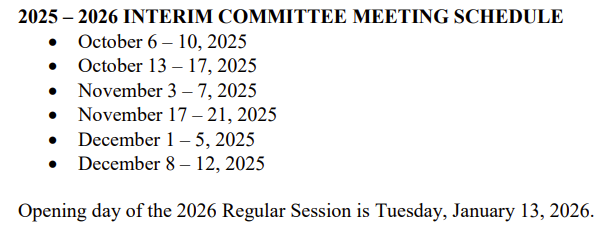
The upcoming 2026 regular legislative session is slated to begin on Jan. 13, when lawmakers will begin work on crafting the 2026-27 fiscal year budget poised to take effect on July 1. 


On the Agenda for Next Week

House Health Care Facilities & Systems Subcommittee

TUESDAY, OCT 14, 3:30

Briefing by the Office of Insurance Regulation on the health insurance market and the impact of the expiring American Rescue Plan Act-set Affordable Care Act premium tax credit.

House Civil Justice & Claims Subcommittee

Wednesday, OCT 15, 11:30

HB 6003 - Recovery of Damages for Medical Negligence Resulting in Death

Removes the statutory bar preventing adult children and parents of an adult child from recovering damages in medical negligence wrongful death cases.

  • Deletes language in s. 768.21(8), F.S., that previously prohibited adult children and certain parents from recovering damages for medical negligence resulting in death.

House Health Professions & Programs Subcommittee

Wednesday, OCT 15, 11:30

Implementation briefing on the state Medical Marijuana program by the Office of Medical Marijuana Use (OMMU), Department of Health.

IN the NEWS

Bracy Davis Sworn In as Senator After Special Election Win:

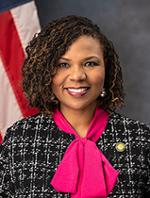
Senator LaVon Bracy Davis, an Ocoee Democrat elected in a Sept. 2 special election, was sworn into the Florida Senate on Tuesday after winning 72.6% of the vote in the special election for Orange County's Senate District 15.

Bracy Davis succeeds the late Sen. Geraldine Thompson, who died in February following complications from a surgical procedure.

Bracy Davis previously served in the Florida House from 2022 until her state Senate special election victory.

Her election brings the Senate's composition to 26 Republicans, 11 Democrats, and one unaffiliated member, with two seats still vacant following Gov. Ron DeSantis' appointments of Republican former Sens. Jay Collins as lieutenant governor and Blaise Ingoglia as state chief financial officer.

Democrat Rep. RaShon Young of Orlando won the Sept. 2 special election to fill Bracy Davis' former House District 40 seat. 

Florida Department of Health Announces Annual $50 Million Health Care Innovation Fund Revolving Loan Program


State Launches $50M Health Innovation Loan Program: The state Department of Health last week rolled out its Florida Health Care Innovation Loan Program, a new initiative to boost inventive solutions across the state's health care system. The program, backed by $50 million annually in state funding, aims to finance proposals that improve care delivery, reduce costs, strengthen the health care workforce, expand access, and enhance patient outcomes. The initiative, created under 2024's SB 7018, which was part of a priority legislative package called the "Live Healthy" initiative, established the Health Care Innovation Council and enshrined the loan program in state law. Under the legislation, the state will appropriate $50 million per year through 2034-35, creating a revolving loan fund that supports eligible health care entities implementing innovative models and technologies. The Health Care Innovation Council, chaired by the lieutenant governor and composed of health, technology, finance, and advocacy experts, will review applications and advise on project prioritization. Eligible applicants include entities licensed by the Agency for Health Care Administration — such as hospitals, nursing homes, ambulatory surgery centers — and educational or clinical training providers collaborating with these facilities. The program gives priority to rural hospitals and nonprofit Medicaid-serving entities, especially those in medically underserved regions.