Michigan State University Extension
Blueberry Newsletter - Blueberry Bites
| |
|
Horticulture Update
A lack of water at high temperatures will limit berry size and yield. In some areas, it may be useful to use overhead irrigation to cool plantings; however, remember that follow-up fungicide sprays will be needed to prevent fruit rot development.
Although the fall planting season is still months ahead, I want to point out a few important results from our replanting survey that will be elaborated on in more detail later this summer and fall. Replanted fields that have struggled to grow tend to have a few horticultural issues, including a higher pH (~5.2), lower wood chip levels, and typically a single drip line (rarely two) compared to healthy replanted fields. Neither of these points are the sole cause of replanting issues, and there are others we will be exploring, but certainly each contributes and highlights the importance of the initial horticulture set up to the success of “replanted” plantings.
| | |
Insect Update
With the cooler mornings, rainfall, and increasing abundance of wild fruiting plants, conditions have become much more suitable for SWD populations to grow. Our sampling of traps and ripe wild host plants indicates that this pest is increasing rapidly in southern Michigan. Blueberry growers managing fields during harvest-time should be protecting their fruit from SWD, in addition to the blueberry maggot and other insects that might be active at this time. Regular checking of traps and blueberry fruit can be done to make informed decisions on how well your spray program is working. Use the guide in MSU’s Fruit Pest Management Guide to select effective insecticides, and rotate chemical classes to minimize the risk of resistance.
| | |
Pathogen Update
Rain this week will drive fruit rot diseases (I.e. Anthracnose Fruit Rot, Alternaria Fruit Rot and Botrytis Fruit Rot). Preventative fungicide applications can play a crucial role at this moment (e.g. FRAC codes 3, 7, 9, 11, 12, 17 and 29). Please be mindful of preharvest interval on various products. Also timing irrigation practices to coincide with natural dew formation is important. During harvest, remember to harvest fruit quickly and ideally under dry conditions. Also, once fruit has been cooled, ensure that it remains cool during shipment/delivery. Sharp rises in temperature will cause significant moisture to form on fruit.
Finally, we have been observing more stress in newer plantings, it is important to remember to keep these young plantings well-watered and to look for signs of shoot blight. Fungal pathogens like Phomopsis have been isolated from these bushes and in some cases these young bushes die. If you have a question about stem blights, it is best to submit a sample of MSU Plant & Pest Diagnostics.
| | |
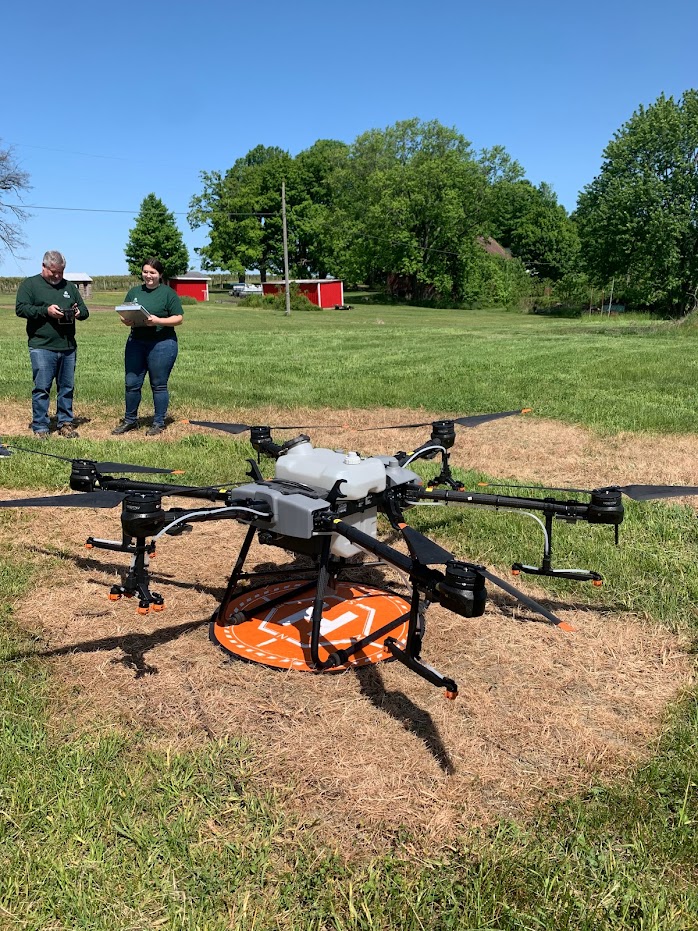
Let us fly a drone like this on your farm! For science! | |
We Need Your Help!
We are looking for a grower to partner with us for a drone project. We received funding to test out drone spraying technology in blueberries this summer. If you have two different types of sprayers, a few continuous acres of blueberries we can spray, and someone to help us operate the ground sprayers for a day in the next two months, please send an email to Cheyenne. If you have any questions about the project feel free to reach out to Cheyenne as well.
| | |
Don't Guess, Test!
Growers have been submitting samples to the diagnostic clinic that range from stem blights to viral symptoms. Remember the Michigan Blueberry Commission has a program to subsidize any testing through MSU Plant & Pest Diagnostics. Click below to get more information about how to submit a sample.
| |
Pictured here is a blueberry with blueberry mosaic virus. While this virus test is still in the works, many other virus tests are able to be screened by the lab! | | |
MSU is an affirmative-action, equal-opportunity employer, committed to achieving excellence through a diverse workforce and inclusive culture that encourages all people to reach their full potential. Michigan State University Extension programs and materials are open to all without regard to race, color, national origin, gender, gender identity, religion, age, height, weight, disability, political beliefs, sexual orientation, marital status, family status or veteran status. | | | | |