|
|
|
POLICY & ADVOCACY UPDATE
Issue #29, 18 September 2024
| | | |
- STRA Bill introduction results in backlash
- AA welcomes new runway at Melbourne airport
- Proposed extension of NABERs rating disclosure to hotels
- Mandatory climate-reporting passed by parliament
- Trends in hospitality occupations
- ANZSCO consultation concludes
- Overseas arrivals for July 2024
| |
STRA Bill introduction results in backlash
As reported in the last update, the Bill to enact the 7.5% Short Term Rental Accommodation (STRA) levy in Victoria was introduced into Parliament this month. The introduction of the Bill, which affirmed the government's decision to not extend the levy to commercial accommodation, has resulted in strong statements in response from tourism stakeholders as well as the Victorian Opposition about the potential impact on tourism, particularly in Victorian regional areas.
Although it is a positive outcome of our advocacy that the levy does not cover commercial accommodation, a levy to address the growth in STRA is also not part of the AA policy agenda. It is ironic, therefore, in the current debate that the one organisation that did support a levy, being Air BNB itself, is the most vocal opponent of the Bill. Their initial support was conditional on the levy applying to all accommodation, which would have been even worse for Victorian tourism. We have consistently said to all governments (see our STRA policy) that a levy on any accommodation is not only bad for tourism but will not achieve the housing outcomes that governments and the public want. More impactful on converting STRA to long term rentals in Victoria will be the use of the additional powers that will be given to local government to cap the number of days. Local councils will also be given the power to limit the number of registered STRA properties, but it is to be hoped they do not take this option as it will increase the attractiveness of properties who are within the limit to stay as STRA. A cap on days will be much more effective in changing the business case as it will reduce the overall rental income earned by property owners and increase the likelihood they would convert to long term rental.
Our opposition to any levy and the evidence of what works is not only relevant to Victoria but all other States and Territories yet to finalise their policy. NSW is the likely next jurisdiction to seek to implement a levy which would be a very poor outcome.
| | |
|
AA welcomes new runway at Melbourne airport
Last Friday, Accommodation Australia welcomed news that Melbourne Airport’s long-awaited third runway has been cleared for construction by the Federal Government. The key infrastructure project, scheduled to commence construction in 2025 and open in 2031, could not come at a better time for Melbourne. As AA Victoria manager Dougal Hollis noted, “Melbourne is set to become Australia’s largest city by 2031, with just over 6 million people, and Melbourne Airport’s annual passenger numbers are expected to grow from 36 million currently to 76 million by 2042.” A third parallel runway configuration will enable simultaneous take offs and landings, increasing flight reliability and reducing delays. In announcing the decision, the Federal Minister for Infrastructure, Transport and Regional Development Catherine King imposed conditions on Melbourne Airport including a legally-enforceable commitment to restore the length of the east-west runway to maximise the opportunities for noise sharing and Implementation of a noise amelioration program to communities most impacted. A full copy of the AA media release can be seen here.
| |
|
Proposed extension of NABERs rating disclosure to hotels
The Department of Climate Change, Energy, Environment and Water has been undertaking consultation on extending the current Commercial Building Disclosure Program using the NABERs rating system to cover buildings such as hotels. Further information on the proposal can be found here. In the same way as the NABERs rating can impact government decisions to rent space, the concern in this extension is that it could impact government procurement decisions for accommodation. As part of the consultation process, AHA and AA have made a joint submission to follow up recent meetings on the issue. Our submission can be viewed here.
| |
|
Mandatory climate-reporting passed by parliament
On 9 September 2024 a Bill to enact mandatory climate-reporting for large and medium sized companies was passed by both houses of the federal parliament. Entities that are required to prepare and lodge annual reports under the Corporations Act will be required to disclose information about climate-related risks and opportunities. The requirements will be phased in according to three categories based on size, with the Top 200 largest companies needing to report in their annual report relating to the 2024-25 financial year. Businesses with revenue over $250 m ($500 m group) or 250 employees will need to incorporate the new standards into their 2026-27 reports, and businesses over 100 employees the year after. The new reporting requirements are broadly in line with standards released by the IFRS Foundation’s International Sustainability Standards Board (ISSB), including disclosures on climate-related risks and opportunities, and on greenhouse gas emissions across the value chain. For more information see the Treasury policy statement issued earlier this year.
| |
Trends in hospitality occupations
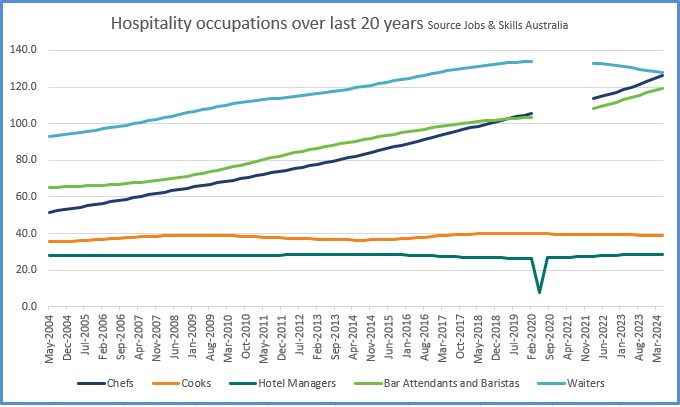
In the last Advocacy Update, I summarised the latest employment data released by Jobs & Skills Australia which reviewed long term trends by taking out the seasonal and short-term influences, with the exception of the dramatic influence of COVID 19. The graph below looks at the equivalent data for the five key hospitality occupations, and shows some interesting trends:
- main growth has been in bar attendants & baristas, waiters and chefs.
- hotel managers have shown only modest growth, indicating that there is a higher proportion of front-line staff to managers in 2024 compared to 20 years ago.
- There has only been modest growth with those that call themselves cook, which implies that even though there has been very little growth in apprenticeship completions, more people are calling themselves chef even though they may not have completed their full qualification.
| |
 | |
ANZSCO consultations have concluded
While on the subject of occupations in hospitality, over the last few months AA have continued to actively engage with the Australian Bureau of Statistics as they undertake their review of hospitality occupations in ANZSCO. As mentioned previously, how ANZSCO represents our industry occupations affects how employment is summarised, access to training support such as apprenticeship incentives and very directly, access by members to sponsorship of migrants. We have also worked with the Jobs & Skills Council, SaCSA, on a joint industry submission to the ABS. Our meetings with the ABS have indicated that we are likely to be successful in achieving a range of changes we have advocated for, including new occupations for sommelier, bar supervisor and hopefully some of the other supervisory positions. The hotel general manager will also be separately referred to in the corporate general manager skill level 1 code. Our advocacy would not have been successful without the great support from members, who turned around data requests quickly and effectively. The final result of the review will not be announced for several months.
| |
|
Overseas arrivals for July
The latest statistics from the ABS for July 2024 show that there were 658,970 short-term visitor arrivals in Australia, an increase of only 5.4% compared to July 2023 and 16.6% below pre-COVID July 2019 arrivals. New Zealand was the largest source country, accounting for 18% of all visitor arrivals, followed by China and the US. The modest 5.4% rise was far outpaced by the 15.1% increase in the return of 1.1 million Australians returning from their short-term trip.
In July 2024 there were 132,970 international student arrivals to Australia, an increase of 1,330 students compared with the corresponding month of the previous year. The number of student arrivals in July 2024 was 7.6% lower than the pre-COVID levels in July 2019.
| |
|
Drop me an email at policy@accommodationaustralia.org or give me a call on 0418 277 919 if you have any national policy issue that you think AA should be following up. If you know an AA member who is not receiving this advocacy report but wants to, then encourage them to email me and we can add them to the distribution list.
Kind Regards
Jenny Lambert OAM
National Policy & Research Advisor
Accommodation Australia
| | | | |




