The Outreach Vision Spring 2023 | |
In this issue we mark and celebrate Mental Health Awareness month because the more we normalize mental health care, reduce stigma, and expand treatment options for people with substance use and other co-occurring disorders, the healthier individuals, communities, and our society will be. And that’s definitely something worth celebrating. | | |
A Message from our President | |
DEBBIE PANTIN President/CEO
Outreach Development Corporation
| |
|
This year during Mental Health Awareness Month, our colleagues at Mental Health America are encouraging people to “look around and look within.” This call to action is important because we need to take in all the different factors that come into play with a person’s mental health – such as their family’s history of substance use and mental health issues, their genetics, where they live, if they have a stable source of income, among other factors and social determinants of health.
We need to ask our clients to look around and within and consider how the environment is affecting their mental health: Does their surroundings impact how they feel? If so, how do those feelings in turn impact their mental health? The good news is that we can help our clients take steps to change their environment and, in doing so, help them take care of their mental health.
For example, having safe, stable, and healthy living conditions can set the foundation for achieving and maintaining good mental health. For many people, not having a stable home base to consistently return to can leave them feeling distressed, disconnected, and isolated. Secure and safe housing allows people to feel settled in their lives, develop routines, and forge deeper connections to family, friends, and their communities, all of which is beneficial for good mental health. Wherever someone calls “home” that place should be one that offers feelings of calm, comfort, and support.
| |
|
At Outreach, our outpatient, residential and mobile programs offer judgement free, trauma-informed, evidence-based, safe, and supportive environments for people - adolescents to adults - who are in treatment to address substance misuse and other co-occurring disorders, and who are working toward transitioning back into their communities. Our dedicated residential treatment programs for young people (12-18 years old) allow adolescents to focus full-time on their recovery in structured, caring, and supportive living environments, where they receive intensive on-site treatment, education, and family supports and gain the tools and skills they need to live healthy, sustainable drug- and alcohol-free lives, return to school, and rejoin their families.
At Outreach, we are dedicated to providing person-centered care to help each individual we work with –build a healthy life. If you or someone you know is struggling with their mental health, please contact us 24/7 at our toll-free number for a free and confidential consultation: 1-833-OPINYORG (1-833-674-6967).
I also encourage you this Mental Health Awareness Month, and every month, to “look around and look within” yourself and take care of your mental health. You are important. Help is always available. All of us at Outreach are always here to support you and your loved ones.
In Good Health,
| |
|
President/CEO
Outreach Development Corporation
| | |
|
Look Around,
Look Within:
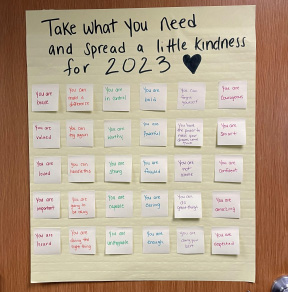
| The team at Outreach’s Adolescent Outpatient Clinic at Brentwood kicked off 2023 on a “kind” note. | |
|
Your surroundings say a lot about your mental health:
Thoughts and ideas from our friends and colleagues at the Mental Health Association
Take a moment to consider your surroundings. Do you feel safe? Do you have access to health care and grocery stores? Does your home support you, both physically and mentally?
This Mental Health Awareness month, challenge yourself to look at your world and how different factors can affect your mental health.
Where a person is born, lives, learns, works, plays, and gathers, as well as their economic stability and social connections, are part of what is called “Social Determinants of Health” (SDOH). The more these factors work in your favor means you are more likely to have better mental well-being. However, when it seems like the world is working against you, your mental health can suffer.
| |
|
While many parts of your environment can be out of your control, there are steps you can take to change your space and protect your well-being.
• Work toward securing safe and stable housing: This can be challenging due to finances, age, and other reasons, but there are a few things you can try, such as reaching out to state/local agencies to secure housing, removing safety hazards in the home, or finding another space (such as a community center or friend’s home) where you can get the comfort you are missing at home.
• Focus on your home: Consider keeping your space tidy, sleep-friendly, and well-ventilated. Surround yourself with items that help you feel calm and positive.
• Create bonds with your neighborhood and community: Get to know the people living around you, join or start neighbors-helping-neighbors groups, and support local businesses to challenge gentrification.
• Connect with nature: Hike in a forest, sit in a city park, bring a plant inside, or keep the shades open to absorb natural light.
If you’re taking steps to improve your surroundings but are still struggling with your mental health, you may be experiencing signs of a mental health condition. Get a free, private screening at a local agency, clinic or hospital, to help you figure out what is going on and determine next steps.
| |
|
Countering Stigma – Speaking as If
Our Words Matter
| |
|
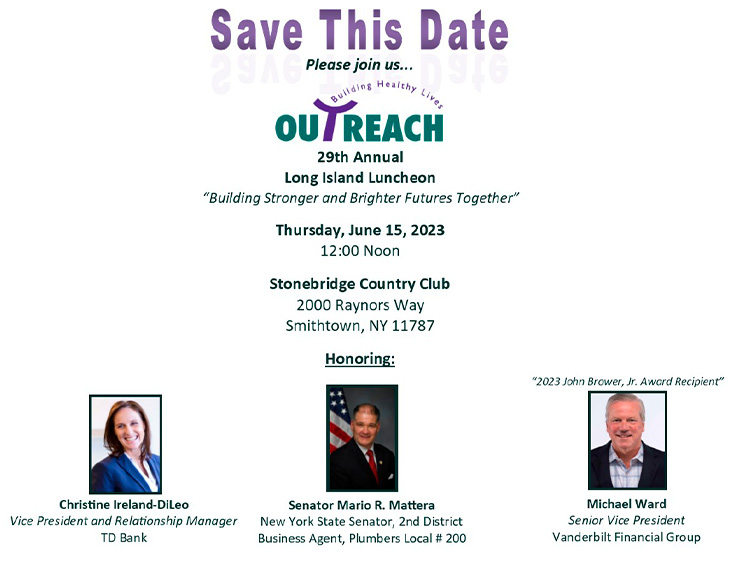
Outreach to host
29th Annual Long Island Luncheon
| |
Treating Teens with Co-Occurring Disorders: | |
No Longer the Exception, Perhaps the Rule | | |
|
It was not long ago that the treatment options for teenagers were determined by whether or not their primary diagnosis was mental health or substance use. Sadly, many teenagers and families were denied to the ability to choose their treatment options because of a diagnosis. Today, quality adolescent providers have created highly specialized and person-centered treatment approaches, which address teenagers’ substance use and mental health in a concurrently. A “no wrong door approach” has emerged as the gold standard of care.
Effective and comprehensive treatment for teenagers with co-occurring disorders (COD) include some important considerations. First is the importance of a comprehensive assessment and diagnosis by clinicians well versed in adolescent development, mental health, and substance use. It can be difficult to determine if a teen’s moodiness is due to a mental health issue, substance use or just part of the developmental changes associated with adolescence. Once this is properly diagnosed, an individualized course of treatment and goals can be established and captured in a comprehensive treatment plan.
| |
|
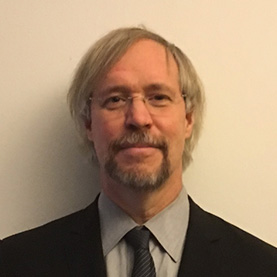
John Venza, LCSW-R, LMHC
Vice President
Adolescent and Residential Services
| |
|
Treatment whether it’s for 30 days or six months, is considered “an episode.” After the treatment episode, many adolescents return home. This simple fact necessitates a family-centered treatment approach that provides services for the entire family on a small, pillared treatment track. By doing this, the provider can improve the health of the family system to support sustained recovery in the adolescent.
The program design of an integrated or multi-disciplinary team (MDT) is paramount in addressing a teen with a COD. The medical doctor, psychiatrist, nursing staff and licensed clinicians all need to collaborate and conference with an adolescent regularly given the risk factors involved. This is achieved most efficiently by having all these disciplines on one team and in the same building which provides the highest level of continuity in the care of the teenager.
In addition to a diverse and skilled MDT, clinical services for youth with a COD must be eclectic. While evidenced-based talk therapies are a central part of the treatment, they cannot be the only services provided. Treatment for teenagers with a COD is challenging, so it is incumbent on the clinical team to ensure the challenges are tempered with fun. Adolescents are still largely kids at heart and live to have fun. This may be best achieved by infusing the program with experiential, multi-modal therapies including, drumming circles, creative art therapy, yoga, meditation, music therapy, equine and exercise therapy, just to name few. The diversity of these therapies is essential given the range of cathartic experiences a teenager can have. Depending on their specific mental health challenges some teens may struggle with traditional talk therapies, making other fun and innovative approaches critical elements of their care.
At a time when adolescents are entering treatment far more progressed in their mental health and substance use disorder symptomology, providers must think outside the box. By being creative and providing high quality and fun treatment experiences, engagement and retention of teens in treatment can and will improve. By stabilizing and improving an adolescent’s mental health while addressing their recovery from substances, a young person with COD will have a solid foundation to build on as they move forward on their recovery journey.
| | |
Renewing Our Focus on Quality | |
Kelsey Silver, LMFT
Assistant Vice President of Quality and Data Analytics
| |
|
While quality of care has always been central to the Outreach mission, using data analytics is also critical to ensure continuous improvement has been integrated into our everyday practice. By utilizing evidence-based practices integrated into our clinical records, and visualizing a client’s improvement through analytics, our clinicians are well-equipped to serve an increasingly complex population. Previously, information about a client and the population served lived deep within the client’s chart, requiring time to access and potentially impacted client care.
Since 2021, the prevalence of co-occurring diagnoses (COD) present within the population Outreach serves has increased over 10%, with over a third of our population seeking support for both mental health and substance use disorders simultaneously. By moving towards an “at-your-fingertips” approach to our Electronic Health Record (EHR), Outreach is committed to ensuring clinicians have information about the client when they need it, and when it is most actionable to positively impact client care. This includes our continued focus on co-occurring diagnoses and how we may best treat them to uphold the quality of care our community expects.
| |
|
Leave No Man or Woman Behind:
Outreach’s Commitment to Serving Veterans
| | |
|
“Leave no man or woman behind.” Variations of this quote are found in the Soldier’s Creed for all branches of service and imbedded in our programs and services for veterans here at Outreach. We are committed to ensuring that every veteran who comes through our doors knows that we are here to support them through their recovery journey and transition back to civilian life. | |
|
Men and women who have served this country and are in need of drug and alcohol treatment deserve a specialized treatment approach that is uniquely designed for them. Their experiences, communication styles, and distinctive set of traumas, call for counselors who can speak their language. At Outreach, our dedicated staff of treatment professionals include those who are veterans themselves. Their shared experience lends credibility for veterans, and helps them feel comfortable in their treatment environment, and therefore increases the likelihood that they will complete their treatment program.
As a behavioral health provider, Outreach is committed to using the latest evidence-based practices in our services for veterans, including Seeking Safety which focuses on PTSD, Strength of the Struggle, Trauma-Informed Care and more. Our Outpatient program for veterans offers both individual and group therapy sessions, as well as case management and vocational services, where we address drug use, co-occurring issues, and life skills deficits. The focus is not just on past traumas but also on grounding and identifying coping skills on how to heal from those traumas.
Our Outpatient program houses a veterans’ lounge which provides a quiet and supervised retreat where veterans can search for jobs, and socialize and connect with other veterans. Most of the group sessions for veterans are held in the veterans’ lounge, and discussions range from relapse prevention, to mindfulness, to emotional regulation, grief and loss, and creative arts therapy.
Outreach recently welcomed a new fulltime Veterans’ Counselor, Danielle “Dani” Koulermos, to help facilitate groups and administer art therapy. According to our Outpatient Services Director Thomas Olivo, “We felt Dani was our missing link. We are thrilled to have her onboard and deepen the work with our clients who are veterans.”
Dani Koulermos shared that oftentimes after discussing their feelings and past trauma in groups many veterans find it hard to identify the language to explain why they feel a certain way. Art offers a way to express something that has happened to them or is happening in the moment, without having to use words and share too much about their past. “Clinical art therapy is a growing modality within the mental health umbrella which services allow people to create rather than speak,” says Koulermos. “Art can be anonymous so whether the barrier is shame, confusion, memory loss or just lack of words to describe what we have lived through. Art making allows the vessel to process trauma with a clinician in a safe space without using triggering details of storytelling.” Art therapists who practice trauma informed care can help direct veterans suffering from PTSD graduate to post traumatic growth by using psychoeducation to help teach and learn about their emotional triggers, creating their own personal narrative, and encouraging acceptance by being open and honest about their recovery. Art therapy is very versatile because you can choose so many different mediums like music in song writing, passages from books, motivational speeches on audiobooks as well as the traditional tools like drawing, painting, and sculpture. Utilizing art therapy, the clients have the autonomy to choose what they would like to use and what they feel comfortable exploring. For our clients at Outreach, and veterans alike, choice is something that they have not always had throughout their lives, whether it be in the military following orders, being incarcerated, or addicted to substances itself. So having the choice over which medium to use or what they design is paramount in their recovery to make good decisions and trying new things.”
Veterans can also take part in Outreach’s new 16-bed intensive residential treatment program which is centered around the evidence-based Rehabilitation to Care practice. The program, which lasts approximately 28 days (though the length of stay is ultimately based on the individual’s needs) offers the skills necessary to establish sobriety. Upon completion of the program, veterans are referred to the next appropriate level of care, either residential living or outpatient treatment. All options are explored, discussed, and determined in collaboration with the client to ensure that they are fully engaged in the continuation of their recovery. Clients also have access to veteran support groups and community resources through Outreach. These services include referrals to agencies that can help them overturn an dishonorable discharge status in order to be eligible for military benefits.
| |
|
Tom Olivo and colleagues laying wreaths
at LI National Cemetery.
| |
At Outreach, we are constantly seeking to learn more about the resources and supports available for our veterans. Jessica Shuren, Director of Outreach’s Men’s Residence and a veteran herself, chairs the Veterans Committee of the New York State Alcoholism and Substance Abuse Providers (NYSASPAP). This Committee seeks to enhance the quality of services that veterans receive through the prevention, treatment, and recovery network. This includes veterans who have less than honorable or dishonorable discharges because they as well as believe that regardless of discharge status, substance misuse is an issue that must be treated with the appropriate benefits and services. | |
|
Recently, New York State instituted a Change to the Military Discharge Status due to former drug use or even discharge due to sexual orientation as highlighted in the federal government’s Don’t Ask Don’t Tell policy.
Our staff also seeks out ways in which to give back to the veteran’s community in meaningful ways. One of those ways through our annual participation in Wreaths Across America. For the past 4 years staff have participated in wreath laying ceremonies at veteran cemeteries in Long Island to show our support in memory of our fallen soldiers.
|
|
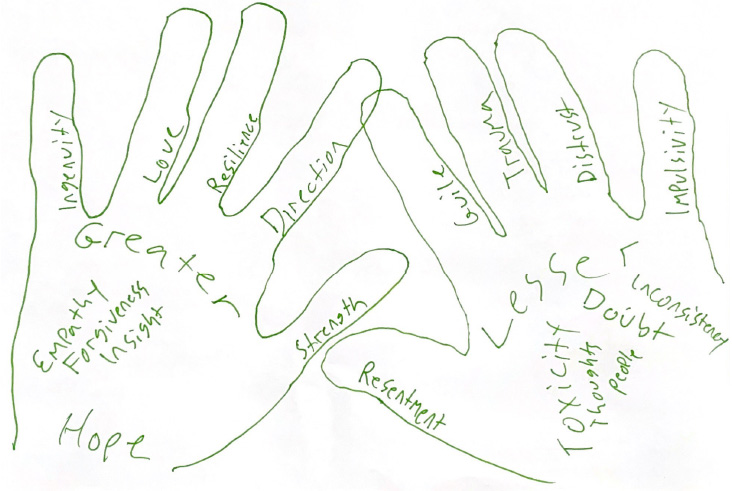
Counselor and Art Therapist Dani Koulermos shares:
Below is an example from our Veterans Grief and Loss group. “A hand to hold on to, a hand to let go,” says Koulermos, “is an art directive I used to show that although loss is the main catalyst of grief, we always learn or gain something from every experience. There is a positive and negative from every situation. There are things we would like to keep and things we would like to get rid of in different areas of our lives as well, so the veterans had a choice on what they were going to write about. The veterans traced their hands or asked for a helping hand to trace and then wrote inside each of the outlines.”
| |
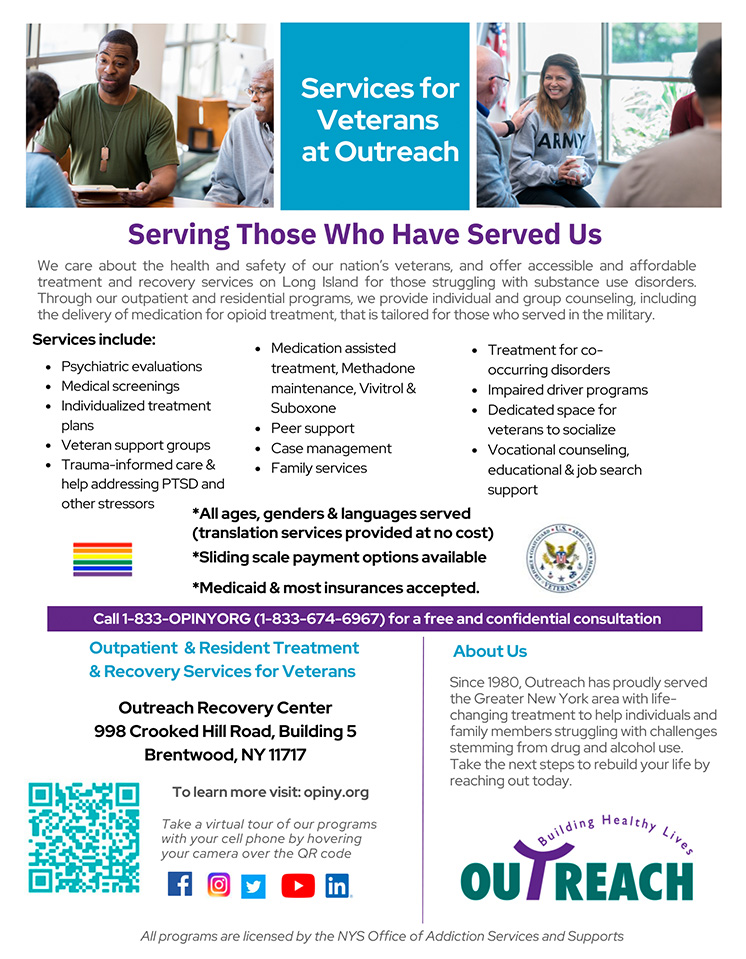
To learn more about how Outreach is serving those who served us, please see our Veterans Services flyer below. If you or someone you know is a veteran in need of treatment and support services, contact us 24/7 at our toll-free number at 1-833-OPINYORG / 1-833-674-6967). | |
|
Outreach CEO Named by Crain’s
One of 2023’s Notable Black Leaders
| |
|
Each year Crain’s Business New York recognizes 50 Black New Yorkers who are
exemplars of leadership in their offices and in their communities.
Outreach is thrilled and honored that our very own President and CEO Debra Pantin
was named as one of Crain’s 2023 Notable Black Leaders. To qualify, candidates
must self-identify as Black and have held a leadership position in the New York
metropolitan area for at least five years. The Black professionals who make up
this year’s list represent a broad range of backgrounds, occupations,
and leadership styles. Below Debbie Pantin shares, in her own words,
what this recognition means to her, her approach to leadership, and how
she is inspired to mentor the next generation of Black leaders.
| | |
|
IN HER OWN WORDS
Thoughts on Leadership
| Debra Pantin, President and CEO | |
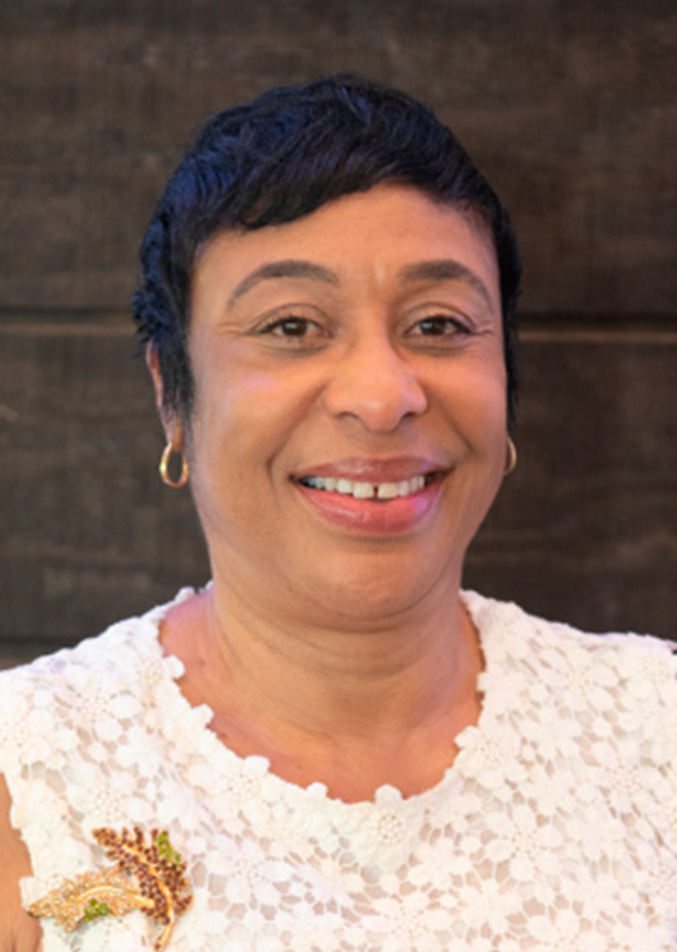
I am truly honored to be a part of Crain’s 2023 Notable Black Leaders. For me it’s all about doing the work. While the opportunity to be recognized feels good, it also, quite frankly, feels a little weird. I approach leadership through service, and this is just a natural part of what I do. | |
|
My priority is, and has always been my staff, to support them and keep communication open and transparent. To be an effective leader, especially one of color, you must be tuned into your staff. People need to feel that you are involved and that you care about them. People in our field don’t always feel that. I think it is so important to be respectful of others. I try to inspire respect.
As a woman of color in this field, I have worked with a variety of leaders and learned a lot from everyone. Throughout my career, it has been important for me to bond with my sisterhood, and brotherhood too for that matter, and to learn from and connect with other Black leaders; because our experience is different, especially for those of us who are C-suite executives. The sisterhood connections I’ve made have been with women leaders across race and ethnic groups. We play an important role for each other and for women of color who are up and coming. It is important that we support each other along each step of the way.
For me, mentoring is vital to helping people get to where they need to go. This can be done by taking the time for a talk, a meal, or, meeting up informally to listen and give advice. In a true mentorship relationship, you are learning a lot from each other; it’s a give and take that goes both ways. It is also important to mentor people who look like us. I especially enjoy mentoring young people; their perspectives are always so fresh and different. Hearing from them helps me refine my leadership approaches. I also love sitting down and talking to people who are just interested in our field.
I think the way to address the workforce issues our field is facing is through mentorship. There must be a way of steering and guiding people, especially people of color, into leadership roles. A lot of that has to do with instilling confidence. There are a lot of passionate, smart, and dedicated individuals out there, but the ability to cultivate their leadership is missing. This is where education needs to be coupled with leadership opportunities. A lot of people of color in our field don’t have the same starting point as others do to get to a master’s level degree.
I am part of a working group with ASAPNYS and the Coalition for Behavioral Health that is looking into how to identify and cultivate leaders of color in the behavioral health space. Thanks to a two-year start up grant from OASAS, OMH and a private foundation, we kicked off this initiative in March 2023. The idea for this project came about when we started talking about the sustainability of our field. As we were talking about workforce on a broader level, we felt it was important to focus on Justice, Equity, Diversity, and Inclusion issues. We’re in the planning process now, working with leaders across the field, including CEO and lead program positions at organizations throughout New York State. We are developing a (to be named) leadership institute that will provide training curriculum and mentorship for people of color. Individuals will be nominated and sponsored by organizations. The leaders of the sponsoring organizations will take part in the institute alongside their mentee to ensure that they learn and grow together. Our plan is to start with 25 individuals, and then enroll more participants each year.
Outreach has long been committed to equity work; this is not something new here. Cultural diversity is part of our organizational values, and we instill that in our staff starting at orientation through our ongoing staff development trainings. It has been exciting to build on this foundation. Right now, we are focused on ensuring that all the aspects of the National CLAS standards are integrated into everything we do here at the agency.
As black leaders, it is critical that we approach the work through the lens of imbalance due to systematic racism in our society. We need to steer the ship forward in a more balanced way and always through a justice and equity lens.
I am honored to be among those nominated and recognized for Crain’s list of 2023 Notable Black Leaders. Now that we have this recognition it is even more important that all of us on the list continue to do this important work and inspire and encourage others to join us.
| |
|
Staff Accolades, Transitions
& Promotions
| |
|
After over three decades at Outreach, our Senior Vice President and Chief Operating Officer Christine Casiano has stepped down. Christine joined Outreach in 1992 as a grant researcher working on a NIDA project, and steadily grew within the ranks of the agency. Most notably, Christine is credited with establishing Outreach’s first Human Resources Department. Her efforts established the initial organization and structure to the department while providing pathways of communication for managers and staff. Afterward, she shifted focus to Outreach Training Institute (OTI) for which she had already developed a familiarity through the numerous grants she helped secure over the years. One of the grants – the Department of Health’s retraining grant – helped kickstart the growth of the OTI.
Christine was also instrumental in successfully leading the agency program operations throughout the COVID-19 pandemic, providing onsite leadership, managing shifting protocols and requirements, making fast paced critical decisions to help ensure the safety of clients and staff while providing critically needed services.
| |
|
Full Scholarships Now Available
For Casac Training For Suffolk County Residents
| |
|
Applications are now being accepted for the Suffolk County Department of Health scholarships for Suffolk County residents who wish to obtain CASAC certification at the Outreach Training Institute (OTI). This funding is made possible out of the first phase of the Opioid Settlement funds in Suffolk County.
The Suffolk County Workforce Development Scholarships (SCWDS) will be targeted at individuals seeking to pursue their CASAC certification and who have demonstrated an interest and passion for helping people in the Suffolk County community. These individuals might be those who work in Office of Addiction Services and Supports (OASAS) and Office of Mental Health (OMH) programs, human and social service agencies, or at health facilities. They may have been involved in volunteer work in their communities and/or religious, civic, or cultural institutions. They could be individuals in recovery who provide peer-to-peer support to others.
Two programs will be funded, the full 350-clock hour program needed to obtain CASAC certification and a 135-hour program for master’s level social workers, mental health counselors, marriage and family therapists, creative arts therapists, and psychoanalysts.
| |
STAFF PROMOTIONS AND TRANSITIONS | | | | |