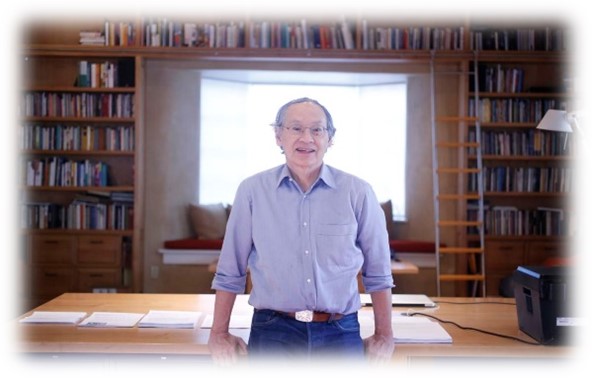
One of the enjoyments real bookstores provide that Amazon’s “Others Who Bought This Book Also Bought” suggestions cannot supply are serendipitous discoveries. In a previous Book Notes, I noted discovering the poems of Pauli Murray while browsing in a bookstore in South Carolina; today I want to share with you Arthur Sze (pronounced Z-ee), who I found while rummaging in a Cleveland area bookstore. That I only recently discovered Sze is on me, not him, for he is one of the most accomplished contemporary American poets.
Not that awards mean much, but they mean something. Among the many Sze has received are the 2019 National Book Award for his collection Sightlines; he was a 2015 Pulitzer Prize finalist for his collection Compass Rose; and in 2021 received the Shelley Memorial Award from the Poetry Society of America. [1] As the Judges Citation announcing the award said:
lllllIn Sze’s poems, multitudes of oppositions—between a spare and a baroque
lllllsensibility, between minute particulars and large general truths, between the
lllllexperimental and the perennial, between concretion and abstraction, between
lllllimage and sound, between the quotidian and the eternal—are composed and
lllllreconciled through a subtle, ever-present, ever-active interweaving of
lllllperception, apperception, and piercing insight. [2]
As I have said numerous times in previous Book Notes, a poet’s gift is to help us be more present-to-the-present – to help us be more mindful. If that is true, then Sze’s finely tuned attention to “reality’s” interwoven threads deepens his readers’ connection to reality in all its multiplicity. He does this by deepening his readers’ sense of being an observer and by the act of observing being part of that which is observed. In short, Sze helps his readers be here now.
That is not easy.
At first reading, Sze can be a difficult poet to grasp. In a very different way, he is trying to do what James Joyce did in Ulysses, what Thomas Pynchon tried to do in Gravity’s Rainbow, and other poets have attempted to do – to capture “reality” in all its nuances and textures, in all its layers of meaning in a book, in a poem. Sze wants to do that without the imposition of a narrative line, without the imposition of a “story” that makes sense of all those impressions and perceptions. He wants us to see it as it “is.” Sze wants us to see what he sees, which is all the ways in which the discordant, apparently unrelated threads of experience swirling around us at any moment are, in fact, reality.
Illustrating both their point and my observation above, the Shelley Memorial Award judges quoted excerpts from Sze’s “First Snow,” but I am going to take the liberty to quote the poem in full. Reminding myself that explication can kill a poem, I’ll resist trying to explain “First Snow.” Just slowly read the poem; listen to it; pay attention to the spacing – the blank spaces are like a pause in a dancer’s dance letting the mind catch up with itself. Then read it again resisting the temptation to make it mean something, and simply letting it be “see what you see.”
First Snow
A rabbit has stopped on the gravel driveway:
lllllimbibing the silence,
lllllyou stare at spruce needles:
llllllllllthere’s no sound of a leaf blower,
llllllllllno sign of a black bear;
a few weeks ago, a buck scraped his rack
lllllagainst an aspen trunk;
llllla carpenter scribed on a plank along a curved stone wall.
llllllllllYou only spot the rabbit’s ears and tail:
when it moves, you locate it against speckled gravel,
but when it stops, it blends again;
lllllthe world of being is like this grave:
llllllllllyou think you own a car, a house,
llllllllllthis blue-zigzagged shirt, but you just borrow these things.
Yesterday, you constructed an aqueduct of dreams
lllllllllland stood at Gibraltar,
llllllllllllllllllllllllllllllllllbut you possess nothing.
Snow melts into a pool of clear water;
llllland, in this stillness,
lllllllllllllllstarlight behind daylight wherever you gaze. [3]
Most biographies of Sze point out that he is a second generation Chinese American whose parents immigrated to America when the Japanese occupied China during World War II. [4] While his ancestry and sensitivity to Chinese culture and language are important, I think equally important is that his father was a chemical engineer with a Ph.D. from M.I.T. Emulating his father, Sze first began his education in engineering at M.I.T before falling in love with poetry and transferring to the University of California at Berkeley to major in English.
As an observer, Sze brings a scientist’s deep attention to detail. In his use of language, Sze brings a precision that, while not mathematical, is exact. His precise language enables a reader to see no more or no less than what there is to see. Sze’s language is not metaphorical, but literal and beautifully evocative in its descriptive power.
Sze’s “Chrysalis” provides a good example. A chrysalis is “a quiescent pupa, especially of a butterfly or moth; the hard outer case enclosing a chrysalis.” Chrysalis also means “a transitional stage” in which something moves from one stage of development to the next. [5] Each of the images is a transition from one stage of consciousness, one stage of observational awareness to another. Although by pulling lines from the poem I have diminished it, the juxtaposition of the images still conveys its own sense of the transitions simultaneously occurring all around us all the time.
from Chrysalis
Corpses push up through thawing permafrost
as I scrape salmon skin off a pan at the sink;
on the porch, motes in slanting yellow light
undulate in air. Is Venus at dusk as luminous
as Venus at dawn?
The song of a knife sharpener in an alley
passes through the mind of a microbiologist
before he undergoes anesthesia for surgery.
The first night of autumn has singed
bell peppers by the fence, while budding
chamisa stalks in the courtyard bend to ground.
Observing people conversing at a nearby table,
he visualizes the momentary convergence
and divergence of lines passing through a point.
The wisteria along the porch never blooms;
a praying mantis on the wood floor sips water
from a dog bowl …
An imprint of ginkgo leaf – fan-shaped, slightly
thickened, slightly wavy on broad edge, two-
lobed, with forking parallel veins but no
midvein – in a slab of coal is momentary beauty,
while ginkgoes along a street dropping gold
leaves are mindless beauty of the quotidian.
Once thought extinct, the ginkgo
was discovered in Himalayan monasteries
and propagated back into the world …
… when I still
my eyes, the moments dilate. Rain darkens
gravel in the courtyard; shriveled apples
on branches are weightless against dawn. [6]
As frequent readers of these Book Notes know, I am very interested in storytelling as the means by which we make sense of our individual experience and weave those experiences into a common culture. A week or two ago, I wrote about Joan Didion, whose famous opening to The White Album states, “We tell ourselves stories in order to live … we live entirely, especially if we are writers, by the imposition of narrative line upon the disparate images, by the ‘ideas’ with which we have learned to freeze the shifting phantasmagoria which is our actual experience.” [7]
In many respects, Sze rejects that by refusing to impose a narrative line upon his comparing and contrasting the multiplicity of experiences, both literal, in the sense of events in the physical world, and figurative, in the sense of the imagined, the intuited world of our shifting perceptions. Sze’s art explores the interweaving of all the lines, conscious and unconscious, real and imagined, known and only hinted at, intuited and reasoned, past and present, and past and present interwoven as memory that constitutes our experience.
In short, in his poems he rides that phantasmagoria Didion and the rationalists seek to tame, seek to reduce to the manageable. Sze understands what Didion meant when she said we tell ourselves stories to make sense of our experience until they don’t.
Sze works the terrain of “don’t.”
How?
Well, as was hinted in the brief biographical comments above, Sze meshes both his western analytical heritage with his eastern spiritual heritage to create a fusion consciousness of east and west. Which, as I reread that sentence, I realize smacks of gibberish! While influenced by both western and eastern ways of knowing, Sze is a modernist with a post-modern’s sense of modernism’s limits.
Which means what? That Sze does not write in logical patterns explaining what he sees and what he sees might mean. Instead, in a line directly descended from Ezra Pound and T.S. Eliot, he speaks in images and juxtaposed ideas that find their “meaning” in their very contrast as they play off of one another creating new insights, new ways of saying, and, dare one say, new ways of meaning.
He creates verbal collages in which each image has its own integrity while simultaneously contributing to the total poetic experience. In a fine early review of Sze’s art in Where We Live: Poetry of New Mexico, R.W. French quotes Henry James, of all people, who wrote:
lllllIf experience consists of impressions, it may be said that impressions ARE
lllllexperience, just as (have we not seen it?) they are the very air we breathe.
lllllTherefore, if I should certainly say to a novice, ‘Write from experience and
lllllexperience only.’ I should feel that this was rather a tantalizing monition if I
lllllwere not careful immediately to add, ‘Try to be one of the people on whom
lllllnothing is lost!’ [8]
As French writes, Sze’s “poetry is a poetry of extraordinary attentiveness; like Emily Dickinson, Sze finds depths of significance in the small and ordinary. [9] As for example, Sze on the challenge of sitting at one’s desk trying to write, trying to focus, trying to rein in the mind’s “busyness” to focus on the task at hand:
from Stilling to North
Just as the blue tip of a compass needle
stills to north, you stare at a pencil
with sharpened point, a small soapstone
bear with a tiny chunk of turquoise
tied to its back, the random pattern
of straw flecked in an adobe wall;
you peruse the silver poplar branches,
the spaces between the branches, and as
a cursor blinks, situate at the edge
of lost …
it’s a bit of line that arcs – a parsec
made visible … [10]
Or, from the collection Compass Rose, “At the Equinox” he never mentions vernal, but he doesn’t have to as the images speak it for him.
from At the Equinox
The tide ebbs and reveals orange and purple sea stars.
I have no special theory of radiance,
lllllllllllllbut after rain evaporates
off pine needles, the needles glisten.
In the courtyard, we spot the rising shell of a moon,
and, at the equinox, bathe in its gleam …
Looping out into the world, we thread
lllllland return. The lapping waves
cover an expanse of mussels clustered on rocks;
and, giving shape to what is unspoken,
llllllllllllllforsythia buds and blooms in our arms. [11]
Some, like Lisa Russ Spaar in a Virginia Quarterly Review commentary on Sightlines, want to reduce Sze to some sort of woke progressive critic of the American experience as she quotes these lines from the poem “Sightlines”:
from Sightlines
I’m walking in sight of the Rio Nambé –
salt cedar rises through silt in an irrigation ditch –
the snowpack in the Sangre de Cristos has already dwindled before spring –
at least no fires erupt in the conifers above Los Alamos –
the plutonium waste has been hauled to an underground site –
a man who built plutonium triggers breeds horses now –
no one could anticipate this distance from Monticello –
Jefferson despised newspapers, but no one thing takes us out of ourselves – [12]
Hmmm, no, that is not what Sze really wants us to see or to not only see. He is in pursuit of essences and Spaar herself gets that when she says Sze’s “poems enact the prodigious multiplicity and simultaneity of any one moment.” [13] If Sze is a moralist, then the moral he wants us to grasp is what R.W. French said about another of Sze’s poems, “North to Taos.”
from North to Taos
The aspen twig
lor leaf will snap: bells in the wind,
and the hills, obsidian,
las the stars wheeling halt;
ltwig and bark curling in the fire
kindle clusters of sparks.
lSteer north, then, to Taos, where
lthe river, running deeper, cuts a gorge,
land at midnight the moon
waxes; minnows scatter
lat your step,
lthe boat is moored to sky. [14]
As French writes, “A slight experience, one might say? Well, yes; but no. Poetry enhances. Poetry redeems the ordinary from insignificance and rescues the unobserved from indifference.” [15]
Which is what the work of Arthur Sze does – it redeems the ordinary and rescues the unobserved by enabling his readers to be more present-to-the-present, as in this last selection for today from Sightlines.
from #3 in Python Skin
The housewives of Konigsberg* set their kitchen
clocks to when a philosopher walked by the window;
a daily timed walk is a single violin string
out of which all waves rise and fall – deep fried
crabs are immersed in a basket of Sichuan chiles;
at a subway juncture, a man bows an erhu**,
and a melody reverberates down the walkways;
the outlines of branches emerge out of the dark –
I peruse the pale eyes of cuttlefish crammed
into a tank: what if you ask the vibrating
python skin of an erhu how it feels to make sound –
what if salt or a lichen or the erhu spoke? [16]
llllll*Konigsberg was the home of Immanuel Kant, who took his daily walk at the same time every day.
llllll**An erhu is a Chinese fiddle; a two-stringed instrument played with a bow whose sound box is covered with python skin on the front.
Arthur Sze – he can be a difficult read, but, like a meditation master, he is worth the disciplined effort because he’ll help you be more present-to-the-present.