Your Monthly News & Updates |
|
|
For a town of 13,000 people, Medfield has lot of history worth preserving, and the historical society has been preserving and sharing it for 131 years. Ours is a modest operation, and every year, as I ask for memberships and donations, I think of the guy who quipped as he headed for Las Vegas – “I hope I break even – I need the money.”
Routinely, every year we spend money on utilities – chiefly heat, electricity, telephone, and internet – plus office expenses like printing and postage, building maintenance, rent for the historic meetinghouse space, and occasionally on speaker fees and acquisitions. The biggest single annual bill is for insurance – last year it was $1,886. It takes a lot of memberships dues payments to add up to $1,886!
In January I sent out the first batch of letters, and about 35 percent responded. I once worked at a direct mail ad agency, and I know 35 percent is an excellent response. But that meant 65 percent did not respond, so I sent a second letter to them, saying, “I got a good response – but none from you – so I’m giving it one more try. Hope springs eternal!”
One person - R… – was clearly annoyed, said she’d never gotten the first letter, said I was rude – but she sent a check anyway, recognizing it was important to keep the society going. Thank you, R, and thanks to everyone else who helped bring our response rate over 50 percent to keep us in business.
---
Has this ever happened to you? You read something interesting about a country you’ve barely heard of – and you wonder, “Where is it? What’s it about?”
It shouldn’t surprise you to learn that the CIA knows about this sort of thing. You can get a one-page summary on any country, showing where it is, with a map of it superimposed over the U.S., and basic information about its government, economy, geography, natural resources, population and society…plus more if you want it. Here's the link.
|
|
The Green Book with Gloria Greis |
|
Tuesday, April 5
7:30 pm
Via Zoom
In a return visit by an engaging and entertaining speaker, Dr. Gloria Greis will be featured on Tuesday evening, April 5, at 7:30, via Zoom. Gloria is the long-time executive director of the Needham History Center and Museum; she was previously collections manager at Harvard’s Peabody Museum.
Her subject will be The Green Book, which was also the title of the movie that won the Best Picture Oscar in 2018. Victor H. Green published The Negro Motorist Green Book, or more simply, The Green Book from 1936 to 1966 to enable African-American travelers to find businesses, restaurants, sleeping accommodations, entertainment and other facilities that served them along the road...not just in the south, but everywhere, including Massachusetts. The Green Book became "the Bible of Black travel" during the Jim Crow era. Gloria will discuss The Green Book as a reflection of changing social expectations and opportunities and will talk about some of its local Massachusetts venues.
Mark your calendar and please join us!
|
|
|
Will you attend our Zoom presentation?
|
|
|
DATE AND TIME
04/05/22 7:30pm
-
04/05/22 8:30pm
|
|
|
|
|
|
|
|
Major Lowell Mason Additions to Our Collection |
|
by David Temple
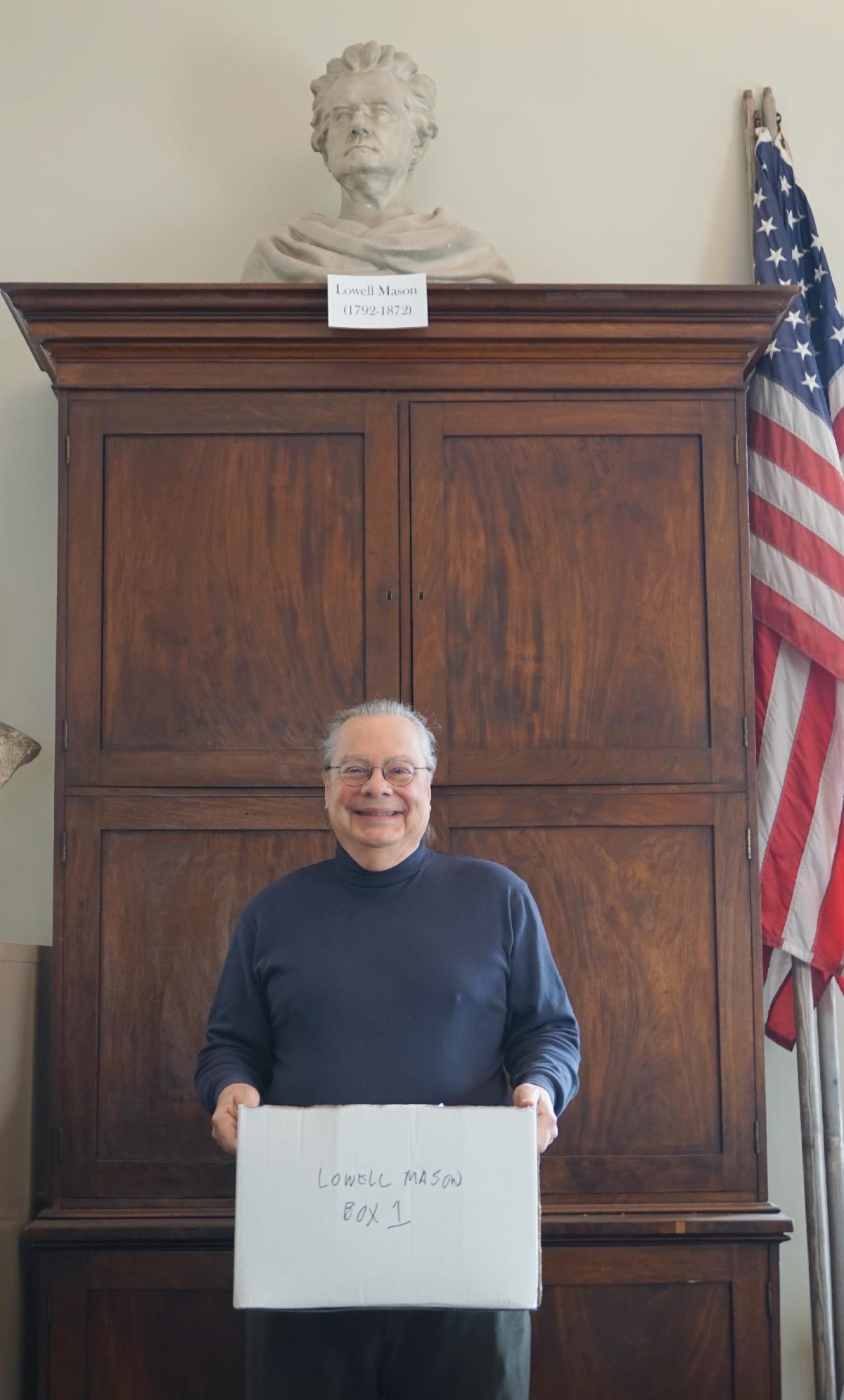
In March the Medfield Historical Society had the good fortune to acquire a significant expansion to our collection of 19th century documents related to Lowell Mason (1792 – 1872). They fall into four categories: printed music (13), published writings (7), manuscripts and personal papers (6), and photographs (3 folders), plus the inevitable “miscellaneous” (15).
All are well-curated and in good condition.
The donor is Dr. Stephen Marini, professor of religion at Wellesley College, whose research and writing for the last decade has concentrated on early American sacred music and poetry. He writes, “Sacred music is one of my greatest personal passions, and I pursue it as a performer as well as a scholar.” He continues to lead Norumbega Harmony, a choral group he founded at Wellesley 45 years ago and which has given over 125 concerts and released three recordings.
Lowell Mason, known as the father of public school music education in America, was born in Medfield in 1792. As a teen-ager he led the First Parish church choir and a local band.
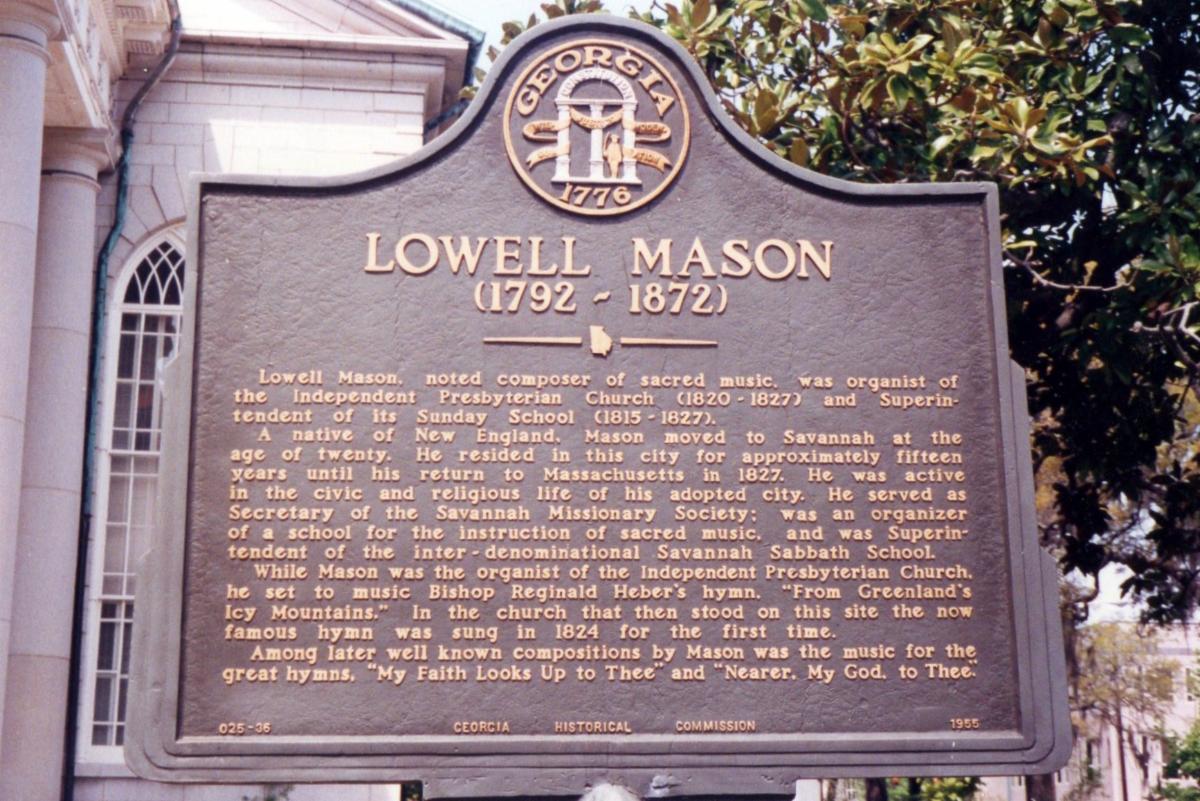
From about 1812 to 1827 he lived in Savannah and worked as a banker, but he studied and taught music and was a church organist and choir director. While there he also published anonymously The Boston Handel and Haydn Society Collection of Church Music in 1822, which sold more than 50,000 copies and led to his return to Boston in 1827 to be president of H&H. Over the course of his lifetime, he wrote some 2,000 hymns that were published.
Mason also developed an extraordinary reputation as a music educator. Beginning as a Sunday school teacher, Mason taught in private schools, established the Boston Academy of Music, organized teacher training conventions, and published numerous pedagogical works. A pioneering advocate for the place of music in public education, he served as superintendent of music in the Boston school system from 1837 to 1851.
In 1851 he moved to New York, where two of his sons had become music publishers, one a professional pianist, and his son Henry was a cofounder of Mason and Hamlin, which became a leading manufacturer of high-end pianos.
The 115-year-old, 60,000-member National Association for Music Education honors outstanding achievers with the designation of Lowell Mason Fellow.
Thanks to Prof. Marini, the Medfield Historical Society now has one of the better collections of Masoniana anywhere.
|
|
Lowell Mason plaque in Savannah, Georgia. |
|
Interesting Diggings at the Former State Hospital |
|
Ted Chisholm and Andrew Bolton, former Millis residents, have brought their metal detectors to the former Medfield State Hospital many times. Recently they made a particularly striking discovery.
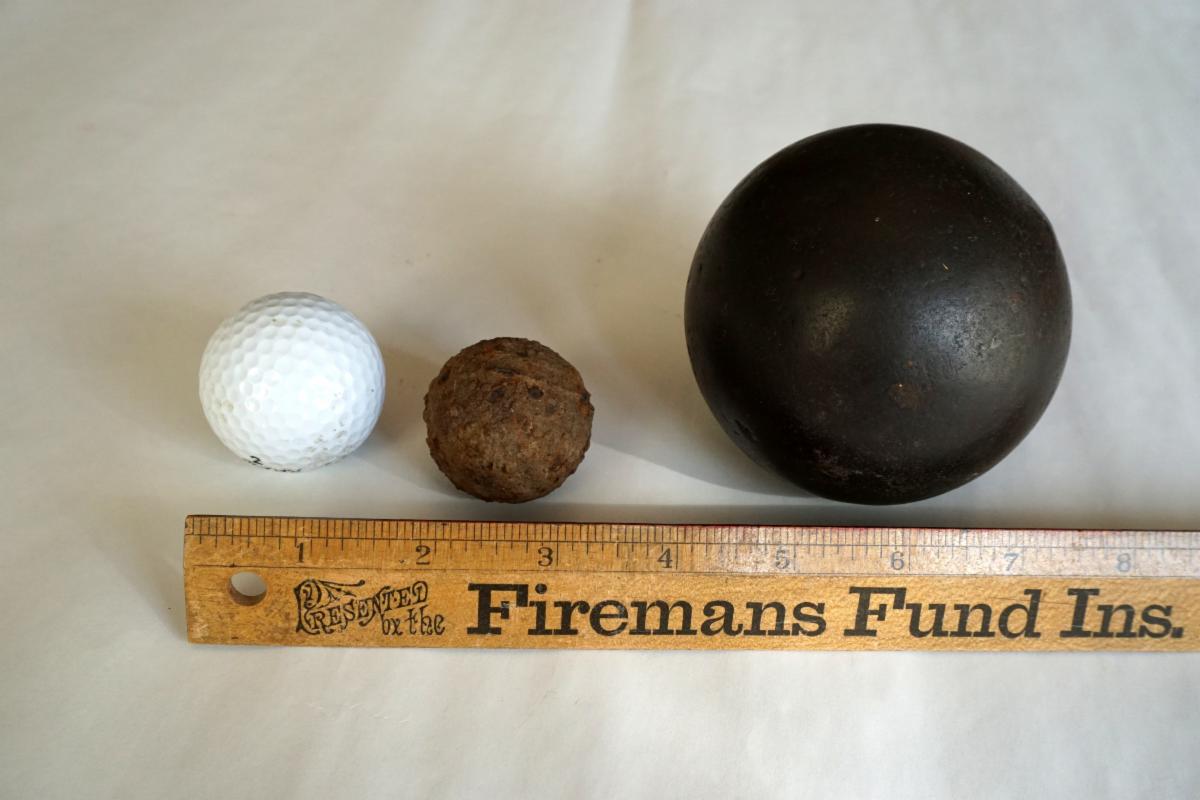
Eighteen inches below the ground they found an iron ball, probably a cannon shot. It’s about the size of a golf ball but weighs ½ pound, five times the weight of a golf ball. Online research was inconclusive about small 17th century cannons. Perhaps a Portal reader can provide us with more information about what this ball might be?
King Philip’s men attacked and partially burned Medfield on February 21, 1676. William S. Tilden wrote on page 86 of his History of Medfield 1650-1886, “As soon as the people were aroused to the perils which threatened, the cannon was fired as a signal to Dedham. After the second firing of this ‘greate gune,’ a panic seized the Indians; and they hastily retreated across the bridge over the Charles River” near the hospital. **
That cannon was at the meetinghouse (now Unitarian church) about two miles away. It seems extremely unlikely that the ball found by Ted and Andrew is the actual shot fired 346 years ago, buried 1-1/2 feet deep at the hospital – but how could it be proved or disproved conclusively?
|
|
The iron ball (middle) that Ted and Andrew found is about the size of a golf ball but weighs 1/2 pound, five times the weight of the golf ball on the left. The larger ball to the right is a six-pound cannon ball believed to have been recovered at Dorchester heights in March 1776. |
|
The third ball in the photo is a six-pound cannon ball, 3-1/2 inches in diameter. Town historian Richard DeSorgher said the cannon ball was of British manufacture, and he believed it had been recovered at Dorchester Heights in March 1776 after the British evacuated Boston. Richard believed someone in the Medfield Allen family had donated it to the society in the 20th century. But Ellis Allen, longtime Medfield resident and noted tree expert and warden, did not recall the story.
In the fall of 1775, Boston was occupied by the British but under siege. To help force the British out, George Washington sent Henry Knox of Boston on a mission to retrieve the cannons and other supplies from Fort Ticonderoga (now part of Essex County in northeastern New York), which had been captured from the British in May 1775 by Colonel Benedict Arnold and Ethan Allen and the Green Mountain Boys.
|
|
Ted Chisholm (left) and Andrew Bolton at the Medfield Historical Society. |
|
Knox and his men brought 59 cannons and similar weapons, weighing a total of 60 tons, mostly by ox-drawn sleds, 300 miles to the Boston area. The route roughly tracked what is today the Mass Pike. In t5he lot were six, six-pound cannons, which would fire a ball like the one on the photo.
As the cannons were being put in place in Dorchester Heights, the British opened fire on March 9, 1776. The next day Dorchester colonists recovered 700 balls, and it seems quite reasonable that one of those is now in the Medfield Historical Society.
Once the cannons were put in place at Dorchester Heights, British Commander William Howe realized British ships would no longer be able to bring supplies for his besieged troops. So the 10,000 British troops boarded ships and evacuated Boston on March 17, 1776.
Ted and Andrew also brought some of their other findings buried on the hospital land; graciously, they donated them to the society. Our thanks to Ted and Andrew!
** In 1776, according to Tilden’s History of Medfield, the town “voted ‘£6, the money that the Great Gun was sold for,’ toward paying the bounties for the Canada soldiers. The unfortunate expedition against Quebec under Montgomery and Arnold is here referenced to.”
|
|
People and Places of the Past |
|
Gone Fishing, Like You, Like Me |
|
It might be hard for some people to imagine, with all the attention on social media, that going fishing in the waters of Medfield is still a fun adventure for the young and the young at heart. So, for a while, forget about the pandemic and let your mind float downstream!
Fishing allows us to relax outdoors, develop patience, and form special bonds with family and friends. Even a solitary fisherman is never alone, because he’s always in the mix with
the fish. What’s not to love?
In the mid-20th century, one of the best and most scenic places to go fishing in Medfield was Jewel’s Pond on Foundry Street. Tommy Cebrowski and friends would get into his rowboat and row the hidden cove, where the water was just five feet deep, and cast their lines with the red and white bobbers and wait for the fish to start biting and jumping.
Seemingly clairvoyant, 10-year-old rookie fisherman Dennis Flaherty said he was going to catch a shiner as he cast his line. Suddenly Dennis felt a tug and pulled in a six-inch shiner, so named for its eye-catching golden scales. Was Dennis lucky or physic? They didn’t even consider eating that fish – they threw it back and felt it a harbinger of some good fishing to come.
|
|
|
|
Medfield Historical Society
info@medfieldhistoricalsociety.org
|
|
|
|
|
|
|