|
|
Addressing Wellness and Building
Community Coalitions
|
|
In this Issue:
- Addressing Wellness and Building Community Coalitions
- Additional Resources
- Building Community Coalitions
- Suicide Prevention Month
- What's Happening Around the Region?
- Join Our Team
- Funding Opportunities
- Training: Coalition Building Two-part Workshop, September 16 and 17 and Methamphetamine Use: What are the Data Telling Us?, October 26
- National Prevention Network Resources
- PTTC Network Training
- Foundations in Prevention Science
-
Spotlight on Online Courses: Early Childhood Development: Toxic Stress and Adverse Childhood Experiences
- Epi Corner: Evaluating Coalitions: Structure, Context, Relationships and Outcomes
|
|
Addressing Wellness and Building Community Coalitions
By Sarah Davis
A coalition of individuals and organizations committed to a common goal can be an effective vehicle to achieve community wellness. Coalitions harness the power of their member organizations and amplify individual voices. Additionally, the process of engaging in a coalition itself can support community wellness by honoring and valuing community voices, supporting a sense of agency, providing social and professional connection, and fostering collective power.
Coalitions are organized to address numerous challenges related to the seven dimensions of wellness, which include:
- Social or Emotional– coalitions addressing abuse or trauma, positive youth development, or culture and the arts.
- Spiritual– coalitions focusing on inter-faith alliances.
- Intellectual– groups focused on autism, early childhood education, college readiness, or parent-teacher associations.
- Physical– coalitions organized around neighborhood safety, healthy eating, active living, tobacco, alcohol, opioid, or other substance misuse.
- Environmental– groups advocating against environmental threats, or to support clean air or water, or address the lack of green space in a community.
- Financial– coalitions addressing poverty or homelessness; business or economic development associations; groups looking at neighborhood revitalization, zoning, property taxes, levies, or allocation of funding.
- Occupational– coalitions focused on workforce readiness, independent living, or workers’ rights.
Skilled coalitions honor the expertise and elevate the voices of those directly impacted by issues the coalition seeks to address. Doing so not only ensures that the coalition is seeking solutions that truly benefit and are supported by the community, but also serve to build power within the community. Through participation in the coalition, community members build their leadership and advocacy skills. Members are connected to each other and to professional networks beyond their community. They are part of something larger and experience “wins” for themselves and their community.
Join us for a Coalitions Building Block workshop series coming up September 16 and 17 where we will explore how to recruit community partners for your coalition, honor their voice, engage coalition members to action, and build community power for change.
|
|
About the Author
Sarah Davis is the facilitator for the two-part series on the Coalitions Building Block workshop. Mrs. Davis is the associate director for the Rocky Mountain Public Health Training Center, housed within the Center for Public Health Practice at the Colorado School of Public Health. She also supports national workforce development efforts as part of the Public Health Learning Network and through previous collaborations with the Centers for Disease Control, the National Association of Chronic Disease Directors, and the National Network of Public Health Institutes.
Her background includes program planning and implementation, integrating program and policy initiatives, and working with coalitions.
|
|
The South Southwest Prevention Technology Transfer Center is on Social Media! Follow us on Twitter and like and subscribe our channel on YouTube. |
|
Building Community Coalitions
The Global PTTC Community Coalitions and Collaborators Work Group
The Community Coalitions and Collaborators (C3) Working Group (WG) exists to develop training and technical assistance tools, products, and services on effective community coalitions and collaborations, to be deployed across the PTTC network to increase the capacity of prevention coalitions and collaborators to reduce substance misuse outcomes. View further training and resources on their website.
Building Strong Prevention Coalitions
Great Lakes PTTC
This 90-minute webinar reviews the best practices in effective coalitions and the role that coalitions play in successful prevention efforts.
The Community Engagement Guide to Sustainable Communities
PolicyLink and Kirwan Institute
The Sustainable Communities Initiative provides an opportunity to create a new collaborative framework for both local communities and regions to foster a vision that builds on strengths and reduces harmful disparities. In this report, on page 8, you might find the section, Guidelines for Meaningful Community Engagement Strategies helpful as you consider strategies to build your coalition in transformative ways.
Community Coalitions Handbook Primer
Community Anti-Drug Coalitions of America
CADCA’s National Coalition Institute developed this handbook to educate, inform, and empower community coalitions. It provides some of the basic tools needed for success and offers links to a myriad of resources to help coalitions achieve the goal of safer, healthier, and substance-free communities.
Ten of the Most Effective Group Decision-making Techniques
Fellow
Check out these ten group decision making techniques to collaborate effectively with your team on decisions that matter.
|
|
Suicide Prevention Month: Ideas for Action
This two-page resource offers information to help anyone, anywhere get involved in Suicide Prevention Month in September. It includes tips on how to take action to help prevent suicide in your community, such as learning about effective suicide...
Read more
www.sprc.org
|
|
|
|
|
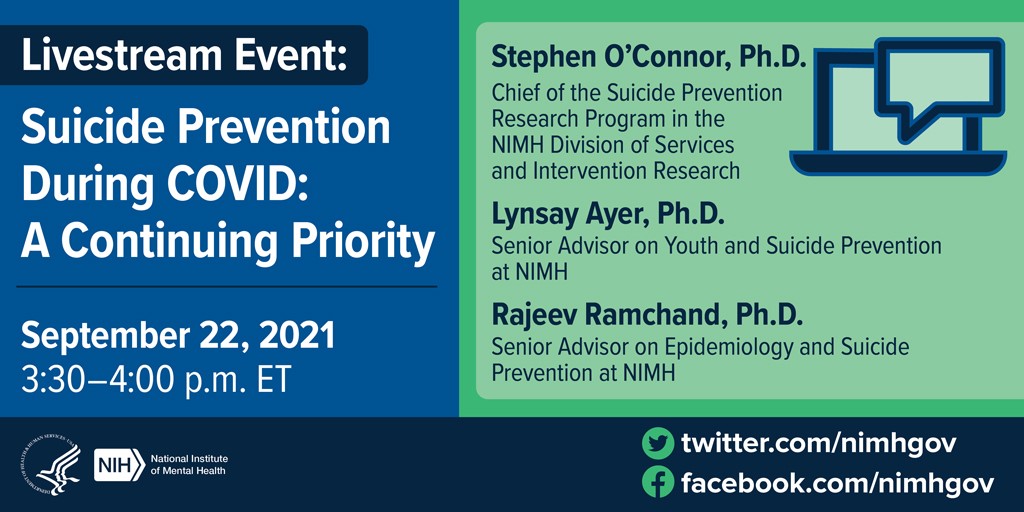
NIMH will host a livestream event on September 22, 2021, on suicide prevention during the pandemic, focusing on unemployment, youth, and other population subgroups who may be experiencing elevated risk.
Watch the livestream event on NIMH’s Facebook or Twitter feeds. You must have either a Facebook or Twitter account to watch.
|
If you or someone you know is in crisis, call the National Suicide Prevention Lifeline (Lifeline) at 1-800-273-TALK (8255), or text the Crisis Text Line (text HELLO to 741741). Both services are free and available 24 hours a day, seven days a week. All calls are confidential. Contact social media outlets directly if you are concerned about a friend’s social media updates or dial 911 in an emergency.
|
|
The South Southwest PTTC is continuing to suspend in-person training and meetings until further notice. Take advantage of our many virtual products and services available for free from our website.
|
|
What's Happening Around the Region? |
|
Job Opportunity!
Join our Team!
The South Southwest Prevention Technology Transfer Center is looking for a detail oriented person that is passionate about behavioral health and wants to plan, develop, and coordinate substance misuse training and technical assistance for prevention professionals and their partners.
|
|
|
Funding Opportunities from SAMHSA! |
|
Training
Community Coalition Building, A Two-part Workshop by the South Southwest Prevention Technology Transfer Center
|
Part One: Coalition Building: Recruitment and Retention
September 16 10:00 a.m. - 12:30 p.m. CT
Coalition member recruitment, retention, and engagement requires intentional efforts to mobilize members to move the community’s prevention work forward. During part one of the series, PTTC Associate Sarah Davis and colleagues will guide participants through developing mutually beneficial relationships with coalition members.
|
|
Part Two: Coalition Building: Coalition Design and Member Engagement
September 17, 10:00 a.m. – 12:00 p.m. CT
“Make new friends but keep the old. One is silver and the other is gold,” is a chant that many former Girl Scouts remember. Its emphasis on growing new relationships while nurturing old ones resonates with coalition coordinators, leaders, and members considering new ways to recruit, engage, and retain coalition members.
During part two of our coalition building series, Sarah Davis and guests will be back to talk about how different coalition structures impact member participation, the participation spectrum, and strategies for improving engagement amongst your membership.
|
|
Save the Date!
Methamphetamine Use: What are the Data Telling Us?
October 26, 10-11:30 a.m. CT
Methamphetamine use has grown increasingly prevalent over the past couple decades, with overdose consequences mirroring that of opioid use. This webinar will overview the current state of methamphetamine use in the Great Lakes and South Southwest PTTC regions. Highlighting use and overdose patterns, risk and protective factors, and the current state of prevention research.
We look forward to you joining us as we discuss what the data are telling us about methamphetamine use and how we can reduce use and associated risks. Watch for registration details on the two PTTC websites in the above paragraph and through email invitation.
|
|
National Prevention Network Resources on the Web |
|
If you attended the NPN conference you may have had the chance to join the presentations by Marie Cox, Nicole Schoenborn, and Beverly Triana-Tremain from the South Southwest PTTC. We have collected the resources they provided as part of their presentations and made them available to you on our website.
The presentation developed by Ms. Cox and Ms. Schoenborn, Twenty Questions to Assess and Sharpen Advanced Skills: A New Tool for Prevention Workforce Assessment, described a behaviorally-based, interview-style tool recently developed by the SSW PTTC. The tool has a fully operationalized rating scale that provides an objective, consistent, and skills-focused capacity assessment for experienced prevention professionals.
|
|
Materials and products developed for the presentation given by South Southwest PTTC epidemiologist, Dr. Triana-Tremain in her presentation, Systems Change Shift: Application to Substance Use and Mental Health Prevention are now available. This training was designed to increase awareness about system change and its application to substance misuse and mental health and to illustrate how substance use and poor mental health outcomes can be changed at the structural, relational, and transformative levels.
|
|
Please join our email list or follow us on Twitter @SSWPTTC6 to receive notifications about training opportunities and registration details.
|
|
Foundations in Prevention Science |
|
Evidence-Based Prevention Science: Applying Prevention Science to Practice: A Collaborative Opportunity
Applying Prevention Science to Practice: Using Environmental Strategies to Reduce Substance Use
Applying Prevention Science to Practice Series: Strategic Fit and Evidence-Based Practices in Today’s Prevention Landscape
Applying Prevention Science to Practice: What Implementation Experts Need to Know About Program Fidelity
|
|
Prevention Online Course Spotlight
Free online courses are available through the Prevention Technology Transfer Center.
Early Childhood Development: Toxic Stress and Adverse Childhood Experiences
Those working with young children have long known the importance of early experiences and relationships in healthy child development. Newer terms such as toxic stress and ACES are used when describing these not-so-new ideas, and are particularly important when working with families impacted by substance abuse. During this online training, learners will expand their current knowledge about early development to include up-to-date science that is accessible and useful in daily real-life interactions. Using a case-based approach, participants will apply new knowledge to familiar scenarios to enhance their engagement with high-risk young children and families. Certificate of completion is issued.
|
|
Epi Corner
Iris Smith, Ph.D., M.P.H.
South Southwest Prevention Technology Transfer Center
|
|
Evaluating Coalitions: Structure, Context, Relationships, and Outcomes
Engaging diverse stakeholders in community prevention efforts is critical to the success and sustainability of those efforts. Step 2 of the Strategic Prevention Framework (SPF) focuses on building prevention capacity by identifying and engaging community stakeholders and opinion leaders to both raise awareness of the issues facing a community and building a cohesive and effective prevention coalition. Stakeholders from diverse segments of the community such as community advocacy groups, the faith community, education, law enforcement, corrections, and medical providers and emergency medical services bring unique perspectives, skills, and resources essential to a sustainable community coalition.
Evaluations of collaborations have typically focused on documenting the structure and process of the collaboration, rather than its impact on the prevention goal. As a result, despite 30 years of practice, there is limited information about effectiveness. In a systematic review of 14 evaluations that list significant outcomes to collaborative prevention efforts, only two provided effect sizes making it difficult to assess each efforts’ contribution compared with previous prevention efforts that may not have relied on community coalition infrastructures (Hutchinson & Russell, 2021).1 Thus, while there is consensus that coalitions make valuable contributions to the implementation of prevention programming, it is unclear how training, technical support, coalition structure, and activities contribute to achieving outcomes (Ibid.). Measures of the nature and strength of relationships, coalition climate, and member expectations and satisfaction (RCE) provide useful information, but often fail to demonstrate the link between these variables and outcome measures (Greenwald et al., 2018).2 These authors suggest incorporating measures of “collaboration extent’ (CE) to examine changes in policy and practice in the larger community context as well as within the collaborating organizations because of participation.
Complex and dynamic community systems must be present when implementing prevention strategies designed to reduce the use and consequence of alcohol and other drug abuse. Richardson & Patton (2021) suggest that capturing the full impact of coalition activities requires systems thinking with measures of transformational change.3 Transformational leadership is characterized by successful navigation of a changing landscape and the ability to respond to changing situations. To capture this information, evaluators must be an integral part of the coalition from the beginning to assess impact more effectively. This developmental approach to evaluation supports innovation and strategic development and can guide identification and adaptation to emerging and dynamic factors within a complex environment (Richardson & Patton, Ibid.). In addition to measuring process and outcomes, the developmental evaluator can promote evaluative thinking and systematic data driven reflection in the decision-making process.
Articles of Interest
-
Gates EF, Walton M, Vidueria P, McNall M (2021). Introducing Systems and Complexity- Informed Evaluation. New Directions for Evaluation; 2021 (170), pg. 13-25. https://doi.org/10.1002/ev.20466
-
Greenwald HP & Zukoski AP (2018) Assessing Collaboration: Alternative Measures and Issues for Evaluation. American Journal of Evaluation; 39(3), pg.322-335. https://doi.org/10.1177/1098214017743813
-
Hutchison M & Russell BS (2021). Community Coalition Efforts to Prevent Adolescent Substance Use: A Systematic Review. Journal of Drug Education: Substance Abuse Research and Prevention; 0(0) pg. 1-28. doi:10.1177/00472379211016384
-
Richardson RA & Patton MQ (2021). Leadership-Evaluation Partnership: Infusing Systems Principles and Complexity Concepts for a Transformational Alliance. New Directions in Evaluation 2021 (170); pg. 139-147. https://doi.org/10.1002/ev.20461
Resources
-
Winer M & Ray K. (1994). Collaboration Handbook: Creating, Sustaining, and Enjoying the Journey. Amherst H. Wilder Foundation.
-
Patton MQ (2011). Developmental Evaluation Applying Complexity Concepts to Enhance Innovation and Use. Guilford Press; N.Y, N.Y.
-
Systems and Complexity- Informed Evaluation Insights from Practice. New Directions in Evaluation; Summer 2021, Issue 170. https://doi.org/10.1002/ev.20466
__________________________________
1 Hutchinson M & Russell BS (2021). Community Coalition Efforts to Prevent Adolescent Substance Use: A Systematic Review. Journal of Drug Education: Substance Abuse Research; pg. 1-28. http://dx.doi.org/10.1177/00472379211016384
2 Greenwald HP & Zukoski AP (2018) Assessing Collaboration: Alternative Measures and Issues for Evaluation. American Journal of Evaluation; 39(3), pg.322-335. doi:10.1177/1098214017743813
|
|
|
|
|
|
|