|
|
Defending wildlife and habitat through:
Advocacy
Conservation
Education
|
|
|
News & Updates: June 2022 |
|
In this issue:
-
Join us! AOK in the field:
- Learn to use iNaturalist at Achterberg Wildlife-Friendly Demonstration Farm, July 16
- Work Week at Hutton Niobrara Ranch Wildlife Sanctuary, July 25-29
-
Henslow's Sparrow spotted at Mount Mitchell Heritage Prairie
-
Video game teaches how to manage cedars to maintain prairie
- AOK News Updates:
- Binocular Backpack
- Recovering America's Wildlife Act (RAWA)
- Chapter Highlight: Summer heat does not stop Topeka Audubon Society
- AOK Nature Walk Recommendations
|
|
|
Join us!
AOK in the field...
|
|
 |
When: July 16 at 8am
Where: Achterberg Wildlife-Friendly Demonstration Farm near Lincoln, KS
What: Learn to use iNaturalist to help AOK document plants and animals
|
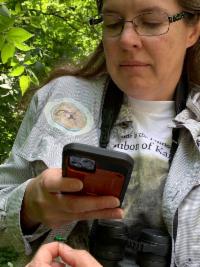
iNaturalist is a free cell phone app that not only identifies the plants and animals you see, but also provides that information to the scientific and conservation community. AOK uses iNaturalist to document the plants and animals on our sanctuaries, gain information on seasonal changes in abundance, and see the impact of our conservation. Join AOK Executive Director, Jackie Augustine, at 8am on July 16 to learn how to use the app. After everyone is comfortable using the app, we will spread out and document as many species as possible! Only 69 species have been documented at Achterberg compared to 188 at Hutton and 199 at Mount Mitchell. We need your help to increase that number!
RSVP not required.
Photo by K Hurst: Jackie using iNaturalist to document the presence of a tiger beetle
|
|
|
|
When: July 25-29
Where: Hutton Niobrara Ranch Wildlife Sanctuary near Bassett, NE
What: Work Week for Wildlife
|
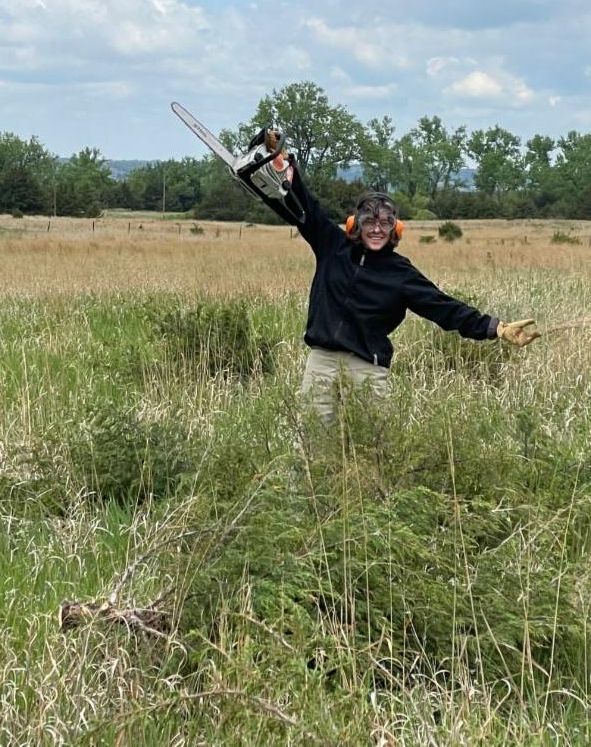
With 5000 acres, there is always a lot to do at Hutton to maintain the best habitat for wildlife and enhance our offerings for human visitors. We hope to have enough people to divide into two crews: one crew will work on removing cedars from a section of pasture and the other will repaint the Lazy Easy. The Lazy Easy is one of two guest houses on the property. We hope to open up the Lazy Easy for public reservations in August, and the place needs some sprucing up. Volunteers can stay at the Hutton homestead for free during the work week. Of course, there will also be plenty of time to explore the property.
Hutton is near Bassett, NE. Opportunities to carpool may be available. Directions provided when RSVP received.
Photo by J Augustine: Elizabeth Dodd poses with the cedars that could not resist her chainsaw at Hutton
|
|
|
|
|
Directions to Achterberg
Coordinates: 38.9873, -98.1887
The trailhead is about a half mile north of the intersection between E Iron Dr and 170th Ave on 170th Ave, just south of the bridge.
Directions from I-70:
Take KS-14 north from I-70. Continue about 9 miles. Follow the road as it curves east (right) and north (left). Turn west (left) onto Hawk Dr. Continue 2 miles. Turn north (right) onto 170th Ave. Continue 1 mile to the intersection of 170th and E Iron Dr.
Note: Iron Dr. does connect with KS-14. However this road is pretty rough and may not be passable after a heavy rain. Access to 170th from Hawk, Kiowa, or KS-18 is recommended.
|
|
|
|
Volunteers needed at Hutton for:
- Cutting cedars using chainsaws or loppers
- Loading/unloading cedars onto a truck
- Driving the 1977 stick shift truck to create a cedar burn pile
- Painting bedrooms at the Lazy Easy
- Installing window air conditioners at the Lazy Easy
- Preparing meals for volunteers
- (If time) cleaning/organizing items in the shed
|
|
|
|
Henslow's Sparrow spotted
at Mount Mitchell Heritage Prairie
|
|
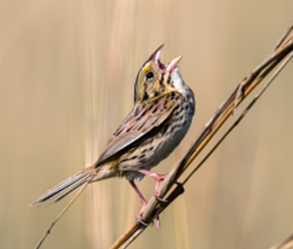
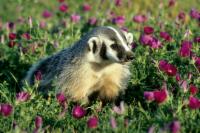
You have to appreciate subtle beauty to appreciate Henslow's Sparrows. These small birds are mostly brown with a hint of yellow by their eye, a greenish wash behind their head, and a few short streaks on the upper breast. Their song is just as uninspiring - a short 'tse-zlik' isn't very loud and only lasts about a half of a second.
However, when you see a Henslow's Sparrow, you know you are looking at an icon of a vanishing habitat. These sparrows require thick native grass and sparse woody vegetation. They place their nests near the ground in a well-developed litter layer (lots of old dead grass). This type of habitat usually occurs 3-4 years after a burn and with little to no grazing. In a state where most native prairie is grazed annually by cattle, these tall, thick, ungrazed prairies are hard to find. The lack of habitat is why the Henslow's Sparrow is listed as a 'Species in Need of Conservation' in Kansas.
When Jackie conducted AOK's annual breeding bird survey at Mount Mitchell Heritage Prairie south of Wamego, she was surprised to see no fewer than three Henslow's Sparrows. Strong winds and dry conditions did not provide the opportunity to burn this spring. Given that no grazing occurs on the property, last year's grass was still tall and new spring grass made good conditions for the sparrows. No Henslow's Sparrows were observed last year when the area had been burned that spring.
Mount Mitchell Heritage Prairie is open to the public with miles of hiking trails that hug the slope of Mount Mitchell. Besides birds, butterflies, and wildflowers, there are several historical monuments to enjoy. The namesake, Captain William Mitchell, was a key figure on the Underground Railroad in Kansas prior to the Civil War. The area is jointly managed with the Mount Mitchell Prairie Guards.
|
|
Video game teaches how to manage cedars
to maintain prairie
|
|
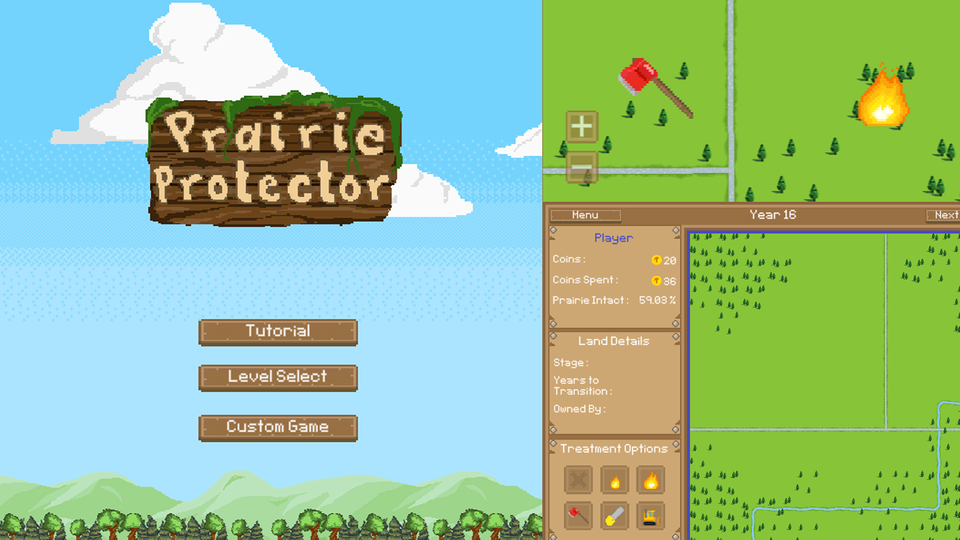
Cedars are moving like a 'green glacier' across the Great Plains, degrading prairie and making it uninhabitable for many prairie species. In order to increase awareness of this issue, faculty and students at the University of Nebraska-Lincoln worked together to produce a game for high school students. In the game, the players take the role of a landowner and must decide how to spend their time and energy to remove cedars from their pasture. Some management techniques, like cutting small trees with an ax, are cheap but time-intensive. Other management techniques, like bulldozing mature trees, are financially expensive. In more complicated versions of the game, simulated neighbors either leave cedars along the property line or remove them.
The game is getting students to notice the cedar encroachment in their communities and understand why removing cedars and preserving the prairie are not easy tasks. Hopefully with the understanding gained through the game, students and their parents will give the prairies a reasonable shot at protection.
|
|
|
Binocular Backpack Program kicks off! |
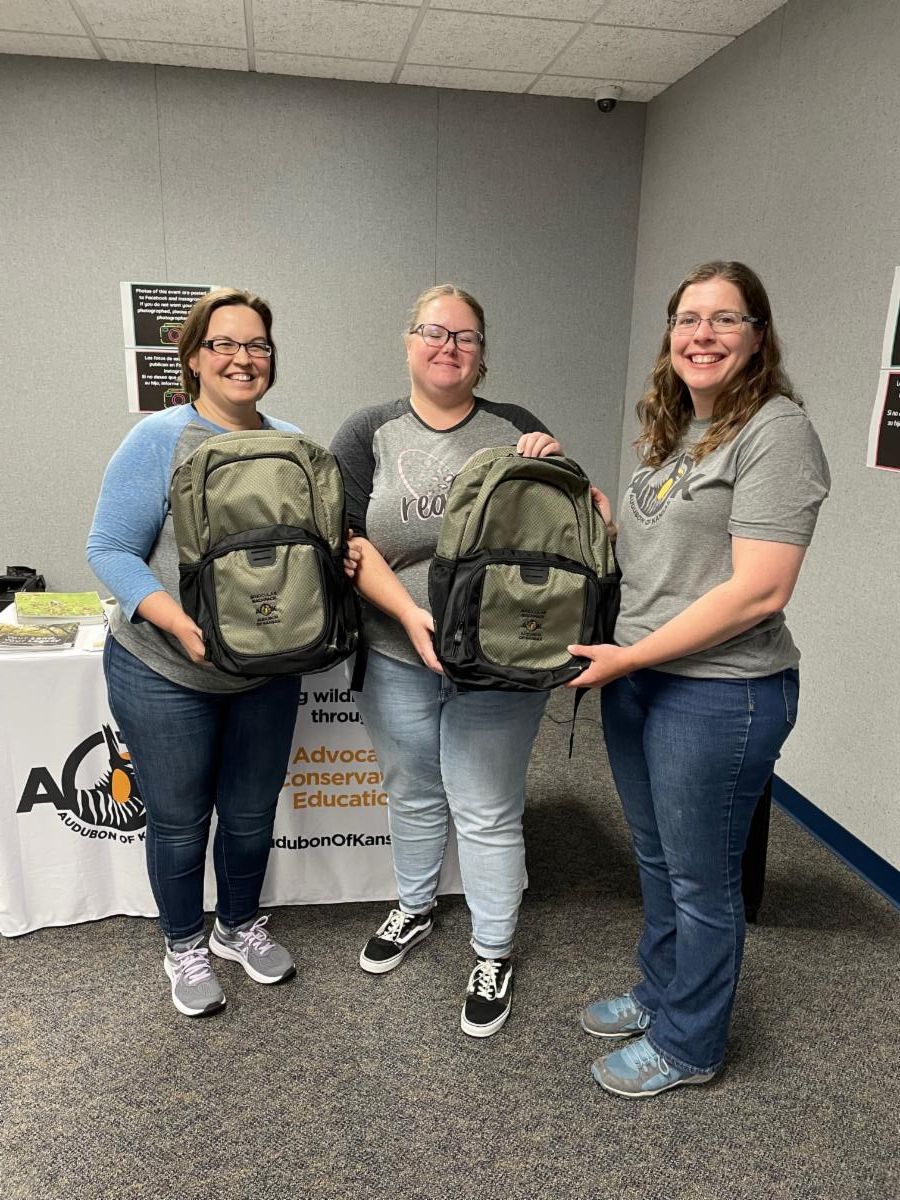
Jackie Augustine presented Stevens County Library with two binocular backpacks for use by their patrons. The backpacks contain one adult pair of binoculars, two children's pairs, fold-out guides to identify birds and butterflies, and a laminated map showing locations to go nature watching in the county. We are working with Stevens County librarians to develop best practices so the binocular backpack program will be a success.
This summer, we will be having a capital campaign to support the purchase of backpacks to place in all 328 libraries throughout Kansas - stay tuned for opportunities for you to contribute through volunteering and fund raising!
Photo by Jackie Augustine
|
|
|
|
Recovering America's Wildlife Act (RAWA) passed in the House with a vote of 231-190. It is a federal bill that provides additional money for management of both wildlife and plants in need of conservation.
Sharice Davids, as a co-sponsor, voted in favor of the bill. Tracey Mann and Jake LaTurner voted against the bill. Ron Estes did not vote.
The bill now moves to the Senate for consideration. At this time, we do not know when it will come up for a vote. Kansas Senators Jerry Moran and Roger Marshall have already agreed to sponsor the bill.
AOK would also like to acknowledge the Kansas Department of Wildlife and Parks (KDWP) for their proactive actions in preparing for the potential influx of conservation dollars. KDWP seems to be ahead of neighboring states as it has already added plants to the State Wildlife Action Plan, making Kansas eligible for additional funding.
|
|
|
|
Chapter Spotlight:
Summer heat does not stop
Topeka Audubon Society
|
|
Most Audubon Chapters take a programming break in the summer. Summer heat can sometimes make walks unpleasant, and the birds are more challenging to observe. Instead of singing loudly to announce their location, defend a territory, and attract a mate as they do in the spring, in the summer, birds are too busy trying to keep their offspring fed.
Topeka Audubon Society (TAS) is one of the few chapters that continue field trips and social events throughout the summer. Since 1943, TAS has served Topeka and surrounding communities by providing nature education, outdoor recreation, and environmental advocacy. On the second Saturday of each month, TAS meets at 8am at McDonald Field, Shunga Trail, Topeka, KS 66611. They also have an additional bird trip each month to different locations. The next is Saturday, July 23, 7:30am – 11:00am to Clinton Lake, Lawrence, Kansas. Finally, they meet the third Tuesday of each month at a local brewery just to discuss 'Birds and Beer'. Click the link below to get more information about any of these events.
|
|
|
AOK shares favorite walks,
hikes and birding spots!
|
|
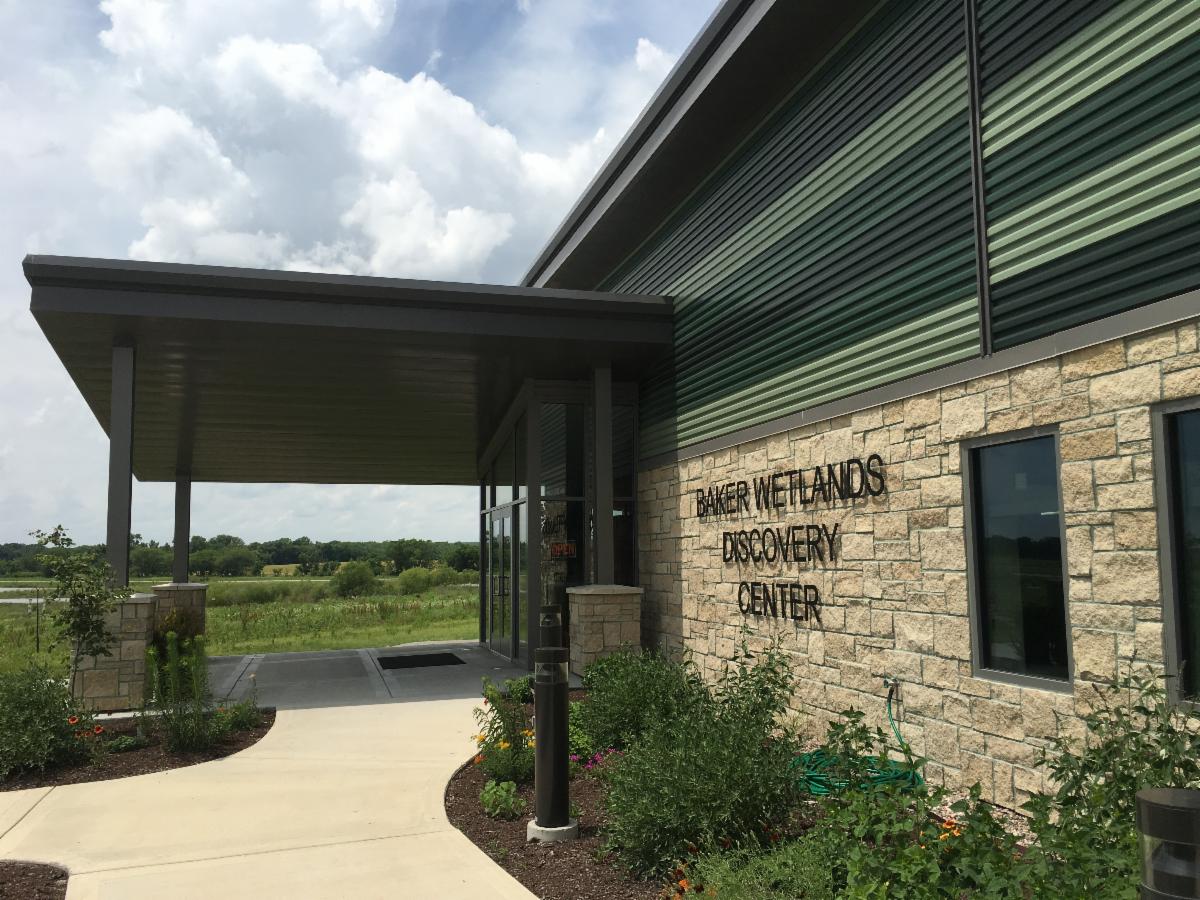
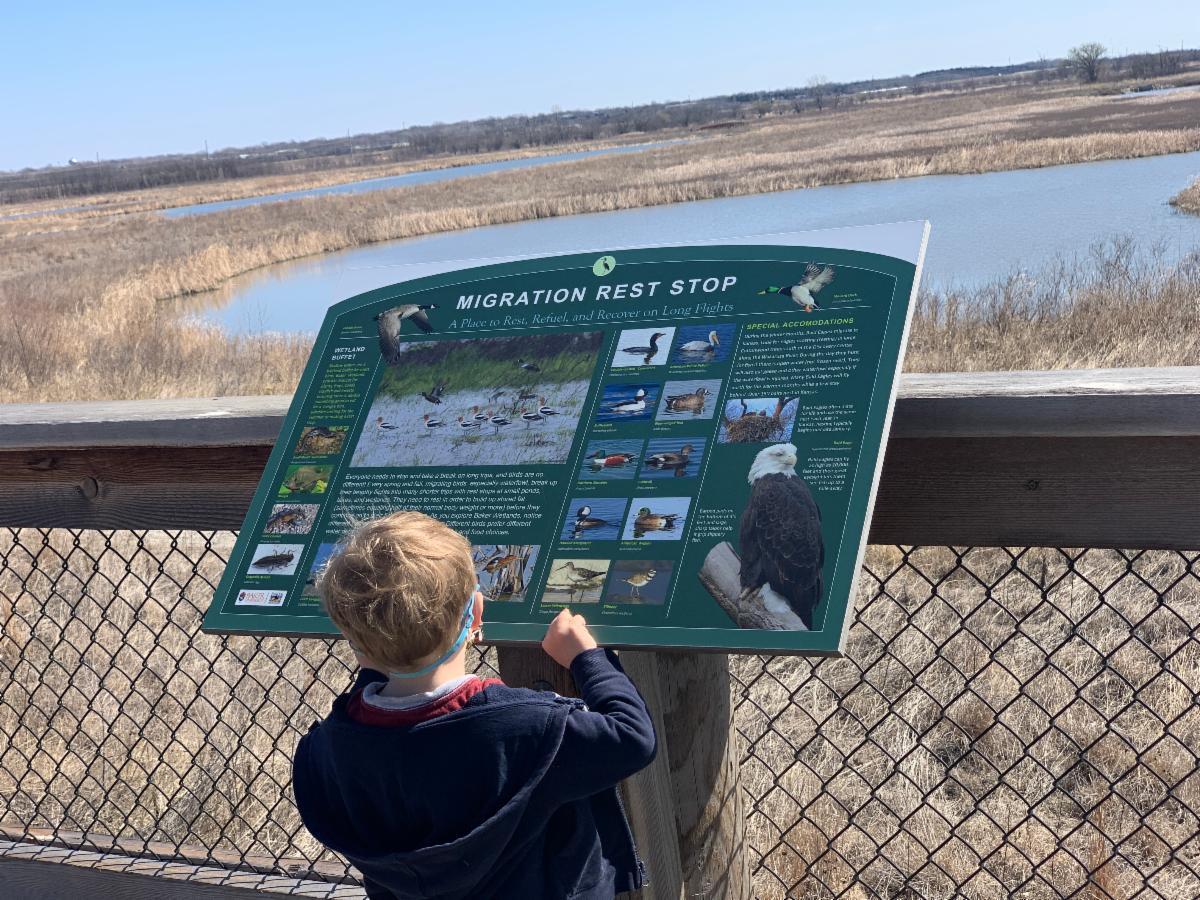
The Baker Wetlands Visitor's Center is at 1365 N 1250 Rd, Lawrence, KS 66046.
Text from the Kansas Birding Trail. This resource provides information on 12 'trails' throughout the state focusing on different bird and habitat communities.
|
|
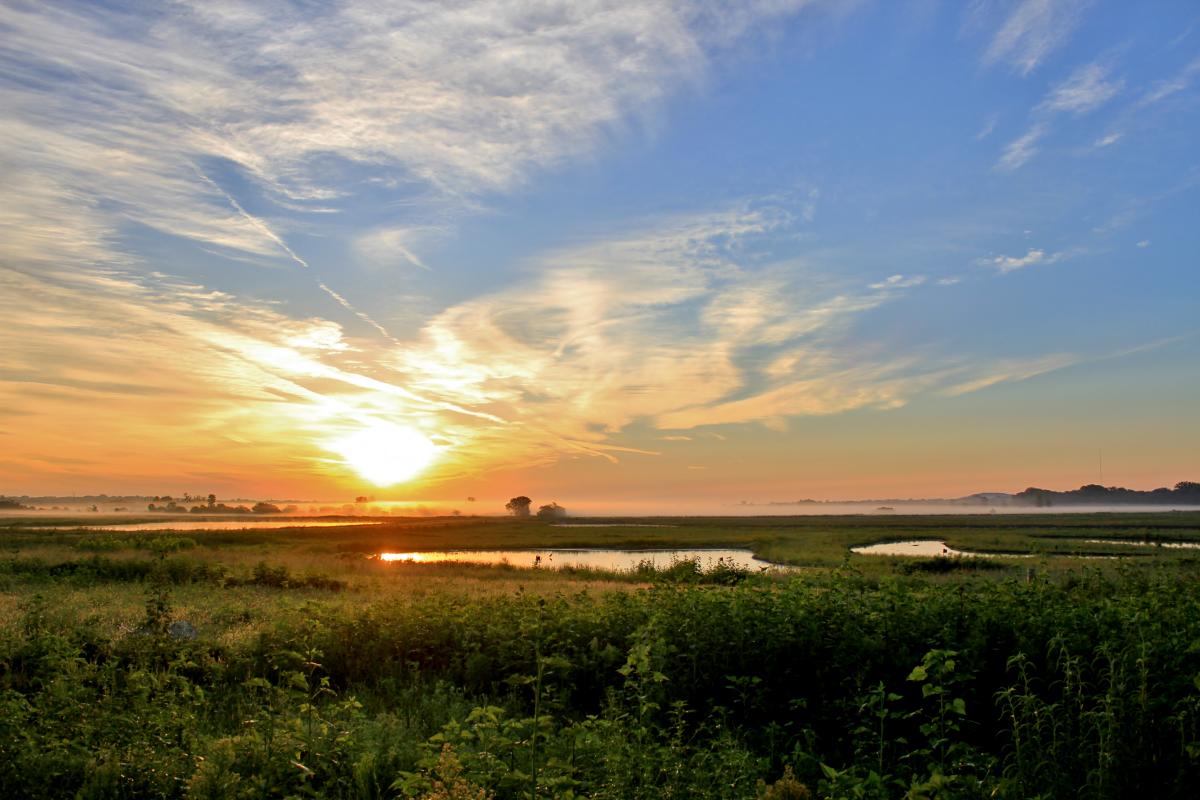
The Baker Wetlands encompasses 927 acres of wetlands, prairie, and riparian forest. At least 285 species of birds have been seen at this wetland treasure. You might want to start your visit at the Discovery Center where you can learn more about the wetlands and the birds that reside here. A boardwalk and 11 miles of trails allow birders and hikers to immerse themselves in the wetland ecosystem. The marsh area is home to rails, herons, both Least and American Bitterns, and Sedge and Marsh Wrens. Although lacking the extensive mudflats, shorebirds can still be plentiful around the margins of the pools, dikes and open areas. Sparrows are often the stars of a walk through the wetland. In fall Le Conte’s, Nelson’s, and Swamps Sparrows are possible. In fact, as many as 15 species of sparrows may be seen in a day during spring and fall. The riparian woodlands along the Wakarusa River on the south edge of the property can be productive for warblers, vireos and other songbirds. |
|
|
|
Lana Arrowsmith - Hutton Niobrara Coordinator - Hutton Sanctuary Management & Reservations lanamicheel@gmail.com
Audubon of Kansas
PO Box 1106 - Manhattan, KS 66505
785-537-4385
|
|
|
|
|
|
|