Weekly Digest Number 9 - March 1, 2022 |
|
Welcome to the RWU Rail & Labor News! This news bulletin is produced and emailed out each Tuesday morning. We hope you find each week's news and information useful. If so, please share with co-workers, friends, and colleagues. If you like, you can sign them up to get all the news from RWU HERE. Or forward them the link. Note: If you read over this news bulletin each week, you will be sure to never miss the important news of what is going on in the railroad world from a worker's perspective!
|
|
(Editor's Note: While this news may seem relatively unimportant, we run it this week as the lead story because it exemplifies the growing solidarity between rail craft and unions. This might just represent a giant step forward for all of rail labor, putting aside petty differences and past animosities, coming together for the greater good of the rank and file, as we inch toward the long standing RWU goal of One Big Bargaining Coalition!) |
|
Coordinated Bargaining Coalition Unions Support BMWED/SMART Mechanical Request For An End To Mediation |
|
February 28, 2022 — By letter dated February 24, 2022, the rail bargaining coalition made up of the Brotherhood of Maintenance of Way Employes Division of the Teamsters Rail Conference and the Mechanical Division of the International Association of Sheet Metal, Air, Rail and Transportation Workers Union petitioned the National Mediation Board (NMB) for a proffer of arbitration, requesting to be released from further mediation sessions. If granted by the NMB, the proffer of arbitration is the next step in the process towards self-help and a potential Presidential Emergency Board to settle their contract dispute with the Nation’s rail carriers.
The Coordinated Bargaining Coalition (CBC) Unions*, which are likewise in negotiations with the same rail carriers, support the BMWED/SMART Mechanical request to be released from mediation and agree that the parties are at impasse and should be allowed to move the contract dispute to the next steps of the Railway Labor Act’s negotiation process. Although the CBC Unions are also in mediation with their next NMB-mediated bargaining session scheduled in March, the CBC made it clear to the NMB upon entering mediation that there is little if any hope of reaching a voluntary agreement in light of the rail carriers’ refusal to bargain in good faith with any of the Rail Unions. Therefore, the CBC fully expects to be making the same request for a release, and once all Rail Unions are released from mediation, the CBC will stand alongside the BMWED/SMART Mechanical Coalition through the final steps of the Railway Labor Act negotiation process to bring the bargaining round to a successful conclusion.
|
|
DOT Report Critical of Railroads: PSR, Rising Rates, and Mergers |
|
A U.S. DOT report critical of railroads discusses pandemic-related supply chain problems and cites concerns with Precision Scheduled Railroading, Class I railroad consolidation, and rising railroad rates.
Among the recommendations in the 141-page report, released on Thursday in response to a Biden administration executive order issued a year ago: Increased regulation of freight railroads.
“Existing regulations may need to be strengthened to address competition (such as economic regulation of railroads or ocean carriers) or other marketplace issues that are only revealed when the system is under extreme supply and demand pressures,” the report says.
The Association of American Railroads criticized some of the report’s conclusions, noting that many of the bottlenecks railroads faced in 2020 and 2021 were due to factors outside the industry’s control, such as labor and container chassis shortages and a lack of warehouse capacity.
“Make no mistake: the recommendation for federal regulators to impose new economic regulations is at direct odds with the stated goals of this report to increase freight fluidity and would also lead to freight diversion away from railroads that would hinder the White House’s other stated goal of reducing carbon emissions,” AAR CEO Ian Jefferies said in a statement. “The current push at the Surface Transportation Board to impose reciprocal switching regulation would create inefficiencies, inhibit investment and in turn make rail transportation less competitive.”
The report notes that railroads have taken steps to reduce waste and improve safety and efficiency. “But poor implementation can come at the cost of jobs and resilience, as workers are asked to do more with less. For example, the number of Class I railroad employees has declined by nearly 25 percent over the past two years,” the report notes.
The document also takes aim at Precision Scheduled Railroading, the low-cost operating model now in place on all of the Class I systems with the exception of BNSF Railway.
“Railroads have increasingly adopted precision railroading, due at least partially to pressure from investors seeking to prioritize reducing operating ratios and increasing stock value over transportation efficiency and resilience,” the report says. “This business practice relies on longer trains to reduce costs; however, some shippers have complained that the practice has reduced performance and resilience, disrupted service schedules, and increased demurrage charges.”
The report footnotes shipper complaints aired at a House Transportation and Infrastructure subcommittee hearing from 2019. Railroads were not represented at the session.
|
|
(Editor's Note: After two years of stonewalling from the rail carriers, the smaller of the two rail coalitions - see below - is moving onward towards arbitration and the prospects of a PEB. Meantime the larger coalition has moved toward mediation. It is time for ALL of rail labor to come together for the good of all and stand united. That day might not be too far off. With solidarity and unity we can win.) |
|
BMWED/SMART-MD Request Proffer of Arbitration-Release from Mediation |
|
Seeing that the National Carriers Conference Committee’s refuses to bargain in good faith, and that the carriers fundamentally fail to accept the very idea that they need to share the bounty of their surging profits with their employees who do the work that generates those profits, the BMWED/SMART-Mechanical bargaining coalition has petitioned the National Mediation board for a proffer of arbitration, requesting to be released from continued mediation sessions.
It is our view that negotiations with the Class I freight railroads are at impasse and that further mediation is not likely to result in agreement. In June of last year, the unions made a comprehensive settlement proposal, to which the NCCC never responded with a comprehensive proposal of its own. In fact, the NCCC has not even made a wage proposal to BMWED and SMART-MD, despite surging inflation and the lack of a pay increase for railroad employees for over two years.
The carriers have made proposals to change the National Health and Welfare plan, however. Naturally for them, those changes would constitute employee concessions, even though the Unions have made concessions on health and welfare benefits, or had them forced on us in the prior three rounds of bargaining. These proposed concessions are non-starters for the Unions. They would be much more significant than those of prior rounds and would substantially diminish any increase in compensation.
“Between 2004 and 2020, which is the period covering the last three bargaining cycles, profits for the Class I railroads have increased by 536 percent,” BMWED President Freddie N. Simpson said. “Rail productivity is up 28 percent since 2004. Profit per employee has increased by 736 percent. The stock prices during the 16-year time period for the three publicly traded Class I railroads have increased 1046 percent!”
“In that same time period, after adjustment for inflation, wages for railroad employees have increased only 14 percent,” President Simpson added. “This cannot go on any longer. Cost of living is up. Railroad profitability continues to rise. In order to ensure that their corporate boards gorge on increased profitability, bonuses, stock incentives and the like, year after year after year, the railroads continue to seek cuts to labor, to diminish the pay and benefits of their work force to keep their investors fat.”
Therefore, the BMWED and SMART-MD bargaining coalition requested that the National Mediation Board determine that its “efforts to bring about an amicable settlement” of the current dispute between the two Unions and the NCCC have been “unsuccessful” within the meaning of Section 5 First of the Railway Labor Act and that the NMB proffer arbitration of the parties’ dispute under Section 5 First, thereby releasing the parties from mediation. Once the NMB proffers arbitration and either or both parties decline arbitration, it starts a 30 day "cooling-off period” where the parties must refrain from engaging in the exercise of self-help. The President can appoint a PEB before the end of that 30 day cooling off period.
|
|
(Editor's Note: This ruling comes as no surprise. What might raise some eyebrows is the judge's complete disregard for the law itself. He continues to cite the damage to BNSF and to the national economy that would result from such a work stoppage, which has nothing to do with whether a dispute is to be ruled "major" or "minor" under the RLA.) |
|
Judge Rules “Hi-Viz” Attendance Policy Court Case as a “Minor” Dispute |
|
The following is a joint statement from Dennis Pierce, National President, BLET and Jeremy Ferguson, President, SMART Transportation Division:
Today the judge considering the case between BNSF and the SMART-TD and BLET unions over the carrier’s new “Hi-Viz” attendance policy ruled that the dispute was “minor” under the provisions of the Railway Labor Act (RLA).
What does this mean? It means that any further action to pursue a strike would be illegal, exposing the Unions and their members to serious legal attacks as well as Carrier discipline up to and including dismissal. But this is only the first round in our fight against the Hi-Viz policy. In the coming days, the Unions will determine if the best course of action is to appeal today’s decision, or to move swiftly to arbitrate the policy before it can be used to terminate any employees. An arbitrator can strike down the policy. If that path is chosen, the Unions will move swiftly to make their case there instead of in the courtroom or on the picket lines.
Rest assured that we are all infuriated. One of the largest and richest corporations in America has been given a free pass to continue forcing its employees to work even when they or their families are sick, and when they are fatigued beyond the point of being able to work safely. BNSF is essentially thumbing its nose at the employees who make them billions of dollars in revenue.
SMART-TD and BLET are considering all legal possibilities to continue to challenge BNSF and its anti-worker, anti-family and unsafe attendance policy. In the coming weeks, the Union’s options are:
- Appeal the District Court decision, but delay arbitration of the policy by doing so
- Aggressively pursue arbitration to challenge every possible aspect of the “Hi-Viz” policy. This is where the actual impact of the policy will become crucial to the Union’s case.
- Demand that state and federal lawmakers pass laws which would protect employees from retaliation for laying off for legitimate reasons.
- Work with federal agencies to end draconian attendance policies on ALLrailroad carriers — not just BNSF.
- Call on Congress to amend the Railway Labor Act, to give rail workers freedom to fight back against the carriers’ abuse.
|
|
(Editor's Note: The harassment of this engineer has lasted now for nearly seven years. Hopefully this will be the last round of this insanity, the engineer will be acquitted and finally able to get on with his life.) |
|
Criminal Trial Begins this Week for Amtrak Engineer in Fatal 2015 Train Crash |
|
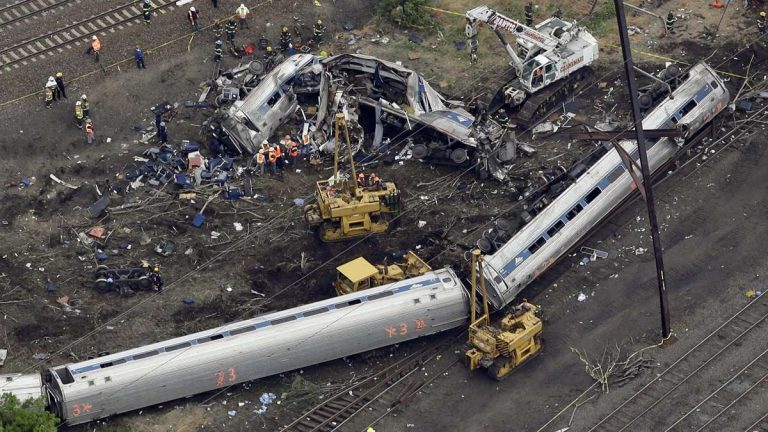
Nearly seven years after an Amtrak train derailed outside Philadelphia, killing eight people and injuring more than 200, the train’s engineer will face a criminal trial.
Starting Thursday, a panel of jurors will be asked whether the crash was a tragic mistake or a crime. The trial was initially scheduled to begin Tuesday but was delayed due to scheduling issues, according to lawyers working on the case.
The charges against engineer Brandon Bostian, 38, include involuntary manslaughter and reckless endangerment.
Those charges have taken a complicated path through the legal system since the 2015 crash. Initially, former Philadelphia District Attorney Seth Williams declined to prosecute. Then, a series of courts dismissed, then revived the case. It’s now before Common Pleas Court in Philadelphia, and the state attorney general’s office is prosecuting.
Amtrak Train 188, which was traveling from Washington D.C. to New York City in May 2015, derailed on a curve in Frankford. The speed limit on the stretch was 50 mph, but Bostian sped the train up to 106 mph before it left the tracks. The derailment left him with a concussion, and he has said since that he has no memory of the entire incident.
“This has just been a case the likes of which I’ve never seen in 30 years,” said Brian McMonagle, one of the attorneys representing Bostian. “This was an accident and not a crime. And it’s unfortunate that we have to have a trial.”
Related Content
|
|
(Editor's Note: Ultimately, this conflict comes down to a fight over PSR. Does this nation allow the Class One rail carriers to continue to use an operating model that emphasizing extremely long and heavy trains, consume vast amounts of track capacity, provide lousy service to shippers, prevent passenger train expansion, while lavishing record profits to their stockholders? Or do we demand that the railroad infrastructure of the USA be used for the benefit of all? What is playing out on the Gulf Coast is surely to affect the direction in which rail industry goes in the coming years. ) |
|
Why Amtrak’s Petition to Restore Gulf Coast Service has Nationwide Implications |
|
But according to the Association of American Railroads (AAR), 97% of Amtrak’s 22,000-mile system uses tracks owned and maintained by the freight railroads. Amtrak does own approximately 730 route miles, primarily in the Northeast Corridor, which accounts for about 40% of Amtrak ridership.
Because Amtrak must use the freight rail network, any expansion of passenger rail service could affect not only freight rail operations but also the shippers and ports that depend on the freight rail network.
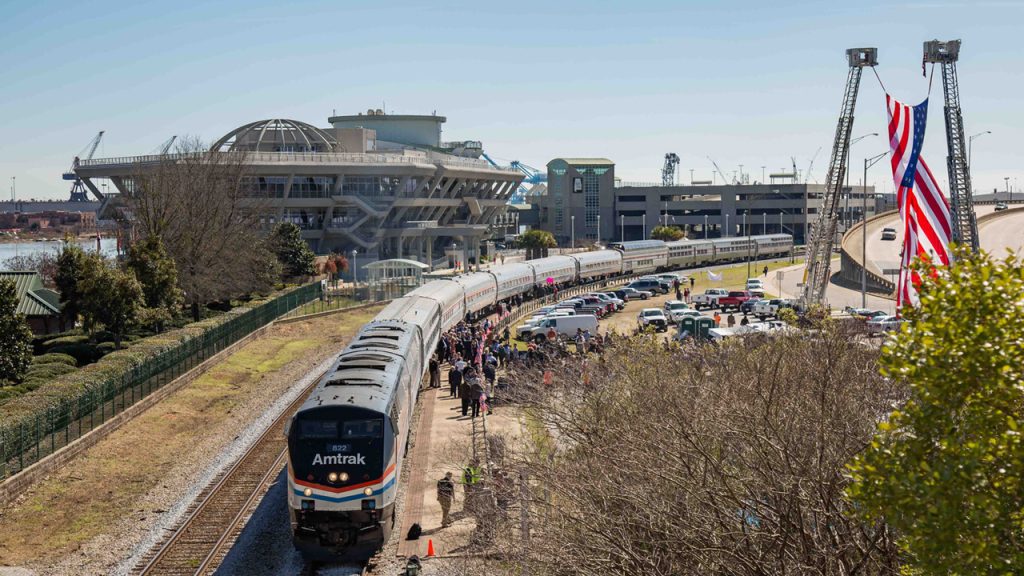
The question of how to accommodate both freight rail and passenger rail is currently before the Surface Transportation Board. Amtrak wants STB to require CSX and Norfolk Southern to let Amtrak use their tracks between Mobile, Alabama, and New Orleans to restore Gulf Coast service between the cities that was washed out by Hurricane Katrina in 2005.
However, a lot has changed since 2005, notably the growth at the Port of Mobile, which Alabama relies on to fuel its economy. Stakeholders testified last Tuesday and Wednesday about what factors the board should consider as it mulls Amtrak’s request.
Speakers included local and state officials for and against Amtrak’s request. Active parties in the case — CSX, Norfolk Southern, Amtrak and the Alabama State Port Authority — will present their arguments on March 9, although they reaffirmed their positions this week at the close of the two-day hearing.
Below are five takeaways from last week’s hearing.
A precedent-setting proceeding
Amtrak brought the issue to STB after years of discussions among itself, CSX and NS. Amtrak contends that the other parties have slow-walked the prospect of service restoration. CSX (NASDAQ: CSX) — whose tracks Amtrak would use for the majority of the route — and NS (NYSE: NSC) argue that Amtrak backed out of a study that would have looked at the impacts passenger rail would have on freight rail in the region. That history is described in more detail here.
“One of the victims that remains is passenger rail service along the Gulf Coast. It was just one of the many harms that resulted. But it has proven difficult to set right and I’m hoping that we are at a moment of fruition in that regard,” said Sen. Roger Wicker, R-Miss., who has been advocating for the resumption of Amtrak service on the Gulf Coast for years. Wicker added that the population has steadily increased in the region since 2010, which in turn has increased demand for transportation options.
“I want to emphasize that this endeavor is not a zero-sum game. Mississippians can and should have access to efficient freight movement and effective means of passenger travel. … This case is not an abstract policy question. It’s about continuing and completing the recovery some 16 years later,” Wicker continued.
|
|
(Editor's Note: Everyone who wants more passenger trains is encouraged to fill out this form and submit your comments to the Federal Railroad Administration by March 9th. This is truly a historic opportunity to revive passenger trains in the U.S. and provide for thousands for good paying union railroad jobs. Got some good ideas for new rail service in your neck of the woods? Let 'em know!) |
|
FRA Seeks Public Comments on New Program with Far-Reaching Impacts |
|
Please submit a comment regarding the Corridor Identification and Development Program to the Federal Railroad Administration (FRA). Comments are due by March 9, 2022.
You can use or edit the suggested text that we have provided on this page. Please feel free to customize it.
At the top of the comment section you can add: “I am particularly interested in improved service to CITY, STATE, because….”
The Corridor Identification and Development Program was created by the recently passed Infrastructure Investment and Jobs Act. While it doesn’t disburse any funds on its own, this Program creates a process for choosing, prioritizing, and building a pipeline of projects for various funding programs for trains, such as the Federal-State Partnership for Intercity Passenger Rail and the Consolidated Rail Infrastructure and Safety Improvements (CRISI) Program.
The FRA’s recently published Request for Information seeks public input on the structure of the Corridor Identification and Development Program. The FRA has made it clear that they want input from a wide range of sources. Many of the FRA’s questions are technical, and meant for inside players, so don’t worry about providing a direct response to them all. It can still help to provide general comments, plus details about what you hope to see where you live.
|
|
(Editor's Note: It is about time that the Class One's take such necessary measures to recruit employees. Here is our advice to NS and the other Class One carriers wishing to recruit and retain good employees: Bargain in good faith, stop stringing us along at the table, provide decent wages, benefits and above all - better working conditions - and you will be able to recruit and retain all of the employees you need. There is not a "labor shortage" in this country. There is a "good jobs shortage.") |
|
Norfolk Southern Offers Bonuses to Recruit More Conductor Trainees |
|
Norfolk Southern Corp. yesterday announced it's offering starting bonuses of up to $5,000 for conductor trainees staffed in priority locations and $2,500 for those stationed in other locations.
Priority locations include Binghamton and Buffalo, New York; Cincinnati, Ohio; Louisville, Kentucky; Manassas and Roanoke, Virginia; Harrisburg and Conway, Pennsylvania; Birmingham and Sheffield, Alabama; Chattanooga, Tennessee; and Linwood, North Carolina.
"We are actively hiring people who want a high degree of responsibility, thrive in autonomy and desire a sense of pride in the work they do," said Brad Dodd, NS' director of talent acquisition, in a press release. "In return, they can expect great pay, best-in-class healthcare benefits, technical training and professional growth opportunities."
Once training is completed, NS conductors are guaranteed a minimum annual pay of $52,000. Conductor’s annual guaranteed minimum earnings progressively increase over their next four years of service to approximately $63,500.
If promoted to locomotive engineer, a conductor could earn a guaranteed minimum annual pay of about $94,000. Many engineers earn more than $100,000 annually, said Dodd.
|
|
(Editor's Note: Despite the fact that truck and air freight rates have skyrocketed the past two years, the rail industry has been incapable of capitalizing on this. Rail freight should be booming as a result. But due to PSR, the rail carriers are moving less freight that they were a few years ago. In fact, they are moving less freight than 16 years ago! The sad fact is that unless new rail freight traffic can immediately return 45 cents on the dollar, the Class One carriers do not want it. The rail industry itself is sabotaging rail transportation in the U.S.) |
|
Freight Rate Hikes Over Past 2 Years Unprecedented, Economist Says |
|
No one needs to tell the users of transport services how high freight rates have climbed during the past two years. But recently released producer price data from the federal government provides empirical evidence to support the painful anecdotes.
The numbers are striking. Import air cargo rates rose 80% from January 2020 through January 2022, due largely to a massive curtailment of belly cargo capacity, which in normal times accounts for about half of international air commerce. Freight brokerage rose by 45% over that time. Rates for truckload, LTL and specialized transportation increased 25%. Parcel rates rose 14.7%, while prices for warehousing services increased 20.5%, with much of that coming after July 2021 as demand spiked hard due to the ripple effect of supply chain bottlenecks at various U.S. seaports.
“We have never seen anything like this before,” said Jason Miller, associate professor of logistics at Michigan State University’s Eli Broad College of Business, referring to the extent of the increases. Miller built a series of charts from the data, which came from the Department of Labor’s Bureau of Labor Statistics and the U.S. Census Bureau.
The good news, at least for some users, is that January’s numbers may be the worst of it, Miller said. For example, his data indicates that demand for truckload services has plateaued as consumers throttle back on what has been an unprecedented two-year spending orgy. At the same time, more truckload supply is entering the market, helping to tamp down rates. The risk for truckload rate declines in the second half of the year is quite high.
|
|
U.S. Railroads Log Traffic Increase in Week 7, But Total Volume is Down so Far this Year |
|
U.S. freight-rail traffic spiked during the week ending Feb. 19, rising 31.7% to 497,822 carloads and intermodal units compared with the same week last year, according to Association of American Railroads (AAR) data.
Total carloads rose 38.2% to 237,256 units, while intermodal volume climbed 26.3% to 260,566 containers and trailers.
All 10 carload commodity groups that AAR tracks posted increases during the week, including coal, up 22,547 carloads to 71,293; nonmetallic minerals, up 12,464 carloads to 28,554; and chemicals, up 11,451 carloads to 35,305.
|
|
(Editor's Note: Railroad workers will recognize the issues raised by these employees of Hershey's. They are fighting back and resisting the oppression of forced overtime, harsh attendance policies and all the rest. Watch the video! NOTE: This is the same outfit, "More Perfect Union" who did the video with RWU a few weeks ago. If you missed that one, you can see it HERE.)
|
|
"Hershey Prison:" Workers EXPOSE Brutal Working Conditions At A Hershey Factory |
|
The workers who make Reese's Peanut Butter Cups describe going to work as a stay in "Hershey's prison."
Once you hear their stories you won’t think it’s an exaggeration. Workers have been forced to work 70+ days straight, receive constant forced overtime, and are punished for taking time off -- if they can even get time off approved.
|
|
|
|
|
|
|