e-Newsletter | October 28, 2022
|
|
Behind the Images: Anatomy of a Stereo-view
By Bethany Groff Dorau
Since my adolescence spent wandering through Oak Hill Cemetery and on to my master’s thesis project on 19th century mourning customs, I have been fascinated by changing cultural representations of death, dying, and mourning. From skull heads and strict “Remember Death” injunctions of the 17th and early 18th centuries to willows and urns of the late 18th and 19th centuries, through wilted roses and lambs of the 19th century to the myriad of individualistic representations available today, death, as inescapable as it is, changes its form to suit the times.
And so, I have been on the sharp lookout for historic images that teach us something about how death and dying were experienced in the past in Newbury, West Newbury, and Newburyport. Thus far, aside from one poor old ancestor of mine who I was convinced was post-mortem in an old daguerreotype (I am no longer so sure), and heaps of images of Oak Hill Cemetery, considered to be one of the most beautiful parks in Newburyport (I concur), we have precious little.
|
|
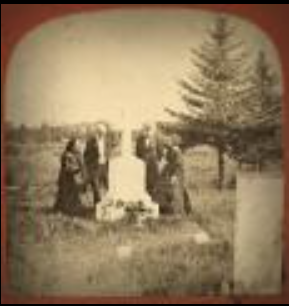
The stereo-view image as first seen in low-resolution, identified as a Newburyport graveside scene, c. 1875
I was excited to stumble across this tiny, fuzzy image on the internet, labelled, incorrectly as it turns out, as a photograph taken by Daniel T. Reed, a Newburyport photographer. The people in the view are not identified, nor is the location. The internet poster theorized that the image was taken c.1875.
|
|
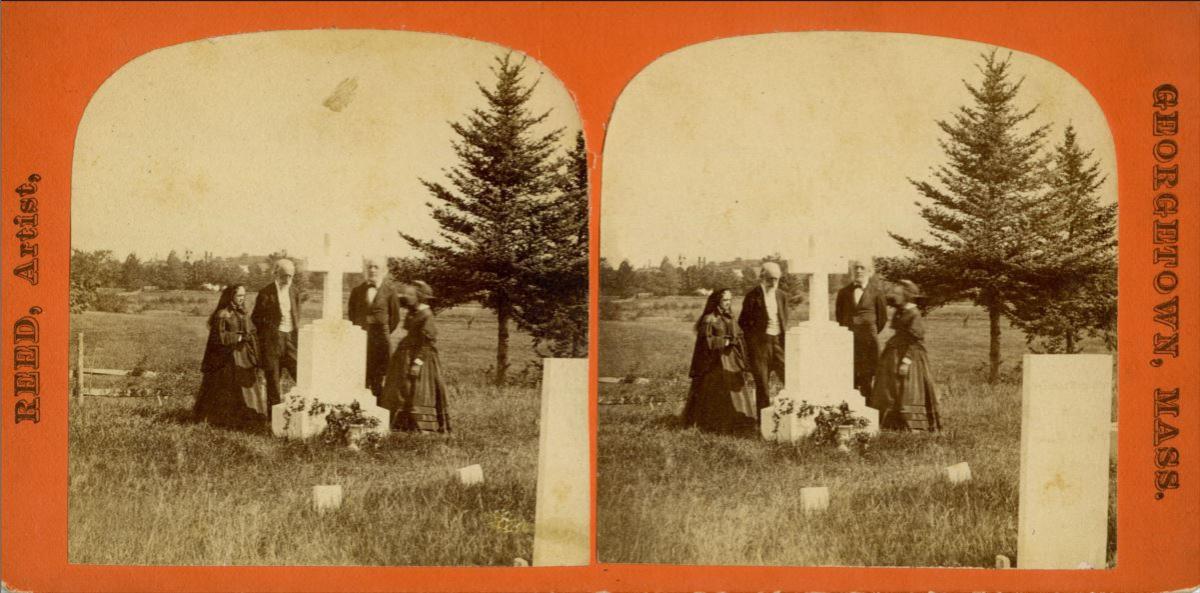
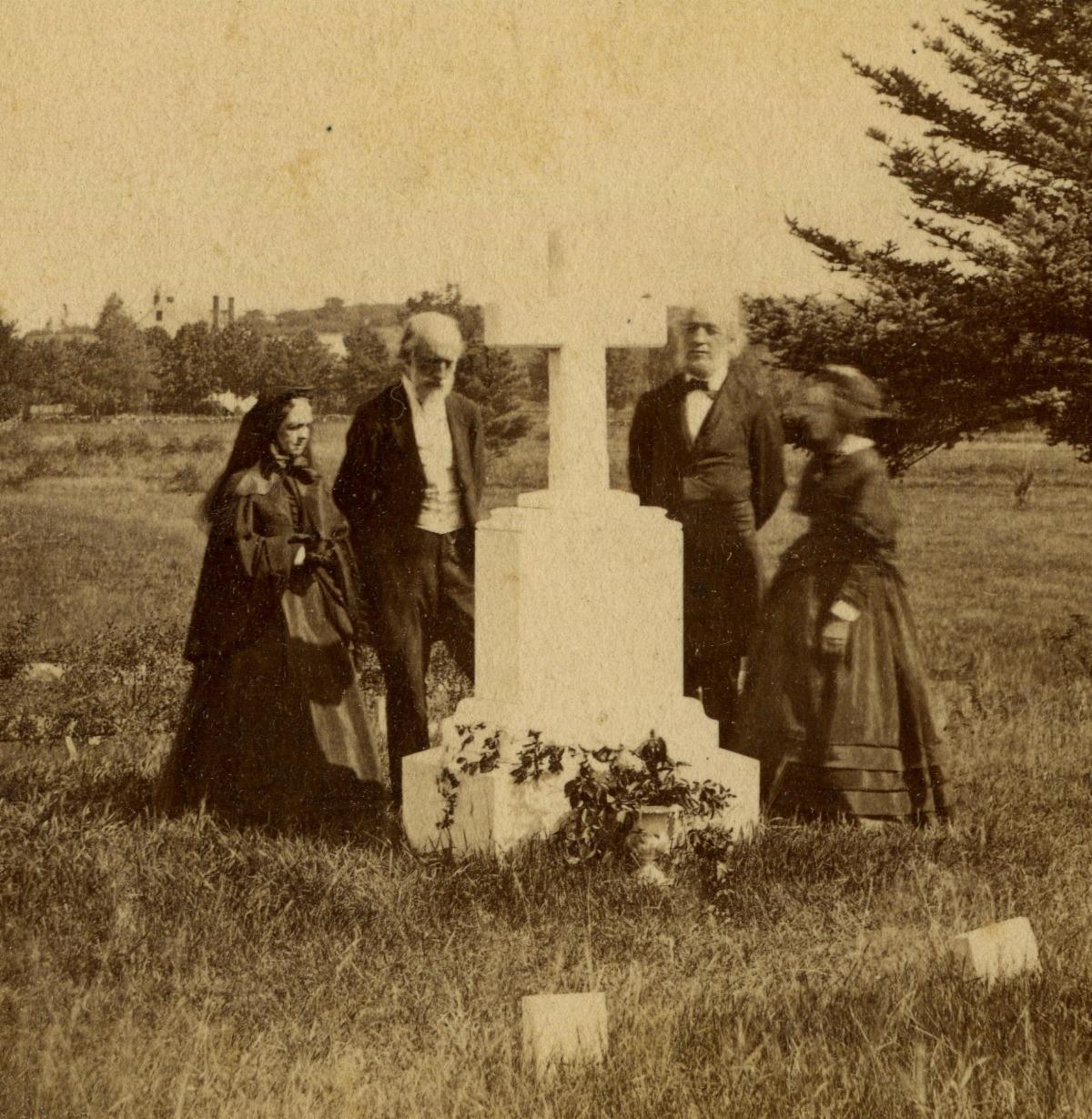
This stereoview photo card was taken with the subjects in mourning dress, so likely before 1869. From the collection of the Museum of Old Newbury.
Imagine my surprise when, preparing for a presentation here, I came across the same image, an original stereo-view card, with some tantalizing clues! First of all, the photographer is not Daniel Reed but his son Selwyn C. Reed, and he did have a business in Newburyport from the 1860’s until the 1910’s, first above the drugstore at the corner of State and Pleasant Streets and then at his home on Garden Street. But as this card indicates, he also had offices on Central Street in Georgetown. But still, are these Georgetown people? Why do we have this image in the collection of the Museum of Old Newbury?
|
|
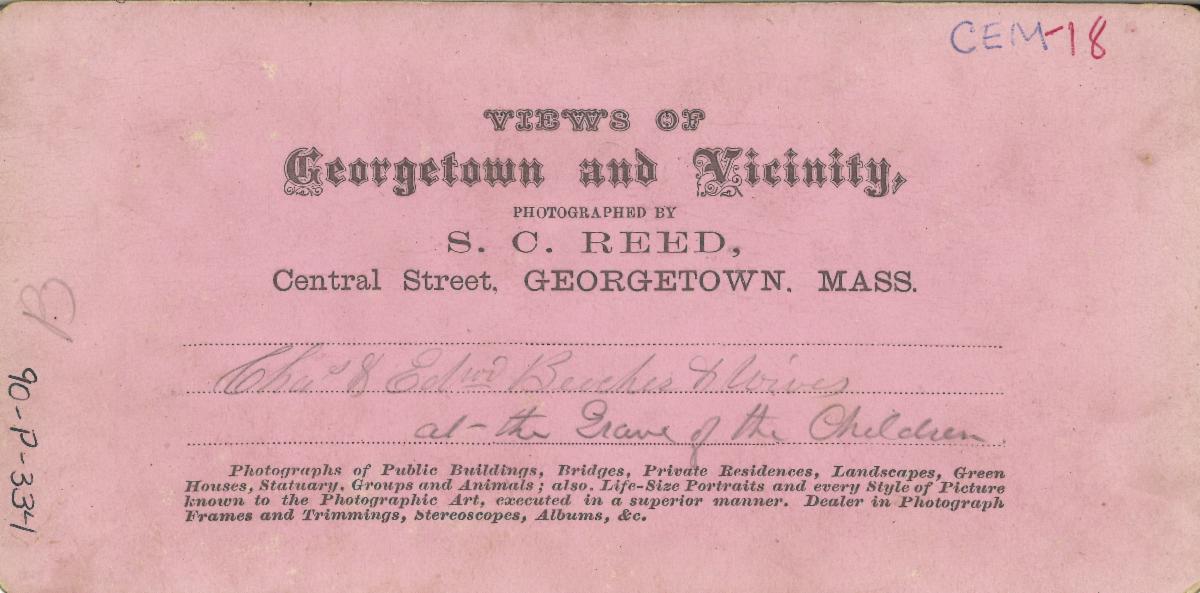
The back of the card identifies it as being from the studio of S.C. Reed in Georgetown, purveyor of “every style of picture known in the Photographic Art…”
And then there is this, in faint pencil, “Chas & Edw Beecher & Wives at the Grave of the Children. Sometimes a wild stab in the dark pays off. Who do you know named Beecher? Most likely Harriett Beecher Stowe or her brother Henry Ward Beecher, two extraordinarily famous people in mid-19th century America. I looked them up. They had an older brother Edward, and a younger brother Charles. We scanned the stereo card at an absurdly high resolution, blew it up and scrutinized the faces. It seemed possible that they were a match, but it was difficult to be certain. Why were they in mourning clothes, and who were “the children”?
|
|
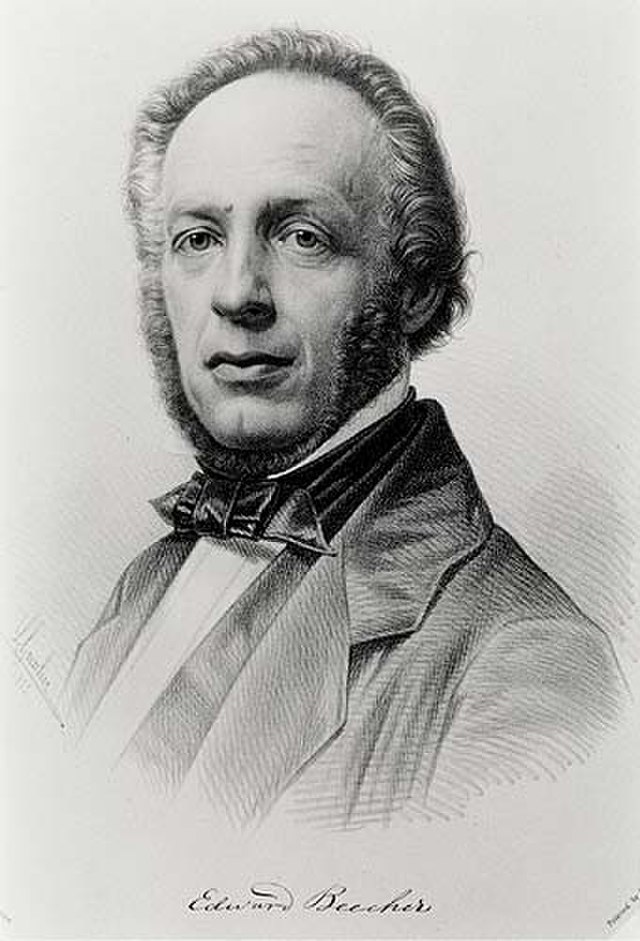
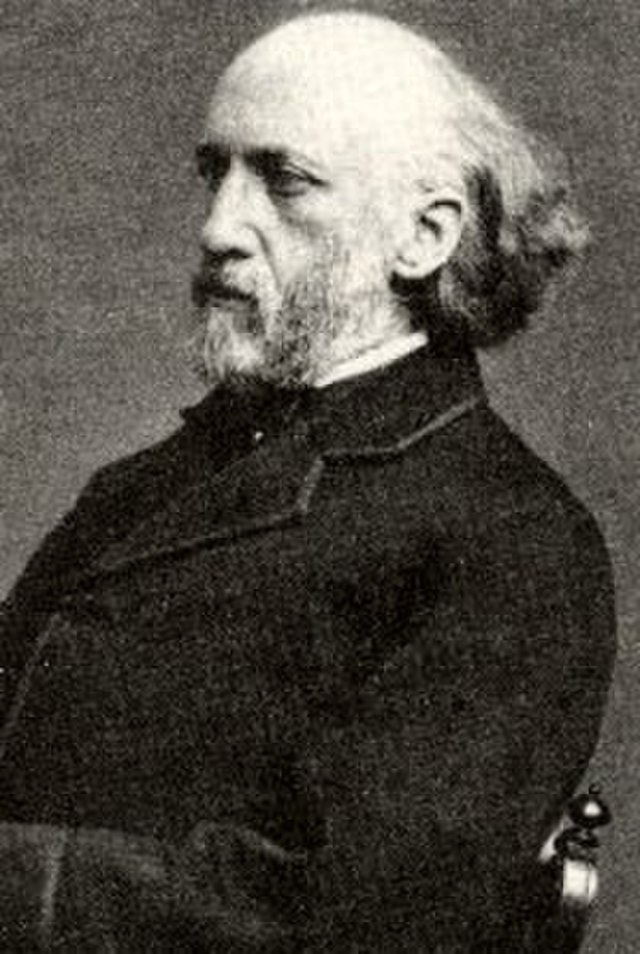
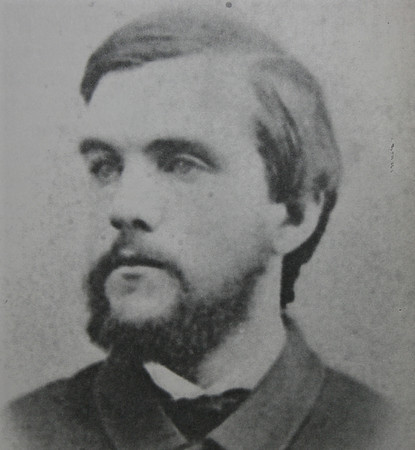
Rev. Edward Beecher (1803-1895) (left) and Rev. Charles Beecher (1815-1900)(right).
I started with the older brother, Edward. No mention of any connection to Georgetown or Newburyport in his biography. Born in New York, preached in Illinois, died in Brooklyn. Seemed unlikely to have been him.
I moved on to Charles, somewhat deflated. Huzzah – Charles Beecher was the minister of the First Congregational Church of Georgetown from 1857 to 1881. He lived on Central Street, not far from Selwyn Reed’s studio, above the current Village Pizza.
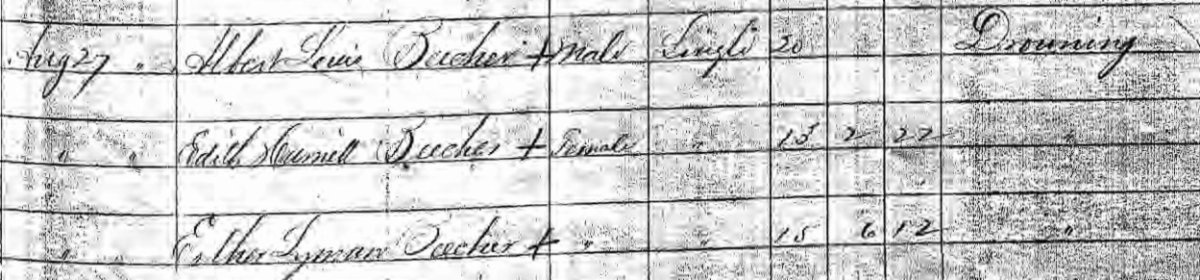
The 1865 census lists him as having six children and being married to Sarah Coffin Beecher, who was, of course, a descendant of the Newbury Coffin family. A deeper dive into the names of his children reveals a tragedy – his two youngest children, Esther Lyman Beecher and Edith Harriet Beecher appear together on the same death register, on the same day. The cause? Drowning. Another Beecher, a 20-year-old man named Albert Lewis, is there too. His father is Edward.
|
|
Massachusetts vital records collection, Georgetown MA, 1867 (from ancestry.com)
The newspaper is the next natural step here, the best way to confirm details that may not appear in the official record. On August 28, 1867, the day after the deaths of these three young cousins, the Newburyport Daily Herald reported the sad details.
“On Tuesday, a party, two sons of Doctor Edward Beecher of Galesburg IL, two daughters of Rev. Charles Beecher, and a son of Rev. William Coffin of Batavia NY, a brother of Mrs. Charles Beecher, were sailing in Pentucket Pond, in Georgetown, when the boat upset, and three of them were drowned. One was a young man of 20 years, son of Dr. Edward Beecher, and two were daughters of Reverend Charles Beecher - girls of 16 and 12 years. The deaths were all, therefore, in one family, but the story thereof will carry sadness to many hearts. From a moment of exciting enjoyment, three young and happy souls were rushed into eternity. The bodies were recovered in about 3 hours.”
Three days later, more news. “The cause of the melancholy accident by which three of the Beecher family were drowned in Georgetown, is said to have been the losing of a knife overboard, when all the party leaned over to one side to ascertain if it could be seen in the clear water. The boat careened to that side, and in alarm they all rushed to the other side and tipped the boat over.”
|
|
Lt. Frederick Henry Beecher, 1841-1868
I have been unable to locate any photographs of the three young people who died on that tragic day in 1867, but there are photographs of Charles and Sarah Coffin’s eldest son, Frederick, who died one year later in present-day Colorado in the Battle of Arickaree Fork. Though his body was never found, his memorial is on the same stone as his sisters and cousin.
We may assume that the triple tragedy suffered by the Beecher family, along with their celebrity siblings, contributed to the interest in this image. Selwyn Reed sold copies of this stereo-view as a “View of Georgetown and Vicinity”. But one must wonder why two sets of grieving parents agreed to be photographed in this way, in 3D, at what must have been a terrible moment in their lives. They must have known that this image would be circulated, as indeed it was, even a century and a half later.
|
|
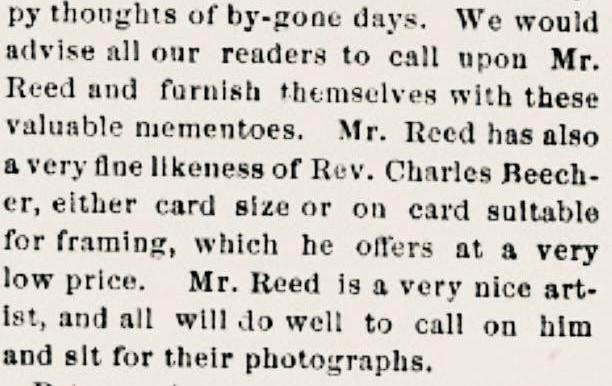
Selwyn Reed advertised “a very fine likeness of Rev. Charles Reed” in the Georgetown Star newspaper in 1871. Image courtesy of Dan Meader.
The key to this, for me, is understanding how important it was for people in the 19th century to ensure that their loved ones would be remembered, particularly in lieu of photographs taken in life. This spurred on the practice of post-mortem photography, and may have, in this case, contributed to the Beecher family’s desire to be together, near their lost children, recorded forever.
|
|
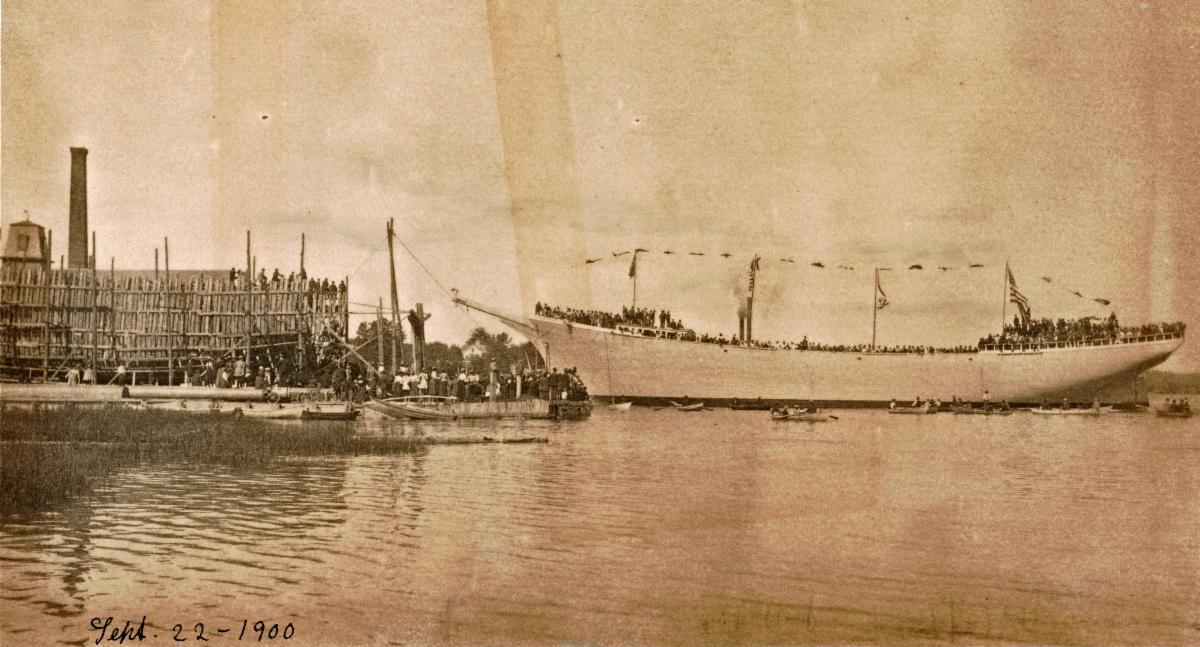
Launch of the schooner "Edith H. Symington." Collection of Museum of Old Newbury and included in "Newburyport Clipper Heritage Trail, Vol. II."
Book Launch Party - Newburyport Clipper Heritage Trail, Vol. II -with Ghlee Woodworth
Wednesday, November 9, 6:30 p.m., 98 High St., Newburyport.
Join us as we celebrate the new work of Ghlee Woodworth, author, speaker, local historian, tour guide, and community volunteer extraordinaire. Ghlee will illuminate the stories and images in the second volume of her Newburyport Clipper Heritage Trail series.
Reserve your signed copy of this fascinating historical record and guidebook. Ghlee will take you through the city, visiting shipyards, authors, poets, sea captains, photographers, cemeteries, and Plum Island. See a castle, the sites of old cotton mills, schoolhouses, a distillery, and comb factory, a hotel and lighthouse, and hear about a summer camp for disabled children. You’ll even discover Wonder Woman’s connection to Newburyport!
Reception is free but book purchase is required. Ghlee will present to a general audience at a later date. This event is a reception and book sale for the author.
|
|
Woman on the MOON
...a blog by Bethany Groff Dorau, Executive Director
|
|
"They Were Innocent Persons..."
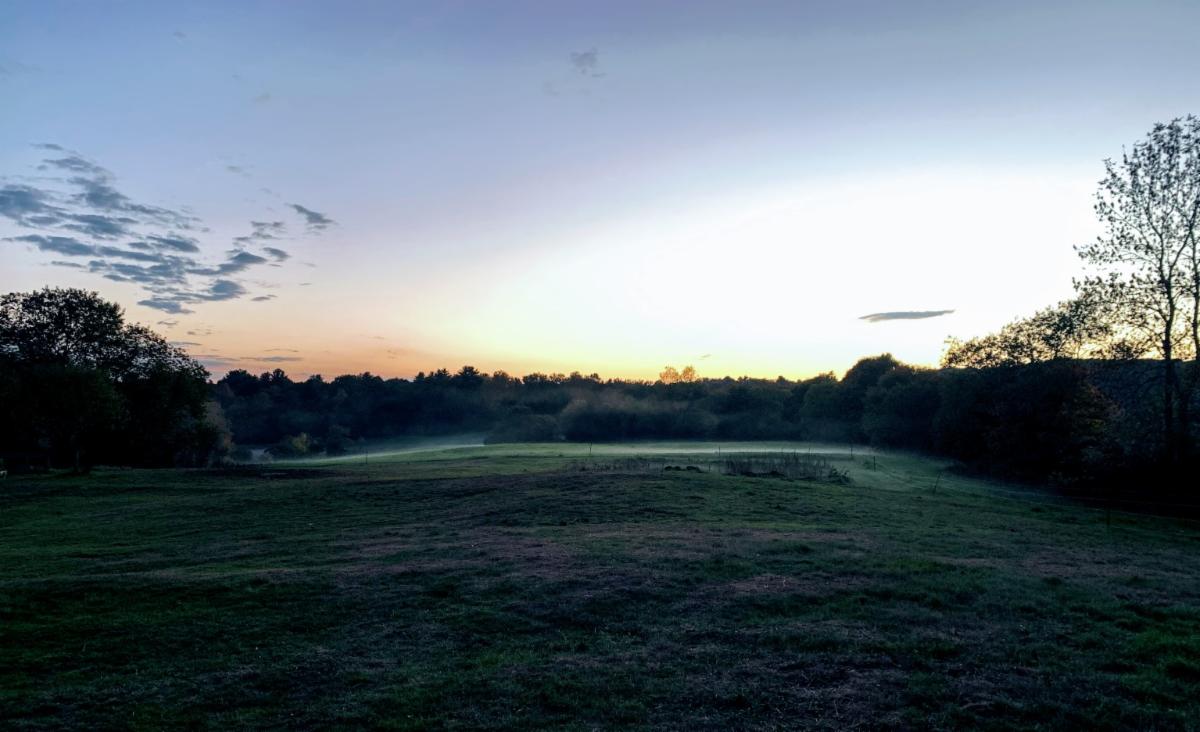
I woke up this morning before dawn, the only sound the muffled thud of our plow horse’s feet in the meadow below my window. I walked outside in my pajamas, barefoot, looked back at the outline of my old house, the great elm tree planted by my great-great grandfather all auburn leaves and gnarled branches. The sky was barely grey around the edges, a thick mist rising from the still-green fields. It was cold, a shimmering frost on the grass. A crow sat atop the flagpole, a repurposed ship spar, and cawed a reply to the last owl of the night. I was half awake, the shadow of a dream lingering. No wonder people believed in spirits, good and evil, I thought. This is a haunted land. I thought of the people accused of witchcraft mounting the scaffold in the cold hours of a fall morning in 1692, their village a warren of ancient houses and…
|
|
The Poore Farm fields at dawn on a fall morning, 2022.
My favorite ghost, my great-aunt, Emily Noyes Poore, came up behind me and snorted. “NONSENSE.” Hers is a true haunting, entirely internal. She does not float along in ethereal mists, nor does she appear as cold vapors in the corner of the room. No. She is, more’s the pity, very much actually dead, but she said just enough in her 96 years of life to be with me always, especially when I am succumbing to the charms of mythical nonsense.
And she thought, for good reason, that people dressed as witches and heading off to Salem as if this was connected somehow to the witchcraft accusations of 1692 was as big a pile of nonsense as she had ever encountered. I’ll recap her best arguments:
1. There were no witches.
2. There were no witches.
3. There were no witches.
Please do not misunderstand me. Aunt Emily was not without a powerful sense of fun. She tobogganed well into her 70s with any child who asked, loved a good go-cart race at Salisbury Beach, and occasionally landed a legendary zinger. Once, I said in my best romantic Anne of Green Gables voice that I wished I could live in the crumbling farmhouse owned by an elderly neighbor. “I think he’s single,” she snorted, and chuckled privately at the thought for hours.
|
|
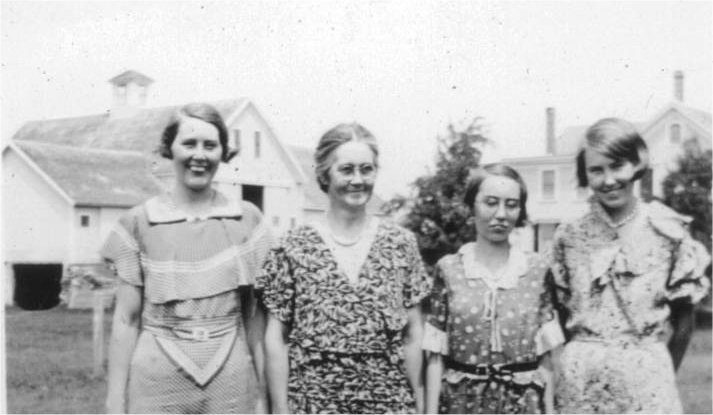
Emily Noyes Poore did not have an easy life. Her mother, the sunshine of her dour old family, died in 1934, when she was barely 14. Her father, who could barely eek a living out of the rocky soil of West Newbury in the best of times, was paralyzed by grief as the Great Depression sucked all the remaining resources from the household. Furniture was sold. The house went unheated in winter. Milk was cut with water. I think that this figured into her general distaste for things supernatural or other-worldly. For her, this present world was hard enough. There was no energy or time to devote to the shadowy forces of darkness. |
|
Emily Noyes Poore, second from the right, with her mother, Mary Dyer (Noyes) Poore, and sisters Charlotte and Louise, the year her mother died.
I respect that, but like so many of the Newbury families in the 17th century, I have an active imagination and veer toward superstition. I can certainly understand how, in a world where almost everything seemed beyond human control, people saw malevolence around every corner. The events of 1692 are so frightening to me because they are so normal, so much a part of the way that human beings often behave. I remember leaving a West Newbury town meeting years ago where a particularly contentious land dispute had been raised. One of the combatants, an older woman, walked out ahead of me while the person behind me said, “they used to burn people like her at the stake.” There was laughter, and a rising cold fear in my chest.
|
|
I know, I know, nobody in 1692 was burned at the stake. Nineteen people were hanged, Giles Corey was pressed to death, and five people died in jail. Put your letter to the editor away. My point is that you can too-easily draw a straight line between the festering squabbles of small-town life today and witchcraft accusations three centuries ago. And the witchcraft trials seem uncomfortably close right now, and our bonds of civil cooperation particularly perilous.
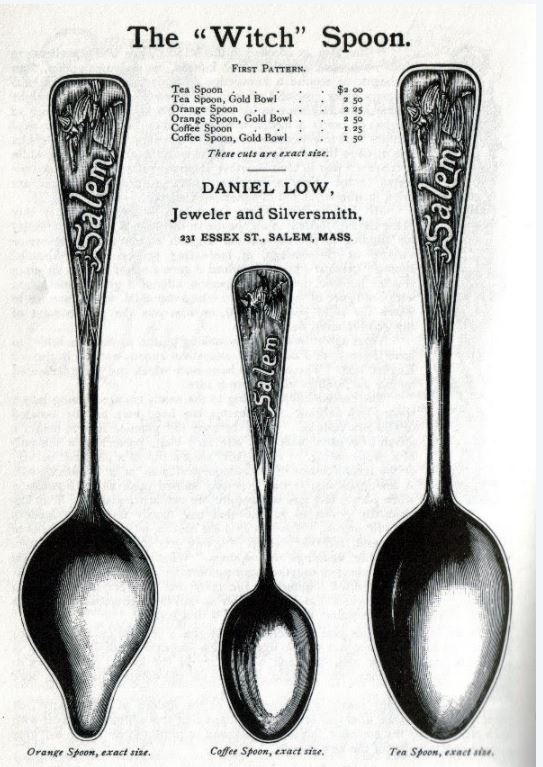
And so, I am having a harder time than usual this year getting into the spirit of Halloween, particularly of the Salem, witch-hat variety. I know the ties between the costumed revelers and the actual witchcraft trials are tangential at best, a bit of wildly successful marketing that began with the sale of souvenir spoons in Daniel Low's late 19th century Salem shop.
|
|
Advertisement for the Salem “witch spoon” that helped solidify Salem as a tourist attraction.
I just can’t get past the fact that this town, this community whose history I love so passionately, was complicit in the judicial murders of 1692. Wicked complicit. Though no Newbury residents were executed in 1692, I can confidently say that there is not one single person involved in the trials, either as accused or accuser, that did not have some connection to Newbury. Their world was simply too small.
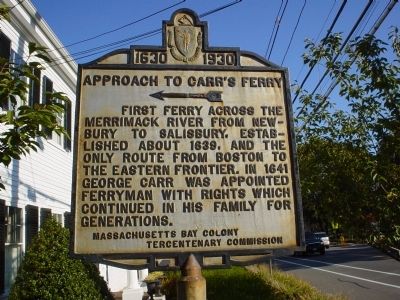
Ann Putnam, whose daughter, also Ann, was one of the “afflicted” girls, primary accusers during the witchcraft trials, was born Ann Carr. Her father, George Carr, was the ferryman first from Newbury to Salisbury via Carr’s Island in the Merrimack River, and then, as business boomed, just the leg from the island to Salisbury. The Carr family is tremendously important in the 17th century history of Newbury. The Carrs were a contentious and litigious family, and so their voices are well recorded in the Essex County Quarterly Courts, where I spend a great deal of my discretionary time. Ann Putnam Jr., granddaughter of George the ferryman, accused a staggering 62 people of witchcraft. Twenty-five people died as a result – five of them in prison.
|
|
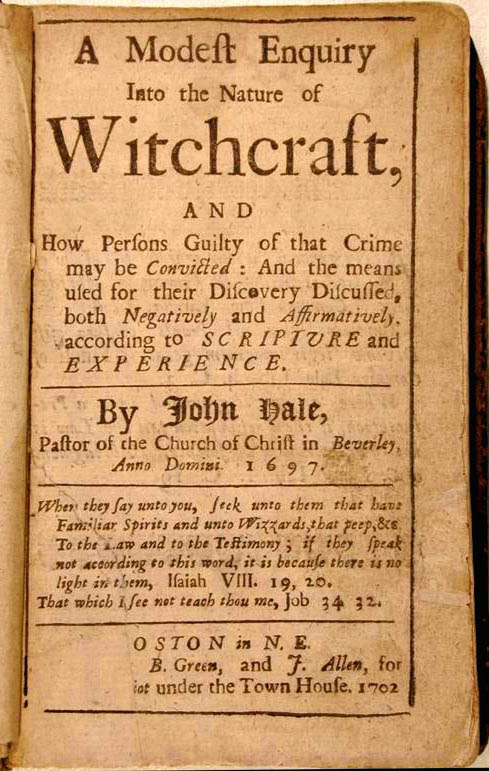
Newbury’s John Atkinson, his wife Sarah, and Ensign Joseph Knight all testified against Susanna Martin, who was hanged alongside Rebecca Nurse. Judith Coffin of Newbury was the mother-in-law of both Joseph Knight and Rev. John Hale (1636-1700) of Beverly, author of A Modest Enquiry into the Nature of Witchcraft and one of the most influential voices in the 1692 witchcraft trials. |
|
Rev. John Hale, married to Newbury’s Elizabeth Somerby, was considered an authority on witchcraft at the time of the trials.
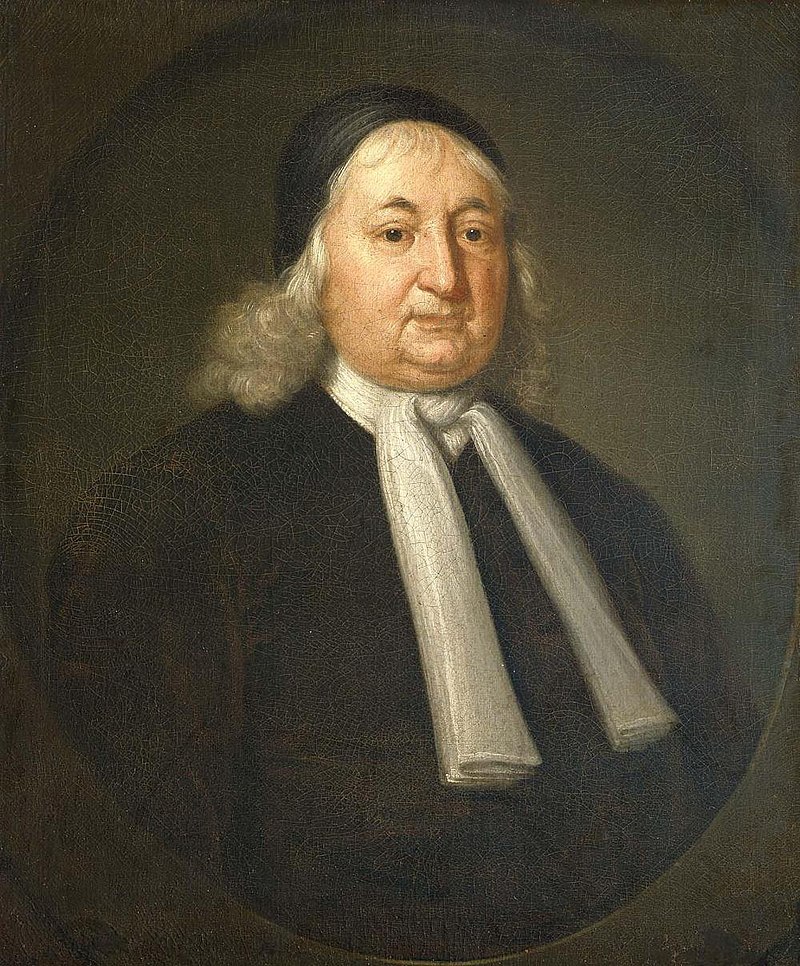
And then there is Judge Samuel Sewell, who also grew up in…you guessed it…Newbury. His mother was living on High Road during the trials, in a house that Sewall later inherited.
|
|
Smibert’s 1729 portrait of Samuel Sewall. Image courtesy of Museum of Fine Arts, Boston.
Aunt Emily (and I) descend from accused and accusers, judges and jurymen, the murdered and the reprieved. It did not take long for these families to begin intermarrying once again, the thin pool of possible spouses triumphing over any lingering bad feeling from that time your grandpa sentenced my grandma to death.
|
|
And maybe that is the lesson here, the ultimate triumph. Communities can only convulse for so long before a trauma becomes a fading memory, or conversely, a ginned-up tourist attraction, a celebration of a mythic past.
And I will leave you with this bit of hope. Ann Putnam, granddaughter of the one-time Newbury ferryman, was the only one of the 1692 accusers to apologize publicly. “I desire to be humbled before God…that I, then being in my childhood, should…(have been) made an instrument for the accusing of several people for grievous crimes, whereby their lives were taken away from them, whom, now I have just grounds and good reason to believe they were innocent persons…”
So, to recap my best arguments:
1. Apologize when you’re wrong.
2. Look out for each other.
3. There were no witches.
Happy Halloween, all! Despite myself, I love it – I promise!
|
|
Something is Always Cooking at the Museum |
|
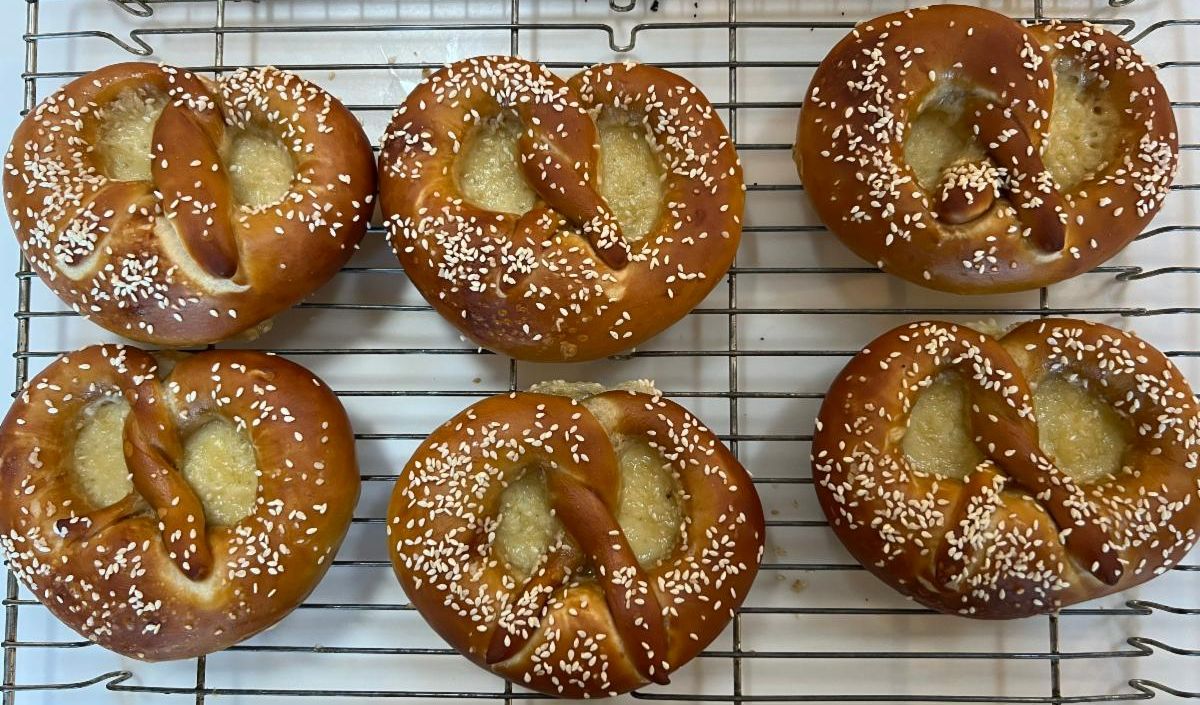
Home-made Pretzels (makes 16)
October has been a month full of pretzels in this corner of the world. It's an easy and quick yeasted dough. The only trick is in the shaping. While a traditional pretzel is dipped in lye to give it its shiny brown exterior, this method uses a baking soda bath. -Kristen Fehlhaber
For the dough:
1000g bread flour
80g butter
600g warm water
10g instant yeast
20g salt
1 T brown sugar
For the bath
1/3 cup baking soda
4 quarts water
Toppings:
Kosher salt, sesame seeds, poppy seeds
To make the dough, cut the butter into the dough (if your butter is cold, you can grate it on a cheese grater to speed up the process). Add water, yeast, salt, and sugar. In a mixer, mix for 10 minutes (Kitchen-Aid speed 2). The dough start out too dry but it should come together in a few minutes. By hand, give this dough 15 minutes of kneading. Immediately divide the dough into 107 gram portions. Flatter and roll up into a cigar shape. This pre-shaping will make the pretzel shaping easier. Once you've got 16 rolled up pieces of dough, cover and let them sit 10 minutes. Take one piece and using both hands on a clean surface, roll and press and stretch the dough. You should be able to get it to 24 inches or longer.
Lay out the dough-rope in a U shape. cross the arms twice, 1/3 of the way down from the top. Press the ends into the dough an voila, you have a pretzel. Place on a baking sheet, cover, and chill for 1 hour or more.
For the bath: bring water to a boil and add baking soda - it will foam up. Set to simmer. Carefully put each pretzel in the bath for 40 seconds, flipping half way through. Remove with a slotted spoon and place on a parchment paper lined baking sheet.
Add toppings and bake at 350F for 30 minutes. Variation shown in photo: Add 1/4 cup grated cheese (cheddar or Swiss) on the baking sheet before placing a pretzel on top to bake. Recipe adapted from Daniel Leader, "Local Breads."
|
|
Click on image above to play the puzzle |
|
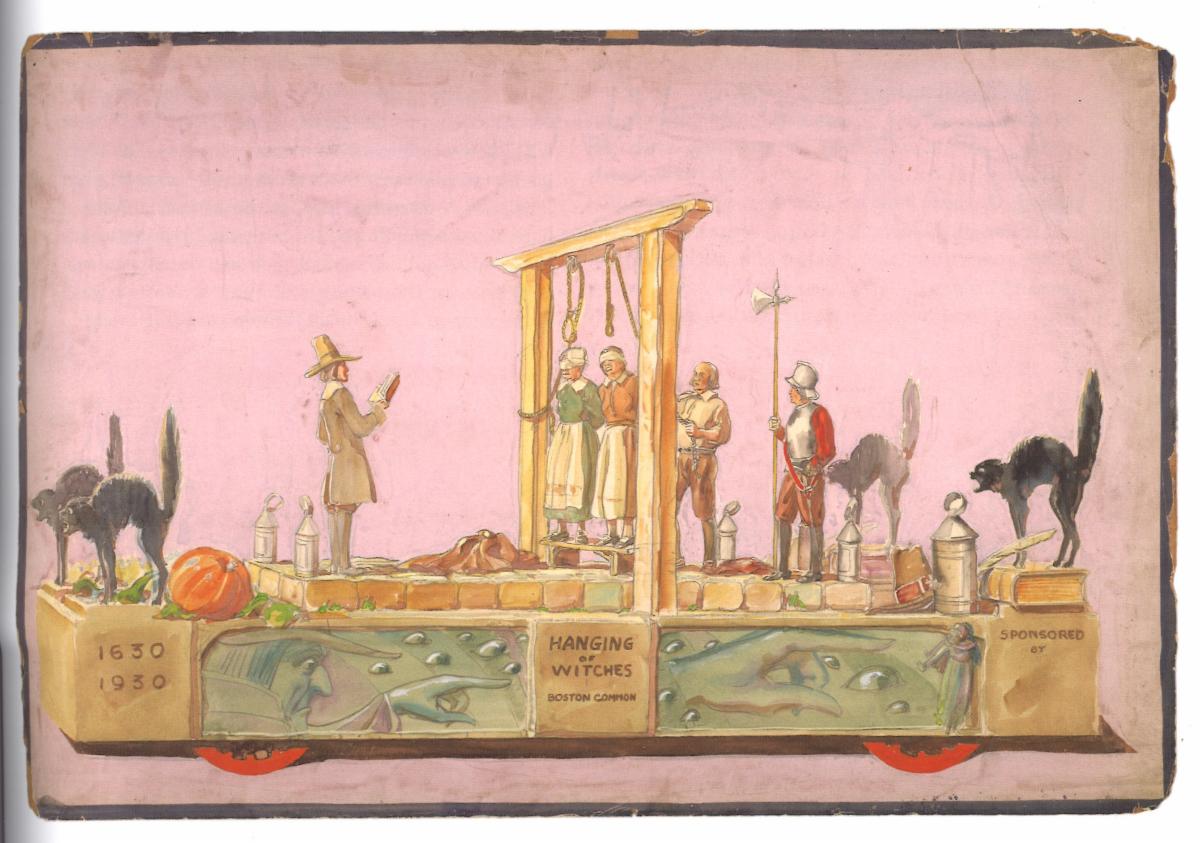
Boston parade float, 1930 Tercentennial
This float mixes the historical with Halloween references. It was built by Messmore and Damon, parade float makers in New York, and comes from "The Best Ever! Parades in New England, 1788-1940" by Jane C. Nylander.
|
|
Museum e-Newsletter made possible through the
generosity of our sponsors:
|
|
|
Museum of Old Newbury
98 High Street
Newburyport, MA 01950
978-462-2681
|
|
|
|
|
|
|
|