Diagnosing Nutrient Deficiencies
|
|
Chris Augustin
Director
Dickinson Research Extension Center
701-456-1100
|
|
Nutrient deficiencies can be difficult to diagnose, but understanding plant symptoms and pairing those observations with soil testing and tissue testing can help save a crop. Plant nutrients are either plant mobile or non-mobile. Plant mobile nutrients include: nitrogen, phosphorus, potassium, chloride, magnesium, molybdenum, and nickel. Non-mobile plant nutrients include: sulfur, boron, calcium, copper, iron, manganese, and zinc.
Plant mobile nutrients are able to be translocated from older tissues and translocated to newer/growing plant tissues. This means that plant mobile nutrient symptoms are expressed as healthy new growth and the older/lower plant parts look sick. Non-mobile plant nutrients cannot be translocated. Therefore, older/lower plant parts appear fine, but the deficiency symptoms are displayed on newer plant growth.
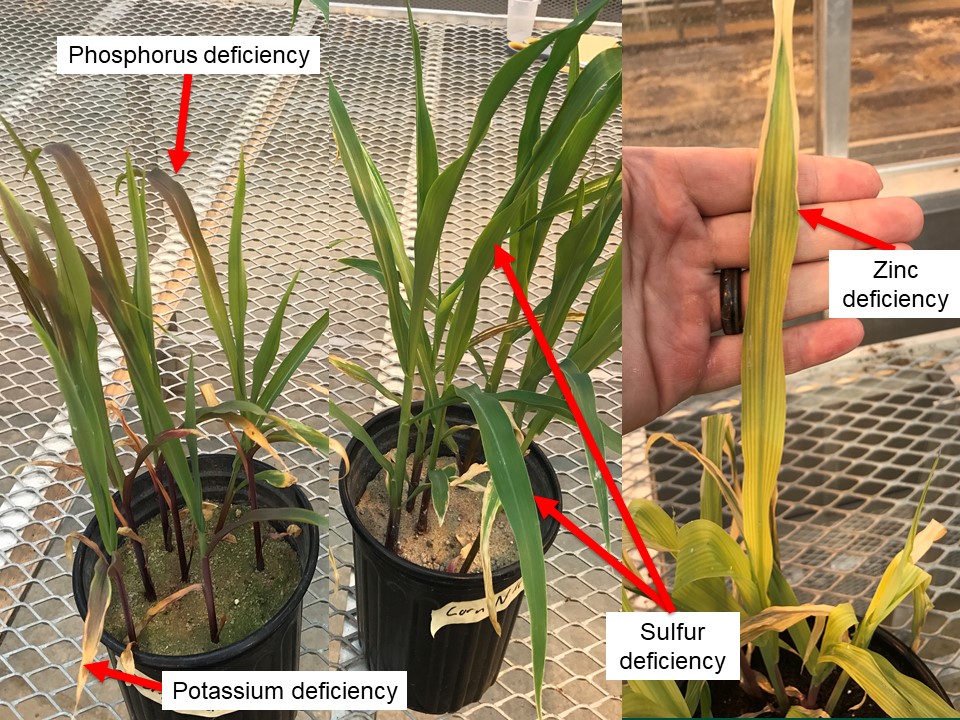
Here is a description of macro-nutrient deficiencies. Nitrogen deficient symptoms include a yellowing of older leaves. Phosphorus deficiency is commonly seen as purple older leaves. Potassium deficient plants’ older leaf margins become chlorotic. Figure 1 shows sulfur, phosphorus, potassium, and zinc (interveinal striping) deficient corn.
Tissue testing can help diagnose plant deficiencies. However, current plant nutrient thresholds were developed more than 40 years ago and plant breeding has improved nutrient efficiency. It is recommended to have a small nutrient sufficiency strip where excess nutrients are applied. Then if a nutrient deficiency occurs, collect separate tissue samples from the nutrient sufficient area and the problematic area. Soil samples should also be collected to determine if nutrients are sufficient. The test results can then be compared to guide an agronomic rescue application. If you do not have a nutrient sufficient area, collect soil and tissue samples are an area within the field where the crop appears healthiest.
Nutrient deficiencies can show up through the growing season. The best method to prevent a nutrient deficiency is to soil sample and fertilize appropriately. If you observe an issue, it’s important to compare the good and bad areas with tissue and soil testing.
|
|
The NDSU Extension does not endorse commercial products or companies even though reference may be made to tradenames, trademarks or service names. NDSU encourages you to use and share this content, but please do so under the conditions of our Creative Commons license. You may copy, distribute, transmit and adapt this work as long as you give full attribution, don’t use the work for commercial purposes and share your resulting work similarly. For more information, visit www.ag.ndsu.edu/agcomm/creative-commons.
County commissions, North Dakota State University and U.S. Department of Agriculture cooperating. NDSU does not discriminate in its programs and activities on the basis of age, color, gender expression/identity, genetic information, marital status, national origin, participation in lawful off-campus activity, physical or mental disability, pregnancy, public assistance status, race, religion, sex, sexual orientation, spousal relationship to current employee, or veteran status, as applicable. Direct inquiries to Vice Provost for Title IX/ADA Coordinator, Old Main 201, NDSU Main Campus, 701-231-7708, ndsu.eoaa@ndsu.edu. This publication will be made available in alternative formats for people with disabilities upon request, 701-231-7881.
|
|
|
|
|
|
|