Rail Workers Weekly News Digest
Number #23 - June 9th, 2020
|
|
Below is a series of articles compiled over the previous week.
They are of interest to railroad workers and activists.
|
|
ARTICLE 1 - LEGISLATIVE NEWS
|
|
House Transportation Committee Releases 5-Year Transportation Legislation
Bill includes $105 billion for transit, $60 billion for rail, would triple Amtrak funding; provisions would require two-man freight crews, take aim at aspects of PSR.
The bill would include $105 billion for transit, including strengthening of “Buy America” provisions to increase domestic jobs in rail and bus manufacturing. The $60 billion in rail funding includes $29 billion for Amtrak, a tripling of the current amount; a new $19 billion grant program devoted entirely to passenger rail projects; an increase in the current Consolidated Rail Infrastructure and Safety Improvements grant program to $7 billion for passenger and freight projects, and a new $2.5 billion grant program for grade-crossing improvements.
The bill was announced by Peter DeFazio (D-Ore.), chairman of the House Committee on Transportation and Infrastructure and cosponsored by chairs of two subcommittees, Eleanor Holmes Norton (D-District of Columbia), and Dan Lipinski (D-Ill.). In the statement announcing the bill, DeFazio said,
“
After holding nearly 20 Committee hearings, receiving
testimony from dozens and dozens of witnesses and members of Congress, and
engaging with hundreds of advocates and transportation agencies, I am proud to
bring together the ideas and the needs into one transformational bill that will
catapult our country into a new era of how we plan, build, and improve U.S.
infrastructure.”
|
|
ARTICLE 2 -
RAIL WORKER FATALITY
|
|
CN Rail Worker Killed in Canada Leaves Behind Wife, Son
The Canadian National Rail worker killed while on the job in Surrey, B.C., this week was a young dad who left behind a wife and nine-month-old son.
Jas Riar, 31, was killed during a switching incident at 2 a.m. Monday at Thornton Yard.
The online fundraiser says Riar was the sole provider for his family.CN Rail has not provided any further details about what happened.
The Transportation Safety Board confirmed an investigator has been assigned to the case.
|
|
ARTICLE 3 - DERAILMENT NEWS
|
|
Georgia Train Derailment Causes Evacuation
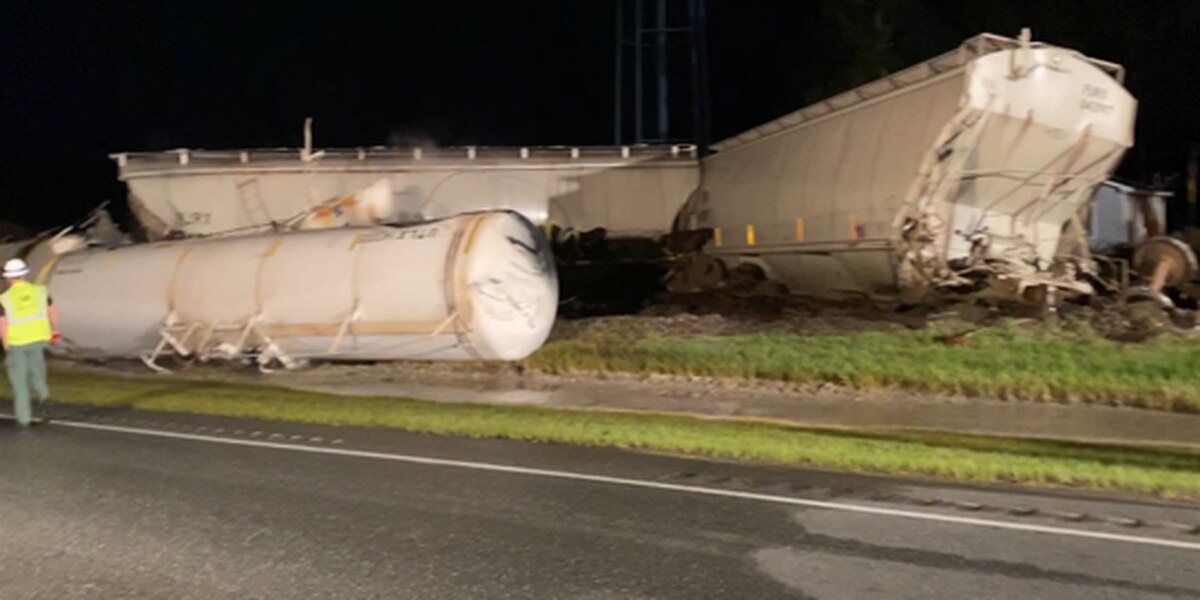
WAYNE COUNTY, Ga. (WTOC) - Highway 84 in Screven is back open after seven cars of a train derailed on Saturday. CSX conducted an investigation into the derailment and finished cleanup efforts on Sunday afternoon.
The derailment happened on Highway 84 near the Screven City Hall in Wayne County just after midnight Saturday. The train was carrying more than 200 cars. Two of those cars were carrying hydrogen peroxide.
“I get up here to see a train derailed in the city and you start thinking about things," said Mayor Jason Weaver. "You gotta think about waterways, you gotta think about what was in the tank, you gotta think about citizens.”
Director of Wayne County Emergency Management Richard Johnson says about 100 people had to be evacuated from the surrounding area as a precaution due to the leaking fuel.
Contaminated dirt and water were collected and placed into containers, with new dirt replacing the gaps....
...According to Director Johnson, 11,000 gallons of hydrogen peroxide spilled and has since been cleaned up. The EPA, as well as various other agencies, have been on-site to ensure no hazards remained. They tested the water to make sure it was not contaminated. He says 270,000 gallons of water was used to dilute the chemical and the contaminated areas that were dug up will be disposed of properly. CSX says all seven cars will be scrapped.
|
|
ARTICLE 4 - PASSENGER RAIL NEWS
|
|
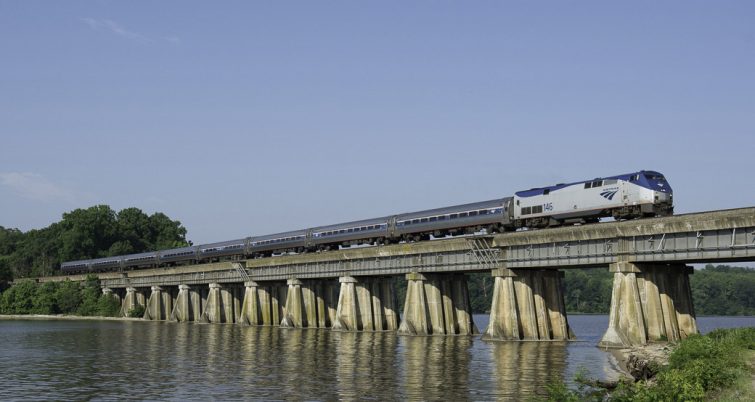
In Crisis, Amtrak is Focused on Testing and Training for New Trains to Debut in 2021
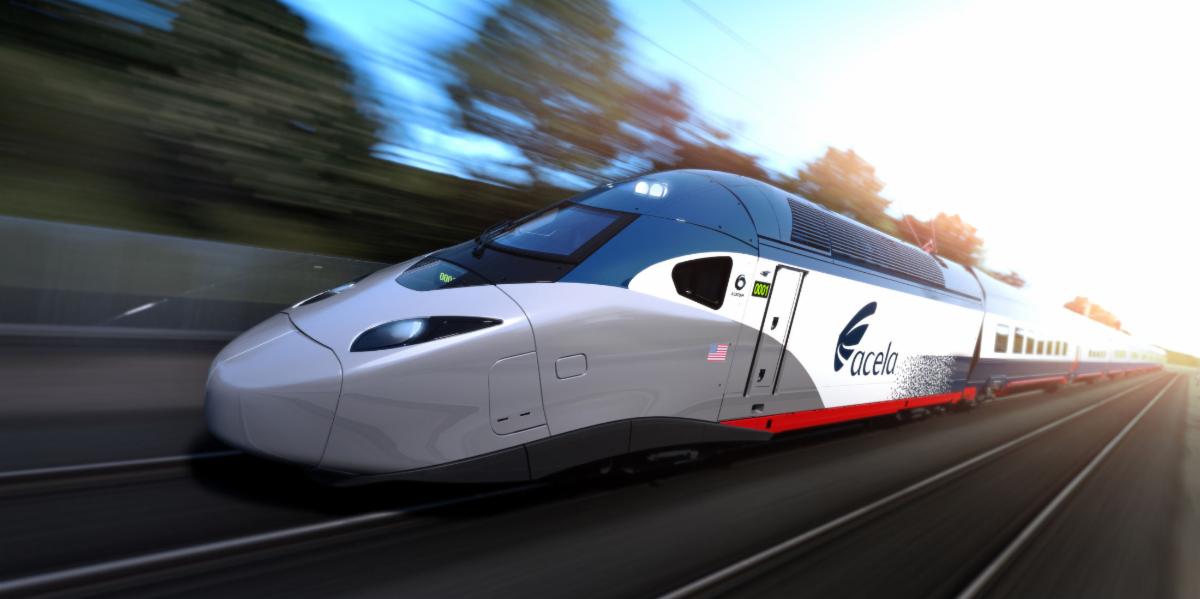
Manufacturing and testing of Amtrak’s new high-speed Acela trains, expected to debut next year in the Northeast, is on track despite interruptions to production and training during the
coronavirus
pandemic, officials said.
Testing of the first two Avelia Liberty high-speed train sets from French manufacturer Alstom, is underway in the Northeast Corridor and at a federal facility in Pueblo, Colo., and Amtrak said railroad crews have started training on the new technology in anticipation of a launch next spring.
The Acela prototype arrived at the Colorado Federal Railroad Administration site for nine months of testing in February. Officials said it recently exceeded performance expectations, traveling at 165 mph, above the 160 mph limit the trains would be allowed to travel once in service between Washington and Boston. The current Acela trains travel up to 150 mph.
“We are laser-focused on delivering this new fleet of trains,” said Caroline N. Decker, Amtrak’s vice president for the Northeast Corridor. “Looking at where we are in terms of the production, we have a high degree of confidence that a 2021 launch is very doable, and certainly we’re eager to introduce the new fleet to the Northeast Corridor as soon as possible.”
The $2.5 billion project, which also includes major infrastructure improvements to accommodate the new trains, is moving forward at a time when Amtrak is preparing to reduce staff by up to 20 percent and is requesting nearly $1.5 billion more in federal aid to keep afloat amid the unprecedented financial hardship from the pandemic. The health crisis that shut down much of the country in March devastated the passenger railroad’s ridership and revenue.
|
|
ARTICLE 5 - UPRISING NEWS
|
|
Rail Union Statements on the Murder of George Floyd
(
Editor's Note
: Numerous unions - including rail unions - have issued statements of solidarity with and support for those protesting the brutal murder of George Floyd while in police custody in Minneapolis, MN. at the end of May. Railroad Workers United is working on drafting a statement of our own, to be released shortly).
|
|
Longer Trains Means Dramatic Derailments
Precision scheduled railroading (PSR) has introduced a new dimension and meaning to the old adage, “Uphill Slow, Downhill Fast, Profits First, Safety Last ,” too wit. Gravity carries great sway over train speeds on river (level) grade, ascending and descending railroad trackage. Everyone who manages train operations or operates trains knows that, and the following: Short trains are easier to operate than long trains, no matter what the grade. If you are operating a train over long descending grades, or long ascending grades, followed by long level grades, there are relatively few in-train forces, slack action, run-in, run-out. But, if you are operating a train over undulating trackage, commonly referred to as hog-backs, where I come from, you have a whole new ballgame, one that increases the probability of an accordion-like derailment.
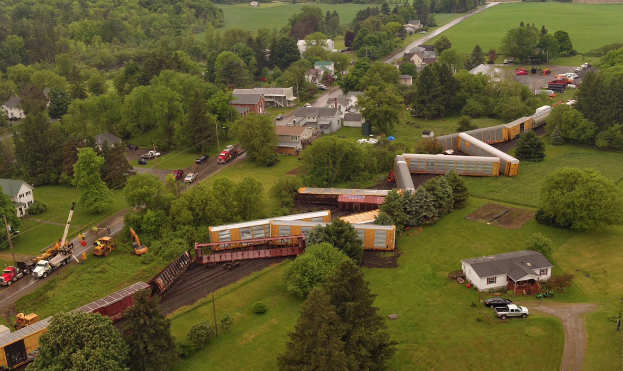
I know, I know, I can hear you now. How can he, the author, Bill Keppen, come to that conclusion? Well, allow me to explain. Let’s start with topography. There are hills on the NS Southern Tier. These are not mountains. They are hills, which would indicate undulating trackage. None of the locomotives on the 212-car-long, 13,500-foot (2.6-mile)-long, 22,850-trailing-ton consist derailed. Locomotives are, as we all know, much heavier that a railcar, particularly an empty railcar. The derailed cars appear to be empties, which don’t fair well when subject to run-in from heavy freight cars further back in a train. All of this can be deduced by looking at the top photo. ...
... When these kinds of things happen, everyone loses. Fortunately, in the derailment pictured here, no employees were injured and public safety, while at risk, was not compromised.
Next time? Let’s do what we can, and should, to prevent “next times.” The laws of physics cannot be changed—even by shareholders.
|
|
ARTICLE 7 - FREIGHT TRAFFIC NEWS
|
|
Volume decline prompts NS to pursue rail yard efficiencies
(
Editor's Note
: Every rail worker and every rail shipper should cringe at this statement. We know what "efficiencies" mean: no quits, short lunches, 12-hour shifts, limited tie-up time and more for workers; poor service, lack of equipment, limited switches for shippers).
The review is part of the Class I's strategic plan launched last year to create a more efficient and responsive railroad, but also is in response to lower volumes resulting from the coronavirus pandemic.
"That [strategic] plan was well underway and achieving significant results before the outbreak of COVID-19. The current economic disruption is a challenge for all of us, but we are using this time to find additional ways to streamline our operations," wrote Alan Shaw, NS' executive vice president and chief marketing officer, in the service update.
In making the network more efficient while "providing a platform for growth," the railroad is routing shipments more directly to their destinations, with fewer handlings and classifications along the way, the update stated.
NS' Linwood hump yard in North Carolina was the first to be reviewed as part of the streamlining.
"After a thorough review, we completely redesigned our train operations and work activity. Today, our service in the region is more fluid," Shaw wrote. "We recently completed a similar review of Bellevue yard in northern Ohio, which will result in a series of service modifications later this month."
|
|
Invitation to a Global Trade Union Assembly — July, August and September, 2020
Pandemic and Beyond: Workers Organizing for a Public Future
A Series of Virtual Meetings during July, August and September 2020
In response to the ongoing public health and economic crises,
more than 30 trade union bodies
from 18 countries have come together to convene a global assembly. TUED has been working with the convening unions to coordinate preparations for the Assembly.
The aim of the Assembly is to further build North-South solidarity and deepen our analysis of the many impacts of COVID19, both immediate and longer term. The convening unions see the Assembly as a means to further promote bold, pro-public solutions that can help address the deep structural flaws in the current system.
The Assembly is open to all trade union members, activists and leaders, as well as movement allies. Please register
here
.
If your union would like to sign on to the list of conveners, or if you have questions about convening, please email Irene HongPing Shen:
irenetued@gmail.com
.
|
|
|
|
|
|
|