Volume 7 Issue 7 | July 2026 | | Cheers to the USA! Let the birthday party begin! | | The Root of It newsletter ends with our monthly quotation. If you find your newsletter has been clipped by your email provider please click HERE for a webpage version of the newsletter. | | |
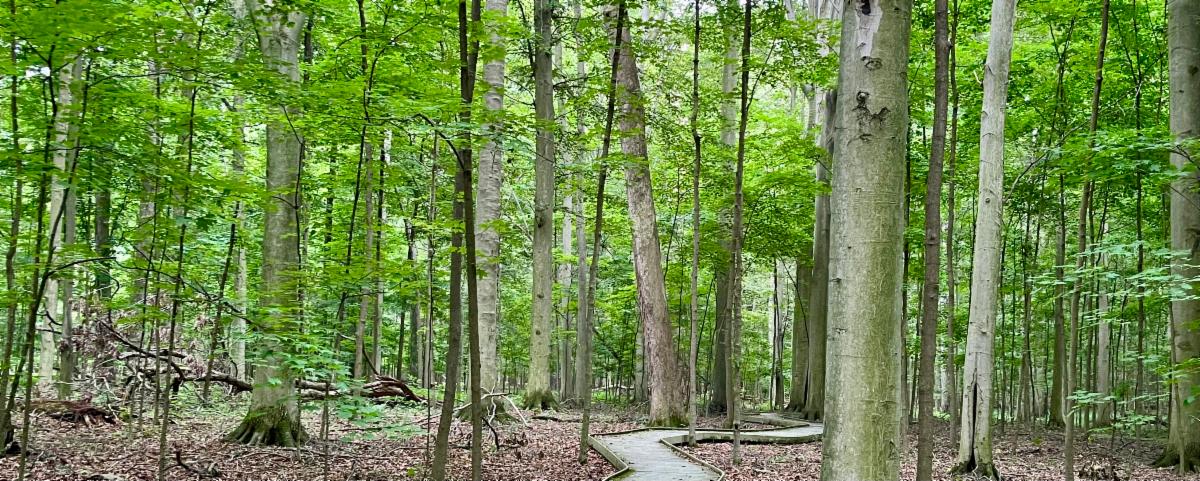
Johnson Woods is a fine place to reconnect with nature.
photo by K Edgington
| | |
Walking through an old growth forest is a spiritual journey. Beyond the beauty lies an appreciation of historical events that have marked its years of growth. America’s founding, wars, accomplishements, innovations—these old trees have stood strong through it all. A hike through one of Ohio’s old growth forests would be an excellent way to say, Happy Birthday, USA!
Old growth forests are stands of trees that have developed free from human disturbance over long periods of time. Because the life spans of trees differ, old growth forests vary in age. (Bristlecone pines can live as long as 500 years, while the average life span of a sugar maple is 300 years.) The floor of these forests contains a series of pits and mounds where trees have fallen, creating vernal (seasonal) pools rife with wildlife. Decomposing logs dot the forest floor and are home to a multitude of animals, bacteria, and fungi. Because of their age and undisturbed nature, these communities of plants and animals are often climax communities, ecosystems in which plant and animal populations are stable and balanced and can withstand minor natural disturbances.
Ohio has more old growth forests than any other state, and several are a short drive from the Summit County area. Strolling the boardwalk at Johnson Woods*, one of Ohio’s largest and finest old growth forests, reveals statuesque, old trees, some of them in excess of 400 years old, whose trunks reach for the skies, many without a lower limb for forty to fifty feet. The largest and oldest are hickories, white oaks, and red oaks. A natural succession to beeches and maples is occurring in the tree community. In the more poorly drained areas of the forest, red maples and pin oaks thrive.
Pileated woodpeckers, wood thrush, scarlet tanager, and hooded warblers are among the birds that nest in Johnson Woods. Species that require large forest areas find a fitting home in its 206 acres. Fungi and frog fans, alike, discover their happy place at Johnson Woods.
The forest floor, with its decomposing trees, is awash in beautiful lichens—fungi of every size and shape abound. Spring peepers, salamanders, and other secretive creatures thrive in the vernal pools and damp areas.
Because of its size, Johnson Woods is a self-supporting ecosystem, and less vulnerable to the disruption of disease and weather patterns. It is a world unto itself. A step on its boardwalks transports the visitor back in time, and the forest quiet welcomes contemplation. Yes, an old growth forest is a fine place to reflect on our nation’s past and future. Look Around!
* Johnson Woods can be found at 13240 Fox Lake Road, Marshallville Ohio 44645. Hours are ½ hour before sunrise until ½ hour after sunset. Visitors are required to stay on trails. No pets or public restrooms.
FIND A NETWORK FOREST: Old Growth Forest Network
OLD-GROWTH FORESTS AND FUNGI: Old-Growth Forest Network
K Edgington
| | |
LEAF BRIEF
The Mulberry—Unmistakably American
| | |
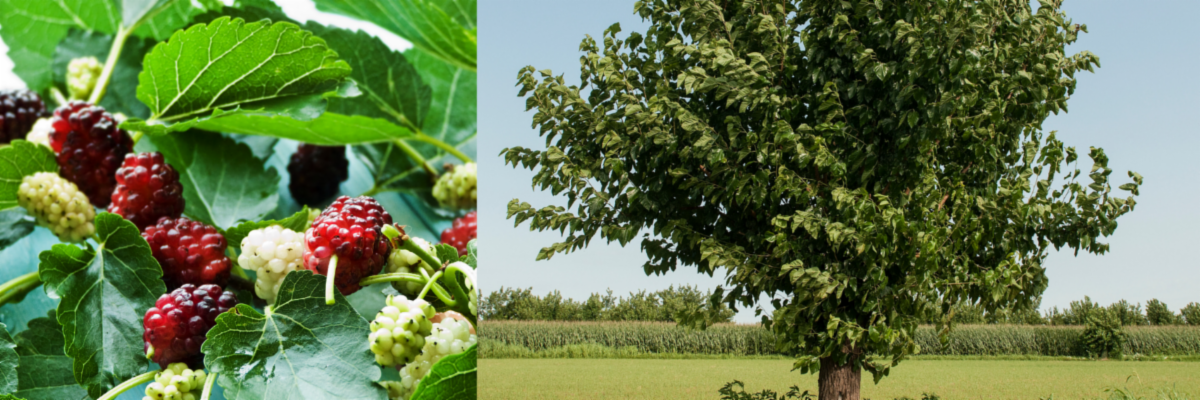
Mulberry fruit and tree
photo by Lucas Pezeta
| | |
The mulberry tree is one of America’s most overlooked native trees, quietly growing along fences, riverbanks, and old farms. It carries with it many connections to early American history.
The native red mulberry (Morus rubra) is found throughout the eastern United States and was here long before European settlers. The Native Americans utilized its fruits, both fresh and dried, and the inner bark was fashioned into textiles. It was commonplace in early colonial settlements as well.
Conversely, the non-native white mulberry (Morus alba) was introduced to the American colonies in the 17th century in an effort to establish a silk industry, since silkworms feed almost exclusively on mulberry leaves. King George and some colonial governments mandated the widespread planting of the white mulberry, which silkworms are said to favor. A frenzy, known as “mulberry mania” ensued. Whole orchards of mulberry trees were planted across the new country. Mulberries were planted extensively at Mount Vernon, Thomas Jefferson’s estate at Monticello and in Georgia, by founder, James Oglethorpe. Alas, making silk was not easy and the vision was doomed by rampant speculation, bad weather, and blight. These invasive remnants now outnumber the native trees.
The charm of the mulberry tree is not in ornamental perfection, but in its scrappy survivability and its interweaving with American history. A mulberry witness tree (a tree present during historical events) is found on the grounds of the Washington Monument in Washington, DC. In fact, two trees, one now angled horizontally, arrived naturally in the late 1800s and still survive in their gangly imperfection, a witness to a century of events on the National Mall. Read about them HERE.
During the 1787 Constitutional Convention, negotiations were tense. Legend has it, Benjamin Franklin invited delegates to “cool off” under the shade of a mulberry tree, where they relaxed, socialized, negotiated and yes, even compromised. (Maybe we need a few more mulberries in politics today.) Read about it HERE.
Despite its colorful history, the mulberry remains a practical landscape tree for gardeners with a few caveats. It typically grows 30 to 60 feet tall and provides a broad shade canopy. It prefers full sun and rich, moist soil but is surprisingly adaptable to poor soils, harsh conditions and neglect. The berries can be messy, leading to purple-stained sidewalks, and the tree suffers from a litany of ailments including borers, whiteflies, blight, canker and more. It is also a prolific self-seeder.
The delicious mulberry fruits consist of clusters of 1 to 1.25 inch long drupes (fleshy fruits with a hard pit) that mature in summer, but you won’t find them in any grocery store. Unfortunately, their skins are fragile and their shelf life is brief. Pick berries when they are dark in color and easily release from the stem. Unripe berries are pink or green and can cause stomach upset (or worse) if eaten too soon. Birds love the fruits and will consume all berries in a matter of days. Gardeners will also be in competition with foxes, raccoons and even box turtles for the tasty treats.
Its imperfections are part of the mulberry’s charm and it deserves a second look. This resilient tree will provide ample shade and abundant harvests of sweet-tart fruits while helping out local wildlife. While not a refined ornamental specimen, it is a practical, tough, adaptable tree, just like our country.
MORUS RUBRA: North Carolina State Extension
J Gramlich
| |
|
CREATURE FEATURE
American as an Eagle
| The Great Seal of the United States of America | |
On July 4, 1776, the Second Continental Congress adopted the Declaration of Independence. A world-changing, fire-works worthy event, but they did something else too—appointing Ben Franklin, John Adams and Thomas Jefferson to create an emblem for the fledgling nation. (Didn’t those guys have enough to do?)
These three (of five) drafters of the Declaration had many talents, unfortunately graphic design was not one of them. They couldn’t agree on a proposal—not surprising given their ideas ranged from Moses, the parting of the Red Sea, a pillar of fire, Saxon chiefs Hengist and Horsa*—and Hercules. Six years and three committees later, only the founders’ slogan e pluribus unum (out of many, one) made it into the final design.
Today the eagle seems like an obvious choice, but it didn’t appear until May of 1782, when William Barton, a young lawyer (who wasn’t a member of the third committee but did all the work), added a small, white crested one. Congress still wasn’t happy. The Secretary of Congress, Charles Thomson, took charge, changing the crested eagle to a bald one to represent the only eagle species found solely in North America.
The principles behind the design of the Great Seal are worth reviewing. The obverse (front) shows the eagle clutching an olive branch and arrows in its talons, symbols of peace and war. The eagle gazes toward the branch, indicating a foremost desire for peace, but a readiness to defend that peace if necessary. The escutcheon (shield) is held by the eagle without assistance, demonstrating self-reliance. This nation depends on no other. Thirteen stars and stripes represent the thirteen original colonies, and the founders’ slogan describes the colonies unifying into one nation.
Peace-loving, but able and willing to defend oneself. Self-reliant, but valuing the power of working together. Sounds pretty American to me…
The Great Seal was finally approved by Congress on June 20, 1782. Fourteen people in total contributed to the design, which has endured for 250 years on official government documents, currency and military insignia, among other things.
Why the eagle? As the King’s symbol, the lion wasn’t an option. Eagles have symbolized freedom, strength and independence dating back to Roman and other ancient civilizations. Over 25 countries feature eagles on flags, coats of arms or as national birds. The eagle’s fierce stare, huge size (6-8 foot wingspan) and up to 50 mph speed projects determination and power. The bald eagle has a majestic, awe-inspiring presence. (And it is not bald—the adult’s head is covered in white feathers. The bald moniker comes from “balde”, a Middle English word meaning ‘shining white’.)
Bald eagles are raptors that live close to water. Their large, hooked beaks, bare legs and rough toe pads are ideal for snagging fish. With their incredible vision (four times better than humans), they spot prey nearly a mile away. Watch HERE and HERE.
While there is no truth to the legend that Ben Franklin lobbied for the turkey to be on the Seal instead of the eagle, Dr. Franklin did write his daughter that the bald eagle is a bird of “bad moral character” and “does not get his living honestly”. Bald eagles are very good at stealing prey from other birds, bypassing the catching part (kleptoparasites). Watch THIS.
With all due respect to Dr. Franklin, I prefer to consider bald eagles opportunists rather than thieves. And isn’t America the land of opportunity? Landfills are the eagle's new favorite hang-out—opportunities galore. Check THIS out.
Strong, independent, freedom-loving, opportunistic—describes Americans just about right. But there’s one more quality the eagle exemplifies—resilience. Like you and me, bald eagles are survivors—overcoming not one but two brushes with extinction—the first in the late 1800’s due to hunting and habitat destruction, the second after WWII with the introduction of the pesticide DDT. By 1978 there were only about 400 breeding pairs left in the lower 48 states. It’s fitting that our government, working at its best, saved our treasured national symbol. The bald eagle is no longer threatened, and in 2024 it was officially named our U.S. national bird.
This Fourth of July, look to the skies for more than fireworks. Look for your national bird boldly soaring overhead. Give thanks for his freedom, his power, his majesty. And acknowledge your kinship with your fellow, feathered, American.
*Legendary Germanic twins who were the founders of Anglo-Saxon England.
C Christian
| | |
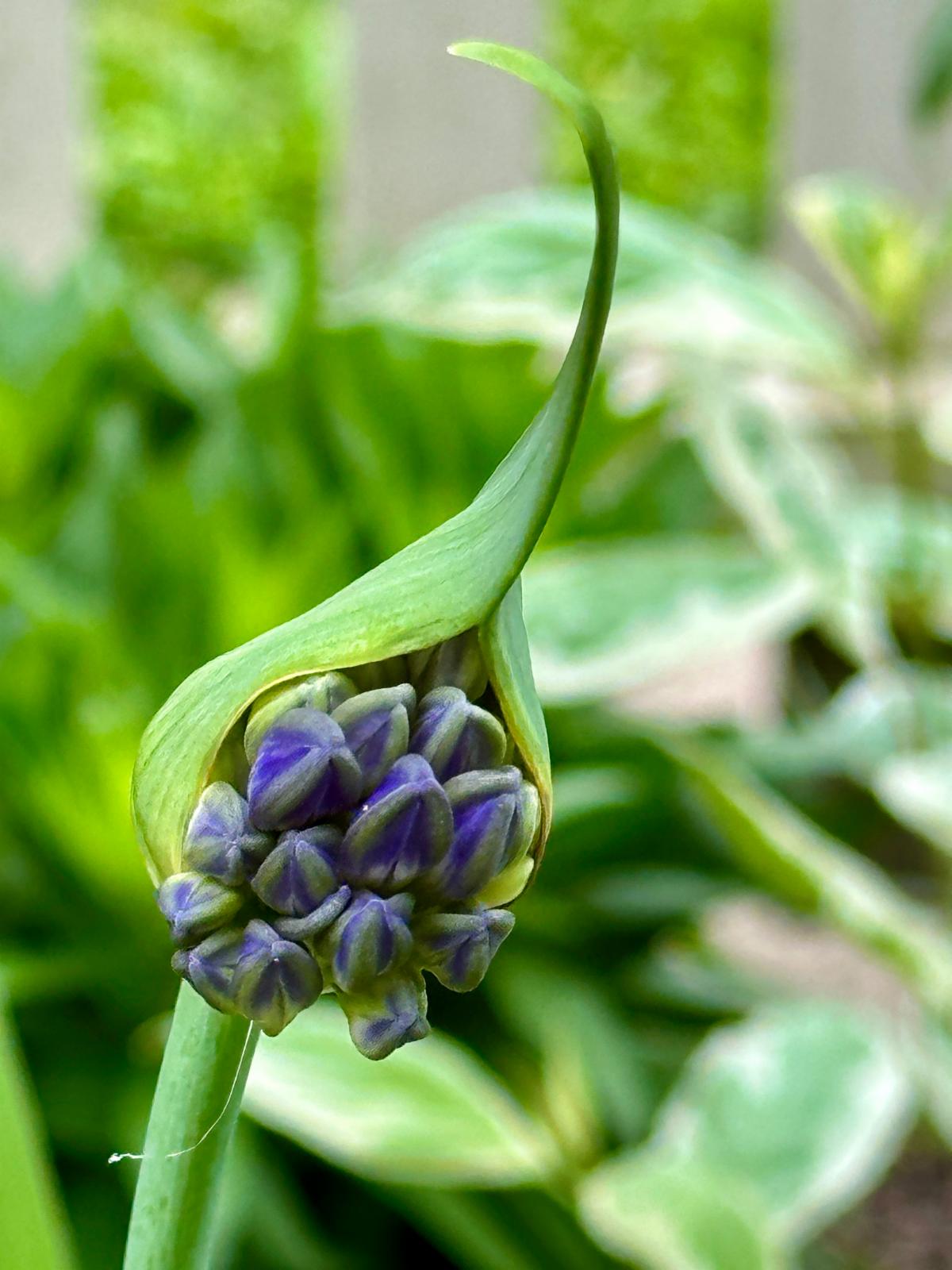
An agapanthus bud unfurls
photo by E Barth-Elias
| | |
As our nation marks its 250th year of existence, we attribute to our Founding Fathers significant qualities: George Washington's leadership in war and as our first president; John Adams' insistence on breaking from England and on recruiting Thomas Jefferson to write the Declaration of Independence; Thomas Jefferson's skill in writing the Declaration of Independence, and James Madison's vision as the father of the U.S. Constitution.
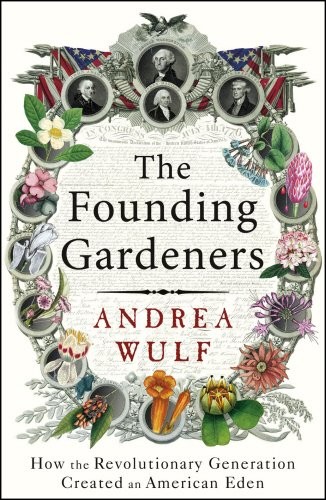
Of course, these men are known for far more than these accomplishments. Still, it’s not often mentioned that these founders were also avid botanists. The book Founding Gardeners by Andrea Wulf, looks at the Revolutionary era through the green lens of plants and agriculture and demonstrates how deeply rooted the nation’s founding was in these leaders’ horticultural passions.
Wulf’s book is painstakingly researched, full of details that give shape to our founders’ personalities. In all ways, their world was scarred by war and by the belief that land, our land, would be the best cradle in which to heal and nurture this new nation.
She cites the meticulous designs for Mount Vernon and the lists of seeds and plants Washington sent home even while fighting the Revolution. When he retired, weary from the war and the burden of leadership, he transformed from warrior to farmer and spent his remaining days riding 20 miles across Mount Vernon each day in order to oversee the progress of his estate. Visitors may have expected a president. They got a farmer dressed in plain clothes and mud-spattered boots.
In the years immediately following the war, the United States not only had to establish itself as a nation to the outside world, it had to come together as the United States. It wasn’t always assured. Wulf describes the fractious nature of the Constitutional Convention of 1787, as delegates were working in an airless room in summer heat to create the United States.
With the convention on the brink of collapse over the issue of equal vs. proportional representation, Wulf recounts a mid-July visit to John Bartram’s garden in Philadelphia. After three hours amid the botanist’s beautiful, and cool, plant collection, three delegates switched their votes. The Great Compromise, which created the House of Representatives and the Senate, finally had enough votes. It can never be proved that this side trip made the difference. But three men budged after a trip to a garden.
One crucial element bolstering the early economy came from a trip Jefferson and Madison took through New England. The United States had long chafed over its dependence on cane sugar from the British West Indies, thus keeping it tied to its former colonial master. During that trip, they saw hillsides of red and gold maple trees, and farmers turning it into maple sugar and other products. Those forests rooted the American economy in the wealth of its natural resources.
Interestingly, Jefferson would not develop gardens at the White House, leaving the dank swamp in which it stood. He felt the building was too ostentatious to suitably reflect a sober, young country. He insisted on a plain residence. Madison brought the president’s home up to horticultural snuff.
Wulf intersperses stories with some of their correspondence, which often asked about soil quality, growing conditions, climate—the minutiae gardeners must heed if they want to be successful.
In retirement, Adams’ irascible nature was softened by his gardens at Peacefield, outside of Boston. Jefferson’s love for the mountains and forests surrounding Monticello gave him the vision of what the Louisiana Purchase could do for America. Washington refused to serve more than two terms in order to return to his gardens. That decision would serve as a template for future presidents until the twentieth century.
Founding Gardeners is filled with detailed history, colorful anecdotes, maps of the gardens and plantations, full-color illustrations of the many plants and trees they grew. Those with a bent to science will appreciate the meticulous listing of flora, both common and Latin names. This book is ideal for history buffs who also have feet planted in the soil. It is not light reading, but it is worth anyone’s time who regards plants and gardening not as a pastime, but as an expression of the soul. These men ensured that America’s soul had strong roots.
Wulf, Andrea. “Founding Gardeners: The Revolutionary Generation, Nature and the Shaping of the American Nation. Vintage Books, 2011, New York
S Vradenburg
| | |
July Checklist:
- Deadhead and fertilize roses and heavy feeding perennials to encourage reblooming.
-
Control invasive Japanese Beetles by handpicking, spraying, or using barriers. JAPANESE BEETLES IN YARDS AND GARDENS: University of Minnesota Extension
- Pinch back mum buds to prevent premature blooming and encourage bushier plants.
- Succession plant basil, beans, cucumbers, cilantro, and radishes from seed in any open garden space.
- Stake delphiniums, dahlias, and hollyhocks.
- Start broccoli, cabbage, Brussels sprouts, and ornamental cabbage seeds for late-summer plantings and fall harvest.
-
Water during dry spells, less often but deeply. HOW TO WATER A GARDEN: Purdue University Extension
- Harvest vegetables frequently to keep beans, cucumbers, zucchini, and tomatoes productive.
J Gramlich
| |
Agriculture is our wisest pursuit, because it will in the end contribute most to real wealth, good morals, and happiness.
Thomas Jefferson to George Washington in Letter dated August 14, 1787
| | |
More learning opportunities:
| | We invite you to share The Root of It with your friends and family. If you would like to subscribe to our mailing list please visit our website, scroll to the bottom, and click on the subscribe link. | | The Root of It staff: Karen Edgington (Editor), Emma Barth-Elias (Photo Editor), Carolyn Christian, Jennifer Gramlich, Sarah Vradenburg, and Geoff Kennedy (Technical Advisor) | |
We Would Like your Feedback
Contact us at: newsletterscmg@gmail.com
To discontinue receiving this newsletter please click on the UPDATE YOUR PROFILE link below. You may then choose what types of information you would like to receive from us.
| | | | |