The American Society of Le Souvenir Français Inc.
Monthly Bulletin - Vol. II. No 11 - November 2022
|
|
THE MERCI TRAIN
49 boxcars of French gifts
|
|
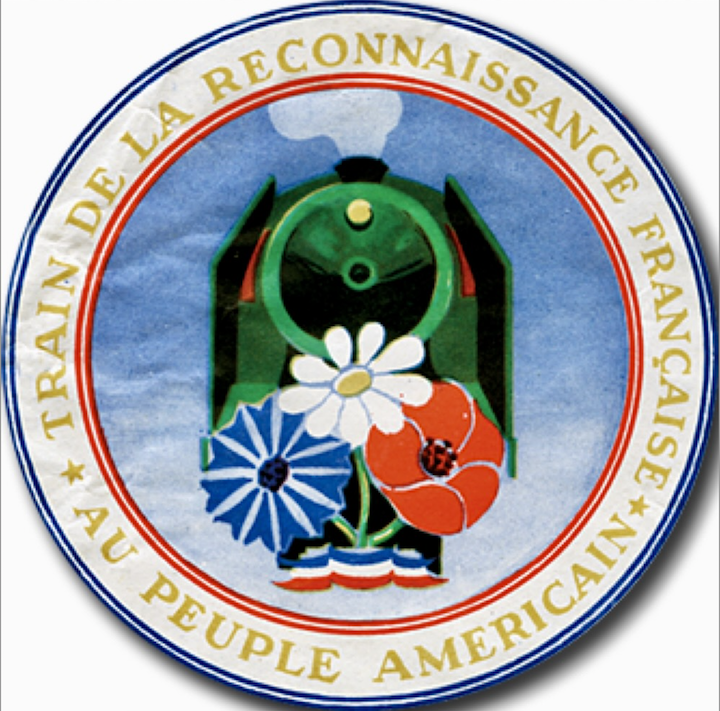
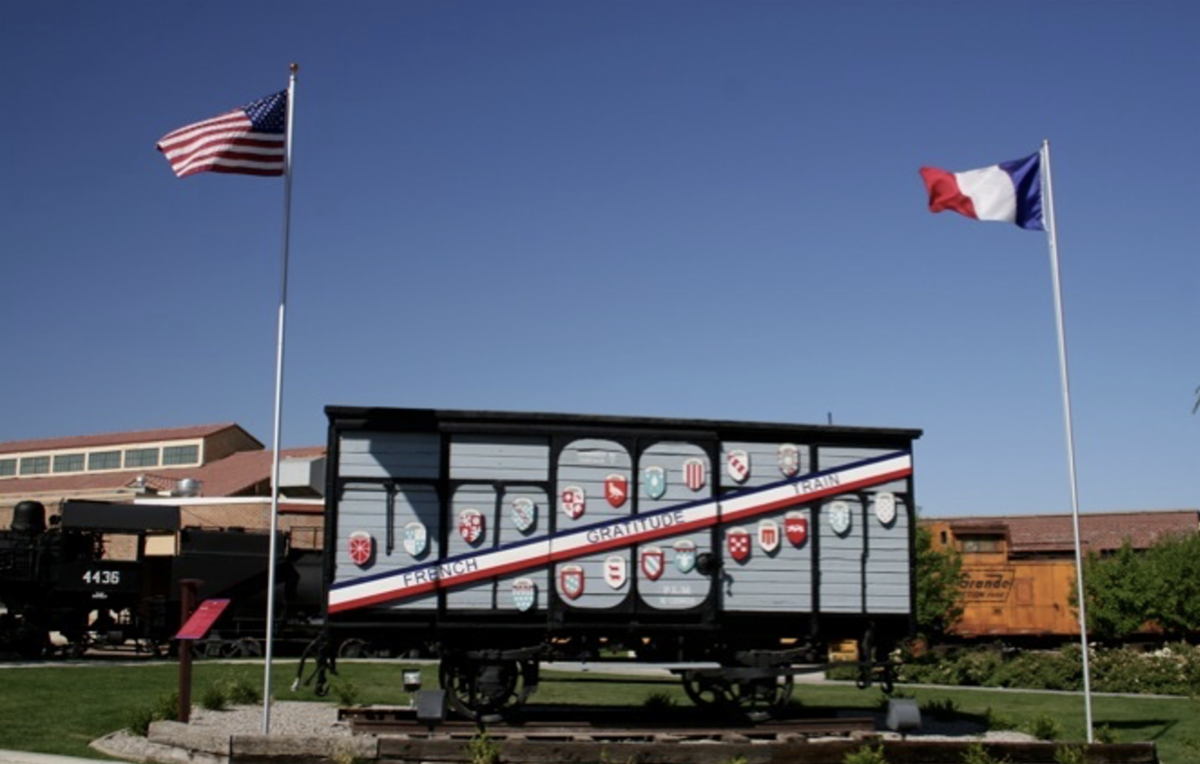
"Le train de la Reconnaissance Française au Peuple Américain" - "The Train of French Gratitude to the American People" aka "The Merci Train" - By Unknown artist http://www.mercitrain.org/
registered trademark, Fair Use https://fr.wikipedia.org/w/index.php?curid=6621610
|
|
EDITORIAL
'Tis the approaching Holiday Season...many of us, especially boys, have fond memories of our childhood wonder upon opening a present with a "choo choo" train. But who remembers this other full-size, real train, loaded with gifts, which crossed the Atlantic as a gesture of friendship and goodwill?
Few indeed remember these unique gestures of love between the French and the American peoples, that took place right after World War II in 1947 and 1949 - - and which legacy is kept alive in almost every State by the "40 & 8" Societies, the American Legionnaires or State museums.
In 1947, when France and Italy were facing hunger and cold, Drew Pearson, an American journalist, launched the idea of a rescue train in his syndicated column "Washington's Merry-Go-Round". Originally thought to be 80 boxcars, it eventually reached the astounding number of 700 boxcars which collected food, clothing, fuel from the 48 States, amounting to $40 million worth of donations (the equivalent of $586 millions today!), collected by high-school students, ordinary citizens, and retirees alike. Prior to boarding the cargo "Friend Ship" and reaching Le Havre, the Friendship Train was celebrated with a ticker tape parade on Broadway. This gesture of popular goodwill and tangible help accompanied the Marshall Plan, which effectively raised Western Europe from its ashes.
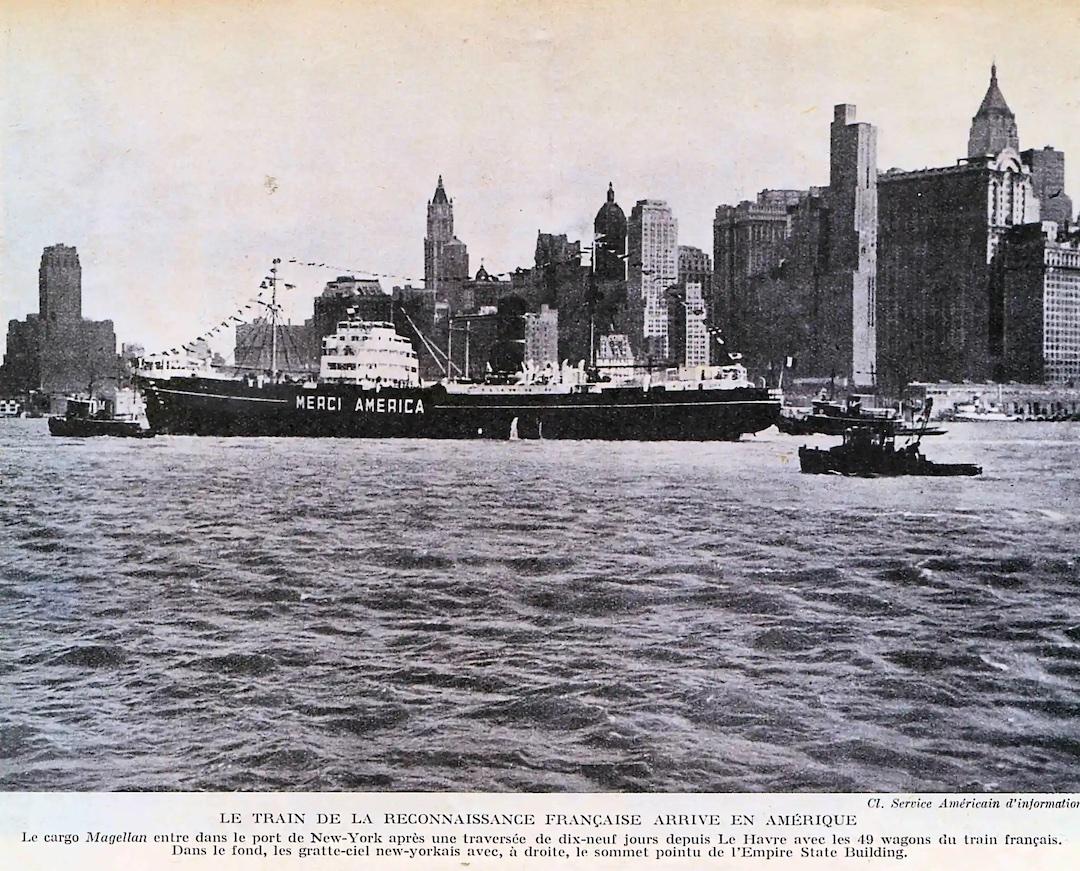
To reciprocate, in 1949, a French railroad worker and WWII veteran, André Picard, launched the idea of a "Train de la Reconnaissance Française", affectionately nicknamed the "Merci Train" in the United States. This initiative was quickly endorsed by several associations of French railroad Resistance veterans and French President Vincent Auriol. Composed of 49 boxcars and filled with "gifts of gratitude", the Merci Train arrived in New York City on February 3, 1949 with over 25,000 onlookers in attendance, and was divided amongst the 48 States with the remaining car to be shared by the District of Columbia and Hawaii.
The boxcars' contents (more than a million gifts weighing a total of 250 tons, ranging from dolls, statues, clothes, ornamental objects, furniture, etc..) were opened and turned into exhibits before being distributed as each State saw fit. Most states continued to exhibit the boxcars to the public after their gifts were distributed. Most, but not all, are preserved today and can be visited.
As André Picard declared, “We found ourselves unable to reply in the same manner as you aided us," explaining the plight of a devastated France following the war. "We did wish to send you remembrances which would last forever.”
This is the touching story we will share in this month's Bulletin. We are particularly grateful to welcome in our pages Professor Norman Desmarais, who wrote the article on Rhode Island's "Merci Train". In addition to being Professor Emeritus at Providence College, and writing numerous articles and books on the Revolutionary War period, Norm Desmarais is also, in his spare time, a Docent at the Museum of Work & Culture in Rhode Island, and, we are proud to add, our Society's Regional Delegate for New England.
We hope you will enjoy riding the "Merci Train" with us, and invite you to pay the remaining 43 boxcars a visit. Look for them! They are like hidden gems.
The Souvenir Français, as it name indicates, is all about remembering, and it is part of our mission here at the American Society of Le Souvenir Français to celebrate events that have tied together France and the United States over almost 250 years.
In this Bulletin, we will continue to report on the Marquis de Lafayette's triumphal tour of the United States, this time on his visit to Jefferson's Monticello and Madison's Montpelier's estates in November 1824. We will also narrate the penultimate chapter of the long march of Rochambeau's soldiers in November 1782, throughout the State of Connecticut and Rhode Island, on its way back to Boston after the victorious siege of Yorktown in October 1781.
And, as always, you will also find the activities in which your association participated in since last month's bulletin, as well as other upcoming worthy patriotic events and historical commemorations uniting French and Americans.
Thank you also for all your kind words or encouragements and valuable suggestions.
We wish you "Bonne Lecture" and a Happy Thanksgiving Holidays!
On behalf of the Board of Directors.
Thierry Chaunu, President,
American Society of Le Souvenir Français, Inc.
Poor is the nation that has no heroes, but poorer still is the nation that having heroes, fails to remember and honor them. Marcus Tullius Cicero 106-43 BC
|
|
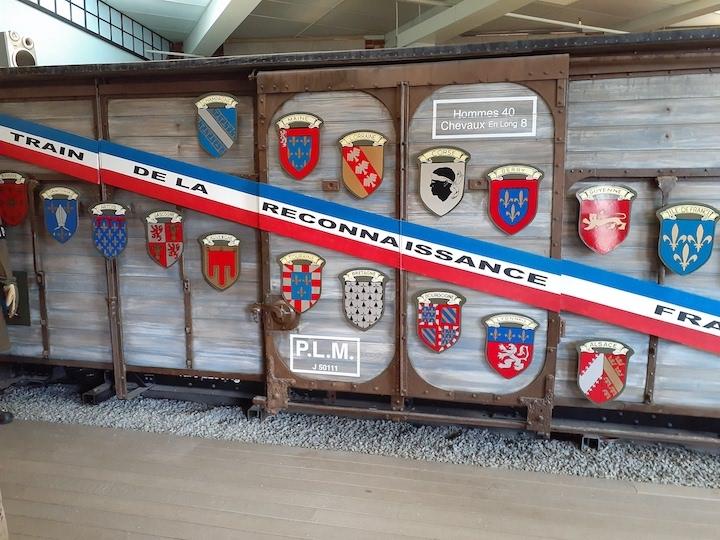
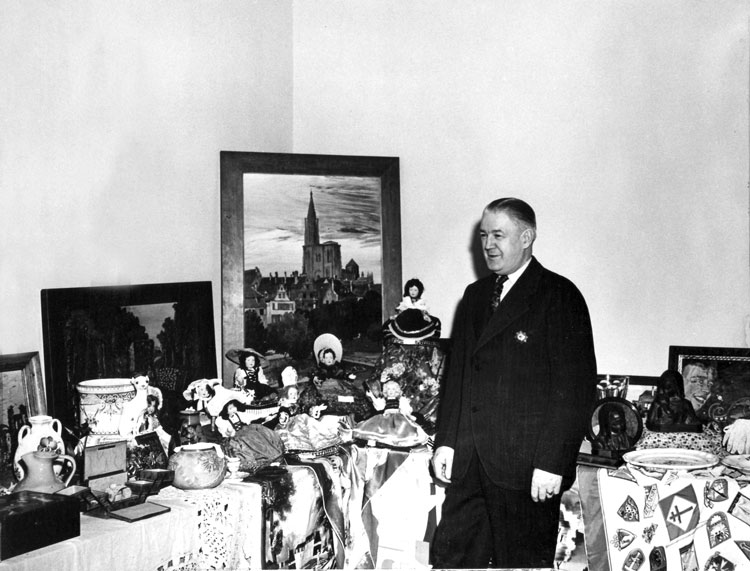
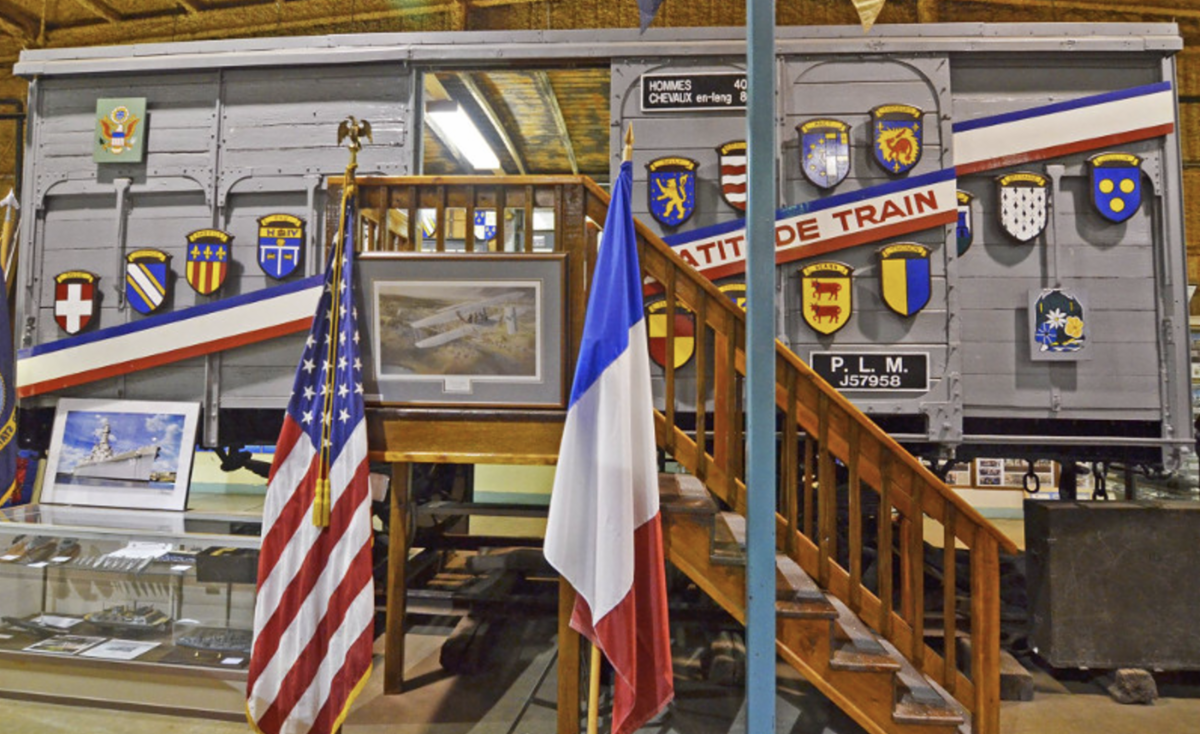
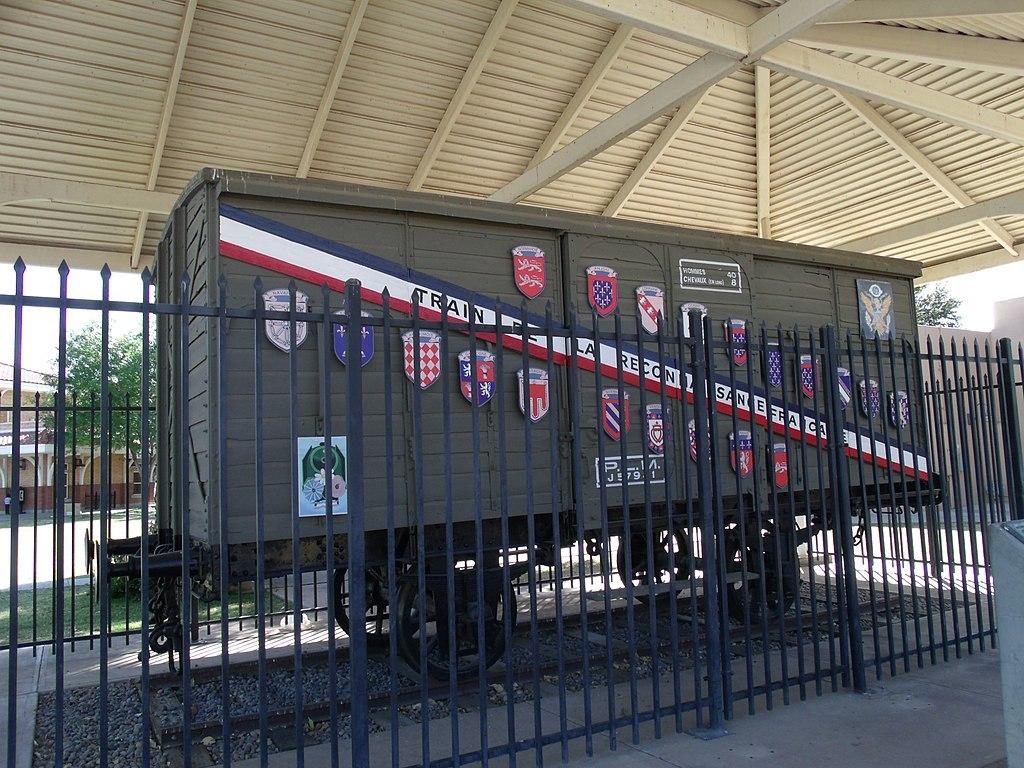
The Rhode Island "40 & 8" boxcar of the Merci Train
Museum of Work & Culture, 42 S Main St, Woonsocket, RI 02895
Photo courtesy Prof. Norman Desmarais, docent
|
|
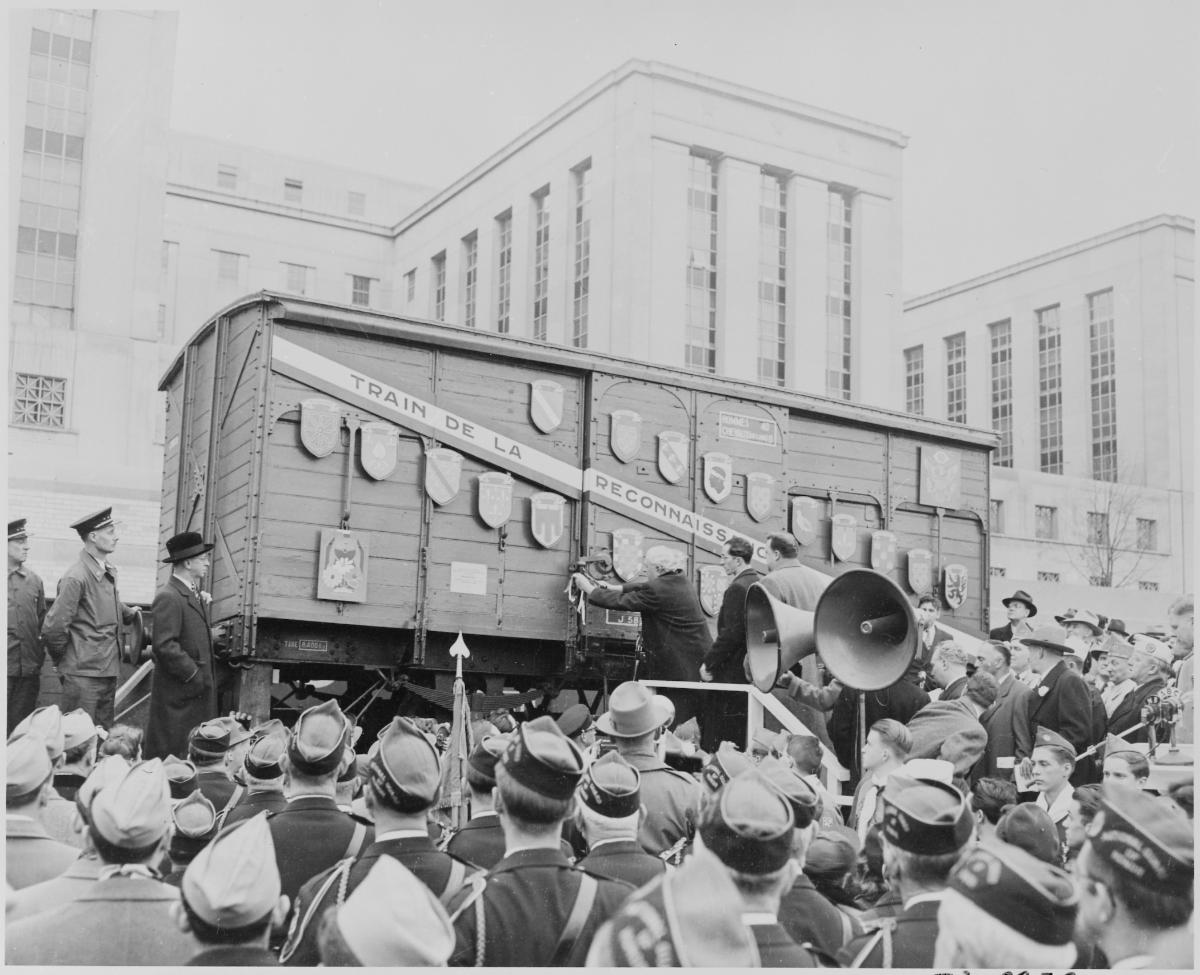
The boxcar gifted to the State of New York presented to the public. By Abbie Rowe, Photographer (NARA record: 8451352) — U.S. National Archives and Records Administration, Public Domain
|
|
What is a "40 & 8" boxcar?
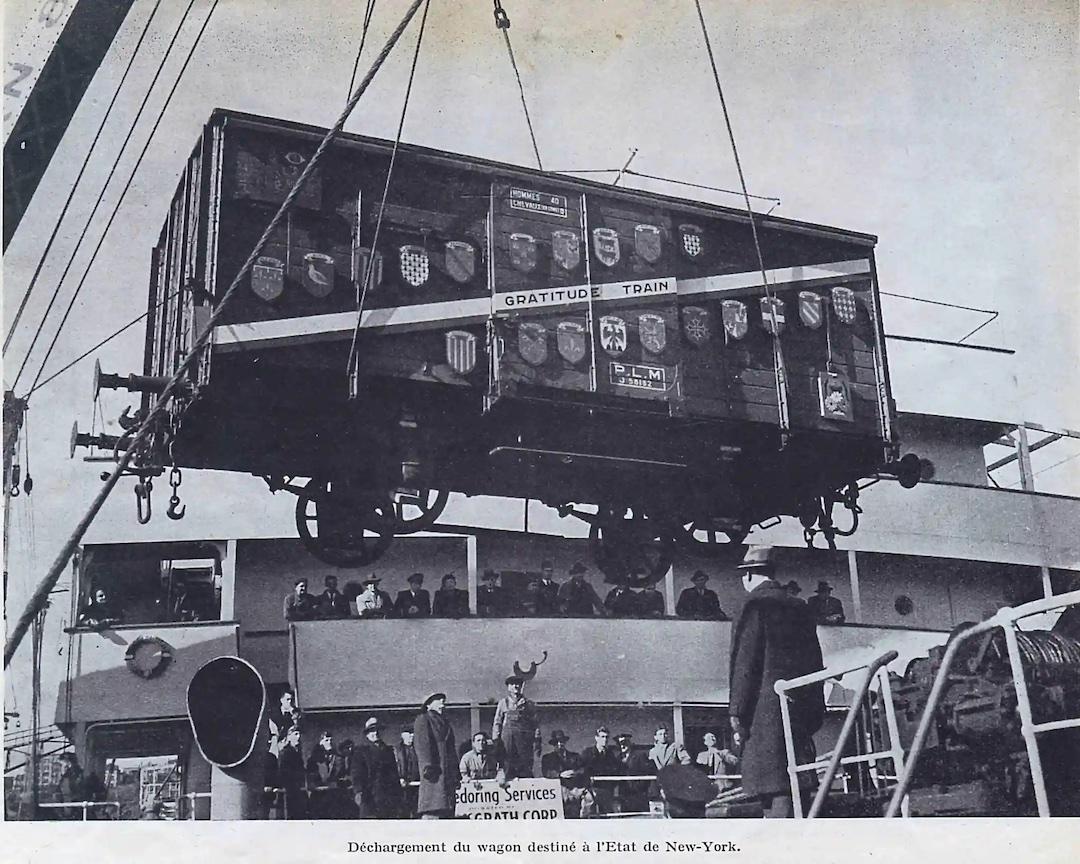
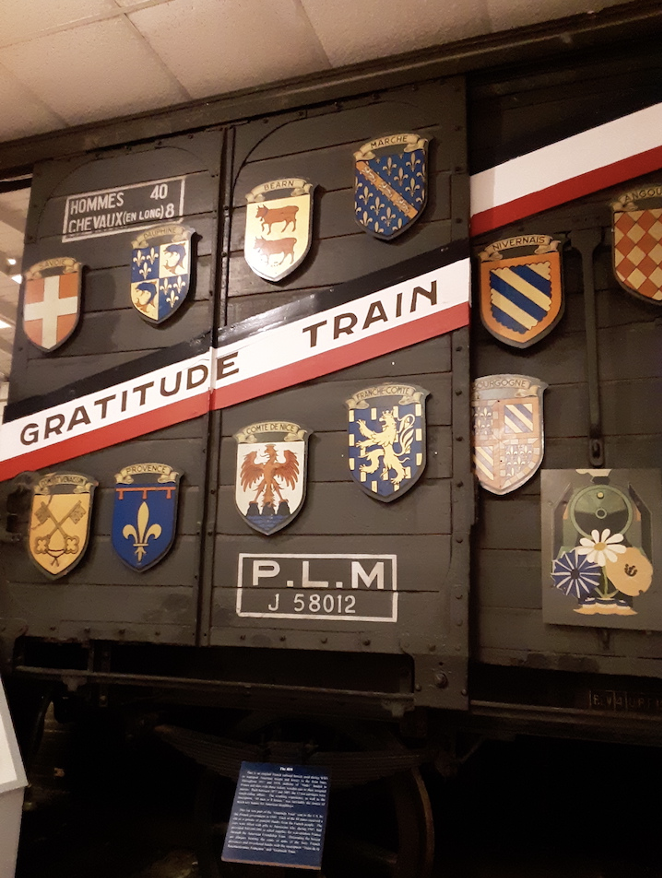
Introduced in the 1870s, these boxcars were used by the French Army in both world wars. They were called "40 & 8" because, well, they could carry either 40 men (no seats! Packed like sardines, with just a layer of straw and a tiny overture to get some fresh air...) or 8 horses. Thousands of French and American soldiers were moved to the front lines in these cars.
What is "La Société des Quarante Hommes et Huit Chevaux"?
It is more commonly known as "The Forty and Eight" and is a charitable patriotic association open to US Armed Forces honorably discharged veterans or service members, by invitation only.
They borrow their terminology from the French: they meet at a Promenade Nationale, members are Voyageur Militaire, their chapters are Grande Voiture, and Voiture Locale, they are directed by a Chef de Gare, Directeurs, Sous-Directeurs, Secrétaires. They also follow their own rituals.
The Society of Forty Men and Eight Horses have been caretakers of many of the Merci Train boxcars since their arrival in the United States back in 1949, soon to be 75 years ago. They are to be greatly admired for their dedication to the memory of Americans who sacrificed so much during World Wars One and Two. They consider the boxcars a symbol to remind themselves, and all of us, of those 20th century patriots and heroes and of their sacrifices.
|
|
A Nation’s Gratitude
by Norman Desmarais
World War II veteran André Picard, a French railroad worker, got the idea to send a "Thank You” gift to the United States for its contribution in winning World Wars I and II and for the food and supplies sent to France and Italy in 1947. The idea was patterned on Drew Pearson’s Friendship Train. Pearson was one of the best-known American columnists of his day. He inspired American volunteers to collect and send $40 million in food relief, medicine, fuel, and clothing to France and Italy in 1947, an effort which saved many French citizens from starvation. The supplies filled more than 700 boxcars.
France, in appreciation for the articles sent to them on the Friendship Train reciprocated in 1949 with the Merci Train, also known as the French Gratitude Train or the Forty and Eight. Forty-and-eights were French 4-wheel covered boxcars which were used as military transport vehicles. The term refers to the cars' carrying capacity: 40 men or eight horses. Built as regular freight boxcars, starting in the 1870s, they were used by the French army in both World Wars to transport troops and horses as well as other military supplies. Later in World War II, they were used by the German occupation and finally by the Allied liberators.
American troops rode these boxcars to and from battle in WW I and WW II. Think about how uncomfortable they were. The men could be in these cars for days with no toilet facilities. Imagine yourself and 39 other men trying to sleep in this unit at the same time, especially after they had been used to transport horses.
The Merci Train was comprised 49 boxcars, one for each state at the time (Alaska and Hawaii were not yet states) and one for Washington, D.C. and Hawaii to share. Each boxcar carried five tons of gifts, all donated by private citizens. Six million citizens of France and Italy donated all kinds of goods, as an expression of gratitude for the liberation of France and for the relief provided by the Friendship Train. The boxcars must have been designated by State because the contents of some of the cars contained messages to the governor of the state.
|
|
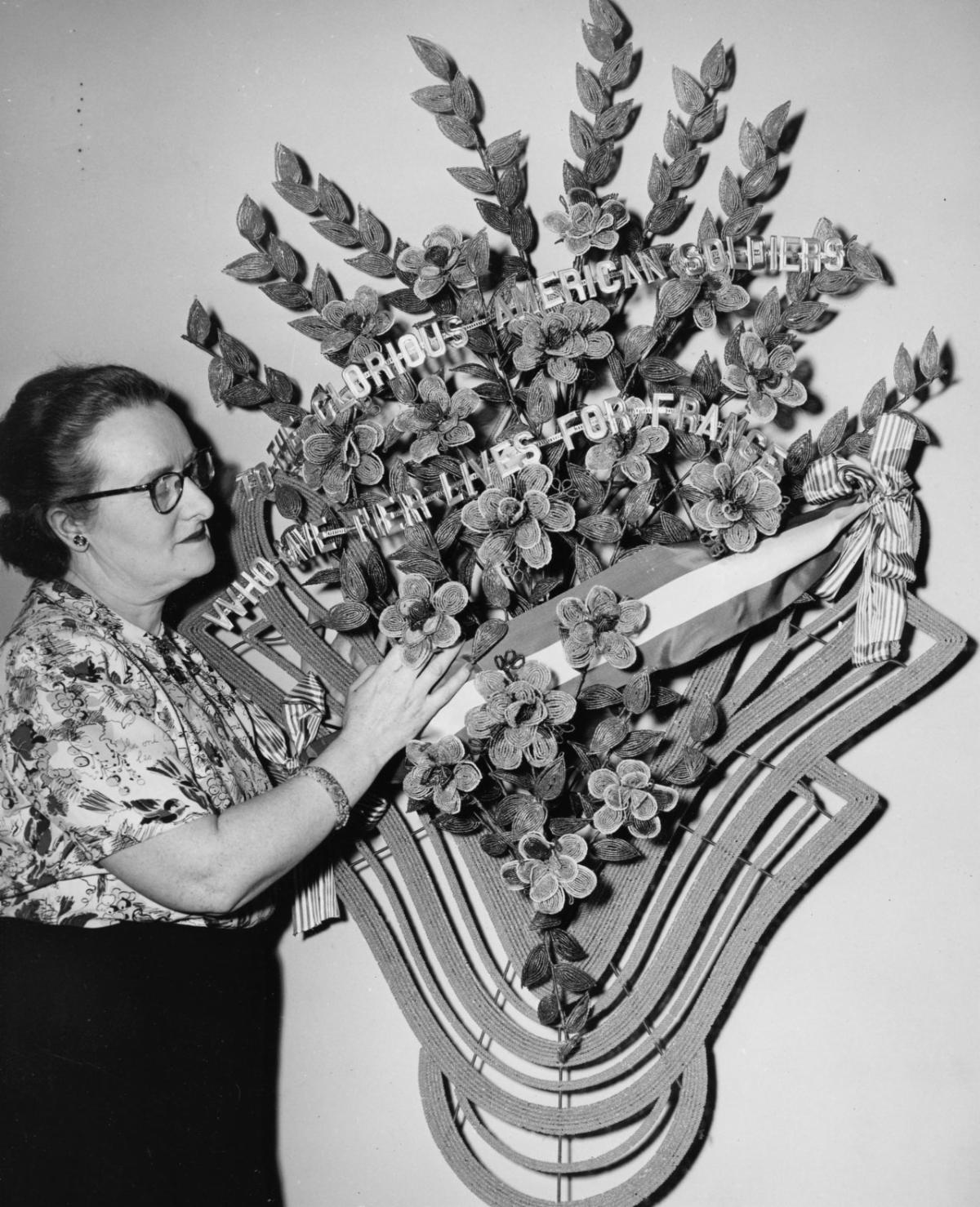
A beaded wreath that is traditionally used on graves in France was one of the gifts in the Gratitude Train from France. It says "To the glorious American soldiers who gave their lives for France." |
|
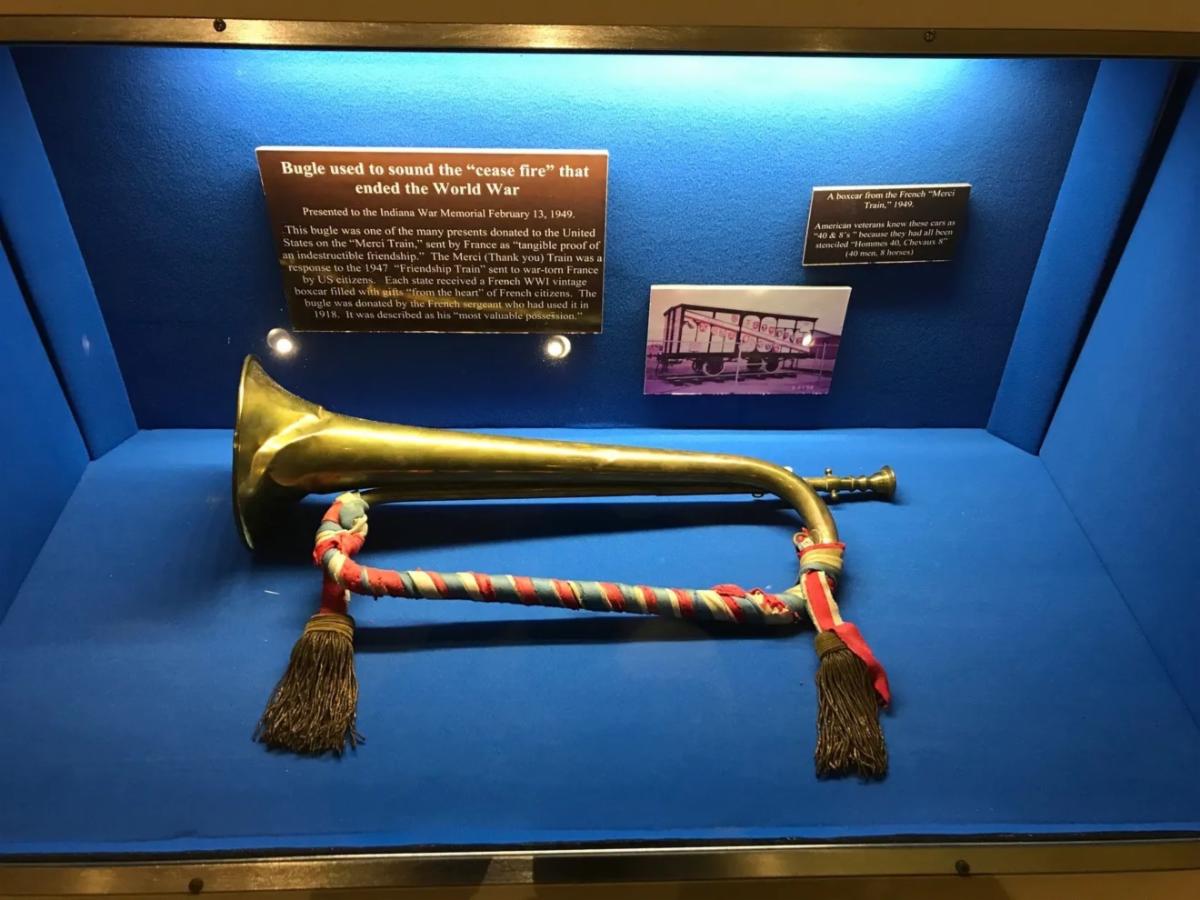
The bugle that sounded the ceasefire at the end of WW1 is on display a the Indiana War Memorial. The bugle, donated by a French sergeant who had used it in 1918, said it was his “most valuable possession” ... Ethan Wrigth/Indiana War Memorial. |
|
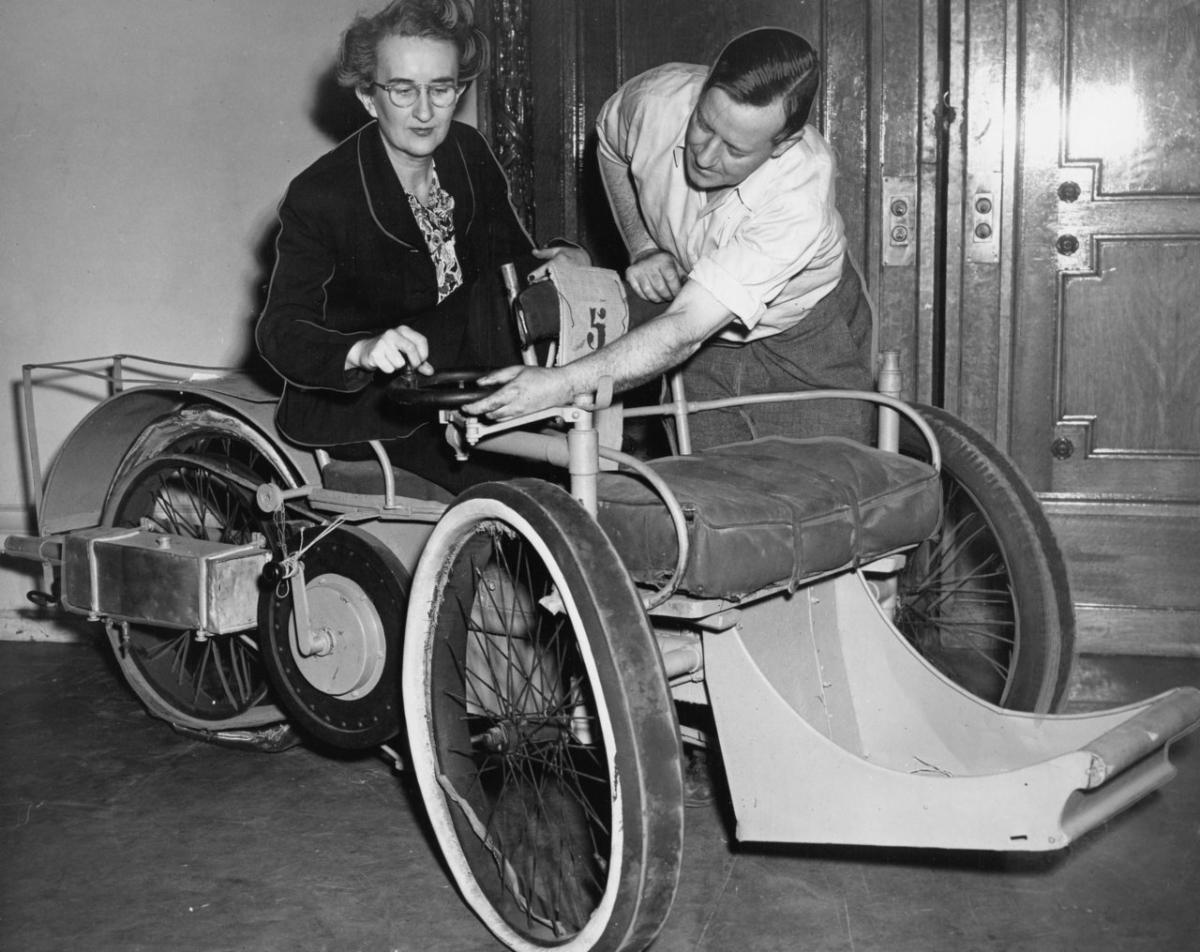
Marion Nordmark and Earl Trayer look at an antique automobile built in 1893 was one of the gifts sent from France to the U.S. on the Gratitude Train. It is one of the first petroleum-operated automobiles. The note attached to the vehicle states it is one of the first petroleum-operated automobiles ‘built in 1893, which could travel at the record speed of 20 miles per hour.’ It was donated by an electrician from Royan, France,” according to The Patriot. |
|
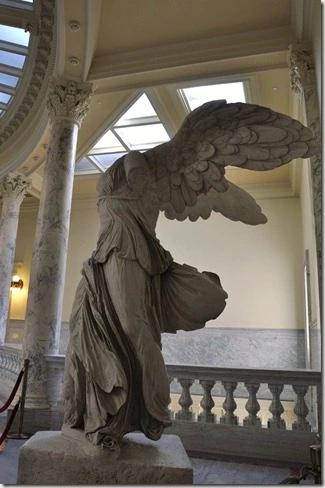
A replica of the Statue of Samothrace from the Louvre and part of the Idaho boxcar adorns the Capitol of Idaho. |
|
Robert P. Hall stands amid Merci Train gifts on display at the Arkansas State Capitol. Courtesy Arkansas State Archives |
|
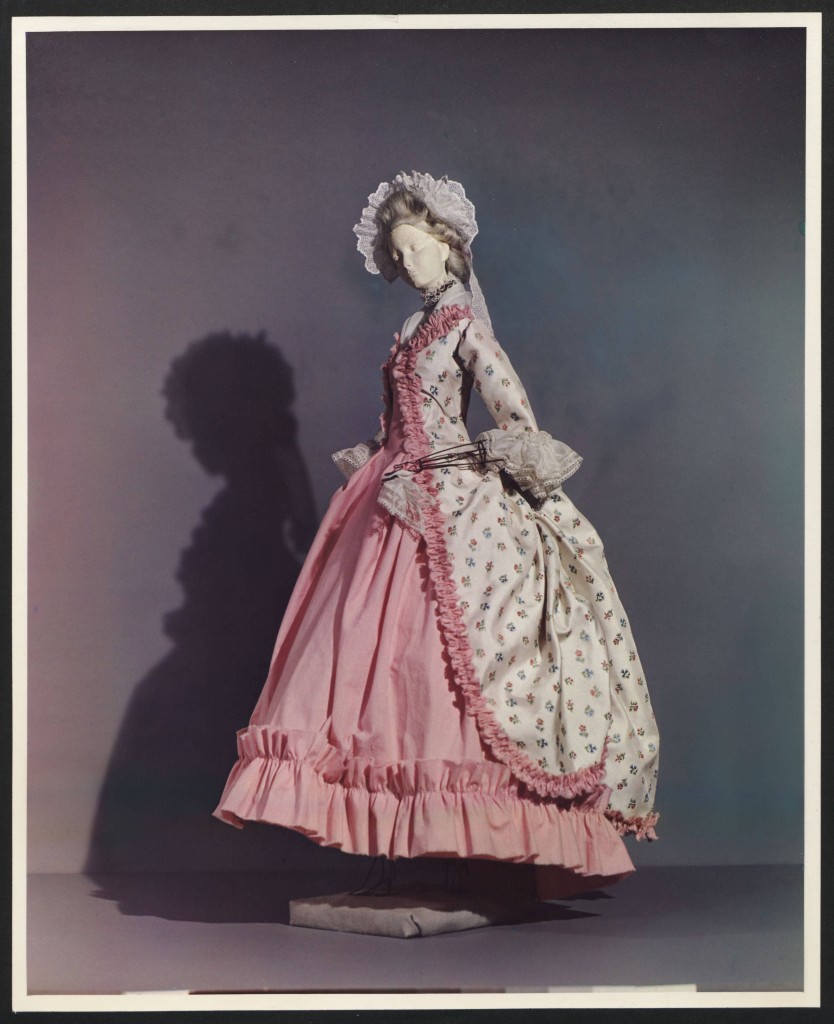
Photo courtesy of the Metropolitan Museum of Art: "Filled with gifts of gratitude, the treasures included a collection of forty-nine dolls dressed in French fashions designed by prominent couturiers of the time reflecting French dress from the early seventeenth century through the early twentieth-century. Each doll, measuring approximately 24″ tall and made of open wire, was outfitted by a different designer to represent the evolution of French fashion. The figures, which are in the Costume Institute collection at The Metropolitan Museum of Art, have been photographed by the Museum and have accompanying descriptions for each figurine summarizing the designers and their influences."
|
|
• The French citizens donated wooden shoes, hand crocheted doilies, children’s toys, the bugle which signaled the armistice signing at Compiegne in 1918, a Louis XV carriage, the first motorcycle ever built, 49 dolls given by the city of Cognac dressed in the regional costume of Charerette.
• The Society of Parisian Couturiers contributed an exquisite set of 49 little manikins dressed in fashions from 1706 to 1906. One of the Marquis de Lafayette’s descendents presented his ancestor’s walking stick. Another person added the original bust of Benjamin Franklin by the French sculptor Jean Antoine Houdon. A disabled veteran offered a wooden gavel he had carved from a tree in Belleau Wood, site of an intense battle of World War I. There were new and old bicycles and just bicycle wheels. A church in La Courtene offered its bell. The city of Lyon, the second largest silk processing center in the world, gave 49 silk wedding dresses. An anonymous donor added a set of black lingerie intended “for a beautiful blonde.” (The French call a beautiful woman or a girlfriend une blonde.)
• A newspaper account mentions a poor woman rushing past the workmen painting one of the cars. She announced “I have nothing else to send. I will send them my fingerprints.” She then pressed her fingers into the wet paint.
|
|
• Arrival
The train’s 49 boxcars were loaded aboard the French freighter Magellan and arrived in New York on February 3, 1949, with over 25,000 onlookers in attendance. "MERCI AMERICA" was painted on the side of the freighter. The Magellan was greeted by a flotilla of small boats while waves of Air Force planes flew overhead in aerial salute. The port resounded with ringing bells, blowing whistles and wailing sirens. Fire boats turned their nozzles skyward, sending columns of spray into the wintry sunlight. The ship docked in Weehawken, New Jersey and local stevedoring companies volunteered to unload the Magellan the following day.
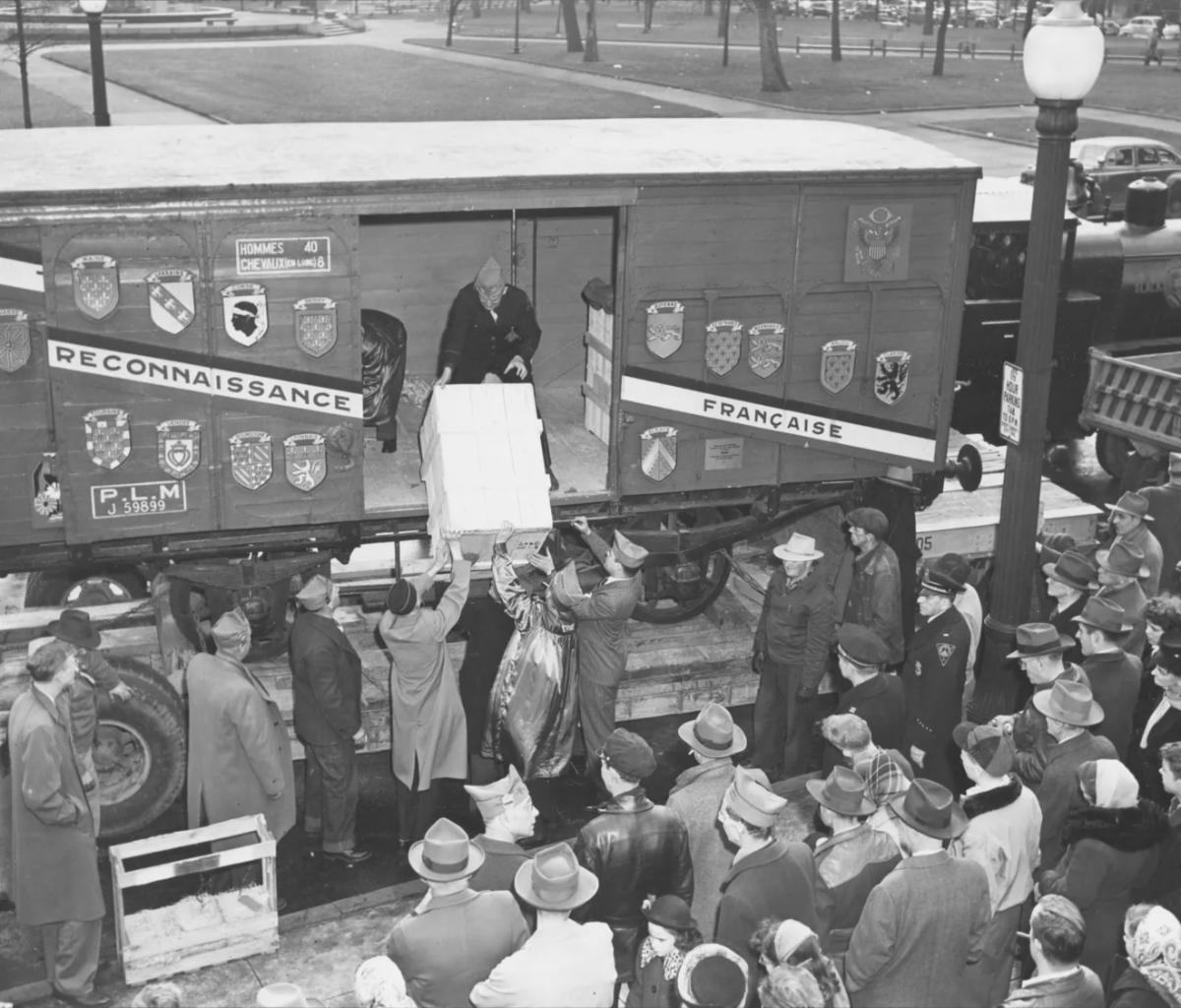
President Truman had signed into law a special resolution permitting the train and its cargo to enter the United States duty-free. Trainmen then sorted the boxcars into three sections for shipment to the South, West, and New England. They were loaded onto flatcars because the wheels were of a different gauge than the American railroads. They were then sent to the capital cities of each state. The flatcar carrying the boxcar bound for Little Rock, Arkansas arrived in the early morning hours of February 13, 1949. People flocked to see the gifts, displayed first at the Rock Island Freight Depot and later the Capitol rotunda.
|
|
• Almost all the states had received theirs by February 22 when the state of Washington received hers. Kansas opened hers at a public ceremony on November 11 and Oregon received hers on December 12, 1949. The remaining car was shared by the District of Columbia and Hawaii. That boxcar ended up in Hawaii, but the contents stayed in the District of Columbia.
• Coats of arms of the provinces of France adorned the sides of each boxcar and each one was stamped "40 Hommes - 8 Chevaux" which means it has the capacity for 40 men or 8 horses.
• Many of the boxcars were opened and turned into exhibits before distributing the contents as each state saw fit. Most states continued to exhibit the boxcars to the public after their gifts were distributed.
Contents
• The contents of the boxcars included dolls, statues, wine, clothing, art, ornamental objects, furniture, paintings, drawings, handmade clothing, lace, dolls, medals, musical instruments, flags, candlesticks and even thank you letters from children. One car included nine dolls dressed in French provincial costumes. Another contained a Legion of Honor medal purported to have belonged to Napoleon.
• The Illinois car contained a letter from the President of France to then Governor Stevenson among 10 original pieces of art and 8 handwritten letters from French school children. The Idaho car included a replica of the Statue of Samothrace (see Fig. 2) which is on display in the Idaho State Capitol building in Boise. The original statue was sculpted about 400–300 BC on Samothrace, an island in the Aegean Sea. Lost for centuries, the sculpture was rediscovered in 1863 and sent to the Louvre Museum in France.
|
|
• Arizona’s boxcar held a surprising array of gifts: a Peugeot bicycle, military helmets, an elegant silk wedding gown, about sixty wind-up toy Renault cars, a handmade lace bonnet, and a mother-of-pearl fan. More striking than the gifts were the emotional notes that accompanied them.
The Société Nationale des Chemins de Fer Français, the French national railways, commissioned contemporary regional artists to depict stunning French landscapes, historical provinces, and cultural regions. The Nevada boxcar contained 21 travel posters (1945-1949). Research indicates that all states received a set of posters, yet only three appear to have retained possession of their collection, and Nevada was the only state to exhibit them.
Most of the gifts can no longer be located as they were scattered to a thousand places and are almost impossible to trace. Some have simply disappeared. In some states, the contents were sold at auction and the proceeds given to charities. Some can be found in various state museums, libraries, state capitol buildings or universities. But, for the most part, time has blurred the connection between these articles and the undertaking which brought them.
|
|
• Rhode Island Boxcar
The Rhode Island General Assembly passed a bill to exempt the train from import taxes on January 27, 1949. The Massachusetts and Rhode Island cars came through Blackstone, Massachusetts to Woonsocket and Manville, Rhode Island where ceremonies were held on February 8, 1949. Crowds stood along the tracks at Albion, Berkeley, Ashton and Lonsdale to see the train, with Gov. John O. Pastore at the throttle, dressed as an engineer. The train slowed to give Valley Falls bystanders a good look and it made an 8-minute stop at the Pawtucket-Central Falls railroad station so the 250 spectators around the station could see the boxcars. However, the throng was not allowed on the station platform because of the danger of overcrowding and possible falls onto the tracks. A crowd of about 5000 people greeted the train when it arrived at Union Station in Providence at 7:45 PM.
A state dinner and ceremonies were held in the ballroom of the Narragansett Hotel that evening. Albert Chambon, the French Consul at Boston said that it was not the material gifts contained in the Rhode Island boxcar which meant the most, but the fact that the gift had come from millions of French homes and included many treasured heirlooms. He concluded, in French, much to the delight of his largely French-Canadian-American audience “Thank you, from France, and all of our affection goes to you the French capital of New England!”
The next morning at 9:30, a parade set out from Memorial Square, proceeding west through Exchange Place. It passed in review before City Hall, returned to Memorial Square, thence under the Promenade Street subway to Pershing Square, where the French boxcar entered the line of march. The parade proceeded up Francis Street to the side of the state house, where a salute was fired, before continuing to Smith Street and into the state house plaza. The Massachusetts boxcar departed for Boston early that morning.
The boxcar (See Fig. 1 at the top of this article) remained at the state house plaza until March 5 when the public exhibit closed. The 41 boxes of gifts were taken by truck to the subbasement entrance of the state house, shifted to an elevator and deposited in the second floor reception room on February 16. Gov. John O. Pastore set up a committee to distribute the gifts, many of which came from children.
|
|
From French Pierre to American Joe
Five-year-old Michelle Waechter, of Alsace, pinned her photograph and a note on her gift: a little picture of a boy and girl with a goose. Her note apologized that her parents “were not rich.” Jeanne Riviere, of Paris, sent her parents’ mandolin. The gifts of the French children did not represent great material value but they were worth a fortune in terms of friendship, gratitude and human relations. They included dolls, toys, artworks, statues and hundreds of other items, including a little stuffed dog with blue ears. Most of the notes accompanying the gifts were in French but a thoughtful donor contributed 10 copies of the book French Without Toil.
A “thank you album” from the children of France to the children of Rhode Island, one of 48 such albums, was presented to Gov. John O. Pastore by members of the American Association of teachers of French at a state house ceremony on May 24. The album included watercolors and drawings by French children, letters from a number of youngsters and phonograph records of folksongs and popular tunes of various French provinces.
Gifts included art objects: antiques; historical mementos; books; paintings; photographs; bronze medals; woodcarvings; intricate needlework from Nantes; a chic Parisian hat; lingerie; bottles made of wood and bound in copper; a bottle carved out of a tree limb; a carved figure of a man in a bottle; a walnut carved work table; brandy snifters; a brass dinner gong; two spike-topped German officers’ helmets of World War I; a delicate Sèvres china vase, gift of President Vincent Auriol to Gov. John O Pastore; a bronze seagull, wings outspread, from the residents of Thonon-les-Bains; 100 small cartons of French cigarettes; 25 dolls many of finely detailed linen. The clothing painstakingly handstitched ranged from bright peasant garb to the lace and frills of medieval France.
The memorials went to the Rhode Island Historical Society and similar historical institutions. Paintings, custom designs and museum pieces selected for value and antiquity went to the Rhode Island School of Design Museum of Art, the John Carter Brown Library and to the Rhode Island Historical Society. Le Theatre Guignol contributed Punch and Judy puppets which went to Sock and Buskin at Brown University. Four pieces of French music and a mandolin were given to the music department of Brown University. Catholic religious subjects and similar items were sent to Bishop Russell J. McVinney. Some of these were then sent to Catholic institutions or agencies.
More than 150 volumes of books were distributed to Rhode Island colleges, universities and libraries. Beechnuts, harvested near Tricourt, France, went to Rhode Island State College to be planted. The seedlings were to be cultivated and the small trees planted on the campus of the college with a French “Merci Train” label. The state library retained an album from a Frenchman in Paris to be loaned to several of the larger libraries throughout the state and special educational institutions for display and study.
One Napoleonic sword and medal went to the Rhode Island Historical Society. Another sword went to the Varnum Continentals in East Greenwich along with some issues of a document with relation to World War I. A doll and creche from the French Red Cross went to the Providence Chapter of the American Red Cross.
Photographs of champagne making and a brochure about the wine went to the state liquor control administrator. The Newport Historical Society received a costume doll for its doll collection.
Moses Brown school requested the painting of Notre Dame Cathedral. Eleven rolls of French velvet in varying shades went to the Bureau for the Blind, Department of Social Welfare, to be used in work for the blind. Three framed designs for a stage production of “La Dame aux Camelias” by Marie-Ange went to The Players, Barker Playhouse. Toys, drawings by schoolchildren of France, a large number of stars in paper and cement were turned over to the public and parochial schools for distribution to honor pupils.
The Rhode Island committee in charge of distribution of the gifts chose a number of persons and groups who served “in aid of France for many years” to receive the remaining gifts and invited them to come to the state house during August to make their choice of what remained.
A card was to accompany each gift. The engraving read:
In recognition of a proven, profound interest in the peoples and welfare of the Republic of France, the committee entrusted with the distribution of gifts from the Rhode Island Merci Train tenders to – – – this token of the appreciation of a grateful French populace for a generous and understanding American citizenry.
|
|
Photo courtesy Prof. Norman Desmarais |
|
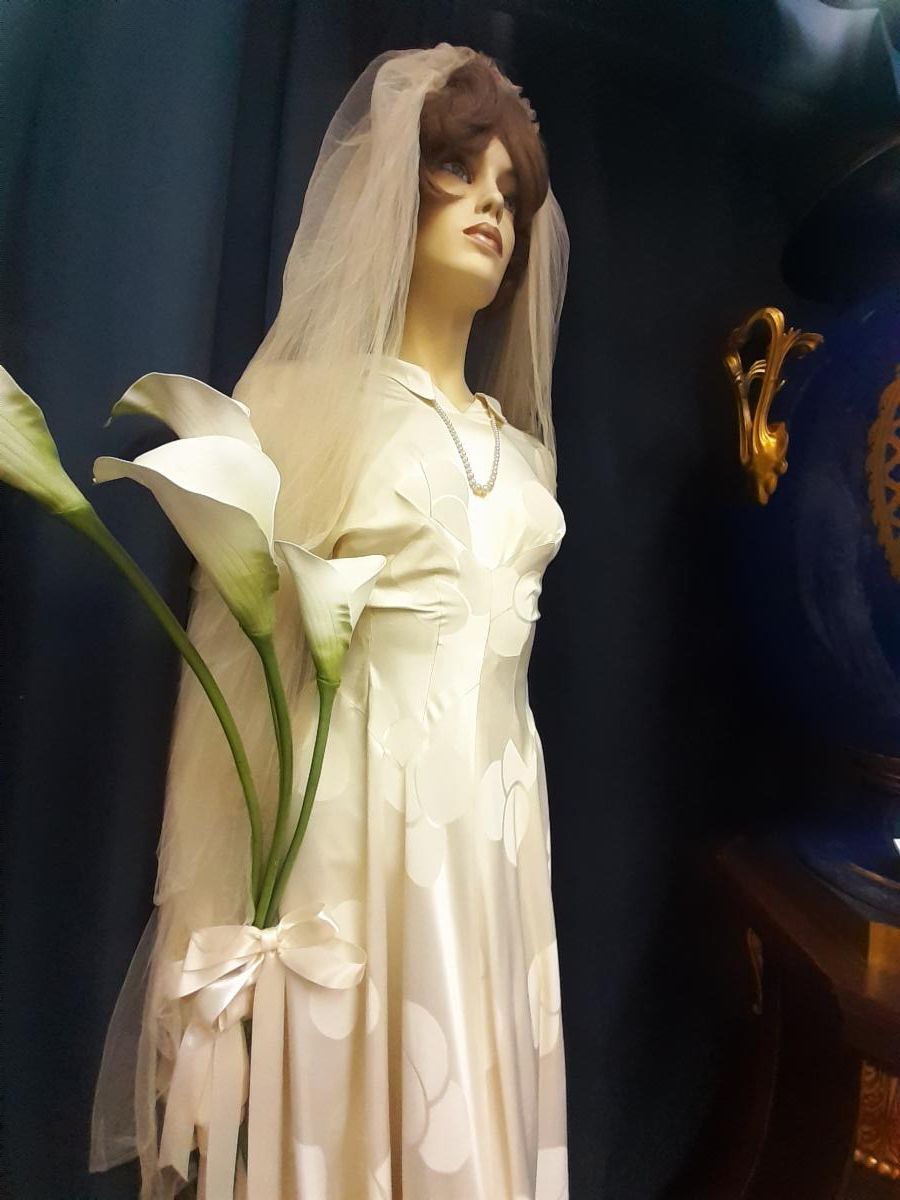
• Wedding Gown
One of the most interesting gifts in the Rhode Island boxcar (as well as those for the other states) was a wedding gown. The size 12 white satin brocaded bridal gown donated by a bride from Lyon was entered into a raffle. There were two conditions: the bride had to have a 24-inch waist and a wedding in September. The gown should fit with little or no alteration.
The committee received 104 applications. The first of three names drawn from a sealed box was that of 25-year-old Lillian Weimar. By coincidence, she was the first to apply for the gown. Ms. Weimar was born in Paris where she lived until she was five years old. Her mother was French and married an American soldier after World War I. Her great-grandfather was commandant of gendarmeries at Lyon around 1870 and she was a direct descendent of one of Napoleon’s generals. Her parents moved to Westerly, Rhode Island in 1929.
Lillian’s 24-inch waist and 33-inch hips matched the gown exactly but her bust was 30 inches and the gown was 31 inches. In a 1995 interview, she recalled how her mother, whose ancestors were from Lyon, was more determined to get the dress than she was. She noted "it had this shiny finish, buttons up the back, all sewn by hand. The seams were all hand-overstitched. It was beautifully made." Lillian died in 1996 at the age of 72 and her daughter donated the dress to the Museum of Work and Culture.
Hartford, Connecticut merchants donated prizes to the recipient of the Connecticut dress. They included a free honeymoon trip to Lyon so the winning bride could personally thank the donors.
|
|
• The Boxcars’ Outcome
Many of the boxcars were given to veterans’ organizations such as the American Legion, 40 & 8, Veterans of Foreign Wars. Some were placed in museums; some incorporated into memorials; others given to fairgrounds and city parks. Many were ignored and fell into disrepair, particularly in the 1960s, following a period of cool relations between France and the United States when France decided to withdraw from NATO. Later, the veterans’ organizations paid to have them restored, preserved and put on display.
The Rhode Island boxcar was turned over to the American Legion 40 and 8 organization along with war trophies for display. Special designs were made for the construction of a chassis upon which the car would be placed for use on patriotic occasions and in parades. It was placed at the American Legion camp in Burlingame State Park in Charlestown which was supposed to be its permanent home. When the park closed, all of the buildings on the site were sold to a junk dealer for scrap, including the boxcar. The boxcar spent more than 20 years in disrepair in the junk dealer’s yard, subject to vandals and the elements.
John Hill, a reporter for the Providence Journal, wrote an article about the unfortunate condition of the boxcar in 1995. That article moved Fred and Betty Tanner of East Greenwich to purchase it. They had it moved to their property, hoping that someday, someone would be interested in restoring it.
Alphonse Auclair and Jacques Staelen met with John Hill two years later and began a search for the boxcar. Their quest led them to the Tanners. The boxcar was restored and donated to the Museum of Work and Culture in Woonsocket on Nov. 7, 1999. The car returned to the city where it first arrived 50 years earlier.
Forty-three of the boxcars remain today. Some were deemed beyond restoration. In the case of the New Mexico boxcar, the restoration team located a similar boxcar in France and transported it to the US in 1987 for use as a replica, next to the original one which is displayed, unrestored, next to a complete replica of the car as it looked when delivered to the state.
Providence Journal Jan. 27, 1949, Feb. 16, 18, May 25, June 18, July 28, Aug. 2, 1949, Feb. 3, 2005; http://www.mercitrain.org/
The Lt. Georges Dubois Veterans Museum
|
|
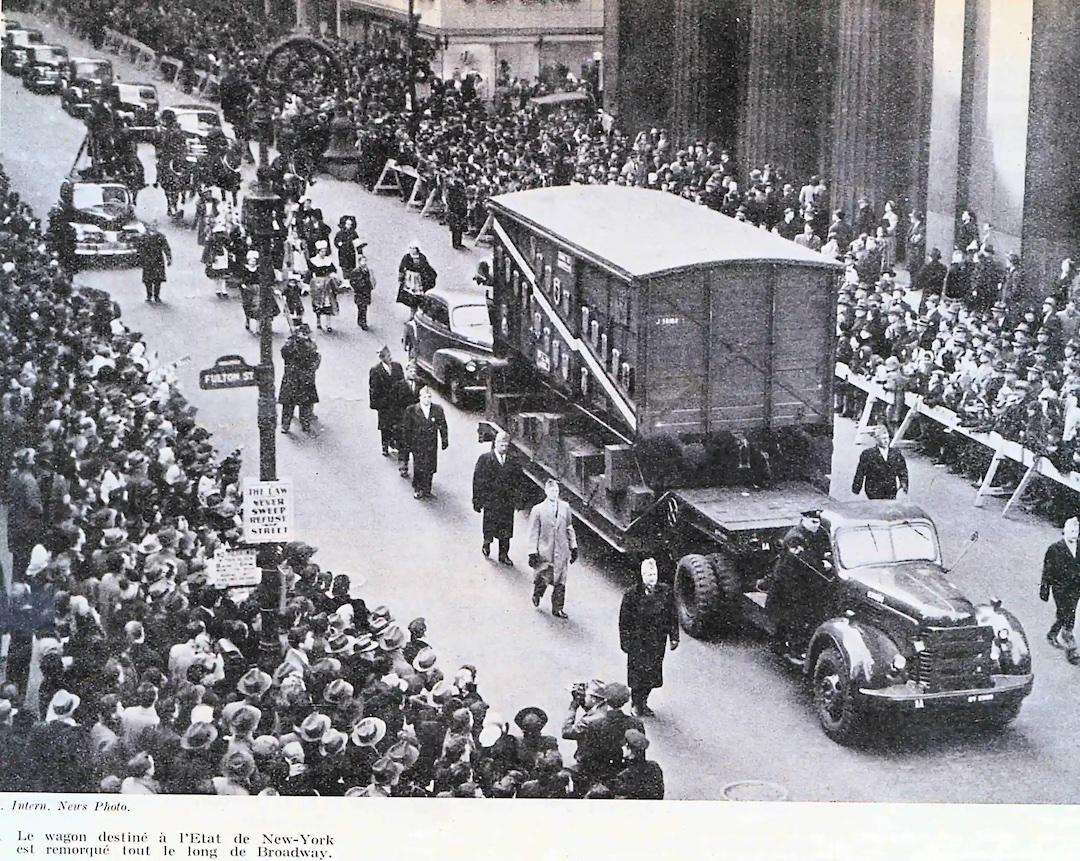
FEBRUARY 3, 1949;
A TICKER TAPE PARADE FOR THE
FRENCH GRATITUDE TRAIN
|
|
Photo: The New York Times
There is (was) a strip marker on Broadway's sidewalk, currently missing probably due to construction on a building and its portion of adjacent sidewalk.
It read: "French gratitude train ("Merci Train") bearing gift from France to the United States in appreciation of the friendship train (February 3, 1949)"
|
|
• The headline of The New York Times read: " City Roars Thanks to France fro Car of Gratitude Train" - "First of 49 Freight Carriers Paraded from the Battery to City Hall as 200,000 Cheer"
The article went on: "The city put out its traditional welcome mat for the first of forty-nine gift-laden boxcars being sent by the French people in appreciation for the $40,000,000 Friendship Train that America sent to France in the bleak winter of 1947" [...] "Each car contains approximately 10,000 cultural, historical, personal and communal gifts..."[...] "the American Legion accepted a torch lighted in January at the tomb of the Unknown Soldier in Paris"[...]"eventually the torch will be taken to Arlington to beunited with teh Eternal Flame at the tomb of the Unknown Soldier there, and then turned over to teh American Legion"[...] "Massed thousands, swelled by the noon-hour crowds in the financial district and by 15,0000 public and parochial school children with French and American flags, packed the parade route along Broadway. An avalanche of confetti and ticker tape danced in the sunlight as it fell in the wind".
|
|
TODAY'S REMAINING 43 BOXCARS
A few examples
|
|
Alabama boxcar: photo US Veterans Memorial Museum, Huntsville, AL
U.S. Veterans Memorial Museum, Paul Bolden Bldg
2060A Airport Road, Huntsville AL 35801
|
|
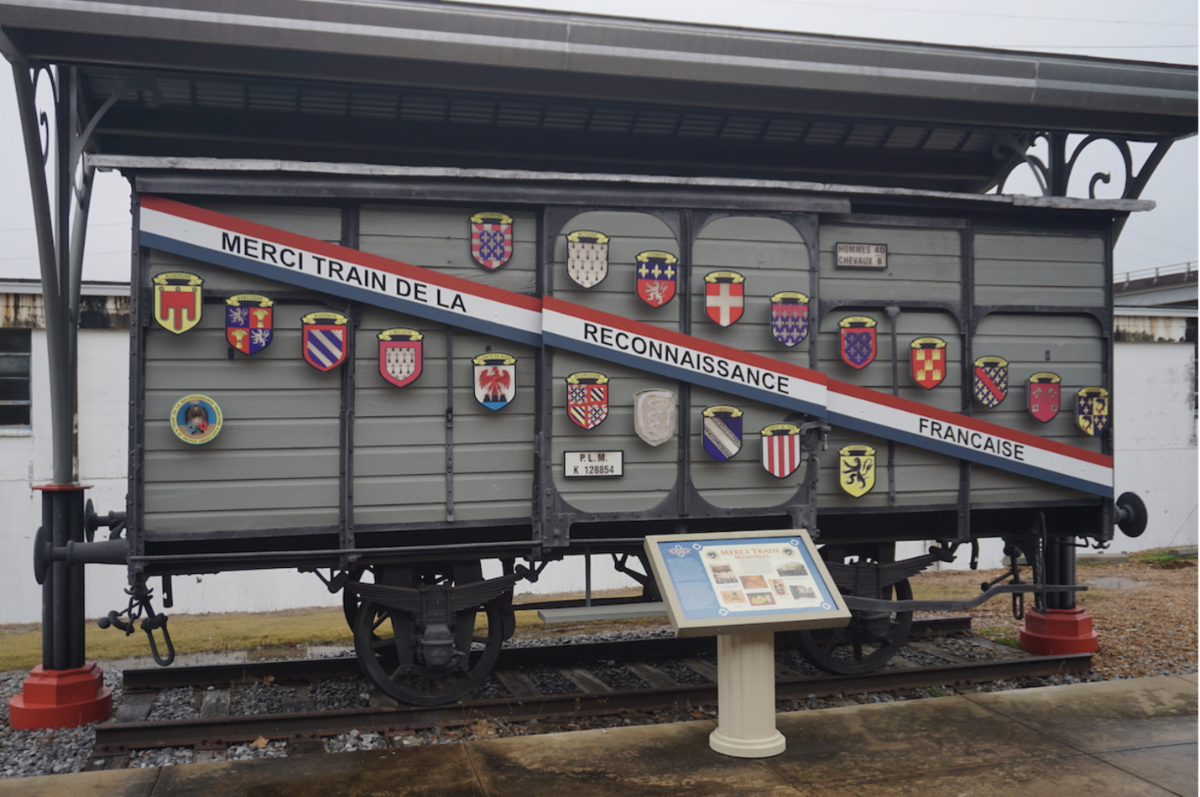
Mississippi boxcar, The old Gulf, Mobile, & Ohio Railroad Depot
618 E. Pearl St., Jackson, MS 39201
|
|
Boxcar of Arizona, at McCormick-Stillman Railroad Park Playground
7301 E Indian Bend Rd, Scottsdale, AZ 85250
Photo: By Marine 69-71 at English Wikipedia, CC BY-SA 3.0, https://commons.wikimedia.org/w/index.php?curid=21978205
The boxcar has been used as a backdrop for Scottsdale's Veterans Day Celebration.
Excerpt of marker: "Today, it serves as a remembrance of two countries who always fought “for the liberty and dignity of man.”
|
|
Utah boxcar, Ogden Union Station, 2429 Wall Avenue, Ogden UT 84401
|
|
Virginia Boxcar at the Virginia War Museum
9285 Warwick Boulevard, Newport News, VA. 23607
Photo courtesy of Nicole Yancey,
|
|
LIST OF SITES FOR THE 43 REMAINING BOXCARS
You can see a list of the locations for all the 43 remaining boxcars at these websites:
And this particularly moving video on YouTube:
|
|
PART FOUR OF THE SERIES
"LAFAYETTE, GUEST OF THE NATION"
If you missed the episodes from our past Bulletins...
• President James Monroe invited Lafayette, the last surviving major general of the American Revolutionary War, to tour the United States, officially to celebrate the nation's 50th anniversary but also to instill the "spirit of 1776" in the next generation of Americans at a time of great political divide. His tour drew large crowds and sparked a renewal of patriotism.
• From July 1824 to September 1825, Lafayette made a tour of all 24 States in the United States. He was received with a hero's welcome everywhere he stopped. Immense crowds, children, old veterans would come from miles away and wait hours to have a chance to see him, approach him, touch him. Many honors and monuments were presented to commemorate and memorialize the visit.
• The 24 states visited were: Alabama, Connecticut, Delaware, Georgia, Illinois, Indiana, Kentucky, Louisiana, Maine (ex-Massachusetts / North part), Maryland, Massachusetts, Mississippi, Missouri, New Hampshire, New Jersey, New York, North Carolina, Ohio, Pennsylvania, Rhode Island, South Carolina, Tennessee, Vermont, Virginia, Washington D.C.
• The main means of transportation were stagecoach, horseback, canal barge, and steamboat.
• Throughout the years 2024 and 2025 each city will celebrate this most illustrious Frenchman, ranked alongside the Founding Fathers, practically on a par with George Washington. If anyone harbors any doubt about it, one only needs to read the some of the hundreds of local newspapers articles and the accounts or memoirs of contemporary witnesses accounts.
|
|
• Several of his stops are memorialized with markers and plaques, some decades-old, and an increasing number of brand new ones, thanks to the energy and enthusiasm deployed by Julien Icher, president of the LafayetteTrail.org, whose goal is to dedicate all 175 markers by 2024.
• These new markers from the LafayetteTrail.org are all made in the same distinctive blue and red cast metal and signed by the William C. Pomeroy Foundation which is generously funding this gigantic project.
• The American Society of Le Souvenir Français Inc. is honored to partner with these two like-minded organizations, all well as all other American patriotic associations and volunteers who are participating in these celebrations.
|
|
As we started with August 2022 Bulletin, we will narrate every month some of the most salient episodes of this remarkable journey of the corresponding month 198 years ago, while keeping you abreast of the many celebrations planned by the local committees of the American Friends of Lafayette in 2024 and in 2025.
For this series we will also borrow from the testimonies of a privileged close witness, Auguste Levasseur, Lafayette’s personal secretary, who traveled along with the Marquis and his son, George Washington Lafayette, and who published his extensive daily journal: “Lafayette en Amérique 1824-1825, ou Journal d'un voyage au Etats-Unis" (Published by the Librairie Baudoin, Paris, in 1829), as well as other well-documented sources, such as Samuel Lorenzo Knapp. “Memoirs of General Lafayette : with an Account of His Visit to America and His Reception By the People of the United States; From His Arrival, August 15th, to the Celebration at Yorktown, October 19th, 1824”(Published in November, 1824)
|
|
- On November 2 – Left Richmond for Monticello to visit Jefferson
- November 8 – Attends a public banquet at the University of Virginia in Charlottesville
- November 20, 21, 22—visits Fredericksburg, VA with several parties in his honor, including 2 in City Hall, now the Fredericksburg Area Museum.
|
|
LAFAYETTE AT MONTICELLO, VIRGINIA
November 4-15, 1824
|
|
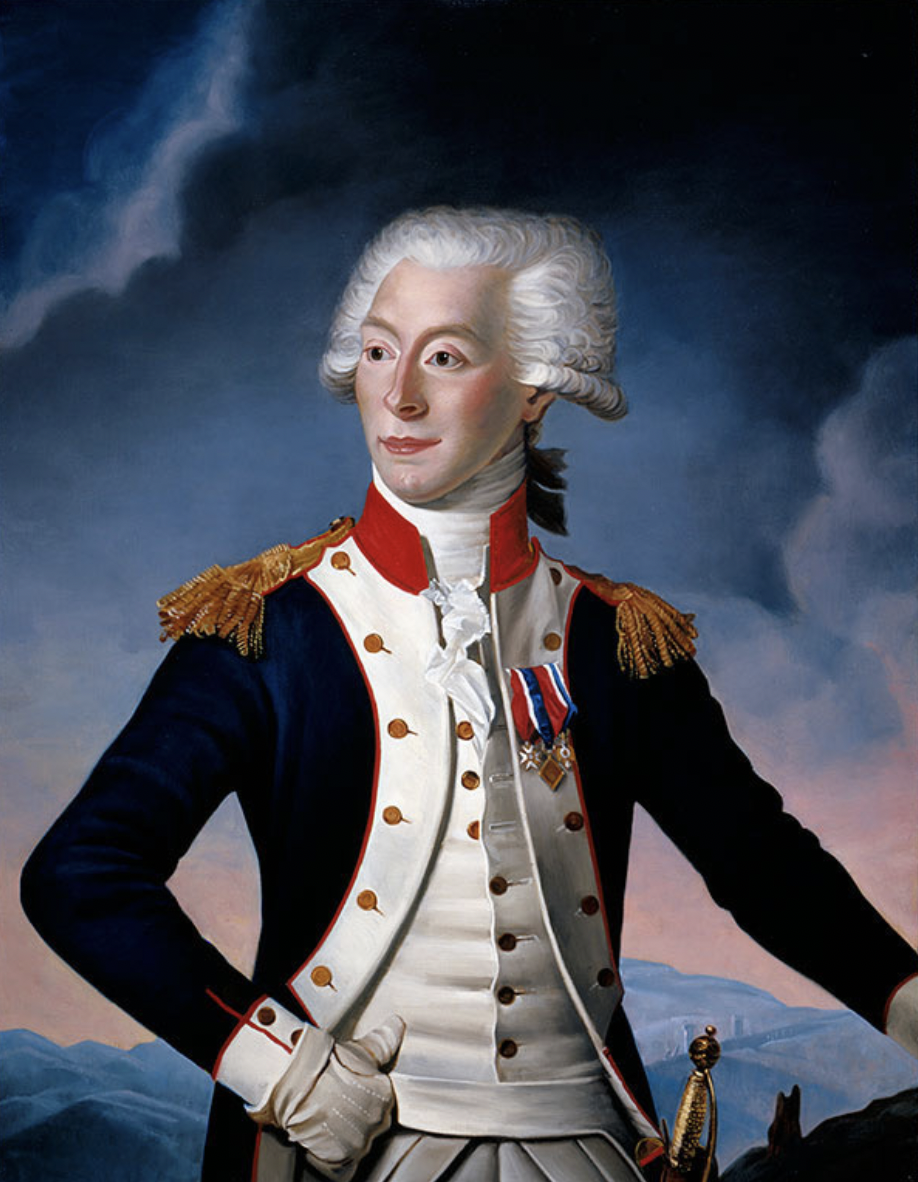
Oil on canvas, 1790, Paris - Original by Joseph Boze (1745-1826); copied by Bradley Stevens.
Located in the parlor, Monticello, Virginia (provenance: Thomas Jefferson) Lafayette is depicted in the military uniform of the Parisian National Guard wearing the medals of the Society of the Cincinnati, the Vainqueurs de la Bastille, and the Cross of Saint Louis. Lafayette saw his portrait when he visited Jefferson.
931 Thomas Jefferson Pkwy, Charlottesville, VA 22902
|
|
November 4-15, 1824
• Lafayette arrived at Monticello on November 4 in a carriage provided by Jefferson with a military escort of 120 men. Jefferson waited outside on the front portico.
His grandson Randolph was present and witnessed the historic reunion: "As they approached each other, their uncertain gait quickened itself into a shuffling run, and exclaiming, 'Ah Jefferson!' 'Ah Lafayette!', they burst into tears as they fell into each other's arms."
The next morning, Jefferson, Lafayette, and James Madison rode to the Central Hotel in Charlottesville in Jefferson's landau.
• Inscription of marker:
“Three miles to the southeast, Thomas Jefferson began the house in 1770 and finished it in 1802. He brought his bride to it in 1772. Lafayette visited it in 1825. Jefferson spent his last years there and died there, July 4, 1826. His tomb is there. The place was raided by British cavalry, June 4, 1781.
Erected 1928 by Conservation & Development Commission. (Marker Number W-200.)”
Marker located at:
610 E Market St, Charlottesville, VA 22902
GPS: 38.031400,-78.477600
|
|
LAFAYETTE IN FREDERICKSBURG
November 20 - 22, 1824
|
|
FOLLOW THE FRENCHMEN | EPISODE 15 - JAMES MADISON'S MONTPELIER
|
|
• Lafayette spent a few days at President Madison at his estate of Montpelier.
“Mr. Madison at the time of our visit was seventy-four years of age, but his well preserved frame contained a youthful soul full of sensibility, which he did not hesitate to show, when he expressed to general Lafayette the pleasure he felt at having him in his house. Although the habit of reflection and application, give to his countenance an aspect of severity, all the impressions of his heart are rapidly depicted in his features, and his conversation is usually animated with a gentle gaiety. Mrs. Madison also contributes much by the graces of her mind, and the amenity of her character to exalt the excellence of that frank hospitality with which strangers are received at Montpelier.
The four days passed with Mr. Madison were agreeably employed in promenades over his beautiful estate, and still more agreeably by our evening conversations, particularly concerning all the great American interests, which are so dear to general Lafayette”...
[...]
...“It was not until sunset on the 20th of November, that we arrived at Fredericksburgh, where the general was received by the little boys formed into a battalion under the name of Lafayette Cadets; the night was already dark, and the town glittered with illumination, when we arrived at the place where the mayor pronounced his welcome. A splendid supper, and a ball in which all the ladies of Fredericksburg were present, terminated the day. Next day being Sunday, we went to the Episcopal church, escorted by the free masons in grand ceremony. The clergyman who officiated was a member of the lodge. On Monday we passed part of the day with Captain Lewis, a nephew of General Washington, and in the evening we set out for Washington, accompanied for several miles by the inhabitants of Fredericksburgh. At the Strafford county line, the extremity of which we crossed, the militia met the general to escort him to the Potomac, where the vessel waited for us, and conveyed us to Washington by a pleasant night voyage.”
Excerpt From: Auguste Levasseur. “Lafayette in America in 1824 and 1825 - Vol I.” Apple Books.
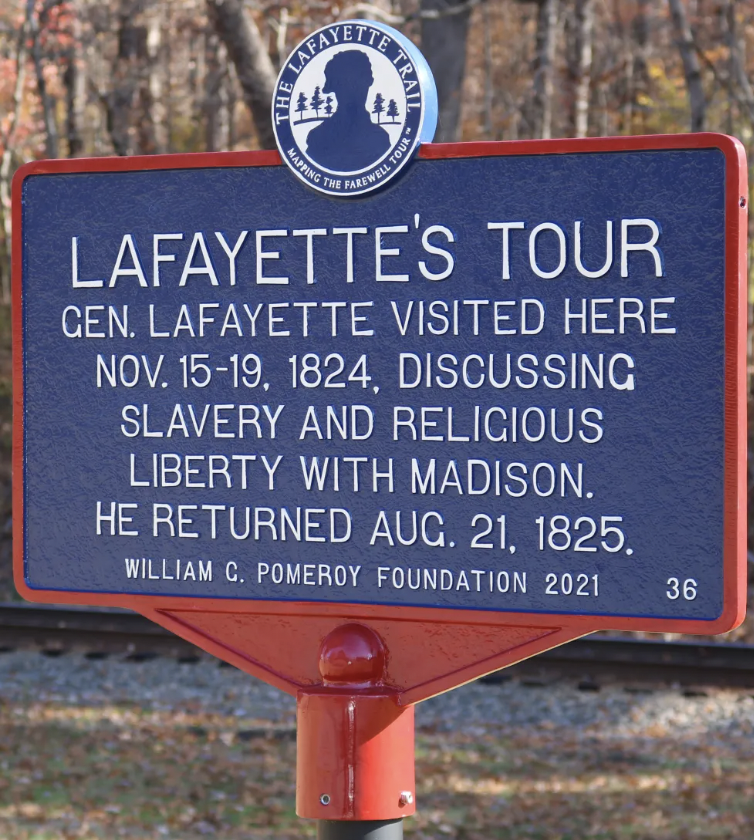
• Marker, Lafayette Tour:
"Gen. Lafayette visited here
Nov. 15-19, 1824, discussing
slavery and religious
liberty with Madison.
He returned Aug. 21, 1825."
William C. Pomeroy Foundation 2021
• Excerpts of marker:
"The General [the Marquis de Lafayette] and his suite were then conducted into the Town Hall, which had been decorated with evergreens and flowers... (Fredericksburg Virginia Herald) [...] On November 20, 1824, the Marquis de Lafayette visited Fredericksburg as part of a grand tour. He was fondly remembered from the American Revolution, when he had led a division of Continental troops in this part of Virginia, in the months prior to the campaign that ended at Yorktown."
Marker located at:
909 Princess Anne St, Fredericksburg VA 22401
|
|
TO BE CONTINUED NEXT MONTH... |
|
SEASON 2, EPISODE 4, NOVEMBER 1782:
THE FRENCH ARMY IN CONNECTICUT AND RHODE ISLAND
|
|
MISSION ACCOMPLISHED
Last year we narrated in 5 episodes, from June to October, the long march of the French Army under general comte de Rochambeau from Newport, R.I. to Yorktown, VA, through the States of CT, NJ, NY, PA, DE, MD
We are resuming the series, which will extend from this month until December: "Season 2, Episode 4: November 1782, Connecticut & Rhode Island"
After the victory in Yorktown, the war was not officially over. It would take several more months before England would recognize the independence of the United States and sign the Treaty of Paris on September 3, 1783.
During that time, British forces were still in control of cities such as New York.
The French army spent the most part of the winter of 1781-1782 stationed in Williamsburg, VA, and starting marching north in July 1st, 1782 to reach Boston in December and sail home.
Some units stayed behind, such as the famous Lauzun Legion of hussards, who kept watch during the winter of 1782-1783.
The return march route was in a much lighter mood, understandably so. It is not as well documented than the south-bound march we narrated last year. Still, there are several markers along the way which we will select, as well as a few nice anecdotes which we will tell in future bulletins until December.
Below are a few markers pertaining to the month of NOVEMBER 1782, while crossing the States of Connecticut and Rhode Island.
|
|
A FEW SELECTED MARKERS ALONG THE WAY...
... November 1782 ...
|
|
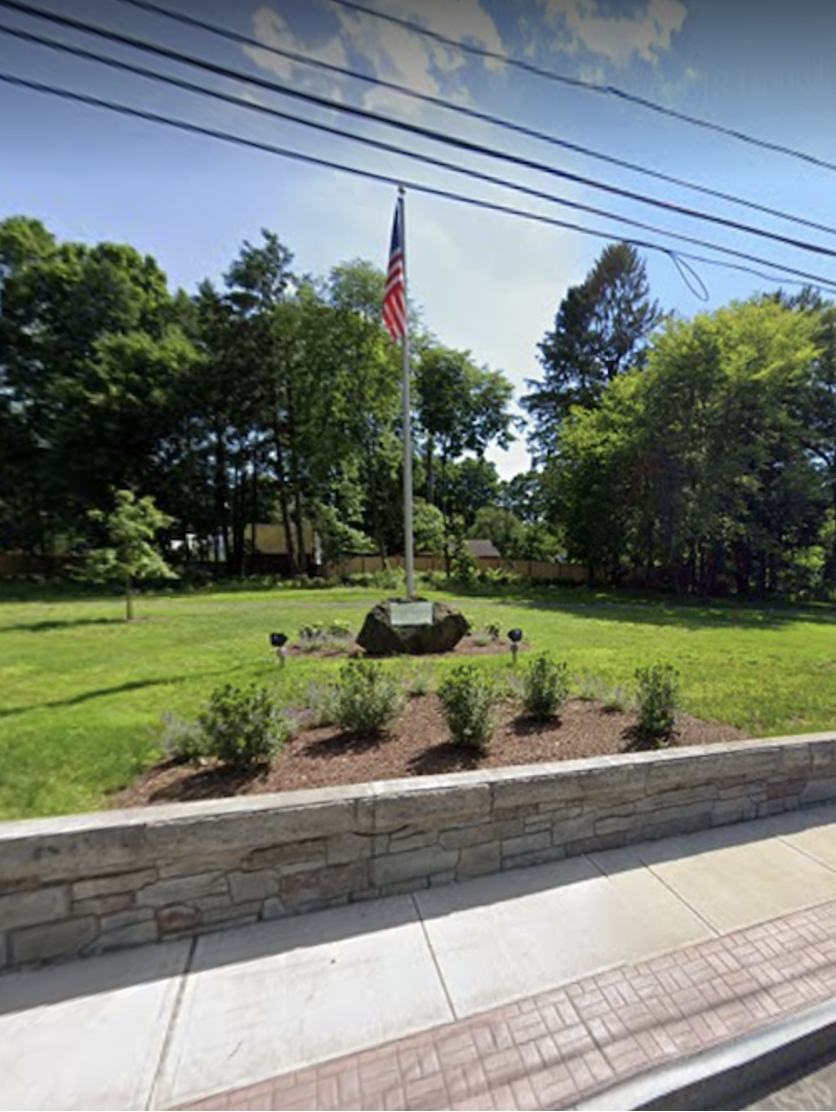
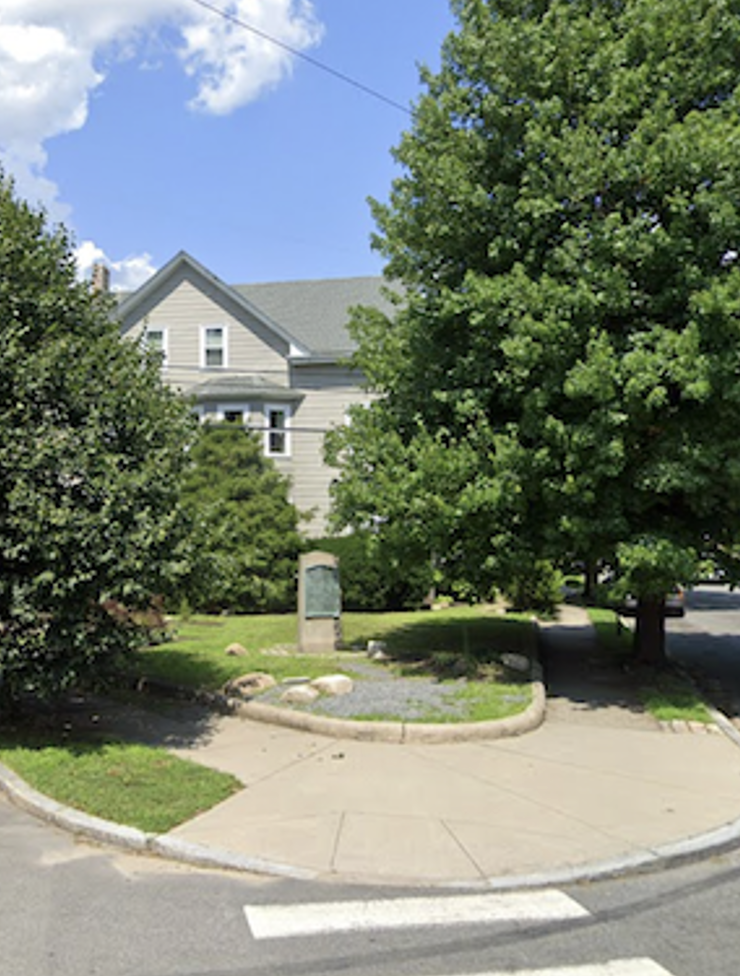
Marker "Lest We Forget", Farmington CT |
|
Marker “LEST WE FORGET”, 790 Farmington Ave, Farmington, CT 06032
GPS: 41.726017, -72.824061
Photo: Image capture June 2019 © Google
|
|
• Inscription:
“LEST WE FORGET”
“In honor and grateful remembrance of our French Allies in the Revolution, whose army, under the command of General Count de Rochambeau, marched past this spot en route from Newport and Providence, R.I., to join General Washington on the Hudson River in 1791, and again on its return from Yorktown, Va. To Boston, Mass., in 1782.”
“The main body of about 4000 men was composed of the Regiments of Bourbonnais, Royal Deux-Ponts, Soissonnais and Saint Onge, [sic] and the artillery. The regiments marched in the foregoing order on successive days from Providence, always keeping between each other the distance of a day's march. The artillery followed immediately in the rear of the second regiment. General Count de Rochambeau marched at the head of the main body and the regiments camped successively a little south of Farmington Village June 25, 26, 27 and 28, 1781. On its return the army marched in two columns, keeping between each other the distance of a day's march, and camped successively in the southern part of the village October 28 and 29, 1782.”
“A left flank guard of about 600 Hussars and light infantry, under the command of the Duke De Lauzun, marched from its winter camp at Lebanon, Conn., abreast of, and about fifteen miles from, the main body in 1781.”
“Maps of the marches and camp sites of the army and literature regarding our French Allies in the Revolution may be seen at the village library. "
Erected by Colonel Jeremiah Wadsworth Branch, Connecticut Society, Sons of the American Revolution, 1926”
|
|
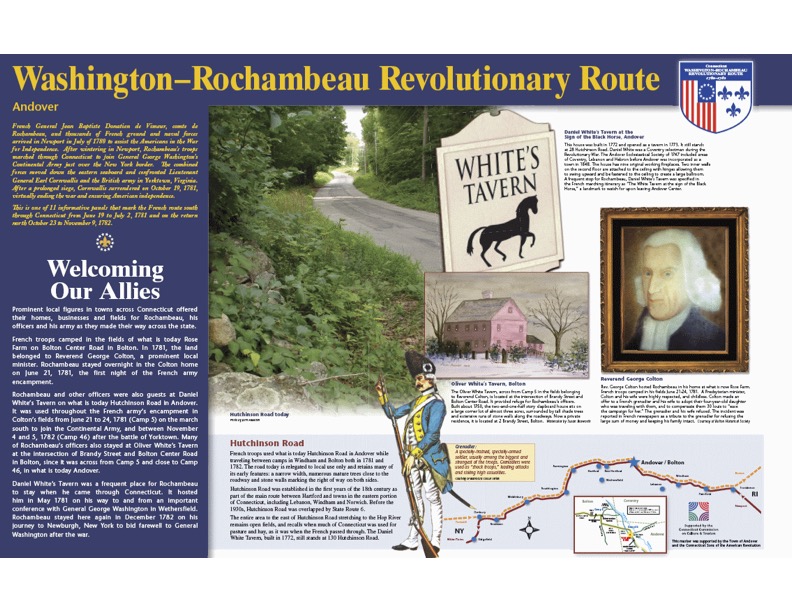
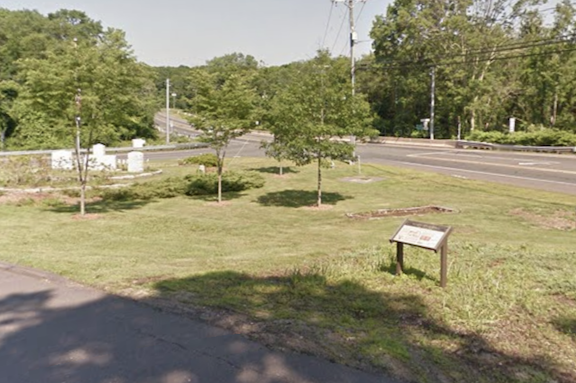
Marker, “Welcoming our Allies”, Andover CT |
|
Marker "Welcoming our Allies" , at the intersection of State Routes 6 & 316
Andover Veterans Park, Monument Lane, Andover, CT 06232
GPS: 41.738133, -72.367979
Image capture June 2011 © Google
|
|
The road retains much of its 18th-century character.
• Excerpts from the marker:
“French troops used what is today Hutchinson Road in Andover while traveling between camps in Windham and Bolton both in 1781 and 1782. The road today is relegated to local use only and retains many of its early features: a narrow width, numerous mature trees close to the roadway and stone walls marking the right of way on both sides.”
“The entire area to the east of Hutchinson Road stretching to the Hop River remains open fields, and recalls when much of Connecticut was used for pasture and hay, as it was when the French passed through. The Daniel White Tavern, built in 1772, still stands at 130 Hutchinson Road”
“Daniel White’s Tavern at the Sign of the Black Horse, Andover:
This house was built in 1772 and opened as a tavern 1773, it still stands at 28 Hutchinson Road. Daniel White was a Coventry Selectman during the Revolutionary War. A frequent stop for Rochambeau, Daniel White’s Tavern was specified in the Marching itinerary as “White Tavern at the sign of the Black Horse,” a landmark to watch for upon leaving Andover Center.”
|
|
48th Encampment of the French Army, Canterbury, CT
7-8 November 1782
|
|
Westminster Congregational Church, 395 Westminster Rd. Canterbury, CT 06331
GPS: 41.71174,-72.02033
|
|
• The First Brigade, now commanded by baron de Vioménil, broke camp in Windham on 7 November and marched through Scotland to its next camp, camp 48, just west of Canterbury. By now it was early November, and winter was upon New England.
Lieutenant Jean-François Louis de Lesquevin, comte de Clermont-Crèvecœur of the Auxonne Regiment could not “
e
xpress how uncomfortable we were while camping in a country where the cold was already very intense. We were frozen in our tents. And the tents were frozen so stiff that, after the pegs and poles were removed to take them down, they stood alone. So you can judge how cold it was".
• The post sign has identical text on both sides:
"ROCHAMBEAU ROUTE 1781-1782 || IN THIS VICINITY || FRENCH TROOPS UNDER || ROCHAMBEAU || ENROUTE FROM YORKTOWN || ENCAMPED DURING NOVEMBER 1782 || ERECTED BY THE STATE || AND || Deborah Avery Putnam || Chap., D.A.R. || cooperating || "
|
|
Marker, 52nd Encampment of the French Army Providence, R.I
November 13 – December 4, 1782
|
|
Marker is at 957 North Main St, Providence, RI 2904
1 Brewster Street, Providence R.I. 02906
Image capture July 2017 (c) Google
Campsite Marker for Camp#52 installed in 1907
|
|
• French infantry had encamped on its June 1781 campsite in Providence on November 10 and 11, 1782, but moved to this new camp their fifty-second camp since departure from Williamsburg, Virginia, on July 1, 1782, along North Main Street on November 13 and 14, 1782.
• De Broglie wrote:
“While in Providence, Rochambeau gave a splendid ball on November 18 to the people of the town at Hackers Hall, then on South Main Street.
One of his well known officers, de Broglie, writes of these entertainments :
" M. de Rochambeau, much vexed with the perpetual delays of the fleet, nevertheless behaved at Providence like a thoroughly good French General: that is to say, in order to divert his army and gratify the ladies of the city, he gave some balls in a handsome and large public apartment intended for such purposes. It was at the first of these balls that I saw for the first time the Misses Bowen, sisters of the Governor of the city. I do not give their portraits because I do not want to turn all the men crazy and render all the women jealous.” (France and New England, page 135)
• Inscription:
“ON THIS GROUND BETWEEN HOPE STREET AND NORTH MAIN STREET AND NORTH OF ROCHAMBEAU AVENUE THE FRENCH TROOPS
COMMANDED BY COUNT ROCHAMBEAU WERE EN CAMPED IN 1782 ON THEIR RETURN MARCH FROM YORKTOWN”
|
|
PAST MONTHLY BULLETINS
OUR GOAL: turn the spotlight on a famous, or less famous, episode or historical figure during the long shared history between France and the United States, with illustrations and anecdotes.
You can have access to all our past Monthly Bulletin
since February 2021 by visiting our website:
You can click on the photos in our bulletins and on the links indicated in blue for more information and direct access to the references.
|
|
In our next Bulletin in December we will continue to follow the steps of the Marquis during his tour in December 1824 in Washington DC, as well as the boarding of French Army in Boston, leaving behind the Lauzun Legion while the Peace negotiations were under way in Paris. |
|
HELP VOLUNTEERS OF THE FRENCH MILITARY AT NATO IN NORFOLK
TO ACQUIRE PERIOD UNIFORMS FOR RE-ENACTMENTS
|
|
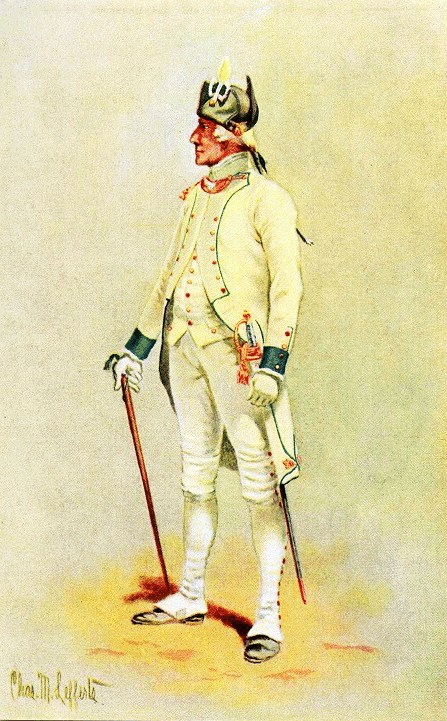
Pictured above: Uniforms of the Armies in the War of the American Revolution, 1775-1783. Lt. Charles M. Lefferts. Limited Edition of 500. New York York Historical Society. New York, NY. 1926.
|
|
• We started a fund raising campaign for the purpose of providing volunteers from the French military contingent stationed at NATO headquarters in Virginia with period uniforms, to participate alongside American volunteers in joint patriotic ceremonies. These sets of period military uniforms are made in the USA by very skilled specialized tailors and will be exact reproductions, down to the last button.
Please help! Your donation is tax deductible! Suggested donations: $50 - $100 – A recognition medal from Le Souvenir Français will be offered for donations over $500.
Please send your donation via PayPal: https://souvenirfrancaisusa.org/donate/ or by check, payable to "American Society of Le Souvenir Français, Inc"
Please indicate: "Rochambeau Historical Uniforms"
|
|
NEWS FROM THE LAFAYETTETRAIL.ORG |
|
We are pleased to announce the release of episode 18 of Follow The Frenchmen, the Video Series about the Lafayette Trail! The episode takes place in Frankfort, KY.
When the French formally joined the Americans as allies against the British in 1778, Kentuckians started adopting French names for their new counties, cities, and towns in honor of France, America’s oldest ally. Fayette and Bourbon Counties, Paris, Louisville, and Versailles, were all named between 1778 and 1792, the year when Kentucky achieved statehood.
Cultivating its French connection was for KY a way to challenge, if not reverse the narrative of patriotism coming from the East Coast. People here had been dealing with the French one hundred years prior to the signing of the Treaty of Alliance in 1778. In 1824, the news of Lafayette’s return to the US resonated throughout the Commonwealth of KY as one last chance to physically welcome a living representative of the American Revolution to the Bluegrass State. What did Lafayette’s visit mean for Kentuckians? Find out now by following the Frenchmen to Kentucky's capital city, Frankfort.
The video on the official YouTube Channel includes Closed Captioning. To enable this feature, click on the CC icon on the right side of the navigation bar at the bottom of the screen.
We hope you will enjoy this episode and look forward to sharing the next installment of Follow the Frenchmen with you soon!
About The Lafayette Trail, Inc.
The Lafayette Trail, Inc. (thelafayettetrail.org) is incorporated in the U.S. state of Maryland as a nonprofit organization under section 501(c)(3) of the IRS code with the mission to document, map, and mark General Lafayette's footsteps during his Farewell Tour of the United States in 1824 and 1825. It aims to educate the public about the national significance of Lafayette's Tour and to promote a broader understanding of Lafayette's numerous contributions to American independence and national coherence in preparation for the 2024-2025 tour bicentennial celebrations.
|
|
NEWS FROM "THE GIRL WHO WORE FREEDOM" |
|
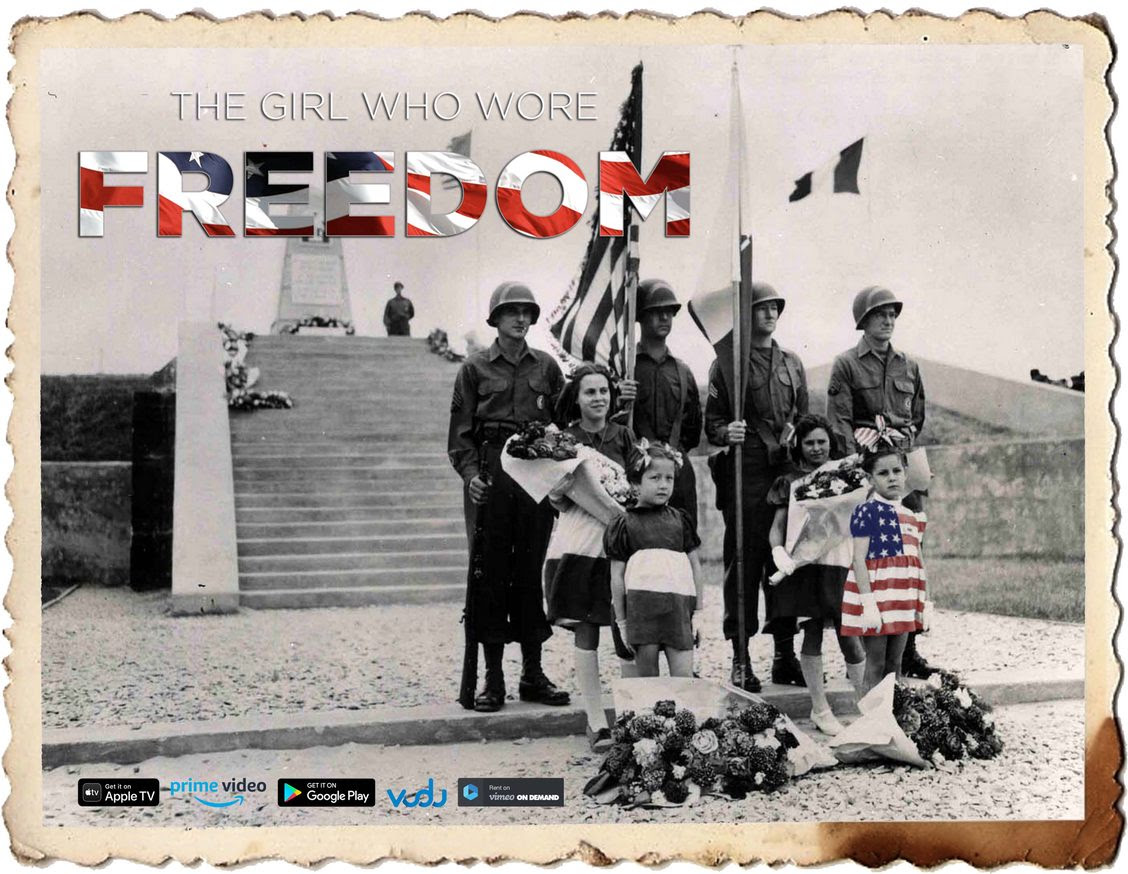
The Girl Who Wore Freedom
Is Now Available on A Screen Near You!
A message from Christian Taylor:
Editor-in-Chief of Media Play News Stephanie Prange recently conducted an interview with director Christian Taylor for MPN about “The Girl Who Wore Freedom”. The beginning of the article discusses the genesis of the film,
“I was so blown away by the gratitude,” says Taylor. “I wanted to know where it came from, and I learned for the first time that the French people have been celebrating their liberation from the moment that it happened, regardless of all the destruction and the damage and the death. And so, as l listened to their stories and learned that 20,000 French people lost their lives in the Battle of Normandy, I realized there was so much more to the story that we never heard as Americans.” Her exploration of that history resulted in the documentary The Girl Who Wore Freedom, available via EST and VOD Nov 1 from Virgil Films.”
If you’re following us on social media you’ve seen how blessed we have been to partner with Delta, Michelin, and the Best Defense Foundation to bring our message to audiences in NYC at the French Institute (150 kids!), the UPS headquarters in Atlanta, GA, Delta’s Veterans Celebration and most recently the French Embassy. Because of your support thousands of people will be touched by this film and inspired to do more for our veterans than simply saying “Thank you for your service.” They now have an example of questions to ask veterans as well as a desire to truly listen.
Thanks for marching on with us,
Christian
P.S. With the Holidays Season upon us, why not send “The Girl Who Wore Freedom” as a gift.
|
|
COMMEMORATIONS SINCE OUR LAST BULLETIN |
|
A TRICOLOR FLAG FOR STUDENTS OF THE LYCÉE ROCHAMBEAU FRENCH INTERNATIONAL SCHOOL
October 21, 2022 - Washington, DC
|
|
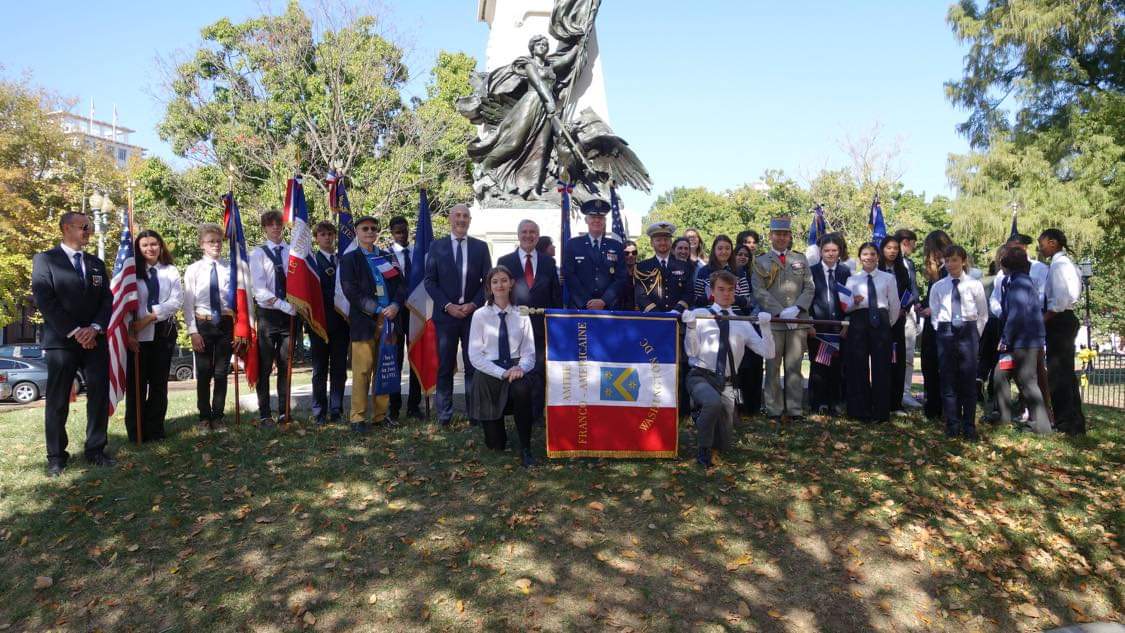
On October 21st, 2022, we were honored to participate in a ceremony organized by Cyril Pefaure and Pierre Oury, to officially present a brand new French flag embroidered with the coat of arms of General de Rochambeau to students of the "History and Memory Club" of the Rochambeau French International School in Washington.
This ceremony was held in front of the Statue of Jean-Baptiste Donatien de Vimeur, comte de Rochambeau facing the White House at Lafayette Park.
Notable speakers included:
- Cyril Péfaure, Representative of the French Veteran's Associations in France
- Colonel Maxime Do Tran, Defense Attaché of the French Embassy in the US
- Thierry Chaunu, National Delegate for the United States of Le Souvenir Français, and president of The American Society of Le Souvenir Français, Inc,
- Jacqueline Oury, 12th-grade student and founder of the "History and Memory" Student Club.
This flag will be kept under their watch and will be proudly displayed in upcoming joint French-American commemorations.
Congratulations to all these fine young men and ladies, and our sincere appreciation to Mr. Xavier Jacquenet, Director of the Rochambeau School, and the history professors, for their wholehearted support.
Among our Society’s missions, the third one (listed below in bold) addresses the importance of reaching out to the younger generations:
• To preserve the memory of the French soldiers, sailors and airmen who gave their lives for freedom, and who are buried in the United States.
• To honor French Citizens who did great deeds in the United States, or with a strong connection with the United States,
• To promote the appreciation for French culture and heritage in the United States, and the ideals that unite our two nations, in order to pass the torch of memory to younger generations.
• To strengthen the long-standing traditional bonds of friendship between the American and French peoples, and to this end: erect or maintain memorials and monuments and encourage historical research, public presentations and publications in the media.
|
|
CELEBRATION OF THE SARATOGA & YORKTOWN VICTORIES
Organized by the Lower Manhattan Historical Association
St Paul Chapel, Broadway, NYC
October 22, 2022
|
|
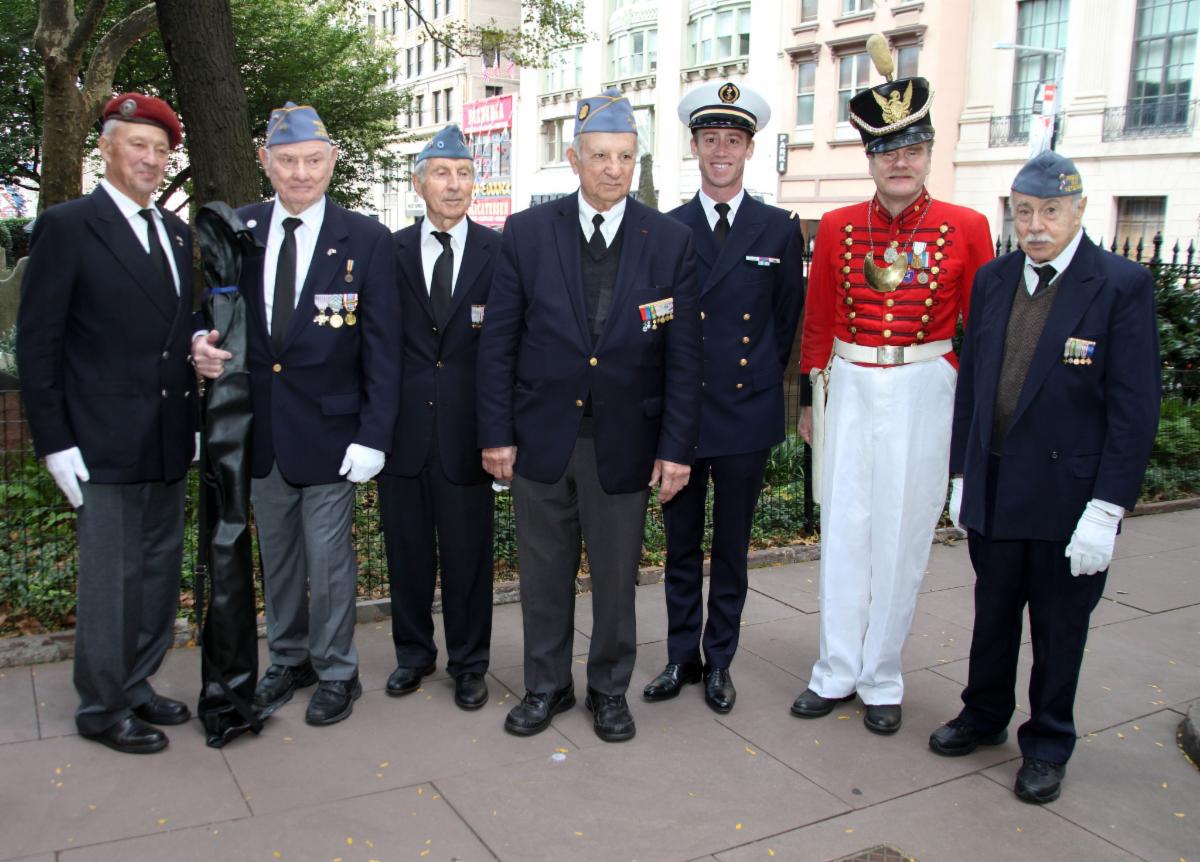
From Left to Right: French War Veterans Michel Dumerchat, Jean Le Gall, Paul Garabedian, Alain Dupuis, PM Frank Le Bris (Military & Defense Mission, French Permanent Mission of France to the United Nations), Henri Dubarry. In period uniform: 2LT Hefler, 7th Regiment Veterans Corps of Artillery New York |
|
On October 22, the Federation of French War Veterans and the American Society of Le Souvenir Français attended the annual celebration of the American of Saratoga on October 17, 1777 and the allied French-American victory of Yorktown, on October 19, 1781.
This ceremony is organized every year by the Lower Manhattan Historical Association at the Churchyard of St. Paul's Chapel in lower Manhattan.
During this hour-long ceremony open to the general public, James Kaplan, LMHA Founder & Chairman of the Board and Ambrose Richardson recounted illuminating details from the events of the period. Peter C. Hein paid homage to the sacrifices made by the American Patriots and their allies. Thierry Chaunu evoked the steadfastness of the bonds between the United States and France, this country’s oldest ally.
Prior to this annual event we were invited to the “Lower Manhattan Saratoga Yorktown Generals Walking Tour” hosted by James S. Kaplan, which started inside the historic Fraunces Tavern and highlighted little-known places of historical significance along Broadway.
|
|
JOINING THE TOMB GUARDS TO HONOR THE US UNKNOWN SOLDIER ON BOARD THE USS OLYMPIA, PHILADELPHIA
October 25, 2022
|
|
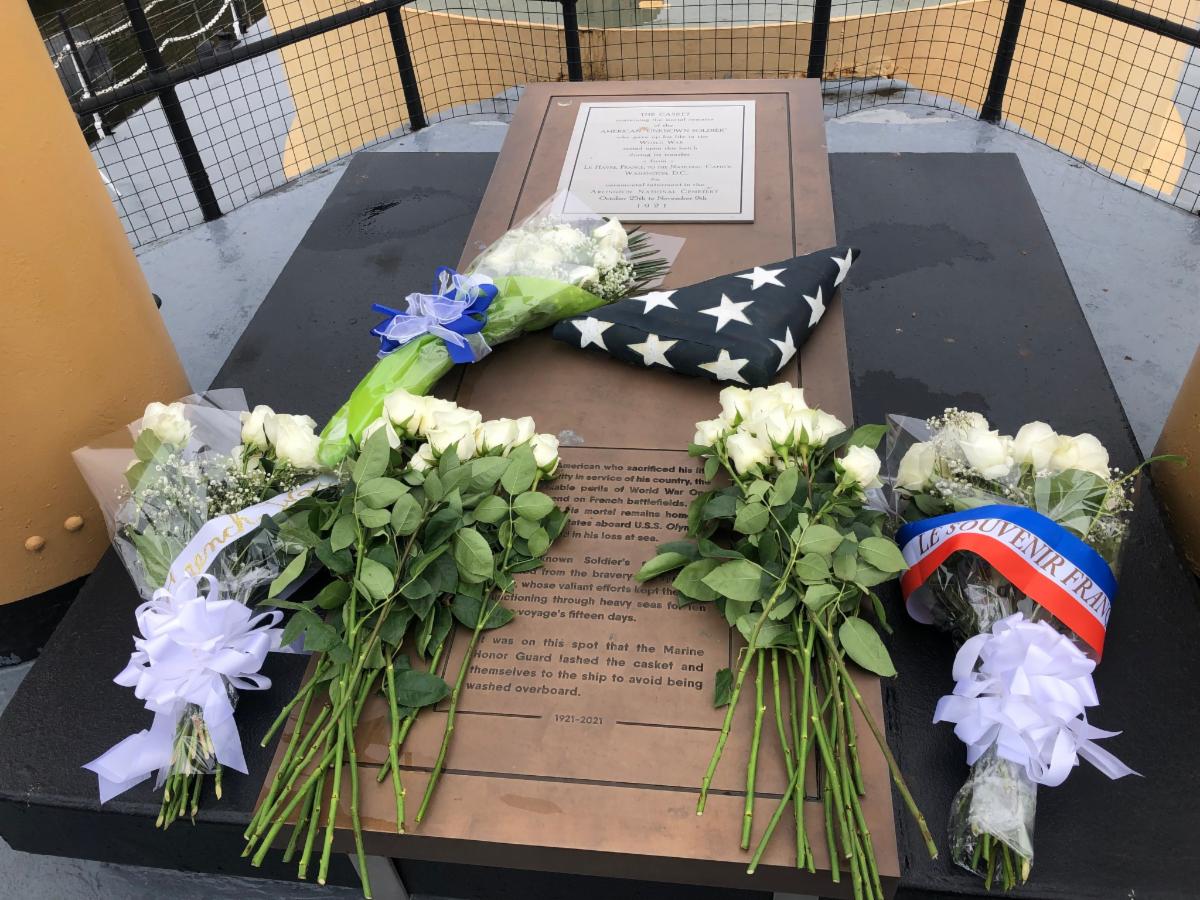
The upper deck of the famed 1892 cruiser USS Olympia, at the exact spot where the casket of the Unknown Soldier was latched while crossing the Atlantic from Le Havre to Washington, D.C. - Independence Seaport Museum, Philadelphia, PA.
|
|
On October 25, we were honored to join the Society of Honor Guard, Tomb of Unknown Soldier on board the USS Olympia in Philadelphia for the annual commemoration of the transfer of the US Unknown Soldier back home from France.
Alain Dupuy, president of the Federation of French War Veterans, Henri Dubarry, French War Veteran, Cyril Pefaure representing the Association of French War Veterans in France, along with his family visiting the United States, and Thierry Chaunu, president of the American Society of Le Souvenir Français, each laid a white rose on the very spot on the upper deck where the Unknown Soldier's casket rested during a particularly hazardous crossing of the Atlantic.
Several current and past Tomb Guards attended and it is always a great honor to shake their hands and express our deepest thanks and respect for their service.
Thank you Kevin Donovan, Tomb Guard Badge #253, for your brotherly welcome and for allowing us to hold the Society's trunk containing the Star-Spangled Banner and several vials of soils from American military cemeteries in France. A very moving experience, symbolizing the profound historical bonds between France and the United States.
Photo by Cyril Pefaure / with our appreciation and thanks for your visit in the United States.
|
|
HONORING 25 FRENCH SOLDIERS
BURIED IN PROVIDENCE, R.I.
November 5, 2022
|
|
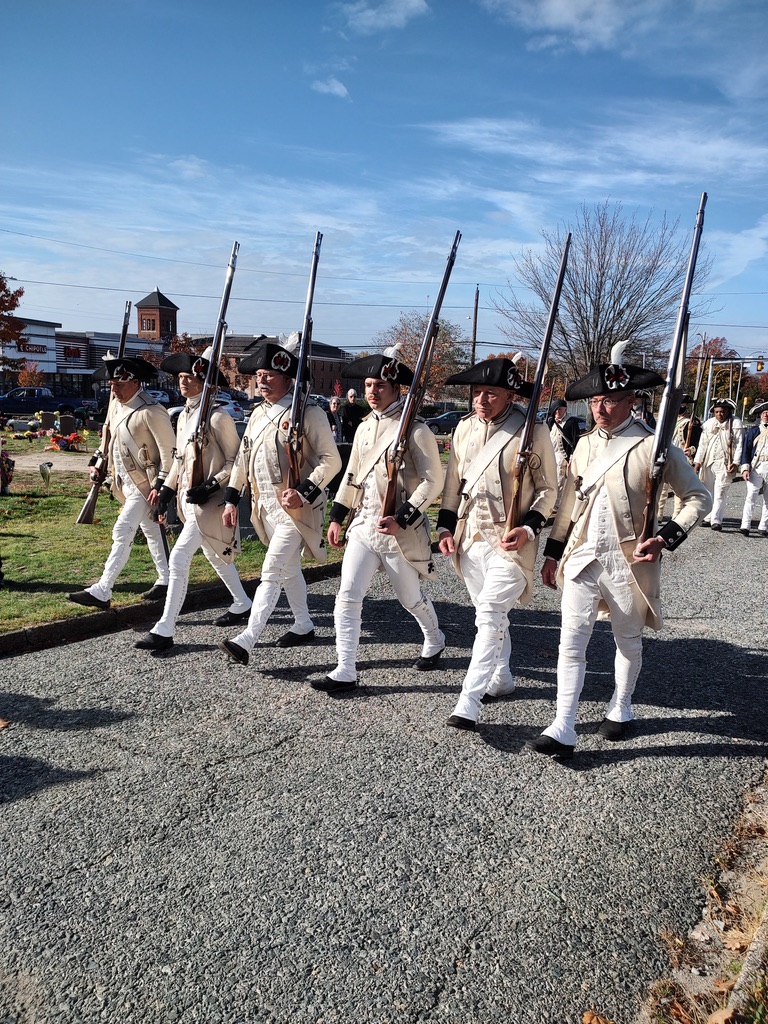
Le Régiment Bourbonnais, the Second Rhode Island Regiment and a group of about 15 Sons of the American Revolution, Rhode Island chapter met at the North Burial Ground in Providence, RI for a joint ceremony, on Saturday morning November 5. A small group of public attended.
The ceremony began with a historical introduction followed by the laying of a wreath at the monument for the French soldiers.
Norman Desmarais, member of le Régiment Bourbonnais, and Regional delegate, New England, of the American Society of Le Souvenir Français, read the names of the 25 soldiers commemorated by the monument. A salute of three musket volleys was followed by a moment of silence.
For a list of their names, please visit our Honor Roll in the Society's website:
Captain Carl Becker, of the Second Rhode Island Regiment, then gave a brief historical explanation of the monument to Colonel Israel Angell adjacent to the monument for the French soldiers. He mentioned that Stephen Hopkins, a signer of the Declaration of Independence, and other officers and soldiers from the Second Rhode Island Regiment were also buried in the cemetery. The two regiments fired a joint volley followed by a moment of silence before being dismissed.
Photo courtesy of Norman Desmarais (second from right) & Pauline Bonin
|
|
TRIBUTE TO ANDRÉ JOSEPH SCHEINMANN
FRENCH RESISTANCE HERO
New Bedford, MA, November 6, 2022
|
|
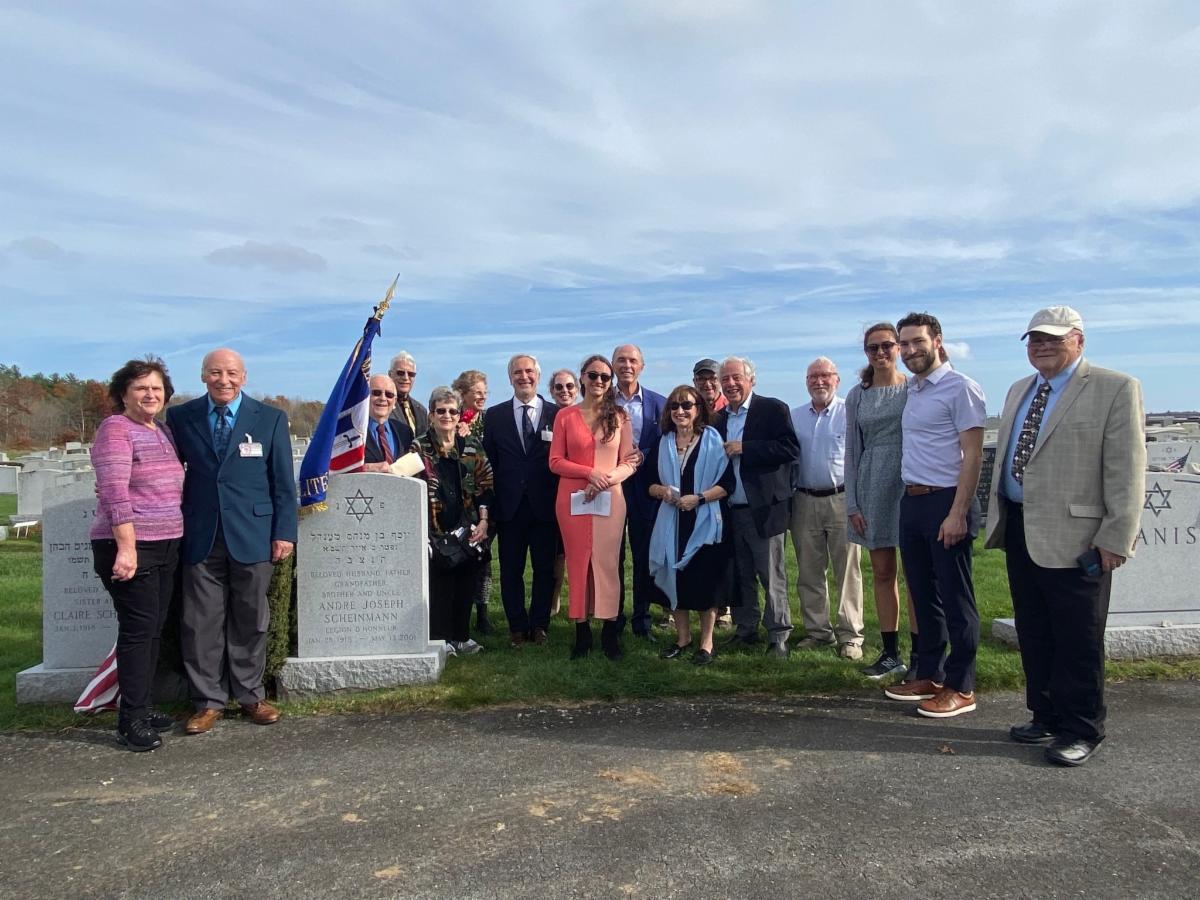
President Thierry Chaunu and Regional delegate Norman Desmarais participated in a ceremony at the Tifereth Israel Cemetery in North Dartmouth, MA on Sunday, November 6 to honor André Joseph Scheinmann.
Mr. Scheinmann fought with the French Resistance during World War Two and survived the concentration camp at Dachau. Mr. Scheinmann’s son Michel and two granddaughters, Clara and Emma, attended along with about 30 family, friends and guests.
This ceremony is part of the yearly tributes organized by Le Souvenir Français in Paris. 80 years after, the association honors 100 patriots who fought for France and the cause of Freedom. In 2022, Le Souvenir Français is honoring those who did great deeds in 1942 - - and one of these 100 is Mr. Scheinmann, who lived and died in the United States.
President Thierry Chaunu and Regional Delegate Prof. Norman Desmarais participated in a ceremony at the Tifereth Israel Cemetery in North Dartmouth, MA on a fine Sunday, November 6. The weather was ideal: partly sunny and 75 degrees – amazing for early November. It was a bit breezy and toppled the flags a few times.
Thierry welcomed everybody and gave a tribute to Mr. Scheinmann. The tribute was interrupted by a helicopter flying overhead. We thought it was very appropriate to have a flyover, even if it was only accidental. Norman explained the mission of Le Souvenir Français and its interest in this ceremony. Michel Scheinmann then gave some brief remarks about his father. After the national anthems of France and the United States, Diana Mara Henry who is working on a biography of André Joseph Scheinmann, placed a white rose at the base of the gravestone. After a moment of silence in memory of Mr. Scheinmann and all who were sent to concentration camps, the rabbi sang a psalm in Hebrew, narrated it in English and then said a prayer in Hebrew. Norman then presented a medallion of Le Souvenir Français to Michel Scheinmann. The poignant ceremony concluded with a photo session.
ANDRÉ JOSEPH SCHEINMANN
Ceremony in tribute to Mr. André Joseph Scheinmann, alias André Maurice Peulevey, Jewish born in Germany in 1915, his family moved to France in 1933. At the outbreak of hostilities, he enlisted in the French Army, which subsequently assigned him a new identity under the three names of his alias: André Maurice Peulevey, in order to avoid persecutions in case of capture by the enemy. In the fall of 1940, he entered the French Resistance.
In 1942, he left clandestinely for England, where he was trained for several weeks in spy techniques. A couple of days after his return to France, he got arrested by the Gestapo. He was deported to KL Natzweiler on July 9, 1943 as a "Nacht und Nebel"/ (Night and Fog) prisoner and later to Dachau on September 4, 1944.
On February 13, 1946, General De Gaulle awarded him the Croix de Guerre 1939-45 avec Palme and he was made Chevalier de la Légion d'Honneur on March 15, 1946.
After five years of post-war service to his camarades in the Resistance, inscribing them into the ledgers of the French Government for honors and pensions for their families, (as Liquidateur de reseau) he made his permanent move to the US with his wife Claire Dyment Jarrett, whose service to the RAF as a wireless interpreter is remembered on the Roll of Honor at Bletchley Park, and his son, Michel.
He died in Boston in 2001, and is buried in New Bedford, MA.
For more information on Mr. Scheinmann's extraordinary exploits and hardships during WWII, visit:
Mel Yoken, Ph.D. Chancellor Professor Emeritus of French Language and Literature, French Legion of Honor, of the University of Massachusetts Dartmouth, and his wife Cynthia, were among the distinguished guests in attendance.
We would like to express our warmest thanks to Ms. Diana Mara Henry for her friendship and support.
|
|
TRIBUTE TO WOMEN SERVING AMERICA
Central Park, Manhattan - November 9, 2022
|
|
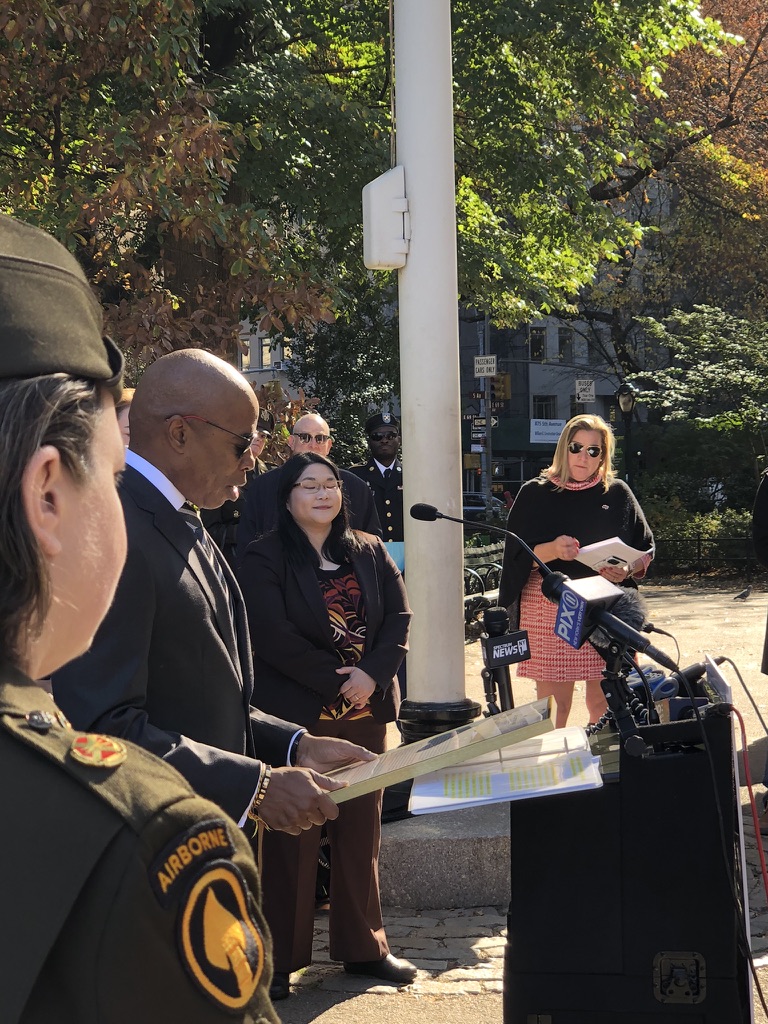
New York City's mayor Eric Adams praised the role of women in the military as well as civil society and issued a Proclamation.
Photo: Thierry Chaunu
|
|
On November 9 we joined New York City Mayor Eric Adams, Mr. Jérémie Robert, Consul General of France, and several New York City officials and distinguished guests, to honor women of service in the military.
The NYC Department of Veterans' Services, the American Red Cross and other Veteran advocates and partners held a ceremony to celebrate women of service on Wednesday, November 9, 2022, at 11 a.m. at the Overseas Service League Flagstaff and Grove in Central Park (located near Fifth Avenue and 68th Street)
In 1925, a Central Park memorial grove of 24 trees and flagstaff was conceptualized for a tribute to 24 American nurses who died in France, and by extension all American women who were enlisted in the U.S. Armed Forces in the First World War. Today, this grove remains an important tribute to women of service in NYC.
Alain Dupuis, president of the Federation of French War Veterans, along with Henri Dubarry, French War Veterans, and Thierry Chaunu, president of the American Society of Le Souvenir Français, stood alongside this event's Master of Ceremony and NY Community Leader Howard Teich, Founder & Chairman at The Howard Teich Network.
Howard Teich is the one who rekindled this ceremony after many years of oblivion, and it is heartwarming to see the event grow in importance year after year.
Mayor Eric Adams, in his remarks, noted on the invaluable contributions of women in service, and the crucial role of mothers in general; the Consul general of France expressed France's eternal gratitude for the brave American women who volunteered and served in two World Wars to fight for the cause of Freedom.
|
|
VENDREDI 11 NOVEMBRE 2022 - ARMISTICE - VETERANS DAY |
|
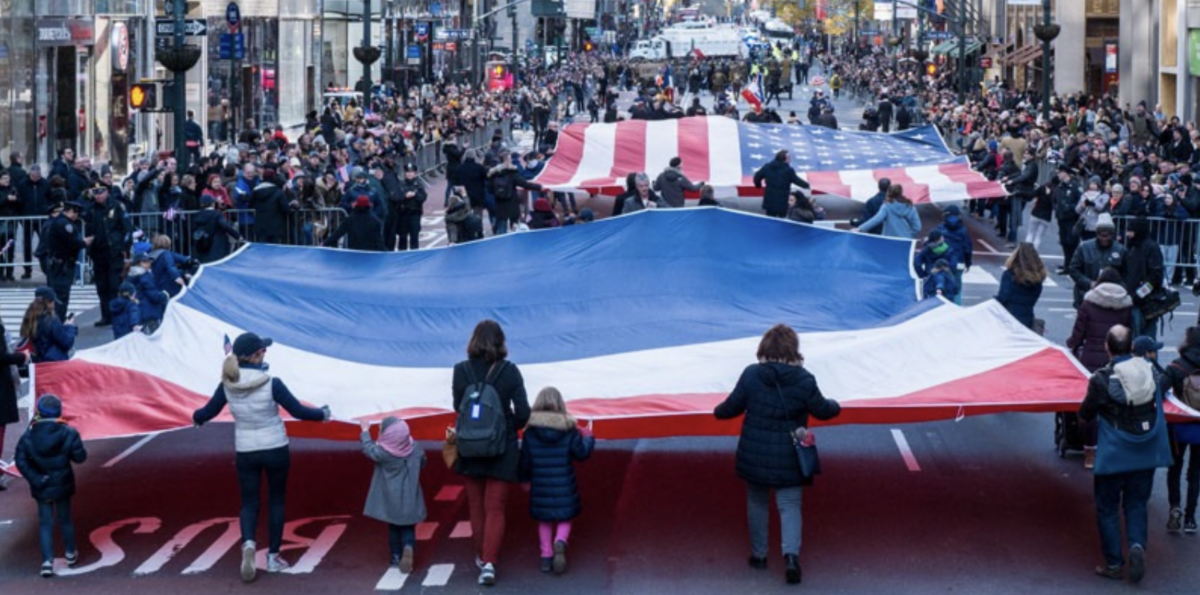
Pictured above: last year's parade on Fifth Avenue with giant French and American flags, and part of the French War Veterans, active and reserve French military marched with Mr. Jérémie Robert, Consul Général of France in New York. (photo: French Consulate) |
|
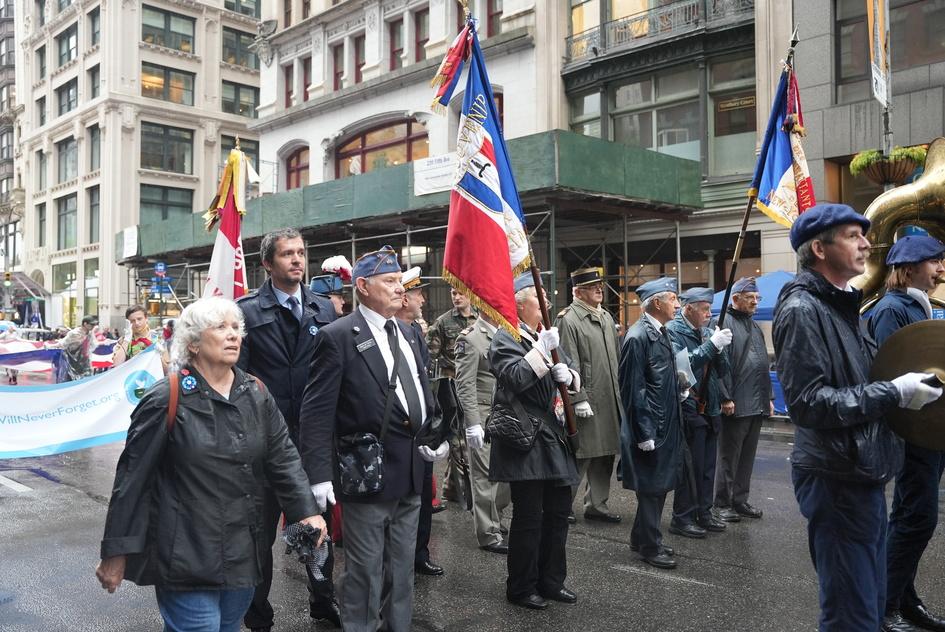
To continue our well-established tradition, we joined the Federation of French War Veterans, the Association of French Reserve Officers in the United States (ACREFEU), and TheFrenchWillNeverForget.org in the Veterans' Day parade on 5th Avenue, following the band of the Cadets Lafayette led by Jacques Letalon, Mr. Jérémie Robert, Consul General of France, and Ms. Gisèle Grosz who came from France to represent the Union of French War Veterans.
We would like to thank Natalie Yates and the Scouts of Troop #1 and their parents who all braved the rain to deploy the huge US Flag provided by TheFrenchWillNeverForget.
In spite of a heavy rain we proudly showed the Star-Spangled banner and the French Tricolor in the middle of New York's famed Fifth Avenue.
|
|
A message from the American Legion Paris Post 1
|
|
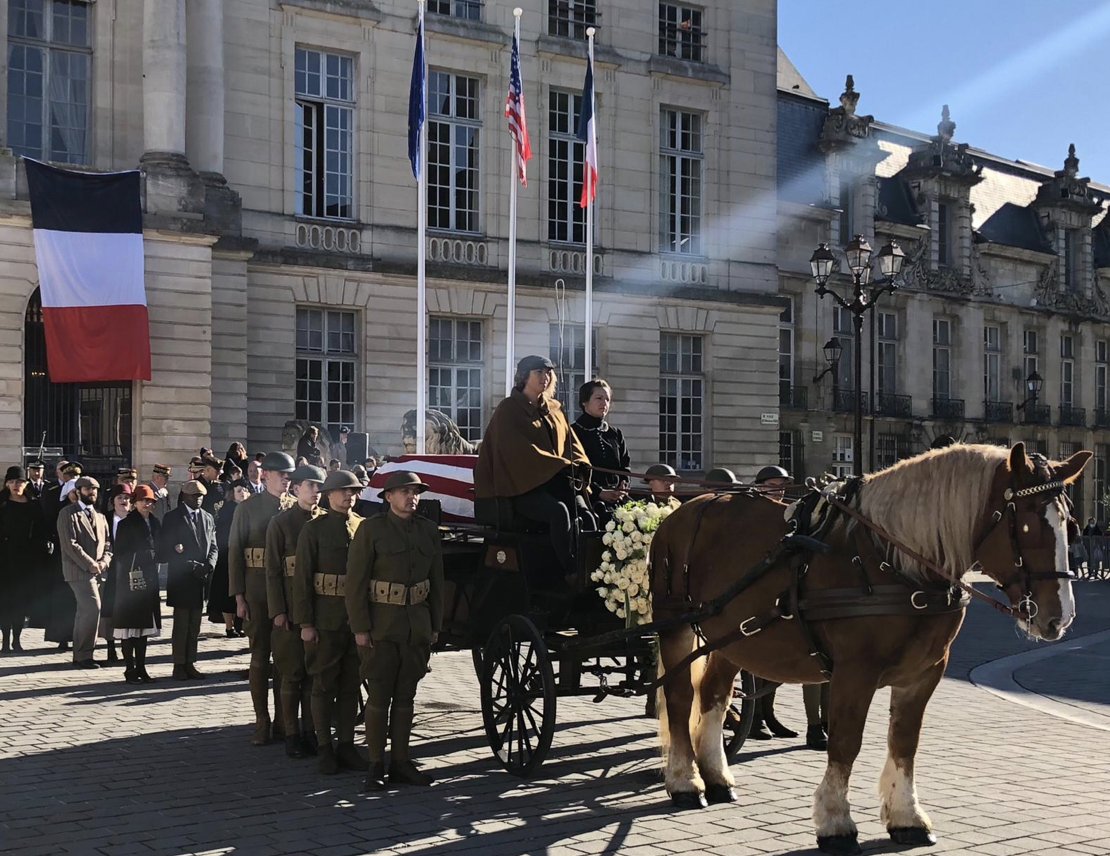
How the Centennial of the Unknown Soldier lives on:
Meuse-Argonne, Châlons-en-Champagne & Le Havre
French & American communities honor the Unknown Soldiers
not chosen to go to Arlington, Virginia this past month in France.
Paris Post 1 is dedicated to supporting the Society of the Honor Guard in never forgetting the Tomb of the Unknown Soldier in Arlington, Virginia, and also those Unknown Soldiers who remain buried in France.
Seen above, historic ceremony in Châlons-en-Champagne in 2021 for the centennial of the Unknown Soldier. During this ceremony, it had been 100 years since all four Unknown Soldiers from four different ABMC cemeteries in France were brought to Châlons-en-Champagne.
At the historic ceremony in 1921, one of the Unknown Soldiers was chosen and transported to Arlington, Virginia for eternal rest.
Paris Post 1 was present in 1921 in Châlons-sur-Champagne when the Unknown Soldier was guarded while en route via train through Paris then to the port city of Le Havre in Normandy.
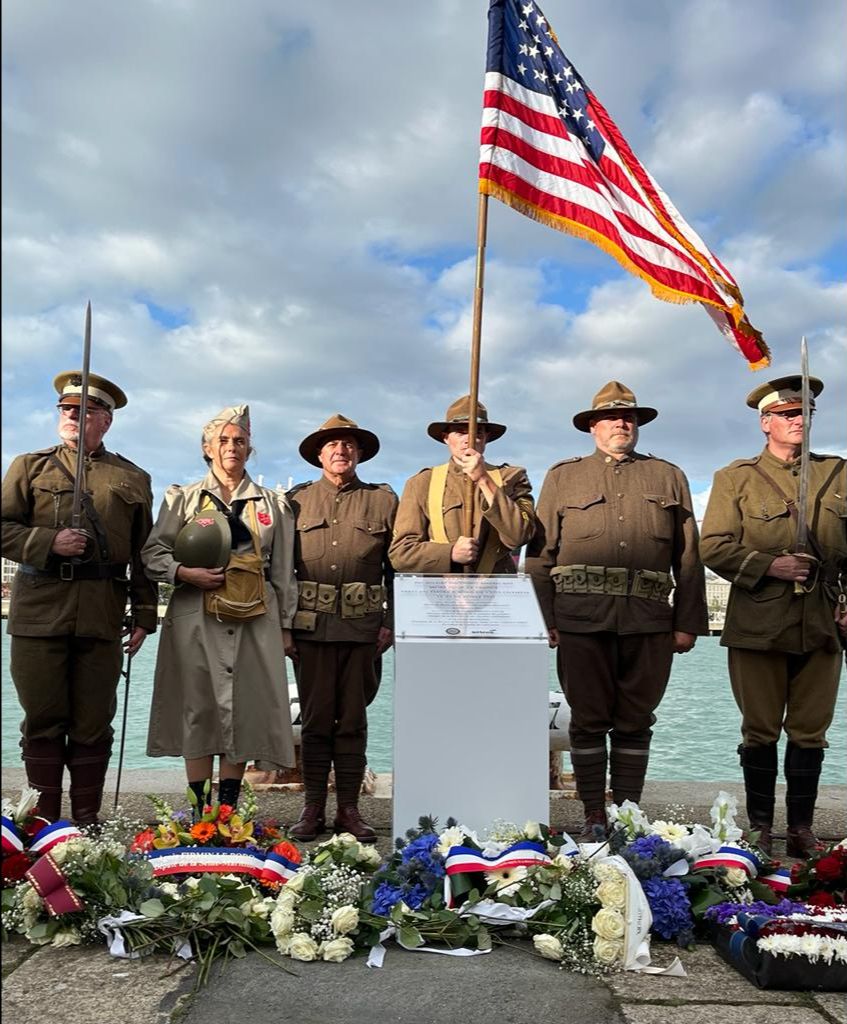
Once at the port in Le Havre, the Unknown Soldier was taken guard by the U.S. Army plus the sailors and Marines of the USS Olympia. The USS Olympia ceremoniously departed for the USA to be in Washington D.C. by Armistice Day.
|
|
Seen in the photo above, the Le Havre honor guard in historic time period uniforms at the port where the Unknown Soldier left for Arlington, Virginia in 1921.
The Unknown Hero later became known as the Unknown Soldier. In Arlington, the Tomb guards have provided a 24-hour watch at the Tomb of the Unknown Soldier since 1930.
|
|
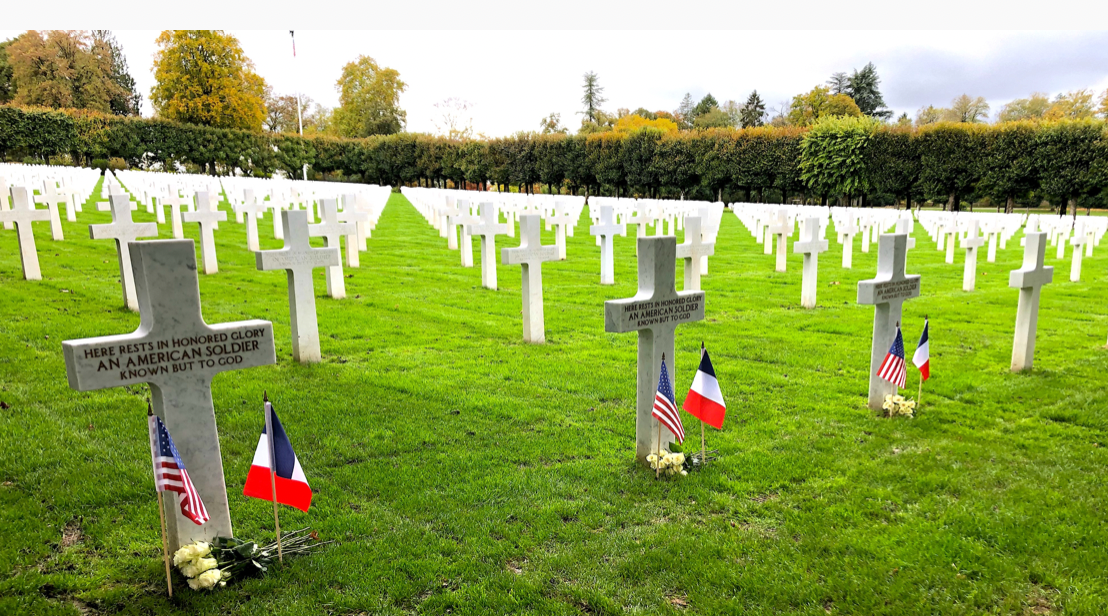
The three Unknown Soldiers who were not chosen remained in France, and they have been forever guarded by the Superintendents and cemetery staff at the ABMC's Meuse Argonne cemetery.
A special thank you to Superintendent Bruce Malone of the Meuse Argonne American Cemetery and their Interpretative Guide Aurélie Kieffer for providing us support for this years flower ceremony. We appreciate your hard work and service of guarding our American veterans buried in France.
Are you interested in learning more history?
Would you like to support the Society of the Honor Guard?
Check out their websites here:
Society of the Honor Guard :
Tomb of the Unknown Soldier:
Meuse-Argonne American Cemetery:
|
|
ANNUAL MEMORIAL SERVICE HONORING NEW YORKERS
WHO DIED FOR FRANCE DURING BOTH WORLD WARS
Sunday, November 13, 2022
|
|
FEDERATION OF FRENCH WAR VETERANS - ANNUAL MEMORIAL SERVICE
Sunday November 13, 2022 at 9:30AM:
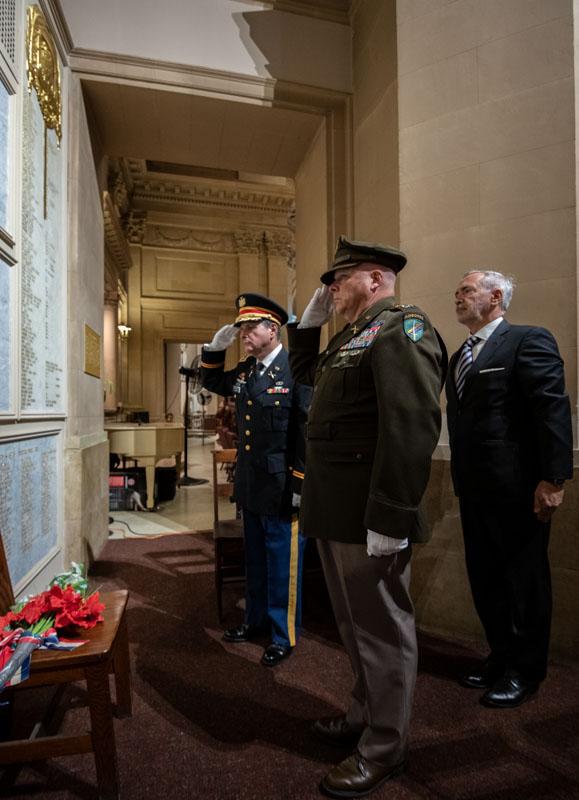
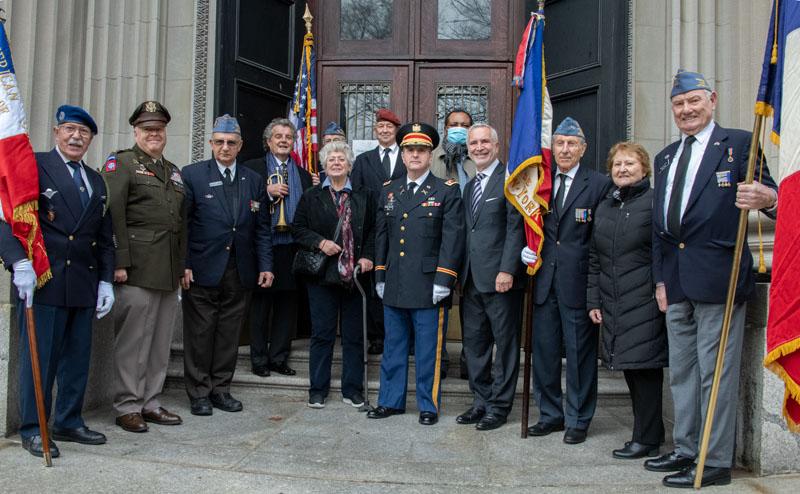
Mass of the Armistice at the Parish of Notre Dame. Father Michael Holloran officiated and the standard bearers of the Federation of French War Veterans were present. After the Mass, a wreath in memory of the dead of the Two World Wars was laid by COL US Army Stephen J. Ryan and LCOL US Army Dyonysios Dionou-Weiss (pictured above with Thierry Chaunu standing at attention behind), to honor the memory of the members of the Federation as well as the 463 French Conscripts and American Volunteers from New York City who "Died For France".
After the traditional photo, a luncheon took place at Restaurant Le Monde.
|
|
From Left to Right: André Ferrara, COL (US Army) Steven Ryan, Alain Dupuis, Jacques Letalon, Mrs. Isabelle Van Bockstaele, Henry Dubarry, Michel Dumerchat, LCOL US Army Dionysios Dionou-Weiss, Prof. Clément Mbom, Thierry Chaunu, Paul Garabedian, Mme Maria Le Gall, Jean Le Gall |
|
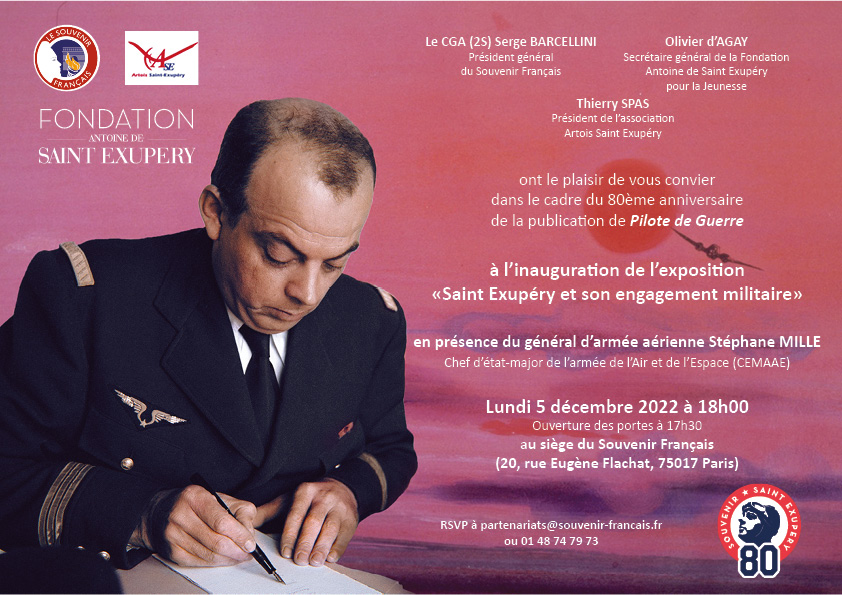
AND IF YOU HAPPEN TO BE IN FRANCE IN DECEMBER....
a special invitation
at the Headquarters of Le Souvenir Français:
|
|
OUR MISSIONS:
• To preserve the memory of the French soldiers, sailors and airmen who gave their lives for freedom, and who are buried in the United States.
• To honor French Citizens who did great deeds in the United States, or with a strong connection with the United States,
• To promote the appreciation for French culture and heritage in the United States, and the ideals that unite our two nations, in order to pass the torch of memory to younger generations.
• To strengthen the long-standing traditional bonds of friendship between the American and French peoples, and to this end: erect or maintain memorials and monuments and encourage historical research, public presentations and publications in the media.
We are looking to complete our geographic coverage with Regional Delegates for the SouthWest in cities such as Austin, or Houston, and Louisiana, in cities such as New Orleans or Baton Rouge.
The American Society of Le Souvenir Français, Inc. is an independent American corporation, apolitical, established in 1993 in NY, with 501 (c) 3 non-profit status.
|
|
Did you know that a portion of every purchase you make on Amazon can benefit American Society of Le Souvenir Francais Inc, at no cost to you?
Simply go to: smile.amazon.com, designate American Society of Le Souvenir Francais Inc. as your beneficiary, and shop away
|
|
Help us implement several historic commemorative projects celebrating the 244-year-old Franco-American friendship and alliance! |
|
The American Society of Le Souvenir Français, Inc. is a registered NY State non-profit corporation and has full IRS tax exempt 501(c)3 status. All donations are tax deductible.
Copyright © 2022 The American Society of Le Souvenir Français, Inc.
All Rights Reserved
Merci de nous contacter si vous souhaitez recevoir ce bulletin dans sa version traduite en français.
Contact: Thierry Chaunu, President
697 Third Avenue #341 New York, NY 10017
|
|
|
|
|
|
|