The Capital Stack

August 27, 2026 | BWE Arizona | Putting clients first. Trusted to be part of their future.


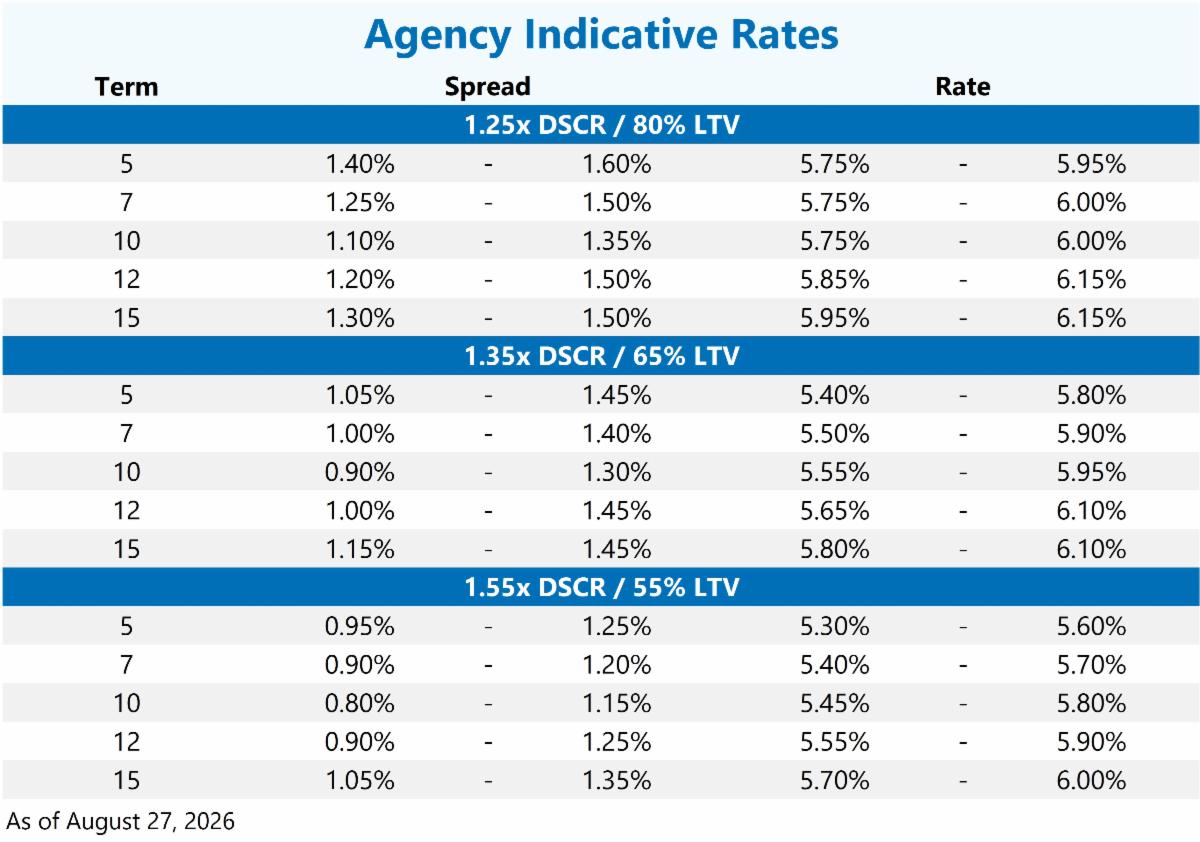
Outlier Pricing

Agency

5.45%

0.80% + 10yr UST

Low leverage multifamily refinance

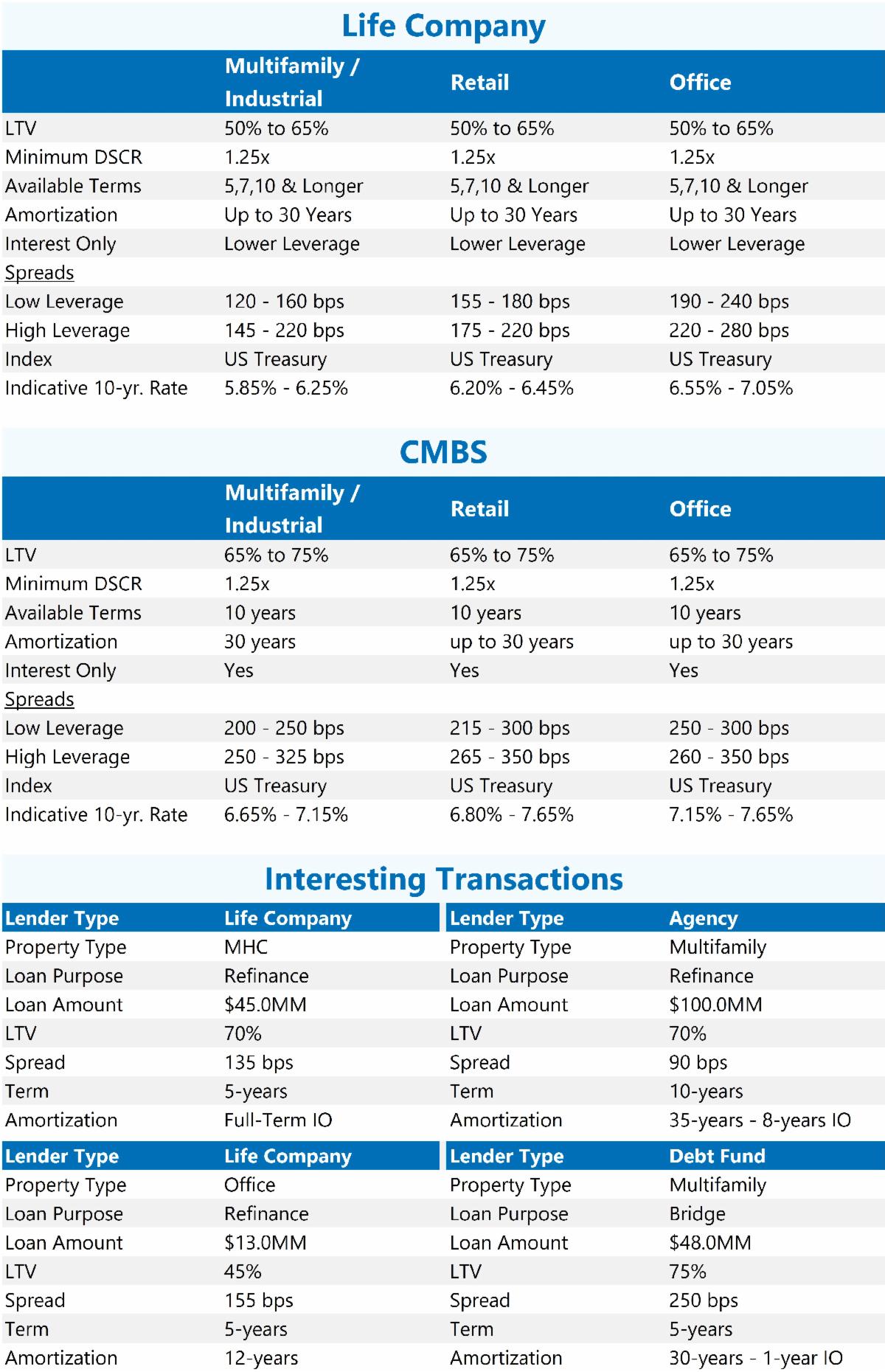
Life Company

5.85%

1.20% + 10yr UST

Low leverage multifamily refinance


Market Commentary

Key takeaways

  • Rate expectations enter the final full week of August largely unchanged and a hawkish Fed and an unproven Treasury buyback program leaves the long end vulnerable
  • Conviction and liquidity are fading into month-end
  • This week's PCE print and Warsh's Jackson Hole debut will set the tone for September


Inflation and monetary policy


July FOMC minutes

  • 9-3 vote held the benchmark Fed Funds rate at 3.50%–3.75%, but the minutes revealed a highly divided, hawkish committee
  • Many officials remain open to a future rate hike if inflation does not decline convincingly
  • Geopolitical pressure on energy prices continues to cloud the outlook, adding upside risk to already-elevated inflation
  • Takeaway: The bar for further tightening is lower than the July hold implied


Fed rate expectations

  • Swap markets imply about a 40% probability of a September hike, though pricing still points to a hold at the September 15–16 FOMC meeting
  • Jackson Hole Economic Policy Symposium runs Thursday and Friday; Chair Warsh delivers the headline address Friday


Fixed income and Treasury markets


Treasury buyback announcement

  • Treasury Secretary Scott Bessent announced a long-end buyback program set to commence in early September, sized at a minimum of $4 billion per issue with room to go higher depending on market conditions
  • Targeted maturities are the 10- to 30-year sector of the curve
  • Stated rationale: combat higher long-end yields, smooth long-end trading by absorbing older off-the-run issues, and shift debt management toward shorter-duration Bills — possibly funded from the Treasury General Account
  • Bessent framed the program as a “Treasury Twist”; CNBC reported Monday that funding may instead come from the roughly $950 billion General Account, avoiding new bill supply and giving him more firepower than the label implied
  • Takeaway: Analysts debated whether a $14 billion quarterly reallocation can move a $32 trillion Treasury market against a $40 trillion national debt


Yields and curve

  • The announcement sparked a sharp bull-flattening rally, with the 30-year down as much as 9 bps, but Treasuries had retraced the entire move by Friday's close
  • Benchmark 10-year traded back near year-to-date highs; down about 2 bps at this writing to roughly 4.70%
  • The 2-yr/10-yr yield curve flattened about 2 bps to 47, in from the low-50s last week


Auction supply

  • $183 billion of coupon supply this week: $69 billion 2-years Tuesday, $70 billion 5-years Wednesday, $44 billion 7-years Thursday
  • Takeaway: A direct test of investor demand for U.S. government debt into month-end


Geopolitical and trade risk factor


Canada-U.S. trade talks collapsed over the weekend, and the U.S. imposed 50% tariffs on roughly $20 billion of Canadian goods. Prime Minister Mark Carney suspended negotiations and pledged to match the tariffs dollar for dollar. Ongoing geopolitical pressure on energy prices remains the Fed's principal upside inflation risk.


Agency

Key takeaways

  • Fannie introduced a new “Treasury Lock” program to compete with Freddie’s Index Lock option with more details to follow. Currently, Fannie has Streamlined Rate Lock (SRL) where a borrower can lock the full rate (both index and spread) within two business days of application.
  • Rate spreads continue to hold very steady and remain at year-to-date lows.
  • BWE has had a record month for Agency loan sign-ups with a mix of acquisition and refinance loan placements despite the overall lower volume of rate locks last week.


Elevated Treasury yields and late-August seasonality continued to slow the pace of Agency CMBS rate lock activity. New issue Fannie Mae DUS/MBS rate lock volumes finished last week at roughly $490 million, under the approximately $871 million four-week moving average. Investor spreads across standard 5-, 7-, and 10-year structures ended flat over the week and remain near year-to-date tights.


Freddie Mac had a quieter week with no structured security issuance. Ginnie Mae activity picked up amid temporary dips in Treasury yields, with over $100 million trading late in the week, causing spreads to widen marginally. Corporate credit spreads, measured against the Markit CDX Investment Grade 5-year Index and the Bloomberg Single A Industrial 10-year Index, were flat throughout the week.


The investment-grade primary market showed clearer signs of the seasonal August slowdown with weekly volume of roughly $18 billion, the lowest in a month. The thin prints across corporate and Agency CMBS new issuance are consistent with late-August seasonality, as conviction and liquidity fade into the final weeks of summer, compounded by a market already softening into weekends on the geopolitical headline cycle.


Loan highlights


Freddie Mac refinance in Huntsville, AL

  • $55 million
  • 65% LTV / 1.25x DSCR
  • 10-yr term
  • 111 bps gross spread, no buydown


Fannie Mae refinance in Rochester, MN

  • $105 million
  • 65% LTV / 1.25x DSCR
  • 3 yrs IO / 35-yr amort
  • 120 bps gross spread, no buydown
 

Life Company

Key takeaways

  • Pricing remains steady with lenders increasingly willing to deviate to win business as year-end allocation deadlines approach.
  • Lender pricing remains highly competitive on low-leveraged industrial and multifamily properties.


Life Company lenders have reported a steady but generally slower stream of loan request activity over the past two weeks, consistent with the typical late-summer pace. With the final quarter of the year approaching, many lenders still have allocations to place and become noticeably more aggressive in pursuit of opportunities that can close by year-end. Capital remains plentiful for both short- and long-term durations.


Indicative spreads remain unchanged, generally landing in the range of 130-180 bps for well-located, good-quality assets. Lenders have quoted lower spreads by as much as 10-20 bps to win loans on high-quality assets with strong borrowers, particularly on lower-leveraged requests with higher debt service coverage and debt yields.


About BWE

Bellwether Enterprise (BWE) is one of the nation's largest privately-owned real estate financing companies. Its trusted advisors combine innovation, extensive experience and strong lender relationships to optimize a loan's capital stack for commercial and multifamily investors, developers and property owners. For more information, visit BWE.com.


Opinions, estimates, forecasts and all other information contained in this document are those of Bellwether Enterprise Real Estate Capital, LLC (“Bellwether”) and should not be construed as indicating Bellwether’s business prospects or expected results. Although Bellwether attempts to provide reliable, useful information, it does not guarantee that the information or other content in this document is accurate, current, or suitable for any particular purpose. All content is provided on an “as is” basis, with no warranties of any kind whatsoever and is subject to change at any time without notice. Information in this document may not be used without permission from Bellwether. This document is not intended to be an offer to buy or sell or a solicitation of an offer to buy or sell securities, if any, referred to herein.


Bellwether Enterprise Real Estate Capital, LLC (BWE) conducts business through Bellwether Enterprise Mortgage Investments, LLC – Mortgage Banker license #BK-1007784 – the Department of Financial Institutions State of AZ (Fannie Mae transactions), as well as Bellwether Enterprise Real Estate Capital, LLC – Mortgage Banker License #BK-1007825 – the Department of Financial Institutions State of AZ (all other transactions).