Newsletter | April 30, 2026 | | |
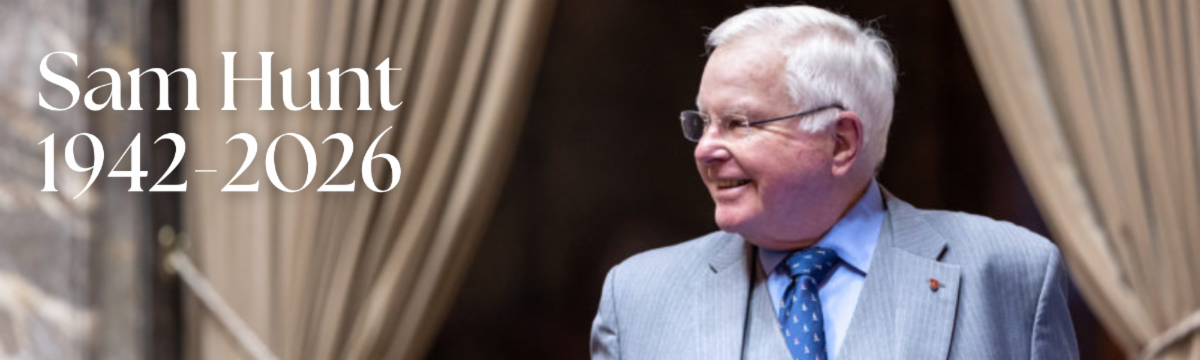
WR remembers Senator Sam Hunt’s legacy of public service
WR is saddened to learn of the passing of longtime Washington State legislator Sam Hunt. Senator Hunt dedicated decades of service to the people of Washington, and his steady presence in Olympia reflected a deep commitment to thoughtful policymaking and public service.
Throughout his career, he was known for his collaborative approach and his willingness to engage on complex issues impacting communities across the state. WR appreciated his openness to dialogue on matters affecting Washington’s business climate, workforce development, and local economies, as well as his respect for the role of employers and employees in shaping a strong and resilient state economy.
Senator Hunt’s contributions extended well beyond individual policy debates. He was a consistent and respected voice in the Legislature, known for his integrity, institutional knowledge, and dedication to serving his constituents with care and consistency.
WR extends its condolences to his family, friends, colleagues, and all who had the privilege of working with him. His legacy of public service will be remembered throughout Washington.
| | |
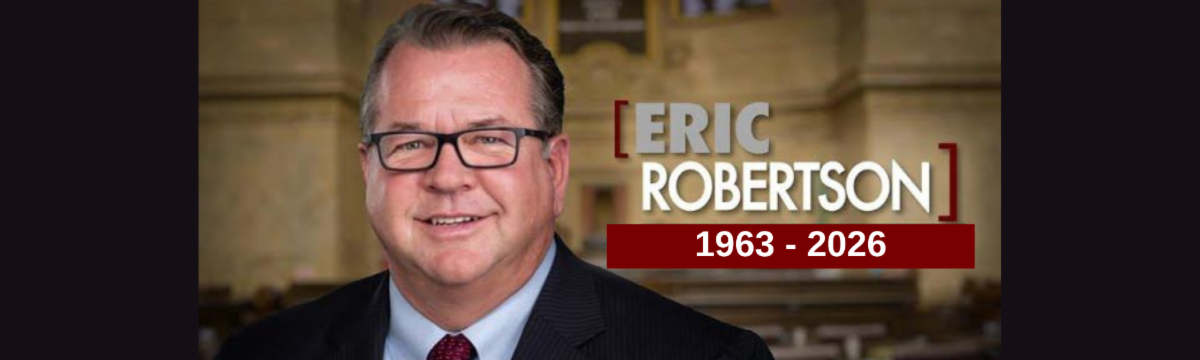
WR Honors the Life and Service of Former Representative Eric Robertson
WR is deeply saddened by the passing of former State Representative Eric Robertson. Throughout his career in public service, as a legislator, law enforcement leader, and advocate for safer communities, Eric brought steady leadership, integrity, and a deep commitment to the people of Washington. WR appreciated his willingness to listen to the concerns of employers, retailers, and the communities they serve, and his understanding that strong local businesses are essential to vibrant neighborhoods.
We extend our heartfelt condolences to Eric’s family, friends, colleagues, and all who served alongside him. His legacy of service will be remembered with gratitude.
| | |
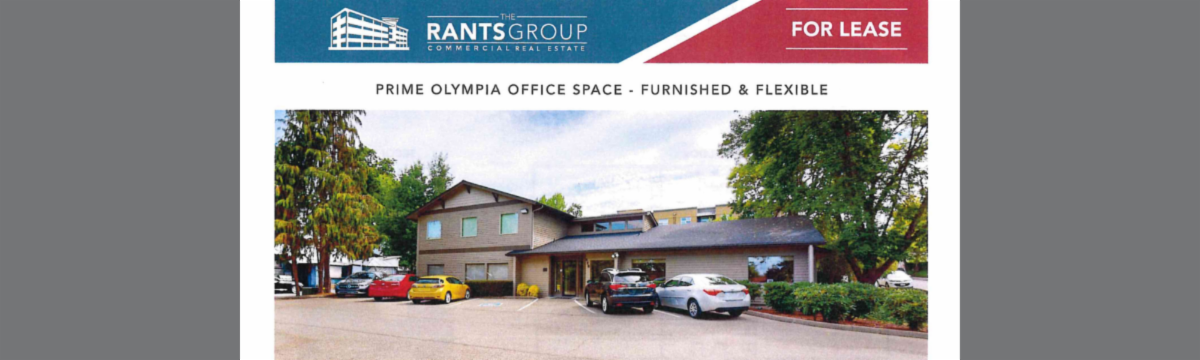
WR offers flexible office space in prime Olympia location
WR is leasing professional office space at its building located at 618 Quince St. SE in Olympia, just minutes from I-5 and Downtown Olympia. The available first-floor offices offer a convenient, flexible option for small businesses, consultants, nonprofit partners, or professionals looking for a well-located workspace in the capital city.
The building currently features three private office suites, ranging from approximately 100 to 120 square feet. Suites are partially or fully furnished, with lease rates from $400 to $600 per month, full service. Each office includes one parking space, and street parking is also available nearby.
The space offers strong visibility, easy access, and a professional setting within the WR Building. Tenants are responsible for their own in-suite internet and janitorial services.
For leasing information, interested tenants may contact Zeke Rehn, Managing Broker with The Rants Group, at (360) 915-5678 or zeke@rantsgroup.com.
Full leasing document
| | |
IN THIS ISSUE
ON THE LOCAL FRONT
POLICY
POLITICAL NEWS
ECONOMY
RETAIL THEFT & PUBLIC SAFETY
| | |
Regional Homelessness Authority on the rocks
After its creation with much fanfare a mere 7 years ago, the Regional Homelessness Authority (“RHA”) could be dismantled if Seattle City Councilmember Maritza Rivera and King County Councilmember Rod Dembowski have their way. “Cats get nine lives . . . This organization has had 10 — one more than it should have,” Councilmember Dembowski declared.
The push to eliminate the agency was triggered by a recent audit that found the $200 million RHA to be $48 million in debt, with another $8 million in spending without meaningful documentation. The audit also questioned $4 million in administrative expenses.
Much of the debt appears to flow from the RHA’s dubious accounting system. The agency makes payments to housing developers but often delays invoicing for reimbursement by as much as 16 months. The audit also found that agency staffers were approving contracts even though they did not have the authority to do so.
Perhaps tellingly, both Seattle Mayor Katie Wilson and King County Executive Girmay Zahilay have announced their own plans to build emergency shelter for the homeless. Neither Wilson nor Zahilay have weighed in on the fate of the RHA.
The RHA has had its skeptics over the years. Three years ago, in his column entitled “What’s the Point of the Regional Homelessness Authority?”, Danny Westneat observed:
“Something’s just off about the whole enterprise . . . There’s a chance to reset its work and direction. I’m also wondering: Should we keep this agency at all?”
With Seattle and King County providing 99.85% of the RHA funding, the agency has fallen far short of being a “regional” organization, as most suburban cities have refused to join.
| | |
Assistance available for December storm recovery
Washington residents, businesses, and nonprofit organizations impacted by the December 2025 storms and flooding have several opportunities to apply for recovery assistance through state and federal programs.
The Federal Emergency Management Agency, or FEMA, is accepting applications for Individual Assistance through June 10, 2026. Eligible applicants in designated counties may receive support for temporary housing, essential home repairs, personal property losses, and other disaster-related expenses. Applications can be submitted online at DisasterAssistance.gov, by phone, or through the FEMA mobile app.
Separately, Washington state, in partnership with The Salvation Army, is offering cash assistance to qualifying disaster survivors. Available support may include household needs grants for urgent expenses and home replacement assistance for qualifying recreational vehicles or campers used as primary residences. The deadline to submit a state Needs Assessment Form is April 27, 2026.
In addition, the U.S. Small Business Administration is offering low-interest disaster loans to businesses, private nonprofit organizations, homeowners, and renters affected by the storms. These loans can help cover property damage, economic losses, and rebuilding costs.
WR encourages members in impacted communities to review available programs and apply separately for each source of assistance, as state, federal, and loan programs each have distinct eligibility requirements and application processes.
Three Ways to Apply for FEMA Disaster Assistance – YouTube
| | |
Seattle’s economy and city budget holding steady despite challenges
A new analysis by Seattle’s Office of Economic and Revenue Forecast provided city officials with a pleasant surprise when it projected that the city’s economy and budget will hold steady through 2027.
Members of the city’s Economic and Revenue Forecast Council, comprised of Councilmembers and staff from the Mayor’s office, expected inflation, tech layoffs, higher oil prices, and international turbulence to slow the economy and drive up the city’s projected budget shortfall. However, the analysis found that those negative factors are being counterbalanced by growth in health care and education.
On the budget front, the impacts of inflation and a sluggish economy are being offset by higher revenue generation by the JumpStart payroll tax, a new $.01 sales tax for public safety, and voter-approved changes to the city’s business and occupancy (“B&O) tax. The revised B&O tax shifts the burden from small and medium-sized businesses to large ones.
Councilmember Dan Strauss, chair of both the Council’s Select Budget Committee and the Economic and Revenue Forecast Council, reacted cautiously to the neutral budget forecast.
“I’m glad that the forecast is a wash because it’s better than a negative. . . . I also think we as a city need to be acting as if this is a negative revenue forecast.”
The city is expected to face a budget shortfall of about $150 million in 2027, so Mayor Katie Wilson has asked city departments to prepare for 5% - 10% cuts.
One area where international turmoil is expected to impact Seattle is FIFA World Cup tourism. While Visit Seattle anticipates that the games will bring about $846 million to the area, the tourism projections are down about 10% from earlier estimates.
| | |
Expanded Fair Chance Act takes effect July 1 for most employers
The Expanded Fair Chance Act (EHB 1747), passed in 2025, takes effect on July 1, 2026, for employers with 15+ employees. All remaining employers must comply by January 1, 2027.
This law significantly expands restrictions on how employers may use criminal history in employment decisions. Employers should proactively review and update hiring, promotion, discipline, and termination practices to ensure compliance.
Key Prohibitions for Covered Employers:
Employers may not:
- Obtain criminal records before first extending a conditional job offer,
- Taking a tangible adverse action based on
- Arrest record (with a narrow exception for pending adult charges),
- Juvenile conviction record,
- Adult conviction record, unless a legitimate business reason is clearly established.
Expanded Obligations for Employers:
Employers must provide a pre-adverse action notice with information on the record they rely on for the pending decision. In addition, employers must provide:
- An additional two business days for the applicant or employee to correct or explain the record.
- A written decision with specific documentation on the reason(s) for the final adverse tangible decision, including assessment of factors related to the criminal records, duties of the position, and consideration of all relevant records.
Enforcement and Penalties:
The Attorney General may use a stepped enforcement approach for the first three violations. Penalties are applied per aggrieved job applicant or employee for each violation.
Additional Allowances and Exception:
- Employers may disclose their intent to provide a conditional job offer subject to a criminal background check.
- Applicants/employees may voluntarily disclose their criminal background at any point during the application process.
- Employers subject to federal contracts requiring criminal background checks are exempt.
| | |
L&I invites input on Pregnancy-Accommodation Expansion rulemaking
SB 5217 (Healthy Start Act under RCW 49.92) passed in 2025 will take effect Jan 1, 2027. L&I is inviting input for rulemaking.
Key Changes Under SB 5217 (Effective Jan. 1, 2027)
-
Enforcement: Moves to L&I and adds a private right of action, allowing employees to file lawsuits directly
-
Employer Coverage: Expands from 15+ employees to all employers
-
Paid Breaks: Requires paid time (including travel time) to express milk if no on-site space is available
-
Unfair Practices Defined: Prohibits denying reasonable accommodation, forcing usage of leave instead, or taking adverse action
-
Medical Certification Limits: Employers cannot require documentation for milk expression or lifting limits under 17 lbs
L&I is inviting input to assist in their development of the scope of rules for this legislation.
- How should L&I clarify or further define the requirements for pregnancy-related accommodation in this rule?
- What factors should L&I consider in determining whether an accommodation causes “undue hardship” for an employer?
- What obligations or prohibited actions for employers should L&I define or clarify in this rule?
L&I will hold a virtual public feedback session on May 1, 2026, at 10:00 a.m. You can join the feedback session here.
| | |
Washington CEMA litigation expands after court ruling
One year after the Washington Supreme Court decision in Brown v. Old Navy LLC, litigation under Washington’s Commercial Electronic Mail Act has grown significantly. The court interpreted the 1998 statute to prohibit any false or misleading information in a commercial email subject line, not just deception about the nature of the message. This interpretation has led to a surge in class action filings.
Since the ruling, more than 100 lawsuits have been filed in Washington, often targeting retailers but also reaching hospitality, beauty, and other consumer brands. Plaintiffs frequently challenge promotional subject lines such as limited-time offers, free gifts, or discounted pricing claims. Statutory damages of $500 per email per recipient have created substantial exposure, with some claims reaching into the millions depending on distribution size.
Defendants have argued that these claims are preempted by the federal CAN-SPAM Act, but early court decisions have largely allowed cases to proceed. Key legal questions, including materiality and consumer reliance, remain unresolved.
In response, Washington enacted HB 2274, signed March 23, 2026, which will take effect June 11, 2026. The law reduces statutory penalties to $100 per violation and adds a scienter requirement for false or misleading claims.
While litigation continues and courts have not yet resolved key issues such as federal preemption and materiality, WR and its partners continue to monitor implementation and advocate for clarity in email marketing standards across Washington.
BallardSpahr.com
| | |
Employment law passed in WA’s 2026 legislative session
Washington’s 2026 legislative session introduced a broad set of employment law changes that will have real, day-to-day implications for employers across the state. These updates reflect an ongoing shift toward increased worker protections, greater transparency, and expanded regulatory oversight. For employers, particularly in industries like retail, where workforce size, turnover, and compliance complexity are high, understanding not just what has changed but how and when to implement those changes will be critical.
The legislation outlined below highlights the most relevant updates for members of WR, with a focus on areas that may require operational adjustments, policy updates, or additional communication with employees.
General Employment Law
-
Eliminate Noncompete Agreements (HB 1155) – This legislation voids all noncompetition covenants prospectively and retroactively. By Oct 1, 2027, employers are required to notify all parties with such agreements that they are now void.
-
Immigrant Worker Protection Act (2SHB 2105) – All employers must notify their workers within five days of an I-9 inspection notice or inspection results. Enforcement is effective Oct 1, 2026, by the Attorney General or via civil action.
-
Expand Attorney General’s Pre-Civil Investigation Authority (ESSB 5925) – Effective Jun 11, 2026, the Attorney General’s pre-civil investigative authority is expanded to cover wages and payments to workers, and the WA Law Against Discrimination.
-
Pregnancy Accommodation Complaints Exempt from Public Records Act (SSB 6014) – Effective Jun 11, 2026, the identity of pregnancy accommodation complainants is exempt from the Public Records Act, and the written certification requirement no longer applies to accommodations related to lifting over 17 pounds.
-
Prohibits Implanting Microchipping Employees (HB 2303) – This legislation prohibits an employer from requesting, requiring, or coercing an employee to have a microchip implanted in the employee for any reason.
-
Establish Labor Standards for Domestic Workers (SHB 2355) – Effective July 1, 2026, employees or independent contractors who work in a private residence for at least four hours a month will be protected under the Minimum Wage Act, other protections that were previously exempt for some of them, and the Washington Law Against Discrimination.
-
Childcare Standards Board (2SHB 1128) – By Sep 1, 2026, the Governor shall appoint a seven-person Childcare Standards Board within Labor & Industries. The Board shall convene to produce a series of reports with recommendations related to childcare worker staffing, recruitment, retention, and staffing ratios.
-
Unpaid Wage Recovery (2SHB 2479) – Creates a Wage Recovery Program in L&I to allow discretionary disbursement of funds to unpaid low-wage employees before a determination is made to address immediate economic harm for wages owed.
-
Allow Discretion to Prioritize Wage Enforcement (ESB 6058) – Instead of investigating every wage claim, this legislation allows L&I to establish a transparent written process that prioritizes complaints based on factors such as severity and probability of retaliation.
Paid Leave, Unemployment Insurance, and Workers’ Compensation
-
Paid Leave Premium Contribution Switch (2SHB 2345) – Effective Jun 11, 2026, the premium contribution will switch between employers and workers to minimize the tax liability on employers and workers due to a 2025 IRS Guidance. The share ratio between employers and workers remains the same.
-
Paid Leave Actuarial Rating (2SSB 5292) – Effective Jan 1, 2028, the statutory rate-setting formula is replaced by actuarial rate-setting while keeping the 1.2% statutory rate cap.
-
Paid Leave Solvency & Integrity Evaluation Report (ESSB 5998 – Sec. 232 (27)) – Within the operating budget, the Legislature required the Employment Security Department to gather input from the Paid Leave Advisory Committee and deliver an evaluation report with recommendations related to the program’s solvency and integrity by November 1, 2026.
-
Access UI for Voluntary Layoff (HB 2264) – Effective Jun 11, 2026, a worker who voluntarily participates in an employer-initiated layoff or reduction plan retains the right to access unemployment insurance benefits so long as their termination is the result of the plan.
-
Waiving Minor Error on UI Employer Reports (SSB 5874) – The Employment Security Department Commissioner may waive minor or insignificant reporting errors on reports requiring the standard occupational classification or job title of each worker.
-
Notice to Striking Workers to Repay UI Benefits (SB 6134) - Striking workers who receive unemployment (UI) benefits will be issued a notice that explains their legal obligation to repay UI benefits if backpay wages are later received.
-
Workers’ Comp Out of Network Provider Access & More (E2SSB 5847) – This legislation opens the option to go outside of the medical guideline and the medical providers' network under certain circumstances. It also establishes standards for utilization review and adds penalties to employers who mandate workers to use specific medical providers. Continued treatment is allowed for certain closed claims.
-
Pilot program for posttraumatic stress disorder treatment and research (SHB 2405) – A pilot program is established in the Department of Labor and Industries to allow workers' compensation coverage of post-traumatic stress disorder treatment up to a specified number of sessions before claim adjudication and after claim closure.
-
Workers’ Comp Rate Transparency (SB 6136) – In addition to publishing the annual proposed premium rates, L&I must publish the actuarially indicated rate for each workers' compensation risk classification as part of its proposed premium rates for the upcoming year.
-
Modernize L&I Communication Across Multiple Programs (SSB 6039) - Specified notice and communication provisions may be sent digitally across multiple L&I administered programs, but L&I must provide the affected party the option to receive communications through a nonelectronic method.
| | |
WR needs you: Lawmakers need to hear from retailers
With the legislative session behind us, WR is already focused on the interim and the work ahead. While lawmakers may have left Olympia, advocacy does not end when the session adjourns. In many ways, the interim is one of the best opportunities to build relationships, elevate retailer voices, and help shape the policy conversations that will carry into the next legislative session.
That is why now is such an important time for WR members and supporters to get involved in our grassroots efforts.
Retail Voices Belong at The Table
Retailers bring something to the table that no one else can. You understand firsthand how public policy affects businesses, employees, customers, and communities. That practical experience is invaluable, and it is exactly the kind of insight lawmakers need.
When policymakers are weighing issues like public safety, labor, consumer costs, and the local economy, they should be hearing directly from retailers, especially the business owners, operators, and retail professionals in their districts. The strongest policy decisions are grounded in the experiences of those living with the impact every day.
Simply put, WR is strongest when retailer voices help shape the outcome.
Ways to Get Involved
Grassroots advocacy is not one-size-fits-all, and there are many ways members and supporters can participate, including:
- Meeting with lawmakers in your district
- Hosting store tours for elected officials
- Attending legislative and campaign events
- Participating in WR policy workgroups
- Speaking with media and community leaders
- Sharing stories and examples from your business
- Responding to action alerts
- Contacting lawmakers about key policy issues
- Testifying on proposed legislation
- Sending letters or emails to policymakers
- Connecting WR with other retailers and stakeholders
Whether you are comfortable speaking publicly or prefer to engage behind the scenes, there is a role for you.
A Little Time Can Make a Real Difference
Getting involved does not have to be a major time commitment. For many members, participating may only take one to two hours a month, and you can engage as much or as little as your schedule allows.
No level of involvement is too small. Whether you respond to an occasional action alert or take part in a meeting or store tour, your involvement helps strengthen WR’s advocacy and expand the reach of retailer voices.
WR Makes It Easy to Get Involved
You will not be doing this alone. WR will be with you every step of the way. We handle scheduling, coordination, preparation, and organizing so participation is simple, manageable, and worthwhile.
We do the legwork. We just need you, your voice, and your experience.
Help WR Advocate as Effectively As Possible
Whether you are a business owner, operator, manager, team member, or industry partner, there is a place for you in WR’s grassroots work. Your involvement helps us advocate more effectively, respond more quickly, and better reflect the full range of experiences across Washington’s retail community.
Retail is too important to be left out of the conversation. If lawmakers are making decisions that affect retailers, they should be hearing directly from retailers.
Interested In Getting Involved?
To learn more about WR’s grassroots efforts and how to participate, please contact WR Director of Policy & Government Affairs Crystal Leatherman at cleatherman@washingtonretail.org or 360-884-0771, or click here to fill out a few details and inquire directly.
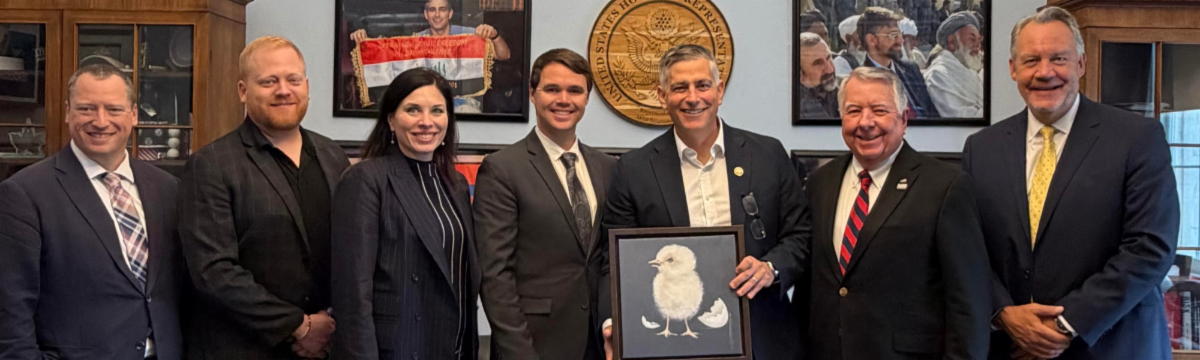
| | WA State Delegation – Chester Baldwin, Kenneth Katzaroff, Alesha Shemwell (WR Interim CEO), Christian Decker, Rep. Michael Baumgartner, Stephen Pohl, Jim Hill (ICSC) | | |
ICSC Fly-In spotlights Washington’s retail impact
ICSC’s Federal Fly-In was held April 20–22, 2026, in Washington DC, bringing together members of the marketplace and retail real estate industry for three days of policy engagement on Capitol Hill. The program gave participants opportunities to meet directly with congressional offices, attend legislative briefings, and participate in committee discussions focused on industry priorities.
Alesha Shemwell, Interim CEO of WR, attended alongside other industry leaders to advocate for policies that support retail, marketplaces, and the communities they serve. For Washington state, the industry’s impact is significant: in 2024, Washington had 2,318 marketplaces, 37,011 marketplace tenants, a 96.7% occupancy rate, and 678,593 jobs tied to the sector, representing 13.8% of total jobs statewide. Marketplaces in Washington also generated $174.7 billion in sales, equal to 20.4% of state GDP, along with $11.4 billion in state sales taxes, $655.2 million in property taxes, and $620 million in construction and redevelopment spending. The data also underscores the importance of small businesses, which make up 70% of shopping center tenants.
Delegates engaged federal policymakers on issues affecting the retail and marketplace sector, including economic competitiveness, tax and regulatory impacts, commercial development, and public safety concerns such as organized retail crime. Conversations also included asking for support of CORCA, highlighting ongoing efforts to improve retail crime coordination, prevention strategies, and information sharing among public- and private-sector partners at the federal level.
The Washington data provided a clear backdrop for these discussions, illustrating how marketplace activity supports jobs and local economies across every congressional district. In 2024, Washington’s 10 congressional districts each reflected substantial marketplace employment, including 89,133 jobs in District 5, 76,747 jobs in District 2, 75,343 jobs in District 7, and 71,984 jobs in District 10. District-level data also showed billions in sales-tax activity and millions in property-tax contributions, reinforcing the importance of retail real estate to both state and local government revenues.
Additional sessions explored environmental policy considerations, economic development trends, and the role of marketplaces in strengthening community vitality.
Attendees participated in structured Capitol Hill meetings that emphasized the value of direct advocacy and relationship-building with federal decision makers. The Fly-In concluded with continued dialogue between industry representatives and congressional staff, centered on shared priorities: strengthening local economies, improving safety, supporting small businesses, and advancing sustainable growth across the retail and commercial real estate landscape.
| | |
Retail trends show resilience amid policy and workforce shifts
Recent updates from the National Retail Federation (NRF) highlight both opportunities and challenges shaping the retail sector.
A new federal tariff refund portal opened in mid-April, allowing importers to file claims related to certain IEEPA tariffs. Early feedback from retailers has been varied as businesses work through the process. U.S. Customs and Border Protection is addressing technical and administrative issues as they emerge, while NRF continues providing guidance to retailers navigating the system.
Consumer spending also remains strong in key seasonal categories. NRF projects Mother’s Day spending will reach a record $38 billion this year, up from $34.1 billion in 2024 and above the previous high of $35.7 billion in 2023. While many consumers remain mindful of fuel prices and broader economic uncertainty, spending tied to family celebrations and personal connections continues to show resilience.
Workforce development remains another major focus across the industry. NRF recently convened senior talent leaders from 25 retail brands in Phoenix to discuss workforce planning, talent mobility, and hiring strategies. Leaders also explored how artificial intelligence is increasingly influencing retail operations, strategy, and long-term workforce needs.
| | |
Mother’s Day spending projected to reach record $38 billion
Mother’s Day spending in the United States is expected to reach a record $38 billion this year, according to a National Retail Federation (NRF) and Prosper Insights & Analytics survey. This surpasses last year’s $34.1 billion and the previous record of $35.7 billion set in 2023.
An estimated 84% of U.S. adults plan to celebrate the holiday, with average spending reaching $284.25 per person, also a record high. Shoppers are primarily purchasing gifts for mothers and stepmothers (54%), followed by wives (22%) and daughters (13%).
Top shopping destinations include online retailers and department stores, both at 33%, followed by specialty and discount stores. Popular gift categories remain consistent, led by flowers (75%), greeting cards (74%), and special outings such as dining experiences (63%). Gift cards and clothing are also common choices.
Total spending is highest on jewelry at $7.5 billion, followed by experiences at $6.4 billion and electronics at $4.4 billion. Experience-based gifts continue to grow, with about one-third of consumers planning to give event-based experiences.
WR notes that these trends reflect continued consumer willingness to prioritize meaningful and experience-driven gifts despite broader economic uncertainty.
| | |
Washington Governor vetoes $500K to combat ORC
Loss Prevention Magazine
By: Courtney Wolfe
April 6, 2026
Washington Governor Bob Ferguson is facing criticism after vetoing $500,000 in funding meant to combat organized retail crime.
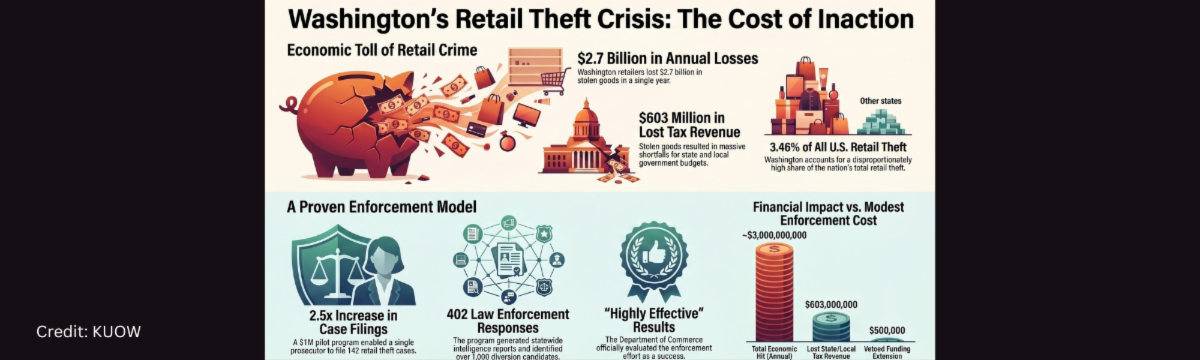
Washington state is number one in the nation for retail crime, according to Forbes, contributing to a nearly $3 billion impact on the economy and safety concerns for employees and customers.
“I am deeply disappointed and puzzled by the governor’s decision to veto a budget measure that focuses on combatting organized retail crime,” Rep. Mari Leavitt (D-University Place) said in a statement.
Leavitt was a champion of the funding after deciding to take a hands-on approach to learning about the real-world impacts of ORC, attending the NRF State Legislative Leadership Experience and an ORC conference, convening a public safety roundtable discussion in the interim, and participating in a ride-along during a fence operation bust, according the Washington Retail Association.
This veto comes after the governor supported a pilot program last year that provided $1 million to combat the issue of retail crime. From January through June of 2025, the King County Prosecuting Attorney’s Office filed 142 retail theft cases, 2.5 times more than the average across the past four years. King County Prosecutor Leesa Manion said the success was a direct result of the funding allocated by the legislature, which allowed the office to temporarily hire an additional prosecutor.
According to the Washington Retail Association, in the first five months of 2025, the pilot generated 402 program-driven law enforcement responses, identified 1,194 people eligible for diversion, offered diversion to 343 individuals, initiated 154 diversions, and generated 5,868 ORC reports.
“While we face this challenging situation, consequently, we have limited ability to absorb additional work or expenses that are not funded in the budget,” Ferguson said. “That is why I vetoed a few programs. It’s also consistent with how I approach budgeting. We have a proposal to do something in our budget. We’ve got to have the funding to do it.”
| | |
At the same time, state leaders point to ongoing work through Washington’s Organized Retail Crime Task Force, launched in 2023, which continues to investigate cases and pursue prosecutions tied to large-scale theft operations.
The funding debate highlights the continued need for coordinated solutions to protect retailers, employees, and consumers
King5.com
| |
WR diversity statement
WR is committed to the principles of justice, equity, diversity, and inclusion. We strive to create a safe, welcoming environment in which these principles can thrive.
We value all people regardless of race, ethnicity, gender, religion, age, identity, sexual orientation, nationality, or disability, and that is the foundation of our commitment to those we serve.
| | |
Alesha Shemwell
Interim CEO
360.200.6450
Email
| |
John Engber
Director, Retail Industry
Coalition of Seattle
206.850.5517
| | | | |