|
MARKET COMMENTARY
We have been in a sustained decline in long-term Treasury yields over the past two months. On Monday, the yield on the 10-year Treasury peaked at 4.28% and then started a slide to 4.16% by mid-Wednesday. We had a monumental FOMC meeting on Wednesday and the 10-year currently stands at 3.92% today. That is over a 100-basis point decrease since October 18th.
The short-term Treasuries have been very popular and in demand from retail investors, money market funds and even hedge funds due to high short-term interest rates and the amount of liquidity in this space. However, demand for long-term Treasuries has been steadily declining as foreign banks, trading partners and governments have been net sellers of long-duration Treasuries.
The Treasury Department would prefer to sell long-term Treasuries to finance government deficits and debt as that will extend out the repayment/refinance resulting in lower demand for ongoing refinances/reissuances. Yellen had an estimated $350 Billion of treasuries to sell this week and, given the lack of liquidity on the long durations, reportedly sold these two tranches in the shorter-durations. That fueled the continued slide in long-term Treasury yields.
In the Federal Reserve FOMC meeting this Wednesday and follow-on commentary, the Federal Reserve announced that short-term interest rate increases appear to be over and that rate decreases will start next year because momentum in the economy will continue to take care of falling inflation. This is the soft landing that Chairman Powell has been looking for.
The equity markets erupted in volume and a number of outlets announced the Bull Market is back in equities. Not only are the long-term Treasury yields falling, the 30-year Residential Mortgage rates have fallen over 100 basis points, now below 7% for the first time since August. Welcome news for the housing market.
| |
|
LIFE COMPANY
Life insurance companies reported a sluggish fourth quarter 2023 production due to elevated US Treasuries driving coupons into the high 6 to mid-7% range, forcing many borrowers to the sidelines. Much of the Life Companies’ 2023 allocations were depleted earlier in the year, due to finding relative value options to lend in the short-term market.
Leading into 2024, preliminary indications are that most lenders’ allocations for the upcoming year will be similar to 2023. Specific allocations will be confirmed during the upcoming Mortgage Bankers Association conference that will be held in February, 2024. We expect lenders to seek larger loan requests with quality borrowers for quality product with a focus on multifamily and industrial asset classes, along with well-located retail and self-storage properties.
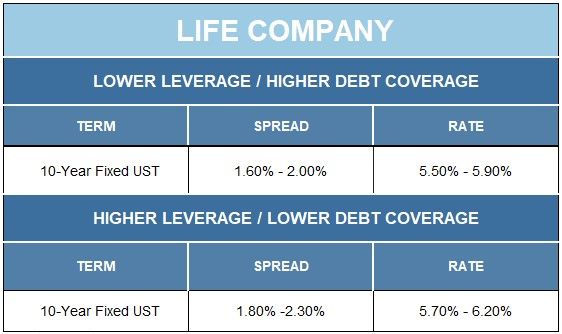
Life Company spreads remained stable over the past month. Loans quoted on attractive property types, characterized with lower leverage and achieving higher debt coverage ratios, realized spreads as low as 160-170 to 200 basis points.
In summary, life insurance companies are still actively providing liquidity to the commercial real estate market. This contrasts with earlier downturns, such as in the early 1990s, where challenges included a lack of liquidity and sidelined financing options for the commercial real estate market.
Transaction Highlights
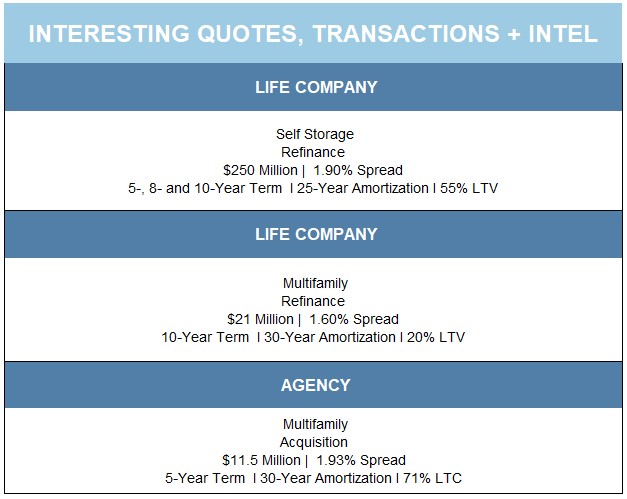
• Life Company Storage Portfolio Loan
o 5- 8- and 10-year Fixed-rate loans, Amortizing over 25 years
o $250,000,000 combined
o 55% LTV
o 1.90% Spread
• Life Company Multifamily Loan
o 10-year Fixed, Amortizing over 30 years
o $21,000,000
o 20% LTV
o 1.60% Spread
• Life Company Shopping Center Deal
o 7-year Fixed with full-term, Interest-Only payments
o $11,990,000
o 55% LTV
o 1.90% Spread
Highlights:
- Life Insurance Companies are still actively quoting and providing liquidity in the market
- With treasuries declining heading into the new year, Life Insurance Companies are ready to deploy their allocated capital
| |
|
AGENCIES
We’ve been extremely active with the Agencies over the past weeks as treasury yields continue to decline, spreads have lowered, acquisition financing inquiries have increased, and we’ve also seen a significant uptick in quote requests for refinance deals that sat on hold earlier in 2023.
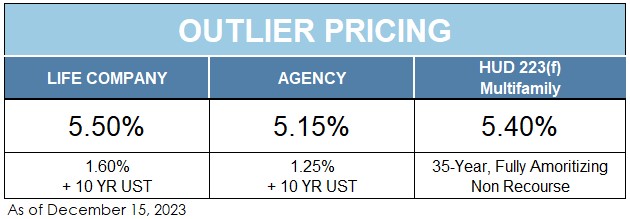
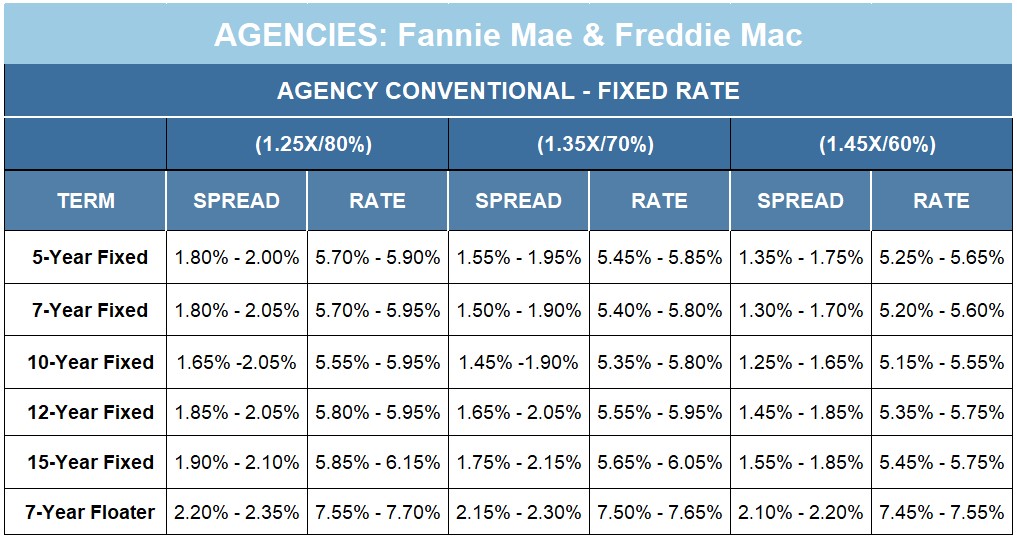
Pricing for deals with High Mission are pricing in the 120-160bps range depending on the pricing tier (ie Tier 2 1.25x DSCR/ 75% LTV; Tier 3 1.35x DSCR/65% LTV; Tier 4 1.55x DSCR/ 55% LTV). All in rates are in the mid to upper 5% range, while we’ve seen max leverage 1.25x DSCR outlier pricing on a 10-year deal at 5.50%. Strong naturally occurring affordability and repeat sponsorship with a given agency continue to be the factors that are delivering the best terms.
Assuming stability in the treasury and agency securitization market, we expect an uptick in existing floating rate deals refinancing into fixed rate deals over the next 6 months while the yield curve remains significantly inverted. If you have an existing floating rate loan and are interested in what a fixed rate take-out loan would look like, we welcome the opportunity to perform an analysis of a potential take out loan as well as estimate the cash value of any existing rate cap that would be unwound because of the refinance. We’ve been very active in this analysis for several of our clients over the last month and happy to share our observations.
35 Year Amortizations: We continue to quote deals with longer amortization periods in the form of 35 years particularly with Freddie Mac. Freddie Mac’s 35-year amortization requirements are as follows:
- 65% LTV or less with high mission – will considers deals without high mission at 55% LTV,
- In Refinance situation, 20% hard cash equity remaining,
- Strong Sponsor with generally 3,000 or more units and double the NW and liquidity requirements, and
- No history of default, foreclosure, or loan modifications.
Compelling Agency CMBS Activity and fixed-income asset performance
Freddie Mac's successful pricing of their structured $254.68 million “Supplemental” K-J48 and the strong demand for their $747.17 million 7-Year fixed rate K-754 K-Deal are two examples of improvement in Agency CMBS market conditions. Client demand has surged in recent weeks, capturing attention from traders who've observed sizeable buying activity increases from banks, money managers, and REITs. This trend, along with moderate new supply and diminished broker/dealer inventories, has bolstered a spread-tightening bias for Agency CMBS products.
High investment grade products maintained near year-to-date low credit spreads, indicating optimism in fixed-income assets. The outlook for investment-grade fixed-income assets remains promising on the premise of rate cuts occurring in the first half of next year, especially for securities with higher credit quality and longer durations. That includes Fannie Mae DUS products, where the investor spreads have shrunk to levels not seen since February. Ginnie Mae permanent loan’s (PL’s) have lagged the ACMBS sector tightening over the past few months though have begun to garner attention from re-activated investors causing credit spreads in PL’s to tighten ~15-20bps from a month ago.
Highlights:
- The Agencies are actively quoting business and have seen an increase in acquisition financing requests
- Agency spreads have lowered across the board. Furthermore, both agencies are aggressively quoting mission driven business
| |
|
HUD
Pullback in Interest Rates:
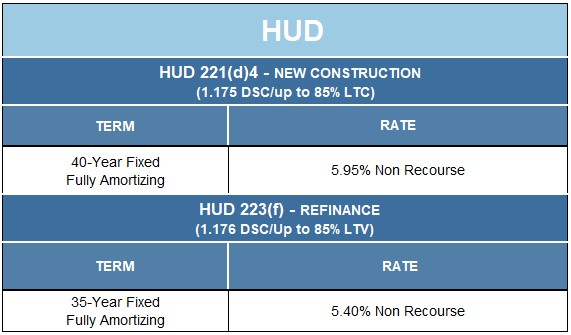
The recent pullback in interest rates comes as welcome relief, as higher rates have been placing significant pressure on loan proceeds across the board. Rates on HUD loans have returned to levels last observed in August of this year, and we encourage borrowers who received preliminary loan sizings in prior months to reach out to us for an updated loan sizing based on the current interest rates.
HUD Policy Change in Build for Rent (BFR) Communities:
We are excited to share a notable and welcomed change that was made to one of HUD’s recently implemented policies regarding Build for Rent (BFR) communities containing detached single unit buildings. In May 2021, HUD issued a letter stating that any site plan (both existing and new construction) on a proposed transaction should have “a preponderance of structures with 4 or more units”. Previously, single-unit structures were not permitted to be included, and structures with 2 or 3 units could only be included if they did not amount to more than half of the buildings (buildings, not units).
This policy was widely met with disapproval among industry participants, as the rise in the BFR product’s popularity and feasibility has become evident at a time when much of the nation is experiencing housing shortages causing apartment rents and housing prices to balloon. Recognizing that these BFR communities support HUD’s goal of creating strong and quality affordable housing, they have now expressed openness to insuring mortgages on Build for Rent communities. As this update begins to take effect, it will provide much needed liquidity for the growing number of Build for Rent communities currently operating and planned for future construction.
The main requirement that borrowers should be aware of is that all units must be contained on one parcel, as HUD will not allow for individually entitled lots. The project must be operated solely as a multifamily for rent community.
For borrowers interested in learning if their Build for Rent community would be a good fit for HUD-insured financing, please reach out to BWE Scottsdale’s HUD team for more information.
Highlights:
- Interest rates on all permanent loans have benefited from the recent downward trend in the 10-year treasury rate, and as a result, loan proceeds are increasing.
- Borrower demand remains strong for HUD loan products, as is HUD’s appetite for incoming deals.
Please contact BWE Arizona HUD team if you have any questions about the above updates and how they might apply to your project.
| | |
|
|
ARASH KOUHI I VICE PRESIDENT
Email: Arash.Kouhi@bwe.com
Direct: 480.209.3869
20555 N. Pima Rd, Suite O-140
Scottsdale, AZ 85255
| |
Opinions, estimates, forecasts and other information contained in this document are those of Bellwether Enterprise Real Estate Capital, LLC (“Bellwether”) and should not be construed as indicating Bellwether’s business prospects or expected results. Although Bellwether attempts to provide reliable, useful information, it does not guarantee that the information or other content in this document is accurate, current, or suitable for any particular purpose. All content is provided on an “as is” basis, with no warranties of any kind whatsoever and is subject to change at any time without notice. Information in this document may not be used without permission from Bellwether. This document is not intended to be an offer to buy or sell or a solicitation of an offer to buy or sell securities, if any, referred to herein.
| |
Bellwether Enterprise Real Estate Capital, LLC (BWE) conducts business through Bellwether Enterprise Mortgage Investments, LLC – Mortgage Banker license #BK-1007784 – the Department of Financial Institutions State of AZ. (Fannie Mae transactions), as well as Bellwether Enterprise Real Estate Capital, LLC – Mortgage Banker License #BK-1007825 – the Department of Financial Instituti9ons State of AZ (all other transactions). | | | | |