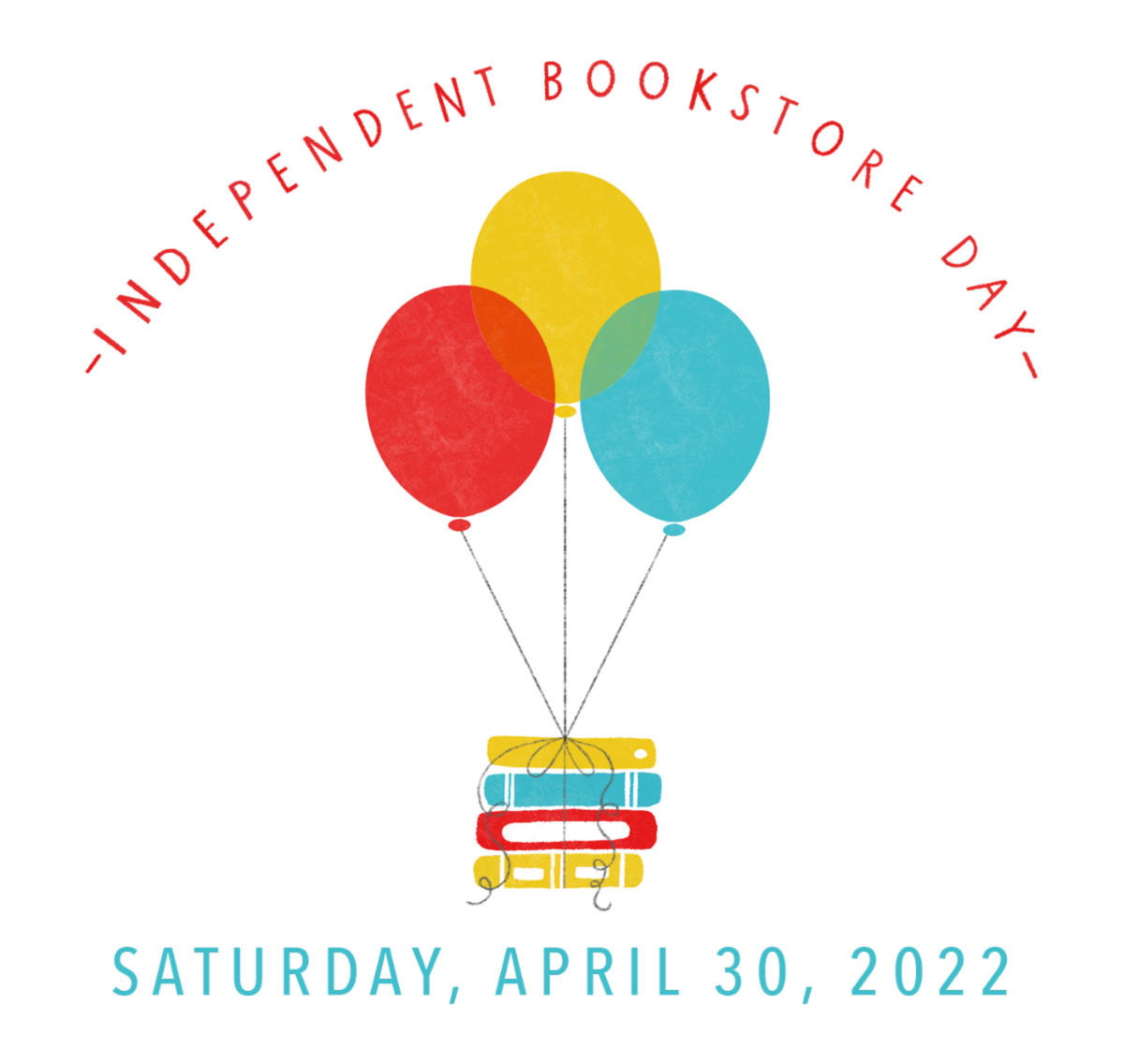
To walk into an indie bookstore is to walk into a world of discovery. The fruits of the products of humanity can be plucked from its shelves. Each store is different; each its own world. The books, diversity of thoughts and ideas, readings, events, and knowledge that indie bookstores bring to their communities are well worth celebrating. That’s why hundreds of independent bookstores across the nation will host celebrations of the wild, woolly, and wonderful institution that is the independent bookstore on Saturday, April 30th.
Of course WBW will be in on the action. We love to get festive.
We’ll have authors reading and signing their books, a special storytime Instagram takeover, and a raffle for three custom stencils made by Tony Weller. We’re still working on more events to keep things special all day long.
We’ll also have exclusive Bookstore Day merch like special Bookstores are My Jam mugs and tote bags, chapbooks of an original story by Mieko Kawakami, and a groovy old-school motel room key tag. These items are very limited in quantity and cannot be purchased or picked up until Bookstore Day.
And to spread the love, My Amour Cafe and Weller Book Works will offer 10% reciprocal discounts. So buy something at WBW and take your receipt to the coffee shop across the way from us, show them your receipt, and get 10% off a coffee and a snack. Or start your day with a cup from My Amour and bring your receipt to Wellers for 10% off your purchase here. This offer is only good on Indie Bookstore Day.
Join the national one-day party on Saturday, April 30. It starts when we open at 10:00 a.m. and when you join us. After all, we can’t do this without you.
|
|
Rare Book Acquisitions
By Tony Weller
|
|
Curious browsers find our rare book room and frequently ask what is the oldest book here. Age is not a very good indicator of value or desirability, but it fascinates us to hold objects from distant eras. Doing so, it’s nearly impossible to not ponder the book’s history and wonder about the minds and hands that made it, how different their lives were than ours; and to try to fathom the hands and circumstances that moved a book from then and there to here and now.
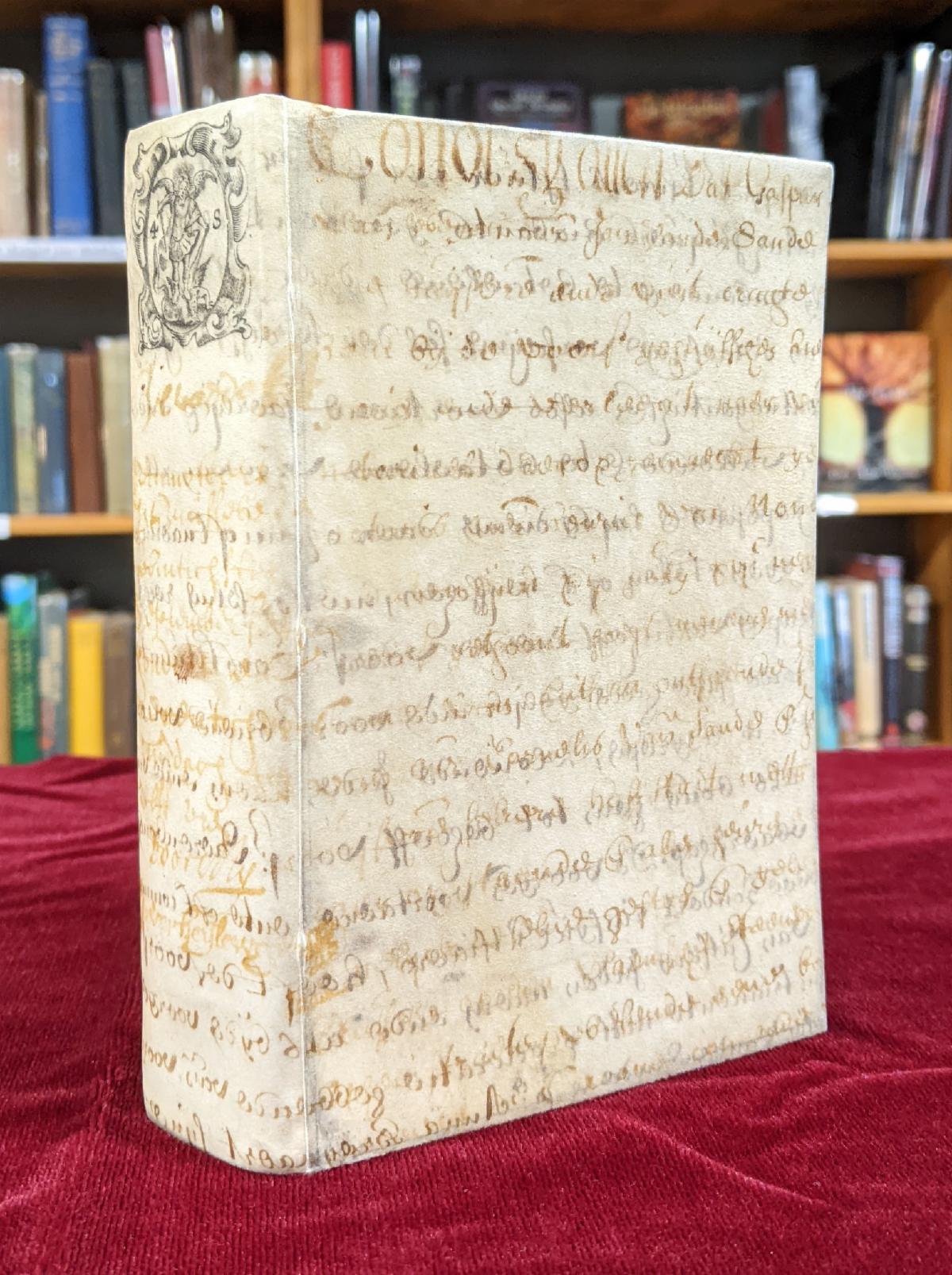
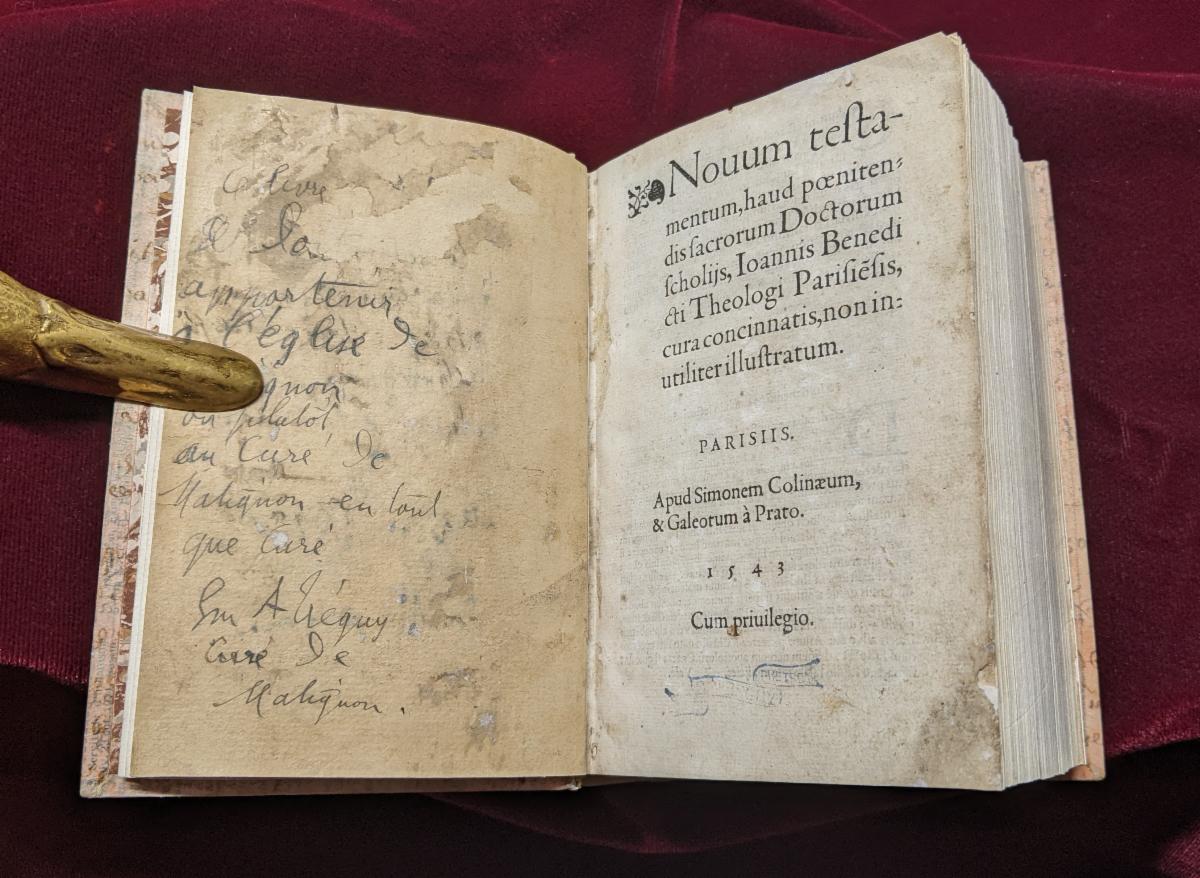
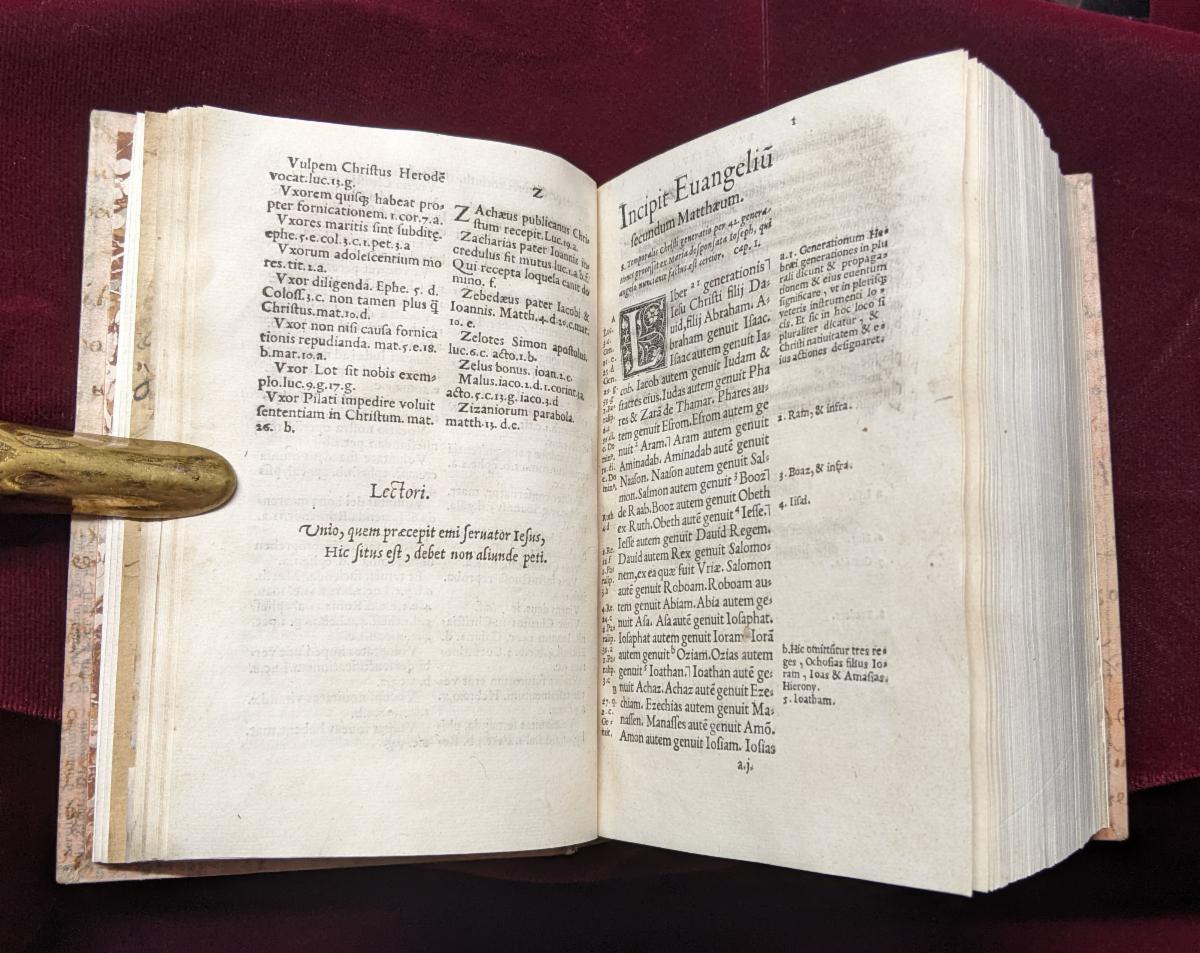
When I hold our 12mo Parisian Latin copy of a 1543 New Testament, Novum Testamentum, poenitendis factorum Doctorum scholiis…etc., I find myself pondering the nature of the days of the papermakers, typesetters, printers and binders who made it. A heavy leaf at the front identifies this as a volume from the 14th century-built Eglise [Notre-Dame] de Matignon, but it’s hard to begin to reconstruct its 22-generation journey to us here and now. And how imagine the effect it had on those persons? It is a strange honor to hold this item that has survived so many parents and their grandchildren. Like preserving land, preserving books depends on a sucession of caring stewards. It only takes one person to ruin.
This book was rebound in the modern era with gestures of historicity informing a skilled but possibly too cute binder. The binding is of translucent “vellucent” japan velum with double layering of indiscernable Latin script (one forward, the other reversed) and an attractive black stamped image of St. Michael on the spine. The marbled endsheets would look correct in a late 19th century British book but…alas. This nearly 500-year old New Testament could be yours for $900
|
|
Receive 20% off when you purchase during March & April
|
|
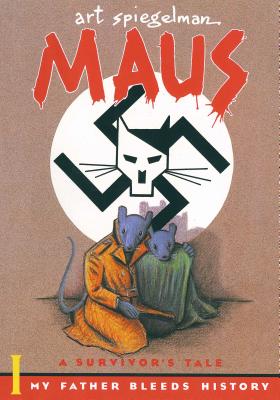
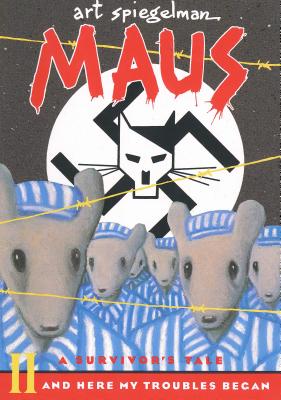
MAUS: A SURVIVOR'S TALE
BY ART SPIEGELMAN
|
|
Pantheon Books
Paperback
Sale price $13.56
Pantheon Books
Paperback
Sale price $13.56
|
|
Maus is widely credited as one of the first comics to be taken seriously by academics, and to challenge the public's popular conception of comics as cheesy genre trash. Spiegelman's artful blend of visual symbolism, personal narrative, and history defies genre and demands dissection. While Spiegelman's influence on the medium cannot be overstated, Maus is often written about as an anomaly that elevated a supposedly juvenile art form. I maintain Maus is not effective in spite of being a comic, but because it is a comic.
The way comics, and Maus in particular, are structured engages the mind in a way that is totally unique to the medium and requires active participation from the reader. In comics, the negative space between panels is called, “the gutter.” The gutter does more than simply divide one frame from the next; it exists as a liminal space in the reader's mind that prompts them to fill in what happens between panels. When Spiegelman transitions from interviewing his father, to recreating his father's experiences, the reader is forced to pause and readjust their perspective accordingly. Maus simultaneously offers a first and second hand account of the Holocaust. By tying his father's memories to his own depiction of them in the present day, Spiegelman also ties the events of the Holocaust to the present day in the reader's mind, showing the two are intrinsically connected. These shifts in perspective occur seamlessly; panels often bleed into each other in a skillful manipulation of time and space, the gutter giving the reader room for inference while allowing them to effortlessly follow the narrative thread.
The pairing of words and images also layers meaning in a way unique to this art form. Visual arts, of course, have a language all their own, and the visual symbolism in Maus is one of its greatest strengths. One of the things that makes Maus so accessible to younger readers is its usage of immediately recognizable cat and mouse imagery. Though Spiegelman's exploration of political power dynamics, identity, and nationalism is by no means facile, the cat and mouse iconography condenses these broader themes into a visual metaphor that can be understood before a single word has been placed on the page. Most striking to me is Spiegelman's inclusion of masks at key points. At one point, Spiegelman draws himself in his artist's studio, reflecting on the unexpected success of the first volume. Here, he does not draw himself as we've seen him before, with a mouse head. He draws himself wearing a mouse mask, a subtle but significant difference that raises questions both about identity and whether art can or should be truly representative of the life it imitates.
Another excellent display of Spiegelman's artful questioning of representation and identity comes when his father recounts his time at Auschwitz. While the prisoners line up to be counted, a man steps out of line, claims to be German, and begs for mercy. In one panel, Spiegelman draws him as a mouse. In the next panel, he is depicted as a cat. Cat or mouse, German or Jew, neither Spiegelman, his father, nor the officers at Auschwitz could tell, and the man is beaten just the same. In the span of just two panels, Spiegelman is able to articulate the oft overlooked fact that under fascism, no identity remains safe for long, and no matter who you are or what privilege you hold, your life will be deemed just as disposable given enough time.
While Maus has long been upheld as a classic, I'm sure you know as well as I do that in recent months, public interest has skyrocketed following a Tennessee school board's unanimous decision to remove Maus from their curriculum. This decision has unsurprisingly evoked nationwide outrage. In the wake of modern-day fascist movements and widespread acceptance of white supremacist ideology, it is deeply disturbing to consider educators would choose this particular climate to challenge one of the most seminal works of Holocaust literature, and it doesn't read as a coincidence. Luckily for Maus, there’s one thing many Americans seem to agree on: it really pisses them off when a book gets challenged or banned. Sales for Maus have seen an unprecedented uptick.
Granted, I am not an educator, nor do I have children. I am a reader who was once a child myself, however, and it feels almost laughable to suggest a Holocaust narrative is too violent or vulgar. The collective trauma of genocide should be hard to look at, and any retelling of history that would seek to sanitize this trauma is at best effectively useless, and at worst, fascist propaganda. Whether you choose to examine history or not, it still has lasting repercussions, and trauma, whether personal or intergenerational, can never truly be erased, only obscured. You can choose to look away, but the monster remains.
* * *
I owe an enormous debt to Scott McCloud's 1994 graphic work, Understanding Comics, which completely blew my mind, and gave me a whole new appreciation for a medium I already loved. After nearly 30 years, it's still an invaluable resource to anyone who cares about comics, and feels as fresh and funny as anything published today.
While you're checking out Maus, I also recommend you seek out Rebecca Hall's graphic history and memoir, Wake: The Hidden History of Women-Led Slave Revolts. Her book also examines intergenerational trauma, history, and representation, and is a stunning piece of research and art.
|
|
Click here for our April events newsletter.
We host both virtual and in-person events, and we look forward to seeing you soon.
|
|
Come visit us!
SUNDAY 12-5
MONDAY-THURSDAY 10-8
FRIDAY & SATURDAY 10-9
|
|
Can't make it to the store?
Support your local indie from home!
|
|
Order by phone or online, then pick up at the store or the curb!
We also ship!
|
|
Give us a call at 801-328-2586
|
|
Thanks for supporting your local, independent bookstore!
|
|
Store hours: Sunday 12PM-5 PM | Monday-Thursday 10 AM-8 PM | Friday & Saturday 10 AM-8 PM
|
|
|
|
|
|
|