Ohio Water Resources Center Newsletter |
|
The anonymous peer review process is an essential step in the scientific process for both research manuscripts and grant applications. To properly evaluate proposals to the Water Resources Research Institutes’ annual 104(b) and 104(g) programs, the Ohio WRC depends on peer reviewers. Having qualified peers reviewing proposals helps the Center invest wisely in water resources research in Ohio and is an important input in our decision process to recommend funding or decline a proposal. A successful peer review process relies on researchers who are willing to share their time and expertise generously. For our 104(b) program, we solicit reviews from respected water resources experts throughout the state. With years of experience and the latest knowledge, these reviewers can judge the merits of proposals and provide constructive feedback to enable proposers to strengthen their projects.
Participating in the review of grant applications provides many benefits. Reviewers gain insight into the peer review process of the funding agency and understanding the expectations of the funder can be helpful in submitting stronger proposals in a future funding cycle. You may also be exposed to new ideas throughout the process that can be the seed to your next research hypothesis. Being exposed to other researchers’ proposals first-hand can lead to improvement in proposal writing skills by comparing aspects of weaker and stronger proposals.
The Ohio WRC invites qualified reviewers to assist with external peer reviews of proposals submitted to USGS 104(b) and 104(g) programs. Recognizing the many demands on one’s time, we limit the number of requests that we make to any individual. We welcome you to learn more about our Center, our review process, and opportunities to be a part of our review process.
If you are interested in being a reviewer, or want to recommend a colleague, please send us an email at OhioWRC@osu.edu. On behalf of Ohio WRC and the USGS 104 program, we thank you for your help.
|
|
Join us for the Ohio WRC-WMAO Luncheon Seminar on August 18th |
|
Storm Outfall Inspections, Lessons Learned, Changes Made
By Joseph R. Reitz, P.E., M. ASCE, CPESC, CESSWI
Public Works Director, City of Avon Lake
The City of Avon Lake on the shoreline of Lake Erie has over 23 storm outfalls directly to the Lake and three natural waterways leading to Lake Erie. Access, conditional and maintenance of these outfalls is important due to the many different tributaries the City oversees. This presentation will present the challenges the City has faced, including during new construction as we are still a growing suburb. This presentation will also discuss how we have improved our inspection techniques and where we are moving forward.
Register for the webinar here. August 18, 2021, 12:00 PM to 1:00 PM
|
|
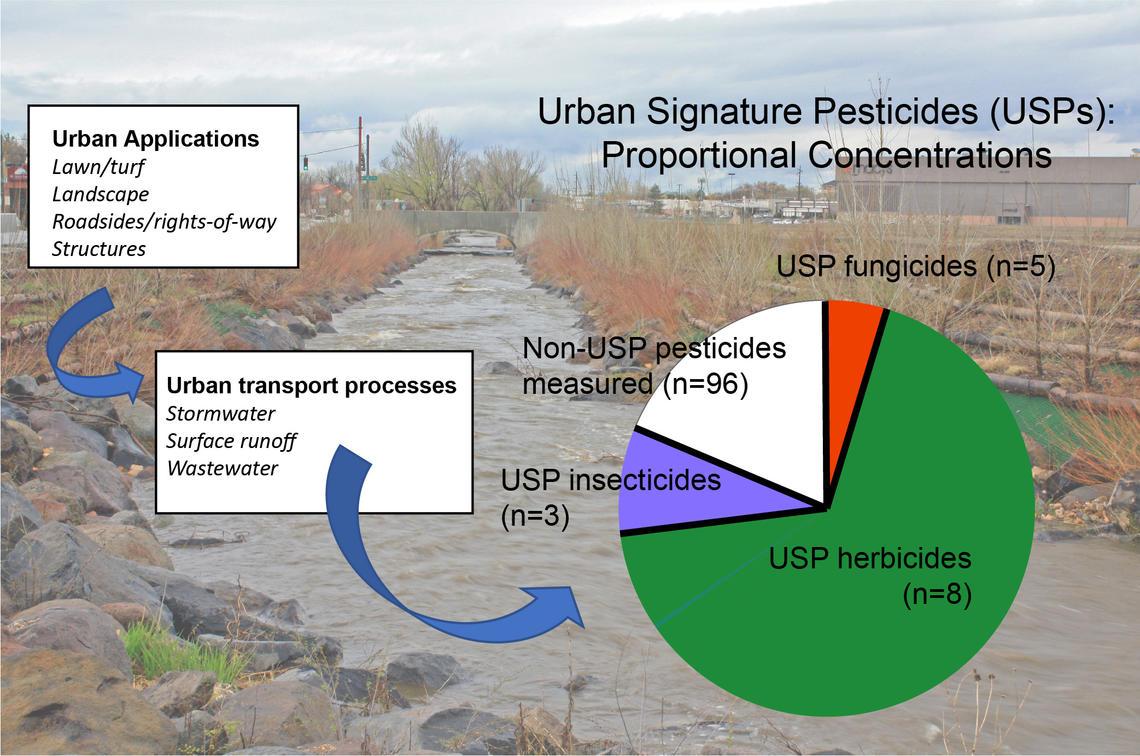
A new USGS study reports that 16 dissolved pesticides were consistently detected in small streams in 16 urban centers across five regions of the United States. These 16 pesticides can be considered as "urban signature pesticides" (USPs) that are common in small urban U.S. streams. The USPs represented some of the highest concentrations and detection frequencies of pesticides detected in urban streams within these five regions.
|
|
Of 108 pesticides analyzed, 16 urban signature pesticides (USPs) were consistently detected in small urban streams. USP concentrations, the number of pesticide compounds present, and potential toxicity associated with pesticides increased with the degree of urbanization in the stream basin. Statistically, pesticide concentrations were better explained by the amount of urbanization in the stream basin than by the region, reinforcing the concept of an urban pesticide signature. However, USP concentrations and frequency of occurrence did vary by region. Concentrations and frequency of occurrence were generally higher in the Midwest, Southeast, and Northeast for insecticides and fungicides, and in the Midwest and Southeast for herbicides.
Potential toxicity at urban sites was driven primarily by 3 of the 16 USPs: the insecticide imidacloprid (for invertebrate toxicity), the herbicide diuron (plant toxicity), and the fungicide carbendazim (fish toxicity). The severity of potential toxicity varied by region, urban center, and type of aquatic organism. Overall, pesticide concentrations were estimated to be toxic to invertebrates in 50% of urban streams across the five regions, compared to 3% of streams for plants and less than 1% of streams for fish.
The results identify for the first time the large degree of commonality in urban pesticide contamination across time and space in small urban U.S. streams. The suite of USPs identified here would make a logical core of target analytes for studies monitoring dissolved pesticides in urban streams, which could be supplemented as needed with other pesticides to meet local objectives.
|
|
Via Ohio Capital Journal, July 5, 2021
Via Great Lakes Now, July 6, 2021
Via Governor.Ohio.gov, July 7, 2021
Via The Associate Press, July 8, 2021
Via The Washington Post, July 11, 2021
Via Cleveland Scene, July 12, 2021
Via The Columbus Dispatch, July 16, 2021
Via The Columbus Dispatch, July 18, 2021
Via Ohio Capital Journal, July 19, 2021
Via US EPA, July 21, 2021
Via Wall Street Journal, July 25, 2021
|
|
Have a news article you'd like us to feature in our Newsletter? Email us at OhioWRC@osu.edu!
|
|
National Priorities: Water Innovation, Science, And Engagement to Advance Water Reuse Request for Applications (RFA) |
|
The U.S. Environmental Protection Agency (EPA) is seeking applications for research to accelerate water innovation that advances clean and safe water reuse goals, promotes better understanding of the Nation’s water and wastewater treatment and infrastructure, and enhances the availability and efficient use of water resources through water reuse. This RFA is intended to address multiple water reuse sources and applications that support national efforts to reduce technological and institutional barriers for expanded water reuse. Applications should address the following research areas:
Research Area 1: Science, Technology Development, and Validation for Water Reuse Applications
Research Area 2: Social Science, Information, Engagement, and Organizational Barriers to Water Reuse
For information on eligibility, project specifications, or how to apply, visit here.
|
|
Earth Science Applications: Water Resources |
|
NASA is currently seeking (in-person) reviewers for Earth Science Applications: Water Resources. Signing up does not commit you to serve, nor will NASA be obligated to invite you to serve on a review panel. If you are a funded team member on proposal to a given panel you will not be able to serve on that review panel, but you may be able to serve on another in the future. SMD recognizes and supports the benefits of having diverse and inclusive scientific, engineering, and technology communities and fully expects that will be reflected in the composition of peer review panels. Fill out the application form here, where you may identify whether you work or study at a minority-serving institution.
|
|
UCOWR Journal of Contemporary Water Research and Education |
|
Universities Council on Water Resources (UCOWR) is interested in publishing research resulting from 104b and 104g grants in the Journal of Contemporary Water Research and Education (JCWRE). JCWRE is published three times per year (April, August & December) and is available on Wiley Online Library. Manuscripts may be submitted at any time, but should be submitted by October 15 to be considered for the April issue; February 15 for August; and June 15 for December. More information about JCWRE, including author guidelines, can be found here.
|
|
Maumee Watershed Nutrient TMDL Project |
|
Ohio EPA's second outreach module on Steps 1 and 2 of the Maumee Watershed Nutrient Total Maximum Daily Load (TMDL) Project is now available for viewing and describes the process for submitting comments on the material presented. The module is available for viewing here. The public comment period ends at 5:00 p.m. Monday, August 9, 2021. For more information about this project, visit here. If you would like to receive notifications on the development of TMDL projects, please subscribe here to subscribe.
|
|
Environmental Regulations for Businesses in your Community |
|
Many environmental regulations affect businesses in your community. Ohio EPA regulates sources of air pollution, waste handling, wastewater and storm water discharges, and more. This webinar will cover environmental regulations affecting both large and small businesses in your community, and explain Ohio EPA's permitting, inspection and enforcement procedures. The main topics are Air Pollution Control Regulations, Surface Water Regulations, Solid and Hazardous Waste Regulations, and Ohio EPA's Compliance Assistance Services. The webinar is Thursday, August 12, 2021, 10:00 a.m. - 11:00 a.m. (EST). Register here.
|
|
Interested Party Release - Updating Outdated Modes of Communication |
|
Ohio EPA has released interested party drafts of various rules in the Ohio Administrative Code (OAC). In a joint rulemaking effort, the Lieutenant Governor's office and Ohio EPA have identified instances where outdated modes of communication are required or with the requirement to submit multiple copies of a document. To reduce adverse impacts and provide modern options, Ohio EPA is releasing drafts containing only amendments to those instances. Ohio EPA welcomes comments on the proposed rules. You may view the drafts rules, interested party fact sheet, and Business Impact Analysis (BIA) on each division's rules page provided below. Comments may be submitted to Mandi Payton, amanda.payton@epa.ohio.gov, through August 13, 2021.
|
|
Final Guidance for Determining when Source and Treatment Changes Trigger Optimal Corrosion Control Evaluation |
|
DDAGW has finalized the Guidance Document: ENG-9119-GD: Guidelines for Determining when Source and Treatment Changes Trigger Optimal Corrosion Control Evaluation. The purpose of this document is to provide guidance on when a source or treatment change in a public water system (PWS) requires the evaluation of optimal corrosion control treatment (OCCT). Click here to view the effective ENG-9119-GD Guidance document under the Water Quality Parameters and Corrosion Control, as well as all other effective Policy and Guidance documents.
|
|
UCOWR Virtual Roundtable Discussions |
|
September 1, 2021 - December 2021• Virtual
The Universities Council on Water Resources (UCOWR) presents their Fall 2021 Virtual Roundtable Series. Join UCOWR for lively discussion and make new connections in the water arena. To RSVP send an email here. The first Roundtable will feature Coastal Water Issues, moderated by Mike O’Driscoll, East Carolina University.
|
|
Understanding Algal Blooms: State of the Science Conference |
|
September 8, 2021 • Stranahan Theater Great Hall, 4645 Heatherdowns Blvd, Toledo, OH
The 6th annual Understanding Algal Blooms: State of the Science conference will highlight current scientific knowledge related to algal blooms. Research and outreach leaders will present findings from recent studies and identify important areas of uncertainty.
|
|
October 16-20, 2021 • McCormick Place, Chicago, IL & Virtual
The 94th Annual Water Environment Federation Technical Exhibition & Conference is planned for 2021! The WEFTEC Program Committee is planning for an in-person event if conditions allow. WEF will continue to monitor the situation. What we do know about WEFTEC 21 is that it will not be exactly like previous events and will be incorporating a limited virtual component.
|
|
November 3-4, 2021 • Crowne Plaza Columbus North-Worthington, Columbus, OH
Water is a dynamic force of nature. It literally ebbs and flows — in this direction and that one. Water is often changing when, where, and for how long it winds through our lives but all the while, it remains a constant aspect in the world we live. The Water Management Association of Ohio (WMAO) is hosting its 50th conference in 2021. Originating before the Clean Water Act was passed into law, WMAO has focused on Ohio's water resources and like water, has been consistently active and ever-changing in bringing professionals together for 5 decades to discuss and learn about the water issues of the day. Deadline to submit an abstract for poster presentation is October 15, 2021.
|
|
Have an event you'd like us to feature in our Newsletter? Email us at OhioWRC@osu.edu!
|
|
Email: OhioWRC@osu.edu
Phone: 614-292-2807
Website: https://wrc.osu.edu/
Address: 311 Hitchcock Hall
2070 Neil Avenue
Columbus, OH 43210
|
|
|
|
|
|
|
|