|
The past two weeks have been interesting.
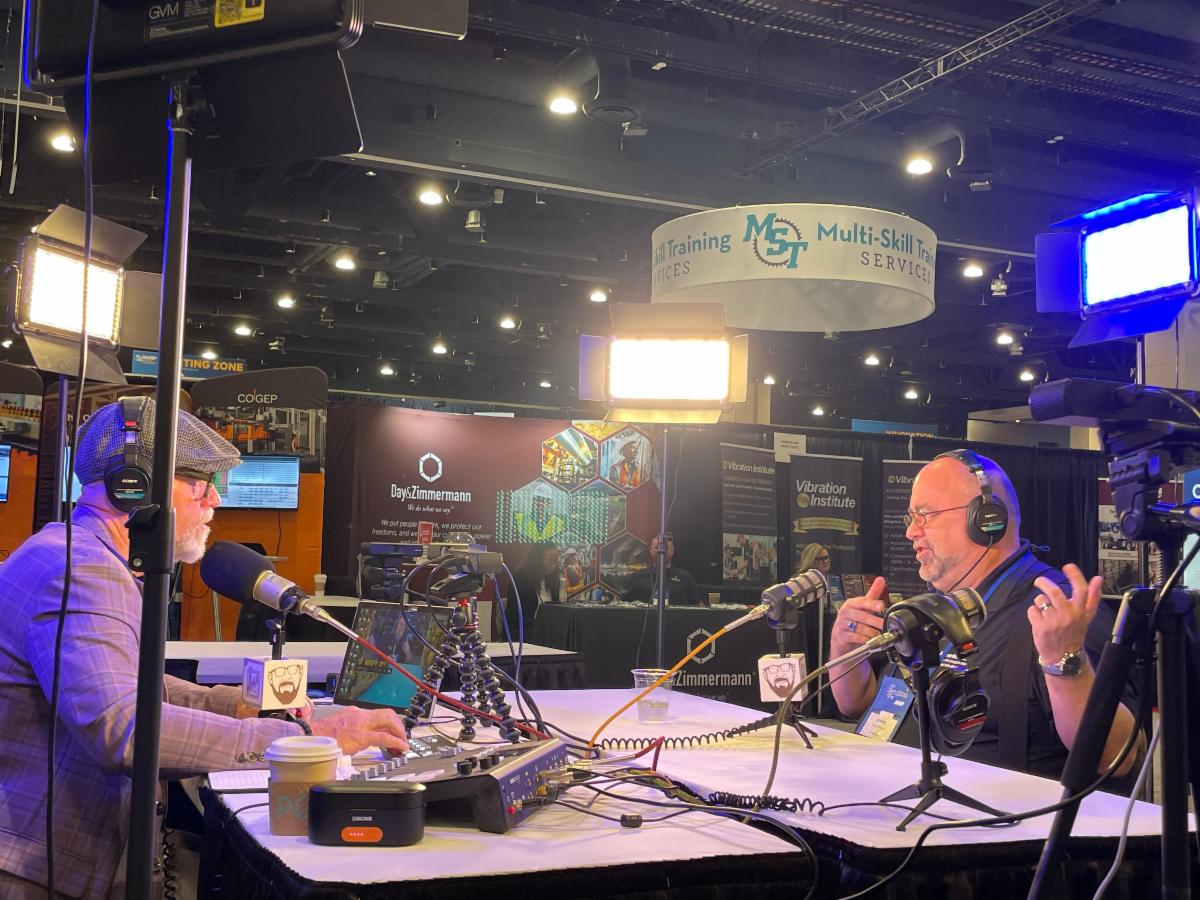
Actually, interesting may not be the appropriate word. Frustrating, entertaining, occasionally encouraging, and somewhat disturbing might be better descriptions. Between conversations with customers, ongoing research projects, developments in artificial intelligence, and some rather remarkable financial projections, I've found myself questioning where parts of our reliability and maintenance industry are heading. This culminated in this week's Chaos and Caffeine podcast, Episode 67, where Silus Barnaby and I were supposed to have a humorous discussion about AI and predictive maintenance. Instead, I went completely off-script, and we ended up conducting something resembling a root cause failure analysis on the industry itself. (See the link to the podcast below).
One of the subjects that caught my attention was the projected market for predictive maintenance technologies. Having spent more than four decades in this industry, I've watched the adoption of vibration analysis, electrical signature analysis, motor current signature analysis, ultrasound, thermography, and numerous other technologies. Adoption has traditionally been relatively slow, primarily because reliability and maintenance organizations frequently struggle to justify investments to senior management. This makes some of the current projections particularly interesting.
Consider two commercial market research organizations. In May 2025, KBV Research projected that the global predictive maintenance market would reach $94.21 billion by 2032, representing approximately 29% compound annual growth. In September 2026, 360iResearch projected that the same broadly described market would reach $30.14 billion by 2032, representing approximately 13.31% annual growth. The companies reported baseline estimates of $12.47 billion in 2024 and $12.56 billion in 2025, respectively. These forecasts differ by approximately $64 billion, or more than a factor of three, for the same target year. (kbvresearch.com)
Now, I'm an industrial engineer by education, with a doctorate in technical business management, and I've spent considerable time teaching and applying statistics, modeling, and research methods. When I see two projections that far apart, my first question isn't which one is correct. It's how they developed the numbers.
Market forecasts generally start with historical estimates, company revenues, published financial information, industry surveys, and interviews with suppliers and customers. Researchers may use top-down models that allocate portions of larger markets or bottom-up models that aggregate anticipated purchases across customer groups. They then apply assumptions about adoption, pricing, technology replacement, economic conditions, and growth. The results are often reconciled through a process called data triangulation. None of these methods is inherently inappropriate. In fact, they're commonly used in legitimate market research. The problem comes when assumptions about what customers might purchase become projections presented with the appearance of measured certainty. (gartner.com)
KBV Research publicly describes using government records, financial filings, surveys, and interviews with industry experts, including sales representatives and marketing managers. Its $94 billion forecast also includes approximately $47.58 billion in projected hardware revenue, not simply AI software and subscriptions. 360iResearch describes source tracking, numerical modeling, statistical checks, AI-assisted research, and analyst review. To its credit, 360iResearch explicitly acknowledges that estimates are not observed facts and that analyst review does not constitute independent verification. (kbvresearch.com)
This brings us to something important. I could not locate publicly available independent audits validating either specific forecast, nor a documented historical record demonstrating how accurately these organizations predicted comparable markets. That doesn't mean their work is incorrect. It means the publicly available evidence is insufficient to independently verify their conclusions. There are established standards for market research, including the recently updated ISO 20252:2026, which addresses research processes and service requirements. However, following a documented research process is not the same thing as independently verifying a prediction of future market revenue. (iso.org)
There are several ways such large differences can develop. Market definitions may include different combinations of sensors, monitoring equipment, software, services, and existing technologies being repackaged as AI solutions. Researchers may assume different adoption rates, subscription costs, equipment replacement cycles, or customer spending. And compound growth magnifies relatively small annual differences into enormous numbers over seven or eight years. Without the detailed models, we cannot establish precisely which assumptions explain the $64 billion difference. That is exactly why those assumptions matter.
My concern is what happens when these numbers move into investor presentations, marketing materials, and industry conferences. A modeled estimate becomes a projected opportunity. The projected opportunity becomes an anticipated market. Eventually, people begin treating the number as though the customers have already committed to spending the money.
Apparently, we've developed a system where we can predict $95 billion in sales with considerably more confidence than we can predict when a bearing will fail.
There's some humor in that, although I'm not sure the investors would appreciate it.
Meanwhile, what is actually happening in maintenance organizations? One encouraging example comes from MaintainX's 2026 State of Industrial Maintenance report, which surveyed 2,234 maintenance and operations leaders. The company reported that 58% of respondents were using AI, while 75% reported measurable returns within six months. However, 79% reported that unplanned downtime had remained unchanged or increased, and 39% reported increasing downtime costs. These are self-reported survey results rather than independently audited outcomes, and they don't establish that AI caused the problems. Nevertheless, I appreciate a technology company publishing findings that raise uncomfortable questions about whether adoption is producing corresponding reliability improvements. (getmaintainx.com)
This goes directly to something we've discussed repeatedly at MotorDoc. Installing sensors on a machine that continually experiences bearing or seal failures does not necessarily constitute predictive maintenance. If the organization hasn't determined why those failures are occurring, it may simply be monitoring the next failure. Root cause failure analysis, reliability-centered maintenance, failure modes and effects analysis, and appropriate engineering practices should help determine which technologies are necessary. Technology selection should be driven by the failure mechanisms and operating requirements, not by whichever product happens to be featured in the latest sales presentation.
Over the past two weeks, we've also encountered situations where customers have struggled with equipment problems for months or years. In some cases, the answers were available in equipment documentation, established standards, and fundamental electrical measurements. We were able to narrow the problems and identify practical corrective approaches in a fraction of the time previously spent investigating them. This isn't because we have a magical algorithm. It's because we start with the equipment, the application, the operating conditions, and the engineering principles involved. Sometimes the most revolutionary diagnostic technology is knowing what question to ask.
We've also been examining harmonic-related losses, energy efficiency, and the application of filtering technologies. There are opportunities for meaningful improvements, but claims about energy savings must be supported by measurements that distinguish actual reductions in power consumption from changes in current, apparent power, or harmonic distortion. This is where my background in measurement and verification becomes particularly important. Estimates have their place, but they must be identified, validated, and accompanied by appropriate uncertainty. You cannot simply manufacture missing measurements because the resulting graph looks better.
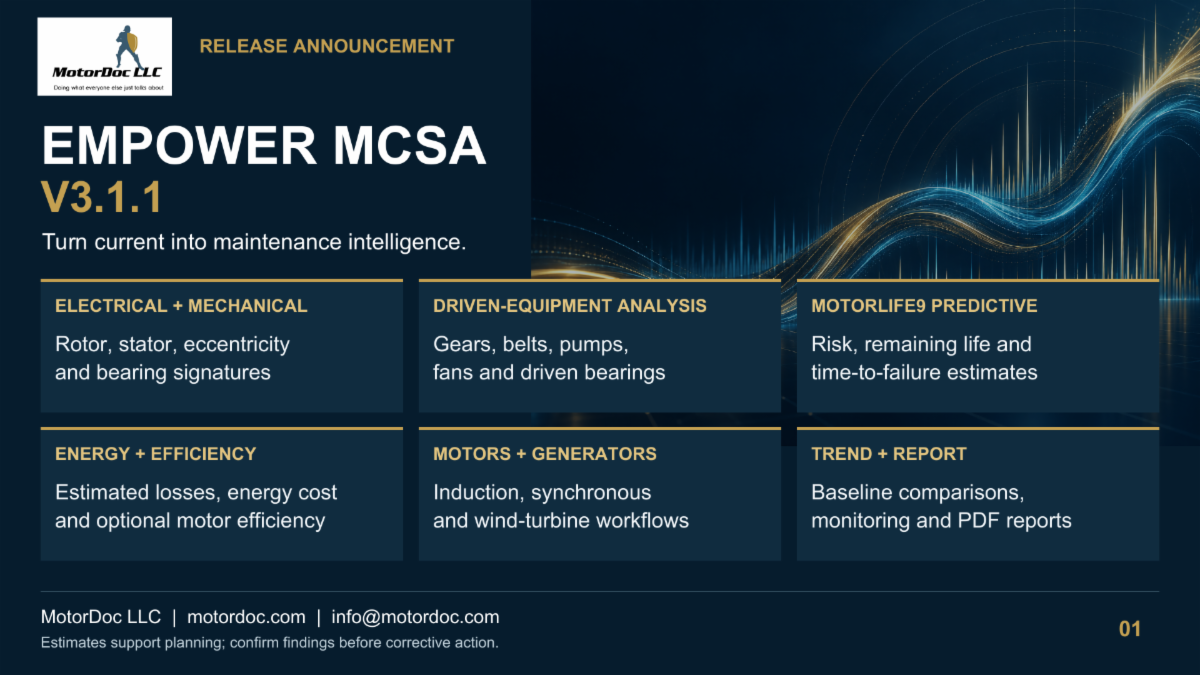
The same principle applies to artificial intelligence. At MotorDoc, we're actively developing and implementing AI-assisted technologies in EMPATH and EMPOWER. We're also applying related principles through HRI Labs. I recently completed the IEEE CertifAIEd professional certification because responsible AI development, transparency, accountability, and human oversight matter to our work. AI has significantly improved our productivity, including research, software development, engineering analysis, and investigations. However, I have absolutely no intention of abandoning engineering judgment or verification simply because an algorithm produces an impressive-looking answer.
In fact, one of our recent discussions concerned AI systems that automatically reconstruct missing or questionable maintenance data. There are legitimate statistical methods for estimating missing values, but estimated data must not be confused with actual measurements. If an algorithm fills in a missing signal during a developing failure, it may inadvertently conceal the very condition we're trying to identify. Human-in-the-loop evaluation is not an inconvenience to be eliminated. It's part of responsible engineering.
All of this leads to another subject that is extremely important to me: research integrity. I'm involved in several ongoing industry studies, and we continue to emphasize that results must be determined by the evidence, not by the financial interests of technology providers, sponsors, or investors. Favorable and unfavorable results are equally important. If a diagnostic method produces false positives, false negatives, or inconclusive findings, we need to understand why. Publishing only successful cases gives an incomplete picture of actual performance.
That brings me to our upcoming MotorDoc and Chaos and Caffeine case-study contest, which supports two research efforts involving electrical signature analysis and motor current signature analysis. We're looking for documented industrial and utility experiences that include both successful and unsuccessful diagnostic outcomes, with sufficient supporting evidence to verify the findings. There will be an award involving a MotorDoc MCSA kit for a U.S. participant and a three-day electrical signature analysis course for an international participant. The U.S. winner may choose the course instead of the equipment. Complete contest requirements, eligibility, and submission information are provided elsewhere in this newsletter.
The objective is straightforward. We want real field evidence that helps establish what works, what doesn't, and under what circumstances. That's how diagnostic technologies improve, and it's how our industry should be advancing.
For those who listened to Chaos and Caffeine Episode 67, you heard a rather unscripted discussion between Silus Barnaby and me. He even challenged several of my positions, which I encouraged. That's the point of a meaningful technical discussion. I don't expect everyone to agree with me, and I certainly don't expect my own conclusions to remain unchallenged.
I'm not opposed to investment, technology development, artificial intelligence, or commercial success. I work with excellent companies, including some investor-owned organizations, that genuinely understand engineering and their customers. What concerns me is allowing commercial expectations to determine technical conclusions before the research has been completed.
We need better technology, better research, more transparency, and a renewed emphasis on solving the customer's actual problems. That includes demonstrating real economic benefits rather than relying exclusively on theoretical cost avoidance or increasingly optimistic market forecasts.
As Silus observed at the conclusion of our podcast, a colorful dashboard isn't a diagnosis, a prediction isn't a repair, and a subscription definitely isn't a reliability strategy.
I couldn't have said it better myself.
In the meantime, we'll continue applying established engineering principles, investigating failures, developing useful technologies, and reporting what the evidence actually demonstrates.
Even when the results aren't particularly convenient.
MotorDoc LLC
Doing what everyone else just talks about.
www.motordoc.com
Research sources referenced in the editorial
These original publications are useful for readers who want to examine the underlying information:
KBV Research: Global Predictive Maintenance Market Forecast, May 2025. Projects $94.21 billion by 2032.
https://www.kbvresearch.com/predictive-maintenance-market/
360iResearch: Predictive Maintenance Market, Global Forecast 2026–2032. Projects $30.14 billion by 2032.
https://www.360iresearch.com/library/intelligence/predictive-maintenance
KBV Research Methodology: Primary Research, Secondary Research, and Data Triangulation.
https://www.kbvresearch.com/about/
360iResearch Methodology: Research Methods, Source Tracking, Modeling, and Analyst Review.
https://www.360iresearch.com/methodology
ISO: ISO 20252:2026, Market and Opinion Research Requirements.
https://www.iso.org/standard/88881.html
MaintainX: 2026 State of Industrial Maintenance Report.
https://www.getmaintainx.com/state-of-industrial-maintenance-report
NIST: Maintenance Costs and Advanced Maintenance Techniques in Manufacturing Machinery, 2021. A useful independent reference for evaluating maintenance strategies and their economic implications.
https://www.nist.gov/publications/maintenance-costs-and-advanced-maintenance-techniques-manufacturing-machinery-survey
Doing what everyone else just talks about.
Want to keep up in advance, make sure to follow us on LinkedIn, which is the only social media we're using.
MotorDoc: https://www.linkedin.com/company/motordoc
My linkedin: (4) Howard W Penrose, PhD, CMRP, CEM, CMVP | LinkedIn. The link is: Subscribe on LinkedIn https://www.linkedin.com/build-relation/newsletter-follow?entityUrn=7362131366408278016 . You may want to follow MotorDoc while you’re at it!
For more information see us at https://motordoc.com or https://motordocai.io or contact us at info@motordoc.com, or by replying to this newsletter.
Sincerely,
Howard W Penrose, Ph.D., CMRP, CEM, CMVP
President, MotorDoc LLC
MotorDoc LLC is a registered Veteran Owned Small Business
|