The PRSAR Newsletter!

Where the science in the lab and the science of search come together

 and

Some Updates on the great volunteers at PRSAR

PEACE RIVER K9 SEARCH & RESCUE • NEWSLETTER FEATURE

First on Scent

Why Tracking and Trailing Dogs Lead the Search


The first resource out of the truck — and the one that aims the entire operation.


Abstract

When a person goes missing, the single most valuable piece of information a search can obtain early is not the subject’s location but the direction in which they traveled. Establishing direction is the defining role of the tracking and trailing dog, and it is why these K-9 teams are so often the first resource a well-run search deploys. Working from the point last seen — before the scent degrades and before other searchers contaminate the scene — a single dog and handler can confirm the subject’s presence, recover the line they took, and collapse a 360-degree problem into a focused search direction, aiming every resource that follows. This paper distinguishes the two disciplines, tracking and trailing, that share that mission; examines the biology and physics of human scent that make the work possible; and explains why deploying these teams first, and protecting the scene for them, is among the most consequential decisions an incident commander makes.


1. The Clock Starts Without You

The moment a person goes missing, an invisible clock begins to run — and it runs against the search. With every passing hour, the subject travels farther, the ground that must be covered grows geometrically, and, most important to a dog, the scent the subject left behind begins to thin and scatter. Scent is never richer, and a trail never more intact, than in the first hours after someone walks away. Those early hours are not the time to gather and plan at length; they are the time to put a nose on the ground. That single fact is the reason a tracking or trailing dog is so often the first resource a well-run search deploys.


2. The Question Every Search Hinges On: Direction of Travel

Before a command post can decide where to send ground teams, ATVs, drones, or air support, it must answer one question: which way did the subject go? In search and rescue, this is called the direction of travel, and early in a search, it is worth more than almost anything else. A single tracking or trailing dog, started at the point last seen — the last place the subject was actually observed, or the last spot a clue places them — can confirm the person was there, find the line they took, and begin following it while the trail is still fresh.


In doing so, that one dog and handler transform the search itself. A problem that began as a full 360-degree circle of possibilities collapses into a focused direction. Instead of guessing, the incident commander can commit resources with purpose, saturating the line the dog indicates and sparing the manpower that would have been wasted on the wrong ground. Deployed first, the dog does not merely look for the subject — it aims the entire operation. No other single resource on a search can do as much, as fast, with as few people.


3. Tracking or Trailing? Two Disciplines, One Goal

The public tends to lump every nose-down dog together, and even veteran handlers argue about where one discipline ends and the other begins. PRSAR draws a distinction worth understanding.


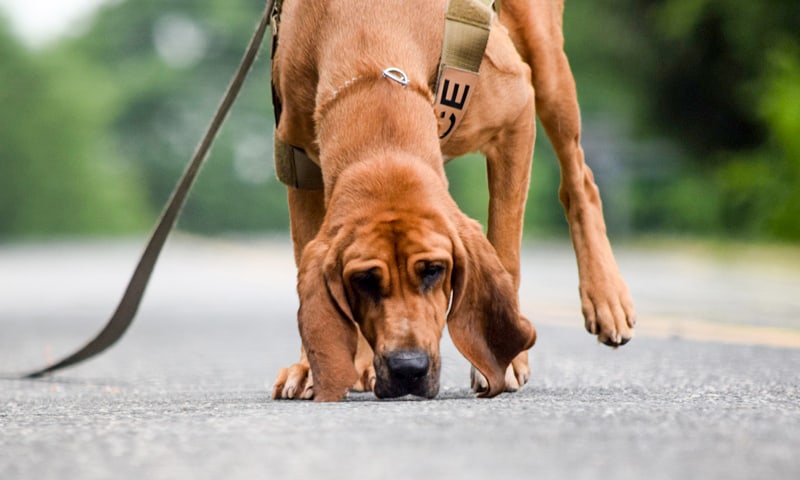
A true footstep tracking dog follows ground-disturbance odor — the scent released when a foot crushes vegetation and presses soil, bruising plants and stirring the earth and the microorganisms within it. The tracking dog is not primarily hunting the person’s body scent at all; it is following the chemical signature of the disturbance itself, moving deliberately, nose down, from one footfall to the next. The discipline traces back more than a century to pioneers such as Konrad Most, whose patient research into aged trails, cross-tracks, and specialized harnesses produced training tools — the “tracker’s cross” among them — still in use today.

A trailing dog works differently. Given a scent article — an uncontaminated piece of clothing or an object the subject handled — it builds an “odor image” of that one individual and follows that specific person’s scent wherever it has come to rest. Because it is keyed to a single human signature, a trailing dog can cut through a crowded environment, work pavement and urban ground where there is little vegetation to disturb, and stay with a scent that has drifted well off the path the person actually walked. These dogs are often called scent-discriminating or scent-specific for exactly that reason.


The two have different strengths. A footstep tracker can struggle across asphalt or in heavily contaminated areas, but its handler can often read its body language cleanly and tell at a glance when the dog is on the track or off it. A trailing dog thrives in contamination, cities, and shifting terrain where scent has moved. Yet the distinction matters less than the mission they share, which is identical: given the scent of one person, follow a continuous path to that person. This is why many U.S. search organizations simply group the work together as “tracking and trailing.”


4. The Scent Article: Where It Begins

For a scent-specific dog, everything depends on one thing: a clean scent article. Almost anything the subject touched, wore, or kept close can carry their signature — a pillowcase, a hairbrush, a car seat, a worn shirt. But the moment well-meaning hands handle that item, or a crowd of searchers tramples the subject’s last-known location, the picture muddies. Flood the last-seen point with people before a dog has worked it, and you can erase the single best lead in the entire search. A contaminated article or scene can send a dog down the wrong scent entirely. Protecting the article — and holding the well-meaning crowd back until the dog has done its job — is one of the quiet disciplines that separate an effective search from a frustrated one.


5. The Science of Scent

What the dog is actually following is, up close, extraordinary. A human body sheds tens of thousands of dead skin cells every minute — by some estimates, around forty thousand — and each cell rides the air as a microscopic “raft,” carrying with it the skin’s bacteria. It is those bacteria, more than the cells themselves, that brew each person’s distinctive scent. The search-dog literature has long drawn a clean line between these body-borne rafts and the distinct odor released when a footstep crushes plants and disturbs the soil — a framework laid down for search work by William Syrotuck more than half a century ago and still taught today (Syrotuck, 1972). Tracking dogs primarily work the vegetative odor; trailing dogs work the rafts.


The individual signature carried on those rafts is tied to genetics. In controlled trials, trained bloodhounds have readily distinguished unrelated people and related people with more effort, while identical twins — who share an odor type — proved the most difficult of all to tell apart (Lost Pet Research, 2018). It is a vivid demonstration that what the dog smells is as individual as a fingerprint.

Those rafts do not stay put. They drift on the wind, ride thermals, and settle into grass, soil, brush, and walls, pooling in low places and streaming downwind in invisible plumes. This is why a trailing dog may work several yards to the side of the route a person actually walked and still be precisely on their scent. Fresh scent, still airborne, may lift a dog’s head; older scent, fallen to the ground, drops the nose. Air scent is strong but fades quickly; ground scent is fainter but lingers far longer. And the weather rewrites the whole picture constantly — wind moves it, sun and heat lift and scatter it, humidity holds it close, and rain can either preserve a trail or wash it away. Working a dog through those conditions is as much art as science.


6. The Team Is the Unit

None of this works without the human at the other end of the line. A handler must know their dog intimately — when it is in scent and when it has lost it, when its body is saying this way and when it is merely curious, and how to support the dog without accidentally steering it. Scent discrimination at this level is a learned craft that takes years to build and constant training to maintain. The dog brings a nose we can scarcely imagine; the handler brings the map, the strategy, and the discipline to trust the dog when it counts. Neither is a search asset alone. Together, they are.


7. Conclusion: First Paws on the Ground

When the call comes, PRSAR’s tracking and trailing teams are frequently the first boots — and first paws — on the ground. The direction they establish in those opening minutes shapes every decision that follows, which is precisely why these teams train relentlessly to be ready before the phone ever rings. In a discipline where minutes cost ground, and ground can cost lives, being first is not a luxury. It is the mission.


First on scene, first on scent — and pointing the way home.


Bibliography

These are the sources consulted for this article. They are a mix of practitioner and reference material; readers are encouraged to consult the primary studies named within them, and any specific figures should be confirmed against those originals before republication.

Daily Dog Discoveries. “Dog Tracking vs. Trailing.” (2016). Discusses footstep tracking versus trailing and the rate of skin-cell shedding (citing V. Theby).

Family Disaster Dogs (Higgins, A.). “Tracking and Scent Discrimination.” (2020). On scent-discriminating versus non-discriminating detection work.

Lost Pet Research and Recovery. “How Accurate Are Search Dogs? Part 2: Scent Discrimination Dogs.” (2018). Summarizes controlled bloodhound-trailing studies (including Stockham et al., 2004, and Woidtke et al., 2018) on scent-specific discrimination and odor type.

Maui Search and Rescue. “K-9 Teams.” mauisar.org. SAR definitions of tracking, trailing, air-scenting, and human remains detection, and the variation in terminology between agencies.

MESARD. “Tracking vs. Trailing, or How to Teach a Working Dog.” mesard.org. On scent discrimination and the federal (FEMA) typing of teams as scent-discriminating or non-scent-discriminating.

Peace River K9 Search and Rescue (PRSAR). “Types of SAR Dogs.” prsar.org. PRSAR’s working definitions of footstep tracking and trailing dogs, and the historical development of the two disciplines.

Schettler, Jeff. “Trailing versus Tracking: The Keys to Success.” Police1. On trailing, scent discrimination, and the role of the scent article, from a police bloodhound handler and trainer.

VCA Animal Hospitals. “Search and Rescue Dogs.” On air-scenting versus trailing dogs and deployment from the last known point.

“Tracking (dog).” Wikipedia. On canine scent-tracking mechanisms, scent groups, and the distinction between air scent and ground scent.


Suggested Reading

A starting library on scent theory and the tracking and trailing disciplines, from the foundational texts to practical field guides.

Syrotuck, William G. (1972). Scent and the Scenting Dog. Canastota, NY: Arner Publications. — The foundational text on canine olfaction and scent behavior for search work, and the origin of the rafts-versus-vegetative-odor framework that underlies tracking and trailing. Still sold and recommended by the National Association for Search and Rescue.

Pearsall, Milo D., & Verbruggen, Hugo. (1982). Scent: Training to Track, Search and Rescue. Loveland, CO: Alpine Publications. — A classic scientific treatment of how dogs follow a track and how wind, humidity, and terrain shape what a dog can scent.

Tweedie, Jan. (1998). On the Trail. Loveland, CO: Alpine Publications. — A practical, field-oriented guide to scent-specific trailing with the working bloodhound and other SAR dogs.

Rebmann, Andrew J., David, Edward, & Sorg, Marcella H. (2000). Cadaver Dog Handbook: Forensic Training and Tactics for the Recovery of Human Remains. Boca Raton, FL: CRC Press. — A practitioner standard whose chapters on scent theory and scent-cone behavior apply well beyond cadaver work.

National Association for Search and Rescue (NASAR) and the AAFS Academy Standards Board (ASB) consensus standards for SAR and human remains detection canines. — Current guidance on training, certification, and documentation for working SAR K-9 teams.

.

PRSAR K9 SEARCH & RESCUE · TEAM NEWSLETTER

Where the Missing Go: The Science of Lost Person Behavior


Why searchers who know the numbers find people faster

By Michael Hadsell, Instructor & Training Officer


Here is the problem every search begins with. A person who walks away at three miles an hour can, in theory, be anywhere inside a circle that grows every minute. One hour after they were last seen, that circle covers about 28 square miles. Three hours in, it is more than 250. No team in the world can search all of it, and no team should try — because more than fifty years of incident data tell us the subject almost certainly is not “anywhere.” They are somewhere very much like where thousands of people before them have been.

That is lost person behavior in a sentence: individuals are unpredictable, but people in the same situation — the same age, activity, and mental state — tend to behave in remarkably consistent patterns. Learn the patterns, and you shrink the haystack before the first boot hits the ground.


From War Stories to Data

The science started in the 1970s, when William Syrotuck sat down with a few hundred search case files from New York and Washington State and did something nobody had bothered to do: he measured. Among his findings, roughly 60 percent of subjects were within 2 miles of where planning began. Search veterans had always carried hunches like this; Syrotuck turned hunch into arithmetic.

Robert Koester finished the job. Beginning with dementia cases in Virginia in the late 1980s, Koester built the International Search & Rescue Incident Database — ISRID — which today holds more than 145,000 real incidents from around the world, sorted into 41 subject categories. For each category, ISRID reports where people were actually found: how far from the starting point, uphill or down, on a trail or off it, mobile or stationary, alive or not. His book, Lost Person Behavior, puts those tables in every planner’s hands and serves as the backbone of the course our team now teaches.


The Anchor: PLS, LKP, and the IPP

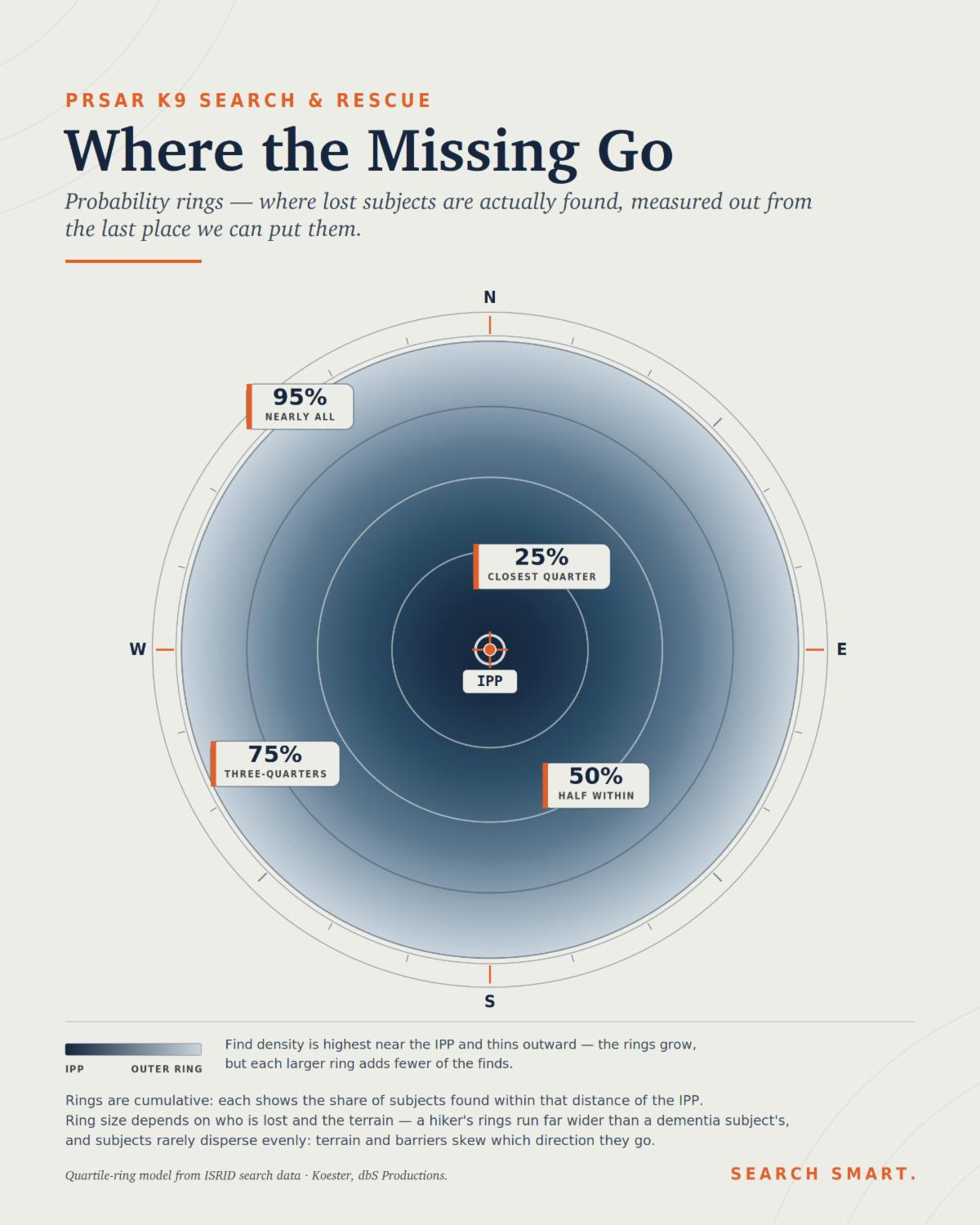
Every statistic in the book is measured from one dot on the map: the Initial Planning Point, or IPP. The IPP is usually one of two things — the Point Last Seen (PLS), where an eyewitness last saw the subject, or the Last Known Position (LKP), the last spot supported by physical evidence such as a footprint, a dropped glove, or a cell phone ping. Establish it, verify it, protect it. Everything that follows is drawn from that dot.


Rings on the Map

Open the tables for your subject’s category, and you get four distances, which planners draw as rings around the IPP. A quarter of past subjects in that category were found inside the smallest ring; half inside the next; three-quarters inside the third; and 95 percent inside the outermost. Only one subject in twenty ever turned up beyond it.

Two warnings come with the rings. First, they are crow’s-flight distances — straight lines on the map, not miles walked. Second, rings prioritize; they never rule out. 5% of subjects are beyond the 95% confidence interval, and the map does not excuse us from thinking. The rings tell us where to spend our first hours, not where to stop.


Track Offset: The Fifteen-Meter Lesson

One ISRID measurement deserves its own explanation, because the name fools people. Track offset has nothing to do with the subject’s footprints. It is simply the straight-line distance from the spot where the subject was found to the nearest linear feature — a road, a trail, a powerline cut, a canal bank. A subject located in a briar patch twelve meters off a dirt road has a track offset of twelve meters.

Why should a searcher care? Because of numbers like this one: among dementia subjects who are not found on the road or trail itself, about half are within fifteen meters of it. Fifteen meters. That subject is invisible to a truck rolling down the road and invisible to a searcher walking the centerline looking straight ahead — and easily found by a team that pushes its eyes fifteen or twenty meters into the vegetation on each side. Track offset is the statistic that tells us how wide a “road search” really has to be, how far our sweeps should reach past the tree line, and why a K9 working the downwind side of a trail covers that hidden band better than any pair of eyes.


Who We Are Looking For

Category drives everything, because a lost hunter and a lost toddler are entirely different search problems. A few of the profiles every technician should carry:

Children behave by age, not by label. Toddlers (1–3) have no concept of being lost; they wander without aim, crawl into cover to escape weather, curl up, and go to sleep — and they rarely answer searchers. Preschoolers (4–6) are more mobile and understand they are lost, but often hide from strangers calling their name or remain silent because they fear punishment. School-age children (7–12) use trails and shortcuts, can cover real distance, and are frequently embarrassed enough to avoid searchers at first.

Hikers stay tied to the trail network and are usually found on or near linear features, often after a wrong turn at a junction. Hunters leave the trail on purpose — their attention is on game, not navigation — and being fit and mobile, they often attempt self-rescue along drainages and field edges.

People with dementia travel in straight lines — the path of least resistance — until briars, a fence, or mud physically stops them. They are usually close to the IPP; they do not call out, and they rarely respond to their name. Koester’s research adds the urgency: roughly half of dementia subjects not found within 24 hours are found dead or seriously injured. A dementia callout is always urgent, at any hour.

Individuals with autism are drawn to water — ponds, pools, canals, retention ditches — and to quiet, low-stimulus hiding places. Drowning accounts for about 91 percent of fatal outcomes after wandering, which is why the first tasking on these searches is always the water, immediately and repeatedly. Nearly half of children with autism will elope at some point, and a wall of shouting strangers can drive a hiding child deeper into cover; quiet tactics and a good caregiver interview find these subjects.

Despondent subjects typically travel only a short distance, favor the interface between two terrain types — a field edge, a tree line, a shoreline — and are often stationary, silent, and within sight or sound of civilization. They may actively avoid searchers, which is one more reason we search as if no one will answer.


Florida Changes the Math

Most published lost-person data relies on mountain and forest searches, so our terrain demands translation. Florida subjects get no elevation cues, and neither do we; palmetto and scrub cut sight lines to a few meters and put subjects on the ground early; water is on the board in virtually every incident, as both magnet and hazard; and heat compresses survivability for the subject — and for our dogs, whose work cycles shrink in a Florida summer. We use the temperate, flat-terrain tables; we expect shorter travel distances in heavy vegetation, and we treat water features as high-probability tasks every single time.


Statistics Start the Search. They Never Finish It.

Lost person behavior is the best first guess in the business — nothing more, nothing less. The rings put our first teams where subjects have actually been found; the profiles tell those teams how to look, and why the Person they are looking for may be ten meters away and silent. But every incident is an investigation, and a single verified clue outranks a thousand incidents in a database. Draw the rings, task the trails and the water, and then let the evidence steer.

Members who want the full treatment — including the written exam and course certificate — should watch the training calendar for the next offering of Lost Person Behavior: Principles & Field Application. Until then: stay safe, and search smart.


Bibliography

Anderson, C., Law, J. K., Daniels, A., Rice, C., Mandell, D. S., Hagopian, L., & Law, P. A. (2012). Occurrence and family impact of elopement in children with autism spectrum disorders. Pediatrics, 130(5), 870–877.

Koester, R. J. (2008). Lost Person Behavior: A Search and Rescue Guide on Where to Look — for Land, Air and Water. Charlottesville, VA: dbS Productions.

Koester, R. J. International Search & Rescue Incident Database (ISRID). Charlottesville, VA: dbS Productions. dbs-sar.com.

Koester, R. J., & Stooksbury, D. E. (1995). Behavioral profile of possible Alzheimer’s disease patients in Virginia search and rescue incidents. Wilderness and Environmental Medicine, 6(1), 34–43.

National Autism Association. (2024). Mortality & risk in ASD wandering/elopement. Portsmouth, RI: NAA. nationalautismassociation.org.

Sava, E., Twardy, C., Koester, R., & Sonwalkar, M. (2016). Evaluating lost person behavior models. Transactions in GIS, 20(1), 38–53.

Syrotuck, W. G. (2000). Analysis of Lost Person Behavior: An Aid to Search Planning. Mechanicsburg, PA: Barkleigh Productions. (Original work published 1976)


Suggested Reading & Resources

Koester, Lost Person Behavior (dbS Productions, 2008) — The field manual. Category profiles, the statistical tables, and the reasoning behind them — if you buy one book, buy this one.

Syrotuck, Analysis of Lost Person Behavior (Barkleigh, 2000 reprint) — The short classic that started the field. An easy read and a good piece of SAR history.

Hill (Ed.), Lost Person Behavior (National SAR Secretariat, Canada, 1999) — Ken Hill’s collection on the psychology of being lost — what it feels like from the subject’s side, and why lost people make the choices they make.

NASAR, Fundamentals of Search and Rescue, 2nd ed. (Jones & Bartlett, 2015) — The baseline technician text; our Search Operations course tracks its framework.

Lost Person Behavior mobile app (dbS Productions) — The ISRID category tables in your pocket — worth having on your phone before your next callout.

dbs-sar.com — Koester’s site: articles, research updates, and how teams can contribute incident data to ISRID — our debriefs can make the next team’s tables better.


STAY SAFE. SEARCH SMART.


PRSAR Legacy K9's

Remembering K957 Riley


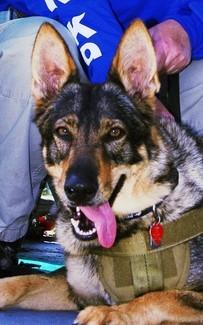
K9 Riley came to us in the Spring of 2012 as a highly intelligent and spirited puppy. Her energies knew no bounds. Due to her unique coloring, she was often mistaken for a coyote. In Fact, it got so bad with all the insinuations that we finally had her DNA tested to make sure she was a real GSD, and SHE WAS! She was an amazing tracking dog and also excelled in Human Remains Detection. She was especially reliable in her water detection work. At age seven, she developed degenerative myopathy, and her hips began to degenerate. Two years later, she would leave us and cross the rainbow bridge. An amazing pup that gave so much to her community. We still miss her!


Water Search & Medicine

There Are Not Two Kinds of Drowning


"Dry drowning" and "wet drowning" were retired from medicine more than twenty years ago. What actually happens to the lungs — and what the water in them can and cannot tell you.


Peace River K9 Search & Rescue Newsletter · July 2026


Abstract

The terms "dry drowning" and "wet drowning" have no standing in current medicine. They were formally abandoned by international consensus in 2002, along with "near-drowning," "secondary drowning" and several others, and their use is actively discouraged by the World Health Organization, ILCOR, the CDC, the American Red Cross and the International Life Saving Federation. The reason is straightforward: drowning injury is caused by lack of oxygen, not by the volume of water in the lungs, and no clinical decision has ever turned on the distinction. This paper traces where the categories came from, why forensic evidence dissolved them, what water in the lungs does and does not indicate at autopsy, and what the eight-hour rule means for the public we serve.


Contents

1. The case that started the panic

2. What drowning actually is

3. Where "dry" and "wet" came from

4. Why the categories collapsed

5. So when is there water in the lungs?

6. The saltwater myth

7. The eight-hour rule

8. What actually prevents drowning


1. The case that started the panic

In June 2017, a four-year-old boy in Texas died roughly a week after being knocked over in knee-deep water. The story went everywhere. Depending on the outlet, he had died of "dry drowning" or "secondary drowning" — a rare, insidious thing that could apparently kill a child days after they left the pool. Parents panicked. Emergency departments filled with children who were entirely well. The autopsy found the boy died of myocarditis — an inflammation of the heart muscle, unrelated to water in any way.


That correction ran essentially nowhere.

The misinformation returns on a seasonal cycle, every summer, mostly through social media. It is worth understanding properly, because we are the people who get asked.


2. What drowning actually is

In 2002, a consensus committee working through the World Health Organization settled on a single definition: drowning is the process of experiencing respiratory impairment from submersion or immersion in liquid. Three things follow from that sentence.


It is a process, not an event. It begins when the airway goes under, and it can be interrupted at any point between distress and death.


It is not a synonym for death. There are exactly two outcomes: fatal drowning and nonfatal drowning. Nonfatal injuries range from a cough on the pool deck to permanent brain injury. A person can drown and survive, just as a person can have a cardiac arrest and survive — and nobody says "near cardiac arrest."


Notice what the definition does not mention: how much water went in. That is deliberate. Drowning injury is caused by a lack of oxygen. Not by water volume. Once the field understood that, the entire wet/dry taxonomy lost its reason to exist.

The clean-up was not cosmetic. Before 2002, there were thirteen published definitions of "near-drowning" alone and at least thirty-three competing definitions circulating in the literature. That made it genuinely impossible to count drownings, compare studies, or evaluate whether prevention programs worked. The terms were not merely imprecise. They were breaking the science.


The retired vocabulary

▪     Discouraged: near-drowning · dry drowning · wet drowning · secondary drowning · delayed drowning · silent drowning · active drowning · passive drowning.

▪     In use: drowning (the process); fatal drowning; nonfatal drowning; nonfatal drowning with injury.

▪     Who says so: the World Health Organization, the International Liaison Committee on Resuscitation, the Utstein reporting system, the US Centers for Disease Control and Prevention, the American Red Cross, the International Life Saving Federation, the Wilderness Medical Society, and the American College of Emergency Physicians.

▪     The paradox worth noting: the medical community invented these terms. Patients and journalists did not. It is on us to retire them.


3. Where "dry" and "wet" came from

They came from the autopsy table and from a real observation.

For decades, pathologists noted that in roughly 10 to 15 percent of people found dead in water, the lungs looked more or less normal — not the heavy, waterlogged, froth-filled organs one would expect. Something had to explain it. The leading candidate was laryngospasm: the vocal cords slamming shut when water contacts the larynx, sealing the airway so effectively that the person asphyxiates without aspirating. Death by drowning, without the water.

It is an elegant story, and mechanically it is not absurd. The pharyngoglottal closure reflex is real — it is why you cough rather than inhale when a drink goes down the wrong pipe. Everything hinged on whether the reflex could hold until death.


4. Why the categories collapsed

The dry lungs were mostly not dry. In 2004, Lunetta, Modell, and Sajantila published a review in the American Journal of Forensic Medicine and Pathology asking, straightforwardly, what the incidence and significance of "dry lungs" in bodies found in water actually was. When those apparently dry-lunged cases were examined properly, more than 98 percent showed signs of liquid inhalation after all. The dry lung was largely an artifact of looking quickly.


Laryngospasm does not do the work it is asked to do. It occurs in fewer than 2 percent of drownings. When it does occur, it is usually brief: hypoxia deepens, the reflex is released, respiratory effort resumes, air leaves the lungs, and water enters. A spasm only protects you if it is still holding at the moment someone pulls you out.


And what is left has a simpler explanation. As Modell put it in 1999, in the absence of significant pulmonary edema, concluding that someone died of "drowning without aspiration" is unwise. If the lungs are genuinely dry and no water was aspirated, the likeliest explanation is not an exotic drowning subtype. It is that the person did not drown. They had a cardiac event, a seizure, a stroke, an arrhythmia — and the water is merely where they happened to be when it killed them. People die of sudden cardiac death on land constantly. Why not in a pool?


This is the real damage the term does, and it is the part that matters to anyone working in recovery. Writing "dry drowning" on a death certificate closes a case that should stay open and buries a cause of death that may have mattered enormously — to a family carrying a heritable cardiac condition, for instance. Forensically, drowning is already a diagnosis of exclusion: there are no findings unique to it, and it is reached by ruling everything else out through a complete autopsy and toxicology. "Dry drowning" is a way of skipping that work.


5. So, when is there water in the lungs?

Here is the honest forensic answer, which is more interesting than the two-box version.

Almost always some, if they drowned — but far less than you would think. Modell's work found that aspirating just 2.2 mL of water per kilogram of body weight is enough to cause severe disruption of oxygen exchange. For a 70-kilogram adult, that is about 154 mL. Two-thirds of a cup. That is the dose. Anyone imagining lungs filling like a bucket has the physiology backward.


The lungs never "fill up," and nobody needs to pump water out. That is a movie.

What is found at autopsy is mostly the body's own fluid, not the pool's. Aspirated water strips away pulmonary surfactant and disrupts the alveolar-capillary membrane; the membrane's increased permeability then pulls plasma and fluid into the alveoli. The heavy, boggy lungs — emphysema aquosum, edema aquosum — are the aftermath of that injury. The foam cone at the mouth and nostrils is air, water, mucus, and plasma whipped together by desperate breathing. It is not the water they inhaled, sitting there waiting to be found.

In survivors, the water leaves. Once breathing restarts, aspirated water is rapidly absorbed into the circulation. There is nothing left to find.


None of the classic signs are specific. A foam cone is dramatic, but it appears in opiate overdose and heart failure, too. Fluid in the sphenoid sinus, water in the stomach, Paltauf spots, pleural effusion, elevated lung weights, overlapping anterior lung margins — every one is suggestive, none is diagnostic, and the absence of all of them does not rule out drowning. Even the diatom test, the traditional gold standard, is contested: sensitive but poorly specific, vulnerable to contamination, and to post-mortem water entering the airway on its own.


The evidence also degrades. Water drains during the body's recovery. Decomposition wrecks the tissue. Resuscitation attempts change the picture. Time in water changes it more.


So, when will you not find water in the lungs? When the person did not drown, when they had been dead in the water long enough for the findings to wash out, when they survived long enough to reabsorb it, or when nobody looked hard enough. The old answer — because their throat closed — is real in under 2 percent of cases and never carried the weight that was put on it.


6. The saltwater myth

While we are here, drowning in saltwater and freshwater is not clinically different.

The old textbook story of dramatic electrolyte shifts came from mid-century dog experiments using volumes no human ever aspirates. In humans, both types destroy surfactant, disrupt the same alveolar-capillary membrane, and produce pulmonary edema and hypoxia. Serum sodium does not track which one you fell into. Clinically significant electrolyte disturbance is rare enough to require something exotic — the Dead Sea, for instance.

The treatment is identical. Which, incidentally, is equally true of "wet" versus "dry." No clinical decision has ever turned on either distinction. That is a fair test of whether a category is real.


7. The eight-hour rule

This is the section to keep if everything else is cut.


The window is eight hours. People rescued from drowning who have minimal symptoms generally improve within four to eight hours. Rarely, they deteriorate within that window. There has never been a published case of a patient who was clinically evaluated, had no symptoms, and then deteriorated and died more than eight hours later. People do not drop dead of drowning days later with no warning. In a study of more than 41,000 lifeguard rescues, only 0.5 percent of symptomatic patients died.


If someone becomes ill a week after swimming, the answer is something else — pneumonia, spontaneous pneumothorax, chest trauma, asthma, chemical pneumonitis, ARDS from another cause. Every one of those has been mislabelled "delayed drowning," and every mislabelling delays the correct diagnosis.


After a rescue: what to tell people

▪     Seek care immediately if, within eight hours, there is: persistent coughing, difficulty breathing, foam at the mouth or nose, confusion, or behaviour that is simply off.

▪     The rule of thumb: if it seems worse than a drink going down the wrong pipe at dinner, get it looked at. Watch for mild symptoms that keep worsening.

▪     Expect observation, not admission. Drowning patients are typically watched for four to eight hours in an emergency department and discharged if normal.

▪     At eight hours and well, stop watching the clock. Fine at eight hours means fine.

▪     If symptoms begin well after eight hours, still seek care — but expect the cause to be something other than drowning, and say so.


The fear this myth generates is not free. It sends healthy children to emergency rooms while pulling attention away from the thing that actually kills them.


8. What actually prevents drowning

Because that thing is not subtle. Drowning kills more than 4,000 people a year in the United States, and the numbers recently moved the wrong way: more than 4,500 a year during 2020–2022, roughly 500 more per year than in 2019, with the sharpest increases among children aged 1–4, adults over 65, and Black Americans of all ages. Drowning is the leading cause of death for children aged 1 to 4 — not the leading injury cause, the leading cause, full stop. It is second for ages 5–14, behind motor vehicle crashes. Nearly 80 percent of those who die are male.


It is also quiet. Drowning does not look like the movies — no thrashing, no shouting. A drowning person is spending every available effort keeping their mouth above water, and there is nothing left over for waving or calling out. It can take under two minutes. Roughly 88 percent of children who drown do so with at least one adult present.


Location tracks age, which is worth knowing before a callout: three-quarters of drownings in infants under one occur in bathtubs; most drownings of children aged 1–4 happen in home swimming pools; over 40 percent of drownings among children 5–14 occur in natural water; and almost half of fatal drownings among people 15 and over occur in lakes, rivers, and oceans.

What works is unglamorous and well established.


•    Four-sided isolation fencing. A fence that separates the pool from the house and yard on all four sides reduces a child's drowning risk by 83 percent compared with three-sided property-line fencing that leaves access through the house (Thompson & Rivara, Cochrane; odds ratio 0.17). Any fencing versus none carries an odds ratio of 0.27. The gate must be self-closing and self-latching. Florida's residential pool density makes this our single highest-leverage message.


•    Formal swimming lessons. They measurably reduce risk among children and young adults. More than half of US adults report never having had any.


•    Life jackets. Particularly for boating and open water.


•    A designated Water Watcher whose only job, for that shift, is watching — and small children within arm's reach, even with a lifeguard present.


•    Reach or throw, don't go. A panicking swimmer will climb a rescuer like a ladder. The Red Cross has said it for decades because rescuers drown, too.


We spend our training hours on the four minutes after someone goes under. This is the article about the twenty years of confusion that keeps the public looking at the wrong danger — and about the fence that would have meant we were never called at all.

STAY SAFE. SEARCH SMART.


Bibliography

American Red Cross. (2024). Debunking dry or delayed/secondary drowning. American National Red Cross.

Bierens, J. J. L. M., Lunetta, P., Tipton, M., & Warner, D. S. (2016). Physiology of drowning: A review. Physiology, 31(2), 147–166.

Centers for Disease Control and Prevention. (2024). Vital Signs: Drowning deaths rise in the U.S. National Center for Injury Prevention and Control.

Centers for Disease Control and Prevention. (2026). Drowning facts and Risk factors for drowning. National Center for Injury Prevention and Control.

Dezfulian, C., McCallin, T. E., Bierens, J., Dunne, C. L., Idris, A. H., Kiragu, A., … Topjian, A. A. (2024). 2024 American Heart Association and American Academy of Pediatrics focused update on special circumstances: Resuscitation following drowning. Circulation, 150(23), e501–e516.

Idris, A. H., Berg, R. A., Bierens, J., Bossaert, L., Branche, C. M., Gabrielli, A., … Modell, J. H. (2003). Recommended guidelines for uniform reporting of data from drowning: The "Utstein style." Circulation, 108(20), 2565–2574.

Lunetta, P., Modell, J. H., & Sajantila, A. (2004). What is the incidence and significance of "dry-lungs" in bodies found in water? American Journal of Forensic Medicine and Pathology, 25(4), 291–301.

Modell, J. H., Bellefleur, M., & Davis, J. H. (1999). Drowning without aspiration: Is this an appropriate diagnosis? Journal of Forensic Sciences, 44(6), 1119–1123.

Modell, J. H., Moya, F., Newby, E. J., Ruiz, B. C., & Showers, A. V. (1967). The effects of fluid volume in seawater drowning. Annals of Internal Medicine, 67(1), 68–80.

Szpilman, D. (1997). Near-drowning and drowning classification: A proposal to stratify mortality based on the analysis of 1,831 cases. Chest, 112(3), 660–665.

Szpilman, D., Bierens, J. J. L. M., Handley, A. J., & Orlowski, J. P. (2012). Drowning. New England Journal of Medicine, 366(22), 2102–2110.

Szpilman, D., Sempsrott, J., Webber, J., Hawkins, S. C., Barcala-Furelos, R., Schmidt, A., & Queiroga, A. C. (2018). 'Dry drowning' and other myths. Cleveland Clinic Journal of Medicine, 85(7), 529–535.

Szpilman, D., Webber, J., Quan, L., Bierens, J., Morizot-Leite, L., Langendorfer, S. J., … Løfgren, B. (2014). Creating a drowning chain of survival. Resuscitation, 85(9), 1149–1152.

Thompson, D. C., & Rivara, F. P. (1998). Pool fencing for preventing drowning in children. Cochrane Database of Systematic Reviews, (1), CD001047.

van Beeck, E. F., Branche, C. M., Szpilman, D., Modell, J. H., & Bierens, J. J. (2005). A new definition of drowning: Towards documentation and prevention of a global public health problem. Bulletin of the World Health Organization, 83(11), 853–856.

World Health Organization. (2014). Global report on drowning: Preventing a leading cause of death. WHO.


Suggested Reading

Szpilman, D., et al. (2018). 'Dry drowning' and other myths. Cleveland Clinic Journal of Medicine, 85(7). — The single best entry point, free online, written by the people who did the work. Short, angry in a controlled way, and the direct source for most of Sections 1–7 here. If you read one thing, read this.

Bierens, J. J. L. M. (Ed.). (2014). Handbook on drowning: Prevention, rescue, treatment (2nd ed.). Springer. — The reference work for the whole field, out of the World Congress on Drowning process that produced the 2002 definition. Expensive; worth having on the shelf at HQ rather than at home.

Bierens, J., Lunetta, P., Tipton, M., & Warner, D. S. (2016). Physiology of drowning: A review. Physiology, 31(2). — For the reader who wants the mechanism rather than the summary: cold shock, the diving response, autonomic conflict, airway reflexes, and a frank account of how much remains unknown.

American Red Cross. Debunking dry or delayed/secondary drowning. — One page, plain language, well sourced. This is the handout to give a worried parent.

Dezfulian, C., et al. (2024). AHA/AAP focused update: Resuscitation following drowning. Circulation, 150(23). — Current resuscitation guidance, including why drowning is the exception to compression-first and gets rescue breaths.

CDC Drowning Prevention (cdc.gov/drowning). — The data behind Section 8, updated annually, with state-level breakdowns. Florida's numbers for the 1–4 age group are the argument for everything we do in public education.

Help Us Continue Our Mission When Using PayPal!

Recently PRSAR got approved as a preferred charity on PayPal! This enables us to be listed on the PayPal app and available to be set as a favorite charity to receive Micro-donations when you make purchases at checkout. How does this work? There are two ways to set PRSAR as your favorite charity. You can find us on the PayPal Giving Fund website and click the heart icon on our page, or you can use the PayPal app on your phone, With the phone app, go to payments, then to Give and set PRSAR as your favorite charity. When you checkout using PayPal you will get the chance to add $1 to your purchase and that money comes to us! This is a simple and great way to support your favorite Nonprofit! Thank you for your giving!

PRSAR is on Zelle!

This QR code offers a quick and easy way to support us on our mission. Please feel free to donate today!

Thank You or Your Support!


Phone: 941-548-7560
 
Facebook  Instagram  Linkedin