ELAM EDGE: YOUR BIWEEKLY NEWSLETTER FOR EVERYTHING ELAM | | |
Celebrating Leadership and Legacy:
50 Years of Impact of Advancing Leadership Through ELAM and GWIMS
| | |
Dear ELAM Community,
Welcome to a special issue of the ELAM Edge as we celebrate the 50th anniversary of the Association of American Medical College’s (AAMC’s) Women in Medicine and Science (WIMS) portfolio, and the partnership with the former AAMC Group on Women in Medicine and Science (GWIMS).
As many of you know, on July 1, 2026, the AAMC restructured its affinity groups to better align with the evolving priorities of its constituents and the association. The Faculty and Staff Vitality (FSV) Group brings together individuals who previously engaged through the former Group on Faculty Affairs, Group on Collaboration, Engagement, and Community, the HR Section of the Group on Business Affairs, GWIMS, and others. The FSV Group brings together diverse perspectives to explore practical approaches to career development, leadership, workplace effectiveness, and well-being. Through collaboration and shared insight, members contribute to shaping resources, programming, and conversations that reflect the evolving needs of academic medicine. While the organizational structure has evolved, the extraordinary contributions of GWIMS over the past half century deserve recognition and celebration.
In this issue, you will read the stories of ELUMs who also served as chairs of the GWIMS Steering Committee and learn how their experiences in ELAM influenced their leadership journeys and careers. Today, 1,837 ELUMs hold leadership positions at 300 organizations around the world, including 36 medical school deans, 3 dental school deans, 13 public health deans, 77 chief academic officers, 16 chancellors or vice chancellors, 3 provosts, and 16 presidents or CEOs. Yet the impact of ELAM extends far beyond these impressive numbers. It lives in the community we have built together and in the partnerships we have fostered with organizations such as the AAMC FSV Group and, previously, GWIMS. Together, we have advanced the development, visibility, and success of leaders across academic healthcare.
As ELAM enters its 31st year, we are more intentional than ever about creating programs and cultivating partnerships that advance our mission of developing and connecting leaders who will shape the future of academic healthcare. The AAMC FSV Group remains an important partner in that work. As academic medicine and healthcare continue to navigate complex challenges and rapid change, effective leadership has never been more essential. Through collaboration and shared purpose, we can help ensure that future generations of leaders are prepared not only to succeed, but also to transform academic medicine for the better.
| | |
Warmly,
Nancy D. Spector, MD
Distinguished Professor, Department of Pediatrics
Betty A. Cohen Chair in Women’s Health
Senior Vice Dean for Faculty
Executive Director, Lynn Yeakel Institute for Women’s Health and Leadership (IWHL)
Executive Director, Executive Leadership in Academic Medicine® (ELAM) and Executive Leadership in Healthcare (ELH)
Drexel University College of Medicine
| | Milestone Reflections on 50 Years of Women in Medicine and Science | | |
Insights and Remarks by Diana Lautenberger, MA
Senior National Advisor and Program Leader, Gender Equity Initiatives at the AAMC
| | |
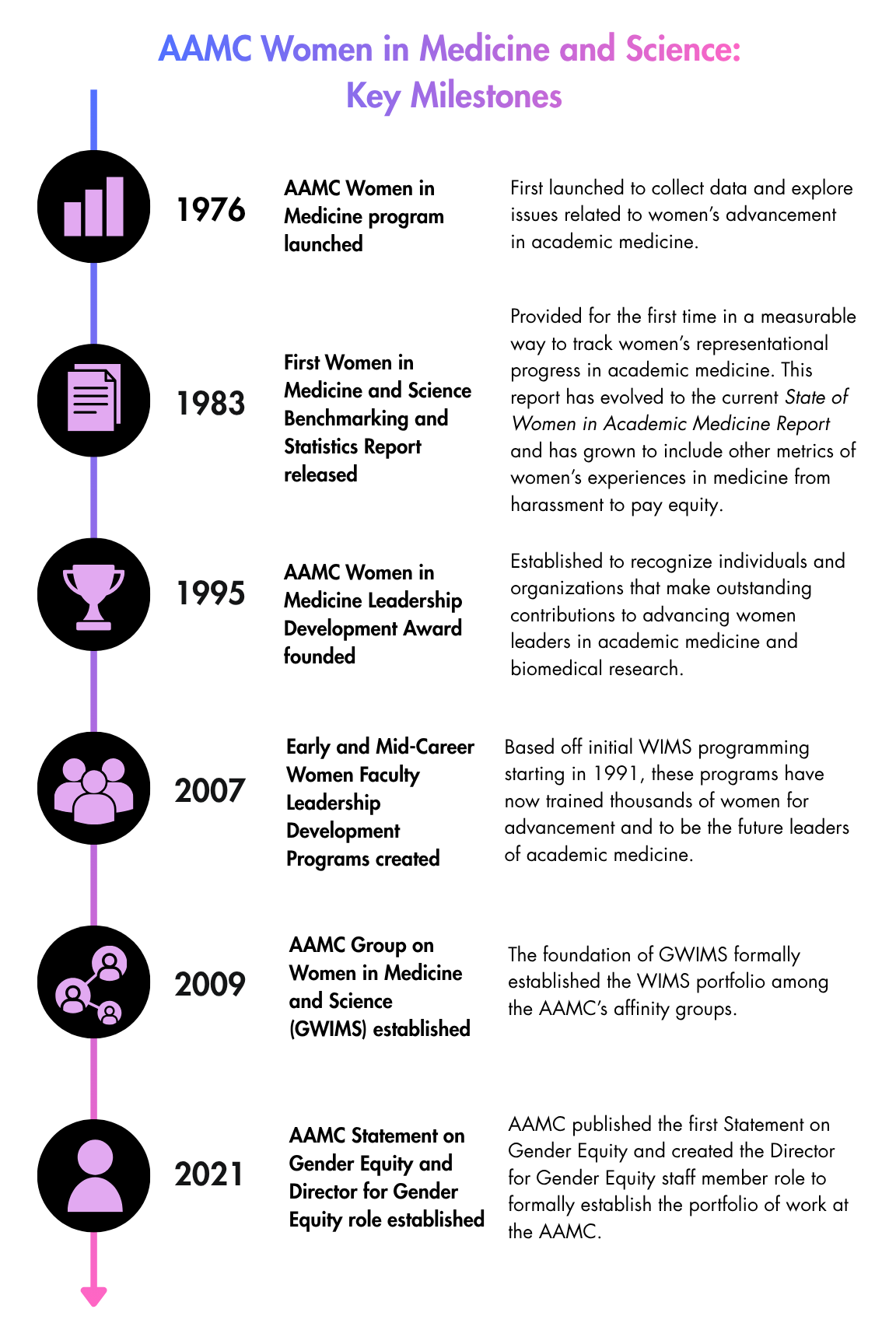
As I reflect on 50 years of Women in Medicine and Science (WIMS) at the AAMC, I am incredibly inspired by the legacy of countless leaders over the decades, and I am honored to be part of shaping our work moving forward. While we still have much to do, our progress is thanks to the incredible leaders and partner organizations, like ELAM, who founded and drove this work, often during times when it was not easy or safe to do so. We truly stand on the shoulders of giants who reached so many milestones that we can celebrate and build off today.
| | |
Recent Accomplishments and Strategic Priorities
The AAMC Gender Equity Portfolio continues to collaborate and partner with AAMC constituents to inform and drive the strategic priorities of the portfolio, ensuring that we are addressing your most pressing gender equity concerns. Our current strategic focus areas are: 1) Leadership and promotion to closely monitor leadership trends, 2) Wellness and thriving to assess burnout, harassment, and respect as they relate to faculty overall wellness, and 3) Continuing our suite of resources related to pay equity.
Recent accomplishments include:
| | |
Current Initiatives Supporting Faculty Advancement
-
One project we are starting is to use AAMC data to create an Institutional Gender Equity Benchmarking Table to easily see how they compare nationally on key faculty career junctures. We are building resources to help institutions track their own AAMC data so they can see the biggest opportunity areas at their institution, since every organization faces different challenges.
-
We are also excited to launch a new, infographic-style State of Women in Academic Medicine Report in 2027. The same data you use and trust but in a more dynamic and reader-friendly format.
| | |
The Future of the AAMC’s Gender Equity Work
We are at a critical moment, facing significant headwinds, but this calls us to deepen our commitment, strengthen our partnerships, and take the opportunity to collectively re-envision and rebuild for greater impact moving forward.
Part of this rebuilding and re-envisioning is, in my view, to engage all genders, especially men, in the fundamental structural and cultural change to make academic medicine a place where everyone can thrive and succeed. Being invested in these changes starts with recognizing that harmful norms, practices, and structures impact everyone. Moving forward means broadening our scope and engaging with a new generation to address the needs and challenges of both the present and future for a thriving workforce.
| | |
The Future of the AAMC’s Faculty and Staff Vitality Group WIMS Work
The Faculty and Staff Vitality (FSV) Group has created distinct Communities of Practice to continue providing convening and leadership opportunities for various interest areas within the larger FSV group. One of these communities of practice is the Workforce Impact in Medicine and Science (WIMS) Community of Practice and creates a space for those who were previously engaged in the GWIMS affinity group, among others, to continue networking, collaborating, and sharing practices related to supporting all faculty.
| | |
Opportunities for Engagement
The partnership between ELAM and the Faculty and Staff Vitality Group has always been greater than the sum of its individual programs. Together, these communities have created opportunities for learning, collaboration, and collective impact.
Looking ahead, there are numerous opportunities to strengthen these connections:
-
Cross-pollination of knowledge and ideas. ELUMs and members of the Faculty and Staff Vitality Group can continue to share best practices, innovative programs, leadership strategies, and scholarship that advance academic medicine.
-
Supporting leadership development across the continuum. ELUMs can serve as mentors, sponsors, faculty, speakers, and advocates for emerging leaders within both organizations.
-
Building the next generation of leaders. By engaging trainees, junior faculty, mid-career professionals, and senior leaders, both organizations can help create a sustainable pipeline of talent prepared to lead the future of academic healthcare.
| | |
Insights and Reflections of ELUMs
as Former GWIMS Chairs
| | We invited ELUMs who served as GWIMS Chairs to share their reflections and respond to a series of prompts. The result was a collection of thoughtful and inspiring insights, rich with personal experiences, leadership lessons, and pearls of wisdom that continue to resonate across our community. | | |
Archana (Archie) Chatterjee, MD, PhD (ELAM ‘08)
Dean, Chicago Medical School
Senior Vice President for Medical Affairs
| | |
In what ways did ELAM prepare you for your role as a GWIMS Chair?
ELAM has been and continues to be the source of my development and evolution as a leader. While I had other leadership training prior to participating in ELAM, it was the most comprehensive in helping me understand the role and impact that a good leader can have.
Here are some of the things I learned at ELAM that were particularly helpful in my role as GWIMS Chair:
- Developing a realistic vision of what was achievable.
- Working with others towards common goals, even when we did not agree on how to get there.
- Creating space for people to speak their minds and bring their authentic selves to the table.
- Setting priorities and timelines to have meaningful impact.
- Identifying and leveraging appropriate resources and partnerships.
How did your experiences as a GWIMS Chair and ELAM fellow complement one another?
Lessons learned in one area often complement and inform other areas of my leadership. To this day, I apply the lessons I learned at ELAM in my formal and informal leadership roles locally, regionally and nationally. Specific to my role as GWIMS Chair, I used the tools that ELAM had given me to shape the organization and move it in the direction that I wanted to, so that it would become a beacon and light the paths of women faculty across the country. I was fortunate to lead a dedicated group of people who served on the Steering Committee of GWIMS to operationalize this vision. My experience as GWIMS Chair reinforced many of the lessons I had learned at ELAM. These two opportunities have honed my passion for supporting women’s careers and lives into becoming a champion with a bigger megaphone than I had ever hoped to have.
What leadership lessons from ELAM have remained most relevant throughout your career?
Of the many leadership lessons I learned at ELAM, the following have remained the most relevant:
- Building and sustaining professional relationships and networks
- Sponsorship, both as a beneficiary and sponsor
- Paying it forward
- Self-advocacy
- Relentless focus on goals
Not only do I practice these lessons myself, but I also do my best to share them and teach other aspiring and early-career leaders about them.
| | |
Linda Chaudron, MD, MS (ELAM ‘14)
Senior Associate Dean for Faculty Affairs
Professor, Psychiatry
Virginia Tech Carilion School of Medicine
| | |
In what ways did ELAM prepare you for your role as a GWIMS Chair?
Leading a national committee is different than leading an internal departmental or institutional committee. ELAM taught me to embrace, appreciate and leverage individuals’ different personalities, perspectives, expertise, and ways of working when leading such a committee or team. This lesson was particularly critical for working with GWIMS Steering Committee members who not only have unique experiences and expertise, but who also have a range of history and experience on the committee.
How did your experiences as a GWIMS Chair and ELAM fellow complement one another?
I initially considered ELAM a career development experience and GWIMS a community that also offered career development opportunities. Over time, and specifically in my role as GWIMS Chair, I came to appreciate that ELAM was also a community and, even more importantly, while the two communities had programs targeting different career stages, there was significant overlap, not only in membership, but also in goals and values leading to great opportunities for collaboration and leveraging an even larger voice than either one could alone. Personally, by being deeply involved in both organizations, I was better prepared to encourage and direct individuals to the mentors, resources, and career development opportunities that were most appropriate for their career stage and needs.
What leadership lessons from ELAM have remained most relevant throughout your career?
The most important lesson I learned is that ELAM and GWIMS communities are powerful. The networks and relationships that these organizations provide to individuals impact academic medicine on individual, organizational, and national levels. The personal relationships lead to mentorship, sponsorship, and collaborations that otherwise would not exist. The organizational relationships lead to innovation, distribution of knowledge, and institutional collaboration. The voices of all lead to national advocacy, data transparency, and policy change. No one individual can change academic medicine but the collective voices of these organizations have and can continue to make a difference in the future of medicine.
| | |
Lynn K. Gordon, MD, PhD (ELAM ‘08)
Professor Emerita, Ophthalmology
David Geffen School of Medicine at UCLA
| | |
In what ways did ELAM prepare you for your role as a GWIMS Chair?
ELAM was a pivotal experience that helped me prepare for all aspects of my subsequent academic life including being a GWIMS Chair. In particular, the group activities and exercises helped me better understand both groupthink and how group leaders successfully negotiate challenges both from within as well as external to the group. Identification of both my own personality types as well as how my own approaches to problem solving both complemented, and in some circumstances, conflicted with other approaches allowed me to more successfully navigate the activities as GWIMS Chair.
How did your experiences as a GWIMS Chair and ELAM fellow complement one another?
ELAM taught me many lessons about leadership, and in that setting I was a student and a peer. My own learning community became a vibrant and critical resource for the rest of my career. At that time there were 8 women in each community. Our group continues to periodically meet for a weekend and to have scheduled Zoom discussions on a regular basis. They became an important sounding board to test out new ideas or concepts or just to commiserate and help problem solve through personal and professional activities. The ELAM experience gave me tools that I then used both as a member and as a GWIMS Chair.
What leadership lessons from ELAM have remained most relevant throughout your career?
In addition to the examples already provided, the financial learning became critical to my future career. Following my time in ELAM I took on leadership positions at my institution (Senior Associate Dean) and in several academic societies (Women in Ophthalmology, California Association of Eye Physicians and Surgeons, North American Neuro-Ophthalmology Society, and the American Academy of Ophthalmology). The financial lessons allowed me to recognize when there were pressures in these organizations that needed to be addressed and helped me successfully plan my budget discussions at the medical school.
| | |
Toi Blakley Harris, MD (ELAM ‘19)
Professor, Louis A. Faillace, M.D., Department of Psychiatry and Behavioral Sciences
Harris County Resources for Children and Adults
Harris County Integrated Health Services Division
UTHealth Houston
| | |
In what ways did ELAM prepare you for your role as a GWIMS Chair?
As an incoming Chair-Elect of GWIMS (2018-2020), I received the timely news of my selection to participate in the ELAM Fellowship Program (c/o 2018-2019). I gained the benefit of the wisdom and guidance from the AAMC and GWIMS communities and the ELAM fellowship to enhance my leadership strategies while broadening my network across both academic medicine and health systems.
How did your experiences as a GWIMS Chair and ELAM fellow complement one another?
During my tenure as Chair and Chair-Elect of GWIMS, I had the opportunity to collaborate with the AAMC and ELAM leadership on meaningful and impactful scholarly activities.
- At my home academic institution, my IAP amplified the work we developed centered around holistic review for faculty recruitment with the AAMC. As the IAP was being completed, the AAMC launched a multi-site pilot informed by my IAP. The outputs of those efforts include dissemination through peer review publications and presentations.
-
Another example is the convening of a women’s equity summit led by GWIMS with ELAM leadership participating alongside Association for Women in Science (AWIS), the NIH and other organizations dedicated to the advancement of women in health and academic medicine.
Along with the scholarship, my life and career have been deeply enriched by leaders who have connections with both GWIMS and ELAM.
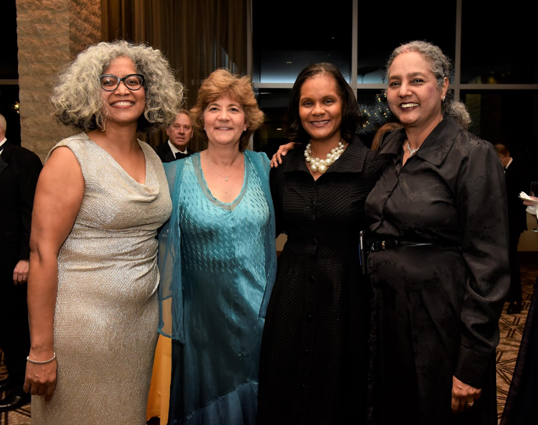
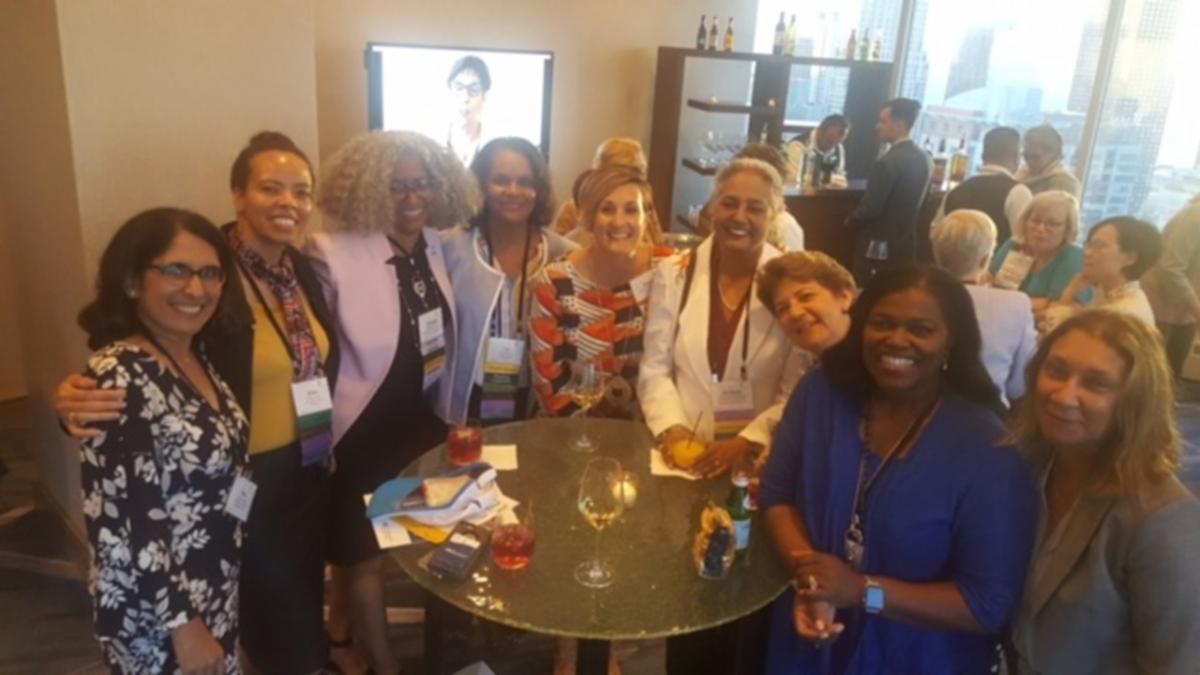
Below is a photo of fellow ELUMS taken at an AAMC event. In order in the photo: Drs. Chiquita Collins, Linda Chaudron, me, and Archie Chatterjee.
| | |
What leadership lessons from ELAM have remained most relevant throughout your career?
I have seen sponsorship in action, and I strive to pay it forward as a leader. It was through the sponsorship of two ELUMS with AAMC legacies, Drs. Liz Travis and Alicia Monroe, that heavily influenced my opportunities to become a member of the GWIMS Steering Committee and an ELUM. Others in the ELUM community have shared “pearls” such as “trust the process,” and “the power of the collective.” These have both been true, especially during my professional times of transition. My learning journey continues as an ELUM, through the leadership of ELAM, my relationships with members of my LC (shout out to my LCA and the Firecrackers, c/o 2019), and the fellows who I have been blessed to meet as an LCA!
| | |
Rebecca R. Pauly, MD FACP (ELAM ‘02)
Vice Dean
Professor of Medicine
Vice Chair, Department of Medicine
Virginia Tech Carilion School of Medicine
Carilion Clinic
| | |
In what ways did ELAM prepare you for your role as GWIMS Chair?
ELAM gave me the context to interact with and learn from peers and role models and to witness first-hand constituting and building a team. In addition to these interpersonal growth interactions and knowledge acquisitions, ELAM afforded me the ability to practice my developing leadership skills. Reflections on my ELAM experience solidified that authenticity and curiosity are the essential values which drive my purpose. I stepped into the GWIMS Chair role poised to engage with highly functional team members and guide the processes of team building and project development. I felt confident and anchored by my practice time at ELAM to actively listen and lead with authenticity and curiosity.
How did your experiences as a GWIMS Chair and ELAM fellow complement one another?
During the ELAM fellowship, I learned theories and practiced simulation concepts of leadership, talent, and skill recognition. Serving as GWIMS Chair, I tapped my knowledge of the theories and prior practice into a real-world setting. GWIMS brings together highly talented and accomplished women from across the country and across disciplines within academic medicine to a intensive few days’ planning sessions. As GWIMS Chair, I was acutely aware of the vast talent, accomplishments, personalities, and mission and vision each member demonstrated. My job was to harness this energy and be efficient and productive. Our task was to generate worthy outcomes for our few days together. Putting the skills learned at ELAM into action with GWIMS was a fabulous full circle moment. Another impactful example is the role and value of networking which I continue to experience from my time with both ELAM and GWIMS, often at Learn Serve Lead.
What leadership lessons from ELAM have remained most relevant throughout your career?
The activity: lower, middle, and upper, which many of you may recall still speaks to me today. I was assigned being a lower and told to make 150 pairs of red shoes in a short turnaround time. I worked diligently on the red shoe production until my middle said the upper now wants to stop red shoe production and focus on silver shoe production. There was no explanation of why, appreciation of the red shoes already made, or forecasting of next requests. My reflections on this activity and the emotions elicited have repeatedly led me to communicate broadly to inform, engage, and build effective teams. It reinforced recognition that we all have unique life experiences with our own skills, talents, and yes: blind spots. Engagement and bringing diverse points of view to creating solutions strengthens the team.
| | |
Elizabeth (Liz) L. Travis, PhD (ELAM ‘00)
The University of Texas MD Anderson Cancer Center
| | |
In what ways did ELAM prepare you for your role as GWIMS Chair?
I joined the ELAM class of 2000, when the new program differed considerably from today’s. As the third MD Anderson Cancer Center faculty member selected, I was nominated by Dr. Margaret Kripke, Chief Academic Officer and a member of ELAM’s inaugural class. She invited me to join a small group examining the status of women faculty. Our work established MD Anderson’s first Office of Women Faculty Programs to identify and address inequities.
ELAM was pivotal, equipping me to advance women in academic medicine, address overlooked inequities, and engage key stakeholders. It prepared me to become Associate Vice President and lead the new Office of Women Faculty Programs. Through GWIMS, I learned from others, joined the steering committee, and became the GWIMS Chair in 2015. ELAM was foundational for assuming this position.
How did your experiences as a GWIMS Chair and ELAM fellow complement one another?
It has always been clear to me that ELAM was foundational in my roles both at MD Anderson and as GWIMS Chair. They truly complemented one another even though they were separated by more than 10 years in my case. Their goals were similar, ELAM was the how and chairing GWIMS was actualizing the how. The leadership skills - listening, asking questions, engaging, and developing others were complementary in both domains. Convincing others and implementing changes without alienating the audience were complementary skills. I am sure that I would not have been successful as Chair of GWIMS without my ELAM background.
What leadership lessons from ELAM have remained most relevant throughout your career?
I think the most important were learning to really listen to others, ask questions to understand where others are coming from, always have your antenna up for new talent, always credit your team, and others when appropriate. Don’t be afraid to ask for what you need/want!
| | |
The Next 50 Years:
Emerging Challenges and Opportunities for ELAM
| | |
Over the past three decades, ELAM has evolved from a pioneering leadership program for women in academic medicine into a global community of transformational leaders. What began as an effort to increase the representation of women in senior leadership roles has expanded to include all genders in 2025 and grown into a robust network of leaders who influence institutions, shape policy, advance science, and improve healthcare across the world.
As academic medicine continues to evolve, ELAM's mission remains steadfast while its approach continues to adapt. The challenges facing future leaders will differ significantly from those faced by previous generations. Leaders must navigate increasingly complex health systems, rapid advances in artificial intelligence and technology, changing workforce expectations, threats to well-being and resilience, and ongoing efforts to create cultures where all individuals can thrive.
In response, ELAM will continue to evolve its curriculum to ensure that participants develop the skills most needed for their current context. While foundational competencies such as strategic leadership, financial acumen, negotiation, and organizational change will remain central, future programs will increasingly focus on leading through uncertainty, managing complexity, building high-performing teams, fostering belonging, and guiding institutional leaders through periods of disruption and transformation.
The Executive Leadership in Transformational Change (ELTC) program represents one example of this evolution. Through an integrated curriculum focused on systems thinking, organizational dynamics, resource stewardship, digital literacy, crisis management, and allyship, ELTC prepares senior leaders to lead transformation at scale. These leaders will be the architects of the future, building the resilient systems, inclusive cultures, and innovative infrastructures needed to advance academic medicine and provide the highest quality care for generations to come.
| | The next 50 years of leadership development will not simply be about preparing individuals for positions of authority. They will be about equipping leaders to navigate complexity, build community, foster belonging, and create institutions that are innovative, resilient, and responsive to a changing world. The enduring strength of both ELAM and GWIMS (now part of the Faculty and Staff Vitality group) has always been their commitment to people. While programs, structures, and priorities may evolve, that commitment remains unchanged. Together, these communities have helped shape generations of leaders in academic medicine. The opportunity before us is to continue that work, ensuring that the next generation of leaders is prepared not only to meet the future, but to define it. | | | | |