|
|
|
POLICY & ADVOCACY UPDATE
Issue #31, 24 October 2024
| | | |
- JSA releases latest shortages list
- Card surcharges set to change
- Hospitality, Travel, Tourism Employment Platform Update
- WR agenda now about consolidation and review
- Reserve Bank of Australia meeting
- Latest Visitor Surveys for June 2024
- Occupancy rates for September
- The future for ANZSCO
| |
JSA releases latest shortages list
Earlier this month Jobs & Skills Australia released its updated Occupation Shortage List (previously known as the Skills Priority List). This analysis informs a range of government decisions including on migration and training funding. The renaming of the list is interesting, and not necessarily positive. We have been saying for some time that priorities should not just be about shortages but also take into account future needs. In hospitality, the predictions for growth and future labour and skills demand are substantial, but yet our occupations at times struggle to be included as priorities. JSA uses the following definition of shortage: "An occupation is in shortage when employers are unable to fill or have considerable difficulty filling vacancies for an occupation or cannot meet significant specialised skill needs within that occupation, at current levels of remuneration and conditions of employment and in reasonably accessible locations." The 2024 OSL results showed that 33% of occupations (303 out of 916 assessed occupations) are in national level Shortage. This is 3 percentage points less than the result in 2023 (36%) but is 1 percentage point higher than the 2022 result (32%).
The assessment of our key occupations is as follows, where S is shortage, NS is not in shortage and R is regional shortage:
| | |
The above occupations are those about which AA made submissions to JSA in relation to the Draft Core Skills List which will dictate what occupations can be sponsored for skilled migration with the exception of the receptionist which is not eligible for migration. On the positive side, the assessment of hotel manager in national shortage bodes well for them remaining available for skilled migration, Restaurant managers on the other hand will struggle to remain available in the new system unless our arguments are successful in support of proper transition arrangements and also that just because these roles are filled, it does not mean that the right level of experience is filling them. | |
Card surcharges set to change
Last week the Federal Government announced it is prepared to ban debit card surcharges - subject to further work by the Reserve Bank of Australia (RBA) and safeguards to ensure both small businesses and consumers can benefit from lower costs. The focus has been on both credit and debit surcharges, but the debit surcharges are particularly controversial as it is contended that the customer is merely using their own money. The AHA and AA have been responding to this potential action to ensure that any costs are not just passed on to the member, and a meeting has been scheduled with the RBA to discuss the matter. The AHA media release on this issue is found here.
| |
|
Hospitality, Travel, Tourism Employment Platform Update
In the past month we welcomed Emilie Howe (pictured right) as the new Project Manager for the Austrade-funded platform. Emilie is based in Sydney and was previously CEO of the Visitor Experience Training (VXT) - an industry training organisation established by the Tasmanian Hospitality Association (THA) and Tourism Industry Council Tasmania (TICT). In a busy first few weeks, Emilie coordinated an Advisory Committee meeting which discussed industry sectors and subsectors, key industry content, including existing content for the platform, and important dates. The platform is expected to have an industry launch in November with full public launch in February 2025. Welcome on board Emilie!
| |
|
|
WR agenda now about consolidation and review
At a recent meeting, Employment and Workplace Relations Minister, Murray Watt, AA informed AA CEO James Goodwin that the Federal Government has no plans for any further workplace relations reform, and that this commitment had been passed on to the Union movement as well. The focus of WR over the next term will be about consolidation of the two tranches of reforms undertaken in the Labor Government's first term. The Minister also said that in the next term, the Government would undertake a review of the first tranche of reforms, including changes to multi-employer bargaining.
| |
Reserve Bank of Australia Meeting
AA recently met with the RBA as part of its business liaison outreach to better understand economic conditions facing accommodation providers in Australia. Issues raised included workforce challenges in the sector, cost of living pressures affecting consumer travel preferences and the need to diversify international tourism markets. Regional tourism and the negative flow on from REX airlines entering administration is a concern.
AA also raised with RBA rising regulatory costs on businesses including planning and environmental regulations. The confidence to invest in new properties or significant refurbishments was also raised by the RBA and it was important to highlight that economy-wide supply chain and labour shortages in the construction sector are creating challenges for hotels.
|
Latest Visitor Surveys for June 2024
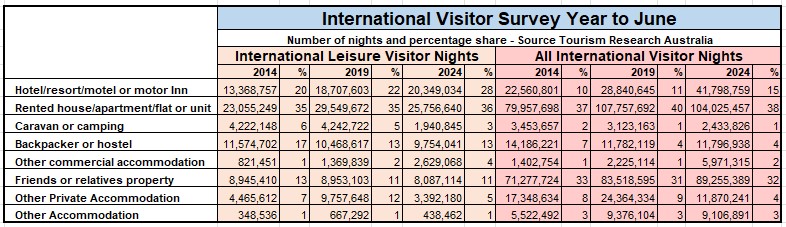
The latest visitor surveys released by Tourism Research Australia show that for the year to June 2024, international tourists spent $31.7 billion in Australia, up 3% on June 2019 levels. The number of nights was also up on 2019 levels even though the number of trips was only 85% of pre-COVID levels. Significantly, the unpublished IVS data obtained by AA for the benefit of members, presented in the table below, shows that the share of international visitor nights spent in hotels has risen substantially compared to the pre-COVID period, and is now 15% for all visitors, and 28% for holiday travellers. The difference is primarily due to accommodation for those visiting friends and relatives. Caravan parks and camping have halved their share in the last ten years down to only 3% of international holiday traveller nights.
| |
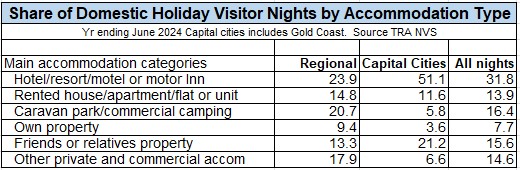
The National Visitor Survey which measures the activities of domestic tourism showed that for the year to June 2024, overnight spend was up only 1% (lower than inflation) compared to the previous year and the number of nights actually fell by 1%. In the unpublished data, the share of those nights spent in hotels, resorts and motor inns was 28.6% (year to June 2023 27.9%) which is the second highest to friends and relatives' properties. Importantly, the hotel share is higher than the COVID and pre-COVID period, as it was in the 21-24% range between 2015 and 2022. As the table below shows, the hotel share of nights is higher for holiday travellers, at 31.8% for the year to June 2024. As would be expected, the hotel share of nights is much higher in the capital cities (including Gold Coast) than in the regions, and varies significantly across the regions. For example, the hotel share of domestic holiday nights in Melbourne is 61.7%, Darwin 60.4% Sydney, 57.8%, Adelaide 51.5%, Perth 49.6%, Gold Coast 48.5% Hobart 40.7%, Canberra 47.2% and Brisbane 35.4%. | |
|
Occupancy rates for September
According to the latest STR data, average occupancy in September across Australia was 72.7% compared with 72.1% in September 2023, but the Average Daily Rate was lower at $232.86 compared with $237.25 in September 2023. Revenue per available room in September 2024 was $169.29, a decrease from $171.04 in September 2023. For the year to September 2024, the average Australian occupancy rate was 70.4% compared with 68.7% in 2023. The rise in the ADR over this period was a modest $0.69 to $234.59, which is well below the inflation rate. Growth in revenue per available room increased from $160.69 in 2023 to $165.05 in the year to September 2024. Occupancy rates for September 2024 were up in most of the capital cities except for Sydney. In contrast to the rise in occupancy rates in Australia, New Zealand continues to struggle, with an occupancy rate for September 2024 at 62.0% compared with 67.1% in September 2023.
The graphs below derived from the STR data show what great months February and March 2024 were, both in occupancy rates and ADR. In all other months this year, the occupancy rates have held up, but ADR has been below 2023.
| |
|
The future for ANZSCO
Regular readers of this update would be aware that Accommodation Australia has been leading the hospitality industry action to update the classification of occupations in our industry that are contained within ANZSCO and used extensively by the Australian Bureau of Statistics, Jobs & Skills Australia, Home Affairs and many other bodies to analyse the labour market and make decisions about skills priorities and migration sponsorship. With many thanks to those members who provided input, we recently concluded our substantial submissions to the ABS with the hope that many of our recommended changes will be taken into the updated classification of occupations. We also provided input to the recent SaCSA submission to the ABS which can be found here. Significantly, earlier this month, the ABS announced that the new structure to be released on 6 December 2024 will no longer be a joint system with New Zealand but will stand alone for Australia. Instead of ANZSCO, the new classification will be called the Occupation Standard Classification for Australia (OSCA) 2024. So, out with ANZSCO and in with OSCA!
| |
|
Drop me an email at policy@accommodationaustralia.org or give me a call on 0418 277 919 if you have any national policy issue that you think AA should be following up. If you know an AA member who is not receiving this advocacy report but wants to, then encourage them to email me and we can add them to the distribution list.
Kind Regards
Jenny Lambert OAM
National Policy & Research Advisor
Accommodation Australia
| | | | |