|
Reflections from Mary of Magdala
Tuesday, April 14, 2026
Reflection by Jared Orsi
The federal government is building a second border wall. This one 150-feet north of the one built in 2019-2020.
This new wall was authorized last summer in the so-called “Big Beautiful Bill.” Construction is already underway in the ecologically sensitive Cabeza Prieta National Wildlife Refuge.
Soon it will reach Quitobaquito, or A’al Vaipia in the Indigenous O’odham tongue. Located inside Organ Pipe Cactus National Monument, smack dab on the border, A’al Vaipia an emerald patch in a sea of hundreds of square miles of desert.
And it’s a site sacred to the O’odham people.
- Sacred because water in the desert is precious.
- Sacred because the spring-fed pond is a meeting place between the underworld where the people originated and the surface they inhabit today.
- Sacred because there are several burial sites nearby where ancestors have been laid to rest.
- Sacred because it has been inhabited since time immemorial. It is home
The new wall will literally run right through the pond.
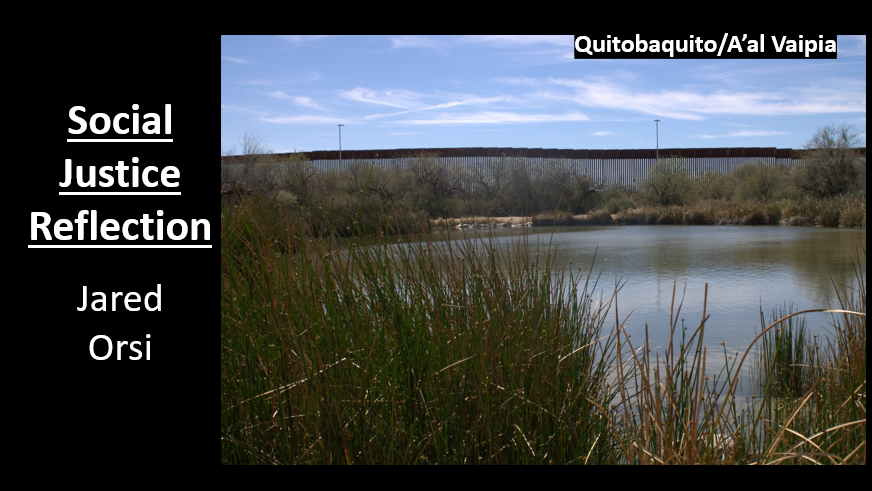
The first wall (pictured here) was bad enough. Its thirty-foot-high steel bollards and towering light standards industrialized the ambiance.
Contractors bulldozed cacti and other vegetation.
The suspension of laws protecting Indigenous heritage led to frantic archeological surveys to try to salvage the human remains and other artifacts buried in the path of the wall construction.
Some blamed it for causing a temporary dry up of A’al Vaipia. This was not entirely accurate, but their suspicions indicate the level of despair that swept over the community as the federal government chewed up their homelands.
There is no word for “wall” in O’odham.
There is an ancient O’odham ritual called the Salt Pilgrimage. Young men would run from the north, camping overnight at A’al Vaipia, and then continue south the next day to the shores of the Sea of Cortez. In total, the journey could cover up to three hundred miles. At the sea, they would gather salt for food preserving and trade. They also sought spiritual visions.
The first wall disrupted this practice. Undeterred, in 2021, a group ran for several days. They held a feast at A’al Vaipia. They filled their baskets with food and the holy waters of Quitobaquito Springs. Meanwhile, a group of Mexican O’odham had run with shells and salt from the Sea of Cortez. The two groups exchanged the gifts through the gaps in the wall at A’al Vaipia.
Even this makeshift symbolic connection between the O’odham and the sea will become impossible with the new second fence. The two sides will be separated by two walls with a150-foot militarized zone of ecological devastation between them. Too far even to hand a basket of holy waters.
Last month I visited an 80-year-old O’odham friend, who grew up near A’al Vaipia, visiting it frequently as a child.
We sat on her porch in Phoenix. I showed her pictures of my own recent pilgrimage to A’al Vaipia, and I told her about the second wall. She’d already heard the news, but as she swiped through the photos, she began sobbing. Her granddaughter, who was with us, gently took my phone from her hands and handed it back to me.
When will Americans stop trying to annihilate Indigenous peoples’ cultures?
|