Welcome to the University of Oklahoma Carceral Studies Consortium Newsletter. The Carceral Studies Consortium strives to build a community for intellectual exploration that includes faculty, staff, graduate students, community members, practitioners, and organizers.
Carceral Studies is concerned with the independent function and nexus of the political and social systems that organize, shape, sustain, and entrench practices of punishment, surveillance, incarceration, and harm.
|
|
Willamette University Professor Laura Appleman recently published “Bloody Lucre: Carceral Labor and Prison Profit,” which explains the history of financial gain and profit in the American carceral labor system. Dating back to the colonial era, Appleman found that the American colonies were a “place where the surplus poor, the waste people of England, could be converted into economic assets.” As a result, penal labor practices evolved into indentured servitude, slavery, convict leasing, “chain gangs,” and meager wage compensation in prisons. These exploitative practices remain present in the current carceral system as mass incarceration manipulates the labor of incarcerated persons to prepare sandbags for hurricanes or clean up oil spills along the Gulf Coast. Appleman believes that unless change occurs “a criminal sentence will continue to be what it has always been, a pernicious form of servitude, trapped in the service of endlessly increasing profit, the literal revenues of physical toil, suffering, and exploitation.”
|
|
According to a North Carolina Department of Public Safety (NC DPS) report, the new minimum age for the juvenile court changed from six years old to ten years old. In addition, juvenile courts will not bring children under ten to court for “undisciplined offenses,” such as truancy or status offenses. However, children that are eight or nine may still appear in court if they have a “prior court judgment of delinquency or who commits a felony A through G.” The bill also includes the addition of a “multi-system Care Review Team” to help assess the needs of juveniles before any disposition or consequence. Still, there is no specific answer for the composition of the multi-system team. The Juvenile Jurisdiction Advisory Committee supported the decision to raise the minimum age, bi-partisan support in the legislature, and Governor Roy Cooper. Deputy Secretary for Juvenile Justice William Lassiter explains that “these changes are researched-based and cost-beneficial. But, most importantly, it’s the right thing to do.” The NC DPS is responsible for conducting annual reports that evaluate evidence-based and research-supported initiatives of these changes.
|
|
SB1109 is a proposal from Oklahoma Senator Cody Rogers that prohibits law enforcement vehicles from appearing unmarked or not affiliated with an agency. Retired Sheriff and critic of the proposal John Whetsel stated, “if you only think that you have to drive safe when you see a marked car present then you are only going to drive safe when you see a marked car present. But if you think that maybe there might be a unmarked car that you can’t see you are going to be safer all the time.” Rogers, however, believes that the deterrent effect for traffic violations comes from the visibility of a law enforcement officer rather than the expectation that any vehicle could be an unmarked car. Rogers notes that all twelve of the traffic citation cars in the Tulsa Police Department are unmarked. Although the proposal has received mixed reviews, Rogers states that the use of unmarked vehicles to enforce traffic violations is merely “a way for cities to make more money.”
|
|
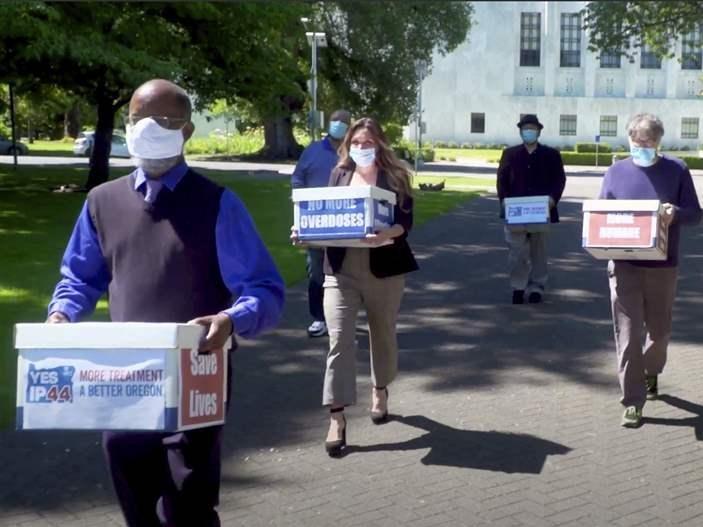
Since Oregon decriminalized minor drug possession in early 2021, arrests for drug offenses have dropped significantly. The bill altered the response to controlling small amounts of drugs (usually less than two grams) from a crime to a monetary fine. In some cases, the person ticketed for the possession could have their citation waived if they agreed to undergo a health assessment over the phone. According to Pew, the decriminalization efforts display decreases in “drug-related crime, such as property crime.” However, Pew notes that the major concerns from critics relate to the failure to appear in court by nearly half of the defendants for possession and the reduction of access to court-ordered drug treatment. Oregon drug decriminalization advocates are attempting to undo the damage from “disproportionately enforced drug laws in low-income, minority neighborhoods.” The advocates believe a process will “advance racial equity, reduce the stigma of addiction and spare people from criminal records that can prevent them from getting jobs and housing.” Sophia Quinton explains that “progressive lawmakers and civil rights groups want more states to follow Oregon’s recent example…and to spend more money on addiction recovery services.” As of December, lawmakers in four states have proposed similar decriminalization bills.
|
|
Please share recent research you would like to see featured, including your own!
Send it to carceralstudies@ou.edu
|
|
EXCERPT: When Fauziya Kassindja landed at New York’s JFK airport in 1994, she was seventeen, seeking asylum, and fleeing the brutal practice of female genital mutilation. She was also menstruating. Hours after her arrival, Fauziya was strip searched, forced to stand before a female officer “completely naked, soiled pad exposed, shamed beyond words.” She was then transferred to an off-site detention facility where she was strip-searched again. When Fauziya asked where she should place her soiled pad, the female guard responded: “I don’t know. Why don’t you eat it?”
|
|
ABSTRACT: Purpose - This paper determined sodium provisions from a seven-day cycle menu and commissary at a rural Southwest County jail and compared it to Dietary Reference Intakes (DRI) and Dietary Approaches to Stop Hypertension (DASH) recommendations for sodium. Design/methodology/approach - A seven-day cycle menu and commissary items were used to determine sodium content for each meal and commissary pack. Estimates for the menu and commissary packs paired with the menu (commissary scenarios) were converted to a daily average of sodium and compared to DRI and DASH recommendations. Findings - Menu provisions provided 167% of daily DRI sodium recommendations and 256% of daily DASH sodium recommendations. The sodium content for individual commissary scenarios averaged 218% of DRI and 334% of DASH recommendations. Commissary items are notably high in sodium and if eaten can significantly exceed dietary recommendations. Originality/value - Small changes to one meal within the cycle menu and the inclusion of fresh or frozen produce could reduce sodium content to align with DRI and DASH recommendations.
|
|
EXCERPT: Because racial disparity data is often frustratingly hard to locate, we’ve compiled the key data available into a series of charts, arranged into five slideshows focused on policing, juvenile justice, jails and pretrial detention, prisons and sentencing, and reentry. These charts provide a fuller picture of racial inequality in the criminal justice system, and make clear that a broad transformation will be needed to uproot the racial injustice of mass incarceration.
|
|
ABSTRACT: In response to the changing nature of policing in the United States, and current climate of police–citizen relations, research has begun to explore the consequences of adolescent police contact for life outcomes. The current study investigates if and under what conditions police contact has repercussions for future orientation during adolescence and the transition into young adulthood. Using data from the Pathways to Desistance study, a multisite longitudinal study of serious offenders followed from adolescence to young adulthood, results from a series of fixed-effects models demonstrated three main findings. First, personal and vicarious police contact, compared with no additional police contact, are negatively associated with within-person changes in future orientation. Second, any exposure to police contact, regardless of how just or unjust the contact is perceived, is negatively associated with future orientation. Third, the negative association between police contact and future orientation is larger for White individuals compared with that for Black or Hispanic individuals. Considering the importance of future orientation for prosocial behavior, the findings suggest that adolescent police contact may serve as an important life-course event with repercussions for later life outcomes.
|
|
Updates, Events & Opportunities |
|
New Carceral Studies Board Member
The Carceral Studies Consortium is pleased to welcome our newest board members:
|
|
|
Carceral Studies Consortium Awards Grant to Project Exploring Impacts of Immigrant Detention Centers on College-Aged Students
Dr. Mata and undergraduate student Mariafernanda González received a Carceral Studies micro-grant to gather testimonials for their upcoming project. Mata and González will conduct research that examines the experiences of traditional college-age students and how they have been impacted by immigration detention centers.
|
|
|
American Prison Newspapers, 1800-2020: Voices from the Inside
American Prison Newspapers is a collection of over 450 prison newspapers from across the country. Sources in the collection date back to the first published newspaper from an incarcerated person, the Forlorn Hope. Prison newspapers are cataloged in Revel Digital’s open-access collection, and new additions will continue through 2022.
|
|
|
CSC member Sara Mata awarded NASPA Foundation 2022 Distinguished Pillar of the Profession
The National Association of Student Personnel Administrators (NASPA) recognizes “Pillars of the Profession” as “distinguished individuals who have served as leaders, teachers, and scholars in student affairs and higher education.” Dr. Sara Mata earned this award for her “many years of outstanding service to NASPA and to our profession.”
|
|
|
CFE-DISC Community-University Event on Housing and Homelessness
CFE-DISC and the United Way will be partnering on a second community-university brainstorming session with community partners and faculty around the theme of overcoming challenges in housing and homelessness through data science and community research. The session will take place entirely via zoom on December 9th from 12-1:30PM.
|
|
|
Abolitionist Organization HEARD Seeks Advocate
HEARD is a cross-disability abolitionist organization that unites across identities, communities, movements, and borders to end ableism, racism, capitalism, and all other forms of oppression and violence. The Advocate’s primary responsibility is to advocate for deaf/disabled incarcerated people who communicate their legal issues to HEARD.
|
|
|
OU Libraries and Carceral Studies Consortium Assemble “Racial Capitalism” Library Guide
In a collaborative effort between OU Libraries and the Carceral Studies Consortium, a library guide on “Racial Capitalism” is now available for all students, staff, and faculty. Racial capitalism contends that racist oppression is central to how capitalism operates. Racial subjugation is not one specific manifestation of a larger capitalist system, but rather, capitalism itself is a racial system. The guide includes resources (written, audiovisual, and contacts) for information about the carceral state, crimmigration, and race and labor.
|
|
|
2021-2022 Carceral Studies Consortium Student Work Prize
The Carceral Studies Consortium is inviting original student essays or creative works developed as part of any course in any discipline during the 2021-2022 academic year that engages the topic of Carceral Studies, broadly conceived. Submissions are not limited to essays, but may be in any creative or scholarly format, including but not limited to art in any medium, story maps, and more.
|
|
|
ABOUT
The Consortium Newsletter will offer a roundup of a few selected articles that reflect today’s news, organizing, and thinking related to the carceral state. We understand that freedom work is built on education and engagement. Education requires an understanding of contemporary issues informed by their historical context. We hope that these curated articles will help you analyze the issues that we face and understand the community that we strive to construct.
Join the conversation!
We encourage feedback, suggestions, and article suggestions. Please reach out to carceralstudies@ou.edu with any ideas, thoughts, or recommendations.
If anyone you know is interested in receiving this newsletter and other information from the Carceral Studies Consortium, please forward them this email and they may click this link to subscribe.
|
|
Land Acknowledgment
The University of Oklahoma is on the traditional lands of the Caddo Nation and the Wichita & Affiliated Tribes. This land was also once part of the Muscogee Creek and Seminole nations. It also served as a hunting ground, trade exchange point, and migration route for the Apache, Cheyenne, Comanche, Kiowa, and Osage nations. Today, 39 federally-recognized Tribal nations dwell in what is now the State of Oklahoma as a result of settler colonial policies designed to confine and forcefully assimilate Indigenous peoples.
|
|
The University of Oklahoma is an equal opportunity institution. ou.edu/eoo |
|
|
|
|
|
|