|
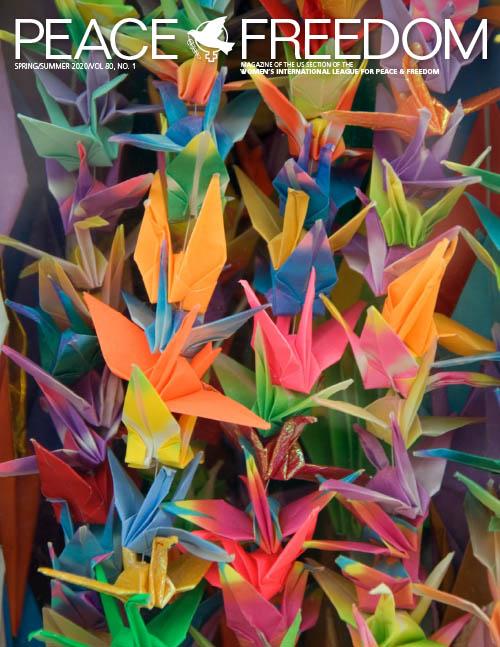
The Spring/Summer 2020 issue of Peace & Freedom magazine will appear soon in your mailboxes.
Watch for the print issue, and let your friends know that the magazine is available as
a PDF
on the
WILPF US website
. In addition, some of the articles will be added as webpages so you can share links by email and through your social media channels.
From COVID-19 reflections, to international collaborations for disarmament and peace, to calls for racial, economic, and environmental justice in the US, the articles in the Spring/Summer 2020 issue challenge, inspire, and explore the intersectional, interlocking issues for which WILPF US has long been known.
In the Spring/Summer 2020 issue:
- Dorothy Van Soest reflects on what COVID-19 is teaching us about inequality in the US. As the pandemic worsens racial inequities and economic disparities, we are learning that "poverty is everyone's problem." She challenges us all to join movements such as the Poor People's Campaign that are "insisting that it doesn't have to be this way in the future" and calling for "widespread, deep, systemic change starting now."
- Mary Hanson Harrison raises an alarm about the exploitation of farmworkers and other agricultural and frontline workers "who often remain nameless and faceless," but are "the most vulnerable employees, many people of color, half of whom are undocumented." Profit has been put over the safety and lives of these workers, she writes, and "women are affected disproportionately." Undocumented women hired hands face "even more horrendous consequences" than a "precarious employment situation": they are especially vulnerable to sexual harassment and rape.
- After spending months in Hawai'i during the extended first leg of the Golden Rule's voyage, Helen Jaccard reports on "some of the past, present, and future activities at military sites-and the protests and movements resisting them--which help explain why Hawai'i is an important place to begin challenging US militarism."
- President Darien De Lu provides a message of hope and encouragement while acknowledging that we are living through "heavy" and "disturbing" times, "times of grief and pain." She encourages caring, collaboration, and community--qualities she finds in WILPF--and writes, "When we ask ourselves what path to choose and how to proceed, let us look to the persistence of resistance."
- A Q&A with Swarthmore College Peace Collection Curator Wendy Chmielewski discusses newly accessible WILPF films and sound recordings. Among them are Crossing Borders, international WILPF footage from the 1930s, film footage of the WILPF trip to the USSR in the 1960s, and a composite film from the 1920s-1940s that includes two sections with Jane Addams talking about the Disarmament Campaign.
- Leni Villagomez Reeves brings us testimonies of six women leaders of Cuba solidarity and anti-blockade activism. "This makes sense," she writes, "since Cuba has been a leader in the area of women's human rights." The testimonies, from impressive women who have collaborated with Cubans and witnessed firsthand how Cuban women have gained leadership roles and health access, point to the ways Cuba is "truly working to put people first in...health, education, sustainable development, and much more."
- Though she had long been suspicious of Twitter, Judy Adams of the Peninsula/Palo Alto Branch describes how the recently published book #HashtagActivism: Networks of Race and Gender Justice persuaded her that this tool can help build activist movements and reach increasingly active young people hungry for change. She encourages all WILPF branches to increase their social media presence ahead of the 2020 elections.
- In a profile of Earth Democracy Co-chair and At-large Board Member Nancy Price, she shares how "the thread is water" in her activism. Nancy has participated in the Nuclear Freeze Campaign, the movement to challenge corporate power, and the global water justice movement. She represented WILPF in a coalition that successfully lobbied for the Human Right to Water bill in California. Recently, she has lent her energies to a project exposing the extensive water and land contamination on military bases, and to the national board's work reimagining and reviving WILPF US.
In other contributions:
- "I have been folding peace cranes ever since I went to Hiroshima in 1985," begins Robin Lloyd's piece, written in preparation for the 75th anniversary "of the lawless decision of the United States government to drop two nuclear bombs on civilians in Hiroshima and Nagasaki." Robin shares ideas about how the "little paper cranes" sent across "the Pacific in the opposite direction from the military airplanes" can be used to spread important messages of peace.
- Rickey Gard Diamond narrates the creation story of An Economy of Our Own and explains why women's consciousness-raising conversations are especially needed right now. "What if government and lack of money isn't the problem, and the lack of democracy in economics is?" she asks.
- Pat Hynes provides snapshots of "the plight of the poor" in three Central American countries--El Salvador, Honduras, and Guatemala--to help us "understand why they seek refugee status here." People from these countries are "fleeing poverty, violence, and now climate crisis."
- Linda Park shares a beautiful remembrance of Yoshiko Ikuta, describing Yoshiko's indefatigable work on a wide range of issues locally, nationally, and internationally, including disarmament, the rights of immigrants, and ending the embargo in Cuba. "She lived life on her own terms," Linda writes. "She was what a feminist looks like." Other remembrances describe lives well lived by Pat Birnie, Rose Daitsman, Nora DeWitt, and Ellie Bluestein.
- Jan Corderman's Treasurer's Report acknowledges that 2019 was a "tumultuous and challenging" year, but she says "tough times call for tough action." and shows how the budgetary needs of branches and national program committees have been put "at the top of our list."
- The branch round-up includes a year's worth of demonstrations, education, collaboration, and lobbying for peace and justice from multiple branches across the country.
|