Weekly update from the National Housing Conference | | News from Washington | By Brittany Webb | | |
HUD moves to end assistance for mixed-status households
The U.S. Department of Housing and Urban Development (HUD) issued a long-anticipated proposed rule to withdraw HUD assistance from households with mixed immigration status. Currently, eligible households with one or more noncitizen members living with citizens are considered mixed-status, and assistance dollars are subsequently prorated to account for a deduction of subsidy based on those ineligible members. HUD's press release titled, “HUD Moves to Close “Mixed Status Households” Roommate Loophole - Illegals, Ineligibles, and Fraudsters: Pack Your Bags” proclaims such mixed-status cases to be a loophole.
The first Trump Administration put forth a similar rule proposal that was not enacted after significant pushback from housing and immigrant advocates and was ultimately withdrawn by the Biden administration. Research from the Center on Budget and Policy Priorities estimates that the rule change will cause 80,000 people to face eviction, nearly half of whom are children. HUD itself estimates that 24,000 noncitizens are currently benefiting from HUD assistance; approximately 9 million total people receive some form of HUD assistance. Further, the excess rent paid by mixed-status families would increase subsidy costs for HUD by an estimated $200 million, as households replacing mixed-status families require full subsidy.
“HUD acknowledges that this rulemaking would adversely affect some tenants and applicants for Section 214 covered programs, especially mixed families and ineligible aliens, as well as responsible entities. The most significant effect of this rulemaking would be to transfer assistance from mixed-status families to fully eligible households. However, HUD believes that this cost is adequately offset by the reallocation of HUD funds to the intended recipients,” the rule argues.
Public Housing Authorities are also still contending with the last HUD guidance on verifying immigration eligibility through HUD’s new Enterprise Income Verification – Systemic Alien Verification for Entitlements (EIV-SAVE) system. The National Association of Housing and Redevelopment Officials, along with the Public Housing Authorities Directors Association and the MTW Collaborative, sent a letter to HUD asking the agency to rescind the latest guidance and engage in a dialogue with industry groups on how to feasibly achieve policy goals, noting HUD’s unrealistic time constraints, contradictory regulations, and persistent inaccuracies within the EIV-SAVE reports.
Comments are due 60 days from publication in the Federal Register.
| | | |
"From Technical to Tangible: Communicating Complex Housing Issues"
On April 8, 2026, the National Housing Conference will convene housing communications leaders from across the country for Solutions for Housing Communications at the National Press Club in Washington, D.C.
Housing policy, finance, and regulation are often highly technical—but public understanding and support depend on how well these issues are explained beyond expert circles. During the panel “From Technical to Tangible: Communicating Complex Housing Issues,” experts will explore strategies housing communicators can use to translate complex concepts into clear, compelling narratives for audiences. Panelists will share practical approaches to simplifying language, framing impact, using data responsibly, and maintaining accuracy while increasing accessibility, drawing on real-world examples. Panelists include:
-
Julian Glover, Senior Advisor for Communications, Marketing, and Education, National Fair Housing Alliance
-
Tobias Peter, Senior Fellow and Codirector of the AEI Housing Center, American Enterprise Institute
-
Zoé Valentín, Media Relations Manager, UnidosUS
-
Caitlin Vannoy, Director, Legal Advocacy, National Association of REALTORS®
Additional panels will spotlight strategies for building strong, effective relationships with housing reporters and understanding how technology and AI are reshaping public discourse. Sessions will also explore the power of intergenerational storytelling, best practices for communicating before, during, and after natural disasters, and practical tools to help participants engage confidently across today’s evolving media landscape.
NHC is pleased to offer anyone with a .gov email address a complimentary in person registration for Solutions for Housing Communications. There are only a limited number of in person complimentary registrations available so act fast! To request your complimentary registration or learn more, please contact info@nhc.org.
| | |
SCOTUS limits Presidential tariff powers
The Supreme Court of the United States (SCOTUS) limited President Trump’s power to impose universal tariffs, ruling that he exceeded his powers by invoking the International Emergency Economic Powers Act of 1977 (IEEPA) to set tariffs on imports from over 100 countries. The Court ruled 6–3, with Chief Justice John Roberts writing the majority opinion, stating that the statute does not authorize tariff imposition and such authority requires Congressional authorization. Dissenters were Justices Clarence Thomas, Samuel Alito Jr., and Brett Kavanaugh.
Though the ruling is welcome news to impacted markets, including homebuilding, the President is anticipated to find other avenues to impose tariffs. Notably, the ruling does not impact all current tariffs and leaves those placed on steel and aluminum in place under separate legal authority. Economists have cautioned that while the clearer trade rules will benefit homebuilders and reduce some “artificial” pressures on construction supply chains, immediate cost relief is unlikely due to ongoing labor shortages and supply issues.
“While the Supreme Court’s ruling reins in presidential authority to impose tariffs under IEEPA, President Trump still has wide latitude in setting tariff policy. With the nation facing a housing affordability crisis, NAHB urges the president to exempt building materials as part of his tariff strategy because they raise construction costs, impede supply chains and result in market and business uncertainty that make it difficult for builders to price their homes,” said Bill Owens, chairman of the National Association of Home Builders (NAHB) in a press release. “NAHB will continue to work with the administration and Congress to remove regulatory obstacles that hinder the construction of new homes and apartments.”
Some industries are expected to pursue refunds of paid tariffs, though the process lacks a formal mechanism and remains unclear.
| | | |
CEA blames CFPB for high borrowing costs
A new report from the White House Council of Economic Advisors (CEA) claims that, between 2011–2024, the Consumer Financial Protection Bureau (CFPB) raised borrowing costs for consumers between $237–$369 billion. The analysis breaks down these costs by loan type, with mortgage costs rising an estimated $116–$183 billion, or $1,100–$1,700 per originated loan. The report specifically calls out Ability-to-Repay and Qualified Mortgage regulations, both implemented after the 2008 financial crisis through the Dodd-Frank Wall Street Reform and Consumer Protection Act, which addressed predatory lending practices that led to the economic crash.
Critics of the CEA’s report have noted that the report makes many methodological assumptions that can be debated, and omits savings generated from the CFPB through protections and guardrails for consumers that look to prevent another economic crisis.
| | | |
Treasury issues AI guidance for financial sector
The U.S. Department of the Treasury released two new resources aimed at guiding the use of artificial intelligence (AI) in the financial sector, including a shared AI Lexicon and Financial Services AI Risk Management Framework (FS AI RMF). Treasury framed the documents as implementation tools for the President’s AI Action Plan, intended to create a common set of definitions and a risk-based approach to AI governance as adoption accelerates across banking and consumer finance. Treasury said that inconsistent terminology and uneven risk management practices have complicated oversight as institutions use AI for decision-making, customer engagement, and operational functions. The new framework adapts the National Institute of Standards and Technology’s AI risk management approach to financial services, with an emphasis on accountability, transparency, cybersecurity, and operational resilience.
“Implementing the President’s AI Action Plan requires more than aspirational statements, it requires practical resources that institutions can use,” said Derek Theurer, currently performing the duties of Deputy Secretary of the Treasury. “By establishing a common language for AI and a tailored framework for managing AI risks in financial services, these deliverables help protect consumers while supporting responsible innovation.”
| | | |
NHC seeks strategic leader for Membership Director role
As the affordable housing landscape continues to shift, the power of strong networks and strategic collaboration has never been clearer. NHC is pleased to announce an opening for a Membership Director, a senior leadership role dedicated to expanding and strengthening our dynamic community of more than 300 corporations, organizations, and individuals across the affordable housing sector.
This position goes beyond traditional membership management. It offers the opportunity to shape how a national organization engages, convenes, and supports leaders working to advance affordable housing nationwide. The Membership Director will balance strategic growth with relationship-building—ensuring members are engaged, valued, and deeply connected to NHC’s mission and impact.
Reporting to the Chief Operating Officer and serving on the senior management team, the Membership Director will spearhead member recruitment, drive retention efforts, and continually refine and elevate NHC’s membership value proposition. We’re seeking a strategic, collaborative leader with at least five years of relevant experience in membership organizations, strong customer service, communication and marketing skills, and a solid understanding of affordable housing policy and finance—someone ready to expand our network, cultivate meaningful partnerships, and help lead in a rapidly evolving environment. To apply for this position, please submit a cover letter and salary requirements, writing sample, and resume to info@nhc.org.
| | |
Home prices surge past incomes
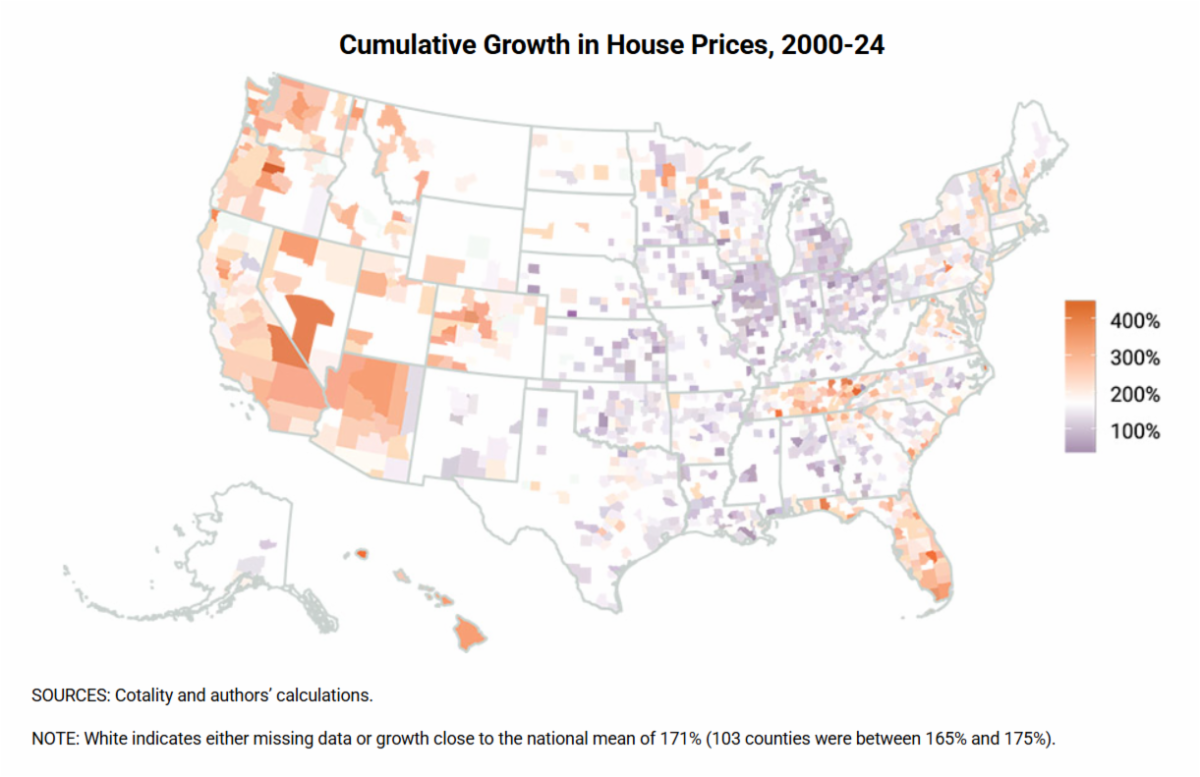
House prices have surged far faster than local incomes over the past two decades, and a new analysis from the Federal Reserve Bank of St. Louis emphasizes that this pattern is visible in nearly every corner of the country. The report, “When Houses Outrun Paychecks: The Lost Decades of Housing Affordability,” analyzes underlying changes in home value between 2000 and 2024, revealing that nominal prices rose about 207% nationwide while per capita incomes increased only about 155%. The map of cumulative house price growth shows that virtually all shaded counties experienced sizable gains, with white areas indicating either missing data or growth clustered around the national mean of roughly 171%. Cooler purple tones mark places where cumulative appreciation was relatively modest, dipping as low as about 22%, whereas progressively deeper oranges highlight extreme run-ups that exceeded 450%. Particularly intense price growth appears across much of the West and Mountain West, large parts of Texas and Florida, and selected metros in other regions, while even many Midwestern and Southeastern counties that historically saw slower appreciation posted solid, positive gains.
| | |
A press release from the National Association of Home Builders reports that builder confidence in the single-family market slipped in February, with the NAHB/Wells Fargo Housing Market Index edging down one point to 36, its second straight monthly decline. NAHB attributes the drop to persistent affordability strains, including high price-to-income ratios and elevated land and construction costs, and notes that while 36% of builders cut prices in February—down from 40% in January—roughly two-thirds are still using incentives to try to bring buyers off the sidelines.
Federal Reserve Vice Chair for Supervision Michelle Bowman delivered a speech on revitalizing bank mortgage lending at the American Bankers Association Conference for Community Bankers. The speech calls out how mortgage servicing rights interact with capital treatment and ultimately impact a bank's decision-making. Bowman stated that she is open to revisiting whether capital treatment of MSRs is appropriately aligned with risk and noted proposals to increase bank incentives to participate in mortgage origination.
A Washington Post opinion column by California YIMBY’s CEO uses a South Los Angeles development with a Costco on the ground floor and 800 apartments above, including 184 affordable units, as a parable about what is and is not working in California housing policy. The author explains that the project pencils out because the developer can leverage a 2022 state law streamlining housing on commercial sites that include affordable units, effectively letting Costco’s ground-floor lease “subsidize” low-income homes in exchange for by-right approval and fewer discretionary hearings. The piece argues that while this model is clever, it is not scalable in a state where impact fees, zoning constraints, and the legacy of Proposition 13 still make the most projects prohibitively expensive, and calls instead for broad reforms that ease zoning, reduce per-unit fees, and rely on predictable, statewide rules so that thousands of homes can get built each year.
| | |
Monday, February 23
NAR RPAC President's Circle Conference, February 23 - 26
Tuesday, February 24
No events listed.
Wednesday, February 25
Women in Housing and Finance Breakfast with Benjamin DeMarzo, Assistant Secretary for Congressional and Intergovernmental Relations at HUD, 9 - 10 AM ET
The Road to Recovery - Understanding your Options | Enterprise Community Partners, 12 – 1:30 PM PT
Thursday, February 26
Digital Gossip and Neighborhood Value: How AI Captures the Perceptions That Shape Neighborhood Premiums | Joint Center for Housing Studies, 12 – 1 PM ET
Friday, February 20
No events listed.
| | The National Housing Conference is a diverse continuum of affordable housing stakeholders that convene and collaborate through dialogue, advocacy, research, and education, to develop equitable solutions that serve our common interest. | | Defending Our American Home since 1931 | | Copyright © 2024. All Rights Reserved. | | | | |