Weekly Digest Number 21 - May 25, 2021 |
|
Worker dies after being pinned between rail cars at Newington plant |
|
A Seabrook man died from injuries he suffered Wednesday afternoon when he was pinned between two rail cars, according to Police Chief Michael D. Bilodeau.
Police and firefighters responded to SubCom, where the incident took place, on Wednesday about 2:20 p.m., the police chief said.
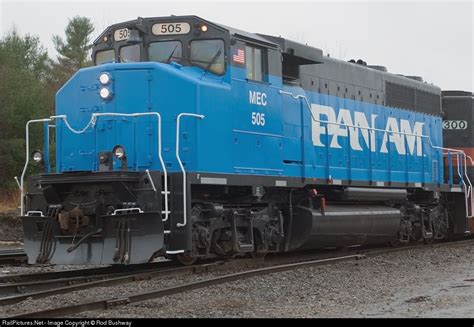
They transported the victim, Dale Jenkins, 61, of Seabrook, a Pan Am employee, to Portsmouth Regional Hospital for treatment.
The hospital later notified police that Jenkins “had succumbed to his injuries,” at about 10 p.m. Wednesday night, Bilodeau said.
SubCom, which is located at 100 Piscataqua Drive and makes undersea fiberoptic cables, has a rail facility on site where the incident took place, he said. The National Transportation Safety Board announced it has sent three investigators to look into the incident.
When officers got to the scene Wednesday, they saw that Jenkins had been “pinned between two knuckles of the rail cards,” Bilodeau said.
The knuckles are the things that connect the rail cars,
Bilodeau said.
He “was conscious and breathing and actually on his cell phone” when officers arrived, and was able to talk to both officers and firefighters, who also responded to the scene, Bilodeau said.
Jenkins was complaining about hip and abdominal pain at the scene, the chief said.
The investigation into how the incident happened is continuing, Bilodeau said.
Police are scheduled to meet with representatives of the NTSB and Pan Am on Friday, he said.
|
|
NTSB Adds Rail Worker Safety to Top-10 Most Wanted Safety Improvements |
|
The National Transportation Safety Board (NTSB) added rail worker safety to its Top-10 list of Most Wanted Safety Improvements this week, citing too many injuries and deaths of people working on or around railroad tracks.
“Train crews, maintenance-of-way employees, and mechanical workers, are getting killed or injured in preventable accidents involving train or equipment movement. Many of these workers were conducting routine maintenance or switching operations when they were struck. Although rail worker fatalities have declined overall in recent years, we continue to see some recurring safety issues in our accident investigations, highlighting the need for better worker protections,” the NTSB said in its press release.
NTSB member Jennifer Homendy led the charge in advocating for rail worker safety to be added to the Top-10 list, which highlights transportation safety improvements needed now to prevent accidents, reduce injuries, and save lives. The NTSB uses the list to focus advocacy efforts during the current Most Wanted List cycle, including urging lawmakers, industry leaders, advocacy and community organizations, and the public to push for stronger worker safety requirements.
The NTSB addition of rail worker safety comes on the heels on a recent statements given to the Associated Press this week from Union Pacific CEO Lance Fritz and CSX spokesperson Cindy Schild that indicated those two Class-1 rail carriers do not think worker safety is currently a problem.
“Across the board, I do not see evidence of our workforce at Union Pacific being rushed, overworked or put in harm’s way. I just don’t see it statistically,” U.P. CEO Fritz told the AP.
CSX officials said most of the key safety measures they track like employee injuries and train accidents have improved since it started using the Precision Scheduled Railroading operating model.
“We do not move freight at the expense of the safety of our employees or the communities where we operate,” CSX spokeswoman Schild said.
The BMWED applauds the NTSB legitimate concern for rail worker safety and hopes its addition to the Top-10 Safety Improvement List spawns real and effective change in safety protocols for American railroads. Rail officials should understand that the regulatory arm of federal safety boards, whether they be the NTSB or the FRA or any other agency, will remain serious and diligent in enforcing safety rules and ensuring that the welfare of the railroad worker is prioritized. Our Union will monitor the situation closely and provide any guidance needed to help the NTSB strengthen work safety rules and remedy unnecessary worker injuries and death.
|
|
Norfolk Southern executive says ‘one-person crew’ is a misnomer |
|
Norfolk Southern’s chief financial officer says the term “one-person crew” is a misnomer that has only stoked controversy about the rail industry’s proposal to use ground-based conductors on routes protected by positive train control.
“It’s unfortunate the terminology on one-man crew or one-person crew … because I don’t think it’s really the right terminology and it’s become a bit of a lightning rod,” Mark George told an investor conference today.
“The reality is this is about crew redeployment. Technology has rendered the role of a conductor in the cab itself unnecessary. So what we would like to see is ground-based conductor positions,” George says. “We think that that’s better for all stakeholders, including the crew people themselves to be on the ground as opposed to stuck in the cab. So that is definitely an area that we’d like to continue to push.”
The Class I systems envision using roving conductors who are responsible for several trains in their territories.
The Class I railroads are currently in national negotiations with rail labor unions. In November 2019 the National Railway Labor Conference told labor unions that it was critical for the industry to take advantage of technology and adapt to changing times and competitive pressures.
“Perhaps the most glaring example of our need for modernization concerns the size and makeup of train crews. In order to take full advantage of new investments in modern technology, reduce human error and better align operational costs with other industries, railroads propose to redeploy conductors from the cab of the locomotive to ground-based positions on territories where PTC or equivalent technologies are enabled,” the labor conference said. “Redeploying employees to ground-based positions in these territories will safely and more efficiently meet the industry’s operational and service requirements while providing those employees with higher quality-of-life jobs that allow more employees to spend their nights at home after shifts rather than at hotels.”
|
|
Kansas City Southern Exits CP Deal, Takes CN’s $34 Billion
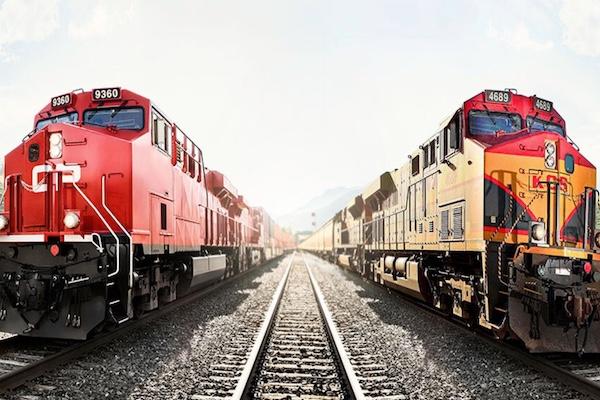
Kansas City Southern has abandoned its agreement to be acquired by Canadian Pacific, choosing instead a competing bid from Canadian National Railway with a bigger price tag, but also greater regulatory risks.
The decision May 21 comes one day after Canadian Pacific said that it wasn’t budging from its initial $25 billion buyout agreement made in March, even after Kansas City Southern said that a richer $33.6 billion bid from Canadian National appeared to be superior.
Canadian Pacific has consistently argued that a tie-up between Kansas City and Canadian National would have trouble getting approved by antitrust regulators and as recently as May 20, said that it would not boost its original offer. Canadian Pacific has asserted that its combination with Kansas City Southern is most likely to get a green light from regulators.
U.S. regulators haven’t approved any major railroad mergers since the 1990s, and officials have said that any deal involving one of the handful of Class I railroads, a group that includes Kansas City Southern, must enhance competition and serve the public interest.
|
|
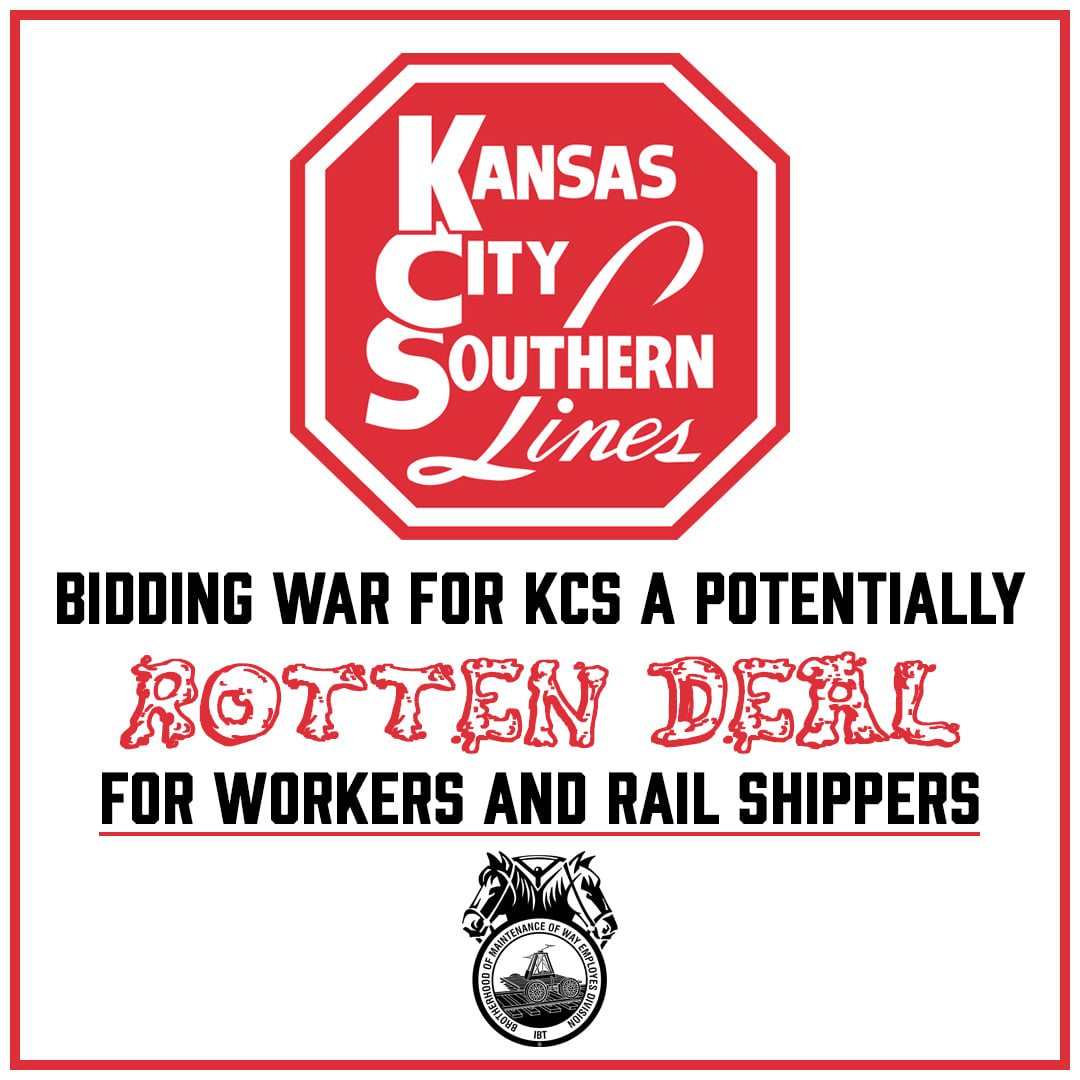
Bidding War for KCS a Potentially Rotten Deal for Workers and Rail Shippers |
|
The Brotherhood of Maintenance of Way Employees Division-IBT, the Brotherhood of Railroad Signalmen, the International Association of Sheet Metal, Air, Rail and Transportation Workers-Mechanical Division; and National Conference of Firemen and Oilers, 32BJ/SEIU have submitted comments to the Surface Transportation Board regarding the potential sale of Kansas City Southern Railway (KCS). Together, the four unions will be collectively referred to as the Allied Rail Unions (ARU). Those comments are summarized below.
The concern of the ARU is the non-productive, and potentially destructive, competition between Canadian National (“CN”) and Canadian Pacific (“CP”). After CP offered a premium to KCS shareholders for its proposed acquisition, CN upped the ante by 21 percent; it bid $5 billion over what CP was offering. Now CN has increased its offer by another $770 million. According to the Surface Transportation Board “CN intends to raise ‘approximately $19.3 billion of new debt’ to finance its proposed merger with KCS”; and CN’s most recent offer “represent[s] ‘an implied premium of 45% when compared to KCS’ unaffected closing stock price on March 19, 2021.” In response, CP may increase its offer. As CN and CP compete for KCS they may negate any potential transportation benefits of a consolidation with KCS, and there is a likelihood that innocent bystanders–– employees of CP, CN and KCS, and shippers which use those carriers—will pay a price for this exercise in one-upmanship.
A bidding war has consequences. By overpaying to keep the target out of the hands of its rival, the successful bidder would have less capital to invest in the ultimate railroad; every dollar spent wooing shareholders of the target is a dollar not invested in the railroad. The successful bidder, having spent more than what was anticipated would likely seek to recoup its excess expenditures by seeking so-called cost-cutting “efficiencies” from rail workers; and it would likely seek to reduce other costs, which, in turn, would diminish service.
|
|
EDITOR'S NOTE: The proposed merger continues to dominate rail industry news.
|
|
Union Push for Increased Staffing At Odds With Green Goals of Expanded Rail |
|
But with the federal government wading into the debate, no one thinks it’s funny.
In 2019, the Federal Railroad Administration under former President Donald Trump issued a rule revoking a 2016 proposed regulation and enabling railroads and labor unions to determine staffing through collective bargaining. California, Nevada, and Washington states sued, claiming the rule would undermine rail safety. The Ninth Circuit Court of Appeals in February upheld a lower court’s order requiring two people in the cab, opining that the Trump rule was arbitrary.
At the end of the month, the U.S. House Subcommittee on Railroads, Pipelines, and Hazardous Materials is scheduled to look at this issue. But rail observers say the focus is misplaced.
“A law or regulation that permanently requires a minimum crew size of two – especially where there is no evidence that one-person crews are less safe – can only stand in the way of further reductions in accidents caused by human error,” said Patrick McLaughlin, senior research fellow at the Mercatus Center at George Mason University.
After the federal government deregulated railroads, it still found ways to impose rules that required the private companies to abide by various mandates and laws, including the Rail Safety Improvement Act in 2008 that paved the way for Positive Train Control across much of the rail network. The technology can stop a train and prevent train-to-train accidents, derailments caused by speeding, and unauthorized train movements. Years’ worth of reports from the Federal Rail Administration point to human error as a factor in a significant number of train accidents.
McLaughlin said mandating a certain number of crew members could deter automation and “lock-in the possibility of human error.”
|
|
EDITOR'S NOTE: We included news of the two Union Pacific derailments in last week's Digest. Here are some updated reports on both.
|
|
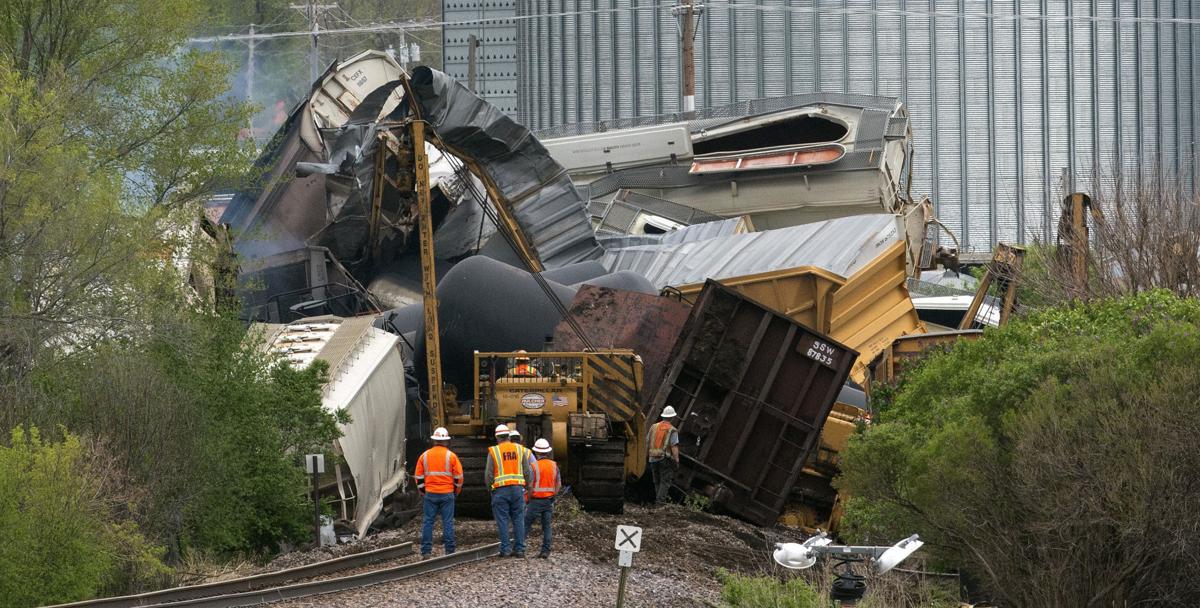
NTSB: Failure to follow restricted speed caused fatal Arizona collision
The National Transportation Safety Board has determined Thursday the failure of a BNSF Railway train crew to operate an intermodal train within restricted speed requirements caused the fatal, June 5, 2018, collision between the intermodal train and a work train, near Kingman, Ariz.
The collision occurred when a westbound BNSF intermodal train, operating in centralized traffic control territory, collided with the rear of a slow-moving eastbound work train. The work train was moving in reverse to drop off an employee before traveling west to exit the main track. One employee was killed, and another was seriously injured.
In Railroad Accident Report 21/01, NTSB investigators noted the crewmembers of the intermodal train operated at a speed that did not allow their train to stop within half the range of vision as required. The NTSB concluded the current training and oversight by railroad supervisors are ineffective in ensuring the operating crew’s use of restricted speed.
FRA regulations require roadway workers who lay track to use a form of on-track safety. However, FRA’s interpretation of its regulation allows railway workers on work trains to lay track without using a form of on-track safety, and this interpretation contributed to the cause of the collision, according to the NTSB’s report.
“It is extremely important the railroad industry is in full compliance with established federal regulations,” said Robert Hall, Director of the NTSB’s Office of Railroad, Pipeline and Hazardous Materials Investigations. “There is no room for misinterpretation of the requirements as this tragic accident demonstrates. Regulations designed to protect railroad workers must be clear to avoid any ambiguity and eliminate risks.”
Between 1997 and 2017, 55 roadway workers were killed in 52 accidents, and the NTSB investigated eight accidents in 2020 involving railroad and transit worker fatalities. These sobering statistics are why “Improve Rail Worker Safety” is an item on the NTSB’s 2021 – 2022 Most Wanted List of Transportation Safety Improvements.
|
|
STARTER Act 2.0: Republican Bill Looks Like a Non-Starter for Rail |
|
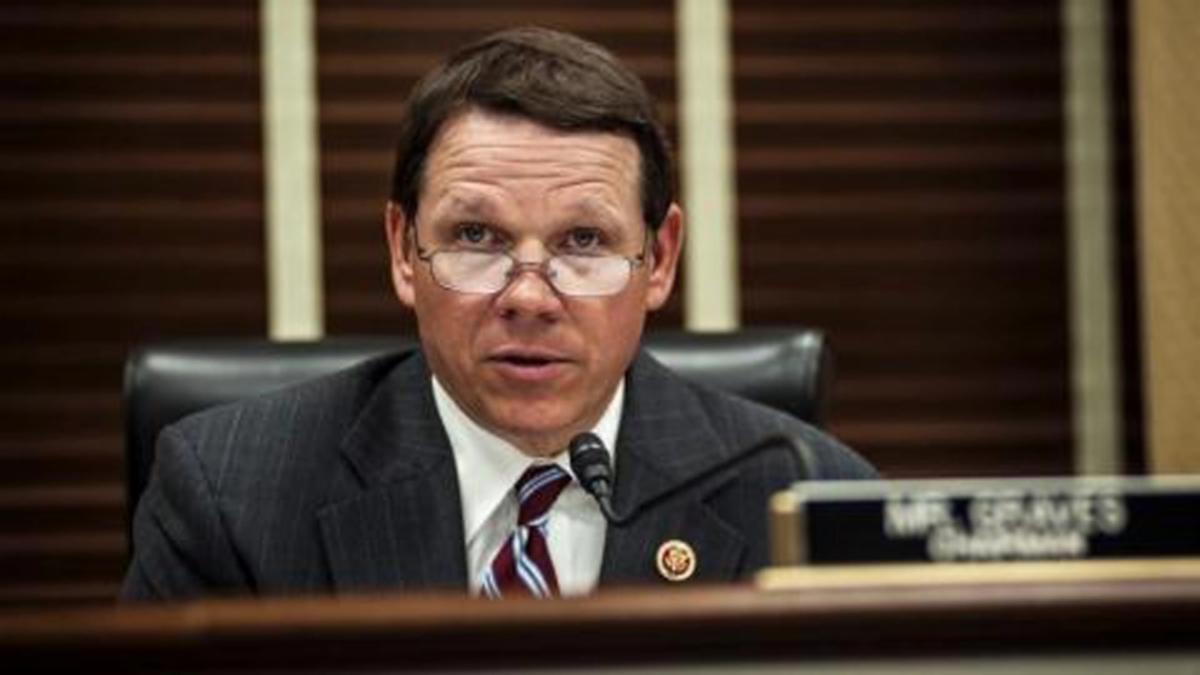
Congressional Republicans have presented their own infrastructure proposal in response to the $1.9 trillion bill supported by Congressional Democrats and the Biden-Harris Administration. Their bill, sponsored by Sam Graves (R-Mo.), Ranking Member of the House Transportation & Infrastructure (T&I) Committee, and Rodney Davis (R-Ill.), Ranking Member of the Highways and Transit Subcommittee, has almost no rail content.
The Surface Transportation Advanced through Reform, Technology, & Efficient Review (STARTER) Act 2.0 “provides more than $400 billion over five years—the largest percentage increase for these programs in the past quarter-century—for the federal highway, transit, and motor carrier and highway safety programs,” Graves and Davis said in a press release. The bill calls for a streamlined process for environmental review under the National Environmental Policy Act (NEPA), a long-held goal of Republicans, who have consistently objected to lengthy reviews that they claim delay highway projects and other measures they support. “Streamlining the federal permitting and environmental review process absolutely must be a part of an infrastructure package,” Davis said.
“Republicans want to work together on bipartisan infrastructure solutions, but in order to reach that goal, key principles must be addressed in this process,” Graves said. “The STARTER Act 2.0 puts forward our Republican principles; provides historic levels of funding for our roads, bridges, and other surface transportation infrastructure; and ensures that we invest those funds wisely and efficiently.”
There was no mention of the word “rail” in the statement, which implies that “roads and bridges” are established “Republican principles,” but rail infrastructure is not.
|
|
In Address to Public Transit Conference, Chair DeFazio Thanks Transit Workers for Their Service Amid COVID-19, Previews Elements of Upcoming Surface Transportation Bill |
|
On Tuesday, May 18, Chair of the House Committee on Transportation and Infrastructure Peter DeFazio (D-OR) addressed the American Public Transportation Association’s Legislative Conference and Virtual Fly-In. APTA represents all modes of public transportation, including bus, paratransit, light rail, commuter rail, subways, and waterborne service, along with intercity and high-speed passenger rail.
"We’ve seen incredible sacrifices from our transit workers. Hundreds lost their lives in the line of duty. Hundreds of thousands have risked their personal safety to transport essential workers and connect residents with doctors’ appointments and access to the vaccine. That’s why at the start of this year my Committee passed the American Rescue Plan, which included over $30 billion in investment for transit. Unlike traditional federal funding, these funds were almost entirely targeted for operating costs, keeping workers on the job, and keeping transit service running.”
|
|
Some major companies announce wage hikes in answer to worker shortages |
|
As restaurants across the country reportedly struggle to fill many of the grueling positions in their sweltering kitchens, conservative lawmakers have descended on the simplistic and erroneous consensus that the pandemic-era enhancement of unemployment insurance payments are the reason that some workers have failed to return to the job market. Top White House economic advisers countered these reactionary accusations in a memo released Tuesday, arguing that the reports of labor shortages were “a positive development, particularly for lower wage workers who have seen little wage growth over the past decades,” because “employers will raise wages to attract workers.” Indeed, the White House’s optimistic theory appears to be based in reality, as in recent weeks some major companies have already begun to announce wage hikes. National Economic Council Director Brian Deese and Chair of the Council of Economic Advisers Cecilia Rouse stressed in the memo that the lingering consequences of the pandemic, not unemployment benefits, remain the most substantial obstacle preventing laborers from reintegrating into the workforce. It is doubtless that the cruel decision by nearly two dozen Republican governors to reject hundreds of millions of dollars in federal aid for the unemployed in their states, available until September under the American Rescue Plan, will have little effect on the purported labor shortages, though it is certain that they will inflict additional pains and difficulties on millions of deeply-strained low-income families and inhibit the post-pandemic recovery of state and local economies.
|
|
The road to U.S. climate goals runs through Alaska |
|
President Joe Biden announced sweeping new climate commitments at his Global Leaders Summit last month. But what do emissions cuts of 50% by 2030 mean to Alaskans? His plan has billions in investments to offer Alaska that would address our state’s greatest challenges, from jobs to our changing landscapes. There are few places on Earth where impacts from climate change are felt more than here in Alaska. Salmon are shrinking, wildfires are increasing, our rainforest is experiencing droughts and communities are washing into the sea. Despite our vulnerability, Alaska’s vast landscapes still provide critical climate refuge to ecosystems, plants and animal life and our communities.
At the same time, Alaska’s resource extraction contributes to climate change and is embedded in our economic and political systems. Alaska also has a senator who often stands as the critical vote on national issues. Sen. Lisa Murkowski’s vote on Biden’s climate agenda, including the American Jobs Plan infrastructure package, could be decisive. The challenges and contradictions of climate change are front and center here in Alaska, and the road to Biden’s climate commitments runs straight through our home state.
Electrifying our transportation infrastructure creates jobs and could breath life back into the ferry system and the Alaska Railroad. Going to 100% renewable electric grids will bring down the cost of utilities around Alaska and creates jobs.
|
|
SCOTUS to DOJ: Is a stopped train in use? Unions want to know |
|
The U.S. Supreme Court on Monday asked the U.S. Solicitor General’s office to take a side in a case involving Union Pacific Railroad Co over whether a train that has temporarily stopped is still “in use,” exposing railroads to liability for worker injuries.
The court invited the Biden administration's input on a pending petition for certiorari by Bradley LeDure, a Union Pacific engineer who slipped on an oil slick on a locomotive before it departed from an Illinois railyard.
The federal Locomotive Inspection Act (LIA) requires that trains "in use" be inspected at least once per day and that walkways be kept free from oil, water, and other obstructions. Federal appeals courts are split over whether a train is in use under the LIA when it is not moving.
LeDure's lawyer, Nelson Wolff of Schlichter Bogard & Denton, did not immediately respond to requests for comment. Nor did Omaha-based Union Pacific and its lead lawyer, J. Scott Ballenger. The railroad is also represented by Latham & Watkins and Taft Stettinius & Hollister.
|
|
|
|
|
|
|